Attacks on the Search-RLWE problem with small errors
Hao Chen1, Kristin Lauter2, and Katherine E. Stange3 1
Microsoft Research, Redmond, USA
2
Microsoft Research, Redmond, USA
3
University of Colorado, Boulder, USA
Abstract. The Ring Learning-With-Errors (RLWE) problem shows great promise for post-quantum cryptography and homomorphic encryption. We describe a new attack on the non-dual search RLWE problem with small error widths, using ring homomorphisms to finite fields and the chi-square sta-tistical test. In particular, we identify a “subfield vulnerability” (Section 5.2) and give a new attack which finds this vulnerability by mapping to a finite field extension and detecting non-uniformity with resepect to the number of elements in the subfield. We use this attack to give examples of vulnerable RLWE instances in Galois number fields. We also extend the well-known search-to-decision reduction result to Galois fields with any unramified prime modulusq, regardless of the residue degreef of q, and we use this in our attacks. The time complexity of our attack isO(nq2f), wherenis the degree of Kandf is the residue degreeofq inK. We also show an attack on the non-dual (resp. dual) RLWE problem with narrow error distributions in prime cyclotomic rings when the modulus is a ramified prime (resp. any integer). We demonstrate the attacks in practice by finding many vulnerable instances and successfully attacking them. We include the code for all attacks.
Key words: attacks, RLWE, cryptanalysis.
1
Introduction
The Ring Learning-with-Errors (RLWE) problem, proposed in [18], is a variant of the Learning-with-Errors (LWE) problem, and is an active research area in lattice based cryptography, and a candidate for post-quantum cryptography. It has drawn increased attention because it can be used for homomorphic encryption ([2,3,4,5,13,17,24]). The problem, which comes insearch anddecision variants, is based on the geometry of ideal lattices, in particular the rings of integers of number fields, or their duals.
It is of great importance to understand the security of RLWE. The first piece of the puzzle is provided by proofs of security [18]. However, it is also important to mount direct attacks on the problem and its variants, in order to illuminate the protective properties of the provably secure instances, the dangers of deviating from established parameters, and the practical runtimes for certain parameter sizes. This work is part of that programme, which has seen much recent interest, e.g. [11,12]. An eprint version of the current paper [8] has already generated much follow-up work [6,7,9,22]. In this paper we provide a brief overview of past work, and then present attacks which are novel in their mathematical underpinnings (based on new homomorphisms to finite fields of higher degree which detect in particular “subfield vulnerabilities”, see Section 5.2). We also discuss the underlying number theory and geometry of these attacks to provide a framework for future work. An instance of the RLWE problem is determined by a choice of a number field K and a primeq called the modulus, along with an error distribution. The authors of [18] proved a reduction from certain hard lattice problems to an instance of search RLWE involving a continuous Gaussian error distribution modulo the dual idealR∨ of the ring of integersR ofK. Ducas and Durmus proposed a non-dual variant of RLWE in the cyclotomic setting and proved its hardness in [10]. Also in [18], a search-to-decision reduction was proved for RLWE problems in cyclotomic fields and modulusqwhich splits completely. This reduction was then generalized in [11] to hold for general Galois number fields where q splits. As an auxiliary result in this paper, we generalize this search-to-decision reduction to work for the case of unramified modulusq of arbitrary degree.
variants are equivalent up to a change in the error distribution (see Section 2). For the non-dual variant of RLWE, the authors of [12] proposed an attack on the decisionRLWE problem. The attack makes use of a modulusq of residue degree 1, giving a ring homomorphismρ:R→Fq (so that it could be called a modq attack, although it differs from [20,21]). The attack works when, with overwhelming probability, the image of the RLWE error distribution under the mapρtakes values only in a small subset of Fq. The authors of [12] then gave an infinite family of examples vulnerable to the attack. Unfortunately, the vulnerable number fields in [12] are not Galois. Hence, the search-to-decision reduction theorem does not apply, and the attack can not be directly used to solve the search variant of RLWE for those instances.
In this paper, we generalize the attack of [12] to certain Galois number fields and moduli of higher degree. As a result, we have an attack on thesearchRLWE problem and an implementation of the attack on concrete RLWE instances, including the search-to-decision reduction. Our attack is new in two major ways: first, the attack considers ring homomorphisms fromR→Fqf, forf >1, instead of just homomorphisms fromR→Fq (so it is no longer ‘modq’); second, the error distribution is distinguished from random (i.e. from the uniform distribution) using the statistical chi-squared test, instead of relying on the values of the error polynomial to be small or in a small subset. The attack aims at an intermediate problem used in the search-to-decision proof of [18], which is to recover the secret modulo a prime ideal (denoted SRLWE(R,q); see Definition 7). The time complexity of our attack isO(nq2f), wheren is the degree ofK andf is the residue degree ofq inK.
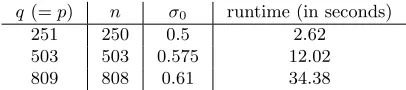
Importantly, we also show an attack on prime cyclotomic rings under certain assumptions on the modulus and error rate, which succeeds with high probability and with surprising efficiency. First, we give attacks for thedecisionversion of the non-dual variant of RLWE considered in [12], when the modulusqis equal to the unique ramified primep. For example, we show that in dimensionn= 808, we can attack an RLWE instance in the cyclotomic ringQ(ζ809) effectively in 35 seconds, where the modulus is 809. This opens up the question of whether general cyclotomic fields are safe for cryptography, depending on whether modulus switching can be used to transfer this attack from the ramified modulus to other larger moduli which are used in practice. In addition, we attack the decision version of the dual RLWE problem on the p-th cyclotomic field with arbitrarymodulusq, assuming that the widthrof the error distribution is around √1
p.
The error widths for which our attacks work are below those required by the security proof of [18], which requires r =ω(√logn). In particular, this work does not affect the hardness results of [18]. On the other hand, in practice, in implementations of homomorphic encryption systems based on the hardness of RLWE, it has been common practice to use small errors to improve efficiency for the systems. We show in this work that for errors in the width range below provably secure but above linear algebra vulnerable (errorless LWE), the security of RLWE depends in an interesting way on the choice of ring and modulus. To be more specific, the geometry of the ring of integers and the manner in which certain prime ideals exist as sublattices are important factors (see Section 5.2). Finally, it is important to note that most implementations of RLWE-based schemes use exclusively 2-power cyclotomic rings, on which our attacks are not effective. Hence the impact of our attacks on the security of existing practical implementations of RLWE-based homomorphic encryption schemes is limited.
Auxiliary results we present include several stand-alone items of possibly independent interest: we prove a search-to-decision reduction for Galois fields which applies for any unramified modulusq, regardless of the residue degree ofq (this relies heavily on Galois theory and Galois fields are the largest class to which we expect this to apply). We also present some heuristic arguments as to whether modulus switching techniques are likely to be successfully combined with our attacks.
Table 1.Security of dual RLWE
field modulus r˜ security
Q(ζm) q≡1 modm,q=poly(m) ω(
√
logn)·Θ(√n) decision is secure [18] Any q=poly(n) ω(√logn)· |dK|1/2n search is secure [18]
Q(ζp) any ∼1 decision is not secure (this paper)
The second table deals with the non-dual discrete version. Here we normalize by ˜r = r/|dK|1/2n. The heuristic expectation is that when ˜r=Ω(√n) andq=poly(n), decision RLWE problem should be hard.
Table 2.Security of non-dual RLWE
field modulus r˜ security
Q(√n1−q) poly(n) ∼1 decision is not secure [12] Q(√n1−q) poly(n) ∼1 search is not secure [7]
certainQ(ζm)H poly(n) w. properties ∼1 search is not secure (this paper)
Q(ζp) p ∼1 decision is not secure (this paper)
certainQ(ζp,
√
d) poly(n) w. properties o(pd/p) search is not secure [9]
1.1 Organization
In Section 2, we review some definitions related to the RLWE problems. In Section 3, we prove a search-to-decision reduction for Galois extensions K and unramified moduli. In Section 4, we introduce an attack on non-dual RLWE problems based on the chi-square statistical test, which directly generalizes the attack in [12]. In Section 5, we give examples of subfields of cyclotomic fields vulnerable to our new attack, where the modulusqhas residue degree two. In Section 6, we give attacks on the non-dual RLWE in prime cyclotomic fields when the modulus is the unique ramified prime and dual RLWE for any modulus, assuming the errors are sufficiently narrow. In Section 7, we consider the possibility of combining modulus switching with our attack.
All computations in this paper were performed in Sage [25]. All the relevant code is available and can be found athttps://github.com/haochenuw/GaloisRLWE.
Acknowledgements
The authors thank Chris Peikert for helpful discussions, and the anonymous referees for helpful suggestions. The third author was supported by NSF grant DMS-1643552.
2
Background
ι:K→Rn : x7→
σ1(x) .. . σr1(x)
√
2 Re(σr1+1)(x)
√
2 Im(σr1+1)(x) ..
.
√
2 Re(σr1+r2)(x)
√
2 Im(σr1+r2)(x).
(1)
It turns out that ΛR :=ι(R) is a lattice in Rn. Let w = (w1,· · ·, wn) be an integral basis for R. The embedding matrix of w, denoted by Aw, is the n-by-n matrix whose i-th column is ι(wi). Note that the columns ofAw form a basis for the latticeΛR.
For σ >0, define the Gaussian functionρσ:Rn →(0,1], depending on the usual inner product onRn, to beρσ(x) =e−||x||2/2σ2.
Definition 1. For a lattice Λ⊂Rn and σ >0, the discrete Gaussian distribution on Λ with parameter σ is:
DΛ,σ(x) =Pρσ(x) y∈Λρσ(y)
,∀x∈Λ.
Equivalently, the probability of sampling any lattice pointxis proportional toρσ(x).
We follow [12] in setting up the non-dual RLWE problem for general number fields. In particular, the error distribution we use is a spherical discrete Gaussian distribution onΛR.
Definition 2. A (non-dual) RLWE instance is a tupleR= (K, q, σ, s), whereKis a number field with ring of integersR,qis a prime, σ >0is a positive real number, and s∈R/qR is called the secret.
SupposeR= (K, q, σ, s) is an RLWE instance and letR be the ring of integers of K. The error distri-butionofRis the discrete Gaussian distributionDΛR,σ.
LetRq denote the quotient ringR/qR; then a (non-dual) RLWE sample is a pair
(a, b=as+e)∈Rq×Rq,
where the first coordinateais chosen uniformly at random inRq, andeis sampled from the error distribution and considered modulo qR. The reader unfamiliar with this problem should consider this analogous to a discrete logarithm pair (g, gs)∈
Fq×Fq, wheresis a secret exponent.
Definition 3 (Search RLWE). Let R be an RLWE instance. The search RLWE problem, denoted by SRLWE(R), is to discovers given access to arbitrarily many independent samples(a, b).
Definition 4 (Decision RLWE). Let R be an RLWE instance. The decision RLWE problem, denoted by DRLWE(R), is to distinguish between the same number of independent samples in two distributions on Rq ×Rq. The first is the RLWE distribution of R, and the second consists of uniformly random and independent samples fromRq×Rq.
Remark 5. As pointed out in [12], when analyzing the error distribution, one needs to take into account the sparsity of the lattice ΛR, which is measured by its covolume det(ΛR) = p|disc(K)|. In light of this, we define a relative version of the standard deviation parameter:σ0= σ
|disc(K)|2n1 .
We now discuss dual RLWE and its relation to non-dual RLWE. In dual RLWE, the secret s lies in R∨q :=R∨/qR∨, whereR∨is the dual ideal ofR, and the erroreis sampled fromR∨with discrete spherical Gaussian distribution with widthr=√2πσ. Therefore the RLWE samples are of the form
(a, b=as+e)∈Rq×R∨q.
The dual and non-dual versions of the RLWE problem are very closely related when the dual ideal is principal: in this case,RandR∨are related by a scaling factor (which may alter a spherical Gaussian to an ellipsoidal one). Even when R∨ is not principal, we have R⊆k1R∨ and R∨ ⊆k2R for some constants k1 andk2, so that a problem in one formulation can be reduced to a problem in the other, with a different error distribution. Several of the non-dual examples of this paper are known to have principal dual ideal [22]. In particular, our attack on the ramified prime for cyclotomic fields is translated to the dual situation in Section 6.2. The full class of elliptic Gaussians (not just spherical) is also considered in the security reductions of [18].
Finally, there is a continuous version of RLWE which is more amenable to security reductions. Since one can always discretize, the continuous version reduces to the discrete one presented here, which is more practical for applications.
3
Search-to-Decision Reduction
In [11], the search-to-decision reduction of [18] is extended to RLWE for Galois number fields, whereqis an unramified prime of degree one. The approach is via an intermediate problem, denotedqi-LWE in [18]. In this section, we extend this result to primesqof arbitrary residue degree. Our intermediate problem, which we denote by SRLWE(R,q), is the same asqi-LWE, and it amounts to finding the secret modulo the prime q. The Galois group allows us to bootstrap this piece of information to discover the full secret.
The attack in Section 4 targets SRLWE(R,q) and hence, by the results of this section, will solve Search RLWE. In Section 5, we demonstrate the attack on Search RLWE in practice.
Definition 7. Let R = (K, q, σ, s) be an RLWE instance and let q be a prime of K lying above q. The problem SRLWE(R,q) is to determine s (modq), given access to arbitrarily many independent samples (a, b)← R.
We recall some facts from algebraic number theory in the following lemma.
Lemma 8. Let K/Q be a finite Galois extension of degreen with ring of integers R, and let q be a prime unramified inK. Then there exists a unique divisorg ofnand a set of g distinct prime ideals q1,· · · ,qg of R such that:
1. qR=Qg
i=1qi,
2. the quotientR/qi is a finite field of cardinality qf for eachi, wheref = ng, 3. there is a canonical isomorphism of rings
Rq ∼=R/q1× · · · ×R/qg, (2)
4. the Galois group acts transitively on the ideals q1, . . . ,qg and this action descends to an action on Rq which permutes the corresponding factors in (2) in the same way.
The number f in the above lemma is called the residue degree ofq in K. Note that the prime q splits completely inKif and only if its residue degree is one.
Proof. The Galois group G = Gal(K/Q) acts on the set {q1,· · ·,qg} transitively. Hence for eachi, there exists σi ∈Gal(K/Q), such that σi(q) =qi. Next, remark that σ−i 1(S) is itself a set of RLWE samples in Rq×Rq, since the action of Galois is an isometry of the Minkowski embedding. (Here it is essential that we consider only spherical Gaussians.) Furthermore, the secret for this set of samples is σi−1(s). Then we call the oracleA on the input (σi−1(S) (modq),q). The algorithm will outputσ−i 1(s) (modq), from which we can recovers (modqi) usingσi. We do this for all 1≤i≤g=n/f and use (2) of Lemma 8 to recovers.
In particular, if the number of samples m is polynomial in n and the time taken to evaluate Galois automorphisms on a single sample is also polynomial inn, then Theorem 9 gives a polynomial time reduction from SRLWE(R) to SRLWE(R,q).
Remark 10. For a proper runtime analysis of the reduction, one must examine the implementation, in par-ticular with regards to Galois automorphisms. The runtime for evaluating an automorphism depends rather strongly on the instance and on the way ring elements are represented. For example, for subfields of cyclotomic fields represented with respect to normal integral bases, the Galois automorphisms are simply permutations of the coordinates, so the time needed to apply these automorphisms is trivial.
The search-to-decision reduction will follow from the lemma below.
Lemma 11. There is a probabilistic polynomial time reduction fromSRLWE(R,q)toDRLWE(R).
Proof. This is a rephrasing of [18, Lemma 5.9 and Lemma 5.12].
Corollary 12. Suppose R is an RLWE instance where K is Galois and q is an unramified prime in K. Then there is a probabilistic polynomial-time reduction fromSRLWE(R)toDRLWE(R).
4
The Chi-square Attack
In this section, we extend the f(1) ≡ 0 (modq) attack of [11] and the root-of-small-order attack of [12]. These attacks can be viewed as examples of a more general principle, as follows. Suppose one has a ring homomorphism
φ:Rq→F whereF is a finite field, and where two properties hold:
1. F is small enough that its elements can be examined exhaustively; and
2. the error distribution onRq, transported byφtoF, is detectably non-uniform.
Then the attack on decision RLWE is as follows:
1. Transport the samples (a, b) inRq×Rq toF×F viaφ.
2. Loop through possible guesses for the image of the secret,φ(s), inF.
3. For each guessg, compute the distribution ofφ(b)−φ(a)gon the available samples. Note that if we let g∗=φ(s) denote the true value,
φ(b)−φ(a)g= (φ(b)−φ(a)g∗) +φ(a)(g−g∗) =φ(e) +φ(a)(g−g∗),
which equalsφ(e) if the guess is correct, and looks uniform otherwise.
4. If the samples are RLWE samples with secretsandg=φ(s), then this distribution will follow the error distribution, which will look non-uniform.
5. If all such distributions look uniform, then the samples were uniform, not RLWE, samples.
4.1 Chi-square Test for Uniform Distribution
We briefly review the properties and usage of the chi-square test for uniform distributions over a finite set S. We partition S into r subsetsS =Fr
j=1Sj, called bins. Suppose there are M samples y1, . . . , yM ∈ S. For each 1≤j ≤r, we compute the expected number of samples in thej-th subset: cj := |S|j|SM| . Then we compute the actual number of samples in Sj, i.e., tj := |{1 ≤ i ≤ r : yi ∈ Sj}|. Finally, the χ2 value is computed as
χ2(S, y) = r
X
j=1
(tj−cj)2 cj .
Suppose the samples are drawn from the uniform distribution onS. Then theχ2value follows the chi-square distribution with (r−1) degrees of freedom, which we denote by χ2
r−1. Let Fr−1(x) denote its cumulative distribution function. For the chi-square test, we choose a confidence level parameterα∈(0,1) and compute δ = F−1
r−1(α). Then we reject the hypothesis that the samples are drawn from the uniform distribution if χ2(S, y)> δ.
IfP, Qare two probability distributions on the setS, then theirstatistical distanceis defined asd(P, Q) = 1
2
P
t∈S|P(t)−Q(t)|. For convenience, we also define the l2 distance between P and Q as d2(P, Q) = (P
t∈S|P(t)−Q(t)| 2)1
2. We have the inequality d(P, Q)≤
√
|S|
2 d2(P, Q).
Remark 13. We chose to use the chi-square test for our attack since we are distinguishing a known distribution (uniform on R/q) from an unkown distribution (discrete Gaussians mod q). If the latter distribution is efficiently computable, then one might switch to other statistical tests, e.g., the Neyman-Pearson test, for better results.
4.2 The Chi-square Attack on SRLWE(R,q)
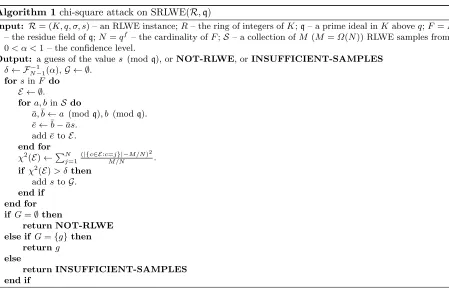
LetRbe an RLWE instance with error distributionDΛR,σ andqbe a prime ideal aboveq. The basic idea of our attack relies on the assumption that the distributionDΛR,σ modqis distinguishable from the uniform distribution on the finite fieldF =R/q. More precisely, the attack loops through allqf possible values ¯s=s (modq), and for each guesss0, it computes the values ¯e0 = ¯b−¯as0 (modq) for every sample (a, b)∈S. If the guess is wrong, or if the samples are taken from the uniform distribution in (Rq)2, the values ¯e0 would be uniformly distributed in F and it is likely to pass the chi-square test. On the other hand, if the guess is correct, then we expect the test on the errors ¯e0 to reject the null hypothesis. Let N := qf denote the cardinality ofF. We remark that as a general rule of thumb for the chi-square test, we need to generate at least 5N samples.
For the attack to be successful, we need the (N−1) tests corresponding to wrong guesses ofs (modq) to pass, and the one test corresponding to the correct guess to be rejected. For this purpose, we need to choose the confidence levelαto be close enough to one (a reasonable choice isα= 1− 1
10N). The detailed attack is described in Algorithm 1. LetFN−1(x) denote the cumulative distribution function ofχ2N−1.
Remark 14. For simplicity of exposition, we useN bins in Algorithm 1, that is one element per bin. In some situations, it might be advantageous to choose the bins differently.
The time complexity of the attack is O(nq2f) since there are qf possible values for s (modq), each reduction moduloqtakesO(n) to compute, and the number of samples needed isO(qf). The correctness of the attack is captured in Theorem 15 below. Forλ∈Randd∈Z, we useFd,λ(x) to denote the cumulative distribution function of the noncentral chi-square distribution with degree of freedomdand parameterλ.
Theorem 15. Let R = (K, q, s, σ) be an RLWE instance. Suppose q be a prime ideal in K above q, and let∆ denote the statistical distance between the distribution DΛR,σ modq and the uniform distribution on R/q. Let M be the number of samples used in Algorithm 1, and let λ = 4M ∆2. Let 0 < α < 1 and let δ=F−1
Algorithm 1chi-square attack on SRLWE(R,q)
Input: R= (K, q, σ, s) – an RLWE instance;R– the ring of integers ofK;q– a prime ideal inKaboveq;F=R/q – the residue field ofq;N =qf – the cardinality ofF;S – a collection ofM (M =Ω(N)) RLWE samples fromR; 0< α <1 – the confidence level.
Output: a guess of the values (modq), orNOT-RLWE, orINSUFFICIENT-SAMPLES δ← F−1
N−1(α),G ← ∅. forsinF do
E ← ∅.
fora, binS do ¯
a,¯b←a (modq), b (modq). ¯
e←¯b−¯as. add ¯etoE. end for χ2(E)←PN
j=1
(|{c∈E:c=j}|−M/N)2
M/N .
if χ2(E)> δthen addstoG. end if end for if G=∅then
return NOT-RLWE else if G={g}then
returng else
return INSUFFICIENT-SAMPLES end if
Proof. It is a standard fact (see [23], for example) that the chi-square value on samples fromDΛR,σ modq follows the noncentral chi-square distribution with (N−1) degrees of freedom and parameterλ0 given by
λ0=d2(DΛR,σ (modq), U(R/q))2·M N. Note that we have λ0 ≥ (2d(DΛR,σ modq, U(R/q))/
√
N)2M N = 4M ∆2 = λ. Recall that our attack succeeds if the “error” setE from each of the (N−1) wrong guesses ofs (modq) passes the test, and the true reduced errors fail the test. We assume that the results of these tests are independent of each other. Then the first event happens with probability αN−1, whereas the second event has probability 1− F
N−1;λ0(δ). Since this is an increasing function inλ0, we can replaceλ0 byλ, and the theorem follows.
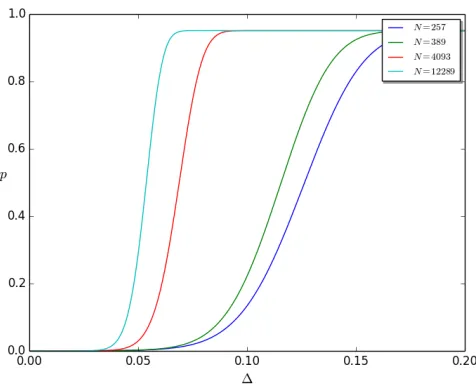
Remark 16. One could choose the value ofα in Theorem 15 to suit the specific instance. The probability of success will change accordingly. When we expect the statistical distance ∆ to be large, it is preferable to choose a larger α to increase the probability of success. For example, if we choose α= 1− 1
10N, then αN−1≥e−1/10= 0.904· · ·.
Figure 1 shows a plot of pversus ∆for various choices of N, made according to Theorem 15, where we fix the number of samples to beM = 5N and fixα= 1− 1
10N.
Remark 17. For linear equations with small errors, there is the attack on the search RLWE problem proposed by Arora and Ge [1]. However, the attack requires solving a linear system in ≈nd/d! variables. Here d is the number of possible values for the error: e.g., if the error can take values 0,1,2,−1,−2, then d = 5. Since it requires ≈nd/d! samples, the attack of Arora and Ge requires ≥108 samples whenn ≥100 and d≥5, for example. In contrast, the complexity of our attack depends linearly onnand quadratically onq. In particular, it does not depend on the error size (although the success rate does depend on the error size).
5
Vulnerable Instances among Subfields of Cyclotomic Fields
Fig. 1.Success probability versus statistical distance
that isodd and squarefree. The Galois group Gal(Q(ζm)/Q) is canonically isomorphic toG= (Z/mZ)∗. For a subgroupHofG, letKm,H=Q(ζm)H be the subfield of elements fixed byH. Then the extensionKm,H/Q is Galois with degreen= ϕ(m)|H| . Also, the residue degree of a primeq in Km,H is equal to the order ofq in the quotient groupG/H. Moreover,Km,H has a canonicalnormal integral basis, as follows. For each integer i coprime to m, set wi =P
h∈Hζ hi
m. Thenw := (wi)i∈G/H is a Z-basis of R. (For a proof of this fact, see [15, Proposition 6.1]). Thus we haveAw=T A0w, where
T =
Ir1 0 0 0 √1
2Ir2 1 √
2Ir2 0 √−i
2Ir2 i √
2Ir2
, (A0w)ij=
X
h∈H
ζmhij, fori, j∈G/H.
Remark 18. The fieldKm,H is totally real if and only if −1∈H, in which case (r1, r2) = (n,0). Otherwise, it is totally complex, and (r1, r2) = (0, n/2).
Lemma 19. SupposeRis an RLWE instance such that the underlying field Kis a Galois number field and thatq is unramified inK. Then the reduced error distributionDΛR,σ modqis independent of the choice of prime idealq aboveq.
Proof. From Lemma 8, we may switch from a primeq to q0 via Gal(K/Q). On the other hand, the Galois group acts on the latticeΛR by permuting the coordinates. Hence we have a group homomorphism
φ: Gal(K/Q)→Aut(Λ).
Since permutation matrices are orthogonal, the Galois group action onΛRgiven byφis distance-preserving. In particular, it preserves any spherical discrete Gaussian distribution onΛR.
5.1 Searching for Vulnerable Instances
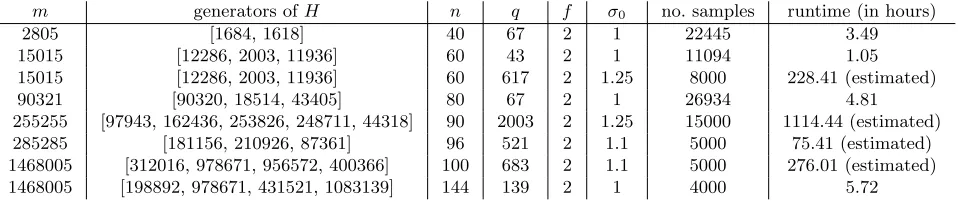
In Table 3, we list some instances on which the attack has succeeded. The columns of Table 3 are as follows. The first two columns specifym and the generators ofH, whereH is represented as a subgroup of (Z/mZ)∗; the column labeledf is the residue degree ofq. The last column consists of either the runtime for an actual attack which succeeded, or an estimation of the runtime. Note that we omitted our choice of prime ideal q, since due to Lemma 19 the choice of q is irrelevant to our attack. The parameters σ0 in Table 3 represent the boundary of the power of our attack, i.e., we tried higherσ0and the attack failed. Note that althoughσ0is relatively small, in practice it still provides exponentially many error vectors. Intuitively, when σ0= 1, ourσis equal to the geometric mean of the lengths of a Gram-Schmidt basis ofΛR. In practice, the lengths of these basis vectors do not differ by a lot, so we still expect to get at leastΩ(2n) error vectors.
Also, in terms of the normal integral basis of R, the coefficients of the error e are of the same size. In particular, none of the coefficients will be zero with overwhelming probability. Thus a standard linear algebra attack does not apply to this case.
The rows of Table 3 with “estimated” runtime mean the following. First, we ran the chi-square test on the correct reduced errors to obtain an estimate ˆ∆of the statistical distance∆. We then choseαaccording to ˆ∆ and obtained an estimation ˆpof the success probability of our attack, using the formula in Theorem 15. The corresponding rows in the table all have ˆp >1−2−10, suggesting that the attack is very likely to succeed. Finally, we ran a few chi-square tests on samples obtained from a few randomly chosen incorrect guesses to compute the average timet for running one chi-square test. We set the estimated runtime for the attack to betN.
Table 3.Attacked sub-cyclotomic RLWE instances
m generators ofH n q f σ0 no. samples runtime (in hours)
2805 [1684, 1618] 40 67 2 1 22445 3.49
15015 [12286, 2003, 11936] 60 43 2 1 11094 1.05
15015 [12286, 2003, 11936] 60 617 2 1.25 8000 228.41 (estimated)
90321 [90320, 18514, 43405] 80 67 2 1 26934 4.81
255255 [97943, 162436, 253826, 248711, 44318] 90 2003 2 1.25 15000 1114.44 (estimated) 285285 [181156, 210926, 87361] 96 521 2 1.1 5000 75.41 (estimated) 1468005 [312016, 978671, 956572, 400366] 100 683 2 1.1 5000 276.01 (estimated) 1468005 [198892, 978671, 431521, 1083139] 144 139 2 1 4000 5.72
Remark 20. Castryk et al [7] show that there are even more weaknesses in the weak instances found in [12] so that one can attack the corresponding search RLWE problem using a standard linear algebra attack using only a few samples. The approach from [7] using linear algebra will not work on the examples in this paper. Although each coordinate of the error vector only takes on small integers, it is unlikely that any fixed coordinate of the error vector will equal to zero. Hence one can not hope to extract exact linear equations from the samples.
Nonetheless, in [6] Castryck et al. performed an analysis of the instances in our Table 3, and showed that one can recover a certain number of approximate linear equations from each RLWE sample. One can certainly run the Arora-Ge attack using these approximate equations. However, a careful analysis shows that for instances in our table, our attack is more efficient than the Arora-Ge attack.
For example, we take the first instance from Table 3. In Section 5 of [6], it is shown that out of each RLWE sample, one can recover 20 noisy linear equations in the secret key, with each noise sampled from a Gaussian of mean zero and standard deviation 0.5381. (In [6], the standard deviation was incorrectly claimed to be 0.5381/√2πdue to a misunderstanding: they usedr= 1 in their analysis but our instance hasr=√2π.)
First, we try d= 7. In order to run the Arora-Ge attack, we need in the best case ( 40+77−1/20)≈221 RLWE samples, assuming all errors after rounding to integers lies in [-3,3]. If we choosed= 5 instead, then in the best case we need ( 40+55−1/20)≈54300 RLWE samples. However, to achieve this, we need the rounded errors in each equation to lie in [-2,2], which happens with probability erf(√ 2.5
2·0.5381)( 40+5−1
attack on the other hand requires 22445 samples and succeeds with probability greater than 1/2. Moreover, the computational complexity of Arora-Ge attack is cubic in the number of samples, while our attack is linear in the number of samples. Hence we conclude that our attack is more efficient. A similar analysis can be done for other instances in Table 3.
5.2 Discussion of the Reason for Vulnerability
We searched for vulnerable instances where the modulus has residue degree one or two. It turns out that all vulnerable instances we found and listed in Table 3 have a modulus of degree two. In this section we give a heuristic explanation for the existence of examples of higher degree. LetK be a Galois number field and suppose q is a prime of residue degreef in K. We will give a scenario under which a vulnerability to our attack may appear.
For the purposes of the thought experiment, we will suppose there exists a “good” integral basisw1,· · · , wn of the ring of integersR, by which we mean that the vectorsι(wi) andι(wj) are almost orthogonal and short fori6=j; this is only for convenience in the discussion. Fix a prime idealqaboveq. Then the images of the basis under the reduction moduloq map are elements ofF :=R/q. Now if for some indexi, the elementwi lies inside some proper subfieldK0 ofK, and ifq has residue degreef0 < f inK0, then wi (modq) will lie in a proper subfield of F. If this occurs for a large number of the basis elements wi, then we could expect the distribution DΛR,σ modq to take values in a proper subfield of F more frequently than the uniform distribution. This would allow us to distinguish it from the uniform distribution onF.
In practice, we found that the above scenario is particularly likely when the field Khas a subfieldK0 of index 2 such thatq splits completely in K0 and has residue degree 2 inK. Since the ring of integers ofK0 is a subring of the ring of integers ofK, one has at leastn/2 linearly independent vectors in ΛR with the desired property, i.e., their reduction modulo some primeqaboveqlie inside Fq instead ofFq2.
5.3 A Detailed Example
In order to illustrate our discussion above together with the search-to-decision reduction, we present a vulnerable Galois instance in detail, where we generated RLWE samples, performed the attack, and used the search-to-decision reduction to recover the entire secrets.
Example 21. Let m= 3003 and H be the subgroup of (Z/mZ)∗ generated by 2276, 2729 and 1123. Then K=Km,H is a Galois number field of degreen= 30. We take the modulus to beq= 131, a prime of residue degree 2, and takeσ0= 1. We generate the secret sfrom the discrete GaussianDΛR,σ. There are 15 prime ideals in K lying aboveq, which we denote by q1,· · · ,q15. We then generate 1000 RLWE samples and use Algorithm 1 and Theorem 9 to recovers (mod qi) for each 1≤j≤15. Then we use the Chinese remainder theorem to recovers. The attack succeeded in 32.8 hours. The code for this attack is in the appendix.
6
Attacks on the Prime Cyclotomic Fields
6.1 Attacking non-dual RLWE when q=p
Let p be an odd prime and let K = Q(ζp) be the p-th cyclotomic field. Then K has degree (p−1) and discriminantpp−2. The primepis totally ramified inK, so there is a unique prime idealp= (1−ζ
p) above p, and the reduction fromR/pRtoR/pR∼=Fp takes all powers ofζp to 1.
We give a heuristic argument that the attack could work: writing the error e as P
eiζi
m, we have e (modp) =P
Table 4.Attacked instances of DRLWE forK=Q(ζp)
q(=p) n σ0 runtime (in seconds)
251 250 0.5 2.62
503 503 0.575 12.02 809 808 0.61 34.38
6.2 Attacking dual RLWE
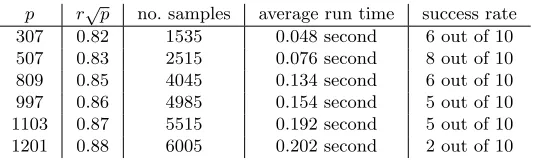
We adopt our attack to the decision version of dual RLWE for the fieldK=Q(ζp), with no assumptions on the modulusq. Keep the notations as above, and letR∨be the dual ideal ofR. Letr >0 be the width parameter. Then the erroreis sampled from the continuous spherical Gaussian distribution of widthr, which is denoted Dr in [18]. Recall that the secrets∈R∨/qR∨, and an RLWE sample is (a, b=as+e)∈Rq×KR/qR∨.
We start by scaling the second coordinate byp. Thenb0=bp=a(ps) +pe. Using the fact thatpR∨=p, we see thats0 =ps∈ p/qp, and e0 =pe ∈KR/qp. Thus we can regards0 as the new secret, ande0 as the new error.
Note that the scaled errore0 =pe is sampled from the continuous spherical GaussianDpr. Equivalently, by [10], we may assumee0 is sampled as
e0=p·e= p−1
X
i=0 eiζpi.
where the coefficientseiare i.i.d. one-dimensional Gaussians with width √pr.
Recall that our goal is to tell the difference between the above samples and samples chosen uniformly fromRq×KR/qp. Letβ=ζp−1. Note thatK=Q(β), hence every element inKRcan be uniquely written asPp−2
i=0 aiβ i (ai∈
R). Consider the map
ρ:KR→R:Xaiβi 7→a0. (*)
It is clear thatρis additive. We examine the image ofe0 under the mapρ. We write
e0 = p−2
X
i=0
iβi,(i ∈R).
Then one verfies that0=e0+· · ·+ep−2−(p−1)ep−1and we haveρ(e) =0.
Now we make two observations: first, since the idealp is generated byβ, we haveρ(p) =pZ; second, we haveas0 =a(p·s)∈p/qp. Combining these observations, we see that
ρ(b0) =ρ(as) +ρ(e0)≡ρ(e0)≡0 modpZ.
We could describe our attack on the decision RLWE as follows: for each scaled sample (a, b0), we compute ρ(b0). Then we perform a statistical test on the set {ρ(b0) modpZ} ⊆ R/pZ to distinguish it from the uniform distribution on the circleR/pZ.
Note that this attack did not involve the modulus q, thus it can be applied to any modulus. This is in contrast to the previous attack on the non-dual case, where the attack was only performed under the assumption thatq=pis the unique ramified prime.
Remark 22. The search-to-decision reduction for dual RLWE in cyclotomic fields and completely split mod-ulus is proved in [18]. However, the theorem requires that the error width r≥ η(R∨) for some negligible = (n). (Here η(R∨) is the smoothing parameter defined in [19]. For R =Z[ζp], if we take = 2−p+1, then one sees thatη(R∨)≤1, andη(R∨) tends to 1 in the limit asp→ ∞). Hence the search-to-decision reduction of [18] essentially requiresr≥1, which is above the parameters we can attack (r∼1/√p). So in this particular case, our attack on the decision problem cannot be transferred to an attack on the search problem using this search-to-decision reduction.
Table 5.Attacking the dual RLWE inQ(ζp)
p r√p no. samples average run time success rate 307 0.82 1535 0.048 second 6 out of 10 507 0.83 2515 0.076 second 8 out of 10 809 0.85 4045 0.134 second 6 out of 10 997 0.86 4985 0.154 second 5 out of 10 1103 0.87 5515 0.192 second 5 out of 10 1201 0.88 6005 0.202 second 2 out of 10
7
Can Modulus Switching be Used?
The modulus switching procedure is a technique to reduce noise in RLWE samples, and has been discussed extensively in [3] and [16]. We recap the basic ideas of modulus switching. LetR= (K, q, σ, s) be an RLWE instance. Choose another primepless thanqas the new modulus and consider the instanceR0= (K, p, σ0, s) for someσ0 > σ. We can “switch modulus” if there exists a map
πq,p:Rq →Rp,
which takes RLWE samples with respect toRto RLWE samples with respect toR0. In what follows, we give a heuristic argument that our attack will not work in combination with modulus switching under a na¨ıve implementation, and isolate the key characteristics a successful implementation of the attack would require. One example of a mapπq,pbeing used in practice is as follows. Letα=pq and fix a small positive number τ. For an equivalence class [a] inRq, we sample a vectora0 from the “shifted discrete Gaussian” DΛR,τ,αa, defined as follows. For a latticeΛand a vector c∈Rn,
DΛ,τ,c(x) = Pρτ(x−c) y∈Λρτ(y−c)
,∀x∈Λ.
Finally, we setπq,p([a]) =a0 (modpR). Note that the definition ofπq,p([a]) is independent of the choice of representativea, as follows. Suppose we choose another representativea1, thena1=a+λq for someλ∈R, henceαa1=αa+λp. Finally, observe that the shifted discrete Gaussian behaves well under translating by a lattice point, i.e., we haveDΛ,τ,c+u=DΛ,τ,c+ufor anyu∈Λ.
Put loosely, the mapπq,pscalesabyp/q and then rounds back into the lattice. It is a natural question then to ask whether modulus switching can be combined with our attack, to switch from a “strong” modulus to a “weak” modulus. However, a heuristic argument shows that the naive combination of our attack with modulus switching will not work.
Let a00 =αa−a0. By construction, we expect a00 to be a short vector inRn, and the point a0 can be viewed as a “rounding” of the pointαato the latticeΛR.
We will make two heuristic assumptions:
1. That πq,p takes the uniform distribution onRq to an almost uniform distribution onRp. 2. The distribution of b00 and (sa)00 is independent moduloq, fors6=±1.
Proposition 23. Under the assumption thatπq,ptakes the uniform distribution onRq to an almost uniform distribution onRp, the reduction ofa00 modulo pwill be almost uniformly distributed inR/pR.
Proof. The reduction mapR→R/pis a ring homomorphism that can be extended to a homomorphism of additive groupsφ: 1qR→R/p by the following chain of maps:
1 qR
(modp1 qR)
−−−−−−−−−→ 1
qR
.
p1 qR
×q
−−→R/pR ×[q] −1
−−−−→R/pR.
Suppose we have a sample (a, b) and the switched sample (a0, b0) = (πq,p(a), πq,p(b)). Consider the error e0:=b0−a0s. Supposeb=as+e+λq for someλ∈R. Then
e0 =b0−a0s
=α(b−as)−b00+a00s. =αe+λp−b00+a00s.
and therefore, considering this as an additive relation in 1qR and applying the map of the proof above,
e0 ≡ −b00+a00s (modp).
By the Proposition above,a00andb00are uniformly distributed modulop. Hence, if we assume thea00and b00 are independent, then the reduced rounding errorsa00 (modp) andb00 (mod p) are also independent, and the new reduced errorse0 (modp) would follow the uniform distribution. So our chi-square attack will fail on these modulus-switched samples, even thoughpmight be a “weak” modulus.
Therefore, the best hope of attack is if one of our two assumptions is violated by a mapπq,p. The second is the most likely target. Note that a00 andb00 are the rounding errors when we try to round αaandαb to the latticeΛR. However,ΛR is a n-dimensional lattice, so there areΩ(2n) options of rounding a vector in Rn to a moderately close lattice point. Even in the scenario with zero error, i.e.,e= 0, an attacker will face the task of finding a “nice” rounding algorithm, so that the roundings of the two vectorsαaandαb=αas are somehow related.
So far, we are not aware of any such algorithm, unless the secretsis trivial, e.g.,s= 1, in which caseαa is almost equal toαb, and one expects thata00 is close tob00.
References
1. Arora, S., Ge, R.: New algorithms for learning in presence of errors. In: Automata, Languages and Programming, pp. 403–415. Springer (2011)
2. Bos, J.W., Lauter, K., Loftus, J., Naehrig, M.: Improved security for a ring-based fully homomorphic encryption scheme. In: Cryptography and Coding, pp. 45–64. Springer (2013)
3. Brakerski, Z., Gentry, C., Vaikuntanathan, V.: (Leveled) fully homomorphic encryption without bootstrapping. In: Proceedings of the 3rd Innovations in Theoretical Computer Science Conference. pp. 309–325. ACM (2012) 4. Brakerski, Z., Vaikuntanathan, V.: Fully homomorphic encryption from Ring-LWE and security for key dependent
messages. In: Advances in Cryptology–CRYPTO 2011, pp. 505–524. Springer (2011)
5. Brakerski, Z., Vaikuntanathan, V.: Efficient fully homomorphic encryption from (standard) LWE. SIAM Journal on Computing 43(2), 831–871 (2014)
6. Castryck, W., Iliashenko, I., Vercauteren, F.: On error distributions in ring-based LWE. LMS Journal of Com-putation and Mathematics 19(A), 130–145 (2016)
7. Castryck, W., Iliashenko, I., Vercauteren, F.: Provably weak instances of Ring-LWE revisited. In: 35th Annual international conference on the Theory and Applications of Cryptographic Techniques (Eurocrypt 2016). vol. 9665, pp. 147–167. Springer (2016)
8. Chen, H., Lauter, K.E., Stange, K.E.: Attacks on search RLWE. Cryptology ePrint Archive, Report 2015/971, 2015.
9. Chen, H., Lauter, K.E., Stange, K.E.: Vulnerable Galois RLWE families and improved attacks. In: Selected Areas in Cryptography – SAC 2016 (2016)
10. Ducas, L., Durmus, A.: Ring-LWE in polynomial rings. In: Public Key Cryptography–PKC 2012, pp. 34–51. Springer (2012)
11. Eisentr¨ager, K., Hallgren, S., Lauter, K.E.: Weak instances of PLWE. In: Selected Areas in Cryptography–SAC 2014, pp. 183–194. Springer (2014)
12. Elias, Y., Lauter, K., Ozman, E., Stange, K.: Provably weak instances of Ring-LWE. In: Advances in Cryptology – CRYPTO 2015, Lecture Notes in Comput. Sci., vol. 9215, pp. 63–92. Springer, Heidelberg (2015)
13. Gentry, C., Halevi, S., Smart, N.P.: Fully homomorphic encryption with polylog overhead. In: Advances in Cryptology–EUROCRYPT 2012, pp. 465–482. Springer (2012)
16. Langlois, A., Stehl´e, D.: Worst-case to average-case reductions for module lattices. Designs, Codes and Cryptog-raphy 75(3), 565–599 (2014)
17. L´opez-Alt, A., Tromer, E., Vaikuntanathan, V.: On-the-fly multiparty computation on the cloud via multikey fully homomorphic encryption. In: Proceedings of the 44th annual ACM Symposium on Theory Of Computing. pp. 1219–1234. ACM (2012)
18. Lyubashevsky, V., Peikert, C., Regev, O.: On ideal lattices and learning with errors over rings. Journal of the ACM (JACM) 60(6), 43:1–43:35 (2013)
19. Micciancio, D., Regev, O.: Worst-case to average-case reductions based on Gaussian measures. SIAM Journal on Computing 37(1), 267–302 (2007)
20. Micciancio, D., Regev, O.: Lattice-based cryptography. In: Post-quantum cryptography, pp. 147–191. Springer (2009)
21. Nguyen, P.: Cryptanalysis of the Goldreich-Goldwasser-Halevi cryptosystem from Crypto 97. In: Advances in Cryptology – CRYPTO 1999. pp. 288–304. Springer (1999)
22. Peikert, C.: How (not) to instantiate Ring-LWE. In: SCN. pp. 411–430 (2016)
23. Ryabko, B.Y., Stognienko, V., Shokin, Y.I.: A new test for randomness and its application to some cryptographic problems. Journal of statistical planning and inference 123(2), 365–376 (2004)
24. Stehl´e, D., Steinfeld, R.: Making NTRU as secure as worst-case problems over ideal lattices. In: Advances in Cryptology–EUROCRYPT 2011, pp. 27–47. Springer (2011)
25. Stein, W., et al.: Sage Mathematics Software (Version 6.4). The Sage Development Team (2014),