Cryptographic Constructions Supporting Implicit
Data Integrity
Michael Kounavis, David Durham, Sergej Deutsch, Antonios Papadimitriou and Amitabh Das
Intel Labs, Intel Corporation, 2111, NE 25th Avenue, Hillsboro, OR 97124 Email: {michael.e.kounavis, david.durham, sergej.deutsch,
antonios.papadimitriou, amitabh.das}@intel.com
May 2018
Abstract
We study a methodology for supporting data integrity called ‘implicit integrity’ and present cryptographic constructions supporting it. Implicit integrity allows for corruption detection without producing, storing or verifying mathematical summaries of the content such as MACs and ICVs, or any other type of message expansion. As with authenti-cated encryption, the main idea behind this methodology is that, whereas typical user data demonstrate patterns such as repeated bytes or words, decrypted data resulting from corrupted ciphertexts no longer demonstrate such patterns. Thus, by checking the entropy of some decrypted ciphertexts, corruption can be possibly detected.
The main contribution of this paper is a new notion of security which is associated with implicit integrity, and which is different from the typical requirement that the output of cryptographic systems should be indistinguishable from the output of a random permuta-tion. The notion of security we discuss reflects the fact that it should be computationally difficult for an adversary to corrupt some ciphertext so that the resulting plaintext demon-strates specific patterns. For this purpose, we introduce two kinds of adversaries. First, an input perturbing adversary performs content corruption attacks. Second an oracle re-placing adversary performs content replay attacks. We discuss requirements for supporting implicit integrity in these two adversary models, and provide security bounds for a con-struction calledIVP, a three-level confusion diffusion network which can support implicit integrity and is inexpensive to implement.
1
Introduction
1.1 The Concept of implicit data integrity
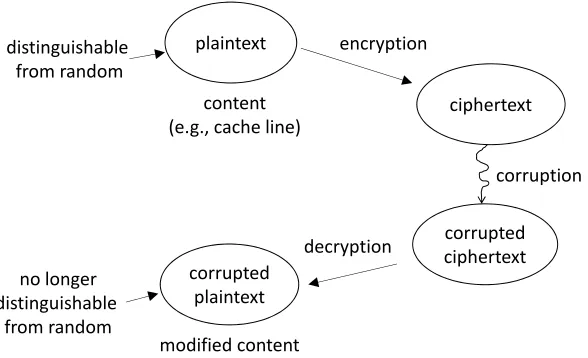
plaintext content (e.g., cache line)
encryption
ciphertext
corruption corrupted ciphertext decryption
corrupted plaintext modified content distinguishable
from random
no longer distinguishable
from random
Figure 1: The concept of implicit integrity
operation. This wastes memory access bandwidth resources as each data read operation needs to be realized as two memory read operations.
Another area where our work applies is in network and communication systems which employ a number of different protocols at different layers of the network stack, ranging from the link layer to the application layer, with additional corruption detection mechanisms [6] [7] [31]. Many of these protocols employ corruption detection mechanisms to cater for any intentional or unintentional corruptions encountered during the transmission of data from point A to point B. The cost of providing such capabilities is the additional metadata per packet, which can be sigificant. This paper describes an alternative methodology that uses pattern techniques in order to support corruption detection for the large majority of user data without message expansion. The main idea is discussed below.
If some content exhibits patterns (i.e., has low entropy), then such content can be dis-tinguished from random data. Let’s consider that this content is encrypted, as shown in the figure, where the encryption algorithm is a good pseudo-random permutation and thus can successfully approximate a random oracle. The cipher text which is produced in this way is no longer distinguishable from random data, under certain reasonable assumptions about the adversary. Any corruption on the cipher text results in a new cipher text value, which is different from the original one. Furthermore, any decryption operation on this new cipher text value results in a corrupted plaintext value which is different from the original one as well. As decryption is the inverse operation of encryption, the decryption algorithm also approximates a random oracle under reasonable adversary models. Because of this reason, the corrupted plaintext value is also indistinguishable from random data with very high probability. From a system realization standpoint, the corrupted plaintext is indistinguishable from random data because block ciphers or cryptographic constructions typically perform strong mixing of their input bits. Due to an ‘avalanche effect’ associated with the decryption oracle, even a single bit change in the cipher text can affect all bits of the decrypted plaintext. For these reasons, checking the entropy of the result of a decryption operation can be a reliable test for detecting corruption for some data. We refer to such methodology as ‘implicit data integrity’ or just ‘implicit integrity’.
how to determine that some content’s entropy is ‘low enough’ or ‘high enough’ so as to safely deduce that the original content has not been corrupted.
Another challenge has to do with the design of cryptographic constructions for supporting implicit integrity and the derivation of analytical proofs associated with security claims. A large body of work exists that focuses on bounds associated with distinguishing the output of cryptographic constructions from that of a random permutation or a random function. In our work we argue that such strong notion of security may not be required in the context of implicit integrity. The security objective which we discuss in this paper is that it should be computationally hard for adversaries to modify a set of given ciphertext messages so as to result in plaintexts of low entropy, while preserving confidentiality. This paper focuses on formalizing this security objective, exploring the requirements of cryptographic constructions supporting it, and providing an example of a simple, implementable three level confusion diffusion network that meets these requirements for a specific security level.
1.2 Summary of our contributions
A first contribution of this paper is the introduction of a class of constructions which we refer to as ‘Random Oracles according to Observer functions’ (RO2). An observer function is a function that searches the output of cryptographic systems in order to detect unusual behavior, such as the presence of patterns. Patterns can be repeated nibbles, bytes, words or double words. If an observer function detects unusual behavior with the same or similar probability in a cryptographic system’s output as in a random oracle’s output then such cryptographic system belongs to the class of RO2 constructions associated with the specific observer function.
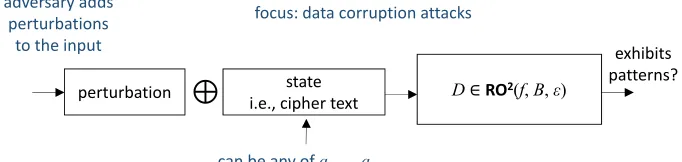
A second contribution of this paper is the description of a security model against data corruption and replay attacks, which is associated with implicit integrity and connected with the class ofRO2 constructions. Specifically, we show that if a construction is in theRO2 class, then the construction always supports some form of implicit data integrity, and is secure in the proposed model. The proposed model comprises two kinds of adversaries. First, an input perturbing adversary is an algorithm which is given a set of ciphertext messages q0, . . . , qm−1,
the plaintexts of which exhibit patterns and a query boundB. The algorithm succeeds if it finds a ciphertext messageywhich is different fromq0, . . . , qm−1, the plaintext of which also exhibits
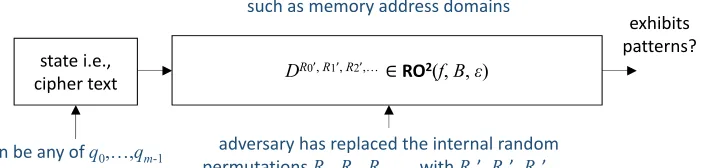
patterns. Security in this adversary model indicates protection against data corruption attacks. Second, an oracle replacing adversary is an algorithm which is also given a set of cipher messages q0, . . . , qm−1 the plaintexts of which exhibit patterns and a query bound B. The algorithm
succeeds if it replaces a set of oracles R0, R1, . . . queried by the decryption system with a
new set of oracles R00, R01, . . ., so that there exists a ciphertext message y ∈ {q0, . . . , qm−1}
the plaintext of which continues to exhibit patterns even when the oracles R0, R1, . . . of the
decryption system are replaced byR00, R01, . . .. We discuss that security in this adversary model indicates protection against content replay attacks.
followed in the proofs is similar to the methodology used for searching for zero correlation linear hulls in block ciphers [22].
1.3 Protecting data that do not exhibit patterns
One issue that needs addressing, when building a system that protects data using the principle of implicit integrity, is how to detect corruption if data do not exhibit patterns. As we elaborate below, patterns can be found in up to 91% of the data of client workloads and 84% of the data of server workloads. The numbers come from observations on 111 million representative client workload cache lines and 1.4 billion representative server workload cache lines. Whereas such data can be protected using implicit integrity, the remaining 9%−16% of the data need protecting also.
Such design issue can be easily addressed. Implementations can protect the overwhelming majority of user data that exhibit patterns using implicit integrity and the remaining data using standard techniques. There is nothing in the implicit integrity methodology, discussed here, that prevents it from being used together with other independent integrity mechanisms such as MACs. Such solutions can co-exist with implicit integrity.
Cost reduction comes from the fact that only MACs computed from high entropy data need to be stored and accessed. If some decrypted content exhibits patterns, then there is some assurance that no corruption has occurred. If no patterns are exhibited, however, a search can be made for a MAC associated with the content. If no MAC is found, then the data is deemed corrupted. Otherwise, an integrity check is made using the returned MAC. Such implementation can use a content addressable memory unit or a hash table for accessing and managing MACs. We remind that MACs are significantly fewer than those required for protecting all the data, and this is the main advantage of this approach. Further investigations on hardware and operating system changes required in order to support implicit integrity are beyond the scope of this paper.
2
Related work
2.1 Robust Authenticated Encryption (RAE)
Our work is rooted to a number of earlier contributions of ours [1, 2, 3], where reference [1] is, according to our knowledge, the first to ever propose the concept of implicit integrity as discussed here, meaning integrity support based on the entropy characteristics of input data without requiring message expansion.
Two subsequent publications [26, 27] discuss an integrity methodology called Robust Au-thenticated Encryption (RAE), which generally involves some type of message expansion in the form of some additional bits of length λ. Such redundancy bits are appended to an input message before encryption. At decryption time, RAE verifies that the redundancy bits have the value they are supposed to have. The authors of [26, 27] also discuss a subcase of RAE whereλ= 0. In this subcase, integrity is provided by taking into account further redundancy which may exist in an input message, besides the additional bits of length λ. Such subcase of RAE is equivalent to our concept of implicit integrity. There are several differences between our work and references [26, 27], however.
there is message expansion. Such simulator is a part of this game and is used in the proofs that reduce the security of the paper’s proposed construction AEZ to the indistinguishability of AEZ from a strong pseudo-random permutation. Whenλ= 0, the ideal primitives considered in the games of reference [26] are reduced from random injections to random functions. In this case, Theorem 2 of reference [26] is reduced to the statement that the difficulty by which an adversary distinguishes a real construction from a random function in games where redundancy is checked, is at least as much as the difficulty when redundancy is not checked. No further insight on the security of RAE without message expansion is provided in this case. On the other hand, reference [27] uses constructive cryptography to better quantify the impact of message redundancy on the level of integrity support offered by a system. However, it does this mainly in the context of systems that include ideal primitives, and more specifically, uniform random injections.
A second difference between our work and references [26, 27] is in the formulation of the security objective that guides the design of the proposed cryptographic constructions. Refer-ences [26, 27] base their notion of security on the indifferentiability or indistinguishability of their proposed constructions from a random permutation or a random function. Indifferen-tiability and indistinguishability are mostly used in these references in the general sense (as in reference [28]). For example reference [26] proposes a wide block cipher design (AEZ) and proves that this design is indeed difficult to distinguish from a wide random permutation. In this paper we argue that, while such notion of security is useful, and the analysis of references [26, 27] insightful, implicit integrity may not need such strong notion of security.
There is a simple argument to see why this is the case. Let’s consider some hypothetical implicit integrity system, the security of which is based on the presence of some specific patterns in input data. For example, patterns may be sequences of 10 repeated adjacent bytes, appearing with probability 2−65.1 among random 1024 bit inputs, while being frequent among specific user data. Let’s also consider that the provided security level of 65 bits is adequate to the users of the system and that the users might not even mind of a small drop in the security offered (e.g., if 62 or 63 bits of security are offered). Finally, let’s assume that the system uses a wide block cipher which is highly indistinguishable from a wide random permutation, where a distinguisher’s advantage is bounded by 2−256 given some adversary query budget. In this hypothetical example, the distinguisher’s advantage is much smaller than the probability of seeing patterns in corrupted input data. As a result, the security of the system is mostly determined by the probability of seeing patterns in corrupted input data, and not by the indistinguishability of the wide block cipher deployed. Due to this fact, a wide block cipher like the one deployed may be functional but possibly unnecessary. A valid design could have used an alternative wide construction, which may have been more distinguishable from a random permutation, but still able to support the necessary security level associated with 62-65 bit implicit integrity and also provide some form of confidentiality. The confidentiality provided might not have been the same as the one provided by a wide block cipher, but it may have been similar to the confidentiality provided by a mode of a narrower block cipher.
due to the fact that, for some constructions, it may be easier to study their behavior in the con-text of producing outputs with specific patterns, as opposed to studying their indifferentiability or indistinguishability in the general sense.
2.2 Correlation intractability
Besides the relationship between our work and references [26, 27], the concept of random oracles according to observer functions bears some similarity with the concept of correlation intractability discussed in reference [23]. The aim of reference [23] is different from ours. Reference [23] establishes that there exist signature and encryption schemes that are secure in the random oracle model, but for which any implementation of a random oracle results in insecure schemes. In the process, reference [23] introduces two concepts which are related to our definition of the classRO2. First, a binary relation is introduced as ‘evasive’ if when given access to a random oracle O, it is infeasible to find a stringx so that the pair (x;O(x)) is in the relation. Second, a function ensembleF is called correlation intractable if for every evasive binary relation, given the description of a uniformly selected functionfsfromF it is infeasible
to find anx such that (x;fs(x)) is in the relation.
Notable differences between our paper and [23] are the following: First, the binary relation as defined in [23] involves a relationship between two strings. In our case, we employ an observer function which examines the output of the system and produces a Boolean value from this output, after running a polynomial time algorithm. The two definitions may be equivalent, however, the difference in the formalism reflects further contrasts. Second, in reference [23], much is said about intractability. There is a function defined, which characterizes the probability values associated with the output of a system as negligible or non-negligible, and the whole function ensemble as tractable or intractable. This is a ‘black-and-white’ binary characterization which is not directly relevant to our analysis. In the case of theRO2 definition, we are more interested in the relative behavioral difference in the output of a system, when compared to a random oracle or a random function, in the context of producing outputs with specific patterns. For this purpose, we introduce an indistinguishability parameter . This parameter characterizes this relative behavioral difference between the real system we examine and a random oracle or random function primitive.
Third, we examine only systems associated with query bounds. Essentially, we push forward research on open problems identified in [23] and associate solutions to these problems (i.e., correlation intractability in the presence of adversary query bounds) with practical implications such as the ability to detect corruptions without message authentication tags. As part of the process, we discover that it is not possible to support implicit integrity without introducing a number of structural constraints in the systems examined. These structural constraints are a unique contribution of our work, and are sufficient in order to demonstrate the usefulness of implicit integrity systems against data replaying adversaries.
Random Oracle
function fobserves unusual behavior with
prob. Pf
f System S
function f observes the same unusual behavior
with prob. Pf,2
If , ≤ 2 for non-repeating input size B,
then ∈ RO ( , , )RO
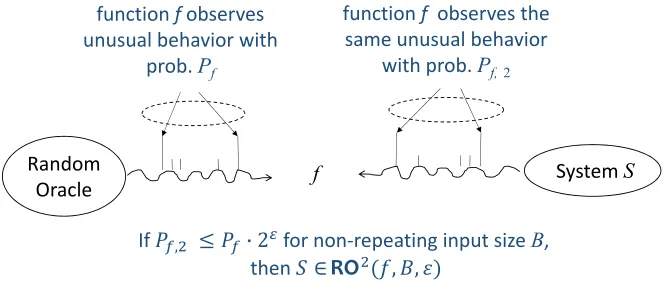
Figure 2: The Concept of a Random Oracle according to an Observer function (RO2)
of which exhibit patterns. Such difference in objectives is reflected in the complexity of the system designs. For example, in section 6 we propose a simple three-level confusion diffu-sion network which provides some assurances against data corruption and data replay attacks without compromising the confidentiality of the output, and which is structurally simpler than some wide block cipher constructions (e.g., [33]). We come back to this issue later in the paper.
3
Preliminary concepts and definitions
3.1 Random Oracles according to Observer functions (RO2)
We begin our discussion with the concept random oracles according to observer functions. We consider ‘observer functions’ that search cryptographic system outputs in order to detect ‘abnormal behavior’, such as repetitions of values of different sizes. Such repetitions are not different from the repetitions termed “needles in a haystack”, which are studied in reference [30].
The concept is illustrated in Figure 2. Function f observes unusual behavior in the values of the output of a random oracle with probabilityPf. The same function f observes the same
unusual behavior in the values of the output of the real system S with probability Pf,2. If
Pf,26Pf·2 for a given maximumnon-repeating input sequence of size B, and if this relation
holds even when Pf,2 is conditioned upon previous inputs, then the system S is a “random
oracle according to observer function f” associated with an indistinguishability parameter: S∈ RO2(f, B, ).
The query bound B denotes the life time of the construction. Furthermore, the query bound B is related to additional structural constraints discussed below. A finite life time B is introduced in the definition of a RO2 construction, so that the construction can contain primitives which are bijective functions (pseudo-random permutations) and which within the bounds of the life timeB are indistinguishable from truncated output random oracles. In what follows we will be denoting such primitives as ‘ingredient random permutations’.
In order for a construction to be RO2 it needs to satisfy the condition Pf,2 6Pf ·2 for
non-repeating input. So what does non-repeating input mean? Having non-repeating input means that:
• within a lifetime of a construction {y0, y1, . . . , yB−1} input is not repeating, i.e., yi 6=
• inputs that result in unusual behavior in one lifetime{y0, y1, . . . , yB−1}of a construction
are not repeated in any other lifetime{z0, z1, . . . , zB−1} of the same construction.
Whereas the inputs to constructions that are in the class RO2 can be from any set of
values, the constructions are most useful when the inputs considered are adversary queries, i.e., corrupted ciphertext values. In this case, the conditions of non-repeating input are not as restrictive as they sound. The intuition behind introducing these conditions, which are used in the derivation of our main results below, is that if an adversary repeats queries as part of the attack strategy, then the system provides the same output for these repeated queries. Specifically, we consider that there are no parameters, potentially randomizing the system which are out of the adversary’s control. Under this assumption it is clear that it is not beneficial for an adversary to repeat queries which are unsuccessful, as their result will be the same. On the other hand, if some queries are successful, then the adversary does not need to repeat these queries, as the adversary possesses the knowledge about the impact of such queries. Because of these reasons, it is not restrictive to introduce the non-repeating input requirement, as we consider adversaries that do not repeat their queries to the construction. We also note that we do not restrict every input to the construction. We just restrict only the inputs for which the condition Pf,26Pf ·2 needs to be satisfied.
Definition 1: Observer function. A function f associated with input strings of length L,
f : {0,1}L → {0,1} is called an observer function if it outputs only one of two values 0 or
1. If for some input x, f(x) = 1, then we will be saying that input x demonstrates unusual behavior according to observer functionf. We will also be denoting this fact asx∈Π(f).
Definition 2: Random Oracle according to an Observer function (RO2). Let {y(0)
0 , y (0) 1 ,
. . . , ym(0)
0−1},{y (1) 0 , y
(1) 1 , . . . , y
(1)
m1−1}, . . . be sets of binary strings of length L, the cardinalities
of which satisfy mi 6B, ∀i > 0. Let also f be an observer function associated with inputs
of length L, and R ← 2∞ a random oracle. A function or system S : {0,1}L → {0,1}L is
called a random oracle according to observer function f associated with a life time B and indistinguishability parameterif the following conditions are true:
i. y(ik)6=y(jk) for all yi(k), yj(k)∈ {y(0k), y1(k), . . . , ym(k)
k−1} such thati6=j, k>0;
ii. ify ∈Π(f) andy∈ {y0(k), y(1k), . . . , ym(k)
k−1}for somek>0, theny /∈ {y
(l) 0 , y
(l) 1 , . . . , y
(l) ml−1} for alll6=k;
iii. for all inputsyand collections of inputs y0, . . . , yq−1 >0 such thaty6=y0, . . . , y6=yq−1,
y ∈ {y0(k), y1(k), . . . , ym(k)
k−1}, yi ∈ {y
(li)
0 , y (li)
1 , . . . , y (li)
mli−1}, k >0, li > 0, 0 6 i < q and
q>0, the following is true:
Prob[S(y)∈Π(f)|y0, . . . , yq−1]6Pf ·2 where Pf = Prob[truncL(R(y))∈Π(f)]
where the function truncL() used in Definition 2 truncates its input returning the input’s L
most significant bits.
When a system S is a random oracle according to an observer function f, life time B and indistinguishability parameter , we will be denoting this fact as S ∈ RO2(f, B, ). We
E(y), D(y)
a1, a2,…
R0
R1
R2
R3
y
r
further processing
p()
… …
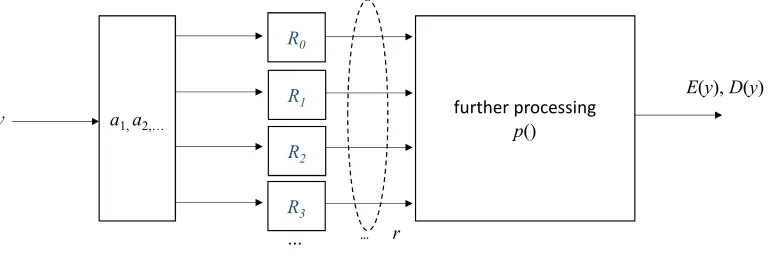
Figure 3: Internal structure of a constrained RO2 construction
is simplified as Prob[S(y) ∈ Π(f)] 6 Pf ·2. The probability value Pf will be denoted as
‘observation probability’ or ‘pattern observation probability’ associated with observer function f in this document.
A ‘constrained’ RO2 function or system uses a number of internal invertible functions which are random permutations and which, for the life time (i.e., query) bound B used, are practically indistinguishable from random oracles in both processing directions. These are the primitives referred to as ingredient random permutations. An RO2 system is invertible itself.
One direction is denoted as E and referred to as ‘encryption’, whereas the other direction is denoted aDand referred to as ‘decryption’. A constrainedRO2 system accepts a construction inputy and uses a set of pre-processing polynomial time algorithms a1, a2, . . . , an to compute
the inputs to ingredient random permutations which provide a response vectorr. Then, it is this response which is further used in theRO2 system for processing. Processing is done by an invertible polynomial time algorithmp() and the inputyis no longer used. A constrainedRO2
system is illustrated in Figure 3. In what follows, whenever we will be using the termRO2 we will be referring only to constrainedRO2 systems.
In what follows we will be using the notation ER0,R1,R2,... and DR0,R1,R2,... to refer to
encryption and decryption systems (encryption and decryption oracles) with access to the ingredient random permutations R0, R1, R2, . . .. Furthermore if ER0,R1,R2,... and DR0,R1,R2,...
areRO2 associated with an observer function f, a query bound B and an indistinguishability
parameter, we will be denoting this fact as:
ER0,R1,R2,..., DR0,R1,R2,... ∈RO2(f, B, ) (3.1)
Finally, regarding the construction of Figure 3, we note that if algorithms a1, a2, . . . , an are
replaced by the identity function and the data path of the figure implements a decryption operation, then the ciphertext of such system is obtained directly from the output of random permutationsR0, R1, R2, . . .. This means that the system does not compromise the
confiden-tiality offered by R0, R1, R2, . . . in any way, provided that the implementation of p(), does
not use any secret information also used by the implementations of R0, R1, R2, . . .. Setting
a1, a2, . . . , an to the identity function is a choice we made in the design of IVP discussed in
Section 6.
3.2 Pattern frequency observers
0 10 20 30 40 50 60 70 80 90 100 ha doop_ wordco un t ha doop_ words ort au dio _play b ac k bla ckja ck-ve gas na vit-gps off ice -imp ress off ice -sp readshe et off ice -writer pict ure-an imate tran scodin g 3dgam e vid eo-play ba ck sp e cpo wer edin bu rgh ad obe-f lash hd r-expos e hd r_ph oto -ma tr ix itu nes m ediasho w ph ot os ho p-e lement s prem ier e-e le ments dra g-n-dro p w indow -media -pla ye r fi ref ox 3dm arkvan tage AV ERA GE Pass Rate (%)
Standard Pattern Matching and ICV Cache Hit Rates
Standard Pattern Matching Rate ICV Cache Hit Rate
0 10 20 30 40 50 60 70 80 90 100 ha doop_ word cou nt ha doop_ wo rds ort au dio _play b ac k bla ckja ck-ve gas na vit-gps off ice -imp ress off ice -sp readshe et off ice -writer pict ure-an imate tran scodin g 3dgam e vid eo-play ba ck sp e cpo wer edin bu rgh ad obe-f lash hd r-expos e hd r_ph oto -ma tr ix itu nes m ediasho w ph ot os ho p-e lement s prem ier e-e le ments dra g-n-dro p w indow -media -pla ye r fi ref ox 3dm arkvan tage AV ERA GE P ass Rate (%)
Extended Pattern Matching and ICV Cache Hit Rates
Extended Pattern Matching Rate ICV Cache Hit Rate
types can range and may include nibbles, bytes, words and double words. The reason why we study these functions in this paper, is because such functions have experimentally been proven successful in characterizing the overwhelming majority of typical uncompressed, unencrypted client and server data. We have observed that client and server data demonstrate repetitions of values of different types, which in truly random data (i.e, random oracle outputs) appear with very low probability. It is these observations that motivate the implicity integrity work.
The fact that uncompressed, unencrypted user data demonstrate patterns should not come as a surprise. User data often consist of code, data structures, media data, pointer tables, and other types of structured data that are characterized by significant redundancy. For example, there exists a simple pattern which is frequently encountered in client and server data. This is the appearance of 4 or more 16-bit words which are equal to each other in a collection of 32 words. In this pattern the input size is 512 bits (i.e., each data is a memory cache line). An observer function which detects the presence of such pattern in inputs of sizeL= 512 bits is denoted as ‘f4×16’. Our experimental observations come from over 111 million client cache
lines and 1.47 billion server cache lines of typical workloads. According to these observations, thef4×16pattern characterizes 82% of the client cache lines and 78% of the server cache lines.
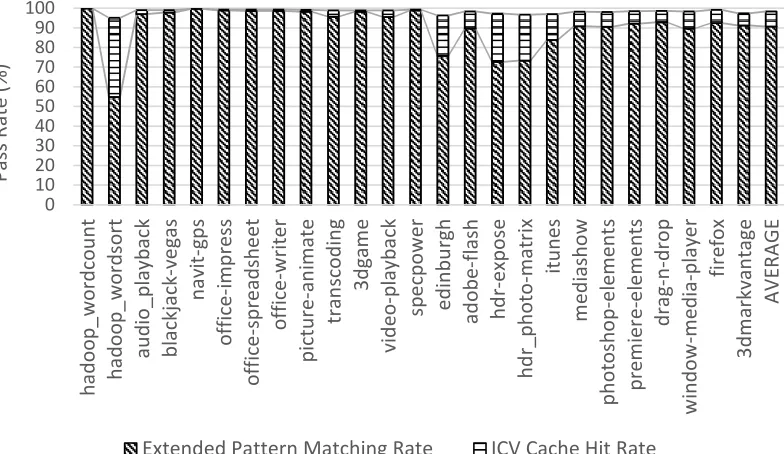
Pass rate comparisons associated with different pattern detectors are shown in Figure 4. Pattern detection based on the observer function f4×16 is referred to as ‘Standard Pattern
Matching’ (SPM). Pattern detection based on the equality of words as well as other types of data such as bytes, double words and nibbles is referred to as ‘Extended Pattern Matching’ (EPM). As is evident from the figure, there are many typical client workloads (e.g., MicrosoftR
Office, transcoding, video player), the pass rates of which are quite high, ranging between 75%-80%, when Standard Pattern Matching is employed. These pass rates are boosted to 98% when Extended Pattern Matching is employed. Overall, the average client pass rates associated with Standard Pattern Matching are 82%. The average pass rates associated with Extended Pattern Matching are 91%. For server data, the corresponding pass rates are 78% and 84% respectively. The EPM scheme encompasses many more pattern detectors than SPM. Pattern frequency observers, associated with the EPM scheme detect entities among the input data which are not only equal to each other, but are also placed in continuous index positions. These observers are not necessarily the same as those detecting value equalities. One can associate these two types of observer functions with different thresholds and, by doing so, build two different integrity schemes. Yet another type of observer function detects entities that take special values. Special values are values that are frequently encountered in regular user data but are infrequently encountered in random or corrupted plaintext data. For example, in memory cache lines obtained from client and server data workloads, a high percentage of bytes take the values of 0x00 or 0xFF.
A last type of observer functions used by EPM detects entities the value histogram of which demonstrates a sum ofn highest entries (i.e., frequencies) being higher than a threshold. The intuition behind this type of pattern check is that there are several types of input messages, the content of which is not as random as that of encrypted data, but also does not demonstrate patterns at the byte or word granularity. One example of such content is media data, where nibble values may be replicated, but data do not demonstrate significant byte or word repli-cations. Our experimental studies showed that there are millions of cache lines demonstrating a limited set of byte equalities but many nibble equalities. By checking whether the sum of the two highest nibble frequencies exceeds a threshold, a more flexible pattern detector can be built, which on the one hand encompasses significantly more regular user inputs, and on the other hand is associated with an event that is infrequent among random data.
state
i.e., cipher text D ∈RO
2(f, Β, ε)
can be any of q0,…,qm-1
perturbation
⊕
adversary adds perturbations
to the input exhibits
patterns?
focus: data corruption attacks
Figure 5: Input perturbing adversary
above, but some are protected using standard methods. For these, ICVs or MACs are cached. The hit rates of Figure 4 are obtained from a simulator implementing the caching of 32-bit ICVs using a 4KB cache unit for this purpose. When ICVs are cached the total pass rate observed by SPM and EPM are boosted significantly. For Standard Pattern Matching, the total pass rate, which includes a pattern check pass rate and an ICV cache hit rate, is 97%. For Extended pattern matching this rate is increased to 99%.
4
Adversary models and main security claims
4.1 Input perturbing adversary
Having presented some preliminary concepts and definitions, we are now in a position where we can present our adversary models and main security claims. The first type of adversary presented, describes adversaries which aim in corrupting encrypted data that are stored some-where, or are in transit, in such a way so that the corruptions pass undetected. We refer to such type of adversary as ‘input perturbing’ adversary.
The input perturbing adversary models any software process or physical intruder that aims in intentional corruptions of data. The underlying assumption of this adversary model is that the adversary can access data only in their encrypted form. This adversary can corrupt ci-phertext data in any possible way hoping that the corruptions will result in plaintexts with patterns, and thus pass undetected. This adversary model is not unrealistic. In secure net-work connections or encrypted storage systems, many attacks originate from sources outside of these trusted domains (e.g., malware running in different processes or virtualized environ-ments, untrusted hypervisors, man-in-the-middle attackers intercepting the packets of secure connections etc.) These attackers can possibly inspect a range of encrypted data, such as the whole encrypted memory of a computing system, but do not have access to the encryption keys required for obtaining the corresponding plaintexts. Thus, these attackers are unable to corrupt user data in a straightforward manner, such as changing special values from 0x00 to 0xFF. Attackers can only do this through the modification of ciphertexts, where ciphertexts are produced using keys unknown to the attackers.
More formally, the input perturbing adversary is defined as follows: Let’s consider a pair of encryption and decryption oracles E and D such that D = E−1 and for which D, E ∈ RO2(f, B, ) for some f, B, . An input perturbing adversary MD(q0, . . . , qm−1, B) is defined
as a polynomial time algorithm which:
• has oracle access to D
• has knowledge of m queries q0, . . . , qm−1 toD and their responses D(q0), . . . , D(qm−1),
state i.e.,
cipher text D
R0’, R1’, R2’,… ∈RO2(f, Β, ε)
can be any of q0,…,qm-1
exhibits patterns?
focus: replay attacks across key domains such as memory address domains
adversary has replaced the internal random permutations R0, R1, R2,… with R0’, R1’, R2’,…
which are also random permutations
Figure 6: Oracle replacing adversary
• can perform at mostB non-repeating queries toDas part of the game, which are other thanq0, . . . , qm−1.
The algorithm succeeds if it finds a new input data word y which is different fromq0, . . . ,
qm−1, the output of which exhibits patterns, i.e.,D(y)∈Π(f). The number of query-response
values knownmis assumed not to be large enough so as to leak information about the internals ofE,D allowing, for instance, rainbow table attacks. The input perturbing adversary type is shown in Figure 5. One special case of attacks performed by this adversary but not the only one studied in this paper, includes attacks where the query budget B is tight. These are the cases of on-line attacks where a single failure from the adversary’s side exposes the attack (e.g., B can be 232). These attacks are further discussed in section 6.
The advantage of the input perturbing adversary is defined for the decryption operation as:
Adv(MD(q0, . . . , qm−1, B), f) = Prob[y←MD(q0, . . . , qm−1, B);
y /∈ {q0, . . . , qm−1}; D(y)∈Π(f)]
(4.1)
4.2 Oracle replacing adversary
Another type of adversary, the ‘oracle replacing adversary’ is associated with replay attacks. Replay attacks may happen across key domains such as network sessions that are encrypted with different keys, or encrypted memory domains. The model of the oracle replacing adversary can indeed be associated with such replay attacks under the assumption that the ingredient random permutations of an RO2 construction use key values which are specific to particular domains of trust. When some valid encrypted data from one domain is replayed in another domain, then this replay attack is equivalent to replacing the ingredient random permutations of a RO2 construction with another set of permutations, associated with a new domain, and observing the output.
More formally, lets consider a pair of encryption and decryption oracles E and D, D = E−1 for which D, E ∈ RO2(f, B, ) for some f, B, and have access to ingredient random permutationsR0, R1, R2, . . .. An oracle replacing adversaryMD(q0, . . . , qm−1, B,R) is defined
as a polynomial time algorithm for which the following are true:
• the algorithm has oracle access toDR0,R1,R2,...
• the algorithm has knowledge ofmqueriesq0, . . . , qm−1toDR0,R1,R2,...and their responses
• the algorithm has access to a setR,R={{R(0)0 , R(0)1 , . . .}, . . . ,{R(0n−1), R(1n−1), . . .}}of nsets of random permutations that have the same input and output length characteristics asR0, R1, R2, . . . and are all different fromR0, R1, R2, . . .
• can perform at most B non-repeating queries to DR0,R1,R2,... as part of the game, other
thanq0, . . . , qm−1
The algorithm succeeds if it finds a set of new ingredient random permutations{R00, R01, R02, . . .} ∈ R and an input query word y ∈ {q0, . . . , qm−1}, the output of which exhibits patterns
when y is applied on an instance of D that uses the new ingredient random permutations R00, R01, R02, . . ., i.e., DR00,R
0 1,R
0
2,...(y) ∈Π(f). As in the case of the input perturbing adversary,
this adversary also does not have any knowledge about possible keys used byE,D. The oracle replacing adversary is shown in Figure 6.
The advantage of the oracle replacing adversary is defined for the decryption operation as:
Adv(MD(q
0, . . . , qm−1, B,R), f) = Prob[{{R00, R10, . . .}, y} ←MD(q0, . . . , qm−1, B,R);
y∈ {q0, . . . , qm−1}; {R00, R01, . . .} ∈R; DR 0 0,R
0
1,...(y)∈Π(f)]
(4.2)
5
Main results
Our main results connect the concept of a random oracle according to an observer function with security claims associated with the input perturbing and oracle replacing adversary models.
Theorem 1: About the security of an RO2 construction in the input perturbing adversary
model. Given a pair of encryption and decryption oracles E and D, D = E−1, an observer functionf, a query bound B, and an observation indistinguishability parameter such that: D, E ∈RO2(f, B, ) then for any input perturbing adversary MD(q0, . . . , qm−1, B):
Adv(MD(q0, . . . , qm−1, B), f)6Pf ·2 (5.1)
We note thatPf is the pattern observation probability associated with observer functionf.
Proof of Theorem 1: We need to show that for every input perturbing adversary:
Prob[y←MD(q0, . . . , qm−1, B); y /∈ {q0, . . . , qm−1}; D(y)∈Π(f)]6Pf ·2 (5.2)
We assume that an adversaryM exists for which the relation 5.2 does not hold. This adversary can succeed in repeatedly producing messages the outputs of which exhibit patterns with probability> Pf·2. We will show that if such adversary exists then it is not possible forE, D
to belong to the setRO2(f, B, ), which contradicts our assumption.
trace of attack 0 trace of attack B-1
y0 yB-1
traces of Battacks …
queries on a replica
of D on the side proposals for yon D values
Figure 7: Hypothetical successful attacks of an input perturbing adversary M’ (first case)
Nattacks; the sum of all querries is ≤ B
trace of attack 0 trace of attack N-1
y0 yN-1
…
all queries on D are
also y proposals proposals for yvalues
Figure 8: Hypothetical successful attacks of an input perturbing adversary M’ (second case)
From algorithmM, one can easily construct an algorithmM0which invokesM and behaves in the following way: If M does not halt before returning a y value, M0 returns the same y value which M returns. If, on the other hand, M halts before returning a y value, then M0 selects a valueyr at random and returns this value. Furthermore, algorithm M0 maintains a
table of previously returned yr values so that every time algorithm M halts, the algorithm
M0 returns a different yr value. From the definition of M0, it is evident that algorithm M0
also succeeds in repeatedly producing messages the outputs of which exhibit patterns with probability> Pf·2. Furthermore, algorithmM0 never halts but always returns someyvalue.
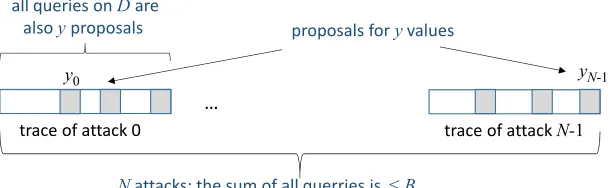
The next step of the proof considers two cases for algorithm M0 shown in Figures 7 and 8 respectively. In this first case, the algorithm M0 as well as the underlying M distinguish between queries made to D that assist in the computation of a returned y value and the proposal of a y value. Such distinction is supported by the control flow of algorithms M, M0. Because of such distinction, the oracle D, which the adversaryM0 accesses on the side for his own calculations can be different the oracle D which is being attacked. In fact, we consider that such oracle is an exact replica of the attacked oracle.
In the second case, the oracle which the adversary M0 accesses is indeed the same as the oracle D under attack. In this second case, there is no distinction between queries assisting the adversary computations and proposals of a y value. Nor such distinction is supported by the control flow of algorithmsM0, M.
In the first case, the adversary M0 performsB attacks which are different from each other. For these attacks the adversary makes all queries but the one corresponding to the computed y to the oracle D, which is available on the side for his calculations. The computed y values are passed to the oracle which is being attacked. The expected value of the ratio of successful queries to the attacked oracle over all queries satisfies simultaneously > Pf ·2 due to the
assumption that the attacker exists and is successful and 6 Pf ·2 due to the fact that the
In the second case, the adversary performs N attacks which are also different from each other. The sum of their trace lengths is at most B. In these attacks there is no distinction between queries assisting the adversary computations and proposals for ayvalue. The expected value of the ratio of successful queries to the attacked oracle over all queries again satisfies simultaneously> Pf·2and6Pf·2which is not possible. This is because we assume that the
adversary exists, and that the attacked oracle isRO2(f, B, ) accepting non-repeating input of
maximum lengthB. Hence Theorem 1 is proven.
The reason for distinguishing between cases 1 and 2 in this proof is because such distinction allows us to construct different sequences of non-repeating inputs in each case, where these se-quences demonstrate a paradox. Such sese-quences need to include quite many successful queries, due to the assumption that the adversary is successful, and at the same time quite too few due to the assumption that the construction used is RO2(f, B, ).
A next theorem concerns the security of RO2 constructions in the oracle replacing adver-sary model. It is in the proof of this theorem that we make use of the constraints of RO2
constructions which we introduce in Figure 3 above.
Theorem 2: About the security of an RO2 construction in the oracle replacing adversary
model. Given a pair of encryption and decryption oracles E and D, D = E−1, an observer functionf, a query bound B, and an observation indistinguishability parameter such that: D, E ∈RO2(f, B, ) then for any oracle replacing adversaryMD(q0, . . . , qm−1, B,R):
Adv(MD(q0, . . . , qm−1, B,R), f)6Pf ·2 (5.3)
wherePf is the pattern observation probability associated with observer function f.
Proof of Theorem 2: We need to show that for every oracle replacing adversary:
Prob[{{R00, R01, . . .}, y} ←MD(q0, . . . , qm−1, B,R); y ∈ {q0, . . . , qm−1};
{R00, R01, . . .} ∈R; DR00,R 0
1,...(y)∈Π(f)]6Pf ·2
(5.4)
We assume that an adversary exists for which the relation 5.4 does not hold. This adversary repeatedly succeeds in producing random permutation replacements and inputsy the outputs of which exhibit patterns with probability greater thanPf·2. We show that if such adversary
exists then it is not possible forE,Dto beRO2(f, B, ) which contradicts our assumption. The proof is similar as in Theorem 1. We first state and prove a lemma that bounds the probability of seeing patterns in the output of anRO2 construction once we replace the ingredient random permutations.
Lemma 1: Let’s assume that we have a pair of encryption and decryption oracles D, E ∈
RO2(f, B, ) for some f, B, , D=E−1, and some input y, such that DR0,R1,R2,...(y)∈ Π(f).
Then for any set of ingredient random permutation replacements R00, R01, . . . which are also random permutations, the probability Prob[DR00,R01,...(y) ∈ Π(f)] of seeing patterns in the
output ofy is bounded by:
Prob[DR00,R 0
1,...(y)∈Π(f)|DR0,R1,R2,...(y)∈Π(f)]6P
f ·2 (5.5)
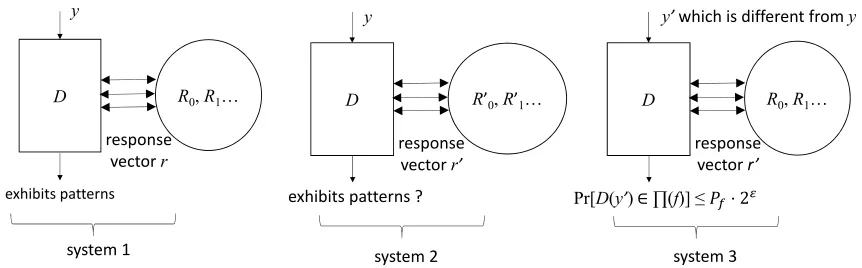
Proof of Lemma 1: We consider a system 1 shown in Figure 9, where the decryption oracle
Daccesses the original ingredient random permutationsR0, R1, R2, . . . and in this system one
particular query to R0, R1, R2, . . . returns a query response vector r. In another system,
sys-tem 2, the original ingredient random permutations R0, R1, R2, . . .are replaced byR00, R10, . . .,
D R0, R1… y
exhibits patterns
response vector r
D R’0, R’1…
y
exhibits patterns ? response vector r’
D R0, R1…
y’ which is different from y
Pr[D(y’)∈∏(f)] ≤ ⋅ 2
response vector r’
system 1 system 2 system 3
systems 2 and 3 generate the same output
Figure 9: Replacing ingredient random permutations inside an RO2 construction
in this system the corresponding query to R0, R1, R2, . . . returns a response vector r0, which
is the same as the one returned by the permutations of system 2. As the ingredient random permutationsR0, R1, R2, . . .are bijective functions, they are invertible. By inverting the
ingre-dient random permutations R0, R1, R2, . . . on the response vector r0, one computes an input
y0 which needs to be provided to system 3 in order for the ingredient random permutations of this system to return the same response vector r0, which is returned in system 2. Due to R0, R1, R2, . . . being bijective and the RO2 construction constraints introduced in Figure 3,
inputy0 must be different fromy. Sincey0 6=y, and system 3 is anRO2 construction, then the
output of system 3 exhibits patterns with probability:
Prob[DR0,R1,...(y0)∈Π(f)|DR0,R1,R2,...(y)∈Π(f)]6P
f ·2 (5.6)
The proof of Lemma 1 completes by observing that systems 2 and 3 generate the same output. Hence:
Prob[DR00,R 0
1,...(y)∈Π(f)|DR0,R1,R2,...(y)∈Π(f)] =
Prob[DR0,R1,...(y0)∈Π(f)|DR0,R1,R2,...(y)∈Π(f)]6P f ·2
(5.7)
and Lemma 1 is proven. We proceed with the proof of Theorem 2 by stating and proving one more Lemma:
Lemma 2: Let’s consider an ensemble of ingredient random permutation sets{R0(i), R(1i), . . .}, i >0. Let’s also consider constructions D, E ∈ RO2(f, B, ) for some f, B, and D = E−1. We further consider a set of input indices,J0= 0, J1 > J0, J2 > J1, . . .for whichJi+1−Ji 6B
for alli>0. Using the constructions E, D and the indicesJ0, J1, . . ., we define permutation
swapping constructions E0, D0 as constructions that accept as input discrete sequences of valuesy0, y1, . . ., have infinite lifetime as opposed to bounded byB, and provide output which
is obtained as follows:
E0(yj) =ER (i) 0 ,R
(i)
1 ,...(yj) and D0(yj) =DR (i) 0 ,R
(i)
1 ,...(yj) for allyj such thatJi 6j < Ji+1
(5.8)
IfE0,D0 are defined by equation 5.8, then for any input sequence ˜y0,y˜1, . . .toD0 which is not
Prob[D0(˜y)∈Π(f)]6Pf ·2 (5.9)
where ˜yj0 6= ˜yj00 for allJi 6j0< Ji+1,Ji 6j00< Ji+1,j06=j00 andi>0, and where the relation
5.9 holds for every input ˜y∈ {y˜0,y˜1, . . .}.
Proof of Lemma 2: From the definition of equation 5.8 it is evident thatE0 and D0 are also encryption and decryption oracles and that D0 = E0−1. The inputs to decryption oracle D0 can either result in outputs with patterns or not. On the other hand, the inputs that result in patterns can be split into repeating inputs and non-repeating inputs, as inputs from the sequence ˜y0,y˜1, . . . to D0 may be repeating across index bounds. It is sufficient to show that
the property Prob[D0(˜y) ∈ Π(f)] 6 Pf ·2 holds for the repeating inputs which produce at
least one output with patterns. This is because the probability Prob[D0(˜y)∈Π(f)] is trivially 0 if it is known that inputs are always unsuccessful. On the other hand, for the non-repeating inputs the property does hold, as the constructions defined byE0,D0 areRO2 inside the index bounds.
It is easy to see that, for the remaining case of repeating inputs that produce at least one output with patterns, the property Prob[D0(˜y)∈Π(f)]6Pf·2holds due to Lemma 1. Indeed
let’s consider some input ˜yj such that Ji 6j < Ji+1 for some i>0. Let’s also consider that
this input, if passed to the decryption oracleD0, produces output that exhibits patterns:
D0(˜yj) =DR (i) 0 ,R
(i)
1 ,...(˜yj)∈Π(f) (5.10)
If this input ˜yj appears in the input sequence again, outside the index bounds Ji and Ji+1,
then the probability of seeing patterns at the output of this repeated instance of ˜yj is bounded
according to Lemma 1. Specifically, if value ˜yj appears again inside the index boundsJi0 and
Ji0+1 for somei0 6=i, then the output of the decryption oracleD0 for this repeated instance is
equal toDR(i
0) 0 ,R
(i0)
1 ,...(˜yj). If we apply Lemma 1 to the sets of ingredient random permutations {R0(i), R(1i), . . .}and {R0(i0), R1(i0), . . .} and to the input value ˜yj, we obtain inequality:
Prob[DR(i
0) 0 ,R
(i0)
1 ,...(˜yj)∈Π(f)|DR (i) 0 ,R
(i)
1 ,...(˜yj)∈Π(f)]6Pf·2 (5.11)
which completes the proof of Lemma 2. We also note that the inequality 5.9 of Lemma 2 holds even if the event D0(˜y) ∈Π(f) is conditioned upon inputs to D0 which are different from ˜y. This is due to the fact that the constructionD0 isRO2 inside index bounds and the reasonable
assumption that systems can be constructed in such a way that different input values do not affect instances of Dthat query different ingredient random permutations.
Completing the proof of Theorem 2: Any instance of D that queries ingredient random
permutations from one of the sets ofRisRO2by the definition ofDand due to the fact that the permutations contained in the sets ofRare random permutations. Similarly, any permutation swapping constructionD0 which is produced fromDand has infinite lifetime, exhibits patterns in its output with probability which is bounded according to Lemma 2, provided that the input is non-repeating inside index bounds.
Now, let’s suppose we have an oracle replacing adversaryM, which is repeatedly successful with probability higher than the boundPf·2 of relation 5.4. In every attack, this adversary
succeeds in computing a differentyvalue and a different set of ingredient random permutations from R all resulting in patterns with probability > Pf ·2. Furthermore, as in the proof of
output
encrypt path input
four parallel random permutations
(e.g., AES block decryptions)
byte remapping
2 rounds of
permutation-substitution stages
decrypt path
input output
byte remapping
four parallel random permutations
(e.g., AES block encryptions) 2 rounds
of substitution-permutation
stages
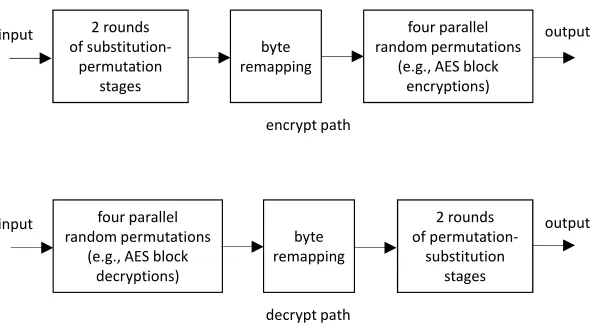
Figure 10: Overview of the encrypt and decrypt paths of theIVP construction
that such attacks are repeated again and again. One can see that the attacks performed by adversary M0 form a trace of queries to a permutation swapping construction D0 as defined in Lemma 2. The expected value E of the ratio of successful queries to D0 over all queries made needs to satisfy the inequalityE > Pf·2, due to the assumption about the existence of
the adversaryM0. On the other hand, the same expected value needs to satisfy the inequality E 6Pf ·2 due to the fact that Lemma 2 holds, which is not possible. Hence, Theorem 2 is
proven.
So far, we have been able to reduce the proofs which establish security in the input per-turbing and oracle replacing adversary models to showing that the constructions used areRO2
according to a chosen observer function, query budget and indistinguishability parameter. The implications from Theorems 1 and 2 is that no matter how the adversary corrupts the cipher text the probability that the patterns are visible in some plaintext can be bounded, if a con-struction isRO2. In what follows we discuss an example of a 512-bit construction, calledIVP, which is built from 128-bit block cipher building blocks and which is RO2 according to the observer function f4×16.
6
Example of a cryptographic construction supporting implicit
integrity
6.1 Construction overview
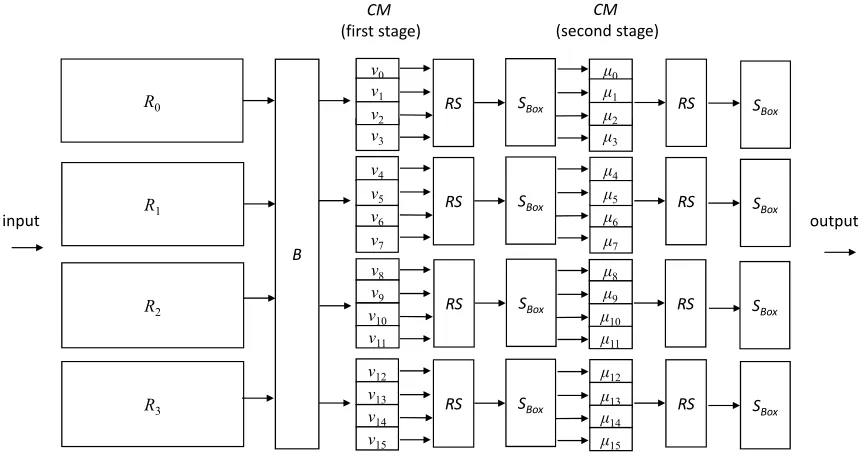
The cryptographic construction we discuss in this section, and which supports implicit integrity, calledIVP, is shown in Figures 10 and 11. Figure 10 provides an overview of the encrypt and decrypt paths of the construction, while Figure 11 provides a description of the stages involved in the decrypt path. TheIVPconstruction is a three level confusion diffusion network. It first employs two rounds of substitution and permutation stages followed by a byte remapping stage. The byte remapping stage prepares the inputs to four parallel random permutations, which provide an encryption result. On the decrypt path this order is reversed. The construction is 512-bit wide and its internal stages are defined for specific input and state lengths, which are discussed below.
of 128 bits. The purpose of the subsequent byte remapping stage is to change the order of bytes so that every 128-bit input, which is passed into the subsequent random permutations, contains bytes that depend on all 512 bits of the input. The random permutations of the construction can be realized using any block cipher which is 128-bit wide. For example, they can be realized as four independent AES block encryption stages. The preceding substitution and permutation stages can also be realized using AES round building blocks for convenience, as discussed later in this section.
The IVP construction, as we prove later, is indeed RO2 for the f4×16 pattern frequency
observer, the life time value ofB = 232queries and the indistinguishability parameter= 2.651
bits. For the sake of clarity, we remind that we are interested in theRO2behavior of the decrypt path of the construction, where the inputs are provided by an entity who has no knowledge of any keys used by the construction. So, the lifetime B = 232 is not the lifetime of a valid user of the construction but of an adversary (i.e., input perturbing or oracle replacing adversary) who attacks it.
6.2 On-line attacks and their implications
IVPsupports implicit integrity at a security level of 32 bits. Such security level is lower than the security levels supported by standard MAC algorithms (e.g., [4] [5]), which are typically at 256 or 512 bits. Still, 32-bit security is not insignificant in the context of on-line attacks. In on-line attacks, the detection of even a single corruption exposes the attack and the adversary. As the adversary can only corrupt data in their encrypted form, any subsequent read operation performed on corrupted data results in a plaintext with high entropy with very high probability, thus exposing the attack. For this reason, even a lower level of security, such as at 32 bits, may be quite effective in protecting some computing systems. Defense against on-line attacks at 32 bits of security also means that the probability of the adversary succeeding one and only time is 2−32+ for some . Moreover, a single corruption detection can cause re-encryption of all user data with new keys, thus mitigating the attack. On-line attacks are discussed in RFC 4086 [34].
In the context of on-line attacks, a lower bound on the number of queries issued by an adversary can be set. Within such bound (e.g., 232 queries) the block cipher stages employed safely approximate random functions. For example, if the output of an 128-bit random permu-tation is not truncated, then the advantage of distinguishing this random permupermu-tation from an 128-bit random function after 232queries are performed is still<2−20. Practically, this means that whereas bytes in the output of a random function are random and uniformly distributed, bytes in the output of a random permutation take every value from 0 to 255 with probability that differs from 2−8 by no more than a value ∆ = 2−20. In the analysis that follows we will either consider the output bytes of the ingredient random permutations as uniformly dis-tributed and statistically independent when the analysis is not impacted by the presence of a distinguishing advantage, or indeed associated with such advantage, which will be present in our proofs yet considered negligible. We will also be using the term ‘almost’ random, uniformly distributed and statistically independent to characterize bytes or words, when the statistical properties of bytes or words differ from the properties of random, uniformly distributed and statistically independent bytes or words by no more thanO(∆).
6.3 Construction stages
per-R0 R2 R1 R3 B CM (first stage) μ0 μ1 μ3 μ4 μ7 μ8 μ9 μ10 μ11 μ12 μ13 μ14 μ15 μ2 μ6 μ5 CM (second stage) RS RS RS RS SBox SBox SBox SBox
RS SBox
ν0 ν1 ν3 ν4 ν7 ν8 ν9 ν10 ν11 ν12 ν13 ν14 ν15 ν2 ν6
ν5 RS S
Box
RS SBox
RS SBox
output input
Figure 11: Description of the decrypt path of theIVPconstruction
mutations employedR0, . . . , R3 are four symmetric encryption/decryption stages. Each stage
applies on inputs of width W1. In the specific design we propose W1 = 128 bits and the
four random permutations of the figure can be realized AES encryption/decryption stages. Encryption/decryption is repeated four times, each for a separate 128-bit block of the input. Encryption/decryption uses a key value K, which is a vector of four concatenated encryption keys, one for each block, and, optionally, a tweak vectorT.
The stage B indicates an entity reordering operation. Entities are groups of W2 bits. In
this designW2 = 8 bits and this stage is a byte remapping operation. Entity reordering takes
place across the entire width of the construction which is 4·W1 bits. Entity reordering is an
interleaving operation that ensures that outputs of the four ingredient random permutations of the construction are evenly distributed among the subsequent processing stages. Such interleaving operation is further discussed below. Two subsequent stages denoted as ‘CM’ perform AES-like bit linear processing on their inputs, which we refer to as ‘column mixing’. In one realization theCM stages may implement the inverse mix columns or the mix columns transformation of AES. In general, the requirement for each CM stage is to implement bit linear systems that connectm W2-bit input entities tom W2-bit output entities using an MDS
matrix. The rank of each bit linear system for each output entity should be exactly W2. It
is easy to see that the AES mix columns and inverse mix columns transformations meet this requirement form= 4 andW2 = 8 bits. For the proofs discussed below we require thatm= 4.
In the figure there are 16 first stageCM transformations denoted asν0, . . . , ν15 and 16 second
stage CM transformations denoted as µ0, . . . , µ15.
The subsequent ‘RS’ stages indicate a ‘Row Shifting’ operation which is an entity reordering operation similar toB. Row shifting occurs only insideW1bit blocks and not across such blocks
as in the case ofB.RS stages operate on entities ofW2 bits and perform cyclic rotation of such
entities by increasing the number of rotate positions one at a time row-by-row. As in AES, it is assumed thatW2 bit entities are arranged in a matrix formation. In this formation rows are
8 bits
byte remapping in the construction …
… …
byte reordering
Figure 12: Byte remapping in theIVP construction
2 by two entity positions to the left etc. In one realization RS stages implement the inverse shift rows or the shift rows transformation of AES.
Sbox stands for substitution box. Substitution occurs in the granularity of W2 bits as
in the case of the CM and RS stages. Each Sbox stage in the figure is an array of multiple substitution boxes of width W2 bits. A substitution box is a randomly chosen 8-bit
Pseudo-Random Permutation (PRP) which can be realized in many ways, such as by combining key additions with strong non-linear bit mixing operations. In one realization the key values used by these PRPs are set at the beginning of the operation of the IVP construction. This is equivalent to selecting a set of W2-bit PRPs at random in the beginning of operation and
using these PRPs as substitution boxes. It is under these considerations that we have proven specific security claims for theIVPconstruction, which we discuss in this section. Since we can select PRPs once at the beginning of operation of the construction, this means that we can have a single key set for theSbox stages, which is independent of the keys used by the block ciphers that implement the random permutations R0, . . . , R3.
The entity reordering operation B of the IVPconstruction is further illustrated in Figure 12 for the case where W2 = 8 bits (byte remapping). Here, each byte is reordered to a new
position so that all bytes coming from the same 128-bit block output are evenly distributed to all 128-bit block inputs of a next stage. For instance, regarding the outputs coming from a first random permutation R0, a first byte is mapped to a first position in a next block. A
second byte is mapped to a fourth position. A third byte to an eighth position, and so on. Similarly, concerning the outputs coming from a second random permutation R1, a first byte
is mapped to a second position. A second byte is mapped to a fifth position. A third byte is mapped to a ninth position, and so on.
To derive our byte remapping scheme we considered all possible ways to place 8 bits coming from the output of an ingredient random permutation into a 32-bit entity. This number which is equal to 328
= 0
= 0+ 0 , 0≠ 0
= 0+ 00| 01,
00≠ 0, 01= 0 original
word
covered word
uncovered word
potentially exhibiting patterns
patterns are not present
partially covered word
(single covered byte) = 0+ 0 , 0= 0
Figure 13: Covered, uncovered and partially covered words
the input output relationship. As stated earlier, it is desirable for the rank of the system characterizing the derivation of each output byte to be exactly equal to W2 = 8 bits. For
the four output bytes we would like to have a cumulative rank equal to 32 bits. From the 10,518,300 choices 158,382 choices have so, including the choice of Figure 12.
6.4 Covered, uncovered and partially covered words
To prove that the IVP construction is RO2 we first demonstrate that the flow of differentials characterizing this construction is associated with values that are almost random, uniformly distributed and statistically independent, where the term almost random, uniformly distributed and statistically independent is defined in Section 6.2. For this purpose we introduce the concept of covered, uncovered and partially covered words and bytes shown in Figure 13. A wordw0 in the output is covered,w0 ∈C(W), if the differentialp0 which is superimposed on
its statex0as a result of some input perturbation is (i) non-zero, (ii) almost random, uniformly
distributed, and (iii) almost statistically independent from other word differentials. A word w0 is uncovered w0 ∈U(W), if the differential p0 superimposed on its state x0 as a result of
some input perturbation is zero (e.g., the word may be exhibiting patterns).
Similarly, a byte b0 in the output is covered, b0 ∈ C(B), if the differential p0 which
is superimposed on its state x0 as a result of some input perturbation is (i) non-zero, (ii)
almost random, uniformly distributed, and (iii) almsot statistically independent from other byte differentials. A byteb0 is uncoveredb0∈U(B), if the differentialp0 superimposed on its
statex0 as a result of some input perturbation is zero. Finally, a wordw0 is partially covered
w0∈P(W) if the differentialp0 superimposed on its statex0 causes one byte to be uncovered
and the other byte to be covered.
ingredient random permutations
R0, R1,…
reordering bit linear
processing
8-bit PRPs
non-zero perturbation bytes are almost random, uniformly distributed,
statistically independent
non-zero perturbation bytes remain almost random, uniformly distributed,
and statistically dependent non-zero perturbation
bytes are almost random, uniformly
distributed, but not statistically
independent
non-zero perturbation bytes are again almost random, uniformly
distributed, statistically independent
…
Figure 14: Statistical properties of differentials associated with ingredient random permutation outputs
states for bytes and can be established by observing that the ingredient random permutations are the sole source of non-zero byte differentials. Any subsequent processing involves only: (i) re-ordering operations at the byte granularity; (ii) full-rank bit-linear processing; and (iii) 8-bit PRPs. Based on this fact, byte differentials remain almost random, uniformly distributed and statistically independent as they flow through the IVP construction, as shown in Figure 14. First, at the output of the ingredient random permutation stages, non-zero byte differentials are almost random, uniformly distributed and statistically independent based on the indistin-guishability of the ingredient random permutations from random functions and the life time limitationB = 232.
After the bit linear preprocessing stage, non-zero byte differentials are still almost random, uniformly distributed, but not necessarily statistically independent as each output byte is a linear combination of input bytes. After the byte remapping stage, non-zero byte differentials remain almost random, uniformly distributed, and possibly statistically dependent. It is in the last stage, and due to the fact that 8-bit PRPs are independently chosen at random, that non-zero byte differentials become again almost random, uniformly distributed and statistically independent. Furthermore, these properties of byte differentials do not change if additional diffusion stages or similar processing steps are added to the construction.
6.5 The state of column mixing transformations
The stateS(µ0) of a 4 byte column mixing transformationµ0 can only be any of the following
three of Figure 15: (i) zero stateS(µ0) =Szero. In this state all differential inputsa0, . . . , a3 to
the transformationµ0 are equal to zero: ai = 0∀i∈[0,3]. Furthermore all output differentials
are zero too; (ii) single byte stimulus state S(µ0) = Sstim. In this state only one of the
input byte differentials is non-zero and all other byte differentials are zero: ∃i∈[0,3] :ai 6=
0 ∧ (∀j, j6=i, j∈[0,3], aj = 0). Since the column mixing transformation matrix is MDS, all
output byte differentials are non-zero; and (iii) saturation stateS(µ0) =Ssatwhere more than
one of the input byte differentials is non-zero: ∃q0, . . . , qm−1 ∈[0,3] : 1< m64∧aqi 6= 0∀i∈ [0, m−1]. Since the transformation µ0 is bit linear of full rank, the following four possible