Good Quality Color image Compression using
Multi-level BTC and DWT Technique
Varsha Udde
1, Prof. Amrita Khera
2Research Scholar, Department of Electronics and Communication, Trinity Institute of Technology & Research,
Bhopal, India 1
Assistant Professor, Department of Electronics and Communication, Trinity Institute of Technology & Research,
Bhopal, India 2
ABSTRACT:-In the present time of media, the prerequisite of picture/video stockpiling and transmission for video conferencing, picture and video recovery, video playback, and so forth are expanding exponentially. As a result, the need for better compression technology is always in demand. Modern applications, in addition to high compression ratio, also demand for efficient encoding and decoding processes, so that computational constraint of many real-time applications is satisfied.Two widely used spatial domain compression techniques are discrete wavelet transform and multi-level block truncation coding (BTC). DWT method is used to stationary and non-stationary images and applied to all average pixel value of image. Muli-level BTC is a type of lossy image compression technique for greyscale images. It isolates the first pictures into squares and after that utilizes a quantizer to lessen the quantity of dark dimensions in each square while keeping up a similar mean and standard deviation. In this paper is simulated of Multi-level BTCand DWT technique for for gray and color image.
KEYWORDS: Discrete Wavelet Transform, Multi-level, Block Truncation Code (BTC), PSNR MSE, Compression Ratio
I. INTRODUCTION
The rising sight and sound innovation and development of GUI based programming have made computerized picture information an inalienable piece of present day life. At the point when a 2-D light power work is examined and quantized to make an advanced picture, the measure of information created might be expansive in volume that it results in gigantic capacity, preparing and correspondence necessities. In this manner, the hypothesis of information pressure turns out to be increasingly more vital for diminishing the information repetition to spare more equipment space and transmission transfer speed.
In software engineering and data hypothesis, information pressure is the way toward encoding data utilizing less number of bits or some other data bearing units. Pressure is valuable as it diminishes the utilization of costly assets, for example, hard plate space or transmission transfer speed [1] [2]. BTC is a basic and quick lossy pressure method for dark scale pictures. The fundamental thought of BTC [3] is to perform minute protecting quantization for squares of pixels. The info picture is partitioned into non-covering squares of pixels of sizes 4×4, 8×8, etc. Mean and standard deviation of the squares are determined. Mean is considered as the edge and reproduction esteems are resolved utilizing mean and standard deviation.
staircase impacts or tattered state close to the edges. Because of its straightforwardness and simple execution, BTC has increased wide enthusiasm for its further improvement and application for picture pressure.
To enhance the nature of the remade picture and for the better pressure effectiveness a few variations of BTC have been created amid the last numerous years. Outright Moment Block Truncation Coding (AMBTC) [4] jam the higher mean and lower mean of each square and utilize this amount to quantize yield. AMBTC gives preferable picture quality over picture pressure utilizing BTC. In addition, the AMBTC is very quicker contrasted with BTC. The calculation is computationally quicker in light of the fact that it includes basic diagnostic formulae to process the parameters of the edge highlight in a picture square. Remade pictures are of good quality as per human perceptual experience. The calculation speaks to the picture as far as its twofold edge delineate, data, and the force data on the two sides of the edges.
II. IMAGE COMPRESSION
The HSI compression techniques are categorized into two types, such as, Lossy compression
Lossless compression
In the lossless compression, the resultant image from the decompression process is similar to the original image, whereas in the lossy compression, due to the loss of data during the decompression process, the resultant image from the decompression is not exactly similar to the original image. As the lossless compression techniques prevent the loss of data and consumes low bit rate, it is widely used in the artificial images.
In compression technique, accuracy is vital in compression and decompression. In lossless compression, there occurs a possibility of data/information loss but the compression should be under the limit of tolerance. This type of compression is used for transmitting, sharing, or storing multimedia data, where some loss of data or image is permitted. JPEG is an example of lossy processing methods and when the receiver is human eye, lossy data is allowed, because human eye can tolerate some defectiveness in data/information. When compared to the lossless compression techniques, the lossy compression techniques provide higher compression rate.
III. METHODOLOGY
Discrete Wavelet Transform
Wavelets are signals which are nearby in time and scale and for the most part have a sporadic shape. A wavelet is a waveform of successfully restricted span that has a normal estimation of zero. The term 'wavelet' originates from the way that they incorporate to zero; they wave all over the pivot. Numerous wavelets likewise show a property perfect for smaller flag portrayal: symmetry. This property guarantees that information isn't over spoken to. A flag can be disintegrated into many moved and scaled portrayals of the first mother wavelet. A wavelet change can be utilized to break down a flag into part wavelets. When this is done the coefficients of the wavelets can be pulverized to evacuate a portion of the subtleties. Wavelets have the extraordinary favorable position of having the capacity to isolate the fine subtleties in a flag. Small wavelets can be utilized to separate fine subtleties in a flag, while expansive wavelets can distinguish coarse subtleties. Also, there are a wide range of wavelets to browse.Various types of wavelets are: Morlet, Daubechies, etc. [6].
Fig.1: The structure of the wavelet transform based compression.
The steps of compression algorithm based on DWT are described below:
I. Decompose Choose a wavelet; choose a level N. Compute the wavelet. Decompose the signals at level N. II. Threshold detail coefficients For each level from 1 to N, a threshold is selected and hard thresholding is applied
to the detail coefficients.
III. Reconstruct Compute wavelet reconstruction using the original approximation coefficients of level N and the modified detail coefficients of levels from 1 to N.
Multi-level Block Truncation Code
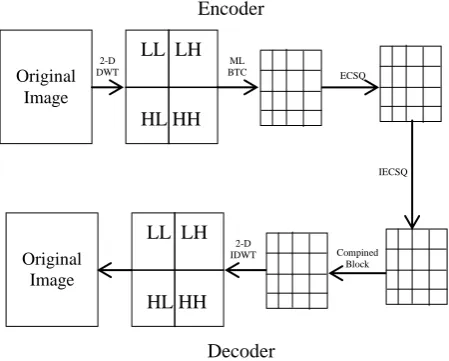
The Encoder and decoder block of the multi-level block truncation code algorithm is shown if figure 2. Encoder part of the proposed algorithm shows that the original image is divided into three parts i.e. R component, G component and B component. Each R, G, B component of the image is divided into non overlapping block of equal size and threshold value for each block size is being calculated.
Threshold value means the average of the maximum value (max) of ‘k × k’ pixels block, minimum value (min) of ‘k × k’ pixels block and
m
1 is the mean value of ‘k × k’ pixels block. Where k represents block size of the color image. So threshold value is:(1)
Each threshold value is passing through the quantization block. Quantization is the process of mapping a set of input fractional values to a whole number. Suppose the fractional value is less than 0.5, then the quantization is replaced by previous whole number and if the fractional value is greater than 0.5, then the quantization is replaced by next whole number.
Fig. 2: Block Diagram of Proposed Algorithm
3
min
max
m
1Each quantization value is passing through the bit map block. Bit map means each block is represented by ‘0’ and ‘1’ bit map. If the Threshold value is less than or equal to the input image value then the pixel value of the image is represent by ‘0’ and if the threshold value is greater than the input image value then the pixel value of the image is represented by ‘1’.
Bit map is directly connected to the high and low component of the proposed decoder multi-level BTC algorithm. High (H) and low (L) component is directly connected to the bit map, bitmap converted the ‘1’ and ‘0’ pixel value to high and low pixel value and arrange the entire block.
(2)
(3)
Wirepresent the input color image block, q is the number of zeros in the bit plane, p is the number of ones in the bit
plane. In the combine block of decoder, the values obtained from the pattern fitting block of individual R, G,B components are combined after that all the individual combined block are merged into a single block . Finally compressed image and all the parameter relative to that image will be obtained.
Error-compensated scalar quantization
The application of ICDF in the TDDC-based coding aims at a better interpolation and a lower compression cost. However, when the compression happens, the interpolation efficiency as well as the coding efficiency will be limited by the distortion occurring on those filtered pixels (denoted as ~x) that will be used for interpolation. To solve this problem, we purpose to reduce the sum of square error (SSE) distortion of ~x as much as possible via controlling the quantization error of the transformed macro-block based on an error-compensated scalar quantization (ECSQ).
IV. PROPOSED METHODOLOGY
Transmission and capacity of crude pictures require enormous amount of circle space. Henceforth, there is an earnest need to decrease the extent of picture before sending or putting away.
Fig. 3: Proposed Methodology
T
W
W
q
L
p i i i
11
T
W
W
p
H
p i i i
11
Encoder IECSQ Original Image 2-D IDWTLL LH
HL HH Compined Block 2-D DWT Original Image ML BTC
LL LH
HL HH
ECSQ
The most ideal answer for the issue is to utilize pressure techniques where the pressure of information on advanced pictures are made to diminish insignificance and repetition of the picture information to have the capacity to proficiently store or transmit information. A large portion of the current pressure systems utilized have their negatives and an improved method which is quicker, successful and memory productive can fulfill the prerequisites of the client. Picture pressure flourishes to store or transmit the information in a capable mode just as to offer a best picture quality at a predetermined piece rate. Picture pressure should be possible in lossy or lossless mode. Lossless pressure is favored for recorded targets and principally utilized in therapeutic imaging, specialized illustrations, cut craftsmanship, or funnies. This is because of the presentation of pressure ancient rarities, low piece rates and furthermore in light of the fact that the assets can't be impressively spared by utilizing picture pressure technique. Lossy techniques are particularly appropriate for characteristic pictures, for example, photos in applications where unimportant loss of loyalty is middle of the road to achieve an impressive decrease in bit rate. Here assuaged resulting picture quality without much observation by the watcher is accomplished.
V. SIMULATION RESULT
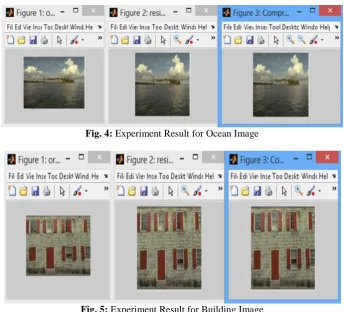
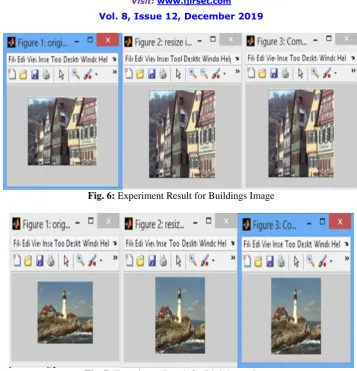
Shows the building, buildings, sailing, ocean and light house images are implemented MATLAB tool. All the images are divided into three part i.e. original image, resize image and compressed image.
Fig. 4: Experiment Result for Ocean Image
Fig. 6: Experiment Result for Buildings Image
Fig. 7: Experiment Result for Lighthouse Image
Table I: Experimental Results for Different Types of Image
Images MSE PSNR (dB) Computation Time Horse 1.5842 52.1879 2.2328
Airplane 4.1678 47.9912 2.7117
Flowers 7.5960 45.3797 3.1563
Peppers 3.4187 48.8478 2.9649
Table II: Comparison Result
Images Shuyuan Zhu
et al. [1]
Proposed
Algorithm
PSNR (dB) PSNR (dB)
Horse 35.0 52.1879
Airplane 35.0 47.9912
Flowers 37.0 45.3797
Peppers 31.5 48.8478
Parrot 38.00 50.2913
VI. CONCLUSION
Such method is suitable in situations where image or image is compressed once but decoded frequently. It is clear that the decoding time due to spatial domain based compression is much less than that of the sub-band compression techniques. In his paper the study of discrete wavelet transform, mult-level block truncation code and error-compensated scalar quantization technique.Further work of this paper is to implement proposed algorithm in MATLAB software and compare result in base paper.
REFERENCES
[1] Shuyuan Zhu, Zhiying He, XiandongMeng, Jiantao Zhou and Bing Zeng, “Compression-dependent Transform Domain Downward Conversion for Block-based Image Coding”, IEEE Transactions on Image Processing, Volume: 27, Issue: 6, June 2018.
[2] Shih-Lun Chen and Guei-Shian Wu, “A Cost and Power Efficient Image Compressor VLSI Design with Fuzzy Decision and Block Partition for Wireless Sensor Networks”, IEEE Sensors Journal, Volume: 17, Issue: 15, Aug.1, 1 2017.
[3] Sunwoong Kim and Hyuk-Jae Lee, “RGBW Image Compression by Low-Complexity Adaptive Multi-Level Block Truncation Coding”, IEEE Transactions on Consumer Electronics, Vol. 62, No. 4, November 2016.
[4] C. Senthilkumar, “Color and Multispectral Image Compression using Enhanced Block Truncation Coding [E-BTC] Scheme”, accepted to be presented at the IEEE WiSPNET, PP. 01-06, 2016 IEEE.
[5] Jing-Ming Guo, Senior Member, IEEE, and Yun-Fu Liu, Member, IEEE, “Improved Block Truncation Coding Using Optimized Dot Diffusion”, IEEE Transactions on Image Processing, Vol. 23, No. 3, March 2014.
[6] Jayamol Mathews, Madhu S. Nair, “Modified BTC Algorithm for Gray Scale Images using max-min Quantizer”, 978-1-4673-5090-7/13/$31.00 ©2013 IEEE.
[7] M. Brunig and W. Niehsen. Fast full search block matching. IEEE Transactions on Circuits and Systems for Video Technology, 11:241 – 247, 2001.
[8] K. W. Chan and K. L. Chan. Optimisation of multi-level block truncation coding. Signal Processing: Image Communication, 16:445 – 459, 2001.
[9] Ki-Won Oh and Kang-Sun Choi, “Parallel Implementation of Hybrid Vector Quantizerbased Block Truncation Coding for Mobile Display Stream Compression”, IEEE ISCE 2014 1569954165.
[10] Seddeq E. Ghrare and Ahmed R. Khobaiz, “Digital Image Compression using Block Truncation Coding and Walsh Hadamard Transform Hybrid Technique”, 2014 IEEE 2014 International Conference on Computer, Communication, and Control Technology (I4CT 2014), September 2 - 4, 2014 - Langkawi, Kedah, Malaysia.