Bin Wang, Xiaozhuo Gu?, and Yingshan Yang
SKLOIS, Institute of Information Engineering, CAS, Beijing, China
School of Cyber Security, University of Chinese Academy of Sciences, Beijing, China [email protected], {guxiaozhuo, yangyingshan}@iie.ac.cn
Abstract. Saber, a CCA-secure lattice-based post-quantum key encap-sulation scheme, is one of the second round candidate algorithms in the post-quantum cryptography standardization process of the US National Institute of Standards and Technology (NIST) in 2019. In this work, we provide an efficient implementation of Saber on ESP32, an embedded microcontroller designed for IoT environment with WiFi and Bluetooth support. RSA coprocessor was used to speed up the polynomial multipli-cations for Kyber variant in a CHES 2019 paper. We propose an improved implementation utilizing the big integer coprocessor for the polynomial multiplications in Saber, which contains significant lower software over-head and takes a better advantage of the big integer coprocessor on ESP32. By using the fast implementation of polynomial multiplications, our single-core version implementation of Saber takes 1639K, 2123K, 2193K clock cycles on ESP32 for key generation, encapsulation and de-capsulation respectively. Benefiting from the dual core feature on ESP32, we speed up the implementation of Saber by rearranging the computing steps and assigning proper tasks to two cores executing in parallel. Our dual-core version implementation takes 1176K, 1625K, 1514K clock cy-cles for key generation, encapsulation and decapsulation respectively.
Keywords: Post-quantum cryptography · Efficient implementation · Saber·ESP32.
1
Introduction
Post-quantum cryptography has been widely developed in recent years since the public key cryptographic primitives based on traditional hard problems such as factoring or discrete logarithms are under the threat of quantum computers [28] [25]. With the goal of accelerating the research and standardization of post-quantum cryptography algorithms, the US National Institute of Standards and Technology (NIST) has initiated a process to solicit, evaluate, and standardize one or more quantum-resistant public-key cryptographic algorithms [1].
In the NIST standardization process [2], a large number of encryption sche-mes against quantum attacks have been proposed, most of which are based on ?Corresponding author: [email protected]. This work has been supported by
the hard problems over lattices. Frodo [13], NewHope [11], Kyber [14] and Saber [16] have entered the second round of candidate processes of NIST.
ESP32, belongs to ESP series, is an embedded microcontroller, which sup-ports WiFi and Bluetooth. And it is widely used in IoT devices. As of 2017, the shipments of ESP have reached 100-Million [4]. The report from TSR in 2018 showed ESP became a leader in the MCU Embedded WiFi chip mar-ket sector [3]. In this work, we choose ESP32 chip to implement the chosen ciphertext attack (CCA) resistant lattice-based key encapsulation mechanism (KEM) Saber [16] which has entered the second round of NIST’s standardiza-tion process [9]. We make full use of the advantages of the big integer copro-cessor and dual core features on ESP32 to provide efficient implementation of Saber. Our implementation mainly focuses on high performance. To the best of our knowledge, this is the first published optimized implementation of post-quantum KEM on ESP32. The source code in this paper is available inhttps: //github.com/SABERONESP32/SABERONESP32.
Contribution
1 Polynomial multiplication is a very time-consuming operation in Saber. The parameters of Saber with modulus 8192 and 1024 prevent the use of the most efficient polynomial multiplication method Number Theoretic Trans-form (NTT) withO(nlogn) complexity. RSA coprocessor was used to speed up the polynomial multiplication for Kyber [14] variant in [10]. In this work, we exploit the ability of the big integer coprocessor on ESP32 to speed up the polynomial multiplication based on the Kronecker substitution [18] which was used in [10]. We adapt the Kronecker substitution to the feature of our coprocessor and provide efficient implementations for polynomial multiplica-tions with 13-bit and 10-bit coefficients respectively in Saber, which contains a significant lower software overhead and takes a better advantage of the big integer coprocessor on ESP32. We lower the polynomial degree by using the Karatsuba [21] and Toom-Cook [12] algorithms before Kronecker substitu-tion to overcome the limitasubstitu-tion of the supported bit length of our big integer coprocessor. Also we rearrange the steps of Karatsuba and Toom-Cook algo-rithm and assign software computing operations to CPU during its idle time using several reasonable strategies. Our fast implementation for 256 degree polynomial multiplication takes 97K, 85K clock cycles for moduli 8192 and 1024 respectively, and competes with the NTT-based polynomial multipli-cations which takes 244K clock cycles for the same degree with modulus 7681 on our platform. Based on the efficient implementation of polynomial multiplication, our optimized implementation of Saber takes 1639K, 2123K, 2193K clock cycles on ESP32 for key generation, encapsulation and decap-sulation respectively.
cores based on hardware level instructions rearrangement, we hand-partition the CCA secure functions into small steps and rearrange them. We start the execution in main core and assign proper computing task to another core based on the computing tasks assigning api provided by FreeRTOS. More-over, since the computing inputs of a step on one core may depend on the results of step execution on another core, we use the semaphore mechanism provided by FreeRTOS to make two cores execute steps of Saber algorithm in our expected order. As a result of executing Saber on two cores in pa-rallel, we can reduce the 462K, 498K, 679K clock cycles for key generation, encapsulation and decapsulation respectively.
Organization. In Section2, we briefly describe the Saber KEM scheme, the al-gorithms for polynomial multiplication, and our target platform. In Section3, we introduce the Kronecker substitution algorithm and provide the implementation for it utilizing big integer coprocessor. Next, we provide our optimized imple-mentations for polynomial multiplications and Saber in detail. Performance of our implementations and the comparisons are provided in Section 5. And the conclusion is described in final section.
2
Background
2.1 Notation
LetZq be the ring of integers with a modulus ofq.Rq =Zq[x]/(xn+ 1) denotes the ring of integer polynomials modulo (xn+ 1) , where nis a power of 2 and each coefficient of the ring is in [0, q). The ring of m×n-matrices over R is referred asRm×n.
The floor functionbxcrepresents the largest integer that is not greater than x, and the ceiling functiondxerepresents the smallest integer that is not less thanx. Moreover,bxerepresents the nearest integer to x.
We use upper case letters to represent big integer (or “large number”), use bold lower case letters to represent vectors, and use bold upper case letters to represent matrices. For a polynomialf, we writefi for theithcoefficient ofxi.
2.2 Saber
Parameters. The standard version of Saber KEM which achieves around 180-bit of quantum-security uses matrix or vector dimensionl= 3 and ring-dimension n= 256. The two modulipandqof multiplications are 210and 213respectively. The binomial error distribution uses the parameter ofµ= 8.
CPA secure Saber KEM. The Algorithm 5, Algorithm 6 and Algorithm7
in the appendix demonstrate the CPA secure key generation, encryption and decryption algorithms used in Saber, respectively. TheKeyGenfunction expands the random seed into the pseudorandom matrix Aand is instantiated by using the extendable output function SHAKE-128.
CCA secure Saber KEM. The Algorithm8and Algorithm9in the appendix demonstrate the encapsulation and decapsulation operations used in the Saber KEM, respectively. The hash functionsGandHare implemented usingSHA3-512
andSHA3-256respectively. In the following, we writeGen,EncandDecfor CCA secure key generation, encapsulation and decapsulation respectively.
The performance of implementing Saber depends highly on the speed of the polynomial multiplication and the generation ofAands. Here, the degree of the polynomials in Saber is 256 and the polynomial multiplication has two forms. One is matrix-vector multiplication. The matrix is composed of 3 by 3 polynomi-als, each having 256 13-bit coefficients. Another is vector-vector multiplication, where the coefficients are 10 bits.
2.3 Polynomial multiplication
Polynomial multiplication is a very time-consuming operation. In many imple-mentations of post-quantum cryptographic schemes involving polynomial multi-plication, number theoretic transform (NTT) is used for acceleration. However, NTT has certain limitations on the modulus. In Saber, the chosen modulus is not a prime number, so NTT-based polynomial multiplication cannot be used. The following multiplication algorithms are used in our implementation.
Toom-Cook. The Toom-Cook algorithm is a generalization of Karatsuba al-gorithm. The implementation described by Knuth achieves the time complexity O(n·2
√
2lgn·lgn) [23]. It splits each polynomial intowparts, each of which has n/w coefficients, so it is calledw-way Toom-Cook multiplication. Following the implementations in [16] and [22], we mainly use four-way Toom-Cook multipli-cation shown in Algorithm 12 in the appendix, referred to as Toom-Cook4. It also contains three phases: splitting, evaluation and interpolation. The process is similar to Karatsuba. For Toom-Cook4, it splits the polynomialA(x) into four parts, i.e. A(y) =A3·y3+A2·y2+A1·y+A0 where y =xn/4, and compu-tes its results at points y ={0,±1,±1
2,2,∞} as recommended in [12]. At last, combining these intermediate results yields the final polynomials.
2.4 Platform
ESP32 is an embedded microcontroller belongs to ESP Series by espressif [6]. Low price, low power consumption and built-in WiFi features (and Bluetooth on some chips) of this series of chips make it is widely used in commercial smart home products. The shipments of ESP have reached 100-Million[4] as of 2017. And the report from TSR in 2018 showed ESP became a leader in the MCU Embedded WiFi chip market sector [3]. ESP32 is based on two Harvard Architecture Xtensa LX6 CPUs running at 240MHz. There are 448 KB internal ROM and 520 KB internal SRAM on the chip. Also ESP32 has built-in both WiFi and Bluetooth support. There are development kits for audio recognition, face recognition, and applications that support Apple HomeKit provided for ESP32. In addition, ESP32 is equipped with several encryption coprocessors such as a True Random Number Generator (TRNG), a big integer coprocessor (for RSA and ECC acceleration), a SHA-2 coprocessor and an AES coprocessor. ESP32 also includes security features of secure boot and flash encryption.
As an embedded microcontroller designed for IoT environment, these copro-cessors and security features built in ESP32 make it a good choice to implement post-quantum cryptographic schemes which will give it a wider prospect for security applications. In this work, we provide an efficient implementation of Saber which is a lattice-based post-quantum KEM on this device. And our main target is high speed. We consider reusing the big integer coprocessor (for RSA and ECC) to accelerate the polynomial multiplications in Saber, and schedu-ling the coprocessor and two CPU cores running in parallel to achieve a better performance.
3
Kronecker substitution
3.1 KS1 and KS2
big integer arithmetic by packing a coefficient into an integer. For example, when multiplying two polynomials f(x) = 2x+ 1 with g(x) = 3x+ 2 in Z[x], we compute the polynomials at pointx= 100, i.e.f(100) = 200 + 1 = 201 and g(100) = 300 + 2 = 302, then multiply 201·302 = 60702. Corresponding to the polynomial coefficients, we can get the final polynomial multiplication result as 6x2+ 7x+ 2. The process of converting a polynomial to an integer is called “packing”. Conversely, the process of converting an integer to a polynomial is called “unpacking”.
We call the standard Kronecker substitution as KS1. For two polynomialsf and g of degrees m and n respectively, where 0 ≤fi, gi < 2c for all i, the bit length of the big integers converted by KS1 needs to beb= 2c+dlg(min(m, n))e. In [18], David Harvey presented negated Kronecker substitution algorithm called KS2 which halves the bit length of the big integer at the cost of increasing the number of multiplications. For two polynomials f andg of degrees m and n, respectively, where 0≤fi, gi <2c for alli, the bit length of the big integers converted by KS2 needs to beb=c+1
2dlg(min(m, n))e.
Different from KS1, KS2 needs to select two negated evaluation points (2b,−2b) for multiplication, that is, perform two integer multiplications to obtain two re-sults. The results are added to obtain the even coefficients of the final polynomial, and the results are subtracted to obtain odd coefficients.
KS1 and KS2 contain two versions of unsigned version as described above and signed version. The signed version is used for polynomial multiplications with signed coefficients. In Saber we need to perform 256 degree polynomial multiplication inZq, hence in this work, we only focus on the unsigned version of Kronecker substitution for performing two polynomials with the same degree. For KS3 and KS4 which were also presented in [18], implementing these two algorithms can further shorten the bit length of multiplications required at the cost of more complicated packing and unpacking operations. However, based on our implementation results of KS2 algorithm, the packing and unpacking routines already take time comparable to the multiplications by hardware big integer coprocessor. Hence we did not consider using KS3 and KS4 algorithms in this work.
We regard a polynomial f ∈ Z[x] with degree n, and f = Pn−1
i=0 fixi. We define KSPACK shown in Algorithm 1 and KSUNPACK shown in Algorithm 2 for packing and unpacking operations in Kronecker substitution.
We defineKS1MUL shown in Algorithm 3 andKS2MUL shown in Algorithm4
to compute the product of two polynomials with the same degree using KS1 and KS2 algorithm respectively. In the following description, we writeKS1MUL(n,b) and KS2MUL(n,b) simply for KS1MUL(f,g,n,b) and KS2MUL(f,g,n,b) respectively, since thenandbare the primary parameters. And we writeKSMULas a general name forKS1MULandKS2MULwhen we does not specify which algorithm to use.
3.2 Utilizing the big integer coprocessor
Algorithm 1: KSPACK(f, n, b, sign) Input:polynomialsf∈Z[x]
Input:degreenoff
Input:bit lengthbof evaluate point
Input:signsign∈ {+1,−1}of evaluate point
Output: big integerX
1 X←0
2 fori= 0,1, . . . , n−1do 3 X←X+fi×(sign×2b)i
4 returnX;
Algorithm 2: KSUNPACK(X, n, b) Input:big integerX
Input:degreenof output polynomial
Input:bit lengthbof output polynomial coefficients
Output:polynomialf
1 fori= 0,1, . . . , n−1do 2 fi←X mod 2b
3 X←X / 2b
4 returnf
Algorithm 3: KS1MUL(f, g, n, b)
Input:polynomialsf, g∈Z[x]with same degree
Input:degreenoff, ganddegree(f) =degree(g)=n
Input:bit lengthbof evaluate point (bit length of packing one coefficient)
Output: the producth=f g
1 X←KSPACK(f, n, b,+1)
2 Y ←KSPACK(g, n, b,+1)
3 Z←X×Y // big integer multiplication
4 h←KSUNPCK(Z,2n-1,b)
5 returnh
three sets of 128 registers in 32 bits for storing two inputs and one output and supports fixed bit length operations. For modular multiplication and modular exponentiation, it supports operand bit length ofN ∈ {512; 1024; 1536; 2048; 2560; 3072; 3584; 4096}; and for multiplication, the supported bit length isN ∈ { 512; 1024; 1536; 2048} since the bit length of output is twice of the inputs.
The bit length of packing is crucial for implementing polynomial multipli-cation using KS1MUL and KS2MUL. For two polynomials f and g of the same degreen, withfi, gi∈[0,2c), the minimum bit lengthbto pack one coefficient is 2c+dlg(n)eforKS1MUL, andc+d1
Algorithm 4: KS2MUL(f,g,n,b)
Input:polynomialsf, g∈Z[x]with same degree
Input:degreenoff, ganddegree(f) =degree(g)=n
Input:bit lengthbof evaluate point (bit length of packing one coefficient)
Output: the producth=f g
1 X+←KSPACK(f, n, b,+1) 2 X−←KSPACK(f, n, b,−1) 3 Y+←KSPACK(g, n, b,+1) 4 Y−←KSPACK(g, n, b,−1)
5 Z+←X+×Y+ // big integer multiplication
6 Z−←X−×Y− // big integer multiplication
7 Z0←12 ×(Z++Z−) 8 Z1←12 ×21b(Z+−Z−)
9 h0←KSUNPACK(Z0,d2n2−1e,2b) 10 h1←KSUNPACK(Z1,b2n2−1c,2b) 11 h←h0(x2) +xh1(x2)
12 returnh
We pack one 13-bit coefficient into 32 bits and pack 64-degree polynomial into 64*32=2048 bits big integer and utilize the big integer coprocessor for computa-tion. Also, the packing and unpacking are efficient since the registers of the cop-rocessor is exactly of 32 bits where no shifting operations required. ForKS2MUL, since the KS2 algorithm can halve the number of bits that need to be packed, two times of 2048 bits big integer multiplication can be used to compute 64-degree 29-bit coefficients polynomial multiplication (wherec= 29, b=c+12lg(64) = 32 and 32∗64 = 2048) and 1536 bits to compute 64 degree 21-bit coefficients poly-nomial multiplication (wherec= 21, b=c+12lg(64) = 24 and 24∗64 = 1536).
4
Implementation
4.1 Polynomial multiplication using Kronecker substitution
In Saber, we need to compute 256-degree polynomial multiplications with 13-bit and 10-bit coefficients. We consider utilizing the big integer coprocessor based on Kronecker substitution for speeding up these operations.
bit length is 8704/2/2/2=1088. Considering the coprocessor is capable of mul-tiplication of{512; 1024; 1536; 2048}bits, here 1536 is suitable. To reduce the overhead caused by a large amount of unaligned shifting operations for packing 34 bits, we consider packing the coefficients into 40 bits (byte aligned). And multiplying the 1536 bits is still sufficient as 40*256/2/2/2=1280. We use the mbedtls library [5] which is built in ESP32 software development kit (SDK) to perform big integer addition and shifting operations by CPU, and perform big integer multiplication by coprocessor. As a result, the software-based big integer addition and shifting operations are much less efficient than the hardware-based multiplication, and the entire process requires a total of 1180K clock cycles.
Table 1: Performance of KS1MULandKS2MUL
Implementationa Degree Coefficient(bits) Packing(bits) Cycles
KS1MULb 64 13 32 10,310
KS2MULc 64 16 32 30,555
aThe source code is available in our github link. b
Packed one 13-bit coefficient into 32 bits and required one 2048 bits big integer mul-tiplication by the coprocessor.
c
Packed one 16-bit coefficient into 24 bits and required two 1536 bits big integer multiplications by the coprocessor.
In the following, we consider first splitting the polynomial into low degree and then converting the low degree polynomial multiplication into big inte-ger multiplication based on Kronecker substitution. This leads to some cheap coefficient-level operations as a trade-off for the complex software-based big in-teger addition and shifting operations. We discuss the polynomial multiplication with 13-bit and 10-bit coefficients respectively as follows.
256-degree 13-bit coefficients polynomial multiplication. It is suitable for our coprocessor to compute 64 degree 13-bit coefficients polynomial mul-tiplication using the KS1MUL as described in Section 3.2, where c = 13, b = 2c+lg(64) = 32 and 32∗64 = 2048. For splitting 256-degree polynomial mul-tiplication into 64 degree polynomial mulmul-tiplication, we can use the Karatsuba algorithm of 2 recursive calls or the Toom-Cook4 algorithm once. It requires 3*3=9 64-degree polynomial multiplications using Karatsuba, and 7 using Toom-Cook4. There are 3 feasible methods using different operations shown in Table2, and then we compare them to find the most efficient one.
Table 2: Feasible methods of splitting 256 degree 13-bit coefficients polynomial multiplication
Karatsubaa Toom-Cook4b
Evaluations 3× {w1, w2, w3} {w1 andw7} {w2 tow6}
Inputs 13-bit 13-bit 16-bit
Operations KS1MUL KS1MUL Karatsuba withKS1MUL KS2MUL
Multiplications 9 2 5×3 5×2
2048 bits 2048 bits 1536 bits 1536 bits
aWe define the method described in this column asM ethod
Ausing Karatsuba
algorithm of 2 recursive calls.
b
We defineM ethodB and M ethodC for the two types of operations for w2 to
w6respectively using Toom-Cook4.
inputs ofw2 are 14-bit (the sum of two 13-bit coefficients). We can computew1 andw3 usingKS1MUL(64,32) directly.
As the implementation result shown in Table1,KS1MULis faster thanKS2MUL, butKS2MULcan allow longer bit length input. Since we compute the polynomial multiplication with the coefficients in Zq(q = 213) and there are only addition operations (no division) in the interpolation phase of Karatsuba, we can reduce all inputs to Zq(q = 213) before multiplication. For w2, we can first reduce the inputs into 13 bits then also use KS1MUL(64,32). So using the Karatsuba algorithm for computing, a total of 9KS1MUL(64,32) are required.
M ethodB Toom-Cook4 can split 256-degree polynomial multiplication into 7 64-degree, which is 2 low degree polynomial multiplications less than two re-cursive calls of Karatsuba, at the cost of more complicated computing in the interpolation phase. We use the 7 evaluation points of{0,±1,±1
2,2,∞}as same as the implementation of Saber in [16]. And following the Toom-Cook4 imple-mentation in [16], in the interpolation phase, divisions by odd scalars are per-formed by computing multiplications by their respective inverses, and divisions by even scalars are performed in two steps: first multiply by the inverse of the odd factor, then compute a true division by the power-of-two factor. Hence, we need to add extra 3-bit precision for coefficients such that the extra bits can be used to calculate the divisions by 2, 4 and 8.
For the evaluation pointsw1 andw7, the inputs are the original 13-bit coef-ficients, so we use the efficientKS1MUL(64, 32). For the evaluation points w2 to w6, the inputs are the weighted sums of coefficients with bit length longer than 13-bit (i.e.w2= (A0+ 2A1+ 4A2+ 8A3)∗(B0+ 2B1+ 4B2+ 8B3)). We must keep 13+3=16 bits of precision for their inputs, that is, we can only reduce the coefficients of inputs to 216 before multiplication. We need to choose one more Karatsuba orKS2MULfor computing 16-bit coefficients inputs ofw2 tow6, since
KS1MULonly supports 13-bit coefficients.
3 32-degree, and pack one 16-bit coefficient into 16+16+log(32)=37 bits. We need to choose the 1536 bits multiplication as each polynomial is packed into a big integer of 37*32=1184 bits. To compute the entire 256-degree polynomial multiplication, the coprocessor is required to do 2 2048 bits multiplications (for computingw1 andw7using KS1MUL) and 5*3=15 1536 bits multiplications (for computingw2tow6using one more Karatsuba and 3KS1MULeach), for a total of 2*8.6K+5*3*5.0K=92.2K clock cycles. InM ethodA, the coprocessor needs to do 9 2048 bits multiplication, a total of only 9 * 8.6K = 77.4K clock cycle. Moreover, the Toom-Cook4 of this method requires more complicated computation than the Karatsuba used in M ethodA in the interpolation phase, so this method is less efficient thanM ethodA.
M ethodC In this method, we use Toom-Cook4 and compute w1 and w7 as same asM ethodB. Here we useKS2MULto computew2to w6. We pack one 16-bit coefficient into (16+(1/2)*lg64)=19 16-bits and one 64 degree polynomial can be packed into 19*64=1216 bits. We still need to choose the 1536 bits multiplica-tion of the coprocessor. Furthermore, we pack each coefficient into 24 bits (byte aligned) for more convenient packing operation, which can still be computed of 24*64=1536 bits multiplication.
To compute the entire 256-degree polynomial multiplication, the coprocessor is required to do 2 2048 bits multiplications (for computing w1 and w7 using
KS1MUL) and 5*2=10 1536 bits multiplications (for computing w2 to w6 using
KS2MULincluding 2 1536 bits multiplications each), for a total of 2*8.6k+5*2*5.0k =67.2k clock cycles. This method is more efficient than M ethodA in terms of the cycles it takes for the coprocessor to perform the multiplications. Howe-ver, the software-based functions, such as computing the value of the polyno-mial at positive and negative points, the addition and the division of big in-tegers, lead to a large overhead in KS2MUL. To compute the entire 256 degree polynomial multiplication, it is required 2 KS1MUL and 5KS2MUL, for a total of 2*10K+5*31K=175K clock cycles. However, in M ethodA, 9KS1MUL are requi-red, for a total of 9*10k=90k clock cycles. Furthermore, Toom-Cook4 requires more computation than Karatsuba used inM ethodA in the interpolation phase, so this method is still less efficient thanM ethodA.
As a result, M ethodA is the most efficient one for 256-degree 13-bit coeffi-cients polynomial multiplication.
Table 3: The most efficient methods to perform 256 degree polynomial multipli-cations in Saber
Coefficients Modulus Algorithm Precision in progress Kronecker Multiplications 13-bit 8192 Karatsubaa 13 bits KS1MUL nine 2048 bits 10-bit 1024 Toom-Cook4 10+3=13 bits KS1MUL seven 2048 bits
a
Two recursive calls.
4.2 Random generation
There is a true random number generator (TRNG) on ESP32. The true random numbers are generated based on the noise in the Wi-Fi/BT RF system, and can be read from the TRNG register of 32 bits. The TRNG is fed two bits of entropy every APB clock cycle of 80MHz. However the CPU is clocked at 240MHz, we are able to read the TRNG register at a maximum rate of 5 MHz for maximum amount of entropy. Hence at least 48 cycles should be waited between every two 32-bit random numbers read from the register. In our C implementation, when we read a 32-bit random number from the TRNG register, we need to unpack the 32-bit random number into 4 bytes and copy it to the target byte buffer. This unpacking operation requires 49 cycles, which is long enough for the TRNG to generate the next new 32-bit random number.
4.3 Using CPU idle time
In general, the Karatsuba and the Toom-Cook4 algorithms are composed of following phases: splitting, evaluation and interpolation. In the evaluation phase, we use the KS1MUL utilizing the big integer coprocessor to execute. We notice that the CPU is idle during the coprocessor execution. We propose the following strategies to make reasonable use of CPU idle time to improve the performance.
Pre-compute weighted sum of polynomials inputs. We choose to pre-compute weighted sum of polynomials inputs (i.e.A(2) = (A0+ 2·A1+ 4·A2+ 8·A3) forw2 in Toom-Cook4) of the nextKSMULduring the CPU idle time. For Karatsuba, we abandon the way of recursive calls to the Karatsuba algorithm and fully unrolled the recursively calls of Karatsuba algorithm. We can use this strategy for computingw2 in Karatsuba andw2 tow6 in Toom-Cook4.
Pre-algin inputs for writing to coprocessor registers. The process of performing big integer multiplication is as follows. To compute Z=X*Y, where X, Y, Z are big integers, CPU writes X and Y into the coprocessor’s input data registers. When the execution of the coprocessor completes, CPU reads the value of Z from the output registers. The data registers of our coprocessor consist of several consecutive bit registers. We first align the 64 16-bit elements to 64 32-bit consecutive data array, then use thememcpyfunction in standard C language for fast memory copying. We per-align the inputs for the coprocessor of the next
KSMUL during the CPU idle time. This also avoids the overhead caused by the alignment of the data. In the firstKSMUL, we use aloopfunction to write 16-bit elements into 32-bit registers one by one, since there is no CPU idle time to per-align. It takes 1207 clock cycles to write 256 data in a loop, but only 802 clock cycles to copy 64 consecutive 32-bit data using thememcpyfunction.
Post-reduce outputs read from coprocessor registers. We use thememcpy
function to read the output from the coprocessor into a full buffer data array and choose to preform the reduction operation in the CPU idle time of the next KSMUL. It takes 1288 clock cycles to read 127 data one by one using a
loopfunction, and it takes only 523 clock cycles to use the memcpyfunction for efficient memory copying.
We describe our implementations using these strategies in Algorithm13and Algorithm14in the appendix. As a result, for the entire polynomial multiplica-tion, a large amount of software operations performed by CPU are arranged in its idle time during the co-processor computation, that is, the period between writing data (write regs) to and reading data (read regs) from the coproces-sor registers. Since we ensure the CPU’s executions can be completed before the coprocessor complete, the whole execution time mainly consists of the writing, computing, and reading time of the coprocessor, except for several remaining operations to process the final product.
4.4 Dual core acceleration
There are two CPU cores on ESP32 chip. The two cores are identical in function and share the same memory space. The address mappings of the two cores are symmetric, that is, accessing the same data variables using the same address.
We use FreeRTOS library [8] built in ESP32 for development work. FreeRTOS is a real-time operating system which provides APIs to execute computing task (code blocks) in a specified CPU core, as well as a semaphore mechanism that serves multi-core parallel computing. Here, the two cores are defined as “main core” and “secondary core”. We control the entire algorithm flow in the main core while assigning some computing tasks to the secondary core. We execute the algorithm from the main core and initialize the variables. The two cores can access these variables with the same address and communicate based on the semaphore mechanism.
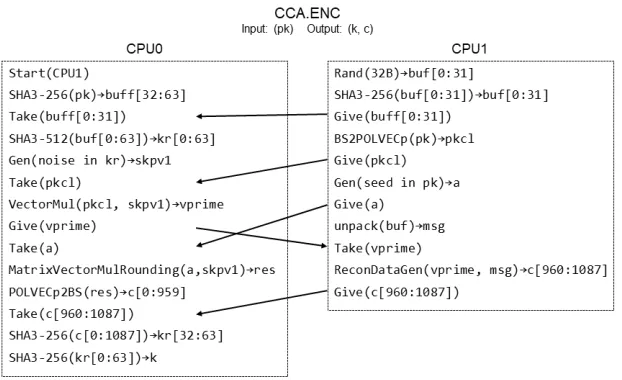
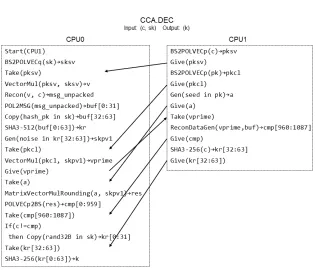
cores based on hardware level instructions rearrangement. For the correctness and efficiency of the progress, we rearrange the small steps of Saber as following rules: if the input of a step does not depend on the output of the previous step, the two steps can be executed in parallel; otherwise we should execute this step after the previous step is completed. Figure explaining of dual-core task partitioning is described in AppendixJin the appendix.
The performance of dual core is twice that of a single core in the ideal state. However, the dual-core parallel execution of the Saber algorithm has two main limitations. First, Saber itself is a sequential execution algorithm, and the input to many steps depends on the results of the previous step, so we can’t parallel all the steps. Also, ESP32 has only one big integer coprocessor and one TRNG, and we can only perform polynomial multiplication and random number generation operations in one core.
We note that our dual-core acceleration is valuable for decreasing latency of the common applications running on ESP32 as IoT clients to communicate with remote server via “PQC-TLS” based network connection. Also there are few requirements for network throughput on these IoT clients.
4.5 Generation of the matrix A
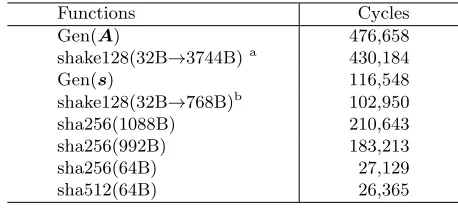
In the GEN algorithm, we choose to generate the vector s in the main core, generate the matrixAin the secondary core, and then compute the product of the two in the main core. It takes 117K clock cycles to generatesand 477K to generateA. Hence the main core needs to wait for the secondary core to complete before performing the next multiplication ofAands. To reduce the wait time, the main core can begin to perform the multiplication when the secondary core generates a row of elements (or even an element) inA. In original implementation of Saber,Awas generated in two steps: using theshake128algorithm to stretch a 32-byte seed into a full buffer of bytes sufficient to generate 9 polynomials at a time, and then convert the bytes into 9 polynomials. Theshake128 takes up 89% in the process of generating A, so we need to “split” the shake128
function to output bytes segment by segment and convert the byte segments to polynomials one by one. We use the idea of the justintime strategy [22], which was originally used to save memory in implementing Saber on ARM, to generate 9 polynomials in matrixAone by one, and use semaphores to inform the main core when a polynomial in matrix A is generated in the secondary core. In our implementation, we remove the global variables of the polynomial and byte count information in the original implementation of justintime, and add the appropriate semaphore mechanism for parallelization.
Compared to the original implementation, there is some additional overhead in justintime, since it needs to handle the “leftover” bits and count the bytes length. In our implementation, the modifiedjustintimeis only used in theGEN
5
Results
5.1 Implementation performance
We develop our implementation in C language, based on the SDK for ESP32 provided in [7]. We execute the implementation on an ESP32-DevKitC develop-ment board [6] to evaluate the performance. And we use the official function
ESP.getCycleCount()to count the clock cycles.
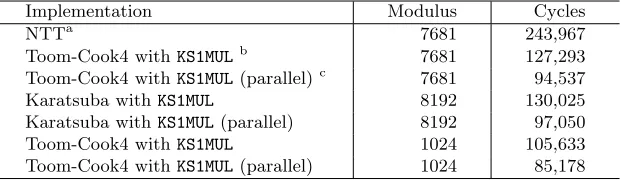
Table 4: Performance of 256 degree polynomial multiplication on ESP32
Implementation Modulus Cycles
NTTa 7681 243,967
Toom-Cook4 withKS1MULb 7681 127,293
Toom-Cook4 withKS1MUL(parallel)c 7681 94,537
Karatsuba withKS1MUL 8192 130,025
Karatsuba withKS1MUL(parallel) 8192 97,050
Toom-Cook4 withKS1MUL 1024 105,633
Toom-Cook4 withKS1MUL(parallel) 1024 85,178
aBased on the NTT implementation of Kyber submission [27]. Including
2*Forward NTT + 1*Pointwise Multiplication + 1*Inverse NTT.
bNo extra bit precision acquired in the interpolation phase in Toom-Cook4
since all the divisions are performed by computing multiplications by their respective inverses with the prime modulus (q= 7681). The coefficients are packed into 32 bits.
c
The “parallel” version is running CPU and coprocessor in parallel with “using CPU idle time” strategies.
In Table4, we compare the performance of a single 256-degree polynomial multiplication with different modulus on ESP32. Here we use the source code in Kyber [14] [27] to execute the multiplication by NTT, and execute the implemen-tations we presented in previous sections utilizing the big integer coprocessor. We note that the cycles in Table4 includes the reduction. The reduction is per-formed as Algorithm 10in the appendix except NTT-based multiplication and the reduction operation is cheap. The correctness of these implementations in Table 4 has been checked and the source code of these implementations is also available in our github link.
Table 5: Performance of polynomial multiplication functions in Saber on ESP32
Functions Cycles
MatrixMulRoundinga 827,050
VectorMul 243,023
a
Merged operation ofMatrixMulandRounding.
Table 5 shows the clock cycles of polynomial multiplication functions in Saber. The benefit of using CPU idle time strategies is also appreciable in
MatrixMulRounding and VectorMul, where the total clock cycles are smaller than the times count of single polynomial multiplication (forMatrixMulRounding, 827,050 vs. 3*3*97,050=873,450; forVectorMul, 243,023 vs. 3*85,178=255,534).
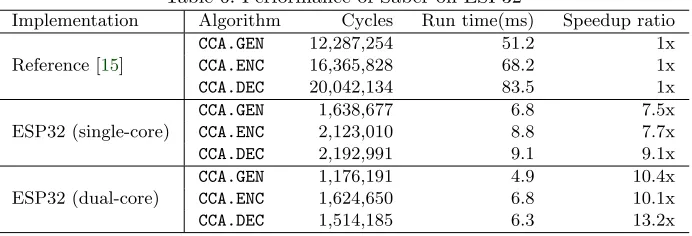
Table 6: Performance of Saber on ESP32
Implementation Algorithm Cycles Run time(ms) Speedup ratio
Reference [15]
CCA.GEN 12,287,254 51.2 1x
CCA.ENC 16,365,828 68.2 1x
CCA.DEC 20,042,134 83.5 1x
ESP32 (single-core)
CCA.GEN 1,638,677 6.8 7.5x
CCA.ENC 2,123,010 8.8 7.7x
CCA.DEC 2,192,991 9.1 9.1x
ESP32 (dual-core)
CCA.GEN 1,176,191 4.9 10.4x
CCA.ENC 1,624,650 6.8 10.1x
CCA.DEC 1,514,185 6.3 13.2x
The performance of our implementation for Saber on ESP32 are listed in Table 6. Our single-core version implementation is faster than the reference by 7.5x, 7.7x and 9.1x times forGEN,ENC,DECrespectively, and the dual-core version is faster than the reference by 10.5x, 10.1x and 13.2x times for GEN, ENC, DEC
respectively.
5.2 Comparison with related work
Table 7: Performance of Saber on Cortex-M4[20]
Implementation Algorithm Cycles Run time(ms) Speedup ratio
Reference [15]a
CCA.GEN 6,530,000 40.8 1x
CCA.ENC 8,684,000 54.3 1x
CCA.DEC 10,581,000 66.1 1x
Cortex-M4 [20]
CCA.GEN 895,000 5.6 7.3x
CCA.ENC 1,161,000 7.3 7.5x
CCA.DEC 1,204,000 7.5 8.8x
aThe cycles are reported in [20].
Cortex-M4, belongs to ARM Cortex-M series, has been well-studied for im-plementing post-quantum cryptography. The performance of the fastest opti-mized implementation of Saber from [20] is shown in Table 7. It is not fair to compare the cycles of the same cryptography scheme in these two different plat-forms, since Cortex-M4 with an ARM CPU and ESP32 with Xtensa LX6 CPUs are of different CPU families with different instruction sets. But as can be seen from two tables, with the “Reference” [15], the speedup ratios of our single-core implementations on ESP32 are slightly higher than the speedup ratios of [20] on Cortex-M4, and our dual-core version are even higher. On the other hand, the run time of our dual-core version is better than [20].
Table 8: Comparison of HW and SW functions for polynomial multiplications
Implementation Algorithm Type Functions Cycles Percentage
Kyber variant [10]
CPA.GEN HW MulAddSingle,FinalEll
a 1,901,046 58%
SW Snort,Sneeze 1,352,445 42%
CPA.ENC HW MulAddSingle,FinalEll 2,534,728 59%
SW Snort,Sneeze 1,772,243 41%
CPA.DEC HW MulAddSingle,FinalEll 633,682 55%
SW Snort,Sneeze 512,849 45%
Saber (ours)
CPA.GEN HW MatrixMulRounding 695,547 84%
SW Internal operations 131,503 16%
CPA.ENC HW MatrixMulRounding,VectorMul 875,874 82%
SW Internal operations 194,199 18%
CPA.DEC HW VectorMul 180,327 74%
SW Internal operations 62,696 26%
a
The detail cycles of internal sw-based operations are not reported.
approach is different from the one used in [10]. Albrecht et al. split theringwith the idea from Sch¨onhage [26] or Nussbaumer [24] and computed the polynomial multiplication C(x) = A(x)∗B(x) mod+ F for A, B, C ∈
Zp with p = F = 22048+ 1 (converted to big integer modular multiplications) by the RSA coprocessor on SLE78, meanwhile we split thepolynomial multiplicationand computed the small degree polynomial multiplications (converted to big integer
standard multiplications) by the big integer coprocessor on ESP32.
For polynomial multiplication, Kyber(n=256, q=7681, k=3) and Saber(n=256, q=8192 or 1024, k=3) are of similar parameters. For CPA secure GEN, ENC,
DEC of functions for polynomial multiplication, implementation of [10] costs 81, 108, 27 calls of hardware-based 2048+1 bits modular multiplicationsin
MulAddSinglerespectively, while ours costs 81, 102, 21 calls of hardware-based 2048 bitsstandard multiplications.
With similar computational complexity of hardware-based functions (ours may be less complex since computing standard multiplication is cheaper than the similar bits of modular multiplication and there are also 3 multiplications in one call ofFinalEll), due to use the coprocessor, the implementation in [10] has a large amount of software overhead. There are 42%, 41%, 45% of total cycles cost by additional software functions of CPA-secureGEN, ENC, DECrespectively. As a result, our approach takes a better advantage of the big integer coprocessor with significantly lower software overhead.
We note that the cycles of [10] in Table 8 are computed by the cycles of single function and the number of calls of KS1 version reported from its Table 3. Although the cycles of KS2 version (slightly less calls of hardware-based modular multiplication but similar total cycles) is slightly different, we can still get the same comparison result.
6
Conclusion
In this paper, we provide an efficient implementation of polynomial multiplicati-ons and a speed-optimized implementation of the CCA-secure lattice-based key encapsulation scheme Saber on embedded microcontroller ESP32.
References
1. National institute of standards and technology. submission requirements and evaluation criteria for the post-quantum cryptography standardization process. http://csrc.nist.gov/groups/ST/post-quantum-crypto/documents/ call-for-proposals-final-dec-2016.pdf(2016)
2. NIST post-quantum cryptography round 1 submissions.https://csrc.nist.gov/ Projects/Post-Quantum-Cryptography/Round-1-Submissions(2017)
3. TSR Report: 2017 wireless connectivity market analysis. www.t-s-r.co.jp/e/ report/4543.html(2018)
4. Espressif milestones. www.espressif.com/en/company/about-us/milestones
(2019)
5. mbedtls.https://tls.mbed.org/(2019)
6. ESP32 development-boards. https://www.espressif.com/en/products/ hardware/development-boards(2019)
7. ESP32 software development kit. https://github.com/espressif/ arduino-esp32(2019)
8. FreeRTOS.https://www.freertos.org/(2019)
9. NIST post-quantum cryptography round 2 submissions.https://csrc.nist.gov/ projects/post-quantum-cryptography/round-2-submissions(2019)
10. Albrecht, M.R., Hanser, C., H¨oller, A., P¨oppelmann, T., Virdia, F., Wallner, A.: Implementing rlwe-based schemes using an RSA co-processor. IACR Trans. Cryp-togr. Hardw. Embed. Syst.2019(1), 169–208 (2019),https://doi.org/10.13154/ tches.v2019.i1.169-208
11. Alkim, E., Ducas, L., P¨oppelmann, T., Schwabe, P.: Post-quantum key ex-change - A new hope. In: Holz, T., Savage, S. (eds.) 25th USENIX Secu-rity Symposium, USENIX SecuSecu-rity 16, Austin, TX, USA, August 10-12, 2016. pp. 327–343. USENIX Association (2016),https://www.usenix.org/conference/ usenixsecurity16/technical-sessions/presentation/alkim
12. Bodrato, M., Zanoni, A.: Integer and polynomial multiplication: towards optimal toom-cook matrices. In: Wang, D. (ed.) Symbolic and Algebraic Computation, International Symposium, ISSAC 2007, Waterloo, Ontario, Canada, July 28 - Au-gust 1, 2007, Proceedings. pp. 17–24. ACM (2007), https://doi.org/10.1145/ 1277548.1277552
13. Bos, J.W., Costello, C., Ducas, L., Mironov, I., Naehrig, M., Nikolaenko, V., Rag-hunathan, A., Stebila, D.: Frodo: Take off the ring! practical, quantum-secure key exchange from LWE. In: Weippl, E.R., Katzenbeisser, S., Kruegel, C., Myers, A.C., Halevi, S. (eds.) Proceedings of the 2016 ACM SIGSAC Conference on Computer and Communications Security, Vienna, Austria, October 24-28, 2016. pp. 1006– 1018. ACM (2016),https://doi.org/10.1145/2976749.2978425
14. Bos, J.W., Ducas, L., Kiltz, E., Lepoint, T., Lyubashevsky, V., Schanck, J.M., Schwabe, P., Seiler, G., Stehl´e, D.: CRYSTALS - kyber: A cca-secure module-lattice-based KEM. In: 2018 IEEE European Symposium on Security and Privacy, EuroS&P 2018, London, United Kingdom, April 24-26, 2018. pp. 353–367. IEEE (2018),https://doi.org/10.1109/EuroSP.2018.00032
15. D’Anvers, J.P., Karmakar, A., Roy, S.S., Vercauteren, F.: Saber algorithm in-formation in the NIST round-1 submissions.https://csrc.nist.gov/Projects/ Post-Quantum-Cryptography/Round-1-Submissions(2017)
Rachidi, T. (eds.) Progress in Cryptology - AFRICACRYPT 2018 - 10th Interna-tional Conference on Cryptology in Africa, Marrakesh, Morocco, May 7-9, 2018, Proceedings. Lecture Notes in Computer Science, vol. 10831, pp. 282–305. Springer (2018),https://doi.org/10.1007/978-3-319-89339-6_16
17. D’Anvers, J.P., Karmakar, A., Roy, S.S., Vercauteren, F.: Saber algorithm in-formation in the NIST round-2 submissions.https://csrc.nist.gov/Projects/ Post-Quantum-Cryptography/Round-2-Submissions(2019)
18. Harvey, D.: Faster polynomial multiplication via multipoint kronecker substitution. J. Symb. Comput. 44(10), 1502–1510 (2009), https://doi.org/10.1016/j.jsc. 2009.05.004
19. Hofheinz, D., H¨ovelmanns, K., Kiltz, E.: A modular analysis of the fujisaki-okamoto transformation. In: Kalai, Y., Reyzin, L. (eds.) Theory of Cryptography - 15th International Conference, TCC 2017, Baltimore, MD, USA, November 12-15, 2017, Proceedings, Part I. Lecture Notes in Computer Science, vol. 10677, pp. 341–371. Springer (2017),https://doi.org/10.1007/978-3-319-70500-2_12
20. Kannwischer, M.J., Rijneveld, J., Schwabe, P.: Faster multiplication inZ2m[x] on Cortex-M4 to speed up NIST PQC candidates. In: Deng, R.H., Gauthier-Uma˜na, V., Ochoa, M., Yung, M. (eds.) Applied Cryptography and Network Security -17th International Conference, ACNS 2019, Bogota, Colombia, June 5-7, 2019, Proceedings. Lecture Notes in Computer Science, vol. 11464, pp. 281–301. Springer (2019),https://doi.org/10.1007/978-3-030-21568-2_14
21. Karatsuba, A.A., Ofman, Y.P.: Multiplication of many-digital numbers by au-tomatic computers. In: Doklady Akademii Nauk. vol. 145, pp. 293–294. Russian Academy of Sciences (1962)
22. Karmakar, A., Mera, J.M.B., Roy, S.S., Verbauwhede, I.: Saber on ARM cca-secure module lattice-based key encapsulation on ARM. IACR Trans. Cryp-togr. Hardw. Embed. Syst.2018(3), 243–266 (2018),https://doi.org/10.13154/ tches.v2018.i3.243-266
23. Knuth, D.E.: The art of computer programming, Volume I: Fundamental Al-gorithms, 3rd Edition. Addison-Wesley (1997),http://www.worldcat.org/oclc/ 312910844
24. Nussbaumer, H.: Fast polynomial transform algorithms for digital convolution. IEEE Transactions on Acoustics, Speech, and Signal Processing 28(2), 205–215 (1980)
25. Proos, J., Zalka, C.: Shor’s discrete logarithm quantum algorithm for elliptic curves. arXiv preprint quant-ph/0301141 (2003)
26. Sch¨onhage, A.: Schnelle multiplikation von polynomen ¨uber k¨orpern der charakte-ristik 2. Acta Inf.7, 395–398 (1977),https://doi.org/10.1007/BF00289470
27. Schwabe, P., Avanzi, R., Bos, J., Ducas, L., Kiltz, E., Lepoint, T., Lyu-bashevsky, V., Schanck, J.M., Seiler, G., Stehle, D.: Kyber algorithm infor-mation in the NIST round-2 submissions. https://csrc.nist.gov/Projects/ Post-Quantum-Cryptography/Round-1-Submissions(2019)
28. Shor, P.W.: Polynomial-time algorithms for prime factorization and discrete lo-garithms on a quantum computer. SIAM J. Comput. 26(5), 1484–1509 (1997),
A
CPA secure Saber KEM
Algorithm 5: Saber.KeyGen()
1 seedA← U({0,1}256)
2 A←gen(seedA)∈Rlq×l
3 s←βµ(Rlq×1)
4 b=bits(As+h, q, p)∈Rlq×1 5 return(pk:= (b, seedA), sk:=s)
Algorithm 6: Saber.Enc(pk= (b, seedA), m∈M;r) 1 A←gen(seedA)∈Rlq×l
2 s0←βµ(Rlq×1)
3 b0=bits(ATs0+h, q, p)∈Rlp×1
4 v0=bTbits(s0
, p, p) +h1 ∈Rp 5 cm=bits(v0+ 2p−1m, p, t+ 1)∈R2t 6 returnc:= (cm,b0)
Algorithm 7: Saber.Dec(sk=s, cm,b0) 1 v=b0Tbits(s,
p, p) +h1∈Rp 2 m0=bits(v−2p−t−1c
B
CCA secure Saber KEM
Algorithm 8: Saber.Encaps(pk= (b, seedA)) 1 m← U {0,1}256
2 ( ˆK, r) =G(pk, m)
3 c=Saber.Enc(pk, m;r)
4 K=H( ˆK, c)
5 return(c, K)
Algorithm 9: Saber.Decaps(sk= (s, z), pk= (b, seedA, c)) 1 m0=Saber.Dec(s, c)
2 ( ˆK0, r0) =G(pk, m0)
3 c0=Saber.Enc(pk, m0;r0)
4 if c=c0 then
5 returnK=H( ˆK0, c)
6 else
7 returnK=H(z, c)
C
Performance of big integer multiplication by
coprocessor
Table 9: Performance of big integer multiplication by coprocessor
Bits Cyclesa
1536 4,966
2048 8,587
a
D
Reduction in the ring
R
q=
Z
q[
x
]
/
(
x
n+ 1)
Algorithm 10:Reduction(h, n, q)
Input:producthof twondegree polynomials
Input:modulusqof coefficients inhto reduce
Output:reduced polynomialr fromhin the ringRq=Zq[x]/(xn+ 1) 1 fori= 0,1, . . . , n−2do
2 ri←(hi−h(i+n)) modq
3 r(n−1)←h(n−1)modq 4 returnr;
E
Performance of other key functions in Saber on ESP32
Table 10: Performance of other key functions in Saber on ESP32
Functions Cycles
Gen(A) 476,658
shake128(32B→3744B)a 430,184
Gen(s) 116,548
shake128(32B→768B)b 102,950
sha256(1088B) 210,643
sha256(992B) 183,213
sha256(64B) 27,129
sha512(64B) 26,365
aInternal operation in Gen(A). b
F
Karatsuba Algorithm
Algorithm 11:Karatsuba Algorithm
Input:Two polynomialsA(x) andB(x) of degreen
Output:C(x) =A(x)∗B(x)
// Splitting A(x) and B(x) into two polynomials of size n2
1 A(y) =A1·y+A0wherey=x
n 2
2 B(y) =B1·y+B0
// Evaluation of the Polynomials at y={0,1,∞}
3 w1 =A(∞)∗B(∞) =A1∗B1
4 w2 =A(1)∗B(1) = (A0+A1)∗(B0+B1) 5 w3 =A(0)∗B(0) =A0∗B0
// Interpolation
6 w2 =w2−w1−w3
G
Toom-Cook4 Algorithm
Algorithm 12:Toom-Cook4 Algorithm
Input:Two polynomialsA(x) andB(x) of degreen
Output:C(x) =A(x)∗B(x)
// Splitting A(x) and B(x) into four polynomials of size n4
1 A(y) =A3·y3+A2·y2+A1·y+A0 wherey=x
n 4
2 B(y) =B3·y3+B2·y2+B1·y+B0
// Evaluation of the Polynomials at y={0,±1,±1 2,2,∞} 3 w1 =A(∞)∗B(∞) =A3∗B3
4 w2 =A(2)∗B(2) = (A0+ 2·A1+ 4·A2+ 8·A3)∗(B0+ 2·B1+ 4·B2+ 8·B3) 5 w3 =A(1)∗B(1) = (A0+A1+A2+A3)∗(B0+B1+B2+B3)
6 w4 =A(−1)∗B(−1) = (A0−A1+A2−A3)∗(B0−B1+B2−B3)
7 w5 =A(12)∗B(12) = (8·A0+ 4·A1+ 2·A2+A3)∗(8·B0+ 4·B1+ 2·B2+B3) 8 w6 =A(−12 )∗B(−12 ) = (8·A0−4·A1+ 2·A2−A3)∗(8·B0−4·B1+ 2·B2−B3) 9 w7 =A(0)∗B(0) =A0∗B0
// Interpolation
10 w2 =w2+w5 11 w6 =w6−w5 12 w4 = (w4−w3)/2 13 w2 =w5−w1−64·w7 14 w3 =w3+w4
15 w5 = 2·w5+w6 16 w2 =w2−65·w3 17 w3 =w3−w7−w1 18 w2 =w2+ 45·w3 19 w5 = (w5−8·w3)/24 20 w6 =w6+w2
21 w2 = (w2+ 16·w4)/18 22 w3 =w3−w5
23 w4 =−(w4+w2) 24 w6 = (30·w2−w6)/60 25 w2 =w2−w6
H
Implementation of unrolled Karatsuba with
KS1MUL
Algorithm 13:Unrolled Karatsuba parallel
Input:polynomialsa, b∈Z[x] with same degreen= 256 Output: root res=a∗b
1 aL= &a[0];aH= &a[128];bL= &b[0];bH= &b[128];
2 aLL= &a[0];aLH= &a[64];aHL= &a[64∗2];aHH= &a[64∗3];
3 bLL= &b[0];bLH= &b[64] ;bHL= &b[64∗2];bHH= &b[64∗3]; //root w3←(aL, bL)
4 write regs(aLL, bLL) // write aLL, bLL by loop function
5 aS=aL+aH;bS=bL+bH;
6 aSL= &aS[0];aSH= &aS[64];bSL= &bS[0];bSH= &bS[64];
7 aREG=alignment(aLH);bREG=alignment(bLH);
8 read regs(rREG);
9 write regs(aREG, bREG) // write aLH, bLH by memcpy function
10 sub w3 =reduction(rREG) // reduce 32-bit to 13-bit
11 aLS=aLL+aLH;bLS=bLL+bLH
12 aREG=alignment(aLS);bREG=alignment(bLS); // 32-bit alignment
13 read regs(rREG);
14 write regs(aREG, bREG) // aLS,bLS
15 sub w1 =reduction(rREG);
16 aREG=alignment(aHL);bREG=alignment(aHL); 17 read regs(rREG);
//root w1←(aH, bH)
18 write regs(aREG, bREG) ; // aHL,bHL
19 sub w2 =reduction(rREG);sub w2 =sub w2−sub w1−sub w3 ;
20 root w3 =recomposition(sub w1, sub w2, sub w3);
21 aREG=alignment(aHH);bREG=alignment(aHH);
22 read regs(rREG);
23 write regs(aREG, bREG) // aHH,bHH
24 sub w3 =reduction(rREG);
25 aHS=aHL+aHH;bHS=bHL+bHH;
26 aREG=alignment(aHS);bREG=alignment(bHS);
27 read regs(rREG);
28 write regs(aREG, bREG); // aHS,bHS
29 sub w1 =reduction(rREG)
30 aREG=alignment(aSL);bREG=alignment(bSL);
31 read regs(rREG); //root w2←(aS, bS)
32 write regs(aREG, bREG); // aSL,bSL
33 sub w2 =reduction(rREG);
34 sub w2 =sub w2−sub w1−sub w3 ;
35 root w1 =recomposition(sub w1, sub w2, sub w3);
36 aREG=alignment(aSH);bREG=alignment(bSH); 37 read regs(rREG);
38 write regs(aREG, bREG) // aSH,bSH
39 sub w3 =reduction(rREG);
40 aSS=aSL+aSH;bSS=bSL+bSH
41 aREG=alignment(aSS);bREG=alignment(bSS);
42 read regs(rREG);
43 write regs(aREG, bREG); // aSS,bSS
44 sub w1 =reduction(rREG);
45 read regs(rREG);
46 sub w2 =reduction(rREG);
47 sub w2 =sub w2−sub w1−sub w3 ;
48 root w2 =recomposition(sub w1, sub w2, sub w3);
49 root w2 =root w2−root w1−root w3;
50 root res=recomposition(root w1, root w2, root w3);
I
Implementation of Toom-Cook4 with
KS1MUL
Algorithm 14:Toom-Cook4 parallel
Input:polynomialsa, b∈Z[x] with same degreen= 256 Output: res=a∗b
1 a0= &a[0];a1= &a[64];a2= &a[64∗2];a3= &a[64∗3];
2 b0= &b[0];b1= &b[64];b2= &b[64∗2];b3= &b[64∗3];
3 ainf=a3;binf=b3;
//w1←ainf∗binf
4 write regs(ainf, binf); // write ainf,binf by loop
5 a1 =a0+a1+a2+a3;b1 =b0+b1+b2+b3;
6 an1 =a0+a2−(a1+a3);bn1 =b0+b2−(b1+b3);
7 aREG=alignment(a1);bREG=alignment(b1); // 32-bit alignment
8 read regs(rREG); //w3←a1∗b1
9 write regs(aREG, bREG); // write a1,b1 by memcpy
10 w1 =reduction(rREG);
11 ahalf= 8∗a0+ 4∗a1+ 2∗a2+a3;bhalf= 8∗b0+ 4∗b1+ 2∗b2+b3;
12 anhalf= 8∗a0+ 2∗a2−(4∗a1+a3);bnhalf= 8∗b0+ 2∗b2−(4∗b1+b3);
13 aREG=alignment(an1);bREG=alignment(bn1);
14 read regs(rREG); //w4←an1∗bn1
15 write regs(aREG, bREG); // an1,bn1
16 w3 =reduction(rREG);
17 a2 =a0+ 2∗a1+ 4∗a2+ 8∗a3;b2 =b0+ 2∗b1+ 4∗b2+ 8∗b3;
18 aREG=alignment(ahalf);bREG=alignment(bhalf); 19 read regs(rREG);
//w5←ahalf∗bhalf
20 write regs(aREG, bREG); // ahalf,bhalf
21 w4 =reduction(rREG);
22 w4 = (w4−w3)/2;
23 w3 =w3 +w4;
24 aREG=alignment(a2);bREG=alignment(b2);
25 read regs(rREG); //w2←a2∗b2
26 write regs(aREG, bREG); // a2,b2
27 w5 =reduction(rREG);
28 w5copy=w5;
29 w5 =w5−w1;
30 aREG=alignment(a0);bREG=alignment(b0);
31 read regs(rREG); //w7←a0∗b0
32 write regs(aREG, bREG) // a0,b0
33 w2 =reduction(rREG);
34 w2 =w2 +w5copy;
35 w2 =w2−65∗w3;
36 w3 =w3−w1;
37 aREG=alignment(anhalf);bREG=alignment(bnhalf); 38 read regs(rREG);
//w6 =anhalf∗bnhalf
39 write regs(aREG, bREG) // anhalf,bnhalf
40 w7 =reduction(rREG);
41 w5 =w5−64∗w7;w3 =w3−w7;
42 w2 =w2 + 45∗w3;w2copy=w2;
43 w2 = (w2 + 16∗w4)/18;w4 =−(w4 +w2/2);
44 read regs(rREG);
45 w7 =reduction(rREG);
46 w6 =w6−w5copy;w5 = 2∗w5 +w6;
47 w5 = (w5−8∗w3)/24;w6 =w6 +w2copy;
48 w3 =w3−w5;w6 = (30∗w2−w6)/60;w2 =w2−w6;
49 res=recomposition(w1, w2, w3, w4, w5, w6, w7);
J
Figure explaining of dual-core task partitioning
Fig. 1: Task partitioning of CCA secureGEN. The arrow indicates the semaphore for two cores communication.

![Table 7: Performance of Saber on Cortex-M4[20]](https://thumb-us.123doks.com/thumbv2/123dok_us/7989448.1325967/17.612.134.487.461.606/table-performance-of-saber-on-cortex-m.webp)