Abstract
SHARMA, TANU. Generation And Verification Of Software Robustness Properties
Through Static Analysis (Under the direction of Jun Xu). Increasing reliance on
GENERATION AND VERIFICATION OF SOFTWARE
ROBUSTNESS PROPERTIES THROUGH STATIC
ANALYSIS
BY TANUSHARMA
A THESIS SUBMITTED TO THE GRADUATE FACULTY OF NORTH CAROLINA STATE UNIVERSITY
IN PARTIAL FULFILLMENT OF THE REQUIREMENTS FOR THE DEGREE OF
MASTER OF SCIENCE COMPUTER SCIENCE
RALEIGH JANUARY 2006
APPROVED BY:
DAVIDJ. THUENTE TAOXIE
JUNXU
Biography
Acknowledgment
I would like to extend my foremost gratitude and appreciation to my advisor Dr. Jun Xu for his constant guidance and support throughout. Special thanks are also due to my co-advisor Dr. Thuente for giving me useful directions and motivating me every now and then. I am also grateful to Dr. Tao Xie for agreeing to be on my committee.
I would also like to thank my project partner and friend Mithun Acharya for adding basic data flow extentions to pushdown static analysis procedure used for verification. I also thank Qun He for building the initial version of the specification database used in the thesis. I am also thankful to my manager at Harris Corporation, RTP, Roger Boyer for his support and for providing me with the time I needed for the completion of this thesis.
I am thankful to all my friends who have always been a good support system for me. Special thanks to my best friend Nitu for giving me confidence and for being there always. I wish to again thank Mithun here for teaching me how to drive a car which made it possible for me to shuttle from work to college.
Table of Contents
List of Figures viii
1 Introduction 1
1.1 Related Work . . . 4
1.2 Roadmap for this Thesis . . . 5
2 Motivation for FSA Generator 6 2.1 MOPS . . . 7
2.2 Using MOPS for checking Robustness Violations . . . 8
2.3 Representation of Properties . . . 9
2.3.1 FSA . . . 9
2.3.2 MFSA . . . 11
2.4 Need for FSA Generator . . . 12
3 FSA Generator Framework 13 3.1 Generic robustness properties . . . 15
3.2 API Classification . . . 17
3.3 Language specific patterns . . . 21
3.4 Property Engine . . . 23
3.5 An Example . . . 25
3.6 Features and Advantages of FSA Generator . . . 28
4 Experiments and Results 29 4.1 Evaluation . . . 33
4.2 API Robustness Violations . . . 34
4.3 Malloc Use Before Check Violations . . . 36
5.2 Future Work . . . 39
List of References 41
Appendices 44
A Errors Found in each package 45
List of Figures
1.1 Code snippet for vixie-cron . . . . 2
2.1 FSA for exevec . . . 10
2.2 MFSA for execve . . . 12
3.1 Property Engine . . . 14
3.2 The Use Before Check Generic Property . . . 16
3.3 API-DB . . . 18
3.4 API-Classification . . . 20
3.5 compareNULL Pattern Example . . . 22
3.6 Concrete Use Before Check property for malloc API call . . . 24
3.7 Use Before Check Generic Property . . . 26
3.8 FSA for malloc . . . 27
3.9 MFSA for malloc . . . 27
4.1 API calls selected for experiments . . . 31
4.2 Packages . . . 33
4.3 Robustness Errors . . . 34
4.4 Robustness Errors found for different API . . . 35
4.5 malloc Use Before Check Violations . . . 36
4.6 malloc Use Before Check Violation in dos2unix . . . 37
4.7 malloc Use Before Check Violation in routed . . . 37
A.1 Violations found in packages tested . . . 46
A.2 Violations found in packages tested cont’d . . . 47
B.1 Code snippets . . . 49
B.2 Code snippets cont’d . . . 50
B.3 Code snippets cont’d . . . 51
Chapter 1
Introduction
With the increasing importance of computers in present world, be it for small commercial use or for highly critical and dependable systems, the significance of software robustness is becoming more and more obvious.
How can we define software robustness and how can we measure it?
The IEEE Standard Glossary of Software Engineering Terminology (IEEE STD 610.12-1990)[1] defines robustness as the degree to which a system or component can function
correctly in the presence of invalid inputs or stressful environment conditions.
Where even general applications need a certain degree of robustness, the concern be-comes unavoidable in cases of critical dependable systems such as telephone systems. Hos-pitals, banks, military organizations, etc. are using commercial software for highly secure and dependable applications. Correct functioning of these applications under exceptional or stressful settings is highly desired. Abnormal task termination or erroneous output may lead to severe loss of productivity or disruption of service.
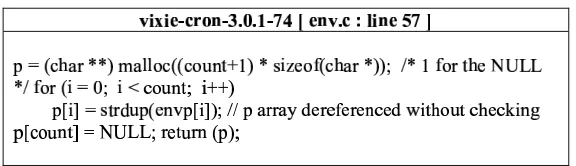
Figure 1.1: Code snippet for vixie-cron
system failures. Many reliability failures occur due to incorrect use of system API calls. Programmer’s logical errors and lack of exception handling routines can lead to serious robustness failures. For example, dereferencing the return value of C memory management APIs on a NULL path leads to memory corruption leading to a system crash.
One such example can be seen in a redhat 9.0 package vixie-cron, where a robustness violation is caused due to dereference of a variable array without checking. Figure 1.1 shows the code snippet example for vixie-cron package. As can be seen in the example, the
malloc API is used to allocate memory to the variable array p, which is being dereferenced
and returned without any check. Usage without any check like this can lead to problems like memory corruptions and worse.
In small packages, there can be several programming errors like these, but in bigger packages, with more complex features and many more API calls, the possibility of presence of such weak points for robustness failures becomes more pronounced.
In this direction, there should be a method to directly find robustness violations in the source code. This can be achieved by static analysis which uses compilers to detect such bugs. For such an analysis, some robustness properties are defined which the application should conform to. Any violations reported while checking for these properties are robust-ness bugs that warn for possible system failures.
these finite state machines are to be written with hand, the whole purpose of using tools to avoid manual effort to detect these errors in a code becomes insignificant. Moreover, a manually written property can be erroneous. Also the process becomes monotonous and tedious if the program is huge and needs to be checked for a lot of properties and API calls. There are 282 POSIX API and one can imagine writing so many finite state machines in case the need arises. This would even increase if the generic properties that need be checked increase. The FSA Generator implemented in this thesis is able to do the task in seconds and all that it needs as inputs are the API call and the generic property desired to be checked. The automation engine then converts the generic property into the concrete ones by using source code and interface level from the two databases AST-DB and API-DB.
Even if we carry out the manual effort once and write all finite state machines keeping all the possible combinations of API calls and properties in mind, it might not be applicable to all programming languages and leave out the properties that might become a concern in future. The FSA Generator, is very extensible and the other generic properties can be easily added to the framework as need may arise. Same is true for the pattern database and modifications and extensions can be done quickly and easily. The FSA Generator is very flexible and can be tuned to work with programming languages other than C.
1.1
Related Work
Research done in the direction of improving software robustness has resulted in various methodologies such as black box testing [4] . The black box method inserts stressful condi-tions directly or indirectly and studies the response of the application. Similar various other traditional software testing methods [19][22] focus on functionality of the application and thus its implementation correctness. These methods only make sure that the system gives expected output given a normal set of inputs. In a research project at University of Wis-consin, Fuzz [10][21][20], a program is subjected to random input streams. It studies the robustness of Unix system utilities and the results show that the failure rate of systems is quite high. Ballista [16][17], a Carnegie Mellon University research project, studied the robustness of different Unix operating systems while handling exceptional conditions. It uses extreme input parameter values to test the robustness of systems call interface im-plementation. Similar approaches have been applied by researchers at Reliable Software Technologies [12][23] and Bell Labs [29] for robustness testing of system library interfaces on Microsoft Windows. All these traditional methods do not address handling stressful en-vironment conditions faced by software. Research [8] in this direction has proved that exception detection and handling code is the most ignored part of the software systems. These aspects are not understood completely and least tested in software testing. One such example is the field experience with telephone switch systems [27] that clearly shows that approximately two thirds of system failures are due to design faults in exception handling algorithms.
conditions for Windows applications [11]. FTAPE [28], NFTAPE [26], FIAT [24], FER-RARI [14] and Xception [5] use fault injection methods for validating reliability of fault tolerant computing systems.
Some others [18][25][30] use static compiler analysis to find bugs and security holes in source code. The Meta-Compilation (MC) Project at Stanford University uses programmer written compiler extension to statically find bugs in operating systems [2][9] and cache protocols [7]. SLAM [3] and BLAST [13] are static analysis tools based on theorem prov-ing and model checkprov-ing Boolean abstractions of the program with iterative refinements. MOPS [6] is a static analysis checker that detects vulnerable system call sequences in the program.
1.2
Roadmap for this Thesis
Chapter 2
Motivation for FSA Generator
Ignorant and prudent programming practice can lead to software bugs in software where security is relevant. To avoid this, rules can be specified which governs the programming. These rules are known as temporal robustness/reliability/security properties. Once identi-fied, these rules can be used to verify whether software code complies with such properties or not. Such verification can be manual for small pieces of code, but when scalability comes as an issue with the consideration of large programs, it becomes necessary to automate such a procedure. There have been several static tools available for detecting violations in a large and complex software code.
2.1
MOPS
MOPS is a static analysis tool to automatically detect violations of a temporal security property in code. A temporal security property dictates the order of a sequence of security-relevant operations. Violation of this ordering constraint can lead to serious security attacks or even complete system compromise. For example, a temporal security property states that the call strncpy(dst,src,n) in a C program should be followed immediately by the statement dst[n]=’\0’. Violation of such order makes it vulnerable to buffer overrun attacks.
MOPS ensures that properties are satisfied on all execution paths in the program. It makes use of model checking to determine this at compile time. Model checking techniques are utilized as we need to traverse each execution path.
It takes a program and security property, where security property is represented by a finite state automaton and the program is modeled as a pushdown automaton. All sequences of operations that violate the property end in the final (risky) states of the FSA. MOPS then determines whether certain states representing violation of the security property in the FSA are reachable in the PDA.
MOPS was initiated with the goals of soundness and scalability. Soundness is achieved through model checking of PDA. Scalability is mainly attained by MOPS by ignoring data flow analysis as it is quite expensive. MOPS is full inter-procedural , and thus it is efficient in finding inter-procedural bugs. Apart from these factors, another advantage of MOPS is modularization
There are several limitations in MOPS. Sometimes, there might be extra warnings (false
positives) in the output as MOPS can mistakenly consider paths that are infeasible in the
program to be feasible. Also, the stage when MOPS transforms a C program into a PDA is sound only as long as the program has no implementation-defined behavior.
2.2
Using MOPS for checking Robustness Violations
failure is inconsistency reported in the tracked variable.
The modified MOPS is intra-procedural. Future work may make it inter-procedural such that a variable can be tracked in different procedures.
2.3
Representation of Properties
MOPS requires each property in the form of a finite state automata.
2.3.1
FSA
A FSA is described in a text file where each statement ends with a semicolon (‘;’). The three types of statements in the FSA file can be identified with the following keywords:
• state: This statement declares a state. For example:
state start “state start”;
A finite state automaton consists of several states such as a start state and an end state. All sequences of operations that result in the violation of the property end in the final risky states of the FSA. In the above example, a state named
start is defined and labeled as “state start”.
• ast: This statement declares an Abstract Syntax Tree (AST) that MOPS needs
to check while looking through the source code for any violation. For example:
ast execvePlain{function call{identifier “execve”} {ellipsis}};
This statement matches execve() in a source code. Patterns are discussed more in detail in Chapter 4.
• transition: This statement declares a transition from one state to another. For
example:
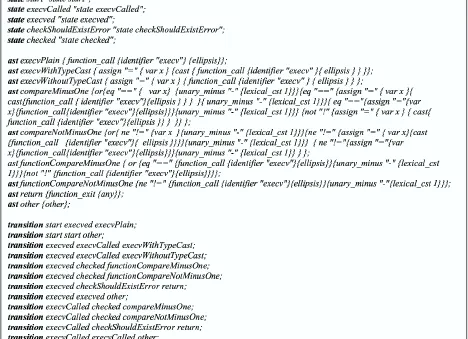
Figure 2.1: FSA for exevec
This statement defines a transition from state execveed to another state named
execvePlain.
2.3.2
MFSA
There is another small file required by MOPS to locate the right FSA and perform checking. It is called meta-FSA or simply MFSA. A complex property may be decomposed into a set of simpler ones described by FSAs. MFSA represents a FSA that is the product of multiple FSAs. It is again a text file with statements ending with semicolon.
It consists of statements starting with the following keywords:
• label: This statement describes a meta-FSA and is optional. Each MFSA can
have only one label statement. For example:
label “Checking for violation”;
• fsa: This statement consists of all the FSAs that form this MFSA. It may also
consists of only one FSA. For example:
fsa “execvCheckShouldExist.fsa”;
• initial state: This statement declares an initial state of the meta-FSA and its
description. It may consist of one or more initial states depending on the num-ber of FSAs that are included in the meta-FSA. For example:
initialstate start “start”;
• final state: This statement declares a final state of the meta-FSA followed by
its description. It may consists of one or more final states depending on the number of FSAs that are included in the meta-FSA. For example:
finalstate checkShouldExistError “Error: checkShouldExist”;
Figure 2.2: MFSA for execve
2.4
Need for FSA Generator
MOPS is a tool for static analysis which checks for violations for security properties. These properties are temporal in nature and require a specific order in which operations are ex-pected to be performed. In this thesis we aim towards finding robustness violations making use of the model checking techniques provided by MOPS. Thus we define robustness rules for safe programming practice and pass them as inputs into modified MOPS for checking.
Chapter 3
FSA Generator Framework
The static checker MOPS requires concrete properties with source code and interface level information in order to detect the violations in the code. These concrete properties are represented by finite state machines. Writing large number of such concrete properties is very labor intensive and can be erroneous. The automatic checking advantages provided by MOPS are over-shadowed by the human cost involved in creating its input. Moreover, the users using MOPS for static checking need to have knowledge of all the information that form a concrete property. Thus the task of writing concrete properties requires a lot of human effort and knowledge, and is time-consuming. Thus there is a need for automating such a procedure of generating concrete properties. The framework for this task should be able to keep the details hidden from the user and the relevant source code, interface level and language specific information should be taken into consideration. The FSA Gen-erator framework provides such an automation for generating concrete properties. MOPS takes these concrete properties and program code as inputs and checks whether there is a violation of these properties.
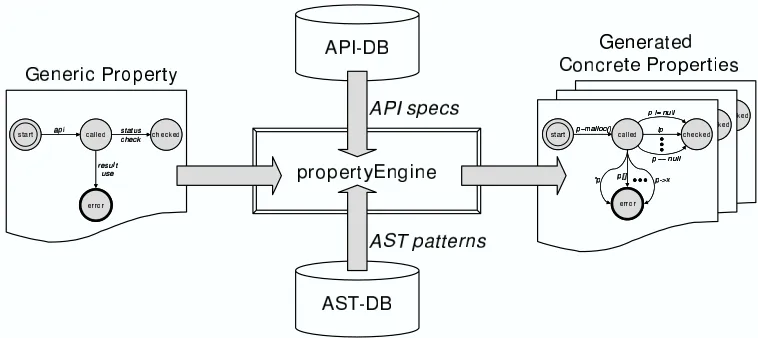
Figure 3.1: Property Engine
interact. The entire framework has the following components:
• Generic properties database
• API-DB
• AST-DB
• Property or Automation Engine
Figure 3.1 depicts the interaction among these components of the framework. Prop-erties in the generic propProp-erties database have no concrete information. The automation engine translates a generic robustness property into a concrete property using source code level information from a programming language specific pattern database (AST-DB) and interface level information from an API specification database (API-DB). Thus these two databases provide the needed inputs to the framework in order to carry out the translation.
3.1
Generic robustness properties
A generic property for an interface i can be defined as follows. Assume the following for the execution of an interface i:
rs(i) : Result set of i consisting of variables containing the result of i’s execution. ss(i) : Status set of i consisting of variables indicating success or failure status.
A simple property Use Before Check states: For an interface i, an element in rs(i) can
be used only after an element in ss(i) is checked for error on all execution paths.
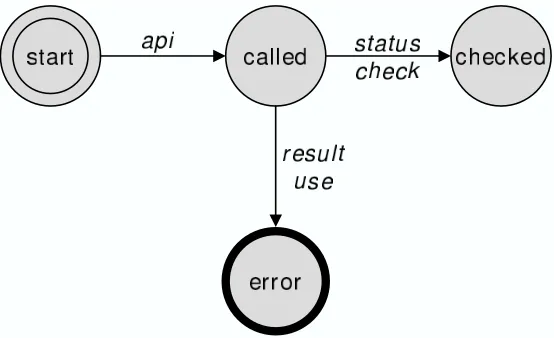
In the FSA Generator framework, these properties are represented by simple finite state machines. Figure 3.2 shows a simple finite state machine for Use Before Check property. As can be seen, the generic property makes use of abstract and generic terms. In this finite state machine, api is the transition from the initial start state to the called state. In this finite state machine, error state represents the robustness violation and the checked state is the safe state. Thus if the result of an API call is used before its error status is checked, the end state is the error state and the violation is reported. For example, consider API Call malloc which returns NULL on failures, thus the Use Before Check property for malloc states that the return value of malloc should be checked for NULL before it can be used. If no such check is made and the return value of malloc is used, it is a violation to the property.
In the current implementation, the framework defines the following generic properties which cover some of the most common robustness violations, however, the framework is extensible and new generic properties can be easily defined by a user using a simple finite state automata.
• Use Before Check: This generic property applies to the API calls that return a
Figure 3.2: The Use Before Check Generic Property
such an API before checking.
• Check Should Exist: All those API calls that return an integer value on success
or failure, should be checked before use. For example closedir returns ‘0’ on success and ‘-1’ on failure.
• Null Pointer Dereferencing: For API calls in p:np class, a variable holding the
return value should not be dereferenced on a NULL path.
• Null Pointer Free: For API calls in p:np class, a variable holding the return
value should not be freed on a NULL path.
• Free Pointer Dereferencing: For API calls in p:np class, a pointer variable that
is freed once should not be dereferenced along all execution paths.
• Double Free: For API calls in p:np class, a pointer variable that is freed once
should not be freed again along all execution paths.
extended to support a new property, a new file can be written and simply included in the system. It requires minimal changes in the engine to make it recognize and handle the new property.
These files consist of the generic states and transitions which are checked for a prop-erty. The FSA Generator generates a specific concrete property output making use of these generic files.
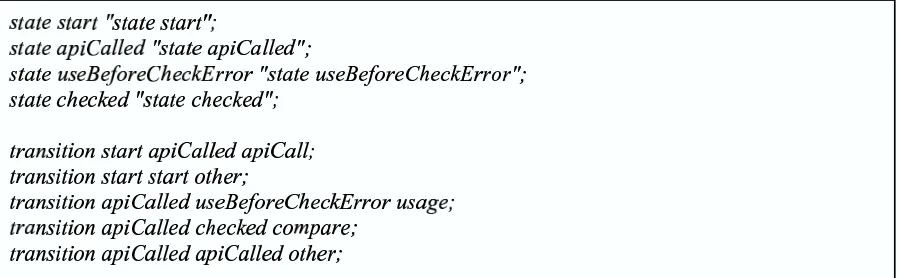
For example , for property Use Before Check, the generic property file consist of the following states:
state start “state start”;
state API called “state API called”;
state useBeforeCheckError “state useBeforeCheckError”; state checked state “checked”;
For malloc API call and Use Before Check property, the output finite state automaton would consist of the following specific states:
state start “state start”;
state mallocCalled “state mallocCalled”;
state useBeforeCheckError “state useBeforeCheckError”; state NULLCompared “state NULLCompared”;
state notNULLCompared “state notNULLCompared”;
3.2
API Classification
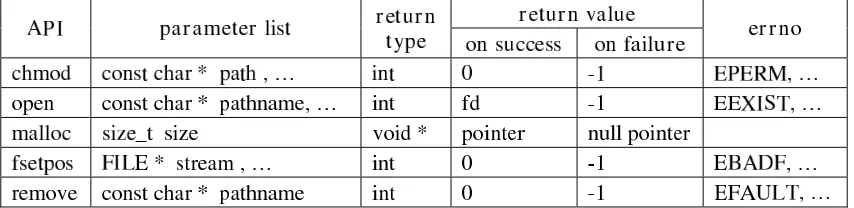
Figure 3.3: API-DB
functions. POSIX stands for Portable Operating System Interface. The entries in the data-base show the input parameters for the API call, return value types, return values on suc-cess/failure and the error flags set.
The database consists of the API call information in the following record format:
[sequential number]:[function name]:[parameter list]:[return type]:[return value on success]:[return value on failure]:[error number list]
Figure 3.3 shows several important specifications.
The FSA Generator queries the database for a specific API, and obtains its interface level information in the form of its return values on success/failure and error specifications. This knowledge is used in order to convert the generic properties into concrete ones.
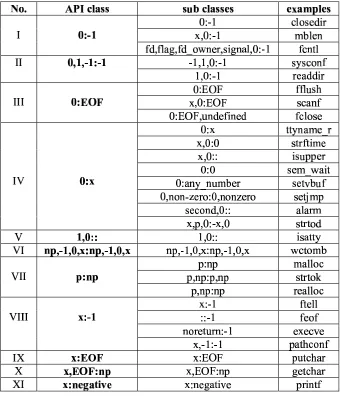
According to the return values on success and failure, the APIs are classified into dif-ferent classes. Figure 3.4 shows the classification. It also includes an example API member for each class. After identifying a particular class for an API, the FSA Generator picks up the right source code level information from a pattern database.
A class in API classification is represented as:
[Return Values On Success: Return Value on Failure]
classification, ‘x’ refers to some undefined value, ‘p’ is the returned pointer for API calls such as malloc etc., ‘np’ stands for null pointer,‘EOF’ is end of file and ‘negative’ stands for ‘<0’ values. There are some classes which return no value on success or failure. An
example of such a set of classes is [1,0::]. Classes which do not return anything on success or return, such as [::], are those that do not require any checks and thus the supported properties do not apply to them, such as [x:x] or [p:p], are not included in the classification. For any API class, the properties are defined in a manner that requires checks for the values returned. For example, for [p:np] class, the code should have ‘NULL’ value checks before the pointer variable can be used. This can be done in several ways like whether the variable is equal to ‘NULL’ or it is not equal to ‘NULL’ etc. Similarly for class say [0:-1], the checking looks for patterns like ‘==0’ , ‘!=0’ , ‘==1’ , ‘!=1’ in the code.
Such type of pattern matching groups several subclasses together as can be seen in the classification. Thus for classes [-1,1,0:-1], whose members return ‘-1’ or ‘1’ or ‘0’ on success and ‘-1’ on failure and [1,0:-1], where return values on success are ‘1’ or ‘0’ and ‘-1’ on failure, same comparison patterns are searched for, that is , ‘==’ and ‘!=’ with ‘1’,‘-1’ and ‘0’. All the classes are termed subclasses, and those which require the same patterns are grouped under an API class which is named after the simplest among all its subclasses. Identifying a class is also important as several properties should not be checked for some API classes. These properties are applicable to the API calls on the basis of their return values. For example, those which do not have “null ptr” as their return value cannot have any of the properties which apply to pointers. Examples are Double Free,Null Pointer
Dereference or Use Before Check.
• Use Before Check
• Null Pointer Dereferencing
• Null Pointer Free
• Free Pointer Dereferencing
• Double Free
Rest of the other classes can be checked for Check Should Exist property.
3.3
Language specific patterns
The patterns database includes the syntax and semantics of the API calls and the various components of exception handling code like checking routines and variables usages in Ab-stract Syntax Tree (AST) notations. The transitions in the generic finite state machine have no language level semantic. Thus the FSA Generator converts these abstract transitions into the programming language specific transitions to be included in the final output FSM by using information provided in the patterns database termed here as AST-DB. The FSA Generator queries the patterns database using the return values on success/failure and er-ror status and the database gives the right patterns containing the right source code level information.
For example, for the property Use Before Check, the malloc API call returns a memory pointer on success and a NULL pointer on failure. Assuming pointer variable contains the return value of the malloc call, the check status implies that p is compared to NULL. This can be done in various ways such as (p == NULL) , (!p), (p) , (p !=NULL) etc. The pattern database returns all such possible patterns for checking of a NULL pointer.
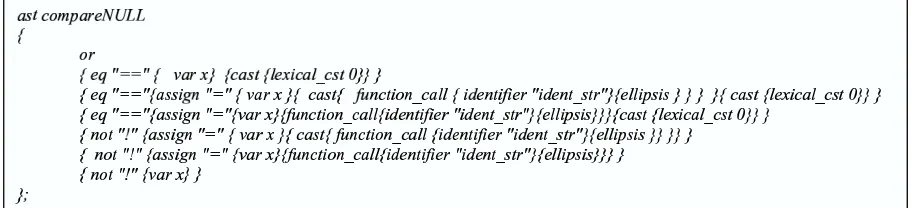
Figure 3.5: compareNULL Pattern Example
various possible ways. Consider checking robustness violation for API call malloc. The ast pattern compares the return value to NULL in various ways. For example, consider the expression in the pattern
eq “==”{var x} {cast{lexical cst 0}}
The statement can be translated to this: (p==NULL) where p is the pointer variable holding the return value of malloc API call represented by ‘x’. In the above expression,
cast{lexical cst 0}compares to NULL value. The next statement:
eq “==”{assign “=”{var x}{cast{function call{identifier “ident str”}{ellipsis
}}} }{cast{lexical cst 0}}
This can be translated to something like this for example:
(p=(int *)malloc(sizeof(int)))==NULL
In this expression, var x is the variable which is the return value of malloc API. In this case, cast matches the cast of the function malloc which is (int *) here. In this case, ellipsis matches zero or more ASTs. Thus the following matches printf (...) for example:
{function call{identifier printf} {ellipsis}}
3.4
Property Engine
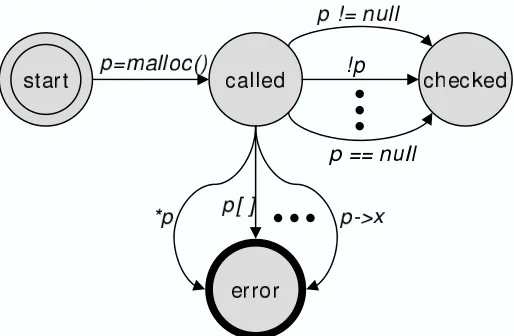
As discussed previously, the property engine takes inputs from API-DB and AST-DB and generates FSA and MFSA files. It converts abstract terms from these databases into spe-cific to those for a given API call and thus results in concrete properties. These properties are specific to an API call and language for which patterns are supported in the framework. This can be understood by studying the generated concrete property of the previously dis-cussed example of Use Before Check property for malloc API call. In the concrete FSM, each directed edge and vertex from the generic FSM could be spilt into multiple edges and vertices.
Figure 3.6 shows the generated concrete property FSM for the malloc API Call from the previously considered generic property. As we can see, the check keyword is split into different edges labeled by the NULL pointer check patterns and the use keyword is replaced by patterns denoting different ways in which a pointer variable can be used. Figure 3.6 discusses the case p=malloc(). If ‘p’ is checked for ‘NULL’ value, which can be done in various ways, for example, ‘p!=NULL’, ‘p==NULL’ , ‘!p’ etc, the execution ends in safe state. If ‘p’ is used in any way without any check for example, ‘*p’, ‘p[]’,‘p->x’ etc., a
robustness violation is reported.
The FSA Generator currently supports 282 API calls and six properties. The engine is intelligent enough to ignore the API calls with no return values and no error codes. Also, there are several API calls for which no checking is needed. Some of these API calls have the same return values on success and failure. For example, values returned are x:x or p:p or -x:-x or -x: : etc. An example of such an API is fread.
Figure 3.6: Concrete Use Before Check property for malloc API call
the rest others can be checked for the Check Should Exist property. There might also exist a class to which all the properties may apply, for example, a class [x,-1,np,0:x,-1,np,0]. The engine inspects all such possible cases and in case of an expected result, it generates the output FSA file or do nothing.
The FSA Generator is very simple to use and gives output files in seconds. One or more finite state machines can be generated at one time. Output files can be generated with any of the following options on the command line:
• java fsaGenerator apiCall property
Gives FSA and MFSA files for the specific property and API call.
• java fsaGenerator apiCall all
Gives FSA and MFSA files for the specific API call against all the properties.
• java fsaGenerator all property
Gives FSA and MFSA files for all API calls against the specific property.
• java fsaGenerator all all
“apiCall” is the API call for which we need the FSA and MFSA files. “property” is the name of the property, which is being checked.
Thus we see that the user need not have to be aware of all the details about the finite state automaton or worry about writing it. Just by providing the API call and the generic property desired to the FSA Generator, the concrete property can be obtained.
The next section explains a simple example that knits together all the sections discussed so far.
3.5
An Example
Here is an example of how the FSA Generator generates FSA output files. In this section, we assume that we want to check for a robustness violation for property Use Before Check for API call malloc in the given code.
In order to check for a robustness violation for an API call, the following command is used:
java fsaGenerator malloc useBeforeCheck
Using this command, the FSA Generator creates a concrete property FSA describing
Use Before Check generic robustness property that states: “Check the returned value of malloc before use”.
Knowing which property to check, the FSA Generator goes through the properties data-base and picks up the file containing the generic property defined for Use Before Check. Figure 3.7 depicts the generic property file for Use Before Check that consists of states and transitions. This can be graphically represented by Figure 3.2.
Figure 3.7: Use Before Check Generic Property
as follows:
2:malloc:size t size :void :p:np:
Now the FSA Generator knows that the malloc API call returns ‘p’ on success and ‘np’ on failure. Based on this knowledge, the FSA Generator identifies the API class malloc belongs to, which is [p:np] in this case. Once this is done, the automation engine knows which patterns to pick up from the pattern database AST-DB. AST patterns consist of the source code level information needed for the finite state automaton. As malloc belongs to [p:np] class and the property is Use Before Check, the check could be present in the form ‘==NULL’ or ‘!=NULL’. Thus the correct ’compareNULL’ and ’compareNotNULL’ ast patterns are picked up along with the other usual ones.
Figure 3.8: FSA for malloc
3.6
Features and Advantages of FSA Generator
The key advantages of the FSA Generator are its simplicity and usefulness in static analysis checking. It can be tuned to support more languages and facilitates adding new functional-ities to the system. All this can be achieved through its several features:
• Automation: The FSA Generator automatically generates as many concrete
finite state machines as needed by taking inputs from the previously defined generic properties and the databases AST-DB and API-DB. The automation saves manual effort and time which otherwise might have made property gen-eration non-scalable and error-prone.
• Transparency: The FSA Generator makes use of source code and interface
level information from the AST and API databases while the user is completely unaware of this. The user just has to deal with generic properties that are defined as simple finite state automata. The details are all hidden from whoever uses it for generating concrete properties.
• Extensible: The framework can support as many API calls by simply
Chapter 4
Experiments and Results
In order to evaluate the practical use and significance of the framework, commonly used open source packages were tested. Most of these are from Redhat 9.0 distribution. The configuration used was a Pentium IV machine with 2.8 GHz processor speed and 1GB RAM running on Fedora Code 32.6.9-1.667smp kernel. The framework generates concrete properties from the 6 generic properties we currently have.
Due to experimentation resource constraints (mainly long run time), out of the 282 POSIX API, 60 critical API calls were selected. These are frequently used API calls in common and critical operations such as memory management, file and string I/O and per-mission management.
Robustness failures can be classified as critical or minor.This can be done on evaluating recovery costs in case of such failures. In general, critical failures include system and application crashes and minor failures include hindering cases. Ballista [19] suggests a failure mode classification called CRASH. It is an acronym for the following failure modes:
• Catastrophic Failures: These failures result in a complete system crash and
requires a system reboot.
restart.
• Abort Failures: The application is abnormally terminated in this case.
• Silent Failures: They occur when the called function or system call is
com-pleted successfully instead of returning an error indication as expected due to the invalid parameter values used in the call.
• Hindering Failures: These result in incorrect error indication such as the wrong
error reporting code.
In the comparison of robustness of POSIX operating systems [15], several examples of catastrophic failures due to malloc API call are discussed. It also lists data types which are most commonly associated with abort robustness failures. The results show that NULL and invalid pointer values are the most common causes of abort failures. We also see that string and math functions are also responsible for significant number of robustness failures. It lists several system calls as having high failure rates.
Selection of API Calls for experiments in this thesis has been made on the basis of their frequent use in applications. In case of improper usage of these calls, critical failures may happen. These API Calls are mainly which are used for memory operations for example,
malloc, realloc, calloc, permission management such as chmod, setuid, file and directory
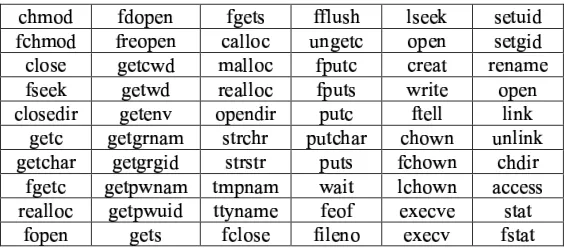
operations for example, closedir, fopen, fileno and string operations for example, strrchr. The selected API calls are listed in Figure 4.1. Some of these are applicable to be checked for Use Before Check property and the rest for Check Should Exist based on their return values as discussed in Chapter 3. Thus they can be divided into two groups as follows:
• Check Should Exist: access, chdir, chmod, chown, close, closedir, creat, execv,
Figure 4.1: API calls selected for experiments
readdir, rename, setgid, setuid, stat, ungetc, unlink, wait, write
• Use Before Check: calloc, fdopen, fgets, fopen, freopen, getcwd, getenv,
get-grgid, getgrnam, getpwnam, getpwuid, gets, getwd, malloc, opendir, strrchr, strstr, tmpnam, ttyname
For the experiments, 12 widely used open source packages were used. Figure 4.2 lists these packages. Each package is briefly discussed here:
• ftp-0.17-17: The ftp package provides the standard UNIX command-line FTP
(File Transfer Protocol) client. FTP is a widely used protocol for transferring files over the Internet and for archiving files.
• ncompress-4.2.4-33: The ncompress package contains the compress and
un-compress file un-compression and deun-compression utilities, which are compatible with the original UNIX compress utility (.Z file extensions).
• routed-0.17-14: It is the RIP-based routing daemon used by most UNIX
sys-tems to handle the routing tables. It can exchange RIP messages with other machines, updating its route tables as necessary.
• rsh-0.17-14: The rsh package contains a set of programs which allow users
• sysklogd-1.3.31-3: The sysklogd package contains two system utilities
(sys-logd and k(sys-logd) which provide support for system logging. Sys(sys-logd and k(sys-logd run as daemons (background processes) and log system messages to different places, like sendmail logs, security logs, error logs, etc.
• sysstat-4.0.7-3: This package provides the sar and iostat commands for Linux.
Sar and iostat enable system monitoring of disk, network, and other IO activity.
• SysVinit-2.84-13: The SysVinit package contains a group of processes that
con-trol the very basic functions of the system. SysVinit includes the init program, the first program started by the Linux kernel when the system boots. Init then controls the startup, running, and shutdown of all other programs.
• tftp-0.32-4: The Trivial File Transfer Protocol (TFTP) is normally used only
for booting diskless workstations. The tftp package provides the user interface for TFTP, which allows users to transfer files to and from a remote machine.
• traceroute-1.4a12-9: The traceroute utility displays the route used by IP
pack-ets on their way to a specified network (or Internet) host. traceroute displays the IP number and host name (if possible) of the machines along the route taken by the packets. traceroute is used as a network debugging tool.
• zlib-1.1.3-3: The zlib compression library provides in-memory compression
and decompression functions, including integrity checks of the uncompressed data. This library is used by a number of different system programs.
• ltrace-0.3.29-1: ltrace is a debugging program which runs a specified
Figure 4.2: Packages
• pciutils-2.1.10-7: The PCI Utilities package contains a library for portable
ac-cess to PCI bus configuration registers and several utilities based on this li-brary. The utilities include lspci which displays detailed information about all PCI busses and devices and setpci which allows to read from and write to PCI device configuration registers.
4.1
Evaluation
Concisely, the total number of robustness violations found in each package can be seen in Figure 4.3(a). As can be seen in the table, these commonly used open source packages have unavoidable number of robustness violations. These violations include several critical APIs which can lead to critical robustness failures. Only 12 of these packages showed 192 violations for just two properties.
Figure 4.3: Robustness Errors
can lead to failures such as memory corruption, file system failures etc. Thus it is important to detect such failures and correct them.
It is important to see how many critical API violations are present in these experiments. Errors found in each package can be seen in their individual tables in Appendix A.
4.2
API Robustness Violations
Figure 4.5: malloc Use Before Check Violations
4.3
Malloc Use Before Check Violations
This section covers all the violations for malloc API call found in the experiments done. Improper use of certain critical API calls such as malloc may result in catastrophic failures. For this purpose, several more experiments were conducted. In addition to the packages used above, other two important open source packages were:
• dos2unix-3.1-15: It converts DOS or MAC text files to UNIX format.
• vixie-cron-3.0.1-74: The vixie-cron package contains the Vixie version of cron.
Cron is a standard UNIX daemon that runs specified programs at scheduled times. Package vixie-cron adds better security and more powerful configura-tion opconfigura-tions to the standard version of cron.
In total, 11 malloc Use Before Check violations were found in these 14 packages which can lead to system failure. They are listed in Figure 4.5.
Figure 4.6 shows one such violation in an open source package dos2unix. In this case,
pFlag is used without being checked for NULL value. Another malloc violation can be
seen in open source package routed as shown if Figure 4.7
Figure 4.6: malloc Use Before Check Violation in dos2unix
Chapter 5
Conclusion and Future Work
This chapter summarizes the thesis and discusses directions for future work.
5.1
Conclusion
Robustness failures are becoming an increasing concern with increase in use of commercial software in critical applications. Thus it becomes important to provide more reliable and cost effective software validation to such applications. Among several present techniques and tools available for automated testing of robustness bugs in a software, this thesis con-siders a modified MOPS for experimentation purposes. MOPS requires intelligent concrete properties which are automatically generated by the framework presented in this study.
language-level transitions in the concrete property. The API-DB lists all the API calls and the information which is required by the engine to decide whether a concrete property is possible for that API call and if it does, generates it. This database carries information for 282 POSIX API calls and the AST-DB consists of all the patterns required for these calls. For experiments, 10 open source packages and 60 critical commonly used API calls were selected.
The experiment results clearly show the value of our framework. The large number of concrete properties generated are used to check the open source packages. Many er-rors were found which indicated that the normal programming practice leaves open many possibilities for robustness failures that may cause a commercial software crash in case of exceptions etc. Even in critical packages, many robustness violations have been detected for important API calls. Without our framework, these properties would take many human efforts to write while the correctness is not guaranteed.
5.2
Future Work
Writing concrete properties takes a lot of time and manual effort and makes the use of tools like MOPS difficult and time-consuming. The FSA Generator does the task correctly in matters of seconds.
calls. Once all these databases have been modified and expanded, only little modification is required in the automation engine. The current implementation of the engine allows it to be extensible and flexible.
List of References
[1] IEEE Computer Society, IEEE Standard Glossary of Software Engineering
Terminol-ogy, IEEE STD 610.12-1990. December 1990.
[2] K. Ashcraft and D. Engler. Using programmer-written compiler extensions to catch security holes. In Proceedings of IEEE Symposium on Security and Privacy, 2002.
[3] T. Ball and S. Rajamani. Automatically validating temporal safety properties of in-terfaces. In Workshop on Model Checking Software, SPIN, 2001.
[4] B. Beizer. Black-Box Testing: Techniques for Functional Testing of Software and
Systems. John Wiley and Sons, 1995.
[5] J. Carreira, H. Madeira, and J. G. Silva. Xception: Software fault injection and mon-itoring in processor functional units. IEEE Transactions on Software Engineering, 24(2), February 1998.
[6] H. Chen and D. Wagner. MOPS: an infrastructure for examining security properties of software. In Proceedings of CCS 2002, November 2002.
[7] A. Chou, B. Chelf, D. Engler, and M. Heinrich. Using meta-level compilation to check FLASH protocol code. In Proceedings of Architectural Support for
[8] F. Cristian. Exception Handling and Tolerance of Software Faults. In Software Fault
Tolerance, Michael Lyu (Editor), chapter 5. John Wiley and Sons, 1995.
[9] D. Engler, B. Chelf, A. Chou, and S. Hallem. Checking system rules using system-specific, programmer-written compiler extensions. In Proceedings of the Fourth
Sym-posium on Operating Systems Design (OSDI), 2000.
[10] J. Forrester and B. P. Miller. An empirical study of the robustness of Windows NT applications using random testing. In Proceedings of 4th USENIX Windows Systems
Symposium, August 2000.
[11] A. Ghosh and M. Schmid. An approach to testing COTS software for robustness to operating system exceptions and errors. In Proceedings of 1999 International
Sym-posium on Software Reliability Engineering (ISSRE99), 1999.
[12] J. Haddox, G. Kapfhammer, C. Michael, and M. Schatz. Testing commercial-off-the-shelf software components. In Proceedings of the 18th International Conference and
Exposition on Testing, 2001.
[13] T. Henzinger, R. Jhala, R. Majumdar, and G. Sutre. Software verification with BLAST. In Workshop on Model Checking Software, SPIN, 2003.
[14] G. Kanawati, N. Kanawati, and J. A. Abraham. FERRARI: a tool for the validation of system dependability properties. In IEEE Workshop on Fault-Tolerant Parallel and
Distributed Systems, 1992.
[15] P. Koopman and J. DeVale. Comparing the robustness of POSIX operating systems. In 29th Annual International Symposium on Fault-Tolerant
[16] P. Koopman and J. DeVale. The exception handling effectiveness of posix operating systems. IEEE Transactions on Software Engineering, 26(9), 26(9), September 2000.
[17] N. Kropp, P. J. Koopman, and D. P. Siewiorek. Automated robustness testing of off-the-shelf software components. In Proceedings of IEEE International Symposium on
Fault-Tolerant Computing (FTCS), 1998.
[18] D. Larochelle and D. Evans. Statically detecting likely buffer overflow vulnerabili-ties. In In 2001 USENIX Security Symposium, 2001.
[19] B. Marick. Craft of Software Testing: Subsystems Testing Including Object-Based
and Object-Oriented Testing. Prentice Hall, 1994.
[20] B. Miller, L. Fredriksen, and B. So. An empirical study of the reliability of UNIX utilities. Communications of the ACM, 33(12), December 1990.
[21] B. Miller, D. Koski, C. P. Lee, V. Maganty, R. Murthy, A. Natarajan, and J. Steidl. Fuzz revisited: A re-examination of the reliability of UNIX utilities and services.
Computer Science Technical Report 1268, University of Wisconsin-Madison, 1995.
[22] G. Myers. The Art of Software Testing. John Wiley and Sons, 1979.
[23] M. Schmid, A. Ghosh, and F. Hill. Techniques for evaluating the robustness of Win-dows NT software. In Proceedings of the 2000 DARPA Information Survivability
Conference and Exposition (DISCEX’00), January 2000.
[24] Z. Segall, D. Vrsalovic, D. Siewiorek, D. Yaskin, J. Kownacki, J. Barton, D. Rancey, A. Robinson, and T. Lin. FIAT - fault injection based automated testing environ-ment. In Proceedings of 18th International Symposium on Fault-Tolerant Computing
[25] U. Shankar, K. Talwar, J. S. Foster, and D. Wagner. Detecting format string vulner-abilities with type qualifiers. In Proceedings of 10th USENIX Security Symposium, 2001.
[26] D. Stott, B. Floering, D. Burke, Z. Kalbarczyk, and R. K. Iyer. NFTAPE: A frame-work for assessing dependability in distributed systems with lightweight fault injec-tors. In Proceedings of the IEEE International Computer Performance and
Depend-ability Symposium, 2000.
[27] W. Toy. Fault-tolerant design of local ESS processors. In The Theory and Practice of
Reliable System Design, D. P. Siewiorek and R. S. Swarz, Eds., Digital Press, 1982.
[28] T. Tsai and R. Iyer. Measuring fault tolerance with the FTAPE fault injection tool. In
Proceedings of Eighth International Conference On Modeling Techniques and Tools for Computer Performance Evaluation, 1995.
[29] T. Tsai and N. Singh. Reliability testing of applications on Windows NT. In
Proceed-ings of IEEE International Conference on Dependable Systems and Networks (DSN),
June 2000.
[30] D. Wagner, J. S. Foster, E. Brewer, and A. Aiken. A first step towards automated de-tection of buffer overrun vulnerabilities. In Proceedings of Network and Distributed
Appendix A
Errors Found in each package
Appendix B
Malloc Use Before Check Error Code Snippets
Appendix B shows examples of codes from several packages that gave malloc Use Before