Exact Simultaneous Iterative Reconstruction
Technique Algorithm-An Effective Tool In
Biomedical Imaging
Kalyan Adhikary
1, Poulomi Sinha
2, Priyam Nandy
3, Prantika Mondal
4Assistant Professor, Dept of ECE, Modern Institute of Engineering and Technology, Bandel, West Bengal, India 1
B.Tech (Final Year), Dept of ECE, Modern Institute of Engineering and Technology, Bandel, West Bengal, India 2,3,4
ABSTRACT: In this paper, authors have verified and validated the effectiveness of Exact SIRT algorithm [1] for reconstruction of biological model. The biological model has been illuminated by a transmitting array antenna with a beam width of 60. The biological target is divided into large number of cells here 420 cells, so that complex permittivity and electric fields are assumed to be constant in the small area of each cell. Here Exact SIRT method of reconstruction algorithm has been applied on a semi-human sized biological model consisting of human organs like fat, muscle, liver, gallbladder and muscle type material and reconstructed complex permittivity value of the biological target are tabulated and reconstructed images obtained are presented in this paper. Reconstruction of complex permittivity of target area is simulated using Force 209 FORTRAN [2] and reconstructed images are depicted by using colour gradation scale.
KEYWORDS: SIRT, Tomography, Complex permittivity, Exact algorithm
.
I. INTRODUCTION
The Greek word „tomos‟ means parts or section and „graph‟ means representation in pictorial means. Hence tomography is the imaging technique of unknown cross section of any object. Tomography of a biological body using low microwave frequency range (near about 1 GHz) will be a non invasive technique for medical diagnosis as low microwave signal has less radiation hazard compare to X-rays in computed tomography. Moreover, interaction of microwaves with dielectric properties of biological tissue is attractive as complex permittivity of the tissue changes with the water content in it and this water content also changes with the penetration of disease. Thus the reconstruction of complex permittivity of the biological tissue discriminates the healthier tissue from the diseased one. Various iterative reconstruction algorithms based on moment method solution for randomly inhomogeneous biological model had been developed on the assumption that change of characteristic parameter of a cell produces effects on the other and hence, results a coupled effect on the receiver point. But the exact solution of such a large number of non-linear equations containing a large number of unknown variables is quite impossible. So, for ease of calculation the iteration methods [3]-[6] have been adopted.
Improved first order and second order algorithm [7] considering the first order and second order mutual interaction terms fails to reconstruct larger model as higher order play the dominant role as compared to first order and second order mutual interaction terms. Hence perturbation equation becomes non-convergent. For the same reason these algorithms are not applicable for smaller model with large perturbation.
The exact algorithm is based on the integral equation for the field of harmonic source in presence of a dielectric medium which is assumed to be divided into large number of small cells. The areas of the cells are kept very smallso that electric field intensity and complex permittivity in each cell remain constant. Richmond [8] stated that total field at the centre of each cell must be equal to the sum of the incident field and the scattered field in that cell from the neighbouring cells and hence a system of linear equations can be obtained.
Further, the change of characteristic parameter such as conductivity, permittivity etc. of a cell produces effects on all other cells and hence, results a coupled effect at the receiver point. Necessary modifications have been made subsequently in Exact algorithm for measurement of incident fields perturbed fields and the received fields in the targeted region [9], [10], [11], [12], [13]. In this paper, rectangular region of a biological target is illuminated by a transmitting antenna having beam width 60.
II. PERTURBATION TECHNIQUE
It is assumed that the dielectric region is divided into large number of cells, so that electric field intensity and complex permittivity in each cell is nearby uniform. According to Richmond [8] a system of linear equation can be obtained by equating the total field at the centre of each cell with the sum of incident and scattered fields at that centre for a sufficiently large number of cells, the solution approaches the exact solution.
The field distribution in unperturbed homogeneous medium is expressed by the equation [C]. [Ei] = [Ei in] (1)
where in i
E is the incident field at i-th cell in free space and
E
i is the internal field at i-th cell when the medium is assumed to be homogeneous one having known permittivity distribution.[C] is (nxn) coefficient matrix of homogeneous medium.The homogeneous medium is now replaced by the inhomogeneous biological targets. As the dielectric medium is changed, the permittivity values of the cells are perturbed simultaneously by small amounts of Δεi ( i = 1, 2 ,…., n ) and the corresponding changes in the internal fields are ΔE i‟s then
[C ].[E
i′]=[E
i in] (2)
where [C ] is the coefficient matrix of the inhomogeneous medium and Ei′=[Ei + ΔEi] is the perturbed total field at the i-th cell
.
Exact algorithm [6] has been developed by expressing this field difference ΔEi in terms of requisite fractional change of permittivity xi of the i-th cell, relevant cofactors and perturbed internal fields
∆E
i=-x
iE
i+
Nj=1x
jE
j'
Mji(0)∆(0)
(3)
Δ(0) and Mji(0) are the determinant and cofactor of (j,i)-th element of unperturbed coefficient matrix [C] respectively. xi is the requisite fractional changes in permittivity values for different cells from the assumed initial permittivity for the medium which is given as
x
i=(
model-
homo)/
(
ε
homo-1)
where homo and model are the complex permittivity of i-th cell of homogeneous medium and model to be imaged
respectively.
Hence the difference in field equation at the l-th receiver location for the k-th beam passing through it is
ERml (k) – E Rol(k) = Nj=1xjE′j MjR(0)
Δ(0) (4)
If there are k=1, 2….q no. of beams passing through a particular cell, a set of q number of ∆xj can be calculated from eqn.(4).The required value of ∆xj is the average of the all the values.
Here it is assumed that all the cells within the beam width are equally responsible for a particular change at the receiver location. The resultant correction in the complex permittivity that is applied to a particular cell is the average of all the corrections predicted by the different beams passing through that cell. In this way, different cells in the medium are examined one after another and resultant corrections in the complex permittivity are determined.
III. RESULTS
Numerical Model
We have chosen a semi human-size model of 360 cells, each of 1 sq. cm. in area for verifying Exact SIRT algorithm [1]
. It is a complex biological model consisting of different internal structures having complex permittivity identical to those observed in different human organs viz. stomach (60-j18 ), gallbladder (58-j18), liver(48-j12), muscle (50-j23), muscle type material (40-j23) and fat (25-j5)[14],[15]. The model is surrounded by saline water region having 340 cells, each of same 1 sq. cm. area. The total area of model and saline water region is 28x25 sq. cm.
The model is illuminated by 15x15 quarter wave dipole array antenna shown in the fig. 1 with a beam width of 60 operating at 1 GHz [16]. 20 half wave dipoles are used as receivers and placed at the opposite side of the transmitting antenna. To reduce the effective length of the antenna and multipath propagation, transmitting antenna, receiving antenna and the biological target should be immersed in saline water. Wavelength in the saline water is reduced by a factor of 76 and reduced to 3.14 cm. Block diagram of proposed experimental setup of model and data collecting system is shown in fig.1.
Figures and Tables
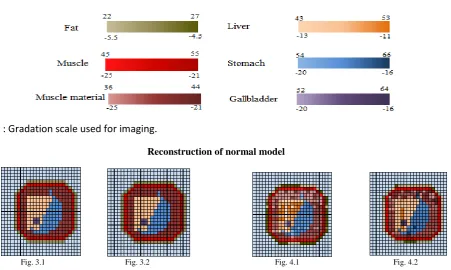
Numerical models are simulated using Force 209 Fortran and depicted using colour gradation scale.
Fig. 2 : Gradation scale used for imaging.
Reconstruction of normal model
Fig. 3.1 Fig. 3.2
Fig. 4.1 Fig. 4.2
Fig. 3.1 & Fig. 3.2 : Real and imaginary values of complex permittivity of normal model; Fig. 4.1 & fig. 4.2: Reconstructed real and imaginary values of complex permittivity of normal model.
Reconstruction of diseased model
The model under study is the same as that considered in earlier case, except its stomach region is affected by some disease and hence characterized by a different value of complex permittivity (66-j19.8) where as for normal stomach it is assumed as (60-j18).
Fig. 5.1 Fig. 5.2 Fig. 6.1 Fig. 6.2 Fig. 5.1 & fig. 5.2: Real and imaginary values of complex permittivity of diseased model;
TABLE I
AVERAGE VALUES OF PERMITTIVITY OF DIFFERENT ORGANS OF NORMAL MODEL
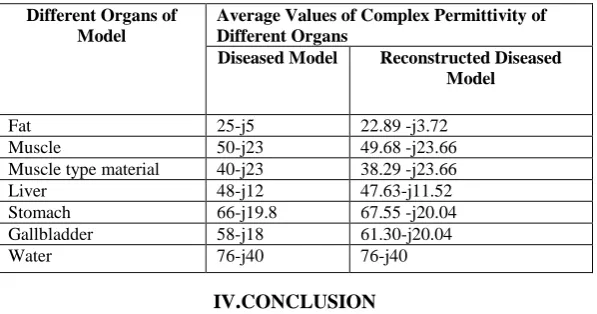
TABLE II
AVERAGE VALUES OF PERMITTIVITY OF DIFFERENT ORGANS OF DISEASED MODEL
IV
.
CONCLUSIONSo in this paper, Exact simultaneous iterative reconstruction algorithm has been discussed and validated on a semi human size normal biological model and a diseased model (stomach region is affected). The reconstructed image of normal model obtained by Exact SIRT has an average accuracy of 99.75%.
In case of diseased stomach model the real part of the reconstructed images obtained by using Exact SIRT show a great amount of deviations of complex permittivity from their normal values which indicate some ailment at the stomach region. The imaginary part of reconstructed image of diseased stomach region is able to indicate the affected portion and showing better resemblance with the diseased model and appears to be very promising for detection of diseased portion in its early stage even in larger model with large perturbation (not more than 20%).
Considering the quality of microwave images achieved so far, it can be concluded that future improvement in microwave imaging technique will help the medical professionals to detect the cancerous cells in early stage, to locate and measure edema, to inspect the infectious muscles and soft tissues structures and to measure lung water content more accurately. Thus microwave imaging technique will serve immense benefit to mankind.
Different Organs of Model
Average Values of Complex Permittivity of Different Organs
Normal Model
Reconstructed Normal Model
Fat 25-j5 23.24 -j3.82 Muscle 50-j23 50.26-j23.78 Muscle type material 40-j23 39.07-j23.78 Liver 48-j12 48.06-j11.53 Stomach 60-j18 61.34-j18.11 Gallbladder 58-j18 61.40-j18.11 Water 76-j40 76-j40
Different Organs of Model
Average Values of Complex Permittivity of Different Organs
Diseased Model Reconstructed Diseased
Model
Fat 25-j5 22.89 -j3.72
Muscle 50-j23 49.68 -j23.66 Muscle type material 40-j23 38.29 -j23.66 Liver 48-j12 47.63-j11.52 Stomach 66-j19.8 67.55 -j20.04 Gallbladder 58-j18 61.30-j20.04
REFERENCES
[1] K.Purkait & A.N.Datta, An Exact Algorithm for Microwave Tomography, presented at symposium HOT-2003,INRAPHEL,C.U.3rd-5th Feb.2003.
[2] Force 209 FORTRAN Compiler, www.lepsch.com.
[3] A.N. Datta & B. Bondopadhyay, Int J Electronics, Vol. 58, No.5 ,pp.831-832, 1985.
[4] A.N. Datta & B. Bandyopadhyay, An Improved SIRT-Style Reconstruction Algorithm for Microwave Tomography, IEEE Transactions on Biomedical Engineering, Vol. BME-32, No. 9, pp.719-723, September 1985.
[5] A N Datta & B. Bondopadhyay, Proc. of IEEE, Vol. 74, pp.604-606, 1986. [6] A N Datta & B. Bondopadhyay, Innov. Tech Biol. Med, Vol. 8, pp.409-416, 1987.
[7] K.Purkait & A.N.Datta, An Improved form of Iterative Reconstruction Algorithm for First Order and Second Order Microwave Image Reconstruction, Indian Journal of Pure & Applied Physics,CSIR,Vol.34,pp.420-424, June1996.
[8] J.H. Richmond, IEEE Trans. Antennas Propag. Vol. AP-B, pp 334-341, 1965.
[9] K.D. Prasad, Antenna & Wave propagation(ISBN No: 81-7684-025-4, 3rd edition, 2007). [10] K.T. McDonald, Radiation in the Near Zone of a Centre -Fed Linear Antenna (June21,2003) (http://puhep1.princeton.edu/~mcdonald/examples/linearantenna.pdf).
[11] K.T. McDonald, The Fields of a Short, Linear Dipole Antenna If There Were No Displacement Current(Joseph Henry Laboratories, Princeton University, Princeton, NJ 08544, July 5 , 2006).
[12] Kabita Purkait and Kalyan Adhikary “Application of Modified Cell Scanning Technique in Exact Algorithm for Medical Diagnosis”, IJTS Vol-21,pp.115-127,October 2012.
[13] Kabita Purkait and Kalyan Adhikary,” Modification in field measurement applied on exact algorithm for biomedical imaging”, IJMER, Vol. 2, Issue-3, pp. 1157-1161, May 2012.
[14 ] Herman Schwan and Kenneth Foster, RF-field interaction with biological systems: Electrical properties and biophysical mechanisms, Proc. of the IEEE, 68(1), 1980.
![Fig. 1: Block diagram of proposed experimental setup of model and data collecting system [16]](https://thumb-us.123doks.com/thumbv2/123dok_us/1530729.1187688/3.595.115.485.450.686/fig-block-diagram-proposed-experimental-setup-model-collecting.webp)