Copyright to IJIRSET www.ijirset.com 439
Effect of Copper Slag, Fly Ash and Granite
Power as a Partial Replacement in Fine
Aggregate
K.Kayathri1, C.Vigneshkumar2, M.Gohila Rani3, K.Karthik4
ME-CEM, Dept of Civil Engineering, KLN College of Information Technology, Madurai, TN, India1
ME-CEM, Dept of Civil Engineering, KLN College of Information Technology, Madurai, TN, India2
ME-CEM, Dept of Civil Engineering, KLN College of Information Technology, Madurai, TN, India3
ME-CEM, Dept of Civil Engineering, KLN College of Information Technology, Madurai, TN, India4
ABSTRACT: The demand for sand is the major problem for conventional construction recently. We need a best alternate construction material to fulfill the sand demand. In this paper we presents the results of an experimental investigation carried out to evaluate the mechanical properties of concrete mixtures in which fine aggregate (sand) was partially replaced with fly ash, copper slag and granite powder using M30 grade concrete. Fine aggregate (sand) was replaced with four
different percentages (0%, 25%, 50% and 75%) of fly ash, copper slag and granite powder by weight. Tests were performed for properties of fresh concrete. Compressive strength, split tensile strength were determined at 7, 14 and 28days. Test results indicate significant improvement in the strength properties of plain concrete by the inclusion of above mentioned industrial waste as partial replacement of fine aggregate (sand) and it can be effectively used in structural concrete. Concrete is an artificial conglomerate stone made essentially of Portland cement, water, sand and coarse aggregates. The mixture of the materials results in a chemical reaction called hydration and a change in the mixture from plastic to a solid state. The worldwide consumption of sand as fine aggregate in concrete production is very high, and several developing countries have encountered some strain in the supply of natural sand in order to meet the increasing needs of infrastructural development in recent years. A situation that is responsible for increase in the price of sand, and the cost of concrete.
KEYWORDS: Copper slag, Fly Ash, Granite powder, Compressive strength, Split tensile strength
I. INTRODUCTION
Concrete is the widely used structural material in the world today. The demand to make this material lighter has been the subject of study that has challenged scientists and engineers alike. The challenge in making a lightweight concrete is decreasing the density while maintaining strength and without adversely affecting cost. Introducing new aggregates into the mix design is a common way to lower a concrete’s density. Normal concrete contains four components, cement, crushed stone, river sand and water. The crushed stone and sand are the components that are usually replaced with lightweight aggregates.
Copyright to IJIRSET www.ijirset.com 440
In this paper we presents the results of an experimental investigation carried out to evaluate the mechanical properties of concrete mixtures in which fine aggregate (sand) was partially replaced with fly ash, copper slag and granite powder using M30 grade concrete.
Fine aggregate (sand) was replaced with four different percentages (0%, 25%, 50% and 75%) of fly ash, copper slag and granite powder by weight. Tests were performed for properties of fresh concrete. Compressive strength, split tensile strength were determined at 7, 14 and 28days. Test results indicate significant improvement in the strength properties of plain concrete by the inclusion of above mentioned industrial waste as partial replacement of fine aggregate (sand) and it can be effectively used in structural concrete.
II MATERIALS USED
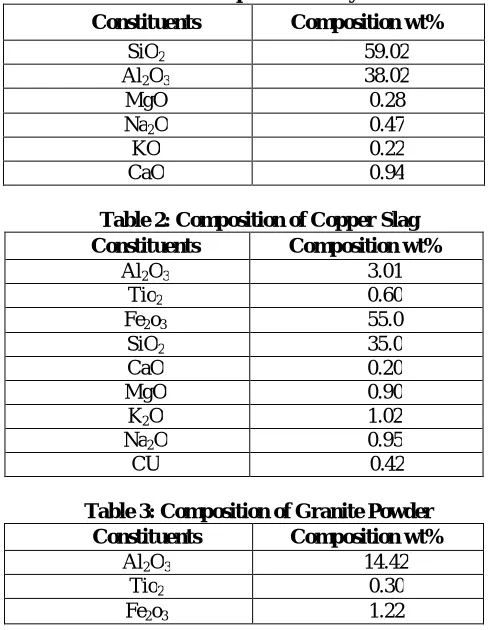
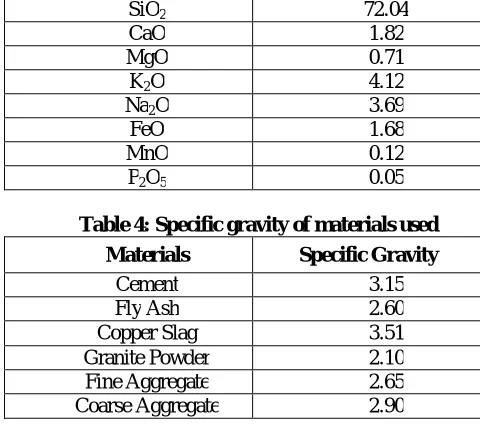
Ordinary Pozzolana cement (OPC) 43grade conforming to IS 12269:1987 and ASTM type 1 specifications was used. Natural river sand owing to their rounded shape was used in this work to ensure a better packing characteristic than that of the crushed sand. The grading of sand satisfied the IS: 383:1970. Fly Ash (FA) was taken from Tuticorin Thermal Power Plant and its chemical composition is given in Table 1. Copper Slag (CS) used in this work was brought from Sterlite Industries Ltd (SIL), Tuticorin and its chemical composition is given in Table 2. Granite Powder (GP) is a commercially available material, collected from K.R Traders, Madurai and its chemical composition is given in the Table 3. Crushed 20-mm (maximum) graded quartzite aggregate was used as coarse aggregate. The overall grading requirement of coarse aggregate satisfied ASTM C 33-03 and IS: 383:1970. The specific gravity of materials used in the mix is given in Table 4.
Table 1: Composition of Fly Ash Constituents Composition wt%
SiO2 59.02
Al2O3 38.02
MgO 0.28
Na2O 0.47
KO 0.22
CaO 0.94
Table 2: Composition of Copper Slag Constituents Composition wt%
Al2O3 3.01
Tio2 0.60
Fe2o3 55.0
SiO2 35.0
CaO 0.20
MgO 0.90
K2O 1.02
Na2O 0.95
CU 0.42
Table 3: Composition of Granite Powder Constituents Composition wt%
Al2O3 14.42
Tio2 0.30
Copyright to IJIRSET www.ijirset.com 441
SiO2 72.04
CaO 1.82
MgO 0.71
K2O 4.12
Na2O 3.69
FeO 1.68
MnO 0.12
P2O5 0.05
Table 4: Specific gravity of materials used Materials Specific Gravity
Cement 3.15
Fly Ash 2.60
Copper Slag 3.51
Granite Powder 2.10
Fine Aggregate 2.65
Coarse Aggregate 2.90
III.EXPERIMENTALPROGRAMME
A. Design Mix
Normal strength concrete of grade M30 is used for this study. The water cement ratio of 0.42 is used. The cement with coarse aggregate to fine aggregate ratio used is 1:1.87:3.5. The quantity of materials used is given in Table 5. The mix design was prepared based on the guidelines of IS: 10262(1982).
B. Casting and Curing of specimens
Nine cubes each of size 150mm x150mm x 150mm are prepared and tested at an age of 7,14 and 28 days. The concrete mix was designed as per code IS 10262(1982). The constituents materials are weigh batched. The specimens are cast in steel moulds. The specimens are demoulded on the next day. The specimens are cured by immersing in water. Specimens were tested for age of 7, 14 and 28 days. Nine specimens are tested on each day using compression testing machine and tensile testing machine. The compressive strength and tensile strength is determined and reported in this paper.
Table 5: Mix used in this study
Specimen Materials
Cement FA CA Ash Slag Granite
CCGF0 100% 100% 100% - - -
CCGF 25 100% 75% 100% 8.33% 8.33% 33%
CCGF 50 100% 50% 100% 16.67% 16.67% 16.67%
Copyright to IJIRSET www.ijirset.com 442
C. Design Mix
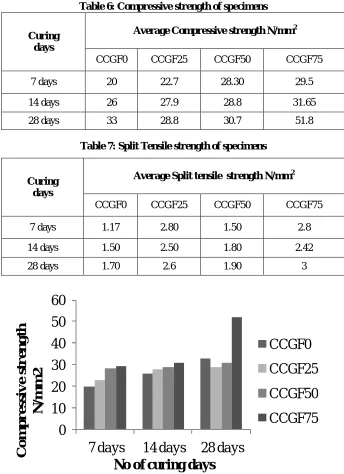
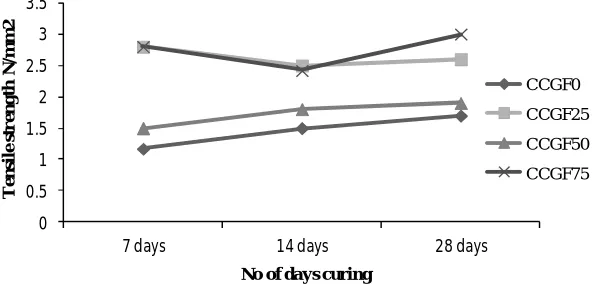
The test data is given in Table 6, 7. The test results are also given in Fig 1, 2.
Table 6: Compressive strength of specimens
Table 7: Split Tensile strength of specimens
Fig 1: Comparison of Compressive strength with different ages Curing
days
Average Compressive strength N/mm2
CCGF0 CCGF25 CCGF50 CCGF75
7 days 20 22.7 28.30 29.5
14 days 26 27.9 28.8 31.65
28 days 33 28.8 30.7 51.8
Curing days
Average Split tensile strength N/mm2
CCGF0 CCGF25 CCGF50 CCGF75
7 days 1.17 2.80 1.50 2.8
14 days 1.50 2.50 1.80 2.42
28 days 1.70 2.6 1.90 3
0
10
20
30
40
50
60
7 da ys
14 days
28 da ys
C
o
m
p
r
e
ssi
v
e
s
tr
e
n
g
th
N
/m
m
2
No of curing days
CCGF0
CCGF25
CCGF50
Copyright to IJIRSET www.ijirset.com 443
Fig 2: Comparison of Tensile strength with different ages
D. Results and Discussion
The test results are given in Table 6 and 7. As a result the compression strength attains with the 75% replacement of cement with Fly Ash, Copper slag, Granite powder is found to be greater strength compared to all other mixes. While considering tensile strength, CCGF25 decreases by days of curing. At the replacement of FA, CCGF0 and CCGF50 increase by days of curing. At the replacement of FA, CCGF75 decrease and then suddenly increases with days of curing.
IV.CONCLUSION
The strength of concrete is determined by the properties of Copper slag, Granite powder, Fly ash and percentage replacement. From the experimental results and discussion, the combination of CCGF has a potential of High strength in concrete. The combination of CCGF can reduce the material cost so that construction cost becomes low and abundant industrial waste. Sustainable in nature prevents the industrial wastes for environment degradation. The compressive strength of various mixes of Copper slag, Granite powder, and Fly ash fiber in concrete at 28days will be 51.8 N/mm 2.
REFERENCES
[1] Semsi Yazici and Hasan Sahan Arel, “Effects of flyash fineness on the mechanical properties of concrete,” Indian Academy of Science, vol. 37, pp. 389-403, June 2012.
[2] C. Freeda Christy and D. Tensing, “Effect of Class F flyash as partial replacement with cement and fine aggregate in mortar,” Indian Journal of Engineering and Material Sciences, vol. 17, pp. 140-144, April. 2010.
[3] Dr. G. Prince Arul Raj, A. Adin and T. Suresh Kannan, “Granite Powder Concrete,” IRACST-Engineering Science and Technology, vol. 3, no. 1, pp. 193-198, Feb 2013.
[4] R. R. Chavan and D.B. Kulkarni, “Performance of Copper slag on strength properties as partial replace of Fine aggregate,” International Journal of Advanced Engineering Research and studies, vol. 37, pp. 95-98, July-Sept 2013.
[5] B. Bhobasher, M.Asce, R. Devaguptapu and A. M. Arino, “Effect of Copper Slag on the Hydration of Blended Cementations Mixture,” Proceedings, ASCE, Materials Engineering Conference, pp. 1677-86, 1996.
[6] Dr. T. Felix Kala, “Effect of Granite Powder on strength properties of Concrete,” International Journal of Engineering and Sciences, vol. 2, pp. 36-50, May 2013.
0 0.5 1 1.5 2 2.5 3 3.5
7 days 14 days 28 days
T
en
si
le
s
tr
en
g
th
N
/m
m
2
No of days curing
CCGF0
CCGF25
CCGF50