18th International Conference on Structural Mechanics in Reactor Technology (SMiRT 18) Beijing, China, August 7-12, 2005 SMiRT18-H07-7
INFLUENCE OF THE MIX PARAMETERS AND MICROSTRUCTURE
ON THE BEHAVIOUR OF CONCRETE AT HIGH TEMPERATURE
KANEMA M.
Université de Cergy-Pontoise, France
NOUMOWE A.*
Université de Cergy-Pontoise, France
Phone: 331 3425 6916, Fax: 331 3425
6941
[email protected]
GALLIAS J.L.
Université de Cergy-Pontoise, France
CABRILLAC R.
Université de Cergy-Pontoise, France
ABSTRACT
Concrete is used in structures likely to be exposed to high temperature. Data on the behaviour of concrete at high temperature are necessary to design buildings and other civil engineering structures in order to resist under accidental conditions (fire) or particular conditions of service (storage of radioactive waste).
The present experimental study was carried out on the behaviour of five concretes containing the same nature and quantity of aggregates and presenting different water/cement ratios. Concrete specimens were submitted to heating - cooling cycles whose maximum temperatures were 150, 300, 450 and 600 °C. Measurements of compressive and tensile strength, modulus of elasticity and permeability were carried out on cylindrical specimens before and after heating – cooling cycles.
The results showed the influence of concrete mix parameters on the residual properties and the dehydration of the cement paste matrix, the evolution of the permeability and thermal stability of concrete when it is subjected to high temperature.
Keywords: concrete, temperature, mechanical strength, dehydration, permeability.
1. INTRODUCTION
3, 4]. These phenomena (build up of pressure, increase of mechanical stresses) are coupled and simultaneous and seem to depend mainly on the mortar matrix of the concrete [5, 6, 7]. In the present study, we investigated the influence of the mixture parameters (characteristics of the cementing matrix) and microstructure on the behaviour of a concrete element subjected to elevated temperature. Five formulations of concrete were carried out in which the quantities of cement and water varied while the volume and the characteristics of the granular skeleton were kept constant. The cement content of the five studied concretes were 325, 350, 400, 450 and 500 kg/m3. Cylindrical concrete specimens were heated in a furnace according to four heating - cooling cycles which maximum temperature were 150°C, 300°C, 450°C and 600°C. Compression and splitting tensile tests, and permeability measurements were carried out before and after the heating-cooling cycles in order to determine initial and residual properties of the studied concretes. Complementary measurements of concrete mass losses and temperature field in various points of the specimen were carried out during the heating – cooling cycles. The results obtained make it possible to understand certain concrete degradation phenomena and to draw conclusions on the behaviour of concrete elements exposed to high temperature.
2. CONCRETE MIXES
2 1. MATERIALS
Cement CEM I 52,5 coming from the factory of Villiers-au-Boin (in France) was used to make the concrete mixes. Three granular phases coming from the same career were also used :
• a semi-crushed siliceous gravel of class 10/20 mm.
• a rolled siliceous fine gravel of class 5/10 mm.
• a rolled siliceous sand of class 0/5 mm.
• a high water reducing superplasticizer CIMFLUID 2002 containing modified polycarboxylate was employed (with different contents) to ensure a satisfactory workability of the studied concrete mixtures. Its density at 20°C is 1100 kg/m3. Its pH is 7 ± 1. The dried material is 35.0 ± 1,7 %. The advised content of CIMFLUID 2002 is in the range from 0.2 to 2 kg for 100 kg of cement.
2 2. FORMULATIONS
Table 1: Composition of the studied concretes
Components (kg/m3) B325 B350 B400 B450 B500
Cement 325 350 400 450 500
Gravel 960 960 960 960 960
Fine gravel 89 89 89 89 89
Sand 740 740 740 740 740
Water 202 194 177 160 143
Superplasticizer (dry extract) 0 0.35 1.04 1.73 2.43
W/C 0.62 0.55 0.44 0.36 0.29
A/C (dry extract) 0.00% 0.10% 0.26% 0.39% 0.49%
Theoretical vol. mass (kg/m3) 2316 2333 2367 2401 2435
2 3. SPECIMENS AND CONSERVATION
Cylindrical specimens (16x32 cm, 15x30 cm and 11x22 cm) were made. Two type K thermocouples were embedded in fresh concrete 16x32 cm specimens. These thermocouples make it possible to measure the temperature in the center and semi-ray of the specimens and deduce the thermal gradients. After casting, the specimens were wrapped in a plastic sheet and cured at ambient temperature during three days, before being demoulded and stored in water. The mechanical and thermal tests were carried out when the specimens were 28 days old.
3. HEATING AND MECHANICAL TESTS
3 1. HEATING– COOLING CYCLES
The specimens were heated in an electric furnace. Four heating - cooling cycles from 20 °C to 150 °C, 300 °C, 450 °C and 600 °C were applied. The first phase of the cycle is heating rise ramp. The temperature increases at 1 °C/min from 20 °C to the maximum target temperature. The second phase is a constant temperature dwell at the maximum target temperature for one hour. The last phase is a cooling ramp. The temperature decreases at approximately 1 °C/min until the room temperature. The chosen heating and cooling rates refer to the recommendations of the RILEM TC-129 technical committee [8]. The four heating - cooling cycles are presented on figure 1.
For each heating – cooling cycle, various sizes of cylindrical specimens (11x22 cm, 16x32 cm, 15x5 cm) were tested. The placement of the specimens in the furnace was carried out so as to get a quite homogeneous temperature around the specimens.
Additional thermocouples were placed on the surface of the specimens. All the thermocouples (those placed on the surface and those inserted in the specimens) were connected to an automatic acquisition unit. A regulator-programmer allowed to control the furnace temperature and to carry out the desired cycle.
In addition a 11x22 cm cylindrical specimen was hanged to a load cell in order to measure the weight of the concrete specimen during the heating – cooling cycle. The used device makes it possible to measure, plot and store the specimen mass variation during the heating – cooling cycle.
3 2. MECHANICALS TESTS
1. Compression test
The French standard NF P 18-406 was followed for the measurement of the concrete compressive strength. 11x22 cm cylindrical specimens were used to characterize the compressive strength of the concrete before and after the heating – cooling cycles. Four specimens were tested for each cycle.
2. Splitting tensile test
The French standard NF P 18-408 was followed for the measurement of the concrete tensile strength. For reasons of homogeneity of the results, 11x22 cm cylindrical specimens were kept for the measurement of the concrete tensile strength. Four specimens were tested for each cycle.
3. Modulus of elasticity measurement
Measurement of the modulus of elasticity was carried out on three 16x32 cm specimens for each heating – cooling cycle. The secant modulus of the stress-strain curve was measured by applying 70 % of the specimen yield load.
3 3. PERMEABILITY TEST
CEMBUREAU permeameter with constant pressure of Nitrogen was used to determine the concrete apparent permeability. The apparent permeability of concrete was measured. Intrinsic permeability Kv can be obtained by considering the relation suggested by Klinkenberg which takes into account the slip of the gas molecules on the concrete pores and cracks walls.
) 1 ( *
P b
v k
k = + with
Kv : intrinsic permeability (m²)
B * : slope at the curve origin
P
: Average pressure (Pa)after the heating – cooling cycle. Non-heated samples undergo a simple drying at 80 °C until constant mass before testing.
3 4. CONCRETE MASS LOSS DURING THE HEATING – COOLING CYCLE
The knowledge of the specimen mass loss during the heating - cooling cycle makes it possible to determine the part of eliminated water according to the applied heating – cooling cycle.
3 5. TEMPERATURE DIFFERENCES AND THERMAL GRADIENT
The two thermocouples embedded in the concrete specimen made it possible to measure the temperature at the centre and at the middle-ray of the specimen during the cycle. A third thermocouple was placed on the surface of the specimen.
The three thermocouples thus made it possible to measure the temperature field within the specimen during the heating – cooling cycle and to calculate the thermal gradient.
4. EXPERIMENTAL RESULTS
4 1. MECHANICAL STRENGTH
Figure 2 presents the residual compressive strength of the studied concrete mixtures as a function of the maximum temperature of the heating – cooling cycle. It can be noticed that all the curves of residual compressive strength included two parts. In the first part, from 20 °C until 300°C or 350 °C, various evolutions of strength were observed. B325 concrete presented almost no compressive strength decrease. B350 and B400 concretes presented a weak decrease of compressive strength between 20 °C and 150 °C and then an equivalent increase between 150 °C and 300 °C. B450 and B500 concretes presented a quasi continuous increase between 20 °C at 300 °C or 350 °C.
On the other hand for temperatures higher than 300°C or 350°C, compressive strength decreased significantly whatever the concrete. When the studied concretes were heated at 600 °C, the residual compressive strength was lesser than 10 MPa.
Figure 2: Residual compressive strength as
a function of temperature
Figure 3: Residual tensile strength as a function
of temperature
compressive strength (see figure 3). However no increase was observed for the tensile strength curves. Furthermore, the concretes with low cement content (B325 and B350) seemed to preserve their initial tensile strength until 150°C.
It appeared that when the tested concrete mixtures were heated up to 300 °C or 350 °C the mechanical strength was slightly influenced by the heating whereas from 300 °C or 350 °C to 600 °C it decreased very significantly and became quasi negligible at 600 °C.
4 2. MODULUS OF ELASTICITY
The evolution of the residual modulus of elasticity of the tested concrete mixtures is presented on figure 4. It could be noticed that contrary to the mechanical strength, the modulus of elasticity of the tested concretes was regularly deteriorated by the heating. This deterioration was quasi linear from 20 °C to 300 °C and accentuated from 350 °C to 450°C. After a heating at 600 °C the tested concretes specimens did not have a significant rigidity.
Figure 4: Residual modulus of elasticity as a function of temperature
4 3. PERMEABILITY
Figure 5: Intrinsic permeability as a function of temperature
4 4. CONCRETE MASS LOSS
Figures 6 and 7 present the evolution of mass loss during the heating - cooling cycles of the studied concrete mixtures. It was observed that before 150 °C, the variation of mass is very weak. The mass loss in this temperature range corresponds mainly to the escape of the concrete interstitial water. Between 150 and 300 °C, one could observe a strong mass loss for all the tested concretes. It corresponds to the decomposition of cement hydrates and represents about 65 to 80 % of the total water in the concrete. Each concrete loosed between 5 and 6 % of its initial mass. Knowing that the total water in the concretes is 6 to 9 % of the concrete mass, we could notice that the main part of the water contained in each concrete escaped during the heating between 150 and 300 °C. The other part of water (between 1 and 3 % of the concrete mass) was evacuated at temperatures beyond 300 °C.
By comparing the evolutions of the mechanical strength, the permeability and the mass loss, we could notice that the significant strength decrease (after 300 °C) occurred after a significant mass loss. That seemed to confirm that the heating between 150 °C and 300 °C induced the decomposition of the cement hydrates without significant effect on the concrete strength. The decomposition of cement hydrates beyond 300 °C induced a significant increase of permeability and a significant decrease of mechanical strength.
Figure 6: Concrete mass loss as a
function of time (heating – cooling cycle
at 450 °C)
Figure 7: Concrete mass loss as a function
of the specimen surface temperature (for
B450 concrete subjected to three heating –
cooling cycles)
4 5. TEMPERATURE DIFFERENCES AND THERMAL GRADIENTS
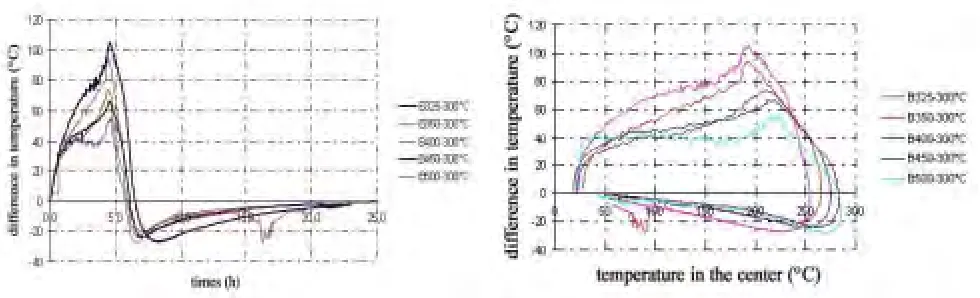
during the heating - cooling cycle for a maximum temperature of 300 °C. For the five studied concrete mixtures the temperature differences increased, reached a maximum (when the temperature at the centre of the specimen was about 200 °C) and decreased after 200 °C. The maximum value was located near 105 °C and corresponded to a global thermal gradient in the specimen of approximately 13 °C/cm. High thermal gradient may cause high thermal stresses in the concrete specimen. Numerical calculations are being carried out to confirm this assumption.
Figure 8: Temperature difference between
the surface and the centre of the
specimen as a function of time
Figure 9: Temperature difference between the
surface and the centre of the specimen as a
function of the temperature at the centre
5. DISCUSSION AND CONCLUSION
In the present study, five concrete mixtures with various cement contents and water cement ratios and a constant aggregate content were studied before and after heating – cooling cycles. The concrete cylindrical specimens were subjected to several tests : compression and splitting tensile tests, measurement of modulus of elasticity, heating – cooling cycles, measurements of thermal field and mass loss during the heating – cooling cycles, permeability tests.
The effect of the heating on the tested concretes was analyzed. The experimental results showed two temperature ranges :
A second temperature range from 300 to 600 °C was also observed. There was a major decrease in the mechanical properties, a weak mass loss, important thermal gradients probably leading to elevated thermal stresses and a deterioration of the tested concretes matrix from 300 to 600 °C.
BIBLIOGRAPHICAL REFERENCES
[1] HARMATHY T.Z., SHORTER G.W. Discussion one the fire concrete resistance of Prestressed beams. Proceedings, Institution of Civil engineers, 1961. Vol. 20 pp. 313-315
[2] BAZANT Z.P. Pore pressure and Drying of concrete at High temperature. Journal of the engineer mechanics. Oct 1978. pp. 1059 - 1079
[3] NISHIDA A., YAMAZAKI N., INOUE H., SCHENEIDER U., DIEDERICHS U. Study on properties of High Strength Concrete with short Polypropylene Fiber for Spalling Resistance. International Conf. On Concrete under severe Conditions. Sapporo, August 1995. 10 p
[4] NOUMOWE N.A., 1995 : Effet de hautes températures sur le béton. Cas particulier du béton à hautes performances. Thèse de doctorat INSA de Lyon.
[5] Kontani O. Shah S.P. Pore pressure in sealed concrete at sustained high temperatures, Concrete Under Severe Conditions: Environment and Loading, Vol. 2, Edited by K. Sakai, N. Banthia, O.E. Gjorv, 1995, pp. 1151-1162.
[6] Phan L.T., Carino N.J. Review of mechanical properties of HSC at elevated temperature, Journal of Materials in civil engineering, Vol. 10, N°1, 1998, pp. 58-64.
[7] KALIFA P. et al. Comportement à haute température des bétons à hautes performances : de l’éclatement à la microstructure. Cahiers du CSTB, 2002.