ISSN(Online): 2320-9801 ISSN (Print) : 2320-9798
I
nternational
J
ournal of
I
nnovative
R
esearch in
C
omputer
and
C
ommunication
E
ngineering
(An ISO 3297: 2007 Certified Organization)
Vol. 4, Issue 2, February 2016
Embedded Security Considering
Hardware Trojan
Bharath K B, Roopa K Swamy
Student, Dept. of E.C.E, SJBIT, Bangalore, India
Assistant Professor, Dept. of E.C.E, SJBIT, Bangalore, India
ABSTRACT: The security in today’s life is too difficult, since many hacking algorithms have been generated so that there is no security for the data. To provide security for the data, many intelligent have been developed different algorithms to safe the data. One of the techniques is the hardware Trojan. This paper attempts to provide a security for the data using the Hardware Trojan mechanism. The proposed algorithm used here is to provide the data only for the valid users. Questasim tool is used to implement and simulation of the system and Precision RTL tool used for simulation purpose. The algorithm used here provides the data in the secured way.
KEYWORDS: Hardware Trojans; Embedded security; password generation; Questasim, Precision RTL.
I. INTRODUCTION
In general, hardware Trojans try to bypass or destroy the three major security concerns of any system by: leaking confidential information and secret keys covertly to the adversary (Confidentiality attack); changing the value of a certain register (Integrity attack); disabling, deranging or destroying the entire hardware or components of it (Availability attack). Traditional Hardware testing strategies cannot effectively detect Trojans because the probability of triggering a Hardware Trojan during functional testing is extremely low. Plus, the small Trojan size with respect to chip overall size reduces the Trojan impact on side channels such as static and dynamic power.
A hardware Trojan (HT) is a malicious modification of the circuitry of an integrated circuit. A hardware Trojan is completely characterized by its physical representation and its behavior. The payload of an HT is the entire activity that the Trojan executes when it is triggered. In general, malicious Trojans try to bypass or disable the security fence of a system: It can leak confidential information by radio emission. HTs also could disable, derange or destroy the entire chip or components of it.
The main purpose of this algorithm is to secure the data from the hackers. In this case, the user id is inserted so that the valid user passwords will be stored in the Look Up Table (LUT). When user enters his user id, the password is automatically generated with respect to some function. The password is then compared with the passwords which is stored in the LUT. If the password matches, then that user id is allowed to take the data.
II. RELATED WORK
ISSN(Online): 2320-9801 ISSN (Print) : 2320-9798
I
nternational
J
ournal of
I
nnovative
R
esearch in
C
omputer
and
C
ommunication
E
ngineering
(An ISO 3297: 2007 Certified Organization)
Vol. 4, Issue 2, February 2016
III.PROPOSED ALGORITHM
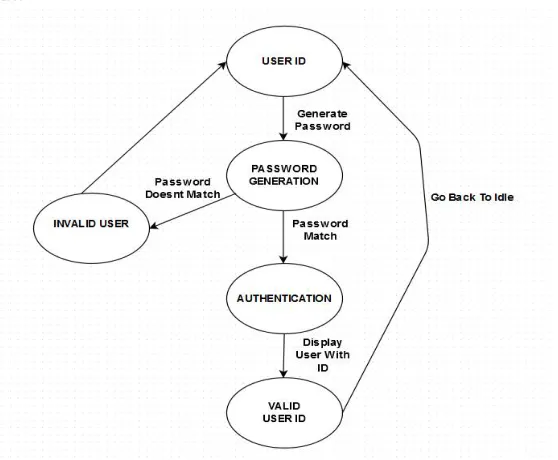
Once the password is generated, It is compared with the original password which has been stored in the LUTs. One of the three possible cases will happen, as shown in the figure 2.
If the password matches, then he is a valid user and he can proceed with the further things. If the password does not match, then he is an invalid user.
If the password matches, and the number of user exceeds more than the requirement, then it enters to the unauthorized state.
Figure 2: State Diagram of Implemented hardware Trojan.
IV.PSEUDO CODE
Step 1: At first User id is inserted by the user.
Step 2: According to some function f(x), the password for valid user id is stored in the LUT. Step 3: After user id is inserted, system generates the password.
Step 4: After the password is generated, it is compared to the password stored in LUT.
Step 5: If the password matches, then he is the valid user and the service is provided to user and go to step 1 else If the password does not match, then he is not a valid user.
Step 6: If more number of user id is entered, more than the valid number of users, then authentication is not done and goes to step 1.
Step 7: End.
V. SIMULATION RESULTS
ISSN(Online): 2320-9801 ISSN (Print) : 2320-9798
I
nternational
J
ournal of
I
nnovative
R
esearch in
C
omputer
and
C
ommunication
E
ngineering
(An ISO 3297: 2007 Certified Organization)
Vol. 4, Issue 2, February 2016
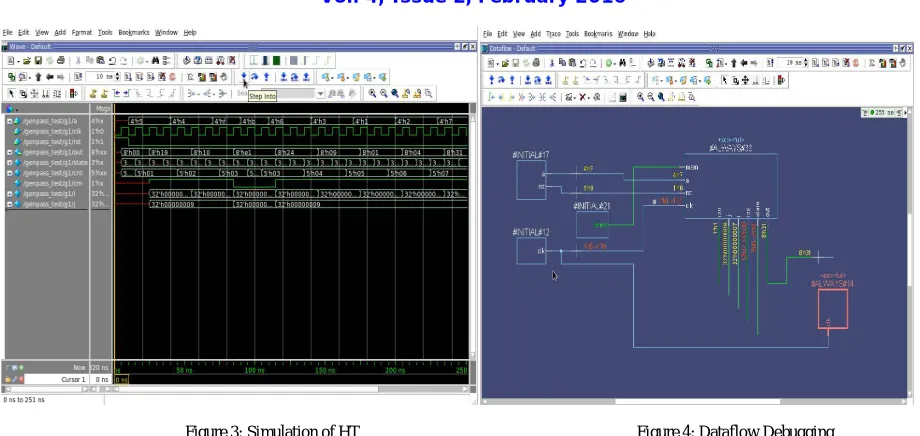
Figure 3: Simulation of HT Figure 4: Dataflow Debugging
The Dataflow window allows you to explore the "physical" connectivity of your design; to trace events that propagate through the design; and to identify the cause of unexpected outputs. The window displays processes; signals, nets, and registers; and interconnect which is as shown in Fig 4. Figure 5 represents the schematic view of Hardware Trojan where it specifies the way to check the physical connections. This tool will also generate a State Diagram according to the design what it is implemented. The expected state diagram is as shown in fig 6. Finally fig 7 represents the coverage report of the design. Code Coverage refers that how the test bench is effective considering all the possible cases
.
A program with high code coverage implies that, code is fully tested and software bugs are less. There are different types of code coverage such as statement coverage, branch coverage, condition coverage and toggle coverage. As shown in fig 7, all coverage is covered resulting the 100% code coverage.
ISSN(Online): 2320-9801 ISSN (Print) : 2320-9798
I
nternational
J
ournal of
I
nnovative
R
esearch in
C
omputer
and
C
ommunication
E
ngineering
(An ISO 3297: 2007 Certified Organization)
Vol. 4, Issue 2, February 2016
Figure 7: Coverage report.
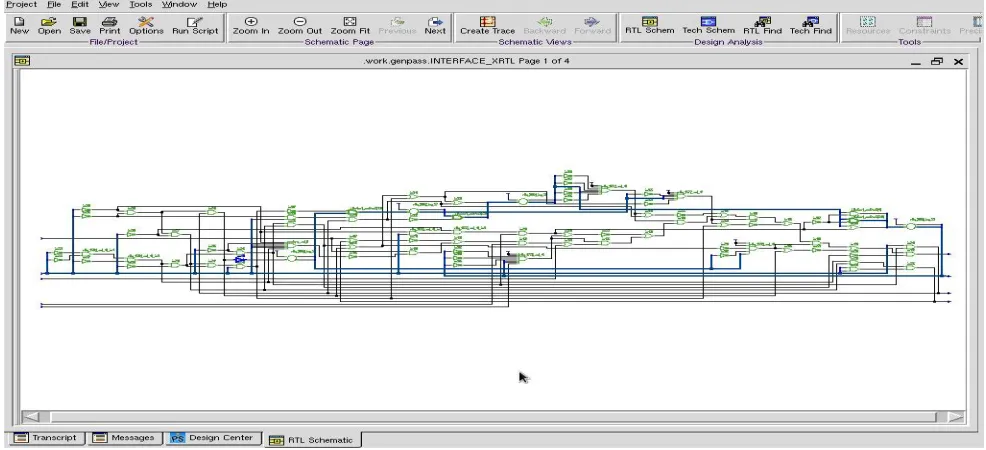
Figure 8 represents the RTL schematic window of the designed hardware Trojan where RTL refers as Register
Transfer Logic which is the basic level to develop any design. Figure 9 represents the Technology schematic is represented in terms of LUTs (Look Up Table) which are designed according to the specific fpga kit that is chosen for the development of the design. Technology schematic will be constructed in such a way that it is same as architecture of the chosen FPGA kit. Figure 10 represents the area report of the hardware Trojan.
ISSN(Online): 2320-9801 ISSN (Print) : 2320-9798
I
nternational
J
ournal of
I
nnovative
R
esearch in
C
omputer
and
C
ommunication
E
ngineering
(An ISO 3297: 2007 Certified Organization)
Vol. 4, Issue 2, February 2016
Figure 9: Technology Schematic.
Figure 10: Area report of designed HT.
VI.CONCLUSION AND FUTURE WORK
The simulation results showed that the proposed algorithm looks more secure so that unwanted users will not be given any service so that the data will be safe. This can be implemented for high security using the cryptographic algorithms so that only valid users can use the system and the service are given to them.
REFERENCES
1. HuafengLiu and HongweiLuo, Liwei Wang “Design of Hardware Trojan Horse Based on Counter” IEEE, ICQR2MSE, P No. 1007 - 1009,
2011.
2. R. S. Chakraborty, S. Narasimhan, and S. Bhunia, “Hardware trojan:threats and emerging solutions,” In Proceedings of IEEE Int’l
WorkshopHardware-Oriented Security and Trust (HOST 09), pp. 166-171, 2009.
3. Chunhua He, Guangzhou, Bo Hou, Liwei Wang, Yunfei En “A novel hardware Trojan detection method based on side-channel analysis and
ISSN(Online): 2320-9801 ISSN (Print) : 2320-9798
I
nternational
J
ournal of
I
nnovative
R
esearch in
C
omputer
and
C
ommunication
E
ngineering
(An ISO 3297: 2007 Certified Organization)
Vol. 4, Issue 2, February 2016
4. Yuan Cao; Chip-Hong Chang; Shoushun Chen, “A Cluster-Based Distributed Active Current Sensing Circuit for HardwareTrojan Detection”,
Information Forensics and Security, IEEE Transactions on Year: 2014, Volume: 9, Issue: 12, Pages: 2220 - 2231
5. M. Tehranipoor and F. Koushanfar, “A survey of hardware Trojan taxonomy and detection,” IEEE Design and Test of Computers, pp. 10-25,
2010.
6. Errui Zhou; Zhixun Zhao; Shaoqing Li; Lin Ni “Nonlinear analysis for hardware Trojan detection”, Signal Processing, Communications and
Computing (ICSPCC), 2015 IEEE International Conference on Year: 2015, P No. 1 – 4
7. He Li; Qiang Liu, “Hardware Trojan detection acceleration based on word-level statistical properties management”, Field-Programmable
Technology (FPT), 2014 International Conference on Year: 2014, P No. 153 – 160
8. Kumar, K.S.; Chanamala, R.; Sahoo, S.R.; Mahapatra, K.K. “An improved AES Hardware Trojan benchmark to validate Trojan detection
schemes in an ASIC design flow”, VLSI Design and Test (VDAT), 2015 19th International Symposium onYear: 2015, P No. 1 - 6
BIOGRAPHY
Bharath K B is an M.Tech student in the VLSI Design and Embedded System Department, S J B Institute of Technology, Bangalore, India.