A Survey on Cloudgenius: A Hybrid Decision
Support Method for Automating the
Migration of Web Application Clusters to
Public Clouds
Chirantan P. Dixit, Prof.Dr.B.D. Phulpagar
Department of Computer Engineering, P.E.S.MCOE, Savitribai Phule Pune University, Maharashtra, India
Department of Computer Engineering, P.E.S.MCOE, Savitribai Phule Pune University, Maharashtra, India
ABSTRACT: One of the key problems in migrating multi-component enterprise applications to Clouds is selecting the best mix of VM images and Cloud infrastructure services. A migration process has to ensure that Quality of Service (QoS) requirements are met, while satisfying conflicting selection criteria, e.g. throughput and cost. When selecting Cloud services, application engineers must consider heterogeneous sets of criteria and complex dependencies across multiple layers impossible to resolve manually. To overcome this challenge, we present the generic recommender framework CloudGenius and an implementation that leverage well known multi-criteria decision making technique Analytic Hierarchy Process to automate the selection process based on a model, factors, and QoS requirements related to enterprise applications. In particular, we introduce a structured migration process for multi-component enterprise applications, clearly identify the most important criteria relevant to the selection problem and present a multi-criteria-based selection algorithm. Experiments with the software prototype CumulusGenius show time complexities. In the last few years, cloud computing as a new computing paradigm has gone through signicant development butalso faces many problems. One of them is the cloud service selection problem, since increasingly boosting cloud services are orderedthrough the Internet, while some of them may be not reliable or even malicious, thus how to select trustworthy cloud services forcloud users is a big challenge. In this paper, we propose a multi-dimensional trust-aware cloud service selection mechanism based onEvidential Reasoning (ER) approach that integrates both perception-based trust value and reputation based trust value, which arederived from direct and indirect trust evidence respectively, to identify trustworthy services. Here, multi-dimensional trust evidence,
Which reacts the trustworthiness of cloud services from di_erent aspects, is elicited in the form of historical users feedback ratings? Then, the ER approach is applied to aggregate the multi-dimensional trust ratings to attain the real-time trust value so as to select the most trustworthy cloud service of some certain type for the active users. Finally, the fresh feedback from the active users will update the trust evidence for other service users in the future.
KEYWORDS: Cloud migration, migration process, selection problem, criteria set, decision-making, decision support,
Cloud Service Selection, Multi-dimensional Trust Evidence, Trust and Reputation Evaluation, Evidential Reasoning.
I. INTRODUCTION
to the actual use. Elasticity, cost benefits, and abundance of resources motivate many organizations to migrate their enterprise applications to Clouds. [3]There are two application engineering layers for compute services: a) software resource, where an engineer builds applications using APIs provided by the Cloud. A software resource (also referred to as an appliance or VM image) is a pre-configured, virtualization-enabled, self-contained, and pre-built Virtual Machine (VM) image that can be integrated with other compatible VM images for architecting complex applications. Major providers at this layer include thecloudmarket. com, 3Tera Applogic, and BitNami; and b) Infrastructure as a Service (IaaS) (hardware resources), where an engineer runs software applicationson compute services, using the APIs provided to leverage other infrastructure services. A VM instance is essentially a piece of virtualization software (e.g. Xen, KVM, etc.) running on physical Cloud servers. It is the most common method of exposing the computational power (e.g. CPU cores, physical memory, storage capacity, etc.) to software applications. Amazon EC2, GoGrid, and Rackspace are among the major providers of virtualized hardware resources as services. Aweb application is a computer software application,which interacts with users through a frontend programmedusing browser-based language (such as JavaScriptand HTML). Web applications are typically accessed by millionsof users over the internet via a common web browser software (e.g., Internet explorer, Firefox, etc.). Commonweb applications include webmail,
online retail sales, onlineauctions, wikis and the like. Cloud computing is a gradually maturing computing service
paradigm where infrastructure and software resourcesare provided over the Internet as scalable and on demand(Web) services [1]. In a cloud computing environment, thereare a mass of service providers that develop and deliver services to external users. With cloud environment becoming more complicated and unpredictable, cloud services arenot always trustworthy, and the Service Level agreements
(SLAs) may not satisfy user’s requirements. On the other hand, in a cloud environment, it is actually required that users give up their physical control to their applications and the underlying operations may be transparent to them. The above mentioned issues caused the major concerns of cloud service users, which can be concluded as follows: (1) whether the cloud service providers, especially those new comers, can be trusted or not. Users have to make sure that the cloud providers will not spy their data or sell them to their competitors. Besides, the cloud service providers should protect their data and applications from any way of damage; (2) whether the services are available all the time or not, as users usually care about the property of plug and play, just as the applications which are equipped on local disks; and (3) whether other non-functional requirements such as Quality of Services (QoS), are provided by cloud according to SLA. Thus, users will not trust a cloud service just considering one factor, but for many properties they concern, that is, the trust evidence should be multi-dimensional so as to reactdifferent aspects of the performance of the cloud services.
II. RELATED WORK
1. CloudGenius: Automated Decision Support forMigrating Multi-Component Enterprise Applications to
Clouds
From this paper we Refer-
2. A Data Outsourcing Architecture Combining Cryptography and Access Control From this paper we Refer-
The paper explored many important issues that arise when enforcing access control in a scenario where data are stored and ordered to clients by an external server. We then presented a novel data outsourcing access control architecture for supporting flexible applications, preserving privacy and empowering the user. We also described an approach forpolicy evolution that takes into account the main features ofthe scenario and is able to guarantee in most cases confidentiality of the information in the presence of signicant policy updates, clearly identifying the exposure to collusion when this risk may arise. Other issues to be investigated include the integration with the Web paradigm, and the efficient execution of queries.
3. Achieving Secure Role-Based Access Control on Encrypted Data in Cloud Storage
From this paper we Refer-
With the rapid developments occurring in cloud computing and services, there has been a growing trend to use the cloud for large-scale data storage. This has raised the important security issue of how to control and prevent unauthorized access to data stored in the cloud. One well known access control model is the role based access control (RBAC), which provides flexible controls and management by having two mappings, users to roles and roles to privileges on data objects. In this paper, we propose a role-based encryption (RBE) scheme that integrates the cryptographic techniques with RBAC. Our RBE scheme allows RBAC policies to be enforced for the encrypted data stored in public clouds. Based on the proposed scheme, we present a secure RBE-based hybrid cloud storage architecture that allows an organization to store data securely in a public cloud, while maintaining the sensitive information related to the organization’s structure in a private cloud. We describe a practical implementation of the proposed RBE-based architecture and discuss the performance results. We demonstrate that users only need to keep a single key for decryption, and system operations are efficient regardless of the complexity of the role hierarchy and user membership in the system.
4. Trust-Based Access Control Model for Pervasive Computing Applications
From this paper we Refer-
With the rapid growth in wireless networks and sensor and mobile devices, we are moving towards an era of pervasive computing. Access control is challenging in these environments. In this work, we propose a trust based approach for access control for pervasive computing systems. Our previously proposed belief based trust model is used to evaluate the trustworthiness of users. Fine-grained access control is achieved depending on the trust levels of users. We develop a class of trust-based access control models having very formal semantics, expressed in graph theory. The models differ with respect to the features they provide, and the types of the trust constraints that they can support.
5. Methods Migration from On-premise to Cloud
From this paper we Refer-
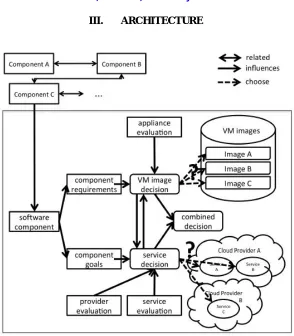
III. ARCHITECTURE
Figure 1: Overview of the Selection Problem
Explanation
IV. PROPOSED SYSTEM MECHANISM
Figure 2: Architecture of Cumulus Genius
CloudGenius Framework-
A migration of an IT system formation to Cloud infrastructures is complex and demands the choice of adequate Cloud infrastructure services and Cloud VM images for every component within the formation. We propose CloudGenius, a framework that guides through a Cloud migration process that provides methods that support multi-criteria-based decisions on selecting a Cloud VM images and Cloud infrastructure services component-wise. In the following subsections we present the process and give details on the formal model of the selection problem, the required user input and flexibilities, and the selection and combination steps that choose an image and service from the abundance of offerings and find the best combination. Finally, an alternative evaluation variant is addressed.
a. Multi-Component Cloud Migration Process
CloudGenius’ migration process for IT system formations in Business Process Model and Notation (BPMN) 2.0. The process is divided in two lanes: (1)”user input” lane with domain experts such as application engineers providing input and (2)”CloudGenius” lane where steps are completed by an implementation of the framework. The process allows for a loop enabling a component-wise migration and cycles for step-wise, incremental improvements of every component’s migration. Within the cycles engineers have to define requirements and preferences and CloudGenius applies the (MC2)2decision-making framework to recommend a ranked VM image and Cloud service combinations for a certain component.
b. Formal Model of CloudGenius
Cloud trust issues:
1 Multiple trustworthiness factors in cloud
Basically, uncertainties can result in untrustworthiness in cloud services. In cloud service system, a range of uncertainties, such as bugs, faults, breakdowns or misbehaviors from the underlying system infrastructure to the service interface level can impact on trust. Obviously that the larger uncertain the cloud service system is, the less trustworthiness it can achieve. Based on the main concerns to cloud services, we conclude the following three aspects of key requirements for trust:
a. The key requirements to the system operational performance: under this level the attributes are usually quantitative and can be acquired from the system records or simulation experiments.
b. The key requirements to the QoS: In the context of web services, it requires a precise description of the nonfunctional properties of the services ordered. Some of the service properties such as throughout, scalability, latency, etc, are commonly referred to as Quality of Service.
c. The key security and privacy requirements to cloud services: the concerns on this aspect are cloud-specific or need to be considered more, as the characteristics of cloud computing environment is more uncertain and dynamic than the traditional computing environments.
So the privacy concern is located an important facet of cloud service trustworthiness.
Table 1 shows the details of the requirements to cloud service trustworthiness respectively on the three aspects. In Table 1, the key requirements are tightly related to the trust from users to services. Here, the definition of trust is inherited from trust is a level of belief representing the relationship established between two entities for a specific action, i.e., the trust that entity A (usually a user’s) places in entity B (usually a Service Provider (SP)) is the degree of entity As certainty (or belief) that entity B will behave a specific action with required standard which will satisfy entity As request. In this sense, trust can be considered as the trustworthiness indicator of the service that a SP can provide, which is also a subjective evaluation measurement from the perspective of users. We propose a multi-indicator evaluation system to evaluate di_erent aspects of the SPs interactions with the users, based on which generates multi- dimensional trust evidences.
2 Trust evidence in cloud
In general, the trust evidence of a service for a user can be divided into two categories, one is the historical records of his/her direct interactions with the service; the other is the direct interaction records of other users with the service. Therefore, as for services users, there are mainly two types of evidence that can be used for service trustworthiness evaluation, which are respectively: 1) direct evidence: it is derived from the direct service interactions between the
V. CONCLUSION
From the Consideration of all the above points we conclude that, we presented the CloudGenius recommender framework that transforms Cloud service selection from manual time-consuming scripting to a process that is flexible, and to a large extend automated. It provides a migration process and helps enterprise application engineers to select best resource mix at both software and IaaS layers over provider boundaries. We believe that CloudGenius framework leaves space for a range of enhancements and, yet, provides an amicable approach. To our knowledge no existing approach has addressed the problem of inter-dependencies between software and IaaS layers while selecting software and hardware resources for Cloud-based engineering of enterprise applications.
REFERENCES
2. Sabrina De Capitani di Vimercati “A Data Outsourcing Architecture Combining Cryptography and Access Control” ACM, (2007). Fairfax, Virginia, USA, November 2, 2007http://doi.acm.org/10.1145/1314466.1314477.
3. Lan Zhou “Achieving Secure Role-Based Access Control on Encrypted Data in Cloud Storage” IEEE TRANSACTIONS ON INFORMATION FORENSICS AND SECURITY, VOL. 8, NO. 12, DECEMBER 2013
4. ManachaiToahchoodee, “A Trust-Based Access Control Model for Pervasive Computing Applications” Department of Computer Science Colorado State University Fort Collins CO 80523-1873