ISSN(Online): 2320-9801 ISSN (Print): 2320-9798
I
nternational
J
ournal of
I
nnovative
R
esearch in
C
omputer
and
C
ommunication
E
ngineering
(An ISO 3297: 2007 Certified Organization)
Vol. 4, Issue 2, February 2016
Implementing Cryptography on the Concept
of Returning Back Its Own Nest of a Bird
Anupam Mondal1, Prof. Dr Pranam Paul2
MCA Final Year Student, Narula Institute of Technology, Agarpara, Kolkata, West Bengal, India1
HOD, Department of Computer Application, Narula Institute of Technology, Agarpara, Kolkata, West Bengal, India2
ABSTRACT-Cryptography is a Greek word that’s means is Hidden Secret. In any communication, security is the most important issue in today’s world. Lots of data security and data hiding algorithms have been developed in the last decade, which worked as motivation for the research. The scenario of present day of information security system includes confidentiality, authenticity, integrity, non-repudiation.
This present work focus is enlightening the technique to secure data or message with authenticity and integrity. With the growth of internet and network, the need for secure data transmission become more and more essential and important, as security is a major concern in the internet world. Data likely to be kept hide from all people except from the authorized user cannot be sent in plain text. So the plain text should be codified by the process of encryption.
Each type of data has its own features; therefore different techniques should be used to protect confidential data from unauthorized access. Here we introduced a new algorithm which is based on simple mathematical operation. In this algorithm encryption is done on binary file so it can be applicable for any type of data such a text as well as multimedia data. Here the same idea of cryptography is working (i.e. using key, conversion of plain text into cipher text called encryption and the reverse, means cipher text to plain text called decryption).
KEYWORDS: Cipher Text, Cryptography, Encryption, Decryption, Plain Text, Symmetric Key.
I. INTRODUCTION
The rapid growth of computer networks allowed larger files, such as digital image, text to be easily transmitted over the internet. Data encryption is widely used to ensure security of those data. Here we introduce a Block based symmetric key encryption algorithm. For encryption a key is to be generated. Key length and bit stream is chosen at random. At first we take block size from key and get all possible number under the bit. The all number will module with number/s which is/are consists in key. Subtract the module result each other’s and arrange the numbers in ascending order and get the original numbers. Indexing the numbers and traverse with a number of time that’s consists in key. That’s our encrypted format. In decryption we traverse all number until the number back again and count the traverse numbers. Find the LCM of all traverse number and subtract it from encrypted traverse number and the number of time we traverse it and get the original file.
In section III, algorithm is defined. While section IV shows the example of whole process. An analysis has been done in section V, along with conclusion in VI.
II. RELATED WORK
ISSN(Online): 2320-9801 ISSN (Print): 2320-9798
I
nternational
J
ournal of
I
nnovative
R
esearch in
C
omputer
and
C
ommunication
E
ngineering
(An ISO 3297: 2007 Certified Organization)
Vol. 4, Issue 2, February 2016
III. ALGORITHM 3.1. Key Structure:-
The Key used to be in Encryption and Decryption process can be choose any integer randomly. IT is content block size, how many numbers we want to module and the module numbers, how many numbers of times we want to traverse.
3.2. Encryption:-
Step 1: We can fetch block size from key file and we get from 0 to 2^block size numbers and store them (example-suppose block size is 4 then we get 0 to 2^4=16 number).
Step 2: We fetch how many module number and what are the numbers. Example-how many number are 2.Numbers are 4 and 5.
Step 3: We module 0 to 2^block size each number by the module number which we fetch from key file. Example-0%2=0, 1%2=1,
Step 4: Then we subtract the module result each other. Example: 0-1=-1
Step 5: We arrange the 0 to 2^block size number according to ascending order of subtract result. Example-suppose we consider block size 2 and we get 0,1,2,3 number from the bit size.
Step 6: Then we are indexing the new arranged number. Example:-
0 1 2 3
3 0 2 1
Step 7: We fetch ASCII value from a file which will be encrypted and convert the ASCII value to binary number and store it to file1.
Step 8: We block size number of bit from file 1 and convert into decimal value. The decimal values will the index number of arranged numbers and this index there is a value and the value will the next index. This is one round and we continue the round number which we fetch the number from key file.
Example-:- Supposes the series is 3, 0, 2, 1.and indexing it that’s 0(3), 1(0), 2(2), 3(1). Traversing 0103. Step 9: We convert the number to binary number with block size number bit size and store into file4.
Step 10: The file 4 is the cipher text or encrypted file.
3.3.
Decryption:-Step 1: We can fetch block size from key file and we get from 0 to 2^block size numbers and store them. Example-suppose block size is 4 then we get 0 to 2^4=16 number.
Step 2: We fetch how many module number and what are the numbers. Example- how many number are 2.Numbers are 4 and 5.
Step 3: We module 0 to 2^block size each number by the module number which we fetch from key file. Example-0%2=0, 1%2=1
Step 4: Then we subtract the module result each other. Example-0-1=-1
Step 5: We arrange the 0 to 2^block size number according to ascending order of subtract result.
Example- supposes we consider block size 2 and we get 0,1,2,3, number from the bit size. Suppose, after the operation we get the series- 3, 0, 2, 1.
Step 6: Then we are indexing the new arranged number. Example-
0 1 2 3
3 0 2 1
Step 7: We go to 1st index number and that number will replace by corresponding index’s value that is one traversing process and the value is the next index and the process is continue until the 1st indexing number is not return and we store how many process is require to find the number again and store the number.
Example: - Supposes the series is 3, 0, 2, 1.and indexing it that’s 0(3), 1(0), 2(2), 3(1). Traversing 0103. Step 8: Then we find the LCM of stored number (which is the counting of process required).
Example:-suppose there are 2, 5, 10.The LCM are 10.
ISSN(Online): 2320-9801 ISSN (Print): 2320-9798
I
nternational
J
ournal of
I
nnovative
R
esearch in
C
omputer
and
C
ommunication
E
ngineering
(An ISO 3297: 2007 Certified Organization)
Vol. 4, Issue 2, February 2016
Step 10: We fetch block size number of bit stream from encrypted binary bit stream and convert the numbers to decimal number.
Step 11: The decimal values will the index number of arranged numbers and this index there is a value and the value will the next index. This is one round and we continue the round number which is equal to subtraction of LCM and terminate number.
Step 12: The numbers will convert into binary stream with block size number bits.
Step 13: We convert the binary stream with 8bit decimal converter and that’s the ASCII value of the original text. |
IV. EXAMPLE 4.1. Key Structure:-
Supposes in key file block size-4,2 numbers we want to module and they are 2,3. The encrypted traversing number is 6.
4.2. Encryption:-
Step 1: In 4 bit block size we have 0-15 maximum number we can represent and store in array.
Step 2: We fetch the module number from key file that’s 2, 3 and module the numbers, shown in Table 4.2.1
Table 4.2.1
No. Mod2 Mod3 No. Mod2 Mod3 No. Mod2 Mod3 No. Mod2 Mod3
0 0 0 4 0 1 8 0 2 12 0 0
1 1 1 5 1 2 9 1 0 13 1 1
2 0 2 6 0 0 10 0 1 14 0 2
3 1 0 7 1 1 11 1 2 15 1 0
Step 3: Subtract the module result from each other, shown Table 4.2.2.
Table 4.2.2
No. Mod2 Mod3 Sub No. Mod2 Mod3 Sub No. Mod2 Mod3 Sub No. Mod2 Mod3 Sub
0 0 0 0 4 0 1 -1 8 0 2 -2 12 0 0 0
1 1 1 0 5 1 2 -1 9 1 0 1 13 1 1 0
2 0 2 -2 6 0 0 0 10 0 1 -1 14 0 2 -2
3 1 0 1 7 1 1 0 11 1 2 -1 15 1 0 1
Step 4: Arrange the number according to subtract value and indexing it, shown in table 4.2.3.
Table 4.2.3
Index 0 1 2 3 4 5 6 7 8 9 10 11 12 13 14 15 No’s 2 8 14 4 5 10 11 0 1 6 7 12 13 3 9 15
Step 5: Suppose in a text file content is NIT and ASCII value of each characters are.
N78 I73 T84
Step 6: Convert the ASCII value of character to 8bit binary number.
7801001110 7301001001 8401010100 Then the bit streams are 010011100100100101010100 and save to file 1.
Step 7: Pick 4 bit (Block size) number from file 1 and convert in to binary number and these numbers are the index of the arrange numbers and next the index value is the next index that is one traversing. These traversing number is equal to 6(6 is the traversing number from key file).
ISSN(Online): 2320-9801 ISSN (Print): 2320-9798
I
nternational
J
ournal of
I
nnovative
R
esearch in
C
omputer
and
C
ommunication
E
ngineering
(An ISO 3297: 2007 Certified Organization)
Vol. 4, Issue 2, February 2016
0100 4 10 12 7 1 8 0 1110 14 3 4 10 12 7 1 0100 4 10 12 7 1 8 0 1001 9 6 5 11 13 9 6 0101 5 11 13 9 6 5 11 0100 4 10 12 7 1 8 0
Step 8: Convert the decimal number to 4bit binary numbers and store in File 2.That is the encrypted binary stream. File2, 000000010000011010110000.
Step 9: Convert the 8bit binary to decimal value that is the ASCII value of encrypted Character and store in Encry.txt file. Content of encrypted chars are “°+”
4.3. Decryption:-
STEP:-1 In 4 bit block size we have 0-15 maximum number we can represent and store in array. 0 1 2 3 4 5 6 7 8 9 10 11 12 13 14 15
Step 2: We fetch the module number from key file that’s 2, 3 and module the numbers, that is same as table 4.2.1 Step 3: Subtract the module result from each other, that is same as 4.2.2.
Step 4: Arrange the number according to subtract value and indexing it, that is same as 4.2.3.
Step 5: We traverse all the arrange number until the number get back and count how many numbers of traversing we back the same number and store it in a array.
10 10 10 10 10 5 5 10 10 5 10 5 10 5 10 1 Step 6: Find the LCM of all traversing number. The value is 10.
Step 7: Pick the ASCII value of each character from encrypted file and convert into 8 bit binary number.The stream is-000000010000011010110000
Step 8: Pick 4 bit binary number and convert into decimal value. These numbers are the index of the arrange numbers and next the index value is the next index that is one traversing. The traversing number is equal to LCM number – Traversing number in key file. 10 – 6 = 4
0000 0 2 14 3 4 0001 1 8 0 2 14 0000 0 2 14 3 4 0110 6 5 11 13 9 1011 11 13 9 6 5 0000 0 2 14 3 4
Step 9: Convert the number into 4bit binary number and store in file5. i.e. 010011100100100101010100.
V. RESULT ANALYSIS
5.1. Choose key:-As before we say the Key used to be in Encryption and Decryption process can be choose any integer randomly. But some integers we cannot be choose, and that is a limitation of this algorithm. Because if we choose 4 as our key then 24=16 and also 42=16.
ISSN(Online): 2320-9801 ISSN (Print): 2320-9798
I
nternational
J
ournal of
I
nnovative
R
esearch in
C
omputer
and
C
ommunication
E
ngineering
(An ISO 3297: 2007 Certified Organization)
Vol. 4, Issue 2, February 2016
Table: 5.1
Comparison of original file and time of encryption
Table.5.1 shows time taken for encryption for different file size (with fixed key)i.e. Original file size and time taken for encryption for each byte, encrypted file size. From the above table data we draw two following figures.
Fig: 5.1
Figure of original file size and Encryption file size. Black-Encrypted file size. Grey- Original file size.
In Fig:-5.1 we notice that the original file size and encryption file size are almost same. So we said that after encryption there are no extra bits add and file size both are almost same.
Fig: 5.2
Figure of original file size and encryption time/byte Black: - Original File size. Grey: - Encryption Time.
0
500
1000
1500
2000
1
2
3
4
0 100 200 300 400 500 600
1 2 3 4
Original File Size (Byte) Encrypted File Size (byte) Encryption time (Sec.) Encryption Time/Byte
348 345 0.164835 4.73663791e-4
578 574 0.274725 4.78619826e-4
232 230 0.109890 4.73663793e-4
ISSN(Online): 2320-9801 ISSN (Print): 2320-9798
I
nternational
J
ournal of
I
nnovative
R
esearch in
C
omputer
and
C
ommunication
E
ngineering
(An ISO 3297: 2007 Certified Organization)
Vol. 4, Issue 2, February 2016
In Fig: 5.2 we have calculated the encryption time taken/ Encrypted file size and show that the all values are almost same. So we can decide that content a file does not effect on encryption time.
TABLE -5.2
Size and Time Comparative Table of decryption
Original File Size (byte) Decrypted File Size (Byte) Decrypted Time (Sec.) Decryption Time/Byte
487 487 0.16483516 3.384705544147844e-4
364 364 0.10989011 3.035638397790055e-4
137 137 0.05494505 4.010587591240876e-4
1638.4 1638.4 0.27472527 1.676789978027344e-4
In Table 5.2 shows time taken for decryption for different file size (with fixed key value) i.e. Original file size and time taken for decryption for each byte, decrypted file size. From the above table data we generate the following figure.
Fig: 5.3
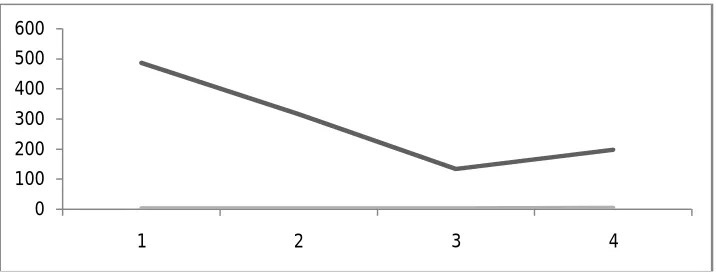
Figure of encrypted file size and decryption file size Grey-Original File Black-Decrypted File size
In fig:-5.3. We notice that we back the same file size in decryption that is equal to original file size. We notice that the original file and decrypted file size same and also said that the contents of original file and decrypted file are same.
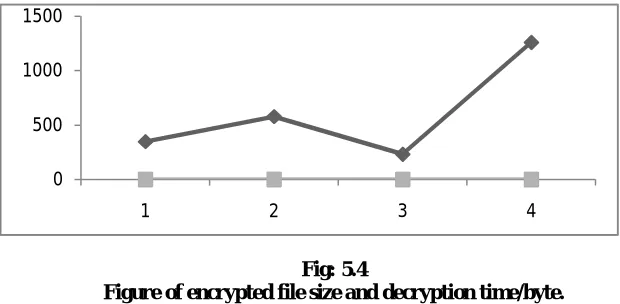
Fig: 5.4
Figure of encrypted file size and decryption time/byte. Black: - Original File Size. Grey: - Decryption time.
In fig: 5.4 we calculate the decryption time taken/ Decrypted file size and show that the all values are almost same. So we can decide that the file content does not effect on decryption time.
0 500 1000 1500
1 2 3 4
0 500 1000 1500
ISSN(Online): 2320-9801 ISSN (Print): 2320-9798
I
nternational
J
ournal of
I
nnovative
R
esearch in
C
omputer
and
C
ommunication
E
ngineering
(An ISO 3297: 2007 Certified Organization)
Vol. 4, Issue 2, February 2016
5.3. Security: -If the size of key is n, then the possibility of number of key generation is 2n.Therefore possibility of choosing the correct key among 2n number is 2(n-1) possible numbers.From the above observation we can say that if the size of the key is increased, then the probability of choose the correct key is also increasing exponentially.
VI. CONCLUSION
My conclusion towards this algorithm is that I have tested the implementation of this algorithm and this algorithm worked correctly for the above set of values. From this we can assume that algorithm can correctly be implemented for various type and size of file. It will be secured.
REFERENCES
[1] William Stallings, ”Cryptography and network security principles and practices”, 4th edition, Pearson Education, Inc. publishing as Prentice Hal, 2006.
[2] Pranam Paul, Saurabh Dutta, A K Bhattacharjee, ”An Approach to ensure Security through Bit-level Encryption with Possible Lossless Compression”, International Journal of Computer Science and Network Security”, Vol. 08, No. 2, pp.291 – 299, 2008.
[3] Sanjit Mazumdar, Sujay Dasgupta, Prof.(Dr) Pranam Paul, ”Implementation of Block based Encryption at Bit-Level”, International journal of Computer Science and Network Security, Vol. 11, No.2, pp. 18-23, 2011.
[4] Sujay Dasgupta, Sanjit Mazumdar, Prof.(Dr) Pranam Paul, “Implementation of Information Security based on Common Division”, International journal of Computer Science and Network Security, Vol. 11, No.2,pp. 51-53, 2011.
[5] http://en.wikipedia.org/wiki/Symmetric-key_algorithm
[6] Asoke Nath, Saima Ghosh, Meheboob Alam Mallik, ”Symmetric Key Cryptography using Random key Generator”, Proceeding of International conference on security and management (SAM’10” held at Las Vegas, USA Jull 12-15,2010), P-Vol-2, pp. 239-244,2010.
[7] Pranam Paul, Saurabh Dutta, “An Enhancement of Information Security using Substitution of Bits Through Prime Detection in Blocks”, Proceeding of National Conference on Recent Trends in information Systems(ReTIS-06), Organized by IEEE Gold Affinity Group, IEEE Calcutta Section,Computer Science & Engineering Department, CMATER &SRUVM Project-Jadavpur University and Computer Jagat.
[8] Oded Goldreich, “Foundation of Cryptography (A primer)”, July 2004.
[9] Bruce Schneier, “Applied Cryptography”, ISBN 0-471-12845-7
[10] John Talbot, Dominic Welsh; “Complexity and Cryptography An introduction”. ISBN-10: 0521852315
[11] Denise Sutherland, Mark Koltko-Rivera “Cracking Codes and Cryptograms For Dummies”; ISBN: 978-0-470-59100-0;October 2009 [12] Alfred J. Menezes, Paul C. van Oorschot and Scott A. Vanstone “Handbook of Applied Cryptography”; CRC Press; ISBN: 0-8493-8523-7 [13] WILLIAM 'F. FRIEDMAN; “MILITARY CRYPTANALYSIS, Part I, MONOALPHABETIC SUBSTITUTION SYSTEMS”
[14] Henk C.A. van Tilborg, Sushil Jajodia; “Encyclopedia of Cryptography and Security”, 2nd edition; 2011; ISBN: 144195905X [15] Wenbo Mao; “Modern Cryptograph”..
[16] Wels Chenbach; “Cryptography in C and C++”.
[17]Ayan Banrjee, Prof. Dr.Pranam Paul, “Bock Based Encryption and Decryption”, International journal of Computer Science and Network Security, ISSN: 0974 – 9616 vol-7,No.2,2015.
[18]Shibaranjan Bhattacharyya, Prof. Dr.Pranam Paul, “An Approach to Block Ciphering using Root of Perfect Square Number”, International journal of Computer Science and Network Security,ISSN: 0974 – 9616 vol-7,No.2,2015.
BIOGRAPHY
Anupam Mondal, he is a student of MCA from Narula Institute of Technology and former student
of BCA from B.P.Poddar Institute of Management & Technology under WBUT.
Dr Pranam Paul, Assistant Professor and Departmental Head, CA Department, Narula Institute of Technology