Web Image Re-Ranking
Waykar Supriya V1, Khilari Poonam D2 , Padwal Roshni S3, Prof.D.N.Wavhal4.
Jaihind College of Engineering, Kuran, India1
Dept. of Computer Engineering, Kuran, SPPU Pune(MH), India
ABSTRACT: Web image search engine is image re-ranking to develop the search results it is very significant feature.
This paper can overcome the problem and new technology can produce for web image re-ranking, online and offline framework with the help of visual feature and mainly of semantic signature of image. This technique can mentioned very useful in the giving specific results to the users in just one click. Image Search engines is mostly use for the keywords and they are depend on the surrounding text for searching images. The duplication of the image query is hard to describe accurately by using keywords. E g: Mouse is query keyword then query categories can be "computer mouse", "white mouse"," animals" etc. The given query keyword, is the various images can be present is based on the textual information. By ask the user to select a query image from the collection of the images, the remaining images are re-ranked based on their visual similarities and semantic similarity with the query image. In different semantic spaces for different query keywords can be found in offline database itself and automatically. The Semantic signatures of the images are acquired by formatted by their visual features and into their related semantic spaces and these semantic signatures. The visual and textual features of images are considered into their related semantic spaces to get semantic signatures. In the online stage the images are re-ranked by compared the semantic signatures obtained from the semantic space and visual space of the query keywords.
KEYWORDS: Image retrieval, Image search, Keyword expansion, Online-offline framework, Semantic signature,
Reverse image.
I. INTRODUCTION
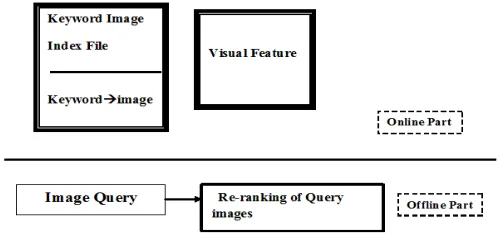
Image re-ranking, is an effective way to good the results of web-based image search, it is surrounded by the current commercial search engines. The given a query keyword, that is pool of the images is first retrieved by the search engine is based on the textual information. To ask the user to select the query image from the pool, then the remaining images are re-ranked is based on the visual similarities and semantic similarities to the query image. A main challenge is that of the similarities of the visual features is not related with the images’ of the semantic feature which is interpret the users’ search intention. In other thing, the learning visual semantic features is characterize by highly miscellaneous images from the web is difficult and not efficient. In this paper, a dictionary framework is proposed for web image re-ranking. Hence of manually defining the same concept of the dictionary, it is learns to different semantic spaces for different query keywords separately and automatically.
Fig 1. Shows traditional image re-ranking
The semantic space are related to the images to re-ranked that can be expressively short down by the query keyword that are provided by the user. For example, if the web query keyword is “apple”, the concepts of “mountain” and “Paris” are irrelevant and should be excluded. A semantic signature is a list of the ordered pairs of {concept codes, concept type codes} associated with an administered metadata object .Since the order is a part of the signature, the representation can be seen as a triplet of the values: (Concept code, Concept type, concept Position).“Computer” and “Fruit” are the dimensions that are to be learning semantic space for the query keyword “apple”. The visual feature and the textual features are projected into the semantic features to obtain the semantic signatures. The images are re-ranked by compared their semantic signatures with semantic features are obtained from the semantic spaces and query keyword. In this paper we used to clustering method are known as K-means. To classify the dataset into a k-clusters. Clustering is the process of the partitioning or grouping a given data set of a patterns into not connect to the clusters. This paper is use one of the clustering methods called K-means. We can do that by looking for query keywords in the user profile ( learner’s context of the interest) help in the specify intend of the meaning. Because the target meaning of the system is that the “computer program language”, we can see for the slave words in the user profile that is the best fit of this specific meaning words such as “computer”, “program”, “awt”, “application”, and “swing”. Content-Based Image Retrieval (CBIR) is refers to the image retrieval of the system that is based on the visual features of image and semantic feature of the images and the objects is rather than textual annotation. Contents of the images tht can be divided into various forms such as, texture, colour and shape etc. In this work, the shape is selected as a primary feature in indexing the image of the database. The content of the images are retrieved by more bracing and makes it is very easy for the image retrieval.
Hence the semantic signatures are very less and the online image re-ranking becomes very efficient because of the large number of query keywords and they are not fixed variations of the web, the visual semantic spaces of the query keywords need to be automatically learned. Therefore they are manually defined as , under our framework is done through the Keyword expansions. They can introduce a large scale of benchmark database with the labeled of the ground truth for the performance evaluation of the image re-ranking.
II. RELATED WORK
The user can be more friendly to the internet. There are the many consideration are important to handle the web but it is very complicated thats why mining are used in that the some information of the data extraction, information retrieval, the web mining, structure mining. There are the many people work on the web. Following are its opinions.
The author W. Ma and B. S. Manjunath proposed to the NeTra, which is the prototype of image retrieval system. It utilizes the colours, shape, texture and spatial location of information in the fragmented image section for searching and extracts similar section from the database. The search based on object or region is permitted in this system and the quality of the image retrieval is also improved when the images feature include many complicated objects.
Cai et al. recommended matching the images are in semantic spaces and re-ranking to them with attributes or reference classes which were manually defined and learned from the different training examples sample which were manually or randomly labelled. They also supposed that there was the one main semantic class for a query keyword. Re-ranking of the images is done by them using this main separate category with the visual feature and textual Features. Still it is tough and inefficient to the learn a universal similar visual semantic space signature to the express highly varied images from the web.
Cui et al. did classification of the query images into eight previous-identified intention of class part and different types of the query images are given different feature weighs. But the huge variety of all the web images was hard to cover up by the eight weighting schemes. In this, a specific query image picture was to be categorized to a wrong class.
III. PROPOSEDSYSTEM
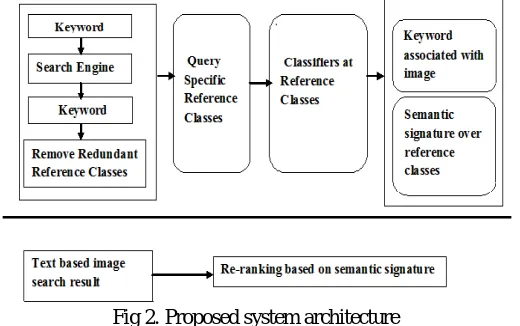
In this section, we can describe a easy and efficient image re-ranking of system. The system Architecture contains the mainly two parts that is online part and offline part. The fig 2 can shows. The online part in that search the images on the bases of the text. Some text can be enter in the search engine. The images can be present on the search result with the help of re-ranking of the query images. If you can enter query as a ’mouse’ that time all mouse related images can be view by user.
Fig 2. Proposed system architecture
The query keyword related references classes can be retrieved. The duplicated information can be return to the database. The following modules can be work on the system that are as follows :
A] Image search: The image search is nothing but a data search that can be used to find the data in search engine. B] Query expansion: We can enter any web query keyword in search engine on web page then the different result are categorize in different form on web page.
C] Visual query expansion: when user can search any web query keyword in search engine that time some images are provided for user .On the basis of visual feature images can re-rank. The expansion means the small database can be created and its related all sub-information can be expand on web page.
D] Image retrieved by keyword expansion: If the user can enter some query keyword on search engine that time in the database that’s related information can be search and get the result to user requirements.
The K-means algorithm can be implemented on this system.
The K-means algorithm is the simplest clustering algorithm. It depends on the unsupervised learning algorithm. The unsupervised algorithm means no training data set are available. The procedure is to follow the simple and easy structure in that making a one cluster.
IV. PSEUDO CODE
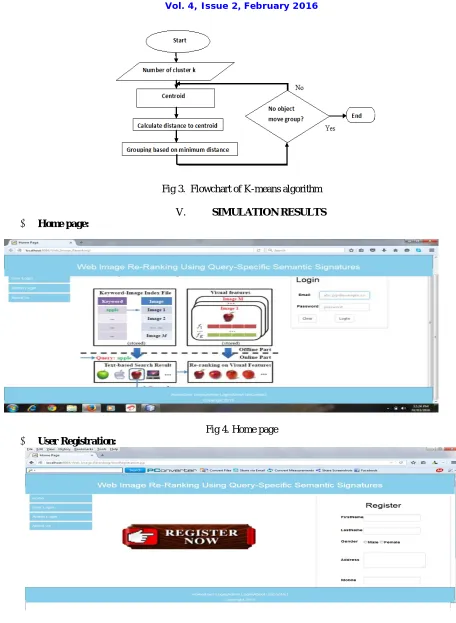
The data sets contain the multiple data point and the K-means algorithm can handle the linear data only. The consider data point is x={ x1,x2,...xn } .find follows the K-means algorithm.
Step 1. Randomly select ‘c’ cluster centre
Step 2: Calculate the distance between each data object and the cluster centre
Step 3: Assign the data point to the cluster centre whose distance from the cluster is minimum of all the cluster centre Step 4: . Recalculate the cluster centre using cluster formula
Step 5: Recalculate the distance between each data point and new obtained cluster centre Step 6: If no data point was reassigned then stop.
Fig 3. Flowchart of K-means algorithm
V. SIMULATION RESULTS
Home page:
Fig 4. Home page
User Registration:
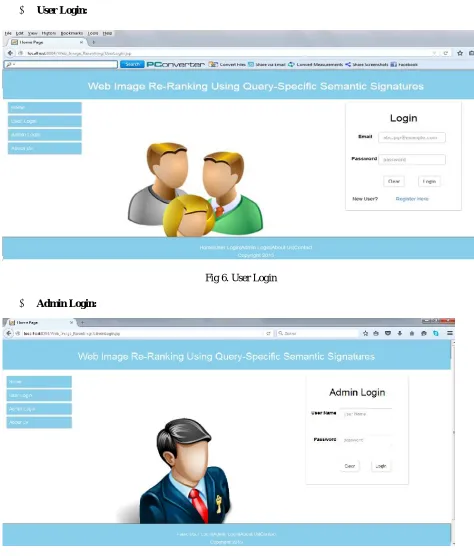
User Login:
Fig 6. User Login
Admin Login:
VI. FUTURE ENHANCEMENT
This project provides the image re-ranking facility to improve the result of the data mining and clustering. In future to improve the better result of image ranking with the help of other clustering algorithm and apply these technique on video ranking also.
VII. CONCLUSION
We proposed a novel framework, which is learns query-specific semantic spaces to significantly improve the effectiveness and efficiency of online image re-ranking. They will be provided the best image search results as well tested the idea of the re-ranking. The visual features of images they are projected into their related semantic spaces are automatically learned through the keyword expansions are offline. The extracted semantic signatures that can be 70 times is shorter than the original visual features, While they achieve to 25-40 percent relative improvement on re ranking the precisions over State-of-the-art methods. The specific query semantic spaces they are used to the get more improvised re-ranking of images. The features are projected into their semantic spaces to which are learned by the expansion of keywords. In the future work, Our framework can be improved along the several directions. Finding the keyword expansions is used to define the reference of classes can be incorporate to the other metadata and log data besides to the textual and the visual features. For example, the co-occurrence to information of the keywords in user queries is the useful and can be obtained in the log data.
ACKNOWLEDGEMENT
We are thankful to Prof. D. N. Wavhal, our Head of Department and Prof. S. D. Gunjals, our Dean of Department and Prof. A. V. Kanade for their consistent guidance during completion of this work. The authors are also thankful to the publisher for their support to develop this document. We would also like to thank all the staff of
Computer Engineering Department for their valuable guidance, suggestion and support through the project work,
who has given co-operation for the project with personal attention.
REFERENCES
1. Khilari Poonam, Waykar Supriya & Padwal Roshni’ Semantic Web Query Image Re-ranking:Online & Offline Framework’, International Journal of Engineering Science & Research Technology, 2015.
2. E. Bart and S. Ullman. Single-example learning of novel classes using representation by similarity. In Proc.BMVC, 2005. 3. Y. Cao, C. Wang, Z. Li, L. Zhang, and L. Zhang. Spatial-bag-of features. In Proc. CVPR, 2010.
4. G. Cauwenberghs and T. Poggio. Incremental and decremental support vector machine learning. In Proc.NIPS, 2011. 5. J. Cui, F. Wen, and X. Tang. Intent search: Interactive on-line image search re-ranking. In Proc.
6. J. Cui, F. Wen, and X. Tang. Real time google and live image search re-ranking. In Proc. ACM Multimedia, 2008.
7. N. Dalal and B. Triggs. Histograms of oriented gradients for human detection. In Proc. CVPR, 2005.