Effective Routing and Bandwidth
Optimization in Node Mobility Aware Zigbee
Cluster Tree Network
M.Iswarya
1, S.Franson Varun Richoarendra
2P.G. Student, Department of Computer Engineering (With Specialization in Networks), Francis Xavier Engineering
College, Tirunelveli, Tamilnadu, India1
Associate Professor, Department of Computer Engineering, Francis Xavier Engineering College, Tirunelveli,
Tamilnadu, India2
ABSTRACT: Zigbee is a unique communication standard designed for low-rate wireless personal area networks. It having extremely low complexity and low amount of cost and power consumption for wireless connectivity in inexpensive, convenient and mobile devices. In Zigbee networks, a tree construction is often used to construct a wireless sensor network for data delivery applications. However, data delivery failures always arise due to node movements and network topology changes. Zigbee cluster-tree network is to increase bandwidth utilization without generating any extra message exchange. Here, using the new method called an adaptive-parent-based framework for Zigbee cluster-tree network is to provide more flexible routing and increase bandwidth utilization .To optimize the throughput in the framework to model the process as a vertex-constraint maximum flow problem. It also includes the Distributed algorithm for vertex-constraint maximum flow to solve the problem. The results demonstrate the significant performance and improvement achieved by the proposed framework.
KEYWORDS:Zigbee,tree topologies, Framework.
I. INTRODUCTION
Zigbee is a higher layer communication protocols built on the IEEE 802.15.4 standards. Zigbee is a smaller packets over large network. Mostly Static networks with many, infrequently used devices. In such applications, Zigbee cluster-tree networks can serve as vehicle to infrastructure communications in vehicular ad hoc networks because Zigbee can provide medium data rates and reliable communications. Zigbee is a new wireless communication technology based on wireless standard 802.15.4. Compared with other protocol standards, Zigbee stack offers a practical application solution coupled with low rate, low cost, low energy consumption characteristics for wireless sensor network .This paper focuses on Zigbee cluster tree as the main topology. Thus the Zigbee specification has lower implementation compared with Bluetooth and Wi-Fi .In a challenging mobility issues, the mobile users raises challenges highly in a network. Based on the Zigbee specifications a device discovery procedure is triggered if the central server cannot be locate any mobile end device.
However, the network can be flooded costly in terms of resources, the network cannot accommodate multiple instances of rapid node mobility. To optimize the location of routers and construct a mobility-robust tree topology in a Zigbee wireless network to improve the downlink data delivery ratio. Zigbee tree topology framework considers the regularity of the mobility patterns during the deployment of routing nodes.
restoration of photographs, films, removal of occlusions such as text, subtitle, logos, stamps, scratches, red eye removal etc.
A. Routing in Zigbee
The Zigbee network layer natively supports both star and tree networks, and generic Mesh networking. Within star networks, the coordinator must be the central node. Both trees and meshes allow the use of Zigbee routers to extend communication at the network level. An effective routing scheme in a Zigbee network is particularly important in that it is the key to achieve resource (e.g., bandwidth and energy) efficiency in Zigbee networks. Routing in a Zigbee network is not exactly the same as in a MANET. In particular, while full function devices (FFD) can serve as network coordinators or network routers, reduced function devices (RFD) can only associate and communicate with FFDs in a Zigbee network. Therefore, different from traditional MANET routing algorithms, which only take into account node mobility to figure out a best route to a given destination, node heterogeneity plays an important role in Zigbee network routing and the node type and the role of the node plays a critical role in deciding routing performances.
B. Zigbee Device types
Zigbee devices are of three types:
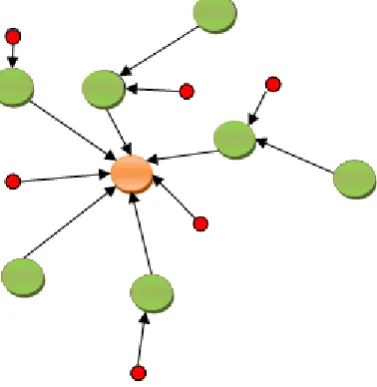
Zigbee Coordinator (ZC): The most capable device, the Coordinator forms the root of the network tree and might bridge to other networks Fig. 1. There is exactly one Zigbee Coordinator in each network since it is the device that started the network originally.
Zigbee Router (ZR): As well as running an application function, a Router can act as an intermediate router, passing on data from other devices Fig. 1.
Zigbee End Device (ZED): Contains just enough functionality to talk to the parent node (either the Coordinator or a Router); it cannot relay data from other devices Fig. 1. This relationship allows the node to be asleep a significant amount of the time thereby giving long battery life.
Fig. 1 Zigbee Coordinator, router and end device
C. Operating Modes
detected. In beacon-enabled networks, the special network nodes called Zigbee Routers transmit periodic beacons to confirm their presence to other network nodes. Nodes may sleep between beacons, thus lowering their duty cycle and extending their battery life. Beacon intervals depend on data rate. However, low duty cycle operation with long beacon intervals requires precise timing, which can conflict with the need for low product cost.
.
II. RELATEDWORK
A. Connection With Node Mobility in MANETs
In particular for mobile ad hoc networks (MANETs), certain routing schemes that utilize mobility prediction have recently been proposed. A routing scheme of the mobile nodes to predict their future moving direction and the predicted information can be used by the sender to choose the forwarding node moving towards the message recipient. This system is used to compute routing path and aware routing based on the property that mobile nodes move among a small set of hubs. With high frequency the recipients visits to forward messages to one of the hubs using routing schemes. The mobility issue in mobile sensor networks have remaining challenges because of low data rates, low power consumption. The routing schemes uses mobility prediction for MANETs cannot directly applied to Zigbee network..
B. Node Mobility and Localization
. Localization in Mobility Wireless Sensor Networks (MWSNs) has focus on the number of works. The coordinator of mobile sensors can be obtained from has a fixed sensor node that has information about its location. MWSN localization algorithms can be used to introduce large complexity because of information exchange and network delay. Network repair is another strategy to resolve node mobility problems in a WSN and reconstructing the topology to maintain connectivity. The drawback that it may cause loops in the repaired network topology, we used routing scheme is called stashing. Stashing is used to minimize energy consumption and network congestion about the mobility sinks. The data stashing is designed for collection applications and unsteady data delivery delay.
C. Deployment of Nodes
Deployment framework is to increase the downlink data delivery ratio in Zigbee cluster tree networks. In node deployment, construct a virtual grid that covers whole region. The router node deployment that contains information stage to perform two subtasks and they are: 1. router node placement and 2.coordinator node selection. The objective is to minimize the number of missed data deliveries caused by mobile-end device mobility. Deployment can used to reduce the cost, to increase the robustness and to improve the energy efficiency of the network. Coverage and Connectivity are crucial factors in sensing the data collection applications. The importance of constructing and maintaining the network topology can be demonstrated in network repair scheme, but it is not suitable for large networks while it increases the overhead when the network is operating. Our node deployment and tree construction algorithm can be used at the design stage.
III. SYSTEMMODELANDPROBLEMDEFINITION
Based on the system model, we define the design objective and the problem under investigation.
A. System Model
called parent nodes are ZC, ZR (Zigbee coordinator and Zigbee router) and Reduced Function Devices (RFD) called children nodes are ZR, ZED (Zigbee router and Zigbee end devices). The PAN coordinator initiating the network set-up and control the whole network. Zigbee sset-upports three kinds of networks topologies, which are star, tree, and mesh networks. A star network has a coordinator with devices directly connecting to the coordinator. For tree and mesh networks is formed by one Zigbee coordinator and multiple Zigbee routers and devices can communicate with each other in a multi-hop fashion Beacons and super frame structure for power saving operations in IEEE 802.15.4. Based on the system model in the Zigbee cluster tree network with coordinator routers and the mobile end devices. The coordinator acts as the tree root and the routers serve as internal nodes in the tree to forwarding the data in the network. Every mobile end devices in our network is randomly assigned a unique address that address is different from those pre-located to coordinator and routers. In the tree topology a mobility-robust tree, the objective is to increase the number of successful data deliveries and reduce the number of broadcasts triggered by the coordinator to the location changes of the mobile end devices. The proposed approach can be implemented by giving end devices and routers with different weights .
B. Problem Formulation
The Throughput maximization problem as a vertex-constraint maximum flow problem. A vertex-constraint flow network represents the vertex and edges in the network, each vertex is associated with a non-negative capacity and each edge is associated with an implicit capacity. For each flow, two vertices are distinguished in the network: a source and a sink, where source is the sender of the data that requires additional bandwidth and sink is the data receiver. A flow in a vertex-constraint flow network with source and sink have to satisfy their desired properties. In the vertex-constraint flow network with source and sink is to find maximum flow. The objective is to minimize the number of missed data deliveries caused by mobile-end device mobility.
IV.IMPLEMENTATIONOFNODES
The implementation of nodes are described by three different types of modules and these types of modules are represented as: (1) Zigbee Coordinator Decision (ZCD), (2) Zigbee Tree Construction (ZTC) and (3) Adoptive-parent-based framework using enabled beacon mode
A. Zigbee Coordinator Decision(ZCD)
The ZCD phase explains the implementation of the ZCD. Based on the deployment completed, the ZCD phase selects one vertex in the region as the root (coordinator) of the routing tree. This phase also builds an edge-weight function based on the mobility profile and appropriate vertex to be the root to maximize the benefit of our mobility-robust framework. The edge between routers represent the communication links and have bidirectional weights. The weight on each edge represents the end-device movement counts from one router coverage area to another router coverage area with the maximum sum of in-edge weights as a coordinator.
B. Zigbee Tree Construction(ZTC)
The ZCD phase explains the implementation of the ZCD. Based on the deployment completed, the ZCD phase selects one vertex in the region as the root (coordinator) of the routing tree. This phase also builds an edge-weight function based on the mobility profile and appropriate vertex to be the root to maximize the benefit of our mobility-robust framework. The edge between routers represent the communication links and have bidirectional weights. The weight on each edge represents the end-device movement counts from one router coverage area to another router coverage area with the maximum sum of in-edge weights as a coordinator. re considered to be text. Still, some s
C. Adoptive-parent-based framework with Beacon enabled Mode
mesh network know when to communicate with each other. In this mode, the timing circuits have to be quite accurate or wake up sooner to be sure not to miss the beacon. This means an increase in power consumption by the coordinator‟s receiver, entailing an optimal increase in costs.
V. STIMULATIONRESULT
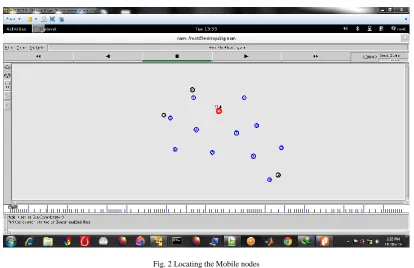
The stimulation results gives us useful information like estimating cost, planning team activities, performing tasks and tracking the team‟s progress throughout the development activities. These requirement include system specification and requirement. From the estimated stimulator the Zigbee cluster tree topology about routing and bandwidth optimization in node mobility is stimulated Fig. 2.
Fig. 2 Locating the Mobile nodes
For stimulation, parameters like number of nodes, topology and path are assigned. Nodes are located with X and Y coordinate.
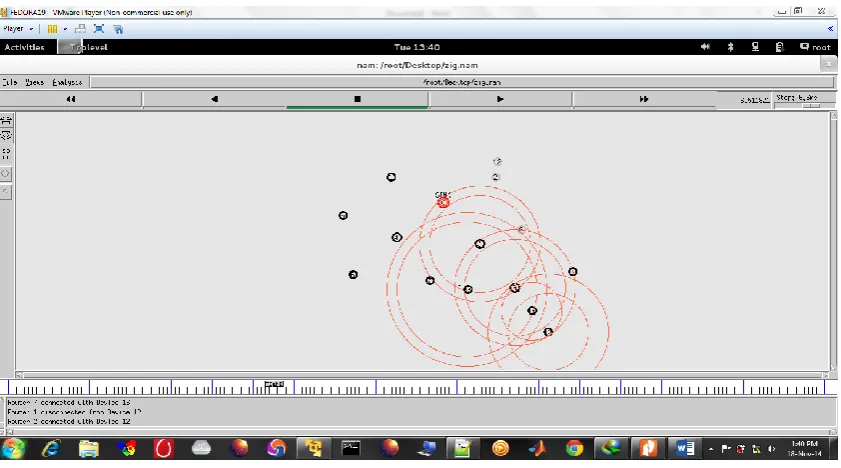
Fig. 3 Enabling the beacon nodes when signal is received
From the assigned nodes, the data are transmitted bidirectional Fig. 4. The Zigbee tree construction (ZTC) constructs the Zigbee routing tree that includes first the coordinator to be selected as the part of the tree. The edge with maximum weight among all remaining edges directed at the tree will be chosen, until all routers are connected by the tree. This tends to grow along the end device movement path and direction to downlink data delivery. The end device movement path can be performed by close in the reverse direction.
When the TCP connection is set for the data transmission, the routing and bandwidth performance is validated. Without violating the operating principles of Zigbee cluster tree protocol the adoptive-parent-based framework is designed to provide flexible routing and increasing bandwidth utilization. The timing circuits have to be quite accurate or wakeup sooner not to miss the enabled-beacon. Depending on the node movement the router gets enabled or disabled.
VI. CONCLUSION
From a Zigbee network, packets are forwarded to mobile devices through routers and the proposed approach is to deploy the routers and construct a tree topology. The enabled mobile end devices are to be moved with high probability in the directions of the routing paths. To increase the bandwidth utilization without incurring any message exchange for a Zigbee cluster tree network, and adaptive-parent-based framework is used and has been proposed. Under the framework, a throughput maximization problem, vertex constraints problem is formulated and a distributed algorithm is fully compatible with the Zigbee standard. The proposed algorithm can provide an optimal solution and the result of simulation demonstrate the significant performance improvement. In the future work, the issues known as interference in router is avoided. Also in additional to interference in router, the data delivery delay is also reduced. Since it is dependent on the topology selected by the network.
ACKNOWLEDGMENT
I thank the Lord Almighty who has been with me through every walk in my life, for guiding me and for the blessings showered on me to complete the project in successful manner. I convey my sincere thanks to Dr. D. C. Joy Winnie Wise, Professor and Head of Department of Computer Science and Engineering, Francis Xavier Engineering College who inspired me and supported me throughout. I also thank my guide Mr. S.Franson Varun Richo, Professor,
Department of Computer Science and Engineering for his valuable guidance throughout and it is great privilege to express my gratitude to him.
REFERENCES
[1] Akkaya K. and Younis M. (2005) „A Survey on Routing Protocols for Wireless Sensor Networks,‟ Ad Hoc Netw., vol.3, no.3, pp.325-349.
[2] Boleng .J, Camp .T and Davis .V (2002) „A Survey of Mobility Models for Ad hoc Network Research,‟ Wireless Commun., Mobile Comput., vol.2, no.5, pp.483-502. [3] Cayirci E., Sankarasubramaniam Y. and Akyildiz I. (2002) „A Survey on Sensor Networks,‟ IEEE Commun., Mag., vol.40, no.8, pp.102-114.
[4] Chung W., Hsiu P. and Hung K., (2011) „Mobility-robust Tree Construction in Zigbee Wireless Networks,‟ in Proc. IEEE Icc, pp. 1-6. [5] Culler D. and Mainwaring A. (2002) „Wireless Sensor Networks for Habitat Monitoring,‟ in Proc. ACM WSNA, pp. 88-97.
[6] Fan Y. and Shen X. (2008) „Mobility-aware Multipath Forwarding Scheme for Wireless Mesh Networks,‟ in Proc. IEEE WCNC, pp.2337-2342. [7] Legacy J. and Friedman T.(2006) „Evaluating Mobility Pattern Space Routing for DTNS,‟ in Proc. IEEEINFOCOM, pp.1-10.
[8] Liang N. and Sun T. (2010) „An Evaluation study of Mobility support in Zigbee Networks,‟ J.Signal Process. Syst., vol.59, No.1, pp.111-122.
[9] Pan M. and Tseng Y. (2009) „A Leightweight Network Repair Scheme for Data collection Applications in Zigbee WSNS,‟ IEEE commun., Lett. vol.13, No.9, pp.649-651.
[10] Shen C. and Lee J-S. (2007) „A Comparative study of Wireless Protocols: Bluetooth, UWB, Zigbee, and WiFi,‟ in Proc. IEEE IECON,‟pp.46-51 [11] Sankarasubramaniam Y. and Akyilidiz (2002) ‟Wireless Sensor Networks: A Survey,‟Comput.Netw.,vol.38,No.4.pp.393-422.
[12] Wang Y. and Tseng Y. (2005) „Efficient Deployment Algorithms for Ensuring Coverage and Connectivity of Wireless sensor Networks,‟ in Proc, IEEE WICON, 2005, pp.114-121.
[13] Wu Z. and Pan Y. (2006) „Bus Priority control System based on Wireless sensor Network (WSN) and Zigbee,‟ in Proc.IEEE ICVES, pp.148-151. [14] Zhou R. and Zhao C. (2010) „Zigbee-based Vehicle access Control System,‟ in Proc. IITSI, pp.232-235.
[15] Zou Y. and Chakrabarty K. (2002) „Sensor Deployment and Target Localization based on Virtual forces,‟ in Proc. IEEE INFOCOM, Vol.2, pp.1293-1303. [16] K.K. Lee, S.H. Kim, and H.S. Park, “Cluster Label-Based ZigBee Routing Protocol with High Scalability,” Proc. Int‟l Conf. Systems and Networks Comm. (ICSNC), Aug. 2007.
[17] L. Chen, T. Sun, and N. Liang, “An evaluation study of mobility support in ZigBee networks,” J. Signal Process. Syst., vol. 59, no. 1, pp. 111–122, Apr. 2010 [18] A. Al-Abdallah, A. Al-Emadi, M. Al-Ansari, N. Mohandes, and Q. Malluhi, “Real-time traffic surveillance using ZigBee,” in Proc.ICCDA, 2010, vol. 1, pp. VI-550– VI-554.