DOI: 10.1534/genetics.110.121756
Unbiased Estimation of Gene Diversity in Samples Containing Related
Individuals: Exact Variance and Arbitrary Ploidy
Michael DeGiorgio,*
,1,2Ivana Jankovic*
,1,3and Noah A. Rosenberg*
,†*Center for Computational Medicine and Bioinformatics, University of Michigan, Ann Arbor, Michigan 48109 and†Department of Human Genetics and the Life Sciences Institute, University of Michigan, Ann Arbor, Michigan 48109
Manuscript received August 3, 2010 Accepted for publication September 21, 2010
ABSTRACT
Gene diversity, a commonly used measure of genetic variation, evaluates the proportion of heterozy-gous individuals expected at a locus in a population, under the assumption of Hardy–Weinberg equilibrium. When using the standard estimator of gene diversity, the inclusion of related or inbred individuals in a sample produces a downward bias. Here, we extend a recently developed estimator shown to be unbiased in a diploid autosomal sample that includes known related or inbred individuals to the general case of arbitrary ploidy. We derive an exact formula for the variance of the new estimator,H, and˜ present an approximation to facilitate evaluation of the variance when each individual is related to at most one other individual in a sample. When examining samples from the human X chromosome, which represent a mixture of haploid and diploid individuals, we find thatH˜ performs favorably compared to the standard estimator, both in theoretical computations of mean squared error and in data analysis. We thus propose that H˜ is a useful tool in characterizing gene diversity in samples of arbitrary ploidy that contain related or inbred individuals.
F
OR a given locus, gene diversity, also known as expected heterozygosity, characterizes the propor-tion of heterozygous genotypes expected in a populapropor-tion under Hardy–Weinberg equilibrium (Nei 1973). Neiand Roychoudhury (1974) devised an estimator of
gene diversity that is unbiased for random samples of unrelated, noninbred individuals. When inbred individ-uals or close relatives are included in a sample, how-ever, this estimator has a downward bias (Weir 1989;
DeGiorgioand Rosenberg2009). To account for the
effects of inbreeding in a sample of diploid individuals, Weir(1989, 1996) derived the expected value of gene
diversity, producing an unbiased estimator of gene diversity that makes use of the mean inbreeding coeffi-cient across sampled individuals, where the inbreeding coefficient of an individual is defined as the probability for a randomly chosen locus that the two alleles of the individual are inherited identically by descent from a common ancestor. Using the mean kinship coefficient across pairs of sampled individuals, DeGiorgio and
Rosenberg(2009) extended this estimator to account
for the bias produced in samples containing close relatives, where the kinship coefficient between two
individuals, j and k, is defined as the probability that an allele randomly selected from individualj at a ran-dom locus and an allele ranran-domly selected from indi-vidualkat the same locus are identical by descent (IBD). The DeGiorgioand Rosenberg(2009) estimator is
useful for autosomal markers in samples from diploid organisms that contain related or inbred individuals. However, in studying gene diversity among related individuals in nondiploid cases (e.g., Buteler et al.
1999) or in cases of mixed ploidy, such as in the analysis of sex chromosomes (e.g., Reiland et al. 2002),
unbi-asedness for this estimator has not been demonstrated. Here, we extend the DeGiorgioand Rosenberg(2009)
estimator of gene diversity to account for situations in which known related and inbred individuals are in-cluded in a sample and in which the sample contains an arbitrary mixture of individuals of different ploidy. We use a more general method to obtain the estimator than the method used for diploids by DeGiorgio and
Rosenberg (2009), and we show that the general
esti-mator reduces to the DeGiorgio and Rosenberg
(2009) estimator in the diploid case. We also derive a formula for the variance of our estimator,H, to facilitate˜ evaluation of the statistical properties of the estimator. This variance formula, which is a function of identity states among individuals, includes terms that involve identity-by-descent among two, three, and four individ-uals and among pairs of pairs of individindivid-uals. Our variance function is convenient because extensive work on IBD probabilities among individuals (e.g., Cotterman 1These authors contributed equally to this work.
2Corresponding author: Center for Computational Medicine and
Bio-informatics, University of Michigan, 2017 Palmer Commons, 100 Washtenaw Ave., Ann Arbor, MI 48109-2218.
E-mail: [email protected]
3Present address: David Geffen School of Medicine, University of
California, Los Angeles, CA 90095.
1940; Harris 1964; Gillois 1965; Cockerham 1971;
Jacquard1974; Thompson1974; Lange2002) has
pro-vided a framework for calculating the quantities incorpo-rated in the formula.
Using the variance formula, we examine the perfor-mance of our estimator in scenarios involving the human X chromosome, for which males and females, who might both be included in a typical sample, differ in ploidy. In our evaluations, we first show that the exact theoretical values of the variance, which are obtained from a quite complex formula, are closely matched by simulations. We also validate that when each sampled individual is related to at most one other individual in the sample, the exact theoretical variance can be approximated well by a simpler formula. Using the variance approximation and simulations, we compare the behavior of our esti-mator to that of the Nei and Roychoudhury (1974)
estimator, which does not account for relatives. We then analyze human SNPs from the X chromosome and find thatH˜also performs well in practice.
THEORY
Consider a sample of ggroups, each with different ploidy (e.g., haploid males and diploid females on the human X chromosome). Suppose that the sample from groupbcontainsnbmb-ploid individuals,b¼1, 2,. . .,g. Further, let (b,k),k¼1, 2,. . .,nb, denote individualk from groupb. The number of copies of allelic typeiin individualkfrom groupbis
XððibÞ;kÞ¼
Xmb
‘¼1
AððibÞ;kÞ;‘; ð1Þ
whereAð Þðib;kÞ;‘is an indicator random variable that takes on the value 1 if the‘th allele in individual (b,k) has typeiand that equals 0 otherwise.
Note that E½Aðð Þbi;kÞ;‘ ¼pi, where pi is the frequency of allelic typeiin the population. We can then define an unbiased estimator for the frequency of alleleias
ˆpi¼
1
Pg b¼1nbmb
Xg
b¼1
Xnb
k¼1
XððibÞ;kÞ: ð2Þ
Rewriting the estimator of Nei and Roychoudhury
(1974) for the mixed-ploidy case, if no inbred or related individuals are included in the sample, then an un-biased estimator of gene diversity is
ˆ H¼
Pg b¼1nbmb ðPgb¼1nbmbÞ 1
1X I
i¼1 ˆp2
i
!
: ð3Þ
If inbred or related individuals are included in the sam-ple, thenHˆ is a biased estimator of H ¼1PI
i¼1p 2
i. We follow the approach of DeGiorgioand Rosenberg
(2009), correcting for this bias by first obtaining the variance of sample allele frequencies. However, we use
a different method here for obtaining the variance of sample allele frequencies, determining the bias correc-tion for diploids as a special case of a more general computation.
An unbiased estimator: Suppose we have four possi-bly, but not necessarily, distinct individuals (a,j), (b,k), (a9, j9), and (b9, k9). Define F(a,j)(b,k) as the
probabil-ity that two alleles randomly chosen, one from individ-ual (a, j) and the other from individual (b, k), are IBD. Similarly, define F(a,j)(b,k)(a9,j9) as the probability
that three alleles randomly chosen, one from (a, j), one from (b,k), and one from (a9,j9), are IBD. Define F(a,j)(b,k)(a9,j9)(b9,k9) as the probability that four alleles
randomly chosen, one from (a,j), one from (b,k), one from (a9, j9), and one from (b9, k9), are IBD. Finally, define F(a,j)(b,k),(a9,j9)(b9,k9) as the joint probability that
two alleles randomly chosen, one from (a,j) and the other from (b, k), are IBD and two alleles randomly chosen, one from (a9,j9) and the other from (b9,k9), are IBD. These four types of probability of identity-by-descent are identical to theu,g,d, andDcoefficients of Cockerham(1971), respectively. We can then define
F2¼X g
a¼1
Xg
b¼1
Xna
j¼1
Xnb
k¼1
wawbFða;jÞðb;kÞ ð4Þ
F3¼X g
a¼1
Xg
b¼1
Xg
a9¼1
Xna
j¼1
Xnb
k¼1
Xna9
j9¼1
wawbwa9Fða;jÞðb;kÞða9;j9Þ ð5Þ
F4¼
Xg
a¼1
Xg
b¼1
Xg
a9¼1
Xg
b9¼1
Xna
j¼1
Xnb
k¼1
Xna9
j9¼1
Xnb9
k0¼1
wawbwa9wb9Fða;jÞðb;kÞða9;j9Þðb9;k9Þ
ð6Þ
F2;2¼
Xg
a¼1
Xg
b¼1
Xg
a9¼1
Xg
b9¼1
Xna
j¼1
Xnb
k¼1
Xna9
j9¼1
Xnb9
k9¼1
wawbwa9wb9Fða;jÞðb;kÞ;ða9;j9Þðb9;k9Þ
ð7Þ
as weighted mean kinship coefficients across all sets of pairs, triplets, quartets, and pairs of pairs of individuals. The weight associated with an individual in group x, wx ¼mx=
Pg
b¼1nbmb, is proportional to the ploidy asso-ciated with the group. Define the inbreeding coefficient for individual (b,k), denoted byf(b,k), as the probability
that two alleles randomly chosen without replacement from individual (b, k) are IBD and let fb ¼
1=nb
ð ÞPnb
k¼1fðb;kÞ be the mean inbreeding coefficient
across individuals in groupb. This definition reduces to the standard definition for the diploid case.
and Rosenberg (2009) for diploids to the case of
ar-bitrary ploidy (Equations 13 and 14) and we show how these generalizations can be reduced to the diploid case. Consider a locus withIdistinct alleles, allele frequen-ciespi2[0, 1], andPIi¼1pi ¼1. Suppose a sample from a population hasggroups, each with different ploidy, and nbmb-ploid individuals in groupb,b¼1, 2,. . .,g, each of whom is possibly inbred and related to other individuals in the sample. Consider the‘th allele of individual (a,j) and thetth allele of individual (b, k). By definition of expected value, we have
E AðiÞ ða;jÞ;‘A
ðiÞ ðb;kÞ;t
h i
¼P AððiaÞ;jÞ;‘¼1;A
ðiÞ ðb;kÞ;t¼1
h i
¼Fða;jÞðb;kÞpi1ð1Fða;jÞðb;kÞÞp2i ¼Fða;jÞðb;kÞpið1piÞ1 p2i: ð8Þ
In taking the expected value of our estimator of gene diversity, we need to evaluate the quantityE ˆp2
i . Using Equation 8, we show inappendix athat
E ˆp2
i ¼ F2pið1piÞ1p2i: ð9Þ
Plugging Equations 8 and 9 into Var½ ¼ˆpi E ˆp2i
E½ ˆpi
ð Þ2 yields Var½ ¼ˆpi F2pið1piÞ, which reduces to the result presented for the diploid case in Equation 7 of DeGiorgioand Rosenberg(2009), by reduction of the
definition of F2 for the diploid case. The following
theorem provides a generalized unbiased estimator of gene diversity when a sample with any mixture of ploidy contains related or inbred individuals.
Theorem1.Consider a locus with I distinct alleles,allele
frequencies pi 2[0, 1],and
PI
i¼1pi¼1.Suppose a sample from a population has g groups,each with different ploidy,and nbmb-ploid individuals in group b,b¼1, 2,. . .,g,each of whom is possibly inbred and related to other individuals in the sample. Then
˜ H¼ 1
1F2
1X I
i¼1 ˆp2
i
!
ð10Þ
is an unbiased estimator for gene diversity.
The proof thatH˜ is unbiased follows that of Propo-sition 1 in DeGiorgioand Rosenberg(2009),
substitut-ing the more generalF2in place of the corresponding
mean kinship coefficient in the earlier proof.
When reducing the definition ofF2 for the diploid
case studied by DeGiorgio and Rosenberg (2009),
the result in Theorem 1 is identical to the result pre-sented for this case in Proposition 1 of DeGiorgioand
Rosenberg (2009). One interesting consequence of
Theorem 1 is that H˜ has a simple representation in terms of the sample proportion of identity-by-state and the probability of identity-by-descent computed on the
basis of assumed levels of inbreeding and relationship. This representation is
˜
H¼1ˆP½IBS
1P½IBD; ð11Þ
whereˆP½IBS is the probability that two alleles in the sample, chosen uniformly at random with replacement, are identical by state, andP[IBD] is the probability that two alleles in the sample, chosen uniformly at random with replacement, are identical by descent. A proof that Equation 11 is a consequence of Equation 10 is provided in appendix a. Note that Equations 10 and 11 have a
connection to estimators of relatedness in a context in which relatedness is unknown. Such estimators essen-tially invert equations similar to Equation 11 to get estimators ofF2(Ritland1996; Rousset2002).
We next seek to transform the estimator in Equation 10 into one that is more convenient for data analysis. Let
Ga,b, a, b ¼ 1, 2,. . ., g, be the set of distinct types of
relative pairs for pairs of distinct individuals in a sample, one from groupaand one from groupb. LethRbe the number of pairs of individuals with relationship typeR inGa,b,and letFRbe the kinship coefficient for each of these pairs. Then, as shown inappendix a, we can write
F2as
F2¼
1
ðPgb¼1nbmbÞ2
3 X g
b¼1
nbmb1
Xg
b¼1
nbmbðmb1Þfb12
Xg
b¼1
X
R2Gb;b m2bhRFR
2 4
12X
g1
a¼1
Xg
b¼a11
X
R2Ga;b
mambhRFR
3
5:
ð12Þ
This version of F2 is convenient for computation. To
obtain a formula forH˜ that is convenient for computa-tion and that is a generalized version of an analo-gous quantity for the diploid case in Equation 9 of DeGiorgioand Rosenberg(2009), we can substitute
Equations 3 and 12 into Equation 10 to get
˜ H¼ð
Pg
b¼1nbmbÞðPbg¼1nbmb1Þ
D Hˆ; ð13Þ where
D¼ X g
b¼1 nbmb
! Xg
b¼1
nbmb1
!
X
g
b¼1
nbmbðmb1Þfb
2X
g
b¼1
X
R2Gb;b
m2bhRFR2X
g1
a¼1
Xg
b¼a11
X
R2Ga;b
mambhRFR:
A proof of Equation 13 is provided inappendix a. We
note that by usingg¼1,n1¼n, andm1¼2 in Equation 13,
we obtain Equation 9 of DeGiorgioand Rosenberg
Note thatH˜ ¼c ˆH, where
c ¼ð
Pg
b¼1nbmbÞðPbg¼1nbmb1Þ
D :
By rearranging and taking the expected value, we get
EHˆ ¼E½ H˜ =c¼H=c. Therefore,
biasðHˆÞ ¼1c c H
¼ 1
ðPgb¼1nbmbÞðPgb¼1nbmb1Þ
3 X
g
b¼1
nbmbðmb1Þfb12
Xg
b¼1
X
R2Gb;b
m2bhRFR
2 4
12X
g1
a¼1
Xg
b¼a11
X
R2Ga;b
mambhRFR
3 5H:
ð14Þ
Equation 14 is a generalized version of the bias formula in the diploid case, in Equation 11 of DeGiorgioand
Rosenberg (2009). The bias is always negative and it
has a magnitude that increases linearly with respect to H. Usingg¼1,n1¼n, andm1¼2 in Equation 14, we
obtain Equation 11 of DeGiorgio and Rosenberg
(2009).
Variance of the estimator: In the previous section, we derived an unbiased estimatorH˜ of gene diversity in a sample of arbitrary ploidy. It is useful to determine the variance of the estimator, a quantity that in the diploid case DeGiorgio and Rosenberg (2009)
ob-tained only by simulation. The following theorem provides a formula for the variance of the generalized estimator of gene diversity in samples with any mixture of ploidy.
Theorem2.Consider a locus with I distinct alleles,allele
frequencies pi2 [0, 1],and PIi¼1pi¼1.Suppose a sample from a population has g groups,each with different ploidy,and nbmb-ploid individuals in group b,b¼1, 2,. . .,g,each of whom is possibly inbred and related to other individuals in the sample. Then the variances of the ˜H and ˆH estimators of gene diversity are
Var½ ¼H˜ 1
ð1F2Þ2Var 1
XI
i¼1 ˆp2
i
" #
ð15Þ
and
VarHˆ ¼
Pg b¼1nbmb ðPgb¼1nbmbÞ 1
" #2
Var 1X I
i¼1 ˆp2
i
" #
; ð16Þ
where
Var 1X I
i¼1 ˆp2
i
" #
¼F2;2F2
212 F22F4
XI
i¼1 p2i
14 2F41F22F3F2;2
XI
i¼1 p3i
1 3F2;218F36F44F2F22
XI
i¼1 p2i
!2 :
ð17Þ
The proof of Theorem 2 is long and is provided in
appendix b.
We next derive an approximate formula that in our calculations below we use in place of Equation 17 inside of Equations 15 and 16. The approximation is based only on pairwise kinship coefficients and is useful in cases in which the number of relatives in a sample is small enough that no individual is related to more than one other sampled individual. In such cases, the only nonzero terms included inF3,F4, andF2;2all involve sampling the same
individual or pairs of individuals more than once. Thus, theF3,F4, andF2;2terms, along withF22, are ignored, as
they are likely to be much smaller than F2 in cases in
which the number of relationships in the sample is small. In addition to the assumptions listed in Theorem 2, suppose that each individual in the sample is related to no more than one other individual in the sample. If we ignore terms involvingðPgb¼1mbnbÞ
k
,k.1, then terms involving F2
2,F3,F4, andF2;2in Equation 17 can be ignored. The
only terms in Equation 17 that we retain are those of orderP g
b¼1mbnb
ð Þ0
and ðPgb¼1mbnbÞ
1
. F2 is of order
Pg b¼1mbnb
ð Þ1
. Therefore, reducing Equation 17 leads to
Var 1X I
i¼1 ˆp2
i
" #
4F2 X
I
i¼1
p3i X I
i¼1 p2i
!2
" #
: ð18Þ
This formula is an approximation to Equation 17 when the number of relatives in a sample is small enough that no individual is related to more than one other sampled individual.
We now show that when no related individuals are included in a sample of diploids, the variance in Equation 18 is exactly the formula given by Weir(1989). Suppose a
sample from a diploid population consists ofnunrelated, but possibly inbred, individuals. Further suppose that we ignore terms involvingnk
,k.1. ThenFkk¼(1/2)(11 fk), wherefkis the inbreeding coefficient for individualk. We can write the mean pairwise kinship coefficient as
F2¼ 1
n2
Xn
k¼1
Fkk ¼ 1
n2
Xn
k¼1 1
2ð11fkÞ ¼ 1
2nð11fÞ; where f ¼ð1=nÞPn
k¼1fk is the mean inbreeding co-efficient across individuals. PluggingF2 ¼11f=ð2nÞ
Var 1X I
i¼1 ˆp2
i
" #
2
nð11fÞ
XI
i¼1
p3i X I
i¼1 p2i
!2
" #
:
ð19Þ
The X chromosome case: A common situation in which data of mixed ploidy arise is on sex chromo-somes, for which members of one sex have two copies of a specific sex chromosome and members of the other sex have one copy. Later, we examine data on the human X chromosome, for which females have two copies and males have one. Thus, we now utilize Equation 13 to derive an unbiased estimator of gene diversity in samples from the X chromosome.
Consider an X-linked locus with I distinct alleles, allele frequenciespi2[0, 1], and
PI
i¼1pi¼1. Suppose a sample from a population has nF females and nM
males, each of whom is possibly inbred and related to other sampled individuals. LetM,F, andUbe the
sets of distinct types of male–male, female–female, and male–female relative pairs in the sample, respectively. Further, let hR be the number of pairs of individuals with relationship type R and let FR be the kinship coefficient for each of these pairs. Let males be group 1 and let females be group 2. Pluggingg¼2,n1¼nM,
n2¼nF,m1¼1, andm2¼2 into Equation 13, we obtain
an unbiased estimator for gene diversity at an X-linked locus as
˜
H¼ ðnM12nFÞðnM12nF1Þ
ðnM12nFÞðnM12nF1Þ 2nFfF2PR2MhRFR8PR2FhRFR4PR2UhRFR
ˆ H;
ð20Þ
where fF¼ð1=nFÞ
PnF
k¼1fk is the mean inbreeding co-efficient across female individuals andfkis the inbreed-ing coefficient for femalek.
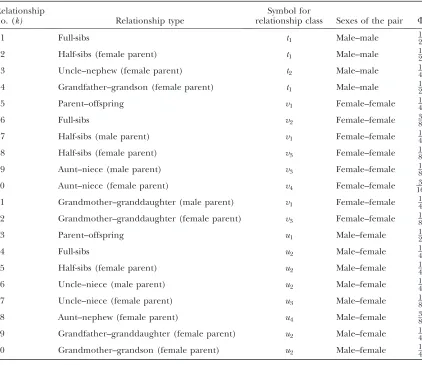
The following special case of Equation 20 is useful for the examples we consider in subsequent sections. It TABLE 1
Relationship types with corresponding X-linked kinship coefficients
Relationship
no. (k) Relationship type
Symbol for
relationship class Sexes of the pair F
1 Full-sibs t1 Male–male 12
2 Half-sibs (female parent) t1 Male–male 12
3 Uncle–nephew (female parent) t2 Male–male 14
4 Grandfather–grandson (female parent) t1 Male–male 12
5 Parent–offspring v1 Female–female 14
6 Full-sibs v2 Female–female 38
7 Half-sibs (male parent) v1 Female–female 14
8 Half-sibs (female parent) v3 Female–female 18
9 Aunt–niece (male parent) v3 Female–female 18
10 Aunt–niece (female parent) v4 Female–female 163
11 Grandmother–granddaughter (male parent) v1 Female–female 14
12 Grandmother–granddaughter (female parent) v3 Female–female 18
13 Parent–offspring u1 Male–female 12
14 Full-sibs u2 Male–female 14
15 Half-sibs (female parent) u2 Male–female 14
16 Uncle–niece (male parent) u2 Male–female 14
17 Uncle–niece (female parent) u3 Male–female 18
18 Aunt–nephew (female parent) u4 Male–female 38
19 Grandfather–granddaughter (female parent) u2 Male–female 14
20 Grandmother–grandson (female parent) u2 Male–female 14
makes use of Table 1, which shows the various types of relationships possible for the X chromosome in pairs of individuals. Suppose a noninbred sample from a pop-ulation hasnFfemales andnMmales, among whichhk pairs of relationship typekare included. LetFkbe the kinship coefficient for each of these pairs. Because the sample is not inbred, the mean inbreeding coefficient across female individuals is fF¼0. Plugging fF as
well ashkandFkfor each relationship typek(Table 1) into Equation 20, we obtain
˜
H¼ ðnM12nFÞðnM12nF1Þ ðnM12nFÞðnM12nF1Þ 2
P4 k¼1hkFk8
P12 k¼5hkFk4
P20 k¼13hkFk
ˆ H:
ð21Þ
DATA ANALYSIS
Data: We investigated the properties ofH˜ on mixed-ploidy data using analytical computations of bias,
variance, and mean squared error; simulations; and analysis of data from human populations. Our choices for simulation parameters were designed on the basis of values in the data. In our analytical computations and simulations, we based our assumed true allele frequen-cies on sample allele frequenfrequen-cies at 36 X-chromosomal loci typed in 950 unrelated individuals, 624 males and 326 females, from the Human Genome Diversity Panel (HGDP-CEPH) microsatellite data set of 1048 individ-uals (Ramachandranet al. 2008). Individuals 127 and
139 from the Ramachandranet al. (2008) data set were
not included in our analyses. The 950 individuals were assumed to have no first- or second-degree relation-ships, on the basis of the Rosenberg(2006) analysis of
the full HGDP-CEPH panel.
Our data analysis was performed on a data set of 13,052 X-chromosomal single-nucleotide polymor-phism (SNP) loci genotyped in 485 individuals from 29 populations in the HGDP-CEPH panel ( Jakobsson
TABLE 2
Symbols used for relative pair types
Relationship
class symbol Y0 Y1 Y2 F Sex Relative types
t1 12 12 0 12 Male–male Full-sib, half-sib (through female parent), grandfather–grandson
(through female)
t2 34 14 0 14 Male–male Uncle–nephew (through female)
v1 0 1 0 14 Female–female Parent–offspring, half-sib (through male parent),
grandmother–granddaughter (through male)
v2 0 12 12 38 Female–female Full-sib
v3 12 12 0 18 Female–female Half-sib (through female parent), aunt–niece (through male),
grandmother–granddaughter (through female)
v4 14 34 0 163 Female–female Aunt–niece (through female)
u1 0 1 0 12 Male–female Parent–offspring
u2 12 12 0 14 Male–female Full-sib, half-sib (through female parent), uncle–niece
(through male), grandfather–granddaughter (through female), grandmother–grandson (through female)
u3 34 14 0 18 Male–female Uncle–niece (through female)
u4 14 34 0 38 Male–female Aunt–nephew (through female)
t3 — — — 245 Male–male Uncertain second-degree relative
v5 — — — 1796 Female–female Uncertain second-degree relative
u5 — — — 203 Male–female Uncertain second-degree relative
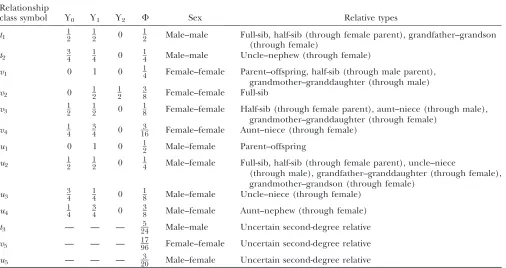
Y0,Y1, andY2designate the probabilities that individuals share 0, 1, and 2 alleles IBD at an X-linked locus, respectively. All types
of relative pairs denoted by the same symbol have the same kinship coefficient, sexes, and probabilities of sharing 0, 1, and 2 alleles IBD.Fcan be calculated fromY1andY2usingFij ¼Y1ifiandjare both male,Fij¼14Y1112Y2 ifiandj are both female,
andFij¼12Y11Y2ifiis male andjis female. For each possible pair of sexes (male–male, female–female, and male–female),
the kinship coefficient for second-degree relatives of an uncertain type was found by averaging the kinship coefficients for all second-degree relationships in Table 1 with that pair of sexes, assuming that all were equally likely. Second-degree relationships include half-sib, grandparent–grandchild, and avuncular pairs. For male–male pairs,t3¼ 2312113141330
=6¼ 5 24. For
female–female pairs, v5¼ 231413318113163
=6¼17
96. For male–female pairs, u5¼ 431411318113381430
= 10¼ 3
20. The divisor in each of the previous equations describes the total number of possible second-degree relatives for that
sex pair (e.g., grandmother–grandson, aunt–nephew, etc., for the male–female case). This number includes second-degree relatives that are not related on the X chromosome, because the assignment of relationships in the data set was based on auto-somal data. The kinship coefficients fort3,v5, andu5were used only for analysis of population data, and they were not used in our
et al. 2008). We also removed individuals related through the X chromosome, yielding a data set of 446 unrelated individuals. Unlike the Jakobsson et al.
(2008) data set of 443 unrelated individuals, our set of 446 individuals did not retain individuals 866, 1046, or 1049, which are not in the H952 subset of the HGDP-CEPH panel. However, individuals 292, 451, 477, 983, 988, and 1089 were included in the data set of non-relatives because they were all involved exclusively in male–male parent–offspring relationships and were therefore unrelated through the X chromosome to other sampled individuals.
Data analysis methods: We used simulations and analytical calculations to evaluate the behavior of the estimatorH˜ for X-chromosomal loci under conditions of varying heterozygosities, sample sizes, and relation-ships of sampled individuals. We compared the relative performance of H˜ and Hˆ by applying H˜ and Hˆ to samples containing related individuals and Hˆ to sam-ples in which relatives were removed so that no relative pairs remained. True allele frequencies were based on microsatellite sample allele frequencies (seeData). In the simulations, individuals of a relative pair were generated by randomly choosing the allele(s) of the first individual on the basis of the empirical allele frequency distribution from the data set. For a given type of relative pair, we then simulated the allele(s) of the second individual by copying alleles from the first individual using the probabilities of sharing zero, one,
and two alleles IBD for that type of pair. Table 2 depicts these probabilities, as well as the symbols used here to denote the various classes of relative pairs. If only one allele was shared, then it was copied in the second individual from the first allele of the first (indepen-dently generated) individual. In cases of male–female relative pairs, the male was generated first and the second allele of the female was always chosen indepen-dently from the allele frequency distribution.
To create a reduced data set of unrelated individuals, the second (possibly dependent) individual was not included for same-sex pairs, whereas for male–female pairs, the male relative was removed. Thus, because each individual in our simulation was included in exactly one relative pair, the number of individuals used to calculate Hˆ for the unrelated sample was al-ways half of that used for the other two estimators. Removing the male in male–female pairs results in the loss of one-third of the alleles, compared to a loss of one-half of the alleles for removal of an individual from a same-sex pair. Thus, compared to removing females, removing males from male–female pairs gen-erates a larger sample of alleles while still ensuring that no individuals are related.
The value assumed for the true heterozygosity,H, of a specific locus, was calculated from the assumed true allele frequencies on the basis of genotypic data of the 950 unrelated individuals. In each simulated scenario, for each of the three estimators, this true heterozygosity TABLE 3
Comparison of exact, approximate, and simulation variances
Estimator Locus Relative pairs Exact variance
Approximate variance
Simulation variance
Relative difference of approximation (%)
˜
H ATCT003 10t1, 10u2, 10v2 7.553104 6.823104 7.483104 9.59
DXS1068 10t1, 10u2, 10v2 1.543103 1.473103 1.503103 4.82
GATA48H04 10t1, 10u2, 10v2 1.503103 1.483103 1.543103 1.52
DXS1068 20t1 3.623103 3.313103 3.493103 8.55
DXS1068 80t1 8.083104 7.823104 7.933104 3.16
DXS1068 20u2 1.973103 1.903103 1.973103 3.29
DXS1068 80u2 4.683104 4.603104 4.613104 1.71
DXS1068 20v2 1.993103 1.873103 1.953103 5.87
DXS1068 80v2 4.643104 4.533104 4.563104 2.37
ˆ
H ATCT003 10t1, 10u2, 10v2 7.453104 6.743104 7.383104 9.59
DXS1068 10t1, 10u2, 10v2 1.523103 1.453103 1.493103 4.82
GATA48H04 10t1, 10u2, 10v2 1.493103 1.463103 1.533103 1.52
DXS1068 20t1 3.533103 3.233103 3.403103 8.55
DXS1068 80t1 8.033104 7.773104 7.883104 3.16
DXS1068 20u2 1.953103 1.883103 1.943103 3.29
DXS1068 80u2 4.673104 4.593104 4.603104 1.71
DXS1068 20v2 1.953103 1.843103 1.913103 5.87
DXS1068 80v2 4.613104 4.513104 4.543104 2.37
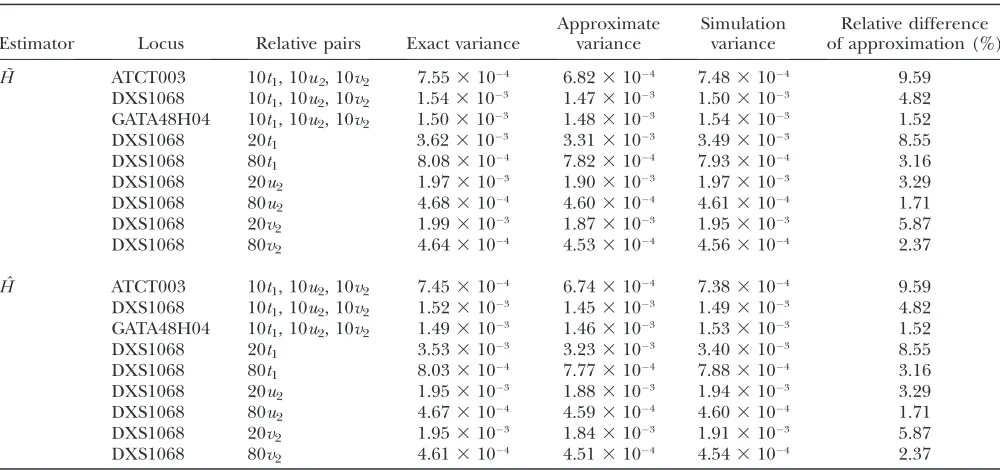
The exact (Equations 15 and 16), approximate (Equation 18 inserted into Equations 15 and 16), and simulation variances were calculated for the combination of 10 male–male (t1), 10 male–female (u2), and 10 female–female (v2) full-sib pairs at the
was compared to the mean of the estimates produced by the estimator in 100,000 replicate simulations. The subscript full is used to denote cases in which an estimator was applied to the entire sample, whereas the subscript reduced indicates that relatives were re-moved from the sample. For a given scenario, the bias of each estimator was found by subtracting H from the mean value of the estimates for that estimator. Variance was calculated as the squared mean of the estimates across simulations subtracted from the mean across simulations of the squares of the estimates. Mean squared error (MSE) was then calculated as the sum of bias squared and variance.
Approximate variance:Because each of our analyses was performed on samples that contained only pairs of related individuals, the assumptions that underlie the derivation of the approximate variance (Equation 18) apply. We compared the exact, the approximate, and the simulated variance forH˜ andHˆ in a series of cases that included only full-sib pairs. We chose nine representative cases of the various parameters that can affect estimator performance. Three of these cases considered an equal
mix of male–male, female–female, and male–female full-sib pairs at the ATCT003 (H¼0.7794), DXS1068 (H¼
0.7344), and GATA48H04 (H¼0.6476) loci, chosen to represent high, intermediate, and low heterozygosity, respectively. Additionally, we considered cases at the intermediate-heterozygosity locus involving 20 male– male, 80 male–male, 20 female–female, 80 female– female, 20 male–female, and 80 male–female pairs, to examine the effects of sample size and the sexes of the individuals. In each of our evaluations, we calculated the exact variances (Equations 15 and 16), approximate variances (Equation 18 plugged into Equations 15 and 16), and simulation variances obtained from 100,000 replicate simulations.
As Table 3 shows, in all cases examined, the exact, approximate, and simulated variances are similar, with the approximate variance slightly underestimating the exact variance. Because of the complexity of the formula for the exact variance, the difference between the approximate variance and the exact variance does not have a simple dependence on heterozygosity or sample size. However, it can be observed in Table 3 that for both
Figure1.—Mean squared error, variance, and bias squared for each estimator, obtained analytically using the variance
approx-imation (Equation 18 inserted into Equations 15 and 16), as a function of heterozygosity for 36 loci. The scheme considered included 60 individuals in 10t1pairs (F¼12), 10u2pairs (F¼14), and 10y2pairs (F¼38). (A)Hˆfull. The curve through the
˜
HandH, the relative difference between the approxi-ˆ mate variance and exact variances is smallest at low heterozygosity and large sample size, typically near
2%. In cases of high heterozygosity and small sample size, the relative difference remains at most 10%. We note that the same approximation to the variance of 1PI
i¼1ˆp2i in Equation 18 is applied in obtaining the approximate variances of both H˜ and H. Thus,ˆ because the approximation is generally reasonably accurate and because it treats H˜ and Hˆ in the same way, our use of the approximation is sensible in our subsequent comparisons of the mean squared errors ofH˜ andH.ˆ
Effect of parameters on the estimators:Several fac-tors can potentially affect the performance of the estimators. These factors include the true value of het-erozygosity itself, the sample size, the type of relative
pair represented in the sample, and, if multiple types of relative pairs are included, the combination of particu-lar types of relative pairs. We now examine each of these factors in sequence.
Varying heterozygosity: To investigate the influence of varying heterozygosity on the estimator, we evaluated the scenario of 60 related individuals in 10t1pairs, 10u2
pairs, and 10 v2pairs (see Table 2) for each of the 36
X-linked microsatellite loci. This scheme incorporates 30 full-sib pairs, considering equally many males and females and utilizing three distinct kinship coefficients: 1
2 for male–male pairs (t1),14 for male–female pairs (u2),
and 38 for female–female pairs (v2). The 36 loci
rep-resent a spread of assumed true heterozygosities rang-ing from 0.4008 to 0.8599. For each locus, we calculated
˜
Hfull(Equation 21), as well asHˆfullandHˆreduced(Neiand
Roychoudhury1974).
Figure2.—Mean squared error as a function of sample size (number of pairs¼number of individuals/2), calculated
Figure 1 displays the properties of the three estimators, ˜
Hfull,Hˆfull, andHˆreduced, based on application of analytical
computations of bias (Equation 14 for Hˆfull) and the
variance approximation (Equation 18 plugged into Equations 15 and 16) to each of the 36 loci. H˜full and
ˆ
Hreducedare unbiased estimators and therefore have zero
bias, whereas Hˆfull exhibits increasing bias squared as
heterozygosity increases. The bias squared forHˆfull as a
function of heterozygosity is plotted using the theoretical prediction based on Equation 14: bias Hˆ 2¼ 2
1031 2
18 103 3 8
1 4 1031 4
=ð3012330Þ3 30123 301
ð ÞHÞ2 ¼
3:8973105
ð ÞH2.
Gener-ally, over the space of heterozygosities defined by the 36 microsatellite loci, the MSE and variance of all three estimators decrease with increasing heterozygosity.
Varying sample size and type of relative pair: We next applied the estimators to scenarios of varying sample size. The ATCT003 (H ¼ 0.7794), DXS1068 (H ¼
0.7344), and GATA48H04 (H ¼ 0.6476) loci were chosen from the data set to represent high, intermedi-ate, and low heterozygosities, respectively. Only the data for the intermediate heterozygosity locus DXS1068 are shown; the other two loci yield similar results. For each locus and for each of the 10 types of relative pairs in Table 2, we varied the sample size from 2 to 100 pairs. We considered a sample size of at least 2 pairs, as no infor-mation is available for the computation ofHˆreducedfrom
a single pair of male–male relatives. For all three loci, analytical calculations were performed using the vari-ance approximation (Equation 18 plugged into Equa-tions 15 and 16).
Figure 2 shows that as sample size increases, MSE decreases for all three estimators, and it is always comparable for H˜full and Hˆfull (H˜full mostly overlaps
ˆ
Hfullin Figure 2). Usually, we expect MSE in a reduced
sample to be highest due to greater variance. However, although the results conformed to this prediction for most types of relative pairs, for male–female relative pairs for which there was probability $3
4 for sharing exactly one allele IBD (typesu1 andu4), the MSE of
ˆ
Hreduced was actually lower than the MSE forH˜full and
ˆ
Hfull. The same result was also detected in our
simu-lations (data not shown). Investigating further, we found that in male–male and female–female pairs, cases with high probabilities for sharing one or two alleles IBD had MSEs for H˜full and Hˆfull that were closer to the
ˆ
HreducedMSE values, compared with the higher MSE for
ˆ
Hreducedobserved in other cases. The MSE ofHˆreducedis
smaller relative to that of the other estimators foru1and
u4 male–female pairs because when only one-third of
the sample is removed in creating the unrelated set of individuals (removal of males), the increase in variance due to the relatively small decrease in sample size in
ˆ
Hreducedis comparable to the increased variance caused
by the high IBD probabilities foru1andu4pairs inH˜full
andHˆfull, unlike in other cases. When females, instead
of males, are removed from male–female pairs, de-creasing the sample by two-thirds rather than one-third, the estimators behave more intuitively (Figure 3), with
ˆ
Hreducedyielding the highest MSE.
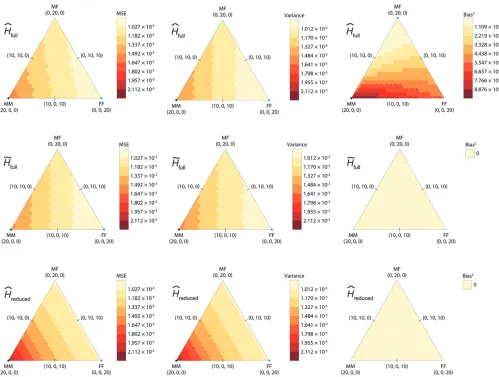
Varying combinations of relative pairs:Finally, we studied the effect of relative pair combinations in a sample, using allele frequencies at the ATCT003, DXS1068, and GATA48H04 loci. Only the results for the highest heterozygosity locus, ATCT003, are shown; as was true in the previous section, each locus yielded similar results. For each locus, we examined each of the 231 possible divisions of exactly 20 full-sib pairs into male– male (t1), male–female (u2), and female–female (v2)
pairs. Figure 4 displays the MSE, variance, and bias squared of the three estimators, calculated analytically using the variance approximation (Equation 18), for var-ious combinations oft1,u2, andv2pairs for the ATCT003
locus. Variance was highest forHˆreduced, because it had
the smallest sample of alleles. For all estimators, var-iance was highest where the configuration of full-sibs had mostly male–male pairs, again due to the smaller sample of alleles.H˜fullandHˆreducedwere unbiased across
the space of possible combinations.Hˆfullshowed a trend
in bias squared in which configurations with a greater proportion of males had higher bias squared, as is predicted analytically from the smaller sample size
Figure3.—Mean squared error as a function of sample size (number of pairs¼number of individuals/2), calculated
analyt-ically using the variance approximation (Equation 18 inserted into Equations 15 and 16), on the basis of allele frequencies at the DXS1068 locus (H¼0.7344) for male–female relative pairs in which the females were removed to evaluateHˆreduced. The range of
(Equation 14). For all configurations, the bias squared ofHˆfull was greater than that for the other estimators.
Among the three estimators, MSE was highest for ˆ
Hreduced. Similarly to the observation for variance, MSE
was greatest for configurations with a high proportion of male–male pairs. Although H˜full performed slightly
worse in having a greater variance compared toHˆfull, it
had a slightly lower MSE due to its lower bias. More generally, althoughH˜fullperformed better in the setting
of Figure 4, the exact formula can be used to determine which estimator has lowest MSE for a given scenario.
Application to data: We next investigated the behav-ior of our estimator using X-chromosomal SNP data sets of 485 individuals and 446 unrelated individuals (see Data). Table 4 displays the relative pairs in the sample of 485 individuals. Because we analyzed the estimators separately by population, the subscripts of 485 and 446
refer to whether or not relatives were included in a calculation, not to the actual numbers of individuals in that calculation. In the same manner as in DeGiorgio
and Rosenberg(2009), we tookHˆ446 for each
popula-tion to be a proxy for true heterozygosity, because this quantity provided an unbiased estimate when no rela-tives were included in the sample. Note that removed individuals belonged only to pairs related through the X chromosome; individuals related only autosomally (such as male–male parent–offspring pairs) were in-cluded in the reduced sample. In our analysis, we compared the means of H˜485 and Hˆ485 across the
13,052 loci to the corresponding mean ofHˆ446.
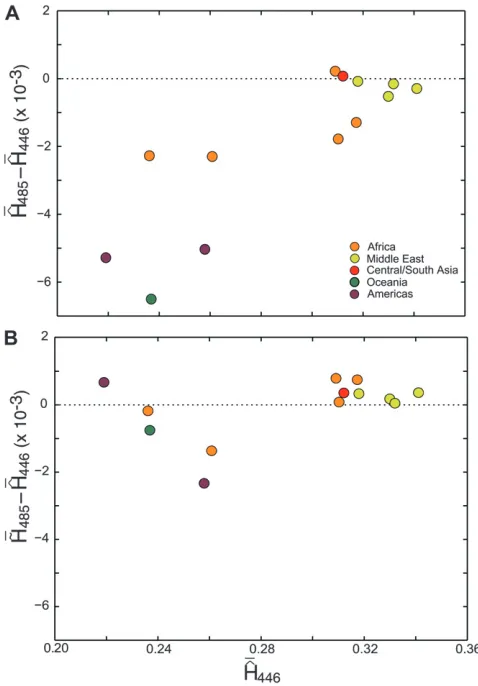
Figure 5 compares the difference between the mean ofHˆ485across loci (Hˆ485) and the mean ofHˆ446(Hˆ446)
with the difference between the mean of H˜485 (H˜485)
and the mean ofHˆ446(Hˆ446). As Figure 5A shows,Hˆ485
Figure4.—Mean squared error (MSE), variance, and bias squared ofHˆ
full,H˜full, andHˆreduced, calculated analytically using the
variance approximation (Equation 18 inserted into Equations 15 and 16), as functions of the configuration oft1male–male
(F¼1
2),u1male–female (F¼12), andy2female–female (F¼38) pairs in 20 total relative pairs, on the basis of allele frequencies
at the ATCT003 locus (H¼ 0.7794). Each row displays a different estimator and each column displays a different statistic. The three vertices of each triangle represent 20 male–male, 20 male–female, and 20 female–female full-sib pairs. The numbers on the scale indicate the cutoff values for colors. Note that unlike for the other two estimators, the scale for bias squared ofHˆfull
includes nonzero values. The black dot on each graph (except the bias squared graphs forH˜fullandHˆreduced) represents the largest
generally yields a lower heterozygosity estimate than ˆ
H446 due to the downward bias caused by related
individuals. Applying H˜485 reduces the magnitude of
the difference between the estimate of heterozygosity in sets with and without relatives (Figure 5B), andH˜485
yields values that are not consistently lower than those of ˆ
H446. It is important to note that because 15 of 45 of the
relative pairs in the data have an uncertain second-degree relationship (t3, u5, or v5), H˜485 might have
overcorrected bias in cases in which the individuals were not related via the X chromosome and undercorrected bias in cases in which the individuals actually were related on the X chromosome.
A Wilcoxon signed-rank test was used to evaluate the differences between Hˆ485 and Hˆ446 applied to the 13
populations that contained relatives (see Table 4). This test yielded aP-value of 0.0024, indicating that the inclusion of relatives had a significant impact on the estimation of heterozygosity usingH. In contrast, the Wilcoxon signed-ˆ rank comparison ofH˜485 and Hˆ446 yielded a P-value of
0.6355, indicating that the inclusion of relatives did not significantly alter the estimation of heterozygosity whenH˜ was used. The mean differenceH˜485Hˆ446(8.04933 105) and the mean absolute difference jH˜
485Hˆ446j
(6.31593 104) were smaller across the 13 populations
than the mean difference (1.93933103) and the mean
absolute difference (1.9849 3 103), Hˆ
446Hˆ485 and
jHˆ446Hˆ485j, respectively.
We also investigated the behavior of H˜ and Hˆ with regard to variance for the 13 populations that contained relatives. We compared Hˆ485Hˆ446 and H˜485Hˆ446,
which we used as proxies for bias, following the methods of DeGiorgioand Rosenberg(2009), and the standard
deviations of the two estimators applied with relatives included. From Figure 6, we observe that while there was a sizeable difference in the bias proxy betweenHˆ485
and H˜485, there was only a small difference in
stan-dard deviation. This result is compatible with the res-ults from our analytical computations, which suggest that H˜ corrects bias without substantially increasing variance.
DISCUSSION
Our estimator,H, is an effective tool for assessing the˜ gene diversity of a sample of arbitrary ploidy containing related or inbred individuals. It can be used to provide unbiased estimates of expected heterozygosity when the inbreeding and kinship coefficients of sampled
individ-Figure 5.—Comparison of the difference between the
mean ofHˆ485across loci and the mean ofHˆ446with the differ-ence between the mean ofH˜485and the mean ofHˆ446. (A) The difference between the mean ofHˆ485and the mean ofHˆ446for
each of the 13 populations containing relatives (Table 4). (B) The difference between the mean ofH˜485and the mean ofHˆ446
for each of the 13 populations. The estimators were applied to a data set of 13,052 SNP loci with 485 individuals belonging to 29 populations, and the results for the 13 populations with rel-atives are shown. Included in the set of 485 individuals was a subset of 446 individuals that contained no relatives. The sub-scripts of 485 and 446 refer to whether or not relatives were in-cluded, not to the actual number of individuals in the calculation. Each data point represents one population, with color indicating the geographic region of that population. The dotted line indicates a difference of zero.
TABLE 4
Types of relative pairs in populations from the data set of 485 individuals reported by JAKOBSSONet al.(2008)
t1 t2 t3 u1 u2 u3 u4 u5 v1 v2 v3 v4 v5
Bantu (Kenya) 1
Bedouin 1 1
Biaka Pygmy 1 2 1 2
Druze 2 1 2
Kalash 1
Mandenka 1 1
Maya 1 1 2
Mbuti Pygmy 1 1
Melanesian 1 3 2 2 1
Mozabite 1
Palestinian 1 1
Pima 1 1 1 1 1 1
Yoruba 1 1 1 1
Total 4 1 5 7 6 1 0 3 5 5 0 1 7
uals are known. We found that the unbiasedness of the diploid estimator of DeGiorgio and Rosenberg
(2009) extends to a much more general set of scenarios, provided that kinship coefficients are appropriately weighted by ploidy in the computation.
Here, we evaluated the properties of H˜ in the spe-cific case of the human X chromosome. Through our analytical calculations, we have shown that, similarly to the DeGiorgioand Rosenberg(2009) estimator in the
diploid case, the performance ofH˜ is generally supe-rior to that of Hˆ when the sample to which the esti-mators are applied contains relatives.H˜accounts for the bias introduced by relatedness while simultaneously maintaining comparable MSE and variance toH. Ourˆ estimator also performs well compared toHˆ when ap-plied to data from human populations. While the true heterozygosity of each population is not known, when we compared H˜ and Hˆ to an approximation of true heterozygosity, with Hˆ applied to the data set with no related individuals, we found that the difference be-tween the estimate when relatives were included and when relatives were not included was significantly smaller forH. Because the reduction in this proxy for˜ bias is accompanied by only a small increase in standard deviation, we argue that H˜ should often be preferred overHˆ in the estimation of gene diversity in a sample containing relatives.
In addition to developing theH˜ estimator for gene diversity, we also determined the analytical variance of
our estimator, allowing us to theoretically evaluate the properties of H. We also developed an approximation˜ for variance (Equation 18) that is simpler to compute and that is applicable when each individual has at most one relative in the sample. Knowledge of the theoretical variance can further allow investigators to evaluate the circumstances under whichH˜ applied to a full sample, including relatives, is superior to usingHˆwith a reduced sample in which members of relative pairs have been removed. For example, Figure 2 indicates that removing relatives will provide a lower MSE of the heterozygosity estimate in some cases. However, Figure 4 suggests that
˜
Hfullyields a lower MSE thanHˆreducedexcept in the small
fraction of relative–pair combinations that contain large numbers ofu1pairs. Thus, we propose that in most cases
the use of H˜ on a sample set that includes related individuals affords a better estimate of gene diversity than applyingHˆ on a sample that contains no relatives and that investigators can use the theoretical variance of
˜
Hto determine whether a given situation is likely to be among the exceptions.
We thank Laurent Excoffier and three anonymous reviewers for their valuable comments. This work was supported by National Institutes of Health (NIH) grant R01 GM081441, NIH training grant T32 GM070449, a University of Michigan Rackham Merit Fellowship, and grants from the Burroughs Wellcome Fund and the Alfred P. Sloan Foundation.
LITERATURE CITED
Buteler, M. I., R. L. Jarretand D. R. LaBonte, 1999 Sequence
characterization of microsatellites in diploid and polyploid Ipo-moea.Theor. Appl. Genet.99:123–132.
Cockerham, C. C., 1971 Higher order probability functions of
iden-tity of alleles by descent. Genetics69:235–246.
Cotterman, C., 1940 A calculus for statistico-genetics. Ph.D. Thesis,
Ohio State University, Columbus, OH. Reprinted inGenetics and Social Structure, pp. 157–272, edited by P. Ballonoff. Dowden,
Hutchinson & Ross, Stroudsburg, PA, 1974.
DeGiorgio, M., and N. A. Rosenberg, 2009 An unbiased estimator
of gene diversity in samples containing related individuals. Mol. Biol. Evol.26:501–512.
Gillois, M., 1965 Relation d’identite´ en ge´ne´tique. Ann. Inst. H.
Poincare´ Sect. B2:1–94 (in French).
Harris, D. L., 1964 Genotypic covariances between inbred relatives.
Genetics50:1319–1348.
Jacquard, A., 1974 The Genetic Structure of Populations.Springer, New
York.
Jakobsson, M., S. W. Scholz, P. Scheet, J. R. Gibbs, J. M. VanLiere
et al., 2008 Genotype, haplotype and copy-number variation in worldwide human populations. Nature451:998–1003.
Lange, K., 2002 Mathematical and Statistical Methods for Genetic
Anal-ysis, Ed. 2. Springer, New York.
Nei, M., 1973 Analysis of gene diversity in subdivided populations.
Proc. Natl. Acad. Sci. USA70:3321–3323.
Nei, M., and A. K. Roychoudhury, 1974 Sampling variances of
het-erozygosity and genetic distance. Genetics76:379–390. Ramachandran, S., N. A. Rosenberg, M. W. Feldmanand J. Wakeley,
2008 Population differentiation and migration: coalescence times in a two-sex island model for autosomal and X-linked loci. Theor. Popul. Biol.74:291–301.
Reiland, J., S. Hodgeand M. A. F. Noor, 2002 Strong founder
effect inDrosophila pseudoobscura colonizing New Zealand from North America. J. Hered.93:415–420.
Ritland, K., 1996 Estimators for pairwise relatedness and
individ-ual inbreeding coefficients. Genet. Res. Camb.67:175–185.
Figure 6.—Comparison of the difference between the
mean of the estimator and the mean ofHˆ446and standard
de-viation of the estimator, for the estimators H˜485 and Hˆ485.
These estimators were applied to a full data set of 13,052 X chromosome SNP loci with 485 individuals belonging to 29 populations, whereas 446 individuals were included in the re-duced data set that contained no relatives. Only the 13 pop-ulations containing relatives are shown. The subscripts 485 and 446 refer to whether or not relatives were included, not to the actual number of individuals in the calculation. Open and solid points represent the estimates forHˆ485and
˜
H485, respectively. The dotted line indicates a difference of
Rosenberg, N. A., 2006 Standardized subsets of the HGDP-CEPH
Human Genome Diversity Panel, accounting for atypical and duplicated samples and pairs of close relatives. Ann. Hum. Genet.70:841–847.
Rousset, F., 2002 Inbreeding and relatedness coefficients: What do
they measure? Heredity88:371–380.
Thompson, E. A., 1974 Gene identities and multiple relationships.
Biometrics30:667–680.
Weir, B. S., 1989 Sampling properties of gene diversity, pp. 23–42 in
Plant Population Genetics, Breeding and Genetic Resources, edited by
A. H. D. Brown, M. T. Clegg, A. L. Kahlerand B. S. Weir
Sinauer Associates, Sunderland, MA.
Weir, B. S., 1996 Genetic Data Analysis II.Sinauer Associates,
Sunder-land, MA.
Communicating editor: L. Excoffier
APPENDIX A
In this section, we present proofs for Equations 9, 11, 12, and 13.
Proof of Equation9. Applying the definition ofˆpiand using Equation 8, we have
E ˆp2
i ¼
1
ðPgb¼1nbmbÞ2
Xg
a¼1
Xg
b¼1
Xna
j¼1
Xnb
k¼1
E XðiÞ ða;jÞX
ðiÞ ðb;kÞ
h i
¼ 1
ðPgb¼1nbmbÞ2
Xg
a¼1
Xg
b¼1
Xna
j¼1
Xnb
k¼1
Xma
‘¼1
Xmb
t¼1
E AðiÞ ða;jÞ;‘A
ðiÞ ðb;kÞ;t
h i
¼ 1
ðPgb¼1nbmbÞ2
Xg
a¼1
Xg
b¼1
Xna
j¼1
Xnb
k¼1
Xma
‘¼1
Xmb
t¼1
ðFða;jÞðb;kÞpið1piÞ1p2iÞ
¼ 1
ðPgb¼1nbmbÞ2
Xg
a¼1
Xg
b¼1
Xna
j¼1
Xnb
k¼1
mambðFða;jÞðb;kÞpið1piÞ1p2iÞ
¼ð
Pg
b¼1nbmbÞ2 ðPgb¼1nbmbÞ2
F2pið1piÞ1ð
Pg
b¼1nbmbÞ2 ðPgb¼1nbmbÞ2
p2i
¼F2pið1piÞ1p2i: n
Proof of Equation11.ˆP½IBS ¼PI
i¼1ˆp2i. We only need to show thatP½IBD ¼F2. Note that while we writeˆP½IBSas an
estimate,P[IBD] depends only on quantities that are treated as known with certainty and we write it as a known quantity itself. Consider two alleles from the sample (that are not necessarily distinct). LetC(a,j)(b,k)denote the event that the
first of the two alleles is from individual (a,j) and the second is from individual (b,k), where (a,j) and (b,k) are not necessarily distinct. Supposing that the two alleles are drawn uniformly at random from the sample, with replacement, letPC(a,j)(b,k)
denote the probability of eventC(a,j)(b,k). LetP
IBDjC(a,j)(b,k)
be the probability that two alleles are IBD given that the first allele is chosen from individual (a,j) and the second is chosen from individual (b,k). Then
P½IBD ¼X
g
b¼1
Xnb
k¼1
PIBDjCðb;kÞðb;kÞPCðb;kÞðb;kÞ1X
nb
j¼1
Xnb
k¼1
k6¼j
PIBDjCðb;jÞðb;kÞPCðb;jÞðb;kÞ
8 > > < > > :
9 > > = > > ;
1 X
g
a¼1
Xg
b¼1
b6¼a
Xna
j¼1
Xnb
k¼1
PIBDjCða;jÞðb;kÞPCða;jÞðb;kÞ:
PCða;jÞðb;kÞ ¼ ma
Pg c¼1ncmc
mb
Pg c¼1ncmc
¼ mamb
ðPgc¼1ncmcÞ2
PIBDjCða;jÞ ðb;kÞ¼Fða;jÞ ðb;kÞ:
It follows that
P½IBD ¼X
g
b¼1
Xnb
k¼1
Fðb;kÞðb;kÞ
m2b
ðPgc¼1ncmcÞ2
1X
nb
j¼1
Xnb
k¼1
k6¼j
Fðb;jÞðb;kÞ
m2b
ðPgc¼1ncmcÞ2
8 > > > > > < > > > > > : 9 > > > > > = > > > > > ; 1 X g
a¼1
Xg
b¼1
b6¼a
Xna
j¼1
Xnb
k¼1
Fða;jÞðb;kÞ
mamb ðPgc¼1ncmcÞ2
¼ 1
ðPgb¼1nbmbÞ2
Xg
a¼1
Xg
b¼1
Xna
j¼1
Xnb
k¼1
mambFða;jÞ ðb;kÞ
¼F2: n
Proof of Equation12. For anmb-ploid individualk,F(b,k)(b,k)¼1/mb1(11/mb)f(b,k)¼(1/mb)[11(mb1)f(b,k)]. Note
that F(a,j)(b,k) ¼0 if individuals (a, j) and (b, k) are unrelated. We can then break F2 into three components, considering three different types of pairs of individuals: same group–same individual, same group–different individual, and different group. Therefore
F2¼ 1
ðPgb¼1nbmbÞ2
Xg
a¼1
Xg
b¼1
Xna
j¼1
Xnb
k¼1
mambFða;jÞðb;kÞ
¼ 1
ðPgb¼1nbmbÞ2
Xg
b¼1
Xnb
k¼1
m2bFðb;kÞðb;kÞ12
Xg
b¼1
X
nb1
j¼1
Xnb
k¼j11
m2bFðb;jÞðb;kÞ
"
1 2X
g1
a¼1
Xg
b¼a11
Xna
j¼1
Xnb
k¼1
mambFða;jÞðb;kÞ
#
¼ 1
ðPgb¼1nbmbÞ2
Xg
b¼1
Xnb
k¼1 m2b 1
mb
11ðmb1Þfðb;kÞ
12X
g
b¼1
X
R2Gb;b
m2bhRFR
2 4
1 2X
g1
a¼1
Xg
b¼a11
X
R2Ga;b
mambhRFR
3 5
¼ 1
ðPgb¼1nbmbÞ2
Xg
b¼1 nbmb1
Xg
b¼1
nbmbðmb1Þfb12
Xg
b¼1
X
R2Gb;b
m2bhRFR
2 4
1 2X
g1
a¼1
Xg
b¼a11
X
R2Ga;b
mambhRFR
3
5: n
Proof of Equation13. First we note that
1F2¼
D
ðPgb¼1nbmbÞ2 :
˜ H¼ð
Pg
b¼1nbmbÞ2
D 1
XI
i¼1 ˆp2
i
!
:
Rearranging Equation 3 we get
1X I
i¼1 ˆp2
i ¼
Pg
b¼1nbmb1
Pg b¼1nbmb
ˆ H; from which
˜ H¼ð
Pg
b¼1nbmbÞ2
D
Pg
b¼1nbmb1
Pg b¼1nbmb
ˆ H
¼ð
Pg
b¼1nbmbÞðPbg¼1nbmb1Þ
D Hˆ: n
APPENDIX B
In this section, we present results that aid in the derivation of the variance of our gene diversity estimator. Lemma 3 derives certain expectations involving four alleles. These expectations are used to calculate the variance and covariance of squared allele frequency estimates in Lemma 4. Lemma 4 is then used to prove the variance formula in Theorem 2 when related and inbred individuals are included in a sample.
Lemma 3.Consider a locus with I distinct alleles,allele frequencies pi2 [0, 1],and PI
i¼1pi¼1.Suppose a sample from a population has g groups,each with different ploidy,and nbmb-ploid individuals in group b,b¼1, 2,. . .,g,each of whom is possibly inbred and related to other individuals in the sample. Consider the‘th allele of individual(a,j),the tth allele of individual (b,k),the‘9th allele of individual(a9,j9),and the t9th allele of individual(b9,k9).For clarity,let w¼(a,j),x¼(b,k),y¼
(a9,j9),and z¼(b9,k9).Then for allelic types i and i96¼i,
E AðiÞ w;‘A
ðiÞ x;tA
ðiÞ y;‘9A
ðiÞ z;t9
h i
¼Fwxyzpi
1 Fwxy1Fwxz1Fwyz1Fxyz1Fwx;yz1Fwy;xz1Fwz;xy7Fwxyz
p2i 1½12Fwxyz1ðFwx1Fwy1Fwz1Fxy1Fxz1FyzÞ
3ðFwxy1Fwxz1Fwyz1FxyzÞ 2ðFwx;yz1Fwy;xz1Fwz;xyÞp3i
1½11ðFwx;yz1Fwy;xz1Fwz;xyÞ12ðFwxy1Fwxz1Fwyz1FxyzÞ
6Fwxyz ðFwx1Fwy1Fwz1Fxy1Fxz1FyzÞp4i ðB1Þ
E AðiÞ w;‘A
ðiÞ x;tA
ði9Þ y;‘9A
ði9Þ z;t9
h i
¼ Fwx;yzFwxyz
pipi91 2Fwxyz1Fwx ðFwxy1FwxzÞ Fwx;yz
pip2i9
1 2Fwxyz1Fyz ðFwyz1FxyzÞ Fwx;yz
p2ipi9
1½11Fwx;yz1Fwy;xz1Fwz;xy12ðFwxy1Fwxz1Fwyz1FxyzÞ
6Fwxyz ðFwx1Fwy1Fwz1Fxy1Fxz1FyzÞp2ip2i9: ðB2Þ
Proof.We need to evaluate
E AðiÞ w;‘A
ðiÞ x;tA
ði9Þ y;‘9A
ði9Þ z;t9
h i
¼X
15
s¼1
DsP AðwiÞ;‘¼1;A
ðiÞ x;t ¼1;A
ði9Þ y;‘9 ¼1;A
ði9Þ
z;t9 ¼1jS¼s
h i
;
X15
s¼1 Ds¼1
Fwxyz¼D1 Fwxy¼D11D2 Fwxz¼D11D3 Fwyz¼D11D4 Fxyz¼D11D5 Fwx;yz¼D11D6 Fwy;xz¼D11D9 Fwz;xy¼D11D12
Fwx ¼D11D21D31D61D7 Fwy¼D11D21D41D91D10 Fwz¼D11D31D41D121D13
Fxy¼D11D21D51D121D14 Fxz¼D11D31D51D91D11
Fyz¼D11D41D51D61D8: ðB3Þ Note that theD-coefficients above are identical to thed-coefficients in Cockerham(1971). Also, theF-coefficients
involving two individuals, three individuals, and pairs of pairs of individuals are identical to Cockerham’su-,g-, and D-coefficients, respectively (Cockerham1971). Ifi9¼i, we get
E AðiÞ w;‘A
ðiÞ x;tA
ðiÞ y;‘9A
ðiÞ z;t9
h i
¼D1pi1ðD21D31D41D51D61D91D12Þp2i: ðB4Þ
Ifi6¼i9, we get
E AðiÞ w;‘A
ðiÞ x;tA
ði9Þ y;‘9A
ði9Þ z;t9
h i
¼D6pipi91D7pip2i91D8p2ipi91D15p2ip2i9: ðB5Þ
The desired result follows by substituting Equation B3 into Equations B4 and B5. n
Note that expressions mathematically identical to Equations B1 and B2 except with different notation appear in Table 1 of Cockerham(1971). However, a slight conceptual difference is that our formulas involve an expectation of
a product among four arbitrary alleles, not necessarily four alleles in two pairs of diploid genotypes. We now use Lemma 3 to derive Var ˆp2
i and Cov ˆp
2
i; ˆp
2
i9
.
Lemma4.Consider a locus with I distinct alleles,allele frequencies pi2[0, 1],andPI
i¼1pi¼1.Suppose a sample from a population has g groups,each with different ploidy,and nbmb-ploid individuals in group b,b¼1, 2,. . .,g,each of whom is possibly inbred and related to other individuals in the sample. Then for allelic types i and i96¼i,
E ˆp4
i ¼F4pi1 4F313F2;27F4
p2i 1 12F416F212F36F2;2
p3i
1113F2;218F36F46F2p4i ðB6Þ
E ˆp2
iˆp2i9
¼F2;2F4pipi91 2F41F22F3F2;2
pip2i91 2F41F22F3F2;2
p2ipi9
1 113F2;218F36F46F2
p2ip2i9 ðB7Þ
and therefore
Var ˆp2
i ¼F4pi1 4F313F2;27F4F22
pi2112F414F212F2212F36F2;2p3i 1 3F2;218F36F44F2F22
p4i ðB8Þ
Covðˆp2
i; ˆp2i9Þ ¼ F2;2F4F22
pipi91 2F41F222F3F2;2
pip2i9
1 2F41F222F3F2;2
p2ipi91 3F2;218F36F44F2F22
p2ip2i9: ðB9Þ
E ˆp4
i ¼
1
ðPgb¼1nbmbÞ4
Xg
a¼1
Xg
b¼1
Xg
a9¼1
Xg
b9¼1
Xna
j¼1
Xnb
k¼1
Xna9
j9¼1
Xnb9
k9¼1
Xma
l¼1
Xmb
t¼1
Xma9
l9¼1
Xmb9
t9¼1 3E AððiaÞ;jÞ;‘A
ðiÞ ðb;kÞ;tA
ðiÞ ða9;j9Þ;‘9A
ðiÞ ðb9;k9Þ;t9
h i
¼ 1
ðPgb¼1nbmbÞ4
Xg
a¼1
Xg
b¼1
Xg
a9¼1
Xg
b9¼1
Xna
j¼1
Xnb
k¼1
Xna9
j9¼1
Xnb9
k9¼1
mambma9mb9
3fFða;jÞðb;kÞða9;j9Þðb9;k9Þpi
1 Fða;jÞðb;kÞða9;j9Þ1Fða;jÞðb;kÞðb9;k9Þ1Fða;jÞða9;j9Þðb9;k9Þ1Fðb;kÞða9;j9Þðb9;k9Þ
1Fða;jÞðb;kÞ;ða9;j9Þðb9;k9Þ1Fða;jÞða9;j9Þ;ðb;kÞðb9;k9Þ1Fða;jÞðb9;k9Þ;ðb;kÞða9;j9Þ
7Fða;jÞðb;kÞða9;j9Þðb9;k9Þ
p2i 112Fða;jÞðb;kÞða9;j9Þðb9;k9Þ
1Fða;jÞðb;kÞ1Fða;jÞða9;j9Þ1Fða;jÞðb9;k9Þ1Fðb;kÞða9;j9Þ1Fðb;kÞðb9;k9Þ1Fða9;j9Þðb9;k9Þ
3ðFða;jÞðb;kÞða9;j9Þ1Fða;jÞðb;kÞðb9;k9Þ1Fða;jÞða9;j9Þðb9;k9Þ1Fðb;kÞða9;j9Þðb9;k9ÞÞ 2ðFða;jÞðb;kÞ;ða9;j9Þðb9;k9Þ1Fða;jÞða9;j9Þ;ðb;kÞðb9;k9Þ1Fða;jÞðb9k9Þ;ðb;kÞða9;j9ÞÞ
p3i 1½11Fða;jÞðb;kÞ;ða9;j9Þðb9;k9Þ1Fða;jÞða9;j9Þ;ðb;kÞðb9;k9Þ1Fða;jÞðb9;k9Þ;ðb;kÞða9;j9Þ
12ðFða;jÞðb;kÞða9;j9Þ1Fða;jÞðb;kÞðb9;k9Þ1Fða;jÞða9;j9Þðb9;k9Þ1Fðb;kÞða9;j9Þðb9;k9ÞÞ 6Fða;jÞðb;kÞða9;j9Þðb9;k9Þ
ðFða;jÞðb;kÞ1Fða;jÞða9;j9Þ1Fða;jÞðb9;k9Þ1Fðb;kÞða9;j9Þ1Fðb;kÞðb9;k9Þ
1Fða9;j9Þðb9;k9ÞÞp4ig ¼ F4pi1 4F313F2;27F4
p2i 1 12F416F212F36F2;2
p3i 1 113F2;218F36F46F2
p4i: For the case with allelesiandi96¼i, we have
E ˆp2
iˆp2i9
¼ 1
ðPgb¼1nbmbÞ4
Xg
a¼1
Xg
b¼1
Xg
a9¼1
Xg
b9¼1
Xna
j¼1
Xnb
k¼1
Xna9
j9¼1
Xnb9
k9¼1
Xma
‘¼1
Xmb
t¼1
Xma9
‘9¼1
Xmb9
t9¼1 3E AððiaÞ;jÞ;‘A
ðiÞ ðb;kÞ;tA
ði9Þ ða9;j9Þ;‘9A
ði9Þ ðb9;k9Þ;t9
h i
¼ 1
ðPgb¼1nbmbÞ4
Xg
a¼1
Xg
b¼1
Xg
a9¼1
Xg
b9¼1
Xna
j¼1
Xnb
k¼1
Xna9
j9¼1
Xnb9
k9¼1
mambma9mb9
3 Fða;jÞðb;kÞ;ða9;j9Þðb9;k9ÞFða;jÞðb;kÞða9;j9Þðb9;k9Þ
pipi9
1 2Fða;jÞðb;kÞða9;j9Þðb9;k9Þ1Fða;jÞðb;kÞ
Fða;jÞðb;kÞða9;j9Þ1Fða;jÞðb;kÞðb9;k9ÞFða;jÞðb;kÞ;ða9;j9Þðb9;k9Þpip2i9
1 2Fða;jÞðb;kÞða9;j9Þðb9;k9Þ1Fða9;j9Þðb9;k9Þ
Fða;jÞða9;j9Þðb9;k9Þ1Fðb;kÞða9;j9Þðb9;k9Þ
Fða;jÞðb;kÞ;ða9;j9Þðb9;k9Þ
p2ipi9
1 11Fða;jÞðb;kÞ;ða9;j9Þðb9;k9Þ1Fða;jÞða9;j9Þ;ðb;kÞðb9;k9Þ1Fða;jÞðb9;k9Þ;ðb;kÞða9;j9Þ
1 2Fða;jÞðb;kÞða9;j9Þ1Fða;jÞðb;kÞðb9;k9Þ1Fða;jÞða9;j9Þðb9;k9Þ1Fðb;kÞða9;j9Þðb9;k9Þ 6Fða;jÞðb;kÞða9;j9Þðb9;k9Þ
Fða;jÞðb;kÞ1Fða;jÞða9;j9Þ1Fða;jÞðb9;k9Þ1Fðb;kÞða9;j9Þ1Fðb;kÞðb9;k9Þ
1Fða9;j9Þðb9;k9Þ
p2ip2i9g ¼ F2;2F4
pipi91 2F41F22F3F2;2
pip2i91 2F41F22F3F2;2
p2ipi9
1 113F2;218F36F46F2
p2ip2i9: