• No results found

Implementation of Solar-To-Fuel Conversions in Achieving Performance by Nanotechnology

N/A
N/A
Protected

Academic year: 2020

Share "Implementation of Solar-To-Fuel Conversions in Achieving Performance by Nanotechnology"

Copied!
12
0
0

Loading.... (view fulltext now)

Full text

(1)

Implementation of Solar-To-Fuel Conversions

in Achieving Performance by Nanotechnology

Farooq Adil Easa Al-Musawi1,Dr. G. Giridhar2

M. Sc., Nanotechnology, Acharya Nagarjuna University, Nagarjunanagar. Guntur District, Andhra Pradesh, India1

Professor, Acharya Nagarjuna University, Nagarjunanagar. Guntur District, Andhra Pradesh, India2

ABSTRACT: One of the greatest difficulties for humanity in the era of 21 is utilization of elective hotspots for Non-renewable, restricted fossil fuels that hugely contribute on the issue of global warming. In this test, solar energy generation is quickly turning into a crucial wellspring of renewable energy being created as an other option to conventional wellsprings of intensity. For enhancing the proficiency of solar gadgets different methodologies was proposed yet nanotechnology, a blend of science and designing, is seen as new possibility for clean energy applications. Nanotechnology will convey noteworthy advantages to the energy area, particularly to energy stockpiling and solar energy. Enhanced materials productivity and lessened assembling costs are only two of the genuine financial advantages that nanotechnology as of now brings these fields.

The global demand for energy is expanding and the unfavorable results of rising ozone harming substance emissions, global warming and natural corruption show real difficulties. Solar energy offers a perfect and practical renewable energy source with the possibility to mitigate the inconvenient results ordinarily connected with fossil fuel-based energy age. Since nanofluids offer considerably more prominent warmth retaining and warm exchange properties contrasted with conventional working fluids. The survey outlines ebb and flow inquire about in this inventive field. It examines coordinate solar absorber gatherers and techniques for enhancing their performance.

KEYWORDS: Solar Engergy, Nanotechnology, Renewable and Sustainable Energy

I. INTRODUCTION

Nanotechnology

Nanotechnology is a field of research and advancement concerned about building 'things' - by and large, materials and gadgets - on the size of iotas and particles. A nanometre is one-billionth of a meter: ten times the breadth of a hydrogen molecule. The measurement of a human hair is, all things considered, 80,000 nanometres. At such scales, the customary standards of material science and science never again apply. For example, materials' attributes, for example, their shading, quality, conductivity and reactivity, can contrast significantly between the nanoscale and the full scale. Carbon 'nanotubes' are 100 times more grounded than steel however six times lighter.

(2)

creators can devise suitable administrative measures. They say an educated open deliberation must occur to decide the harmony amongst dangers and advantages.

Nanotechnology Methods Used in Renewable and Sustainable Energy

Nanotechnology is producing a considerable measure of consideration nowadays and accordingly constructing awesome desires in the scholarly network as well as among financial specialists, the legislatures, and industry. Its one of a kind capacity to create new structures at atomic scale has just delivered novel materials and gadgets with extraordinary potential applications in a wide number of fields. Among them, critical leaps forward are particularly required in the energy segment that will enable us to keep up our expanding hunger for energy, which increments both with the quantity of individuals that join the created economies and with our request per capita.

These days, our principle energy hotspots for human movement are fossil and mineral energizes, atomic and hidroelectric sources. They are exceptionally unsafe to environment since they cause worldwide cautioning, ozone layer consumption, biosphere and geosphere pulverization, and natural obliteration.1 Thus, the genuine energy generation can be viewed as a destructive industry both as far as contamination creation and environmental effect since the mechanical insurgency in the eighteenth century. Around 80 wt% of CO2 emanations on the planet are begun by the energy part.

Nanotechnology offers, out of the blue, instruments to grow new ventures in light of financially savvy and cost-productive economies, along these lines genuinely adding to a practical monetary development. The utilization of nanotechnology in all the energy-related procedures that include the utilization of sunlight based radiation as an energy source. Sun oriented energy is free and fairly accessible in numerous parts around the word. In only multi year, the sun can furnish the earth with 15,000 times more energy than the atomic and fuel energy really required amid the year. This energy source can be utilized as a part of various ways: photovoltaic (PV) innovation – which straightforwardly changes over light into electrical flow, solar– warm frameworks – utilized as a part of sun based authorities, counterfeit photosynthesis – which delivers either sugars or hydrogen by means of water part, the supposed 'latent sun based' advancements, where building configuration boosts sunlight based lighting and warming, and even biomass innovation – where plants utilize the sun oriented radiation to drive concoction changes and make complex starches, which are utilized to create power, steam or biofuels

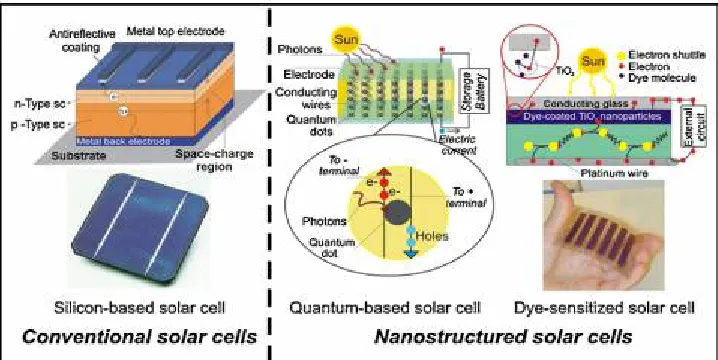
Fig . Evolution of photovoltaic technology: from conventional (silicon-based solar cells) to nanostructured solar cells (quantum-based and dye-sensitized solar cells). Adapted from Refs.

(3)

Presently, PV advertise depends on silicon wafer-based sun powered cells (thick cells of around 150– 300 nm made of crystalline silicon). This innovation, delegated the original of photovoltaic cells, represents over 86% of the worldwide sun based cell advertise. The secondgeneration of photovoltaic materials depends on the presentation of thin film layers (1– 2 nm) of semiconductor materials. All the more particularly, they utilize thin epitaxial stores of semiconductors on cross section coordinated wafers. These cells involve around 90% of the market space yet just a little section of the worldwide PV showcase. Lamentably, in spite of the fact that a lower fabricate.

Quantum specks are productive light producers since they transmit numerous electrons per sun powered photon, with various assimilation and outflow spectra relying upon the molecule measure, accordingly remarkably raising the hypothetical effectiveness restrict by adjusting to the approaching light range. Arthur J. Nozik announced in 1982 that ''a solitary edge quantum-utilizing gadget in which the energized bearers thermally equilibrate among themselves, however not with the environment, changes over sunlight based energy with a proficiency moving toward that of a vast limit gadget''2.

Brinker and Ginger3 investigated the role of nanotechnology for sustainability, energy conversion, storage and conservation. They explained that energy use reduction was the main application for thermoelectricity (TE) waste heat recovery devices. These devices had a very low impact on the environment. Since, they were totally passive, clean and operated without any additional energy supply. Their use in cars and public transport systems would reduce the oil consumption. Subramani et al.4 presented a comprehensive review of energy minimization strategies for membrane-based desalination processes and utilization of lower greenhouse gas emission renewable energy resources.

Grebler and Nentwich 5 displayed an article about the connection between the nanomaterials and the environment. They extricated the accompanying documentations:

1- Nanotechnology can be used to optimize materials.

2- When nanoscale carbon black added to modern automobile tires lead store inforce the material and reduce rolling resistance. This makes a fuel savings of upto10%.

3- Nano materials can help for self-cleaning or “easy-to-clean” coatings. For example, if they added to glass, they save both energy and water in cleaning process, since such surfaces are easier to clean or not required to be clean continuously.

4- Nano tribological wear protection products such as fuel or motor oil additives can reduce fuel consumption of vehicles and extend engine life.

5- Nanoparticles such as flow agents allow plastics to be melted and cast at lower temperatures.

6- Nanoporous insulating materials in the construction industry can help to reduce the energy needed to heat and cool buildings.

7- Nanoceramic corrosion coatings for metals without toxic heavy metals

(chromium, nickel), for example in automobiles, can replace environmentally harmful or hazardous chromium (VI) layers.

8- Nano-scale titanium dioxide and silica can replace the environmentally damaging bromine in flame retardants

Yu and Xie 6 condensed the ongoing advancement on the investigation of nanofluids, for example, the readiness techniques, the assessment strategies for the strength of nanofluids and the ways and systems to upgrade the

2

Ross RT, Nozik AJ. Efficiency of hot-carrier solar energy converters. J Appl Phys 1982;53:3813–8 3

C. J. Brinker and D. Ginger, ‘Nanotechnology for sustainability: energy conversion, storage, and conservation’, in Nanotechnology Research Directions for Societal Needs in 2020, Springer, 2011, pp. 261–303

4

A. Subramani, M. Badruzzaman, J. Oppenheimer, and J. G. Jacangelo, ‘Energy minimization strategies and renewable energy utilization for desalination: A review’, Water Res., vol. 45, no. 5, pp. 1907–1920, 2011

5

S. Grebler and M. Nentwich, ‘Nano and the environment–Part I: Potential environmental benefits and

(4)

steadiness of nanofluids. They introduced the expansive scope of present and future utilizations of nanofluids in different fields, for example, energy, mechanical and biomedical fields. They refereed in their paper, that the nanofluids were set up by the accompanying most utilizing strategies:

1- Two-step method: It was considered the most widely used and economic methodfor preparing nanofluids. Nanoparticles, nanofibers, nanotubes, or other nanomaterials used in this method were first

produced as dry powders by chemical or physical methods. Then, the nano sized powder will be dispersed in to a fluid in the second processing step with the help of intensive magnetic force agitation, ultrasonic agitation, high- shear mixing, homogenizing and ballmilling.

2- One-step method: It consisted of simultaneously making and dispersing the articles in the fluid. In this method, the processes of drying, storage, transportation, and dispersion of nanoparticles were avoided. The one-step method can prepare uniformly dispersed

nanoparticles, and the particles can be stably suspended in the base fluid

Nanotechnology makes a gigantic upheaval in the size and plan of renewable energy gadgets used for energy transformation and capacity, environmental observing, and in addition green building of environmental well disposed materials. It is demonstrated that, nanomaterials assume a huge part on the human life, by giving a cheap and clean energy which is currently turned into a worldwide industry.

III. SOLAR ALTERNATIVE FUELS

Solar energy, among all carbon-free energy sources, is viewed by some experts, as the alternative with the greatest intermediate to long-term potential to replace fossil fuels. For this to happen, however, two important challenges must be addressed. The first is providing adequate energy storage capabilities for solar-generated electricity, given the intermittent character of the solar resource. The second, perhaps more important challenge, is utilizing solar energy to aid in the production of clean alternative fuels for the transportation, industrial, and housing sectors.

Solar energy has, until now, accounted for a relatively small fraction of the overall energy supply, with its fluctuating contributions to the grid controlled and compensated by thermal generation (fossil-fuel combustion). As solar and wind penetration increases, however, the intermittency of these two energy sources seriously compromises the stability and quality of grid power. This issue has already begun to demand urgent attention inwhere 36.8 terawatt-hours (TWh) of electricity (equal to 6.6% of total production) was generated by solar sources in 2015. During this same period, 87.1 TWh was generated by nuclear plants, which are slated for shut down by 2021. While dependence on intermittent renewable energy sources is not yet quite so high in the India, where solar and wind accounted for 0.6 and 4.7% of overall electricity production in 2015, respectively, the relentless decline in PV module prices has continued at a rate of 5–7% annually for the past decade.

The Energy Information Administration now expects utility-scale solar generating capacity to increase by more than 60% between the end of 2014 and the end of 2016, while wind capacity is expected to increase by about 23% over the same time period. While these projections may be optimistic, and may assume the continued existence of various government subsidies, there is little doubt that generation from these intermittent energy sources will continue to show significant growth. Synthetic natural gas has three times the energy density, on a volume basis, of hydrogen. Given the central role that chemical fuels already play in electricity generation, the conversion of solar energy into chemical fuels that are capable of being used in the existing distribution and end-use infrastructure would be highly desirable.

6

(5)

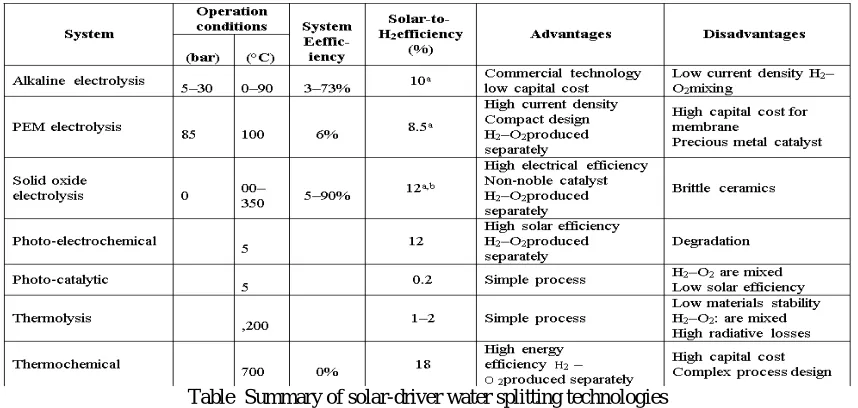
The higher operating temperature allows for a significant reduction in electrical power consumption (efficiencies as high as 85–90% have been reported) and for the use of non-noble metal electrodes (typically Ni-YSZ cermet cathode and a ceramic lanthanum strontium manganese oxide (LSMO) anode). Reduced ohmic and over-potential losses also allow for considerably higher current densities and more compact designs. The high operating temperatures and brittle nature of the oxide components, however, create additional challenges vis-a-vis reduced lifetimes and materials and fabrication costs. The key features of these electrolysis systems are summarized in which is taken from Herron et al Table and includes estimates of projected solar-to-H2 conversion efficiencies, which range from 8.5% for PEM to 12% for solid oxide electrolysis cells, assuming a 15% solar-to-electricity PV conversion efficiency.

Table Summary of solar-driver water splitting technologies

III. SOLAR THERMOCHEMICAL HYDROGEN PRODUCTION

Solar thermal power, or CSP, is an alternate means of harnessing incident solar energy that can be utilized to generate solar fuels, in addition to its more common use, in which high temperatures generated by concentrating incident solar radiation are used to drive conventional steam or gas turbines. Several routes to using CSP for solar fuel generation are discussed in the following. While thermochemical approaches are particularly promising, progress to date has been largely limited to laboratory demonstrations.

(6)

Solar-driven, two-step water splitting to form hydrogen based on reduction/oxidation reactions While the solar thermochemical process provides a clean, efficient, and sustainable route for producing hydrogen from water, challenges include reducing heat losses during each step of the process cycle, scaling up and improving the coupling of the solar concentrators to the reactors, identifying appropriate reactor containment materials and seals, and ensuring that the working materials continue to allow for rapid reduction and oxidation during the cycling process even after many thermochemical cycles.

Carbon dioxide-derived fuels

The earth is going through a rapid period of warming due to high levels of global CO2 emissions from human activity (34 billion tons in 2011). CO2 concentrations in the atmosphere are still low enough (0.04%) that it would be impractically expensive to capture and purify CO2 from the atmosphere. But other sources of CO2 are available that are considerably more concentrated. Power generation based on natural gas or coal combustion is responsible for the major fraction of global CO2 emissions (including 38% of overall emissions in the India), with other important sources being represented by the cement, metals, oil refinery, and petrochemical industries. Nearly, 8000 large, stationary sources of CO2exist worldwide, each with annual CO2 emissions above 0.1 Mt. Indeed, a growing number of large-scale power plant carbon dioxide capture and storage (CSS) projects are either operating, under construction, or in the planning stage, some of them involving facilities as large as 1200 MW capacity.

While solar PV energy conversion has the potential to reduce CO2 emissions by serving as an alternative means of generating electricity, harnessing solar energy to convert the CO2 generated by other sources into useful fuels and chemicals that can be readily integrated into existing storage and distribution systems would move us considerably closer to achieving a carbon–neutral energy environment. This section reviews options for CO2 capture and separation.

(7)

energy cost for regenerating solvent, the cost to compress captured CO2 for transport and storage, and the low degradation temperature of MEA.

Alternatives include membrane and cryogenic separation. With membranes, there is an inverse correlation between selectivity and permeability, so one must optimize between purity and separation rate. Cryogenic separation insures high purity at the expense of low yield and higher cost. Currently, MEA absorption is industrially practiced, but is limited in scale: 320–800 metric tons9 CO2/day (versus a CO2generation rate of 12,000 metric tons per day for a 500 MW power plant). Scale-up would be required to satisfy the needs of a solar refinery. Alternatives, such as membranes, have relatively low capital costs, but require high partial pressures of CO2 and a costly compression step to achieve high selectivity and rates of separation.Indeed, since carbon capture reduces the efficiency of power generation, power plants with carbon capture will produce more CO2 emissions (per MWh) than a power plant that does not capture CO2. Therefore, the cost of transportation fuel produced with the aid of CO2 capture must also cover the incremental cost of the extra CO2 capture. These costs must then be compared to the alternative costs associated with large-scale CO2 sequestration, the practicality of which also remains to be demonstrated. Finally, one also needs to consider the longer term rationale for converting CO2 to liquid fuels once fossil-fuel power plants cease to be major sources of CO2. Closed-cycle fuel combustion and capture of CO2 from, e.g., vehicle tailpipes, present a considerably greater technical and cost challenge than capture from concentrated stationary sources.

CO2 can be converted to fuels with renewable, solar-derived hydrogen and solar heat, as discussed above. For example, the reverse-water–gas shift reaction (RWGS):

CO2 + H2→ CO + H2O

can be used, in concert with catalysts (copper-, iron-, or ceria-based systems), to convert CO2 and hydrogen to CO and water. The CO mixed with hydrogen produces syngas, which can be used to generate a variety of products, including methanol, or liquid hydrocarbons through Fischer–Tropsch synthesis. Issues related to the thermal stability of the catalysts and the undesired formation of methane still need to be resolved. There are also direct routes for hydrogenating CO2 to make products including methanol, methane, and formic acid. Besides these hydrogenation routes, CO2 can also, in principle, be converted to fuels using direct solar energy through electro-catalytic, photo-electrochemical, and thermochemical reduction, although these approaches remain in very early stages of development.

IV. SOLAR ENERGY BASED IEC RESULTS

The sustainable nature of solar electricity along with its associated large resource potential and falling costs have motivated a rapid increase in the deployment of utility-scale solar electricity generation plants in recent years. As the installed capacity of photovoltaics (PVs) continues to grow, cost-effective technologies for solar energy storage will be critical to mitigate the intermittency of the solar resource and to maintain stability of the electrical grid. Hydrogen generation via solar water splitting represents a promising solution to these challenges, as H2 can be stored, transported and consumed without generating harmful byproducts. However, the cost of H2 produced by electrolysis is still significantly higher than that produced by fossil fuels. The Department of Energy has calculated the H2 threshold cost to be $2.00–$4.00 per gallon of gasoline equivalent9, whereas the most up-to-date reported H2production cost via electrolysis is $3.26–$6.62 per gallon of gasoline equivalent. There are several promising approaches to large-scale solar water splitting, including photochemical, photoelectrochemical (PEC) and PV-electrolysis systems; none of these approaches are currently economically viable compared with today’s technologies.

(8)

In this work, we employ a high-efficiency triple-junction solar cell with two series-connected polymer electrolyte membrane (PEM) electrolysers to achieve very high STH efficiency. Our system produces H2 with a 48 h average STH

efficiency of 30%, the highest efficiency reported to date for any solar H2 production system, to the best of our knowledge. This work demonstrates the potential for building extremely high-efficiency solar H2 production systems using current state-of-the-art commercially available solar cells and laboratory PEM electrolysers. The device design presented herein could provide a viable route to implementing large-scale solar water splitting installations.

PV-electrolysis system design

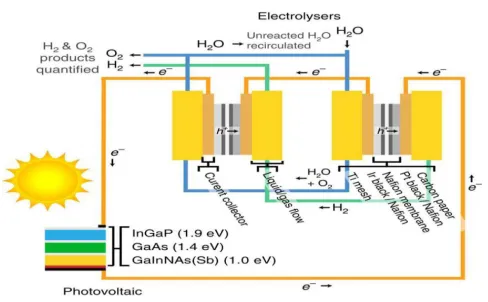
A schematic of the PV-electrolysis system is shown. The solar cell is a commercially available triple-junction solar cell manufactured by Solar Junction, with an active area of 0.316 cm2. From top to bottom, the three subcells of the PV are made of InGaP (Eg=1.895 eV), GaAs (Eg=1.414 eV) and GaInNAs(Sb) (Eg=0.965 eV) respectively. The cell was

installed on a water-cooled stage, which maintained a cell temperature of ∼25 °C and was illuminated with white light from a xenon arc lamp to simulate concentrated AM 1.5D solar illumination. for comparative xenon arc lamp and AM 1.5D spectra.) The two PEM electrolysers consist of Nafion membranes coated with 0.5 mg cm−2 Pt black catalyst at the cathode and 2 mg cm−2 Ir black catalyst at the anode. The two electrolysers were connected in series with the PV cell and a potentiostat, which was used to measure the current through the circuit. Water was pumped into the anode compartment of the first electrolyser, whereas the cathode of the first electrolyser had no input flow. The water and O2 effluent from the first electrolyser’s anode compartment flowed into the anode compartment of the second electrolyser. Likewise, the H2 from the cathode side of the first electrolyser flowed into the cathode side of the second electrolyser. The H2 and O2 products flowing out of the second electrolyser were collected and quantified, whereas the unreacted water was fed back into a water reservoir and recycled through the system. The temperature of the electrolysers was held at ∼80 °C, consistent with standard operating conditions for industrial water electrolysers. The

system operated continuously for 48 h without interruption. Further details of the experimental setup are included in the Methods section.

Figure 1: PV-electrolysis device schematic.

The PV-electrolysis system consists of a triple-junction solar cell and two PEM electrolysers connected in series.

System performance

(9)

Figure 2: PV cell performance.

The IV characteristics of the triple-junction solar cell under (a) 1 sun and (b) 42 suns, which is the illumination

concentration used for the 48 h electrolysis. The key performance parameters are included in the figure.IV curves were collected using both forward and backward voltage sweeps. These measurements generated identical results; thus, this figure shows only the forward sweep results.

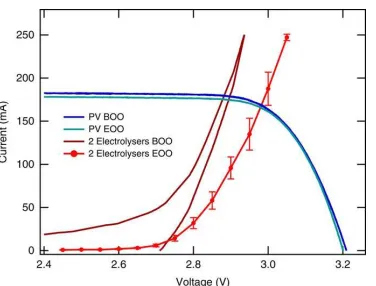
Figure 3: PV cell and PEM electrolyser performance at the beginning and end of operation.

The IV characteristics of the triple-junction solar cell and the dual-electrolyser at both beginning-of-operation (BOO) and end-of-operation (EOO). The blue and cyan curves are the solar cell IV curves under 42 suns at BOO and EOO, respectively. The dark and light red curves are the IV curves of the dual-electrolysers at BOO and EOO, respectively.

STH efficiency

(10)

Figure 4: STH efficiency.

In this system, the thermodynamic potential for the water-splitting reaction is 1.18 V, as the dual electrolyser was operating at 80 °C. APinvalue of 1,328 mW was obtained by multiplying the operational concentration (42 suns) by the

1 sun illumination intensity (100 cm−2) and the solar cell area (0.316 cm2).

V. CONCLUSION

This would allow both the production of biofuel and electricity from the one facility making efficient use of available land. We propose introducing a filter above the algae pond that will allocate the incident illumination to different purposes. The study have modelled this by using commercially available lighting filters as blackbox filters.

This hypothetical filter allows the transmitted light through to the algae and used the remainder to generate electricity using either a highly efficient crystalline silicon solar cell or an amorphous silicon solar cell. Using this system up to 151 W.m−2 of electrical power can be produced. Introducing a method of cogeneration of electrical energy has benefits in the often remote areas microalgae cultivation occurs. This can result in a total available PAR of 177 W.m−2 which can be used to increase the productivity and value of algae cultivation.The results of the Faradaic efficiency measurements and calculations indicate that the electrolyser is selective for producing H2 and O2 . We assume that our system has nearly 100% Faradaic efficiency for hydrogen production, consistent with other studies of PEM electrolysers. Further details about the product quantification measurements and procedure for STH calculations are provided.

(11)

VI. DISCUSSION

The efficiency analysis assumes that the light incident on the PV cell is the only energy input into the system. In reality, there can be additional energy inputs, including the energy required to cool the PV, heat the PEM electrolysers and pump water into the electrolysers. In a concentrated PV device illuminated by natural sunlight, there may also be optical losses in the lenses or mirrors used to concentrate the incident sunlight onto the PV cell, which could reduce the system efficiency. We have chosen to neglect these factors in this study for several reasons, among them to allow for direct comparisons with results from previous studies. We note in general that laboratory-scale systems are designed differently than commercial-scale systems and the losses are not identical. For instance, in this study, lenses or mirrors were not needed to achieve the simulated concentrated solar light; thus, there are no optical losses to measure. In addition, commercial-scale PV systems and PEM electrolysers have been designed to minimize energy losses involving cooling, heating, pumping and so on; thus, the losses in a laboratory-scale demonstration system are less relevant, in addition to being more difficult to accurately quantify. Ultimately, the methods used to supply the aforementioned additional energy inputs in a laboratory-scale system are not optimized; thus, they are not an accurate representation of what could be achieved in large-scale PV-electrolysis systems.

Appropriate designs will minimize the heating, cooling and pumping energy inputs. If needed, additional heat could be supplied by the sunlight that is not converted to electricity. It might also be desirable to operate the PV at a temperature >25 °C. Although this would decrease the PV’s open circuit voltage, it would increase the current output

and decrease the energy input needed to cool the PV (if active cooling methods were employed). This could result in an increased STH efficiency if the PV still produced enough voltage to drive the dual-electrolyser. The PV operating temperature and other operation parameters pose tradeoffs to be optimized. Overall, the system design and operating conditions must be chosen to minimize the levelized cost of hydrogen produced over the operating lifetime of the system. Technoeconomic models of large scale, centralized solar H2production facilities suggest that achieving high STH efficiency is one of the most important factors in reducing the cost of H2, potentially even more important than reducing the cost of the absorber or catalyst materials. Continued development of lower cost, higher efficiency PV cells and electrolysers, optimized PV-electrolysis system designs and technoeconomic models to predict hydrogen costs are all important subjects for continuing research.In summary, we report a PV-electrolysis system that demonstrated an average STH efficiency of 30% over a 48 hr period of continuous operation. This is the highest STH efficiency reported to date and the first solar water splitting system that demonstrates a STH efficiency reaching 30% or higher. Coupling a high-efficiency multi-junction solar cell with two electrolysers in series is an effective way to minimize the excessive voltage generated by a multi-junction solar cell, allowing for greater utilization of the high-efficiency PV for water splitting. The demonstration of this high-efficiency system is an important step closer to the US Department of Energy technology and cost goals, and shows great opportunities for solar energy storage and H2 production with solar water splitting.

REFERENCES

1. Nanoscience and nanotechnologies: opportunities and uncertainties, report by The Royal Society and The Royal Academy of Engineering 2004

2. Hornyak, G. L. et al., Introduction to Nanoscience, CRC Press, 2008

3. U. Sahaym and M. G. Norton, ‘Advances in the application of nanotechnology in enabling a “ hydrogen economy ”’, pp. 5395–5429, 2008 4. H. Lund, ‘Renewable energy strategies for sustainable development’, Energy, vol. 32, no. 6, pp. 912–919, 2007

5. P. F. Siril, ‘Nanotechnology and its application in renewable energy Sustainable energy challenge !’

6. Office of Technology Assessment. Studies of the environmental costs of electricity, OTA-ETI-134. Washington, DC: U.S. Government Printing Office; 1994

7. EA, OECD. Renewables in global energy supply: an IEA facts sheet; 2007

8. Ross RT, Nozik AJ. Efficiency of hot-carrier solar energy converters. J Appl Phys 1982;53:3813–8

9. O’Regan B, Gra¨tzel M. A low-cost, high-efficiency solar cell based on dyesensitized colloidal TiO2 films. Nature 1991;353:737–40. 10. Corma A, Atienzar P, Garcia H, Chane-Ching JY. Hierarchically mesostructured doped CeO2 with potential for solar-cell use. Nat Mater

2004;3:394–7

(12)

12. C. J. Brinker and D. Ginger, ‘Nanotechnology for sustainability: energy conversion, storage, and conservation’, in Nanotechnology Research Directions for Societal Needs in 2020, Springer, 2011, pp. 261–303

13. A. Subramani, M. Badruzzaman, J. Oppenheimer, and J. G. Jacangelo, ‘Energy minimization strategies and renewable energy utilization for desalination: A review’, Water Res., vol. 45, no. 5, pp. 1907–1920, 2011

14. K. W. Guo, ‘Green nanotechnology of trends in future energy: a review’, Int. J. energy Res., vol. 36, no. 1, pp. 1–17, 2012.

15. S. Grebler and M. Nentwich, ‘Nano and the environment–Part I: Potential environmental benefits and sustainability effects’, Nano Trust Dossiers, vol. 026en, no. March 2012, pp. 1–4, 2012

16. W. Yu and H. Xie, ‘A review on nanofluids: preparation, stability mechanisms, and applications’, J. Nanomater., vol. 2012, p. 1, 2012 17. Natarajan, E., and R. Sathish. "Role of nanofluids in solar water heater." The International Journal of Advanced Manufacturing

Technology (2009): 1-5.

18. Peng, Kui-Qing, et al. "Silicon nanowires for advanced energy conversion and storage." Nano Today 8.1 (2013): 75-97.

19. Ager, Joel W., et al. "Experimental demonstrations of spontaneous, solar-driven photoelectrochemical water splitting." Energy &

Environmental Science 8.10 (2015): 2811-2824.

20. Kainth, M.; Sharma, V.K. Latest Evolutions in Flat Plate Solar Collectors Technology. Int. J. Mech. Eng. 2014,1, 7–11.

21. Hellstrom, B.; Adsten, M.; Nostell, P.; Karlsson, B.; Wackelgard, E. The impact of optical and thermalproperties on the performance of flat plate solar collectors. Renew. Energy 2003, 28, 331–344.

22. Konttinen, P.; Lund, P.D.; Kilpi, R.J. Mechanically manufactured selective solar absorber surfaces. Sol. Energy Mater. Sol. Cells 2003, 79, 273–283.

23. Vasiliev, L.L. Heat pipes in modern heat exchangers. Appl. Therm. Eng. 2005, 25, 1–19. 24. A. Ennaoui, S. Fiechter, H. Goslowsky and H. Tributsch// J. Electrochem. Soc. 132 (1985) 1579

25. J.R. Tuttle, A. Szalaj and J.A. Keane, In: Proceedings of the 28th IEEE Photovoltaic Specialists Conference (Anchorage, 2000), p. 1042 26. Johansson, T.B.; Kelly, H.; Reddy, A.K.N.;Williams, R.H. Renewable Energy—Sources for Fuels and Electricity; Island Press: Washington,

DC, USA, 1992.

27. Panwar, N.L.; Kaushik, S.C.; Kothari, S. Role of renewable energy sources in environmental protection: A review. Renew. Sustain. Energy Rev. 2011, 15, 1513–1524.

28. Serrano, E.; Guillermo, R.; García-Martínez, J. Nanotechnology for sustainable energy. Renew. Sustain. Energy Rev. 2009, 13, 2373–2384 29. Tyagi, H.; Phelan, P.; Prasher, R. Predicted efficiency of a low-temperature Nanofluid-based direct absorption solar collector. J. Sol. Energy

Eng. 2009, 131, 041004.

30. Taylor, R.A.; Phelan, P.E.; Otanicar, T.P.; Adrian, R.; Parsher, R. Nanofluid optical property characterisation:Towards efficient direct absorption solar collectors. Nanoscale Res. Lett. 2011, 6, 225

Figure

Fig . Evolution of photovoltaic technology: from conventional (silicon-based solar cells) to nanostructured solar  cells (quantum-based and dye-sensitized solar cells)
Table  Summary of solar-driver water splitting technologies
Figure 1: PV-electrolysis device schematic.
Figure 2: PV cell performance.

References

Related documents

A MOTION WAS MADE BY LIEUTENANT GOVERNOR HUTCHISON TO APPROVE THIS CATALYST FUND APPLICATION FOR GRAND ROUNDS INC.; THIS MOTION WAS SECONDED BY SECRETARY OF

The summary resource report prepared by North Atlantic is based on a 43-101 Compliant Resource Report prepared by M. Holter, Consulting Professional Engineer,

Further, it highlights the necessity of sexual assault response training for university employees, which is a step toward the development of university policies

This introductory course is designed to prepare students with specific skills and knowledge to work as field assistants in the resource, mining and environmental monitoring

Effects are even larger among older elementary and middle school students attending neighborhood schools (located less than a half-mile from home) who are likely to

The risk factors are: site geology (geotechnical properties of the construction site), land use (right to use of the land for the construction of hydropower scheme),

For example, built up land retains maximum temperature but within built up land radiant surface is diversified as the intensities of built up land varies in different parts of