ISSN(Online): 2319-8753 ISSN (Print): 2347-6710
I
nternational
J
ournal of
I
nnovative
R
esearch in
S
cience,
E
ngineering and
T
echnology
(A High Impact Factor, Monthly, Peer Reviewed Journal) Visit: www.ijirset.com
Vol. 8, Issue 7, July 2019
Utilization of Fly Ash in Concrete as Partial
Replacement of Cement
Gaddam Sindhu Krishna
1*, Malisetty V R Harish Babu
2, N. Venkata Sairam Kumar
3M. Tech Student, Department of Civil Engineering, R.V.R & J.C. College of Engineering, Guntur, Andhra Pradesh, India. 1*
B. Tech Student, Department of Civil Engineering, R.V.R & J.C. College of Engineering, Guntur - 19, Andhra Pradesh, India. 2
Assistant professor, Department of Civil Engineering, R.V.R & J.C. College of Engineering, Guntur - 19, Andhra Pradesh, India. 3
ABSTRACT: This paper presents the effect of addition of fly ash (0 to 40%) in concrete. Fly ash is a waste material
having pozzolanic nature obtained from thermal power plant. Fly ash is added to the concrete in varying percentages, ranging from 0 to 40%. The compressive strength, flexural strength, splitting tensile strength and ultrasonic pulse velocity were measured. At all the replacement levels of fly ash in concrete the compressive strength is improved, when compared with nominal concrete (F0). A highest compressive strength is observed with F30 (30% fly ash) concrete. A similar trend of improvement in flexural strength and splitting tensile strength is observed, when compared with compressive strength. As per IS 13311(part 1): 1992 the UPV values obtained for fly ash concrete at 28 days of curing age denotes the excellent quality of concrete. The results support the use of fly ash as partial replacement of cement up to 30%.
KEYWORDS: Fly ash, compressive strength, splitting tensile strength, flexural strength, ultrasonic pulse velocity
I. INTRODUCTION
Fly ash is a waste material having pozzolanic nature obtained after the combustion of pulverized coal in electric power generating plants. It is collected from the exhaust gases by electrostatic precipitators. Fly ash particles are generally spherical in shape and diameter ranges from less than 1 μm – 150 μm. It is generally finer than Portland cement. The chemical composition of fly ash is determined by the types and relative amounts of fire-retardant material in the coal used. The main chemical components present in fly ash are Silicon dioxide (SiO2), Aluminum
oxide (Al2O3), Ferric oxide (Fe2O3), Calcium oxide (CaO). Fly ash is widely used in producing cement and concrete
because of its fineness and pozzolanic nature and sometimes self-cementitious nature. As per ASTM C 618 (1993) fly ash is categorized into the following categories namely, class C which is produced from lignite of sub-bituminous coals, and class F produced from sub-bituminous coals.
ISSN(Online): 2319-8753 ISSN (Print): 2347-6710
I
nternational
J
ournal of
I
nnovative
R
esearch in
S
cience,
E
ngineering and
T
echnology
(A High Impact Factor, Monthly, Peer Reviewed Journal) Visit: www.ijirset.com
Vol. 8, Issue 7, July 2019
produced from various power plants is not equally pozzolanic and, it is not always suitable for use as mineral admixture in concrete. The major disadvantage of fly ash is its disposal in land fields creating environmental burden.
II. MATERIALS AND METHODS
Cement: Ordinary Portland cement 53 grade (OPC) is adopted throughout the experimental investigation. The properties of OPC are given in Table I.
Sand: Krishna river sand which is available locally is used in the experimental investigation. The specific gravity
and fineness modulus of sand is 2.57 and 2.46 having zone II as per IS 383:2016 [1].
Coarse Aggregate: Crushed granite material passing through 20 mm sieve and retained on 10mm sieve. Its specific
gravity and fineness modulus is 2.7 and 8.83.
Water: Potable tap water available from R.V.R & J.C College of Engineering was used for mixing and curing of concrete specimens.
Fly Ash: Fly ash, which is used for the present experimental study is collected from Narla Tata Rao Thermal Power
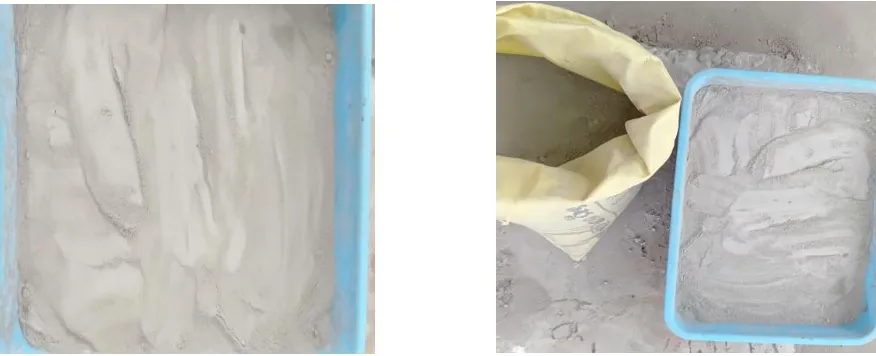
Station near Vijayawada. The fly ash collected is shown in Fig. 1
Fig. 1 Fly ash collected from the power plant
Experimental tests
ISSN(Online): 2319-8753 ISSN (Print): 2347-6710
I
nternational
J
ournal of
I
nnovative
R
esearch in
S
cience,
E
ngineering and
T
echnology
(A High Impact Factor, Monthly, Peer Reviewed Journal) Visit: www.ijirset.com
Vol. 8, Issue 7, July 2019
Table I: Physical properties of cement
S.no Property Value 1. Specific Gravity 3.13 2. Setting Time
Initial setting time Final setting time
92 mins 195 mins 3. Compressive Strength
7 days 28 days
29.23 MPa 41.62 MPa
Table II: code books used for tests
S.no Property Reference
1. Mix (M25) IS 10262: 2009 [2]
2. Compressive Strength IS 516: 1959 [3]
3. Splitting Tensile Strength IS 5816: 1999 [4]
4. Flexural Strength IS 516: 1959 [3]
5. UPV IS 13311(part 1): 1992 [5]
Experimental Procedures
ISSN(Online): 2319-8753 ISSN (Print): 2347-6710
I
nternational
J
ournal of
I
nnovative
R
esearch in
S
cience,
E
ngineering and
T
echnology
(A High Impact Factor, Monthly, Peer Reviewed Journal) Visit: www.ijirset.com
Vol. 8, Issue 7, July 2019
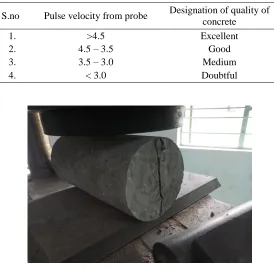
Table III: Quality of concrete as a function of UPV values
S.no Pulse velocity from probe Designation of quality of concrete 1. >4.5 Excellent 2. 4.5 – 3.5 Good 3. 3.5 – 3.0 Medium 4. < 3.0 Doubtful
ISSN(Online): 2319-8753 ISSN (Print): 2347-6710
I
nternational
J
ournal of
I
nnovative
R
esearch in
S
cience,
E
ngineering and
T
echnology
(A High Impact Factor, Monthly, Peer Reviewed Journal) Visit: www.ijirset.com
Vol. 8, Issue 7, July 2019
III. RESULTS AND DISCUSSION
Compressive Strength
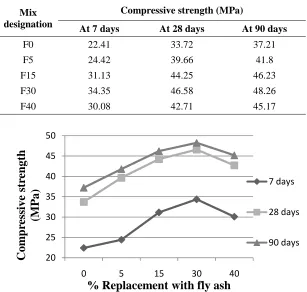
The compressive strength of F0, F5, F15, F30 and F40 at 7, 28 and 90 days are given in Table IV. At 7 days of curing age, the compressive strength of F5, F15, F30 and F40 are 108.96%, 138.91%, 153.27% and 134.22% that of F0. At 28 days of curing age, the compressive strength of F5, F15, F30 and F40 are 117.61%, 131.22%, 138.13% and 126.66% that of F0. At 90 days of curing age, the compressive strength of F5, F15, F30 and F40 are 112.33%, 124.24%, 129.69% and 121.39% that of F0. The performance of fly ash concrete in compression is shown in Fig. 4.
Table IV: compressive strengths for various percentages of Fly ash
Mix designation
Compressive strength (MPa)
At 7 days At 28 days At 90 days
F0 22.41 33.72 37.21 F5 24.42 39.66 41.8 F15 31.13 44.25 46.23 F30 34.35 46.58 48.26 F40 30.08 42.71 45.17
Fig. 4: Compressive strength (vs.) % of fly ash added
20 25 30 35 40 45 50
0 5 15 30 40
Com
p
re
ssi
ve
str
en
gt
h
(M
P
a)
% Replacement with fly ash
7 days
28 days
ISSN(Online): 2319-8753 ISSN (Print): 2347-6710
I
nternational
J
ournal of
I
nnovative
R
esearch in
S
cience,
E
ngineering and
T
echnology
(A High Impact Factor, Monthly, Peer Reviewed Journal) Visit: www.ijirset.com
Vol. 8, Issue 7, July 2019
Flexural strength:
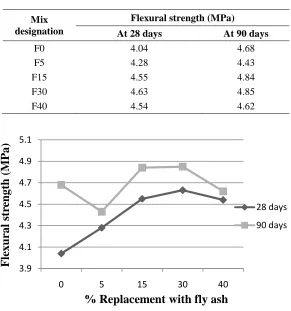
Flexural strength of F0, F5, F15, F30 and F40 at 28 days and 90 days are given in Table V. At 28 days of curing age, the flexural strength of F5, F15, F30 and F40 are 105.94%, 112.62%, 114.60% and 112.37% that of F0. At 90 days of curing age, the flexural strength of F5, F15, F30 and F40 are 94.56%, 103.41%, 103.63% and 98.71% that of F0. The performance of fly ash concrete in flexural strength is shown in Fig. 5.
Table V: Flexural strength for various percentages of fly ash
Mix designation
Flexural strength (MPa)
At 28 days At 90 days
F0 4.04 4.68
F5 4.28 4.43
F15 4.55 4.84
F30 4.63 4.85
F40 4.54 4.62
Fig. 5: Flexural strength (vs.) % of fly ash added
Splitting tensile strength
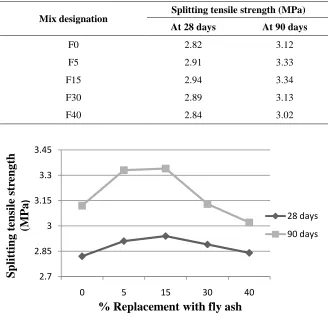
Splitting Tensile strength of F0, F5, F15, F30 and F40 at 28 days and 90 days are given in Table VI. At 28 days of curing age, the splitting tensile strength of F5, F15, F30 and F40 are 103.19%, 104.25%, 102.48% and 100.70% that of F0. At 90 days of curing age, the splitting tensile strength of F5, F15, F30 and F40 are 106.73%, 107.05%, 100.32% and 96.79% that of F0. The performance of fly ash concrete in splitting tensile strength is shown in Fig. 6.
3.9 4.1 4.3 4.5 4.7 4.9 5.1
0 5 15 30 40
F
lexural str
en
gt
h
(M
P
a)
% Replacement with fly ash
28 days
ISSN(Online): 2319-8753 ISSN (Print): 2347-6710
I
nternational
J
ournal of
I
nnovative
R
esearch in
S
cience,
E
ngineering and
T
echnology
(A High Impact Factor, Monthly, Peer Reviewed Journal) Visit: www.ijirset.com
Vol. 8, Issue 7, July 2019
Table VI: Splitting tensile strength for various percentages of fly ash
Mix designation
Splitting tensile strength (MPa)
At 28 days At 90 days
F0 2.82 3.12
F5 2.91 3.33
F15 2.94 3.34
F30 2.89 3.13
F40 2.84 3.02
Fig. 6: Splitting tensile strength (vs.) % of fly ash added
Ultrasonic pulse velocity:
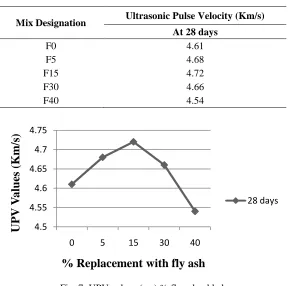
The UPV values obtained for fly ash concrete denotes excellent quality in accordance to IS 13311(Part 1): 1992[5] are shown in Table VII. At 28 days of curing age, the UPV of F5, F15, F30 and F40 are 101.51%, 102.38%, 101.08% and 98.48% that of F0. The performance of fly ash concrete in UPV test is shown in Fig. 7.
2.7 2.85 3 3.15 3.3 3.45
0 5 15 30 40
S
p
li
tt
in
g
te
n
sil
e str
en
gt
h
(M
P
a
)
% Replacement with fly ash
28 days
ISSN(Online): 2319-8753 ISSN (Print): 2347-6710
I
nternational
J
ournal of
I
nnovative
R
esearch in
S
cience,
E
ngineering and
T
echnology
(A High Impact Factor, Monthly, Peer Reviewed Journal) Visit: www.ijirset.com
Vol. 8, Issue 7, July 2019
Table VII: UPV values at various percentages of fly ash in concrete
Mix Designation Ultrasonic Pulse Velocity (Km/s)
At 28 days
F0 4.61
F5 4.68
F15 4.72
F30 4.66
F40 4.54
Fig. 7: UPV values (vs.) % fly ash added
IV. CONCLUSIONS
At all the replacement levels of fly ash in concrete the compressive strength is improved, when compared with nominal concrete (F0). A highest compressive strength is observed with F30 (30% fly ash) concrete. A similar trend of improvement in flexural strength and splitting tensile strength is observed, when compared with compressive strength. The use of pozzolanic material fly ash improved the strength properties of concrete. This could be due to the pozzolanic nature of fly ash and micro-filling property that leads to the dense packing of concrete. As per IS 13311(Part 1): 1992 the UPV values obtained for fly ash concrete at 28 days of curing age denotes the excellent quality of concrete. The results support the use of fly ash as partial replacement of cement up to 30%.
4.5 4.55 4.6 4.65 4.7 4.75
0 5 15 30 40
UP
V
V
alu
es (K
m
/s)
% Replacement with fly ash
ISSN(Online): 2319-8753 ISSN (Print): 2347-6710
I
nternational
J
ournal of
I
nnovative
R
esearch in
S
cience,
E
ngineering and
T
echnology
(A High Impact Factor, Monthly, Peer Reviewed Journal) Visit: www.ijirset.com
Vol. 8, Issue 7, July 2019
REFERENCES
[1] IS: 383-1970. Specifications for coarse and fine aggregates from natural resources for concrete, New Delhi, India: Bureau of Indian Standards.
[2] IS: 10262-2009. Recommended guidelines for concrete mix design, New Delhi, India: Bureau of Indian Standards. [3] IS: 516 – 1959, Methods of tests for strength of concrete, New Delhi, India: Bureau of Indian Standards.
[4] IS: 5816-1999, Method of test for splitting tensile strength of concrete, New Delhi, India: Bureau of Indian Standards. [5] IS 13311(Part 1): 1992, Non-destructive testing of concrete-method of test. Part-1 Ultrasonic pulse velocity.
[6] Krishna Rao, S., Sravana, P., Chandrasekhara Rao, T. (2016). Experimental studies in Ultrasonic Pulse Velocity of roller compacted concrete pavement containing fly ash and M-sand. International Journal of Pavement Research and Technology 9, 289-301.