University of Windsor
University of Windsor
Scholarship at UWindsor
Scholarship at UWindsor
Electronic Theses and Dissertations
Theses, Dissertations, and Major Papers
2010
Towards A Quasi High Level Compiler Comparative and
Towards A Quasi High Level Compiler Comparative and
Attributive Model for OpenMP Programs
Attributive Model for OpenMP Programs
Mohammed F. Mokbel
University of Windsor
Follow this and additional works at:
https://scholar.uwindsor.ca/etd
Recommended Citation
Recommended Citation
Mokbel, Mohammed F., "Towards A Quasi High Level Compiler Comparative and Attributive Model for
OpenMP Programs" (2010). Electronic Theses and Dissertations. 8270.
https://scholar.uwindsor.ca/etd/8270
This online database contains the full-text of PhD dissertations and Masters’ theses of University of Windsor students from 1954 forward. These documents are made available for personal study and research purposes only, in accordance with the Canadian Copyright Act and the Creative Commons license—CC BY-NC-ND (Attribution, Non-Commercial, No Derivative Works). Under this license, works must always be attributed to the copyright holder (original author), cannot be used for any commercial purposes, and may not be altered. Any other use would require the permission of the copyright holder. Students may inquire about withdrawing their dissertation and/or thesis from this database. For additional inquiries, please contact the repository administrator via email
Towards A Quasi High Level Compiler Comparative
and Attributive Model for OpenMP Programs
by
Mohammed F. Mokbel
A Thesis
Submitted to the Faculty of Graduate Studies
through Computer Science
in Partial Fulfillment of the Requirements for
the Degree of Master of Science at the
University of Windsor
Windsor, Ontario, Canada
2010
1*1
Library and Archives
Canada
Published Heritage
Branch
395 Wellington Street
OttawaONK1A0N4
Canada
Bibliotheque et
Archives Canada
Direction du
Patrimoine de I'edition
395, rue Wellington
OttawaONK1A0N4
Canada
Your file Votre reference ISBN: 978-0-494-80240-3 Our file Notre reference ISBN: 978-0-494-80240-3
NOTICE:
AVIS:
The author has granted a
non-exclusive license allowing Library and
Archives Canada to reproduce,
publish, archive, preserve, conserve,
communicate to the public by
telecommunication or on the Internet,
loan, distribute and sell theses
worldwide, for commercial or
non-commercial purposes, in microform,
paper, electronic and/or any other
formats.
L'auteur a accorde une licence non exclusive
permettant a la Bibliotheque et Archives
Canada de reproduce, publier, archiver,
sauvegarder, conserver, transmettre au public
par telecommunication ou par I'lnternet, preter,
distribuer et vendre des theses partout dans le
monde, a des fins commerciales ou autres, sur
support microforme, papier, electronique et/ou
autres formats.
The author retains copyright
ownership and moral rights in this
thesis. Neither the thesis nor
substantial extracts from it may be
printed or otherwise reproduced
without the author's permission.
L'auteur conserve la propriete du droit d'auteur
et des droits moraux qui protege cette these. Ni
la these ni des extraits substantias de celle-ci
ne doivent etre imprimes ou autrement
reproduits sans son autorisation.
In compliance with the Canadian
Privacy Act some supporting forms
may have been removed from this
thesis.
Conformement a la loi canadienne sur la
protection de la vie privee, quelques
formulaires secondaires ont ete enleves de
cette these.
While these forms may be included
in the document page count, their
removal does not represent any loss
of content from the thesis.
Bien que ces formulaires aient inclus dans
la pagination, il n'y aura aucun contenu
manquant.
1*1
Declaration of Co-Authorship / Previous Publication
I. Co-Authorship Declaration
I hereby declare that this thesis incorporates material that is result of joint research, as follows:
This thesis also incorporates the outcome of a joint research undertaken in collaboration with Mr. Michael
Wong. The collaboration is covered in Chapter 4 of the thesis. In all cases, the key ideas, primary
contributions, experimental designs, data analysis and interpretation, were performed by the author, and the
contribution of co-authors was primarily through the provision of constructive criticism.
I am aware of the University of Windsor Senate Policy on Authorship and I certify that I have
properly acknowledged the contribution of other researchers to my thesis, and have obtained written
permission from each of the co-author(s) to include the above matenal(s) in my thesis
I certify that, with the above qualification, this thesis, and the research to which it refers, is the
product of my own work.
II. Declaration of Previous Publication
This thesis includes 1 original paper that has been previously published/submitted for publication in
peer reviewed journals, as follows.
Thesis
Chapter
Chapter 4
Publication tide/ full citation
Mokbel, M. F., Kent, R. D. and Wong, M. (2010) An Abstract
Semantically Rich Compiler Collocative and Interpretative Model for
OpenMP Programs. The Computer Journal.
Publication
status*
I certify that I have obtained a written permission from the copyright owner(s) to include the
above published material(s) in my thesis. I certify that the above material describes work completed
during my registration as graduate student at the University of Windsor.
I declare that, to the best of my knowledge, my thesis does not infringe upon anyone's copyright
nor violate any proprietary rights and that any ideas, techniques, quotations, or any other material
from the work of other people included in my thesis, published or otherwise, are fully acknowledged
in accordance with the standard referencing practices. Furthermore, to the extent that I have
included copyrighted material that surpasses the bounds of fair dealing within the meaning of the
Canada Copyright Act, I certify that I have obtained a written permission from the copyright
owner(s) to include such material(s) in my thesis.
I declare that this is a true copy of my thesis, including any final revisions, as approved by my
thesis committee and the Graduate Studies office, and that this thesis has not been submitted for a
higher degree to any other University or Institution.
ABSTRACT
In order to understand the behavior of OpenMP programs, special tools and adaptive techniques are
needed for performance analysis. However, these tools provide low level profile information at the
assembly and functions boundaries via instrumentation at the binary or code level, which are very
hard to interpret. Hence, this thesis proposes a new model for OpenMP enabled compilers that
assesses the performance differences in well defined formulations by dividing OpenMP program
conditions into four distinct states which account for all the possible cases that an OpenMP program
can take. An improved version of the standard performance metrics is proposed: speedup, overhead
and efficiency based on the model categorization that is state's aware. Moreover, an algorithmic
approach to find patterns between OpenMP compilers is proposed which is verified along with the
model formulations experimentally. Finally, the thesis reveals the mathematical model behind the
DEDICATION
To
The unconscious, unknown of me, the source
My family for theix endless support and encouragement
My mother Amina and brother Ali
ACKNOWLEDGEMENTS
First and foremost, I would like to thank my advisors, Professor Robert Kent and Professor
Akshaikumar Aggarwal Their guidance and encouragement throughout my graduate studies helped
me a lot when I needed it the most. Furthermore, I'm grateful to my thesis advisor, Professor Robert
Kent for encouraging me to do my best while I was philosophizing, and giving me the choice to
research the topics that I like His guidance, benevolence and comradeship were indispensable for me
to complete my thesis work successfully.
I would also like to thank my committee members for their helpful comments and suggestions. I
would like to thank Zina Ibrahim for correcting all the spelling errors in this work.
I would like to thank the whole RL C++ FrontEnd & Runtime Development team at IBM
Toronto Lab for the fantastic 8 months I spent with them as a master co-op student Special thanks
to my mentor Christopher Cambly who provided all the support and directions while working on the
compiler performance analysis tasks. Special thanks to Michael Wong from IBM Toronto Lab who
read the paper and provided valuable comments.
Thanks to many bands and musicians, their music helped me a lot while I was working on my
thesis Among them are: Antonio Vivaldi specially The Four Seasons violin concertos and more
precisely Winter season, Ludwig van Beethoven, Johann Strauss, Amadeus Mozart, Johann Sebastian
Bach, Placebo, Coldplay, Era, The Killers and Travis.
Lasdy but not least, thanks to Walter Isaacson for writing a great book about Albert Einstein: His
Life and Universe. My Saturday's and Sunday's nights were just another dimension on Einstein's life,
TABLE OF CONTENTS
DECLARATION OF CO-AUTHORSHIP / PREVIOUS PUBLICATION iii
ABSTRACT v
DEDICATION vi
ACKNOWLEDGEMENTS vii
LIST OF TABLES x
LIST OF FIGURES xi
LIST OF ALGORITHMS xii
I. INTRODUCTION 1
11 Contribution 5
12 Thesis Organization 5
II. OpenMP T H E LANGUAGE 7
II 1 Why OpenMP 7
II 2 History 8
II 3 OpenMP Features 8
II 4 How it Works An Example 11
II 5 OpenMP Internals 13
III. LITERATURE REVIEW 16
IV. PROPOSED MODEL 21
IV 1 Introduction 21
TABLE OF CONTENTS
IV. 2 Model Definitions 22
IV. 3 Model Consideration for HT 24
IV. 4 Horizontal X Vertical Formulations 25
IV. 5 Vertical Formulations 26
IV. 6 Horizontal Formulations 28
IV 7 K-stage Comparator 29
IV. 8 Detecting Compilers Patterns 30
IV. 9 Graph Theoretical Representation and Problem Modeling 32
IV. 10 Compilers Comparisons Consistency 34
IV. 11 The Model Formulations Characteristics 35
TV. 12 2CA Optimum Performance Characterization 36
IV. 13 An Inclusive Projection of 2CA Over S.O.E Standard Performance Metrics 39
V. EXPERIMENTAL EVALUATION 44
V. 1 Test Programs 44
V. 2 Experimentation Setup 45
V. 3 Results Analysis 45
V. 4 Results Analysis for Different Experimentation Setup 50
VI. CONCLUSION A N D FUTURE WORK 53
BIBLIOGRAPHY 56
LIST OF TABLES
1. The structure of OpenMP compiler comparison model 23
2. The 2CA model optimum performance characterization domains 37
LIST OF FIGURES
1. Time line of OpenMP specification 8
2. OpenMP fork-join model 9
3. Simple OpenMP program 13
4. OpenMP implementation [6] 14
5. K-stage comparator 30
6. Graph mapping of the model 33
7. 2CA model optimum performance characterization 37
8. N-Queens cXlr compiler performance metrics (Speedup, Efficiency and Overhead) evaluation:
2CA vs. Original metrics 41
9. SimpleAdd_s cZlr compiler performance metrics evaluation: 2CA vs. Original metrics 42
10. N-Queens compilers comparison 46
11. SimpleAdd_s compilers comparison 47
12. SimpleAdd_g compilers comparison 48
13. SimpleAdd_d compilers comparison 48
14. Compilers pattern recognition (SimpleAdd_s) 49
15. MD compilers comparison 49
16. MD 64-bit compilers comparison on Intel® Core™2 Quad 51
LIST OF ALGORITHMS
1. Compilers Pattern Detection 31
2. OpenMP Optimum Performance Characterization 39
"Give me extension and motion and I mil construct the universe" - Rene Descartes
INTRODUCTION
OpenMP [1] is a widely accepted Application Programming Interface API for shared memory
parallel programming architecture It consists of a set of compiler directives, runtime library routines
and environment variables OpenMP expands C/C++ and Fortran 77/90 languages to comprise
additional denotative parallel semantics For OpenMP to work, it has to be supported by the
compiler runtime system, because the code is introduced with very high level constructs that depend
on the compiler low level conversion to multithreaded code Two of the most important features of
OpenMP are incremental parallelism that often does not require any changes in the original source
code to be parallelized with OpenMP and sequential equivalence, which preserves the consistency in
the results between one and multiple threads code
The performance of OpenMP programs is closely coupled with the underlying environment, it is
the hardware architecture and software optimization that take a major part in determining the
performance of the program Processor architecture, pipelining, memory speed and bus interconnect
bandwidth and the levels of cache all contribute to the overall performance of the program
Commonly, for OpenMP programs performance to scale, the sequential version should be coded
efficiendy and resourcefully so that the conversion to OpenMP is not affected by the inefficiency of
the serial version of the code Thus, the scalability of OpenMP application is bounded by the
efficient design of the original sequential source code
For a thorough performance analysis of OpenMP programs, specially designed tools are needed to
understand the internal behavior of the application Intel VTune, Intel Thread Profiler [2], Intel
Parallel Studio [3] and others, are the kind of tools which provide low level profile information that
I. INTRODUCTION
can help in determining the real causes of the performance problems. Some of these tools (e.g.
VTune) rely on the hardware performance counters that are architecture speafic for performance
analysis and tuning. However, mastering these tools is not an easy task and requires a deep
knowledge of each tool with respect to OpenMP performance.
In [4], Tian et al clearly state the complexity of conducting a fair comparison between commercial
product compilers that support OpenMP. Since these compilers do not publish their internal
implementation and techniques of optimization transformations, it becomes very difficult to
construct a scientific comparative study among them. In this case, Reverse Code Engineering (RCE)
each compiler would be the only method available to reveal the internal implementation of OpenMP
for each compiler However, RCE is a very complicated process, in which reconstructing the logic of
the implementation starts with disassembling the binary file and entails dealing with the low level
assembly language.
On the other hand, EPCC OpenMP microbenchmarks v2.0 [5] [6] measure the synchronization
and scheduling overheads incurred by OpenMP compiler directives of a specific OpenMP
implementation (synchronization, loop scheduling and array operations), where the overhead cost
incurred by a specific compiler directive is measured by comparing the sequential execution time for
a section of code against the parallel execution of the same code containing the compiler directive.
An important issue with EPCC microbenchmarks is that they do not take into consideration other
important factors such as the effect of the single thread version on the runtime library that is, the
difference between the original serial version of the application and single threaded version with
OpenMP directives being enabled. Nonetheless, these benchmarks can be used to carry out a
comparison among various OpenMP enabled compilers at the directive level. However, the
complexity of the real world OpenMP applications is not appropriate for a synthetic benchmark like
EPCC. Hence, we cannot decisively determine the performance of the compiler based solely on the
overhead and synchronization differences in the OpenMP runtime library The design and structure
I. INTRODUCTION
of the code might dramatically alter the performance of the O p e n M P program since some of the
optimization transformations are applicable t o a specific code pattern. Moreover, the order of the
optimizations implementation in the compiler analysis on the O p e n M P code has an important effect
on the overall performance of the program [4].
In [7], Pierattini noticed an interesting behavior in one of the reported barrier synchronization
overhead. A sudden change in barrier construct speed at 32 processors on Origina2000 machine was
due to a change in the implementation such that, the O p e n M P runtime library uses a specific
processor instruction (11/sc) to implement the barrier up to 32 processors. Since that instruction does
not scale beyond 32 processors, a change in the algorithm is detected (fetch&op). However, this kind
of implementation behavior is not detectable by E P C C O p e n M P microbenchmarks.
SPEC O M P benchmarks suite [8] evaluates the performance of Shared-Memory Multiprocessor
SMP systems. T h e suite consists of 11 O p e n M P large scientific applications that are
compute-intensive. Eight applications are written in F O R T R A N , and three in C. These benchmarks are good
candidates to stress the compiler optimizer to generate an optimum code.
Hence, the need for methodical experimentation with different compilers that support O p e n M P
arises in order to justify the use of a specific compiler over the other. However, there is neither a
systematic way nor a defined model that provide a high level dimensionality capable of assessing the
behavior and performance of O p e n M P programs and compilers.
In this thesis, we propose a comparative model that provides a methodical and well defined
approach to solve these problems from the compiler perspective. Having a proper control over the
states that constitute an O p e n M P program helps in classifying the reasons behind each compiler
performance differences. T h e program states are defined as follows: original code (OpenMP n o t
activated), O p e n M P code with 1 thread, the state when number of threads is equal to the number of
I INTRODUCTION
work at the directive level, because we quantify the performance of the program as a whole based o n
the states partitioning we provide as a better solution.
O p e n M P programs performance is, to a certain extent, determined by the level of optimization
and efficiency of the compiler implementation of O p e n M P as well as the operating system memory
and thread scheduling management implementation. However, there are some architecture-specific
decisions (e g., instruction selection, scheduling and vectorization) that each compiler can exploit to
produce processor-specific optimized code, targeting one or more architecture as part of the same
executable file. For example, P G I and Intel compilers provide Unified Binary [9] and CPU-Dispatch
[10] technologies respectively, which allow the generation of a single executable file that has multiple
binary code streams, each optimized for a specific architecture. Hence, a mapping of one executable
to many compatible platforms is guaranteed to maintain good performance.
Therefore, all the optimization transformations are inherent to each compiler and not all the
compilers have the same capabilities. T o abstract these differences, we need a model that can support
reasoning at a higher level without breaking the underlying variations. T o our knowledge there has
not been any attempt to devise an O p e n M P compiler comparative model.
The model proposed in this thesis works at a higher level of abstraction to reason about the m o s t
probable performance problems It is complementary to the low level analysis phase. T h e state
categorization it provides helps in pointing out specific characteristics of the O p e n M P runtime
system, compiler differences, and code design. Because the proposed model accounts for all the
states that an O p e n M P parallel program can take, it was successfully used to derive a concrete
solution that provides an informative, structured and semantically rich compiler comparative model.
Since the state composition is explicrtiy profiled, an enhanced version of the standard performance
metrics (speedup, overhead and efficiency) is proposed that are m o r e precise in terms of O p e n M P
implementation.
I INTRODUCTION
The model presented here is verified experimentally using three well known commercial compilers
on three OpenMP programs The results are interesting because the model exposed the differences
between the compilers in a subde and unobtrusive way In the experimentation section, it is shown
that OpenMP runtime library has no effect on the performance differences between compilers as
much as it is the compiler optimizer capabilities and dependability
L I Contribution
This thesis presents, for the first time, a complete self-defined compiler comparative model for
OpenMP parallel programming programs The model consists of 16 equations, divided into 3
categories, where each category verifies specific aspects of OpenMP programs performance in terms
of the states definitions and compilers interactions The thesis also presents a compiler pattern
detection algorithm to identify comparable behaviors across multiple OpenMP enabled compilers In
addition, the following pages enfold an improved version of the standard performance metrics based
on the model definitions which are more accurate in terms of OpenMP implementation The model
definitions are also used as a base to find the model behind the optimum performance for a given
OpenMP application
1.2 Thesis Organization
This thesis is organized in six chapters Chapter II provides an overview of the history, execution,
internal and translation model of OpenMP along with a brief review of some OpenMP features and
an example showing how OpenMP works While chapter III briefly discusses related work of
OpenMP performance in terms of compiler optimization differences and various OpenMP
performance monitoring proposals, chapter IV explains in details the proposed compiler comparative
model that addresses the difficulties of conducting performance comparison among OpenMP
I. INTRODUCTION
the applicability of the model. Finally, we conclude in chapter VI and overview possibilities for future
'The shortest path between two truths in the real domain passes
through the complex domain" - Jacques Salomon Hadamard
OpenMP THE LANGUAGE
O p e n M P [1] is a set of compiler directives, library routines and environment variables It supports
C / C + + and F O R T R A N as part of the specification to create a multithreaded programming
language T h e unit of execution in O p e n M P is a thread that shares the same address space with
another thread It is based on the fork-join programming model and is designed with ease of use as
one of its main goals The high performance computing communities as well as major industry
vendors are not only supporting O p e n M P evolution and adopting it as an influential programming
paradigm for shared-memory parallel programming, but also adopting it for hybrid programming,
such as the combination between O p e n M P and M P I on distributed shared memory architectures
IL 1 Why OpenMP
T h e driving force behind O p e n M P is that for the past fifteen years, there has been a need for a
standardization of Symmetric Multi-Processing (SMP) architecture development Since shared
memory architecture have been around for a long time, most of the major corporations of high
performance shared memory multiprocessor computers have their own set of directives,
consequendy obstructing the portability of the code across different platforms T o amend this,
o p e n m p org was established in 1996 to set a standard that is adequate for the high performance
community and industry and to provide better code portability across shared memory platforms T h e
standardization aspect of O p e n M P is supported by all major vendors such as IBM, Intel, H P , SGI,
Sun, NASA Ames and many others and is highly regarded in the high performance computing
community
II. OpenMP THE LANGUAGE
IL 2 History
OpenMP is considered young and promising. In 1997, the first specification of OpenMP for
FORTRAN was released. The Architecture Review Board (ARB) released another version (OpenMP
2.1) for C/C++ and FORTRAN as separate specifications with more features. In version 2.5
FORTRAN and C/C++ were merged together to form a single specification. After that, OpenMP
3.0 was released in May 2008 with a major support for irregular parallelism through the tasking
model to exploit unstructured parallelism efficiendy [1] [11]. Figure 1 shows the evolution of
OpenMP specification.
> i9©7 >^lyil.99& yV ^ &H9& ^~*^PV 2000 rSN'/ 2&Q2 W^ 2005^ >V
FORTRAN C/C++ FORTRAN FORTRAN C/C++ FORTRAN/ FORTRAN/ V.1.0 V.1.0 V . l . l V.2.0 V.2.0 C/C++V.2.5 C/C++V.3.0
Fig. 1. Time line of OpenMP specification
IL 3 OpenMP Features
OpenMP supports the fork-join programming model. An OpenMP program starts with a single
thread called the master thread, and when it encounters a parallel region with one of OpenMP
constructs, a team of threads is created (forked) to execute the work in parallel. At the end of the
parallel region all the spawned threads synchronize (through an implicit or explicit barrier construct)
and terminate (join; with nowait clause, the threads at the end of the construct will immediately
proceed to perform other work) and only the initial master thread continues. If the team of threads
encountered another parallel construct in the same parallel region, then each thread of the original
team will form another team of threads, and this is called nested parallelism. Figure 2 illustrates
II. OpenMP THE LANGUAGE
Parallel region
Fork Join , A «,
' v ' v v ' Nested parallelism
Parallel region Parallel region
Fig. 2. O p e n M P fork-join model
O p e n M P directives are placed at main locations in the program source code. In C / C + + ,
the directives are specified using the # p r a g m a preprocessing directive, and in F O R T R A N ,
they are specified using special comments that are identified by unique sentinels such as
!$omp, c $ o m p or *$omp. Mosdy, O p e n M P directives apply to structured blocks with a single
point of entry at the top and a single point of exit at the bottom. The compiler will check for
O p e n M P directives and generate the appropriate code to parallelize the designated code block.
#pragma omp directive — name [clause[[,]clause] ...]new — line
!$omp directive — name [clause[[,]clause] ...]new — line
Most of O p e n M P directives enable the program to generate a team of threads to execute a
specified region (in O p e n M P , a region embraces all the code that is in the dynamic extent of a
construct) in parallel. The C / C + + for loop or DO in F O R T R A N is usually the main target for
parallelization and especially in the scientific numerical applications. This can be accomplished in
O p e n M P via the work-sharing construct o m p parallel for in C / C + + and o m p parallel d o in
F O R T R A N . In addition, the sections construct o m p sections, clauses private and shared with the
II. OpenMP THE LANGUAGE
The runtime library routines and environment variables provide a mean to monitor and affect
threads, processors and the parallel environment. T h e runtime library routines are defined in the
include header file " o m p h " in the case of C / C + + .
Environment variables manage the internal control variables ICV that are controlled by the
O p e n M P implementation, which in turn govern the behavior of the program at runtime in important
ways (ICV' nthreads-var, dyn-var, nest-var, run-sched-var, def-sched-var).
T h e schedule clause is only supported with the loop construct, which manages the distribution of
loop iterations among the threads. Consequendy, an appropriate scheduler type that fits specific
characteristics of the problem size and properties is a must for performance. O p e n M P specification
3 0 supports five kinds of schedule clauses (static, dynamic, g u i d e d , runtime and auto). The
schedule syntax is as follows.
schedule {kind, [chunk_size])
The schedule clause states how the iterations of the loop are assigned to the threads in the team.
The granularity of this workload distribution is a chunk (the chunk_size need not be a constant), a
contiguous, nonempty subset of the iteration space.
T h e static (iterations are divided as per the size of the chunk_size statically in a round-robin
fashion) schedule has the least overhead, and most of O p e n M P compilers enable it by default if n o
explicit schedule type is specified. For irregular and weakly balanced workloads, dynamic (the
iterations are assigned to threads as the threads demand them) and g u i d e d types are helpful for these
cases. With guided schedule, the size of the chunk decrease over time. T h e reason behind g u i d e d
design is that initially, larger chunks are desirable because they reduce the overhead, and this design
preserves the fairness among large and small thread work distribution A n d often load balancing is
not of an issue toward the end of the computation. For runtime, the decision regarding the schedule
II. OpenMP THE LANGUAGE
kind is made at runtime via the O M P _ S C H E D U L E environment variable. I n auto kind, the
scheduling decision is delegated to the compiler implementation or runtime system
Selecting an appropriate chunk size is not always easy as it depends on the code in the loop, the
specific problem size and the number of threads used. So, delegating the selection of the scheduler t o
the compiler runtime system is a good choice to pick up the optimum scheduler based on the
aforementioned factors as well as other hardware and software specific properties (if designed so).
Except static schedule type, the allocation is n o n deterministic and it could vary from run to run
based on the load on the system.
T h e interested reader can refer to [1] for more information about O p e n M P features.
IL 4 How it Works: An Example
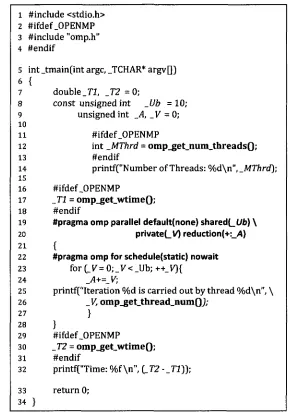
Figure 3 shows a simple O p e n M P program with a for loop. T h e preprocessing directives #ifdef
_ O P E N M P and #endif are used to check if the include header file " o m p . h " (OpenMP support) is
enabled by the compiler or not. As we can see, O p e n M P program is similar t o the original sequential
version, where O p e n M P directives are inserted on top of the original program. T h e compiler will
generate the multithreaded code by parsing O p e n M P directives. Hence, all the low level
implementation details are hidden from the user. A call to the runtime library routine
omp_get_num_threadsQ is used which will return a value of 1, because n o parallel region has been
entered yet. Another call omp_get_wtime() to get the elapsed wall clock time in seconds for the for
parallelized loop.
The upper b o u n d of the loop _UB is set to be shared, so that all the threads have access to _UB
T h e index _ V is set to private because each thread must be given a unique and local copy of the loop
variable _ V so that it can safely modify the value. T h e default clause is set to none so that all the
II. OpenMP THE LANGUAGE
private (In C / C + + , the syntax is default(none | shared)). So, it is to give variables a default
data-sharing attribute, reduction clause (syntax: reduction(operator:list)) is used for specifying some forms
of recurrence calculations involving mathematically associative and cummutative operators [1] so that
they can be performed in parallel without code modification. Thus, we just have to identify the
operation and the variable that will hold the result value, and the compiler will generate all the
appropriate code. If we didn't specify variable _A as a reduction then the result of the summation
would be zero.
T h e schedule type is set t o static. Using nowait clause eliminates the implied barrier o n # p r a g m a
o m p for loop construct, since there is no need to synchronize threads work at the end of the
work-sharing construct in this example. Hence, better performance, and even with this simple example the
difference is in microseconds, once you ensure the correctness of the parallelized program results, it
is always a good strategy to try to pinpoint the places in the code where implcit barrier is not needed.
It is safe to use nowait in this example, since the parallel region ends with a barrier anyhow and the
value of _A is not used before the end of the region. O n c e the threads finish their works, the
reduction will compute the summation and leave the results in variable _A.
The printf inside the for loop is to show which iteration gets executed by which thread via the call
to omp_get_thread_numQ. O n a dual core machine, the number of threads would be two if it hasn't
been explicity set to something else via omp_set_num_threads(int num_threads). And that gives a
perfect speedup!
II. OpenMP THE LANGUAGE
l #include <stdio.h>
2 #ifdef .OPENMP
3 #include "omp.h"
4 #endif
5 int
6 {
7 8 9 10 11 12 13 14 15 16 17 18 19 20 21 22 23 24 25 26 27 28 29 30 31 32 33 34 }_tmain(int argc, _TCHAR* argvQ)
double.Tl, _T2 = 0;
const unsigned int _Ub = 10;
unsigned int _A, _V = 0;
#ifdef .OPENMP
int _MThrd = omp_get_num_threadsO;
#endif
printf("Number of Threads: %d\n'
#ifdef .OPENMP
_T1 = omp_get_wtimeO;
#endif
,_MThrd);
#pragma omp parallel default(none) shared(_Ufa) \
private(_V) reduction(+:
{
#pragma omp for schedule(static) nowait
for l_V= 0;_K<_Ub; ++_V){
_A+=_V;
printf("Iteration %d is carried out by thread
V, omp^et thread numOJ;
}
}
#ifdef .OPENMP
_T2 = omp^et.wtimeO;
#endif
printf("Time: %f \n", {_T2 -_T1));
return 0;
A)
%d\n", \
Fig. 3. Simple OpenMP program
IL 5 OpenMP Internals
It is the developer's responsibihty to ensure that a proper synchronization between threads has been
setup correctiy to manage dependencies between them, and that the compiler will generates all the
II OpenMP THE LANGUAGE
source code, the compiler will generate a multithreaded object program Figure 4 shows O p e n M P
implementation
Program with OpenMP directives
Sequential Compilation^^,^
f OpenMP \ Fortran/C/C++ 1 v Compiler J
OpenMP Compilation *
Sequential Object Code
Parallel Object Code
With calls to runtime library
Fig. 4. O p e n M P implementation [13]
T h e compiler ignores O p e n M P pragmas if it is compiled sequentially without supplying the
required O p e n M P option during compilation phase Hence, the same code is used for generating
O p e n M P parallelized code and serial code just by providing the compiler with the correct O p e n M P
flag
Threading libraries abound, some of the research compilers merely generate a threaded version of
the O p e n M P code without relying on the compiler runtime system, hence breaking this integration
phase In this case, the runtime is managed through a hbrary with the appropriate calls from the
threaded version There are no standard specific runtime libraries or memory management systems to
be used with O p e n M P as the details are compiler specific This allows for better O p e n M P compilers
research based of any, such as O M P i [12] for C, a source-to-source translator, where one has the
choice of any back end to compile and link the code with (even different thread libraries) Thus
providing a flexible environment for experimentation with different compilers
Translating O p e n M P directives to a suitable threaded version takes a set of predefined steps by the
compiler to ensure the correctness as well as the validation of the O p e n M P constructs Parallel
II OpenMP THE LANGUAGE
regions must be handled to the thread runtime hbrary routines appropriately. The compiler
encapsulates the parallel region into a procedure by an explicit outlining of the parallel code.
Preserving shared variables references is done via referencing the shared data accordingly while for
private variables each thread will have it is own copy. The outlining phase incurs some overhead
which needs to be carefully optimized to avoid hindering the optimizer work as compared to inkning
trans formation.
[13] and [14] provide a detailed explanation about OpenMP translation phases for many of the
OpenMP language features such as parallel constructs, work-sharing constructs with their associated
"In times like these, it is helpful to remember that there have always been times like these" - Paul Harvey
LITERATURE REVIEW
Since our model is the first to tackle the O p e n M P compilers comparison problem, there has n o t
been any attempt in the literature for any proposal that has a significant relevance to this work.
Hence, there are not enough research papers that resemble our studies. However, this work is self
contained since everything has been defined in terms of the model definitions. Nonetheless, we list
the m o s t relevant work that touches on some aspects of the studies presented in this thesis.
Compiler optimization is one of the most important factors that can dramatically affect the
performance of O p e n M P programs. For example, loop optimization, especially loop unrolling
improves cache utilization by improving data reuse and loop fusion improves Instruction Level
Parallelism (ILP). Thus, the performance of O p e n M P programs depends on the code generated by
the compiler, the runtime system, compiler options, the hbrary used, calling conventions, the lnhner
and the capability to generate optimized instructions for specific architecture.
For Memory bounded applications, the Intel compiler provides an option that enables
performance tuning and heuristics that control memory bandwidth among processors. Hence, the
compiler imposes a selective adjustment o n the optimizer to be less aggressive with optimizations
that consume more bandwidth, so that the bandwidth can be well-shared among multiple processors
for a parallel program.
Tian et al [4] present many compiler optimization techniques for the Intel compiler with a special
emphasis on the performance of O p e n M P programs. They provided a major analysis on the effect of
order of optimization phases in the compiler and how critical it is for achieving optimal performance
CHAPTER III
III. LITERATURE REVIEW
T o test the effect of the O p e n M P runtime library on the optimization transformations as compared
to the original serial program, 1-thread application with O p e n M P O N is compared against the
original program Some applications such as the 310wupwise_m SPECOMP2001 benchmark [8]
achieved 88.53% of its serial execution performance, mainly because a less aggressive inkning was
performed to reduce resource contention for a better scaling on large CPU count system. O n the
other hand, 328.fma3d_m benchmark obtained 111.83% of its serial execution performance simply
due to an aggression loop invariant code motion being enabled when O p e n M P was enabled, and it
turns out that this optimization should applies to serial code as well.
I n another part of the study, the authors examine the effect of different optimization levels and
options on the performance improvement of SPEC OMPM2001 benchmarks, all compiled with Intel
C + + / F o r t r a n compilers. T h e performance results show a gain of 3 % from O M P + 0 2 to
O M P + 0 2 + I P O (Inter-procedural Optimizations). F r o m O M P + 0 2 to O M P + 0 3 , the performance
gain is 2 2 % and 19% versus O M P + 0 2 + I P O . This proves the importance of high level
optimizations o n the multithreaded-code generated for O p e n M P programs.
Tian and Girkar [15] studied the effect of optimizations on performance of O p e n M P programs.
Using SPEC O M P L and O M P M 2001 benchmarks suite compiled at optimization level 3, a
performance improvement of 4 . 3 % to 28.3% on some of the benchmarks was achieved. The same
study shows a performance gain ranging from 7% to 9 8 % on 10 out of 11 SPEC OMPM2001
benchmarks suite compiled at optimization level 0 3 plus Inter-Procedural Optimization (IPO)
option enabled (compiled with Intel Compiler v8 0). This proves h o w compiler optimization affects
the overall performance of O p e n M P programs In [16], Muller studied the effectiveness of various
compilers optimization capabilities using simple O p e n M P programs to test some of the optimization
features.
The translation of O p e n M P language features by the compiler has already been discussed in the
III. LITERATURE REVIEW
associated clauses and the runtime system. T h e performance of O p e n M P varies from compiler to
compiler, based on the code design pattern and primarily the optimization factor. Some compilers
such as Quaver [18] undertake smart analytical decisions to optimize O p e n M P barrier elimination
whenever possible. T w o methods have been used to generate O p e n M P code, either on
source-to-source transformations (e g., O M P i [12], odinMP [19], NanosCompiler [20]) or these transformations
are done internally by the compiler (eg. Intel [21], P G I [22], MS [23]). T h e latter is better for
vectonzation and loop optimization.
In [24], Aslot proposed a Quantitative performance analysis Model for parallel programs. T h e
purpose of the model is to quantify the reasons that limit scalability of parallel programs by analyzing
the difference between measured and ideal speedup of the parallel program. This difference is
subdivided into speedup components which represent the overhead factors responsible for
suboptimal performance. However, the model relies on code instrumentation and hardware
performance counters as part of the formulations which represent low level profile information.
Defining a performance monitoring interface for O p e n M P is not an easy task and requires
significant work at the language specification level as well as compiler integration. In [25], Mohr et al
proposed an instrumentation (at the code or runtime system level) based monitoring interface called
P O M P . Since O p e n M P specification does not support any performance mterface as a set of
directives, runtime libraries, or API's, P O M P proposal aim is to make it to be part of O p e n M P A P I
specification. T h e objective of P O M P interface is to develop a clear and portable API for O p e n M P
program that makes execution events visible to runtime monitoring tools, primary tools for
performance measurement and debugging. However, O p e n M P directives undergo a complex
transformation by the compiler which poses significant challenges at the instrumentation and
monitoring levels, which entails an instrumentation that is strongly attached with O p e n M P directive
processing
Ill LITERATURE REVIEW
Bui et al. [26] present a fully integrated O p e n M P run-time performance analyzer prototype. This
analyzer does not interfere with static compiler optimizer as no instrumentation points are needed. It
is totally developed to be part of the underlying runtime environment T h e analyzer adopts a
light-weight sampling based technique to extract low level performance metrics, causing less overhead
T h e instrumentation points are part of the O p e n M P runtime library.
Profiling O p e n M P programs is very important to understand the behavior of each construct and
directive under different workloads T o pinpoint the culprit section of the code, a profiler is needed
to help identify any load imbalance that is induced as part of O p e n M P work-sharing constructs and
directives placement. I n [27], Furknger and Gerndt presented o m p P O p e n M P profiling tool to
address this issue in a convenient way, especially to spot any synchronization and communication
problems in parallel regions. Performance data representation is reported in a very expressive way,
for each construct and directive. T h e semantics of each region is preserved so that the reported times
and counts is self informative as per the region descriptor.
Tools are very important assets w h e n it comes to examining the behavior of O p e n M P programs
and the system under analysis. Performance measurements entail careful instrumentation at the
software and system level to provide descriptive and helpful results which can facilitate in
determining the causes of the problem and even provide intelligent advisory solutions for debugging,
creating and optimizing applications for multicore processors. This kind of solutions has been
already addressed with Intel Parallel Studio [3] which can greatiy help in designing, verifying, finding
bottlenecks, pointing out memory and threading errors and tuning parallelized applications for better
performance on multi-core machines
Formalizing performance problems with a well defined specification language is a necessary
objective to simplify testing automatic and manual performance analysis tools That also help express
the correctness and effectiveness of the language under investigation such as O p e n M P , MPI, and
Ill LITERATURE REVIEW
enough performance information that correlates with the language specification. In [28], Fahnnger et
al. defined the A P A R T Specification Language (ASL) for writing portable specifications of typical
performance problems. T o test the automatic performance analysis tools, Gerndt et al. [29] developed
the A P A R T Test Suite (ATS) which allows easy construction of synthetic positive and negative test
programs for testing the correctness and effectiveness of those tools. I n ASL terminology, a
performance property characterizes a particular performance-related behavior of a program based on
available or required performance data. For example, some of O p e n M P load imbalances
performance properties as defined in ASL: imbalance_in_parallel_region,
imbalance_in_parallel_loop, imbalance_in_parallel_loop_nowait, imbalance_in_parallel_section,
imbalance_due_to_uneven_section_distnbution.
APART also defines the properties for synchronization, control of parallelism and inefficient serial
execution. Each performance property is described by a boolean condition, which has an associated
severity for expressing the relative importance of the property. So, a performance property is a
performance problem if it is present and it's severity exceeds a preset threshold. O n the other hand, a
performance bottleneck is the most severe performance problem. In testing Hitachi tool, simple load
imbalance problems weren't detected due to the unavailability of synchronization information. T h e
author proposed the use of hardware performance counters to get hints to load imbalances in
identifying false sharing. O n the other hand, testing E X P E R T tool proved to be able to detect
performance problems automatically with synchronization overhead. However, detecting the reasons
behind load imbalances is n o t automatic, showing the complexity and dependability of these
performance analysis tools when the system under analysis does not fully support the required data.
"And there must be simple substances, because there are compounds; for the compound is nothing but a collection or aggregatum of simples"
- Leibni^
PROPOSED MODEL
IV. 1 Introduction
T h e proposed model provides a topological assessment of the compiler differences in well defined
formulations. T h e model enables an inclusive classification of O p e n M P parallel programs. It works
by dividing the program conditions into four states which account for all the possible cases that need
to b e evaluated Each state models and depicts specific attributes about O p e n M P program
performance. T h e first state {Referenceoriginai ) tells about the performance of the original n o n
-parallelized program without any O p e n M P pragmas enabled by the compiler. T h e second one
(Sequentiali_thread) is to check for the overhead incurred by O p e n M P directives and the runtime
system with o n e thread as compared t o Referenceariginal state. T h e third state (Nthreads = Ncores ) is
when the number of threads is equal to the number of processors/cores, and this state reports the
perfect speedup that the program can achieve in an optimal situation. Lasdy is the state where the
number of threads is greater than the number of cores (Nthreads > Ncores), which for some
applications scales well to some extent (e.g. server-type applications) b u t needs to be quantified to
ensure enough coverage is attained.
Each O p e n M P enabled compiler is mapped to all of the four states for comparison. T h e structure
of the model is shown in Table 1. Each intersection cell represents the timing for one of the states
with a particular compiler. T h e notation in every cell is an abbreviation that links both a particular
state with a specific compiler and is read clockwise starting from T letter, for example, T \ is the
IV PROPOSED MODEL
IV. 2 Model Definitions
T h e model is defined using set notations to clearly describe the relationships and memberships
between the program states and each compiler W e stnved to construct the definitions in simple
proper formulations. However, Table 1 is a helpful visualization tool that provides an easy access to
the set formulations and can be used in conjunction with set notation. Nevertheless, in the
formulation phase, the rules need to be carefully observed. W e believe that the proposed
formulations are enough to account for almost all the major operations in the companson phase. T h e
model is flexible in its formulations in that it is easily extensible. However, our main concern is to
conceptualize the low level details to a higher level of abstraction that is to sustain a semantically n c h
system.
W e define C as the set that contains all the O p e n M P enabled compilers. Implicitty, every C, holds
all the options that are to be used to conduct the experimental companson. <£>Tyz is a globally
restticted set which defines the conformance of options used for every companson and compiler,
consequently, it contains all the options that are supported by every compiler in the companson.
Virtually, it contains the set of locally restricted options that are drawn from the global set <t>yZ for
one companson; hence, it needs to be updated for every c o m p a n s o n with different subset of options.
A n d for the companson to be valid, <I>yZ has to hold true all the time and for every compiler T h e
options for every compiler should be highly comparable to preserve a fair and unbiased companson.
T is the set of all O p e n M P programs. T h e subscnpt y is a tracking number used to differentiate
between different sets of options for the same O p e n M P program, such that more than one <bxf can
map to the same xz where (y > z). © set contains all the states that each O p e n M P program can
spawn. In Q we define a relation between TZ and C in which every O p e n M P program belongs to the
set of states & and compilers C
The 1-argument predicate XQi) is introduced to account for the reference state a in Q Because we
defined TZ as the set that contains all the O p e n M P programs, then not all O p e n M P programs belong
IV. PROPOSED MODEL
to © as defined in Q. And this is controlled via omp_flag option that enables/disables the activation
of OpenMP code.
T
Z= {Z|V(z 6 Z),z is an OpenMP program}
C - {Q|V(q £ Q), q is an OpenMP enabled compiler]
0 = {S\s = a V s = /3Vs = y V s = <}
<P
rf = {X\V(x €X)(x E Q o x e C
i+1) for alii = l,...,nandy = 1, ...,n}
ft = {n e TZ x C\n = (z, q~), where V<(z 6 &)m =» (z 6 C)>}
3! ft=0mp Jlag £ ^j, if k £ &\k=a
n=omp J lag ^ ^y > else
Table 1. The structure of OpenMP compiler comparison model.
Order
a
P
y
!
State
Reference
originalSequential^
thread^threads "*" Scores
^threads ** ™cores
Ci
'ref
'l-th
'Nth=Nc
rpL[
lNth>Nc
Q + i
...
Q+n 7*W+n 'ref 7*W+n 'l-th TCi+n lNth=NcrpCt+n
lNtk>Nc
a, fS, y and ( are mutable variables that simplify the manipulation of each state. So, instead of
referring to the state name in the formulations, it is easier to use a variable that plays many roles
when assigning multiple denotations. The range (number of threads K) of £ is application oriented.
Less often, some applications show good performance when N
threaa-
S>
KN
coresfor small K.
However, in [30], Suleman et al. proposed a mechanism that controls the number of threads based on
the application behavior at runtime, it predicts the optimal number of threads based on the amount
IV. PROPOSED MODEL
bus. Usually, the first three states provide strong evidence about the overall performance of the
application. However, we can formulate the range as follows'
N
cores + 1 ^ Z>N
threads^ N
cores+ K | K > 1 and K is application oriented. (1)
£ can be quantified by taking the geometnc mean for a speafic range as implied by K:
n=N cores +K
Vn
H
n
"threads "threads —"cores + 1The geometric mean is a viable metric to enumerate over all the threads in £ state, since the
purpose at this stage is to compute a single value for differential comparison against y primarily and
the other states.
For/? and y * y * 0 \ {y
NthreadsA y
cJ > l
The four states we defined target a specific behavior of the application. Each state serves a speafic
purpose. However, m order to determine the continuity of the behavioral evolution for a given
OpenMP program, we have to consider each thread as a constituent part of the overall performance
Hence, we define the Intermediate state Iy which lies between /? and y states. Iy state completes the
accountability for every computational thread in the model. On the other hand, we do not consider
Iy as a major state since it does not serve a major functional interpretation by itself as compared to
the other four states But, Iy accounts for the expectancy of finding a time decreasing homogenous
behavior as Iy approaches y Iy can be quantified by taking the geometnc mean as well.
threads
-2
We calculate the number of threads for I-, as follows (l\, )
=YN
1 ' Nthreads '
IV. 3 Model Consideration for H T
Some architectures support Simultaneous Multi-Threading (SMT) such as Intel Xeon processor MP
implementation of Hyper-Threading (HT) Technology [31] which enables the operating system to
IV. PROPOSED MODEL
see a single processor as two logical processors with each processor maintaining a separate run
queue. Almost all of the physical resources are shared by the logical processors, such as cache,
execution umts, branch predictors, control logic and buses. Most importandy, HT provides better
supports for Thread Level Parallelism (TLP) as it allows multiple independent threads to execute
different instructions each cycle. As mentioned in [32] and [33] HT provides no potential gains unless
the application program is multithreaded.
In addition to that, the operating system must support HT via HALT instruction optimization to
avoid the idle loop. The compiler optimizer should take advantage of SMT/HT by leveraging the use
of vectorization instructions such as Stteaming-SIMD-Extensions (SSE and SSE2) with other inter
procedural optimizations. Hence, SMT has no special effect on the definitions and states of the
model and it is to be considered as two logical processors. The reason is that we still have the control
over TLP.
IV. 4 Horizontal X Vertical Formulations
We group the formulations in three categories: Horizontal: the ones that work per state, Vertical: per
compiler and Horizontal X Vertical which provides a joint analysis about the overall performance of
the compilers. The formulation below checks for the consistency of a specific compiler performance
by taking the minimum timing across all the compilers and states.
a
Ci~>min{T
rce'
f- T^"} ]
P
Ci~> min{T^
h- 7&+»}
y
Cl->min{T^
h=Nc-T^l
Nc}
r
Ci~>min{T
cN>
th>Nc- r ^ J
• * / ( « < : , = & : , = * : , = & , ) ( 2 )
(2) => C
tis uniformly superior else unevenly ranked.
In (2), the timing differences between the compilers across the states could be very small (±fe),
rV PROPOSED MODEL
significant in order to obtain meaningful results. In the case where there can be more than one
minimum, the compilers performance is equal.
To determine whether the compilers are close in their performance, we take the total sum o~„ of
the standard deviations a
xfor each state across all the compilers, and then check if every o~
nover the
a
xis much less than a
n. Let
o~n = Sx=a °~x such that if
* * = p .
«o„ (3)
(3) => the compilers exhibit huge differences, and they are not comparable.
else if
<o-
w (4)(4) => the compilers exhibit relative distribution, which means they are comparable.
a state is not included in the conditional evaluation, because of the effect it has on the distribution
as compared to the other states. After all, it has nothing to do with the checking of the actual
differences at the level of the hbrary implementation.
IV. 5 Vertical Formulations
The following formulations provide informative messages that pinpoint the most probable causes of
the performance degradation.
if [(T
rCelf=
er £
h) | £ is very small]
(5)
(5) => OpenMP runtime library incurs no significant overhead.
if[(T^
f>
zTl\
h)\e is small
(6)
(6) ==> could be due to optimizations.
IV. PROPOSED MODEL
if[(Tr% <sT
1C.
ith)\ sis large] (7)
(7) =» OpenMP runtime library incurs significant overhead.
(5), (6) and (7) have already been discussed in the literature [14]; however, they are not adaptable
enough to account for the sensitivity of the assessment of the differences across a and /? states.
Practically, the degree of difference is important to consider, since at this level, minimal variations
cause each formulation to report a specific diagnostic message and that's why we reformulated them
in terms of the model structure with better characterization and sensitivity.
Despite the fact that (6) appears counterintuitive, it seems that it is possible, since the compiler
optimizer may find other opportunities for aggressive optimizations when OpenMP is enabled. In
[4], the authors found a case where 328.fma3d_m SPEC OMPM2001 benchmark compiled with
Intel compiler got 111.83% of its serial execution performance \T
rJr)- And it was due to an
aggression loop invariant code motion being enabled when OpenMP was enabled. (7) could also be
due to less aggressive optimization when OpenMP is enabled.
(8) => Yc, '
sscaling appropriately for the same compiler system.
d s
ei / [ ( y
C i< a
C i) | y
C i= / ^ ] (9)
L "cores J