© 2014, IJCSMC All Rights Reserved
268
Available Online atwww.ijcsmc.com
International Journal of Computer Science and Mobile Computing
A Monthly Journal of Computer Science and Information Technology
ISSN 2320–088X
IJCSMC, Vol. 3, Issue. 7, July 2014, pg.268 – 274
RESEARCH ARTICLE
Solution Level Parallelization of Local
Search Metaheuristic Algorithm on GPU
Mr. S. V. Ghorpade, Prof. Mrs. S. M. Kamalapur
PG Student, Department of Computer Engineering, KKWIEER, University of Pune, India Department of Computer Engineering, KKWIEER, University of Pune, India
[email protected]; [email protected]
Abstract
—
Local search metaheuristic algorithms are proven & powerful
combinatorial optimization strategies to tackle hard problems like traveling
salesman problem. These algorithms explore & evaluate neighbors of a single
solution. Time Consuming LSM algorithms can be improved by parallelizing
exploration & evaluation of neighbors of a solution. GPU architecture is
suitable for algorithms of single program multiple data parallelism.
Implemented algorithm reduces time consuming memory transfers and
improves computational time by efficient use of memory hierarchy.
Keywords— Combinatorial Optimization, GPU, Local Search Metaheuristics,
Parallel Computing
I. INTRODUCTION
© 2014, IJCSMC All Rights Reserved
269
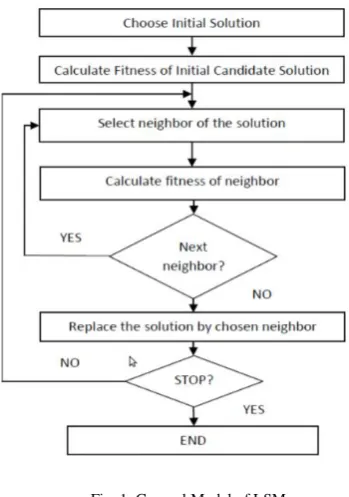
Fig. 1: General Model of LSMMany NP hard problems from industry [4] and science [8] are successfully solved with such combinatorial optimization techniques.
General local search metaheuristic techniques are tabu Search [3], simulated annealing, guided local search, iterative local search and variable neighborhood search [9].
To implement local search, we need to encode our solution in suitable representation which affects performance. Binary encoding, vector of discrete values, permutation and vector of real values are four main encodings [5]. According to results and studies, Increase in neighborhood exploration improves quality of solution [10]. Although Local search metaheuristics (LSM) are effective techniques, problems are also becoming large and complex [11]. To solve large problems, we also need to equip with large computational power.
Initially, a local search metaheuristic algorithm starts with a randomly generated solution. After every iteration of the algorithm, the current solution is replaced by another solution selected from the neighboring candidates of a solution, and so on. An evaluation function calculates a fitness value to each solution as per the problem. Many strategies can be applied for the selection of a next solution: best improvement, first improvement, random selection, etc. Performance of local search is remarkably improved with parallel execution of exploration and execution process. Three major parallel models for local search are: solution level, iteration level and algorithmic level [12] [15] [11]. Solution level parallel model consists of parallelizing time intensive task of the algorithm. These kinds of models are problem dependant and are not always possible. Iteration level parallel model consists of parallel evaluation of all neighbors of a solution. It is a master-worker model which does not alter behavior of algorithm. Algorithmic-level parallel model consists of several self-configured algorithms in parallel. All instances may work in cooperation or independently [7] [9].
GPU architecture provides a very high computation power and very high memory bandwidth compared to traditional CPUs. GPUs have evolved into a mulithreaded, highly parallel and many core architecture due to demand for 3D high-definition graphics [16].
Luong V. et. al [1] and Rocki, K. et. al [2] successfully tested local search algorithms on GPU. In which, Evaluation of neighborhood is performed on GPU, and rest of local search algorithm work is carried out on CPU. To do this, lot of transfer of solutions from CPU to GPU and vice versa need to be done.
We have implemented a solution level parallel model for local search metaheuristic algorithms on GPU. We tested our approach on travelling salesman problem for varying cities datasets.
© 2014, IJCSMC All Rights Reserved
270
II. GPU ARCHITECTUREFig. 2: CPU vs. GPU
A GPU has a large number of arithmetic units with a limited cache and few control units. This allows the GPU to calculate in a massive and parallel way the rendering of small and independent elements, while having a large flow of data processed. Since more transistors are devoted to data processing rather than data caching and flow control, GPU is specialized for compute-intensive and highly parallel computations. It is composed of streaming multiprocessors (SMs), each containing a certain number of streaming processors (SPs) i.e. processor cores. Each core executes a single thread instruction in a SIMD (single-instruction multiple-data) fashion, with the instruction unit distributing the current instruction to the cores [16] [17].
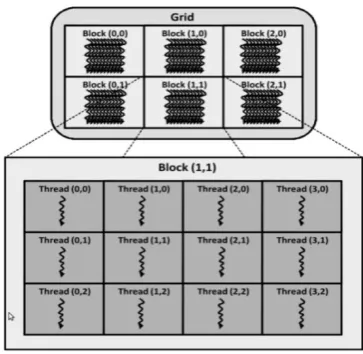
In GPU, multiple processors simultaneously execute the same program on different data. To achieve this, “kernel” concept is introduced. The kernel function is callable from CPU and executed on the GPU by several processors in parallel simultaneously. This kernel handling is dependent of the general-purpose language. CUDA (Compute Unified Device Architecture) is a parallel computing environment, which facilitates an application programming interface for NVIDIA architectures. GPU thread can be seen as an element of the data to be processed. CUDA threads are lightweight than CPU threads. Changing the context between two CUDA threads is not a costly operation. Threads are grouped within a structure called blocks. A kernel is executed by multiple equally threaded blocks. Blocks can be organized into a one or two-dimensional grid of thread blocks, and threads inside a block are grouped in a similar way. All the threads belonging to the same thread block will be assigned as a group to a single multiprocessor, while different thread blocks can be assigned to different multiprocessors. Thus, a unique id can be assigned for each thread to perform computation on different data [17] [18].
© 2014, IJCSMC All Rights Reserved
271
III.LITERATURE REVIEWParallel design and implementation of metaheuristics have been studied as well on different architectures. Some of them are using massively parallel processors [20], clusters of workstations [21] and shared memory or SMP machines [22], large-scale computational grids [19] .
Recently, Rocki, K., Suda, R. implemented 2-opt and 3-opt iterated local search metaheuristic algorithms on GPU to solve traveling salesman problem using standard set of libraries- TSPlib [2]. The core idea is to take a path which crosses over itself and reshuffle it so that it does not. Use of GPU greatly decreases the time needed to search best edges to be exchanged in a route.
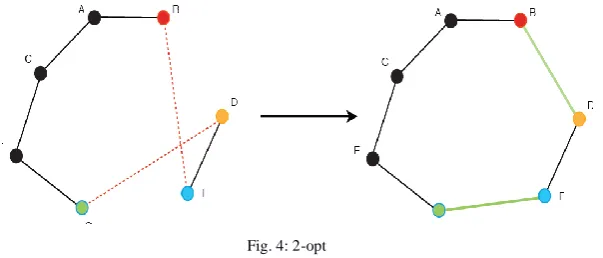
The 2-opt algorithm basically removes two edges from the tour, and reconnects the two new sub-tours created. This is often referred to as a 2-opt move. There is only one way to reconnect the two sub-tours so that the tour remains valid. The steps are repeated only as long as the new tour is shorter. Figure 8 shows example of 2-opt step. The following step will be taken on following condition. If addition of distances of edges (B,F) and (G,D) is greater than addition of distances edges (B,D) and (G,F).
Fig. 4: 2-opt
Using GPU, the time needed to find the best edges to be swapped in a route is greatly decreases. Their results show that by using GPU algorithm, the time can be decreased approximately 3 to 26 times compared to parallel CPU code using 32 cores.
Overview of 2-opt and 3-opt GPU algorithm
1. Copy the tour and the coordinates to the GPU global memory (CPU)
2. Execute the kernel
3. Copy the tour and coordinates to the shared memory
4. Calculate swap effect of one pair
5. Find the best value and store it in the global memory
6. Read the result (CPU)
Results show that more than 90% of the time during iterated Local Search is spent on the 2-opt itself its increasing with the size of problem size. Distance between nodes need to be calculated to know effect of edges exchange. Calculation of distance based on nodes coordinates than using Look up table is proved to better way in terms of memory usage. First way is further optimized by placing nodes coordinate’s data on on-chip shared memory which limits number of cities to 4800. Overall, GPU acceleration to 2-opt and 3-opt search compared to the 32 CPU cores acceleration ranged from 3 to 20 and 12-26 for the respectively.
Luong, Melab and Talbi [1] proposed very efficient approaches for design and implementation of LSM algorithms. Iteration-level parallel model is used and tested for the traveling salesman problem (TSP), quadratic assignment problem (QAP), permuted perceptron problem (PPP) and continuous weierstrass function.
Algorithm 1: Local Search Template Proposed by Luong, Melab and Talibi
1: Choose an initial solution 2: Evaluate the solution 3: Specific LSM initializations
4: Allocate problem inputs on GPU memory 5: Allocate a solution on GPU memory
© 2014, IJCSMC All Rights Reserved
272
8: Copy problem inputs on GPU memory9: Copy the initial solution on GPU memory 10: Copy additional structures on GPU memory 11: repeat
12: for each neighbor in parallel do
13: Incremental evaluation of the candidate solution 14: Insert the resulting fitness into the fitnesses structure 15: end for
16: Copy the fitnesses structure on CPU memory
17: Specific LSM selection strategy on the fitnesses structure 18: Specific LSM post-treatment
19: Copy the chosen solution on GPU memory 20: Copy additional structures on GPU memory 21: until a stopping criterion satisfied
Neighborhood generation on CPU and its evaluation on GPU is a straightforward approach in which for every iteration associated structure is copied from CPU to GPU. Neighborhood generation and its evaluation on GPU is more complex for thread mapping to neighbor but significantly reduces data transfers. For some LSMs like hill climbing parallel reduction techniques are applied to find proper minimum fitness structure which additionally optimizes data transfer.
IV.PROPOSED SOLUTION
Solution level parallel model is suitable for reducing data transfers between CPU and GPU memories which is time ingesting task [20] [23]. Evaluation of neighbourhood is performed on GPU before every iteration. This needs to copy solution from CPU memory to GPU memory. The results obtained need to be copied back to CPU memory. Best solution is chosen using the copied results. Thus there are many memory transfers between CPU and GPU memory [25]. Proposed solution modifies algorithm which will reduce data transfers and all operations on GPU.
Increase of local search in neighbourhood of a solution also increases quality of solution. By parallelization of 2-opt step for a single tour to a single thread block instead of threads reduces memory usage per block. This strategy is helpful to scale up algorithm as per capacity of GPU for simultaneous blocks execution. Based on number of cities and shared memory availability, algorithm calculates best number of threads per block. Algorithm 2 shows our proposed algorithm.
Algorithm 2: Proposed Algorithm
1: Choose an initial solution 2: Evaluate the solution
3: Allocate GPU memory for problem inputs 4: Allocate GPU memory for initial solution
5: Allocate GPU memory for generated neighbours from initial solution
6: Allocate GPU memory for storing results of neighborhood evaluation that is fitness structure 7: Copy problem inputs and initial solution on GPU memory
8: repeat
9: Launch kernel to generate neighbors of chosen solution at calculated memory locations
10: Launch second kernel for evaluation of all neighbors in parallel. Insert the result to fitness structure 11: Launch third kernel of selection strategy over calculated fitness structure for selection of next solution
to evaluate
12: Set chosen solution as a next candidate for generation and evaluation of neighborhood 13: until a termination criterion satisfied
14: Copy best solution to CPU memory
© 2014, IJCSMC All Rights Reserved
273
parallel by mapping a thread to it. Third kernel is launched to select best solution among all evaluated neighbors. Reduction techniques can be employed for this if minimum fitness needs to be computed. Chosen solution is configured a next candidate for evaluation. Advantage of this approach over iteration-level is reduction memory transfer operations and utilization of GPU computing power for useful work. This approach can be parallelized for more than one candidate solution in which availability of memory can put a limit on large neighbourhood LSM algorithms.To validate our approach, proposed algorithm is implemented for travelling salesman problem (TSP) [6] [13] [14]. NVIDIA GPU GTX 680 graphics card using CUDA 5.5 platform architecture is used.
V. RESULTS
TSPlib is a benchmark library contains set of instances of real life travelling salesman problems [24]. We chose datasets of varying number of cities ranging from 127 to 24978. We tested our approach with varying number of blocks. As per the results, increase in number of blocks also increases quality of solution that is minimizes tour length in this case.
TABLEI:RESULTS
Dataset No. of cities No. of Blocks Time Cost of Tour
bier127 127 100 0.0139 s 119892
10000 1.0561 s 119109
20000 1.957 s 118607
ch130 130 100 0.0146 s 6321
200 0.0290 s 6263
400 0.0551 s 6258
500 0.0600 s 6258
10000 1.0689 s 6159
20000 2.1223 s 6157
50000 5.2541 s 6153
100000 10.5240 s 6148
200000 21.0184 s 6110
pr1002 1002 100 1.5762 s 278381
200 3.2850 s 278621
300 4.8314 s 276084
2000 29.1702 s 274778
10000 144.6441 s 274025
fnl4461 4461 2 77.0407 s 203096
10 77.9637 s 202929
20 80.57525 s 202587
30 83.5190 s 202488
100 139.6203 s 202347
usa13509 13509 2 2310.1165 s 22090071
50 9321.2440 s 21999132
d18512 18512 2 5770.9347 s 719576
sw24978 24978 16 15071.5507 s 949792
VI.CONCLUSIONS
In this paper we have presented a solution level parallel model implementation for 2-opt local search of Travelling Salesman Problem. Parallel implementation of local search metaheuristics allows to improve the quality of solution by exploring into more neighbourhood of solution. GPU computing has been revealed to be a good way to provide such high performance computational power.
ACKNOWLEDGMENT
We gratefully acknowledge the support of NVIDIA Corporation with the donation of the kepler architecture (GTX 680) GPU used for this research.
REFERENCES
[1] The Van Luong; Melab, N.; Talbi, E.-G., "GPU Computing for Parallel Local Search Metaheuristic Algorithms," Computers, IEEE Transactions on , vol.62, no.1, pp.173,185, Jan. 2013
© 2014, IJCSMC All Rights Reserved
274
[3] E.D. Taillard, “Robust Taboo Search for the Quadratic Assignment Problem,” Parallel Computing, vol. 17, nos. 4/5, pp. 443-455, 1991.[4] E. Lutton and J.L. Ve hel, “Holder Functions and Deception of Genetic Algorithms,” IEEE Trans. Evolutionary Computation, vol. 2, no. 2, pp. 56-71, July 1998.
[5] E.-G. Talbi, Metaheuristics: From Design to Implementation. Wiley, 2009.
[6] Helsgaun, K.; An Effective Implementation of the Lin-Kernighan Traveling Salesman Heuristic, European Journal of Operational Research, 2000, vol 126, pages 106-130
[7]V. Boyer, D. El Baz, M. Elkihel, Solving knapsack problems on GPU, Computers & Operations Research, Volume 39, Issue 1, January 2012, Pages 42-47
[8] Lee M.,Jeon J., Bae J., Jang H. S., Parallel implementation of a financial application on a GPU. Proceedings of the 2nd International Conference on Interaction Sciences: Information Technology, Culture and Human, 2009. [9] E. H. L. Aarts and J. K. Lenstra, editors. Local Search in Combinatorial Optimization. John Wiley & Sons, Chichester,UK, 1997
[10] E. Alba and M. Tomassini. Parallelism and evolutionary algorithms. IEEE Transactions on Evolutionary Computation,6( 5):443462, October 2002.
[11] S. Che, M. Boyer, J. Meng, D. Tarjan, J.W. Sheaffer, and K. Skadron, “A Performance Study of General-Purpose Applications on Graphics Processors Using Cuda,” J. Parallel Distributed Computing, vol. 68, no. 10, pp. 1370-1380, 2008.
[12] T.-T. Wong and M.L. Wong, “Parallel Evolutionary Algorithms on Consumer-Level Graphics Processing Unit,” Proc. Parallel Evolutionary Computations, pp. 133-155, 2006.
[13] M. Dorigo and L.M. Gambardella, “Ant Colony System: A Cooperative Learning Approach to the Traveling Salesman Problem,” IEEE Trans. Evolutionary Computation, vol. 1, no. 1, pp. 53-66, Apr. 1997. [14]E. Lutton and J.L. Ve hel, “Holder Functions and Deception of Genetic Algorithms,” IEEE Trans. Evolutionary Computation, vol. 2, no. 2, pp. 56-71, July 1998.
[15] T. James, C. Rego, and F. Glover, “A Cooperative Parallel Tabu Search Algorithm for the Quadratic Assignment Problem,” European J. Operational Research, vol. 195, pp. 810-826, 2009.
[16] NVIDIA, CUDA Programming Guide Version 5.0, 2013.
[17] J. D. Owens, M. Houston, D. Luebke, S. Green, J. E. Stone and J. C. Phillips, “GPU Computing”, Vol. 96, IEEE ,May 2008 ,Proceedings of the IEEE
[18] John Nickolls, William J. Dally, “GPU Computing Era”, IEEE MICRO, MARCH/APRIL 2010
[19] Enrique Alba, Francisco Luna, Antonio J. Nebro, and Jos e M. Troya. Parallel heterogeneous genetic algorithms for continuous optimization. Parallel Computing, 30(5-6):699–719, 2004.
[20] J. Chakrapani and J. Skorin-Kapov. Massively Parallel Tabu Search for the Quadratic Assignment Problem. Annals of Operations Research, 41:327–341, 1993.
[21] T.G. Crainic, M. Toulouse, and M. Gendreau. Parallel Asynchronous Tabu Search for Multicommodity Location-Allocation with Balancing Requirements. Annals of Operations Research, 63:277–299, 1995.
[22] T. James, C. Rego, and F. Glover. A cooperative parallel tabu search algorithm for the quadratic assignment problem. European Journal of Operational Research, 195:810–826, 2009.
[23] Alexandru-Adrian Tantar, Nouredine Melab, and El-Ghazali Talbi. A comparative study of parallel metaheuristics for protein structure prediction on the computational grid. In IPDPS, pages 1–10. IEEE, 2007. [24] Reinelt, G.: TSPLIB - A Traveling Salesman Problem Library. ORSA Journal on Computing, Vol. 3, No. 4, pp. 376- 384. Fall 1991.