IJCSMC, Vol. 3, Issue. 7, July 2014, pg.119 – 125
RESEARCH ARTICLE
Routing Protocols in MANET: Comparative Study
Jayanti, Vikram Nandal
M.Tech student, Department of CSE, R.N College of Engineering & Management Assistant Professor, Department of CSE, R.N College of Engineering & Management
[email protected], [email protected]
Abstract— A Mobile Ad Hoc Network (MANET) is composed of mobile nodes without any infrastructure like wireless access points or base stations. MANET describes wireless, mobile and multi-hop networks that operate without the benefit of any existing infrastructure except for the nodes themselves. The main goal of an ad hoc network routing protocol is to establish correct and efficient route between a pair of mobile nodes so that messages delivered within the active route timeout interval. Several protocols are introduced for improving the routing mechanism to find route between any source and destination host across the network. This paper describes and compares various routing protocols used in MANET, viz. proactive, reactive and hybrid routing protocols.
Keywords— MANET, AODV, DSDV, DSR, OLSR
I. INTRODUCTION
Wireless networking is a technology that enables two or more computers to communicate using standard network protocols, but without network cabling. We can categorize wireless network in primarily following two categories. Two types of wireless networks[1]:
Infrastructured network: A network with fixed and wired gateways.
Infrastructureless (ad hoc) network: All nodes of these networks behave as routers and take part in discovery and maintenance of routes to other nodes.
Fig. 1. Mobile Ad-Hoc Network
II. ROUTING IN MANET
The entire routing concept includes two functions: determining optimal routing paths and transferring the packets through the network. Because of the dynamic topology of the ad-hoc networks, routing packets between any pair of nodes becomes difficult. Multi cast routing is another challenge because the multi cast tree is no longer static due to the random movement of nodes within the network. Routes between nodes may contain multiple hops which is more complex.
Routing Protocols Terminology
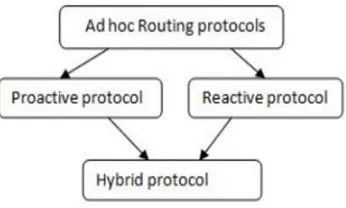
Routing is the process of information exchange from one host to the other host in a network. Routing is the mechanism of forwarding packet towards its destination using most efficient path. In Ad-hoc network each host node acts as specialized router itself. A routing protocol maintains a routing table to keep information about the linking node and neighbors. Researchers have proposed several routing protocols for both wired and wireless networks. They lie into four distinct categories depending on their properties:
A. Centralized Vs. Distributed
In centralized algorithms, all route selection are made at a central node, while in distributed algorithms, the evaluation of route is shared among the network nodes.
B. Static Vs. Adaptive
In static algorithms, the route used by source-destination pairs is fixed being independent of traffic conditions. Here route for transitions change only in response to a node or a link failure. Such types of algorithms cannot achieve high throughput under a wide variety of traffic input patterns. Most major packet networks use some form of adaptive routing which in response to congestion may change the route between the source and destination.
C. Flat Vs. Hierarchical
A flat addressing is one of the pre-requisite for the flat routing approach. Each underlying node participating in routing plays an important role and all nodes have same responsibilities means no special gateway nodes are present. In contrast, hierarchical routing usually assigns different roles to network nodes.
D. Proactive (Table-Driven) Vs. Reactive (On-Demand-Driven) Vs. Hybrid
• Reactive routing protocol
These types of protocols[5] are also called as On Demand Routing Protocols where the routes are not predefined for routing. Reactive protocols establish a route to a destination on demand. The route discovery mechanism is based on flooding algorithm which employs on the technique that a node just broadcasts the packet to all of its neighbors and intermediate nodes just forward that packet to their neighbors. Reactive protocols have higher latency and smaller routing overheads as compared to proactive protocols. Example Protocols: DSR, AODV
• Hybrid routing protocol
Hybrid protocols are the combinations of reactive and proactive protocols and take advantages of these two protocols and thus combine the advantages of both. Example Protocol: ZRP (Zone Routing Protocol).
III. COMPARISON OF VARIOUS PROACTIVE ROUTING PROTOCOLS
i) Destination-Sequenced Distance-Vector (DSDV) protocol
In DSDV, each node is required to transmit a sequence number, which is periodically increased by two and transmitted along with any other routing update messages to all neighboring nodes[7]. On reception of these update messages, the neighboring nodes to decide whether to ignore the update or to make the necessary changes to its routing table based on the following algorithm:
Step 1: Receive the update message.
Step 2: If any one of the two conditions given below satisfies, then update the routing table: i) Sn> Sp
ii) Sn=Sp, Hop count is less
Otherwise, ignore the update message.
Where, Sn is the sequence number of new message & Sp is the sequence number of existing message.
Advantages:
Suitable for small number of nodes,
Other protocols have borrowed similar techniques (e.g. AODV).
Disadvantages:
No formal specification, no significant commercial implementation Need regular update of its routing tables, (battery power problem) Congestion control is bad.
ii) Optimized Link State Routing(OLSR) Protocol
Fig. 3. Packet Transmission Using MPR
Advantages:
No route discovery delay. Greater throughput.
Increase in number of routes does not increase routing overhead.
Disadvantages:
OLSR protocol periodically sends the updated topology information throughout the entire network. Greater bandwidth required.
More processing power required to compute optimal paths.
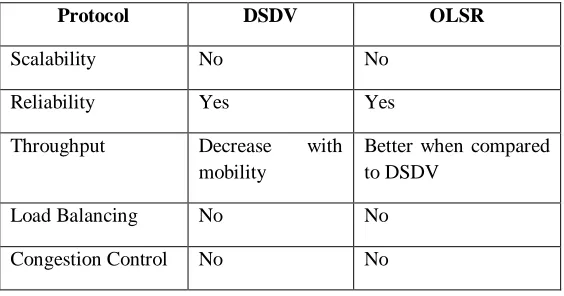
Table 1. Comparison of various proactive routing protocols
Protocol DSDV OLSR
Scalability No No
Reliability Yes Yes
Throughput Decrease with mobility
Better when compared to DSDV
Load Balancing No No
Congestion Control No No
IV. COMPARISON OF VARIOUS REACTIVE ROUTING PROTOCOLS
i) Dynamic Source Routing(DSR) Protocol
Dynamic source routing protocol (DSR) is an on-demand protocol based on source routing designed to restrict the bandwidth consumed by control packets in ad hoc wireless networks by eliminating the periodic table-update messages required in the table-driven approach. The major difference is that it is beacon-less and hence does not require periodic hello packet (beacon) transmissions. In DSR every mobile node in the network needs to maintain a route cache where it caches source routes that it has learned. The basic approach of this protocol (and all other on-demand routing protocols) during the route construction phase is to establish a route by flooding Route Request packets in the network. DSR protocol is based on two mechanisms: Route Discovery and Route Maintenance.
Use of only "soft state" in routing.
Rapid recovery in case of change of routes in the network.
Disadvantages:
One of the major disadvantages of DSR protocol is in implementing the route discovery process. Not scalable to large networks.
Processing resources required are more in comparison to other protocols.
ii) AODV Routing Protocol
AODV (Ad hoc On-Demand Distance Vector Routing) is a variation of destination sequenced distance vector (DSDV) routing protocol which is collectively based on DSDV and DSR. Its aim is to minimize the requirement of system wide broadcasts. It does not maintain routes from every node to every other node in the network rather they are discovered as and when needed and maintained only as long as they are required[4]. The major difference between AODV and Dynamic Source Routing (DSR) stems out from the fact that DSR uses source routing in which a data packet carries the complete path to be traversed. AODV uses a simple request–reply mechanism for the discovery of routes.
Advantages:
Routes are established on demand and destination sequence numbers are used to find the latest route to the destination.
Lower delay for connection setup.
Disadvantages:
AODV doesn’t allow handling unidirectional links.
Multiple Route Reply packets in response to a single Route Request packet can lead to heavy control overhead.
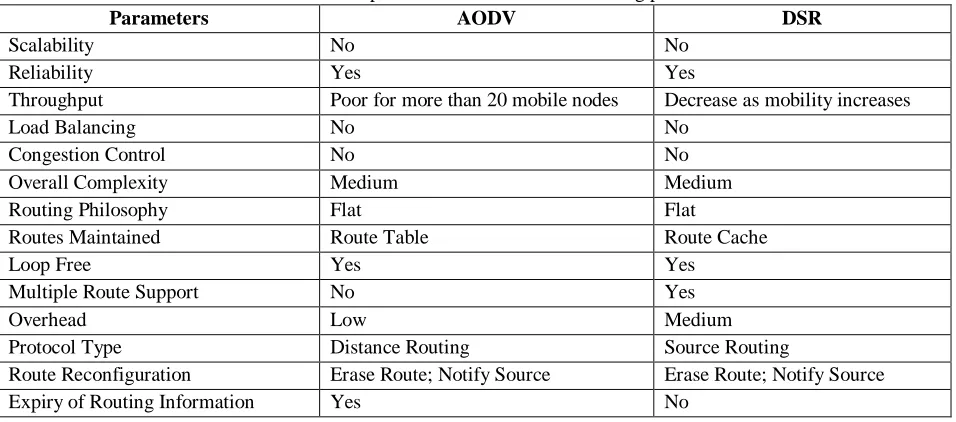
Table 2. Comparison of various reactive routing protocols
Parameters AODV DSR
Scalability No No
Reliability Yes Yes
Throughput Poor for more than 20 mobile nodes Decrease as mobility increases
Load Balancing No No
Congestion Control No No
Overall Complexity Medium Medium
Routing Philosophy Flat Flat
Routes Maintained Route Table Route Cache
Loop Free Yes Yes
Multiple Route Support No Yes
Overhead Low Medium
Protocol Type Distance Routing Source Routing
V. COMPARISON OF AD-HOC ROUTING PROTOCOLS
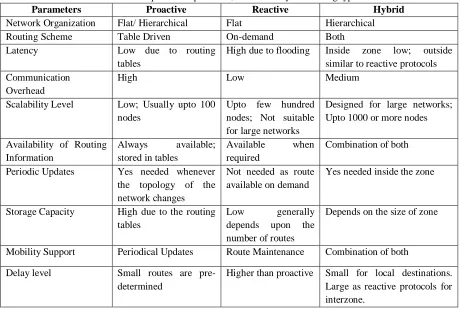
Table 3 shows advantages and disadvantages of proactive, reactive & hybrid routing protocols while table 4 shows comparison between these three types of protocols based on various parameters.
Table 3. Pros and cons of proactive, reactive & hybrid routing types
Protocols Advantages Disadvantages
Proactive Protocols Information is always available. Latency is reduced in the network.
Overhead is high. Routing information is flooded in the whole network.
Reactive Protocols Path available when needed. Free from loops and overhead is low.
Latency is increased.
Hybrid Protocols Suitable for large networks and up to date information available.
Complexity increases.
Table 4. Comparison of proactive, reactive & hybrid routing types
Parameters Proactive Reactive Hybrid
Network Organization Flat/ Hierarchical Flat Hierarchical Routing Scheme Table Driven On-demand Both Latency Low due to routing
tables
High due to flooding Inside zone low; outside similar to reactive protocols Communication
Overhead
High Low Medium
Scalability Level Low; Usually upto 100 nodes
Upto few hundred nodes; Not suitable for large networks
Designed for large networks; Upto 1000 or more nodes
Availability of Routing Information
Always available; stored in tables
Available when required
Combination of both
Periodic Updates Yes needed whenever the topology of the network changes
Not needed as route available on demand
Yes needed inside the zone
Storage Capacity High due to the routing tables
Low generally depends upon the number of routes
Depends on the size of zone
Mobility Support Periodical Updates Route Maintenance Combination of both
Delay level Small routes are pre-determined
Higher than proactive Small for local destinations. Large as reactive protocols for interzone.
VI. CONCLUSION
[3] “C. Siva Ram Murthy and B.S. Manoj “Ad hoc Wireless Networks Architecture and Protocols” Prentice Hall 2004.
[4] Charles Perkins, Elizabeth Royer, and Samir Das “Ad hoc on demand distance vector (AODV) routing” IETF RFC No. 3561, July 2003.
[5] E. Bommaiah et al., AMRoute: Ad-hoc Multicast Routing Protocol, Internet draft, August 1998.
[6] Shakkeera “Optimal path selection technique for Flooding in Link State Routing Protocol Using Forwarding Mechanisms in MANET”.
[7] Study of Distance Vector Routing Protocols for Mobile Ad Hoc Networks IEEE International Conference on Pervasive Computing and Comm.