© 2014, IJCSMC All Rights Reserved 745 Available Online at www.ijcsmc.com
International Journal of Computer Science and Mobile Computing
A Monthly Journal of Computer Science and Information Technology
ISSN 2320–088X
IJCSMC, Vol. 3, Issue. 9, September 2014, pg.745 – 751
RESEARCH ARTICLE
BASICS OF ARTIFICIAL NEURAL NETWORK
Sakshi Kohli
1, Surbhi Miglani2, Rahul Rapariya31, 2, 3
Student, Computer Science and Technology, Maharashi Dayanand University
Gurgaon, Haryana, India
Gurgaon, Haryana, India
New Delhi, India
ABSTRACT-
A neural network is, in essence, an attempt to simulate the brain. Neural network theory revolves around the idea that certain key properties of biological neurons can be extracted and applied to simulations, thus creating a simulated (and very much simplified) brain. An ANN is configured for a specific application, such as pattern recognition or data classification, through a learning process. Learning in biological systems involves adjustments to the synaptic connections that exist between the neuronsKEYWORDS - ANN (Artificial Neural Network), Neurons, pattern recognition, learning
INTRODUCTION TO ARTIFICIAL INTELLIGENCE
Artificial Neural Networks are relatively crude electronic models based on the neural structure of the brain. The brain basically learns from experience. It is natural proof that some problems that are beyond the scope of current computers are indeed solvable by small energy efficient packages. This brain modelling also promises a less technical way to develop machine solutions. This new approach to computing also provides a more graceful degradation during system overload than its more traditional counterparts.
© 2014, IJCSMC All Rights Reserved 746
WORKING OF ANN
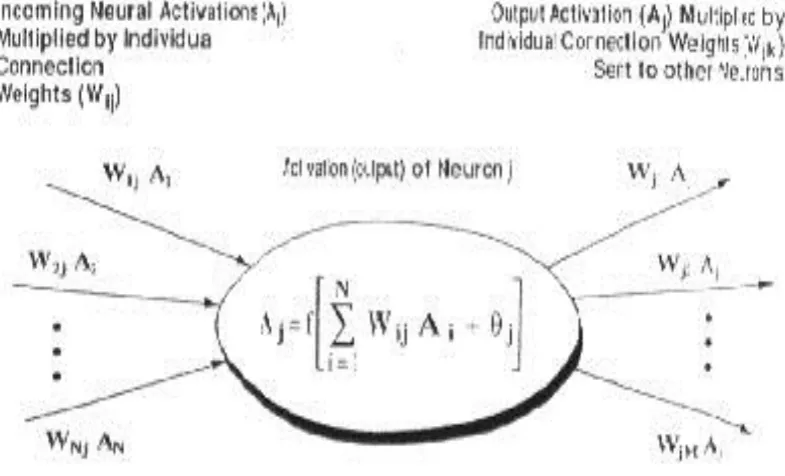
The fundamental processing element of a neural network is a neuron. This building block of human awareness encompasses a few general capabilities. Basically, a biological neuron receives inputs from other sources, combines them in some way, performs a generally nonlinear operation on the result, and then outputs the final result. Figure 2.2.1 shows the relationship of these four parts.
Figure: 1 A Simple Neuron.
Within humans there are many variations on this basic type of neuron, further complicating man's attempts at electrically replicating the process of thinking. Yet, all natural neurons have the same four basic components. These components are known by their biological names - dendrites, soma, axon, and synapses. Dendrites are hair-like extensions of the soma which act like input channels. These input channels receive their input through the synapses of other neurons. The soma then processes these incoming signals over time. The soma then turns that processed value into an output which is sent out to other neurons through the axon and the synapses.
The other parts of the ―art‖ of using neural networks revolve around the myriad of ways these individual neurons can be clustered together. This clustering occurs in the human mind in such a way that information can be processed in a dynamic, interactive, and self-organizing way. Biologically, neural networks are constructed in a three-dimensional world from microscopic components. These neurons seem capable of nearly unrestricted interconnections. That is not true of any proposed, or existing, man-made network. Integrated circuits, using current technology, are two- dimensional devices with a limited number of layers for interconnection. This physical reality restrains the types, and scope, of artificial neural networks that can be implemented in silicon.
Currently, neural networks are the simple clustering of the primitive artificial neurons. This clustering occurs by creating layers which are then connected to one another. How these layers connect is the other part of the "art" of engineering networks to resolve real world problems.
HOW THEY LEARN
© 2014, IJCSMC All Rights Reserved 747
This whole process: input, processing, comparing output with correct answer, and adjusting connection strengths is called one 'back-propagation cycle', or often just one 'iteration'. The net is then presented with another picture and its answer is compared with the correct answer, the connection strengths adjusted where needed. This process can often take hundreds or thousands of iterations. Eventually, the net should become fairly proficient at identifying males and females. There is always a risk however, that the net has not learned to discriminate males from females, but rather that it has effectively memorized the response for each picture. To test for this, the pictures (or whatever input is being used) should be divided into two groups: The training set, and the transfer set. The training set is used during back-propagation cycles, and the transfer set is used once learning is complete. If the net performs as well on the novel transfer stimuli as it did on the training set, then we conclude that learning has occurred.
ANN CHARACTERISTICS
Basically Computers are good in calculations that basically takes inputs process then and after that gives the result on the basis of calculations which are done at particular Algorithm which are programmed in the software’s but ANN improve their own rules, the more decisions they make, the better decisions may become. The Characteristics are basically those which should be present in intelligent System like robots and other Artificial Intelligence Based Applications. There are six characteristics of Artificial Neural Network which are basic and important for this technology which are showed with the help of diagram
Figure: 2 Characteristics of ANN
THE LEARNING PROCESS
The memorisation of patterns and the subsequent response of the network can be categorised into two general paradigms:
Associative mapping in which the network learns to produce a particular pattern on the set of input units
whenever another particular pattern is applied on the set of input units. The associtive mapping can generally be broken down into two mechanisms:
Auto- association
:
an input pattern is associated with itself and the states of input and output units coincide. This is used to provide pattern completition, i.e. to produce a pattern whenever a portion of it or a distorted pattern is presented. In the second case, the network actually stores pairs of patterns building an association between two sets of patterns.
Hetero-association: is related to two recall mechanisms:
Nearest-neighbour recall, where the output pattern produced corresponds to the input pattern
stored, which is closest to the pattern presented, and
Interpolative recall, where the output pattern is a similarity dependent interpolation of the patterns
stored corresponding to the pattern presented. Yet another paradigm, which is a variant associative mapping, is classification, ie when there is a fixed set of categories into which the input patterns are to be classified.
Regularity detection in which units learn to respond to particular properties of the input patterns. Whereas in
associative mapping the network stores the relationships among patterns, in regularity detection the response of eachCHARACTERISTICS OF
ANN
Collective Solution Parallel
Processing Network
Structures
Fault
Tolerance Distributed
Memory
© 2014, IJCSMC All Rights Reserved 748
unit has a particular 'meaning'. This type of learning mechanism is essential for feature discovery and knowledge representation.
Every neural network possesses knowledge which is contained in the values of the connections weights. Modifying the knowledge stored in the network as a function of experience implies a learning rule for changing the values of the weights
Figure : 3 The Leaning Process
APPLICATIONS OF ANN
Data Mining: Discovery of meaningful patterns (knowledge) from large volumes of data.
Expert Systems: A computer program for decision making that simulates thought process of a human expert.
Fuzzy Logic:Theory of approximate reasoning.
Artificial Life: Evolutionary Computation, Swarm Intelligence.
Artificial Immune System: A computer program based on the biological immune system.
Medical: Artificial Neural Networks (ANN) are currently a 'hot' research area in medicine and it is believed that they will receive extensive application to biomedical systems in the next few years. At the moment, the research is mostly on modelling parts of the human body and recognising diseases from various scans (e.g. cardiograms, CAT scans, ultrasonic scans, etc.).
Neural networks are ideal in recognising diseases using scans since there is no need to provide a specific algorithm on how to identify the disease. Neural networks learn by example so the details of how to recognise the disease are not needed. What is needed is a set of examples that are representative of all the variations of the disease. The quantity of examples is not as important as the 'quantity'. The examples need to be selected very carefully if the system is to perform reliably and efficiently.
© 2014, IJCSMC All Rights Reserved 749
Computer Science: Researchers in quest of artificial intelligence have created spin offs like dynamic programming, object oriented programming, symbolic programming, intelligent storage management systems and many more such tools. The primary goal of creating an artificial intelligence still remains a distant dream but people are getting an idea of the ultimate path, which could lead to it.
Aviation: Airlines use expert systems in planes to monitor atmospheric conditions and system status. The plane can be put on autopilot once a course is set for the destination.
Weather Forecast: Neural networks are used for predicting weather conditions. Previous data is fed to a neural network, which learns the pattern and uses that knowledge to predict weather patterns.
Neural Networks in business: Business is a diverted field with several general areas of specialisation such as accounting or financial analysis. Almost any neural network application would fit into one business area or financial analysis.
There is some potential for using neural networks for business purposes, including resource allocation and scheduling. There is also a strong potential for using neural networks for database mining, that is, searching for patterns implicit within the explicitly stored information in databases. Most of the funded work in this area is classified as proprietary. Thus, it is not possible to report on the full extent of the work going on. Most work is applying neural networks, such as the Hopfield-Tank network for optimization and scheduling.
Marketing: There is a marketing application which has been integrated with a neural network
system. The Airline Marketing Tactician (a trademark abbreviated as AMT) is a computer system made of various intelligent technologies including expert systems. A feed forward neural network is integrated with the AMT and was trained using back-propagation to assist the marketing control of airline seat allocations. The adaptive neural approach was amenable to rule expression. Additionally, the application's environment changed rapidly and constantly, which required a continuously adaptive solution.
Credit Evaluation: The HNC company, founded by Robert Hecht-Nielsen, has developed several
neural network applications. One of them is the Credit Scoring system which increases the profitability of the existing model up to 27%. The HNC neural systems were also applied to mortgage screening. A neural network automated mortgage insurance under writing system was developed by the Nestor Company. This system was trained with 5048 applications of which 2597 were certified. The data related to property and borrower qualifications. In a conservative mode the system agreed on the under writers on 97% of the cases. In the liberal model the system agreed 84% of the cases. This is system run on an Apollo DN3000 and used 250K memory while processing a case file in approximately 1 sec.
ADVANTAGES
1. Adaptive learning: An ability to learn how to do tasks based on the data given for training or initial experience.
2. Self-Organisation: An ANN can create its own organisation or representation of the information it receives during learning time.
3. Real Time Operation: ANN computations may be carried out in parallel, and special hardware devices are being designed and manufactured which take advantage of this capability.
4. Pattern recognition: is a powerful technique for harnessing the information in the data and generalizing about it. Neural nets learn to recognize the patterns which exist in the data set.
© 2014, IJCSMC All Rights Reserved 750
6. Neural networks are flexible in a changing environment. Although neural networks may take some time to learn a sudden drastic change they are excellent at adapting to constantly changing information.
7. Neural networks can build informative models whenever conventional approaches fail. Because neural networks can handle very complex interactions they can easily model data which is too difficult to model with traditional approaches such as inferential statistics or programming logic.
8. Performance of neural networks is at least as good as classical statistical modelling, and better on most problems. The neural networks build models that are more reflective of the structure of the data in significantly less time.
LIMITATIONS OF ANN
In this technological era everything has Merits and some Demerits in others words there is a Limitation with every system which makes this ANN technology weak in some points. The various Limitations of ANN are:-
1) ANN is not a daily life general purpose problem solver.
2) There is no structured methodology available in ANN.
3) There is no single standardized paradigm for ANN development.
4) The Output Quality of an ANN may be unpredictable.
5) Many ANN Systems does not describe how they solve problems.
6) Black box Nature
7) Greater computational burden.
8) Proneness to over fitting.
9) Empirical nature of model development.
CONCLUSION
The computing world has a lot to gain fron neural networks. Their ability to learn by example makes them very flexible and powerful. Furthermore there is no need to devise an algorithm in order to perform a specific task; i.e. there is no need to understand the internal mechanisms of that task. They are also very well suited for real time systems because of their fast response and computational times which are due to their parallel architecture.
Neural networks also contribute to other areas of research such as neurology and psychology. They are regularly used to model parts of living organisms and to investigate the internal mechanisms of the brain.
Perhaps the most exciting aspect of neural networks is the possibility that some day 'consious' networks might be produced. There are a number of scientists arguing that consciousness is a 'mechanical' property and that 'consious' neural networks are a realistic possibility.
ANNs provide an analytical alternative to conventional techniques which are often limited by strict assumptions of normality, linearity, variable independence etc. Because an ANN can capture many kinds of relationships it allows the user to quickly and relatively easily model phenomena which otherwise may have been very difficult or impossible to explain otherwise. Today, neural networks discussions are occurring everywhere
© 2014, IJCSMC All Rights Reserved 751
REFERENCES
[1] Bradshaw, J.A., Carden, K.J., Riordan, D., 1991. Ecological ―Applications Using a Novel Expert System Shell.
[2] Rich ,Knight and B Nair, “Artificial Intelligence”, TMH Publication
[3] Jacek M . Zurada, Introduction to Artificial Neural System”, Jaico publishing house.
[4] Ajith Abraham, “Artificial Neural Networks”, Stillwater,OK, USA, 2005.