Available Online atwww.ijcsmc.com
International Journal of Computer Science and Mobile Computing
A Monthly Journal of Computer Science and Information Technology
ISSN 2320–088X
IMPACT FACTOR: 5.258
IJCSMC, Vol. 5, Issue. 4, April 2016, pg.136 – 143
MULTI-ACCESS OF PREVILEGED
DATA IN CLOUD BY
AUTHENTICATION PROTOCOL
Cherukuri Anusha1, Challari Bindu Bhargavi2, Iruku Venkata Sai Sirisha3, Kusumanchi Bhargavi4 ¹Asst. Professor, CSE, INTERNATIONAL SCHOOL OF TECHNOLOGY AND SCIENCES (FOR WOMEN),
EAST GONAGUDEM, RAJANAGARM Rajahmundry, A.P, India
²Student B.Tech CSE, INTERNATIONAL SCHOOL OF TECHNOLOGY AND SCIENCES (FOR WOMEN), EAST GONAGUDEM, RAJANAGARM Rajahmundry, A.P, India
3
Student B.Tech CSE, INTERNATIONAL SCHOOL OF TECHNOLOGY AND SCIENCES (FOR WOMEN), EAST GONAGUDEM, RAJANAGARM Rajahmundry, A.P, India
4
Student B.Tech CSE, INTERNATIONAL SCHOOL OF TECHNOLOGY AND SCIENCES (FOR WOMEN), EAST GONAGUDEM, RAJANAGARM Rajahmundry, A.P, India
1
[email protected]; 2 [email protected];
3
[email protected]; [email protected]
Abstract- Cloud is a kind of Internet-based computing that provides shared processing resources and data to computers and other devices on demand cloud server. During the data accessing, different users may be in a collaborative relationship, and thus data sharing becomes significant to achieve productive benefits. privacy issue during a user access challenging the cloud server to request other users for data sharing. The challenged access request itself may reveal the user’s privacy no matter whether or not it can obtain the data access permissions. In this paper, we propose a multi-access privileged data authentication protocol (MAPDAP) to address above privacy issue for cloud storage. In the MAPDAP, 1) shared access authority is achieved by anonymous access request matching mechanism with security and privacy considerations (e.g., authentication, data anonymity, user privacy, and forward security); 2) attribute based access control is adopted to realize that the user can only access its own data fields; 3) proxy re encryption is applied by the cloud server to provide data sharing among the multiple users. It indicates that the proposed protocol realizing privacy preserving data access authority sharing, is attractive for multi-user collaborative cloud applications.
1. INTRODUCTION
Cloud computing is a promising information technology architecture for both enterprises and individuals. It launches an attractive data storage and interactive paradigm with obvious advantages, including on-demand self-services, ubiquitous network access, and location independent resource pooling[1]. Recent studies have been worked to promote the cloud computing evolve towards the internet of services [2], [3]. Subsequently, security and privacy issues are becoming key concerns with the increasing popularity of cloud services. Conventional security approaches mainly focus on the strong authentication to remote user can access its own data in on-demand mode. Along with the diversity of the application requirements, users may want to access and share each other’s authorized data fields to achieve productive benefits, which brings new security and privacy challenges for the cloud storage.
In this each group owns its users which are permitted to access the authorized data fields, and different users own relatively independent access authorities. It means that any two users from diverse groups should access different data fields of the same file. In cloud environment security
protocol follow some requirements1) Authentication: a legal user can access its own data fields,
only the authorized partial or entire data fields can be identified by the legal user, and any forged
or tampered data fields cannot deceive the legal user. 2) Data anonymity: any irrelevant entity
cannot recognize the exchanged data and communication state even it intercepts the exchanged
messages via an open channel. 3) User privacy: any irrelevant entity cannot know or guess a
user’s accessdesire, which represents a user’s interest in anotheruser’s authorized data fields. If
and only if the both users have mutual interests in each other’s authorized data fields, the cloud server will inform the two users to realize the access permission sharing. 4) Forward security: any adversary cannot correlate two communication sessions to derive the prior interrogations according to the currently captured messages.
Researchers have been worked to strengthen security protection and privacy preservation in cloud applications, and there are various cryptographic algorithms to address potential security and privacy problems, including security architectures [4], [5], data possession protocols [6], [7], data public auditing protocols [8]–[10].
In this paper, we address the privacy issue to propose a multi access privileged data authentication protocol (MAPDAP) to address above privacy issue for cloud storage. In the MAPDAP for cloud data storage, which realizes authentication and authorization without compromising a user’s private information. The main contributions are follows. 1) Identify a new privacy challenge in cloud storage, and address a subtle privacy issue during a user challenging the cloud server for data sharing,
2) Propose an authentication protocol to enhance a user’s access request related privacy, and the shared access authority is achieved by anonymous access request matching mechanism.
3) Apply cipher text-policy attribute based access control to realize that a user can reliably access its own data fields, and adopt the proxy re-encryption to provide temp authorized data sharing among multiple users.
2. RELATED WORK
Dunning et al. [11] proposed an anonymous ID assignment based data sharing algorithm (AIDA)
for multiparty oriented cloud and distributed computing systems. In the AIDA, an integer data sharing algorithm is designed on top of secure sum data mining operation, and adopts a variable and unbounded number of iterations for anonymous assignment. Specifically, Newton’s identities and Sturm’s theorem are used for the data mining, a distributed solution of certain polynomials over finite fields enhances the algorithm scalability, and Markov chain representations are used to determine statistics on the required number of iterations.
Liu et al. [12] proposed a multi-owner data sharing secure scheme (Mona) for dynamic groups
in the cloud [3] applications. The Mona aims to realize that a user can securely share its data with other users via the un trusted cloud server, and can efficiently support dynamic group interaction.
Grzonkowsket al. [13] proposed a zero-knowledge proof (ZKP) based authentication scheme for
sharing cloud services. Based on the social home networks, a user centric approach is applied to enable the sharing of personalized content and sophisticated network-based services via TCP/IP infrastructures, in which a trusted third party is introduced for decentralized interactions, the cloud resources, and the data owners’ real identities can only be revealed by the group manager for dispute arbitration. It indicates the storage overhead and encryption computation cost are independent with the amount of the users.
Fig 1 : The Cloud Storage System Model
3. SYSTEM MODEL
Fig. 1 illustrates a system model for the cloud storage architecture, which includes three main network entities: users (Ux), a cloud server (S), and a trusted third party.
• User: an individual or group entity, which owns its data stored in the cloud for online data storage and computing. Different users may be affiliated with a common organization, and are assigned with independent authorities on certain data fields.
• Cloud server: an entity, which is managed by a particular cloud service provider or cloud application operator to provide data storage and computing services. The cloud server is regarded as an entity with unrestricted storage and computational resources.
• Trusted third party: an optional and neutral entity, which has advanced capabilities on behalf of the users, to perform data public auditing and dispute arbitration.
In the cloud storage, a user remotely stores its data via online infrastructures, flat forms, or software for cloud services, which are operated in the distributed, parallel, and cooperative modes. During cloud data accessing, the user autonomously interacts with the cloud server without external interferences, and is assigned with the full and independent authority on its own data fields. It is necessary to guarantee that the users’ outsourced data cannot be unauthorized accessed by other users, and is of critical importance to ensure the private information during the users’ data access challenges. In some scenarios, there are multiple users in a system (e.g., supply chain management), and the users could have different affiliation attributes from different interest groups.
4. MULTI-ACCESS PRIVILEGED DATA AUTHENTICATION PROTOCOL
The cloud storage system includes a cloud server S, and users {Ux} (x = {1; :::;m}, m ∈ N).
The corresponding Ua and Ub are two users, which have independent access authorities on their
own data fields. It means that a userhas an access permission for particular data fields stored by
S, and the user cannot exceed its authority access to obtain other users’ data fields. Here, we
consider S and {Ua, Ub} to present the protocol phases for data access control and access
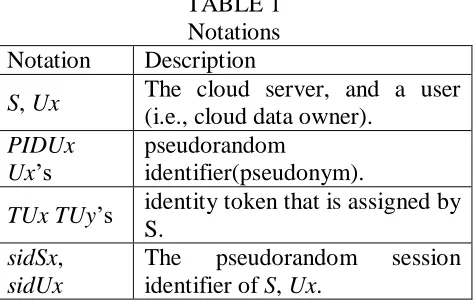
authority sharing with enhanced privacy considerations. The main notations are introduced.
TABLE 1 Notations
Notation Description
S, Ux The cloud server, and a user
(i.e., cloud data owner).
PIDUx Ux’s
pseudorandom
identifier(pseudonym).
TUx TUy’s identity token that is assigned by
S.
sidSx,
sidUx
The pseudorandom session
I,J,K,rUx The randomly generated
numbers R Uy, Ux
RUy RUx
The access request pointer that
represents Ux’s access desire on
Uy’s data fields.
DUx, _DUx Ux’s
own authorized data fields, and
Ux’s temp authorized data
fields.
AUx , LUx ,
PUx
The data attribute access list, re-structure data access list, and data access policy.
fmpk=mskg The pair wise master public/
privacy keys.
fpk=skg The pairwise public/privacy
keys.
kUx , kUx The aggregated keys, and the
re-encryption keys.
Vℓ The locally computed value V
according to the same algorithm.
CSx , CUx The ciphertexts.
FSx (x;
PUx )
The defined polynomial owned by S.
FUx
(x;LUx )
The defined polynomial owned by Ux.
{Ua, Ub} respectively generate the session identifiers {sidUa , sidUb }, extract the identity
tokens {TUa , TUb}, and transmits {sidUa|| TUa, sidUb∥ TUb} to S as an access query to initiate a new
session. Accordingly, we take the interactions of Ua and S as an example to introduce the
following authentication phase. Upon receiving Ua’s challenge, S first generates a session
identifier sidSa , and establishes the master public key mpk = (gi, h, hi,BG, e(g, h),H) and master privacy key msk = (I; g). S randomly chooses I ∈ Zq, andcomputes gi = gαi and hi = hαi−1 (i =
{1….n} ∈ Z*). S randomly chooses v∈ {0, 1}*, and extracts Ua’saccess authority policy PUa=
[pij ]n×m (pij ∈ {0,1}), and Ua are assigned with the access authority on its own datafields DUa
within PUa ’s permission. S further defines a polynomial FSa (x, PUa) according to PUaand LUa.
function FSa (x,PUa)
{
for( i= 1,i<
n, i++)
{
for(j=1,j<m, j++)
x=(x + i*j*H(L
Ua)) **pij
4.1 {Ua, Ub}’s DATA ACCESS CONTROL
Ua
first extracts it data attribute access list AUa= [aij] (aij∈ {0; 1}, aij ≤ pij) to restructure anaccess list LUa=[lij]n×mfor lij= pij − aij. Uaalso defines a polynomial FUa(x,LUa) according to
LUaand TUa
function FSa (x,PUa)
{
for( i= 1,i<
n, i++)
{
for(j=1,j<m, m++)
x=(x + i*j*H(L
Ua)) **pij
}}}
4.2. {Ua, Ub}’s ACCESS REQUEST MATCHING AND DATA ACCESS AUTHORITY SHARING
When receiving the ciphertexts {CUa , CUb} within an allowable time interval, and S extracts {PIDUa , PIDUb} to derive the access requests {RUba, RUab}.
RUba = H(sidSa || PIDUa ) + MUa0
RUab= H(sidSa || PIDUb ) + MUb0
S checks the above mentioned requests with memory request functions MUa0, MUb0 of both
Uaand Ub desires to access each other’s authorized data, and to share its authorized data fields
each other. S extracts the keys values and re-encrypted the memory functions MU’a0 ,MU’b0
give the chance to read the data in cloud systems.
5. CONCLUSION
Data accessing has become a challenging issue in cloud storage systems. Some techniques have been proposed to achieve the secure data access control in a multi authority cloud storage
system. MAPDAP must be designed with sufficient resistance. MAPDAP issues are mainly
related to the security policies provided to the users accessing the uploaded data, and the technique must specify their own defined security In this work, we have finds a new privacy challenge during data accessing in the cloud computing to achieve privileged access authority sharing. Authentication is established to guarantee data confidentiality and data integrity.
REFERENCES
[1] P. Mell and T. Grance, “Draft NIST Working Definition of Cloud Computing,” National Institute of Standards and Technology, USA, 2009.
[2] A. Mishra, R. Jain, and A. Durresi, “Cloud Computing: Networking and Communication
Challenges,” IEEE CommunicationsMagazine, vol. 50, no. 9, pp, 24-25, 2012.
[3] R. Moreno-Vozmediano, R. S. Montero, and I. M. Llorente, “Key Challenges in Cloud
[4] K. Hwang and D. Li, “Trusted Cloud Computing with Secure Resources and Data Coloring,”
IEEE Internet Computing, vol. 14, no. 5, pp. 14-22, 2010.
[5] J. Chen, Y. Wang, and X. Wang, “On-Demand Security Architecture for Cloud Computing,”
Computer, vol. 45, no. 7, pp. 73-78, 2012.
[6] Y. Zhu, H. Hu, G. Ahn, and M. Yu, “Cooperative Provable Data Possession for Integrity
Verification in Multi-cloud Storage,” IEEE Transactions on Parallel and Distributed Systems,
vol. 23, no, 12, pp. 2231-2244, 2012.
[7] H. Wang, “Proxy Provable Data Possession in Public Clouds,” IEEE Transactions on
Services Computing, [online] ieeexplore. ieee.org/stamp/stamp.jsp?tp=&arnumber=6357181, 2012.
[8] K. Yang and X. Jia, “An Efficient and Secure Dynamic Auditing Protocol for Data Storage in
Cloud Computing,” IEEETransactions on Parallel and Distributed Systems, [online] ieeexplore.
ieee.org/stamp/stamp.jsp?tp=&arnumber=6311398, 2012.
[9] Q. Wang, C. Wang, K. Ren, W. Lou, and J. Li, “Enabling Public Auditability and Data
Dynamics for Storage Security in Cloud Computing,” IEEE Transactions on Parallel and
Distributed Systems, vol. 22, no. 5, pp. 847-859, 2011.
[10] C. Wang, K. Ren, W. Lou, J, Lou,“Toward Publicly Auditable Secure Cloud Data Storage
Services,” IEEE Network, vol. 24, no. 4, pp. 19-24, 2010.
[11] L. A. Dunning and R. Kresman, “Privacy Preserving Data Sharing With Anonymous ID
Assignment,” IEEE Transactions on Information Forensics and Security, vol. 8, no. 2, pp.
402-413, 2013.
[12] X. Liu, Y. Zhang, B. Wang, and J. Yan, “Mona: Secure Multi- Owner Data Sharing for
Dynamic Groups in the Cloud,” IEEE Transactions on Parallel and Distributed Systems,
[online] ieeexplore. ieee.org/stamp/stamp.jsp?tp=&arnumber=6374615, 2012.
[13] S. Grzonkowski and P. M. Corcoran, “Sharing Cloud Services: User Authentication for
Social Enhancement of Home Networking,”IEEE Transactions on Consumer Electronics, vol.
57, no. 3, pp. 1424-1432, 2011.
[14] M. Nabeel, N. Shang and E. Bertino, “Privacy Preserving Policy Based Content Sharing in
Public Clouds,” IEEE Transactions on Knowledge and Data Engineering, [online] ieeexplore.
ieee.org/stamp/stamp.jsp?tp=&arnumber=6298891, 2012.
[15] C. Wang, Q. Wang, K. Ren, N. Cao, and W. Lou, “Toward Secure and Dependable Storage
Services in Cloud Computing,” IEEE Transactions on Services Computing, vol. 5, no. 2, pp.
220-232, 2012.
[16] S. Sundareswaran, A. C. Squicciarini, and D. Lin, “Ensuring Distributed Accountability for
Data Sharing in the Cloud,” IEEE Transactions on Dependable and Secure Computing, vol. 9,
AUTHORS
Cherukuri Anusha is currently working as Assistant Professor in ISTS Engineering college in Computer Science department. She focuses on security and privacy issues in Cloud computing environment. Her research interests include authentication protocol design, and security formal modeling and analysis.
Challari Bindu Bhargavi is currently studying Btech(CSE) third year in ISTS Engineering college. Her research interests are cloud computing and Networking.
Iruku Venkata Sai Sirisha is currently studying Btech(CSE) third year in ISTS Engineering college. Her research interests are cloud computing and Networking.