© 2016, IJCSMC All Rights Reserved 615
Available Online atwww.ijcsmc.com
International Journal of Computer Science and Mobile Computing
A Monthly Journal of Computer Science and Information Technology
ISSN 2320–088X
IMPACT FACTOR: 5.258IJCSMC, Vol. 5, Issue. 5, May 2016, pg.615 – 620
A Study on Features and Types of Data-Centric
Routing for WSN
Bhupesh
M.Tech Scholar, Deptt. Of Electronics and Communication, Sat Priya Group of Institutions
Rohtak, Haryana
Sikander
M.Tech Scholar, Deptt. Of Electronics and Communication, Sat Priya Group of Institutions
Rohtak, Haryana [email protected]
Abstract— Sensor network captures the environment or the application features using its sensing capabilities. The data flow in the network can be observed to improve the communication features. Data-Centric routing model is here explored to generate reliable communication path based on query specific analysis. In this paper, the characterization and types of data centric routing is presented. The route formulation features and the analytical behavior of the routing method is also defined in this paper.
Keywords : Sensor Network, Data Centric, Rule-Framed, Power Specific
I. INTRODUCTION
© 2016, IJCSMC All Rights Reserved 616
A) Residual Energy
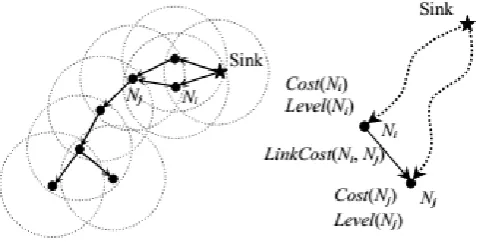
It is the power specific measure criticality used in each architecture and routing algorithm. This parameter defines the current energy of sensor node as the decisive constraint to improve the network lifetime. The energy benefit in sensor network is the critical parameter based on effective route will be formed. The routing parameters and the route formation of a sensor network are shown here in figure 1. Here the source and sink nodes are defined. The level and the link cost estimation are applied for effective route formation. Some of the critical parameters that affect the root formation are described here under
Figure 1 : Routing Trends
B) Transmission Energy
As some node performs the communication and send the data packet, it need to initialize the transmission by setting the destination node, locating the routing path, building the data packet, apply the data encoding etc. These all tasks requires sufficient amount of energy which is called transmission energy. This energy is consumed at the sender node as some transmission is performed. This energy consumption also depends the distance to the next neighbor and the size of data packet.
C) Routing Level
Routing level actually identifies the distance between the source and the destination in terms of hop count or in measurement unit. The number of intermediate nodes other than the source and destination is identified as routing level. A single hop routing level describes the direct communication between source and destination. The multi-hop routing is comparatively more challenging and requires more parametric assessment for optimization of communication route. In sensor network, as the number of routing level increases, the QoS over the route degrades.
D) Routing Cost
The routing cost is defined by the cost of moving to each neighbor and the cooperative communication is performed till the destination node not arrived. The routing cost of sensor network can calculate based on multiple parameters including the energy consumption over the route, communication delay, throughput, etc. When there are more than one alternate route between a pair of nodes, then the route with lesser cost is always considered effective.
E) Routing Cost Trend
This is the generalized measure that estimates the average computation over the network route. The average cost estimation or the average energy consumption over the communication route are considered as the cost trend of routing. This routing cost trend also reflects the energy consumption over the communication route and generates the cost specific attribute and provided the relative interest propagation. The decisive parameter based on which the effectiveness of a route is compared is called routing cost trend.
© 2016, IJCSMC All Rights Reserved 617 II. EXISTING WORK
The optimization of communication in any network is the primary requirement. Different parameter level and algorithmic level methods are suggested by different researchers to optimize the network communication. In this section, the contribution of earlier researchers for effective route formulation is discussed. Some of the researchers provided the comparative and study based work for route formulation. Kumari et. al.[3] has provided a comprehensive survey on different routing protocols for sensor network is presented by the author. Author has categorize the protocols under location specific, data centric, multipath and hierarchical protocols. An extensive study on design challenges is provided by the author to generate effective and optimized network path. Some of researchers provided application specific analysis for different routing approaches. Gnawali et. al.[7] has provided a work on data centric and position based routing method for space network. The requirement adaptation and the predictive trajectory analysis were provided based on architectural requirements. The proximity network is observed to generate the effective address centric communication in sensor network. The simulation of different routing constraints is provided by the author. A comparative analysis on different data centric protocols was provided by Ghaffari et. al.[14]. The network planning feature evaluation is provided under energy, network planning and flooding feature evaluation. The method also controlled the energy consumption in directed mode to achieve effective network communication.
Grover et. al.[1] has provided a work on SPIN protocol for sensor network that uses the data centric negotiation for route generation. The reliability of neighbor node is identified by the protocol for effective route formulation so that the node level optimization will be obtained from the work. The data delivery specific selective forwarding is included under different QoS parameters to generate effective communication route. The selective Repeat protocol is here defined to generate the effective acknowledge based path. An improvement to the routing protocol under energy, reliability and data analysis was provided by Zabin et. al[12] and presented as a separate protocol. The performance feature analysis under direct diffusion is provided to generate effective communication route. The transmission control routing in aggregative form is provided in this work. Some of the researchers worked on single hop, multi hop and broadcast communication. The data mode specific critical fraction analysis is derived to process the state and transmission information. The design patterns are able to improve the network longevity.
This presented work is mainly focussed on data centric routing under different algorithmic scope. Jian Wu et. al.[4] has provided a cost based data centric protocol for dynamic route formulation. The researcher observed the event driven mobility and the situation specific cases to generate the route in extreme conditions. The route maintenance and setup is here observed in multiple cases to improve the communication strength in the network. Guo et. al.[5] also provided the gradient specific observation to improve the data centric routing. Author applied the bloom filters to investigate the communication patterns and by negotiating the critical network observations. A query blending method is here applied to generate the effective routing in critical network. The analytical results under feasible conditions are observed to provide effective routing results. The potential observation under sufficient conditions is provided to generate the probabilistic results. The efficiency and probability based route formulation provides for effective route formulation. Zhou et. al[6] provided the work on multiple attribute based analysis to apply the decision driven route formulation in sensor network. The fuzzy integrated distance processing framework is here presented to generate the effective route under requirements observation. The efficiency and reliability measure is here provided for effective route formulation. The data cost specific next neighbor selection method is optimized under multiple communication parameters. Habden et. al.[8] also provided the bloom filter effective data centric routing for sensor network. A route deployment model for routing decision and filtration is provided by the author. A productive routing service under extensive features provides for effective route formulation. The neighbor connectivity observation under link quality and reinforced trail provides for effective route generation is provided by the author. Another work on data centric routing was provided by Yen et. al.[9]. Author used the linear mathematical formulation with tree constraint specification for heuristic optimization of route. The computational analysis with transmission cost observation is provided under Lagrangean relaxation. The node level conjunction method is provided for effective route formulation. Huang et. al.[10] provided the biased walk specific route generation under spatial cost mapping to generate effective route search results. An extreme route mapping for term computation cost is provided by the author. A dominating set based network characterization is provided to apply the spiral search. The level window based estimation provides for the route formulation in the elective optimal environment. A generalized energy specific data centric routing method was proposed by Khdour et. al.[11]. The work was included the gateway node in the effective node selection under energy and data reliability estimation. The protocol characterization is provided to control the power specification and direct the route phenomenon.
© 2016, IJCSMC All Rights Reserved 618
maps which are later on filtered using ACO approach. A fuzzy rule integrated multipath data centric routing was proposed by Srinivasan et. al.[15]. Author generated the multiple criteria based decision making for route discovery. The network modeling under source-sink connectivity is provided to generate the effective network decisions. The deadlock avoidance under various factors is trained under fuzzy rules to achieve effective network path.
III. DATACENTRICROUTINGMETHODS
In a sensor network where the real time information capturing is performed, the information is generally very critical and important. Sometimes, the communication is performed based on data queries. There is the requirement to control the communication flow and provide the data aggregation to perform reliable communication in the network. In such networks, the major constraint is the data rather than the address. In this routing method, the query specific node or the location search is performed. Some of the common methods or protocols for route formation are defined in this section.
A) Flooding or Gossiping
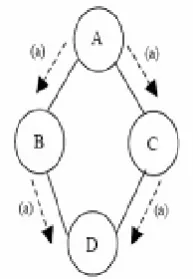
These are the most common data centric communication methods in which the data query applies to each of the neighbor. This query broadcast to neighbor is termed as flooding method. This process is repeated to the next level neighbors till the response from the desired node is not received. But flooding increases the network communication upto a larger extent, because of this, gossiping is the rectified form of flooding. In this method instead of broadcasting the message to all neighbor, some random or the pattern specific nodes are selected. The major advantages of these method is the easy algorithmic approach and easy to implement. But these methods also having some of the associated problems. The first problem is formation of multiple path and multiple communication of same data. It means a next level neighbor can be elected by more than one neighbor of the current node. Gossiping is able to resolve this problem but the method increases the delay in route formation. The problem in this method is shown here in figure 2.
Figure 2 : Flooding with Associated Problem
Here figure 2 is showing the broadcasting of the message from node A to its all neighbors. As the B and C receives the packet, and pass to the next level neighbor. This next level neighbor is same for both node. Because of this the duplicate data transmission is performed in this method.
B) SPIN
In this data centric communication method, other than the data packets some other information is communicated to the network. This information is in the form of the acknowledgement message sent by the receiver to all its neighbors as it receives the data packet. Because of this, the method gives the communication surety as the data receive information is communicated back to the sender neighbor. The acknowledge is sent to all the neighbors from the REQ message is received. This method is able to resolve the problem of flooding method with better efficiency. The method is effective even if the topology of the network is changes. This method also reduces the volume of data communication in the network because of which the energy consumption in this protocol is very less than flooding method. But the only problem in SPIN is that it does not guarantee the transmission to the next sensor. In case of intrusion, the SPIN is not a better choice.
C) Direct Diffusion
© 2016, IJCSMC All Rights Reserved 619
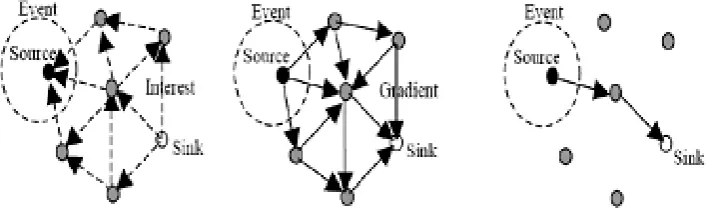
gradient information to identify the neighbor based on request processing. Different communication paths can be built in this method to provide the effective communication between sender and the receiver. The route reinforcement is provided by the measure to achieve the effective route formation. This route formation is shown in figure 3.
Figure 3 : Direct Diffusion Based Route Formation
As shown in the figure, the method is event based and analyzes all the possibility while generating the routing link. The figure is showing the request processing from the neighbor which is relatively applying under the gradient specific response analysis. Based on this information communication the effective route is generated. In the critical system where the critical and optimized communication is required, the direct diffusion is effective choice. But natural environment control is not possible by this protocol. It requires the prior knowledge of the neighbors for effective route processing.
D) Energy Aware Routing
In the sensor network, the major restriction on nodes is the specified energy and the major requirement is to improve the network lifetime. The energy adaptive route formation is one of the better choices in this network. While performing the node or the neighbor selection, the energy specific comparison can be applied. This energy adaptation can be combined with direct diffusion as the essential decision parameter to generate the effective between the source and destination. This method is able to provide the synchronized communication with lesser energy consumption.
IV. Conclusion
In this paper, an exploration to the data centric routing is provided with feature exploration, characterization as well as discussion on various methods. The paper has discussed various parameters or the features that can affect the routing algorithm and can be used as the decisive constraint for route formation. The paper also discussed four major data centric routing methods along with advantages and limitations.
R
EFERENCES[1] J. Grover, M. Sharma and Shikha, "Reliable SPIN in Wireless Sensor Network," Reliability, Infocom Technologies and Optimization (ICRITO) (Trends and Future Directions), 2014 3rd International Conference on, Noida, 2014, pp. 1-6.
[2] Z. Modi, S. Jardosh and P. Ranjan, "Optimized Rumor routing algorithm for Wireless Sensor Networks," Wireless Communication a nd Sensor Networks (WCSN), 2009 Fifth IEEE Conference on, Allahabad, 2009, pp. 1-6.
[3] J. Kumari and Prachi, "A comprehensive survey of routing protocols in wireless sensor networks," Computing for Sustainable Gl obal Development (INDIACom), 2015 2nd International Conference on, New Delhi, 2015, pp. 325-330.
[4] Jian Wu and P. Havinga, "Reliable Cost-based Data-centric Routing Protocol forWireless Sensor Networks," Seventh ACIS International Conference on Software Engineering, Artificial Intelligence, Networking, and Parallel/Distributed Computing (SNPD'06), Las Vegas, NV, 2006, pp. 267-272.
[5] D. Guo, Y. He and Y. Liu, "On the Feasibility of Gradient-Based Data-Centric Routing Using Bloom Filters," in IEEE Transactions on Parallel and Distributed Systems, vol. 25, no. 1, pp. 180-190, Jan. 2014.
[6] J. Zhou, C. L. P. Chen and L. Chen, "Multi-attribute decision making for data-centric routing in wireless sensor network," 2013 International Conference on Fuzzy Theory and Its Applications (iFUZZY), Taipei, 2013, pp. 429-434.
[7] O. Gnawali, M. Polyakovt, P. Bose and R. Govindan, "Data centric, position-based routing in space networks," 2005 IEEE Aerospace Conference, Big Sky, MT, 2005, pp. 1322-1334.
[8] P. Hebden and A. R. Pearce, "Data-Centric Routing using Bloom Filters in Wireless Sensor Networks," Intelligent Sensing and Information Processing, 2006. ICISIP 2006. Fourth International Conference on, Bangalore, 2006, pp. 72 -77.
[9] Hong-Hsu Yen, F. Y. S. Lin and Shu-Ping Lin, "Efficient data-centric routing in wireless sensor networks," IEEE International Conference on Communications, 2005. ICC 2005. 2005, 2005, pp. 3025-3029 Vol. 5.
© 2016, IJCSMC All Rights Reserved 620
[11] T. A. AL-khdour and U. Baroudi, "A Generlaized Energy-Aware Data Centric Routing for Wireless Sensor Network," Signal Processing and Communications, 2007. ICSPC 2007. IEEE International Conference on, Dubai, 2007, pp. 117-120.
[12] F. Zabin, S. Misra, I. Woungang, H. F. Rashvand, N. W. Ma and M. A. Ali, "REEP: data -centric, energy-efficient and reliable routing protocol for wireless sensor networks," in IET Communications, vol. 2, no. 8, pp. 995-1008, September 2008.
[13] X. Zhong, R. Khosla, G. Khanna, S. Bagchi and E. J. Coyle, "Data-Centric Routing in Sensor Networks: Single-hop Broadcast or Multi-hop Unicast?," 2007 IEEE 65th Vehicular Technology Conference - VTC2007-Spring, Dublin, 2007, pp. 150-154.
[14] Z. Ghaffari, T. Jafari and H. E. Shahraki, "Comparison and Analysis Data-Centric Routing Protocols in Wireless Sensor Networks," Communication Systems and Network Technologies (CSNT), 2013 International Conference on, Gwalior, 2013, pp. 351-355.