Constructions and Applications
Miguel Ambrona1,2, Gilles Barthe1, and Benedikt Schmidt3 1
IMDEA Software Institute, Madrid, Spain
{miguel.ambrona,gilles.barthe}@imdea.org 2Universidad Polit´ecnica de Madrid
3
Abstract. Predicate encodings (Wee, TCC 2014; Chen, Gay, Wee, EU-ROCRYPT 2015), are symmetric primitives that can be used for building predicate encryption schemes. We give an algebraic characterization of the notion of privacy from predicate encodings, and explore several of its consequences. Specifically, we propose more efficient predicate encod-ings for boolean formulae and arithmetic span programs, and generic optimizations of predicate encodings. We define new constructions to build boolean combination of predicate encodings. We formalize the rela-tionship between predicate encodings and pair encodings (Attrapadung, EUROCRYPT 2014), another primitive that can be transformed gener-ically into predicate encryption schemes, and compare our constructions for boolean combinations of pair encodings with existing similar con-structions from pair encodings. Finally, we demonstrate that our results carry to tag-based encodings (Kim, Susilo, Guo, and Au, SCN 2016).
1
Introduction
Modular approaches for PE. In 2014, two independent works by Wee [37] and Attrapadung [6] proposed generic and unifying frameworks for obtaining effi-cient fully secure PE schemes for a large class of predicates. Both works use the dual system methodology introduced by Lewko and Waters [27, 36] and de-fine a compiler that takes as input a relatively simple symmetric primitive and produces a fully secure PE construction. Wee introduced so-calledpredicate en-codings, an information-theoretic primitive inspired from linear secret sharing. Attrapadung introduced so-called pair encodings and provided computational and information-theoretic security notions. These approaches greatly simplify the construction and analysis of predicate encryption schemes and share several advantages. First, they provide a good trade-off between expressivity and per-formance, while the security relies on standard and well studied assumptions. Second, they unify existing constructions into a single framework, i.e., previ-ous PE constructions can be seen as instantiations of these new compilers with certain encodings. Third, building PE schemes by analyzing and building these simpler encodings is much easier than building PE schemes directly. Compared to full security for PE, the encodings must verify much weaker security require-ments. The power of pair and predicate encodings is evidenced by the discovery of new constructions and efficiency improvements over existing ones. However, both approaches were designed over composite order bilinear groups. In 2015, Chen, Gay and Wee [15] and Attrapadung [7] respectively extended the predicate encoding and pair encoding compiler to theprime order setting. Next, Agrawal and Chase [1] improved on Attrapadung’s work by relaxing the security require-ment onpair encodingsand thus, capturing new constructions. In addition, their work also brings both generic approaches closer together, because like in [15], the new compiler relies (in a black-box way) on Dual System Groups (DSG) [16, 17]. Additionally, Kim, Susilo, Guo, and Au [22] recently introduced a new generic framework for modular design of predicate encryption that improves on the per-formance of existing compilers. Their core primitive,tag-based encodings, is very similar to predicate encodings.
1.1 Our contributions
We pursue the study of predicate encodings and establish several general results and new constructions that broaden their scope and improve their efficiency. We also compare predicate encodings to pair and tag-based encodings.
Predicate encodings. We show that the information-theoretic definition of α -privacy used in [15, 37] is equivalent to an algebraic statement (furthermore independent of α) about the existence of solutions for a linear system of equa-tions. Leveraging this result, we prove a representation theorem for predicate encodings: every triple of encoding functions implicitly defines a unique pred-icate for which it is a valid predpred-icate encoding. Conversely, every predpred-icate P
First, we define a generic optimization of predicate encodings that often leads to efficiency improvements and reduce the number of required group elements in keys and ciphertexts. We prove the soundness of the transformations and validate their benefits experimentally on examples from [15, 37]; we successfully apply these simplifications to reduce the size of keys and ciphertexts by up to 50% and to reduce the number of group operations needed in some of the existing encodings.
Second, we define generic methods for combining predicate encodings. We provide encoding transformations for thedisjunction,conjunction andnegation
of predicates, and for thedual predicate.
Tag-based encodings. We show that our results on predicate encodings generalize to tag-based encodings. In particular, we give a purely algebraic characteriza-tion of the hiding property of tag-based encodings. Moreover, we demonstrate that the hiding property can be strengthened without any loss of generality, by requiring equality rather than statistical closeness of distributions.
Comparison of encodings. We compare the expressivity of the three core primi-tives (predicate encodings,pair encodings andtag-based encodings) correspond-ing to the three different modular frameworks. We provide an embeddcorrespond-ing that produces an information-theoretical pair encoding from every predicate encod-ing. Then, we use this encoding to compare our constructions to build boolean combination of predicate encodings with similar constructions for pair encodings that were introduced by [6].
In addition, we provide a transformation1 from tag-based encodings into predicate encodings.
New constructions. We develop several new constructions of predicate encodings and predicate encryption:
• Combining predicates.We show how to combine our results to build
Dual-Policy Attribute-Based Encryption (DP-ABE) [9, 10] in the frameworks of predicate encodings and tag-based encodings (Section 6.1). Additionally, we consider the idea of combining arbitrary encodings with abroadcast encryp-tionencoding to achieve direct revocation of keys. The former encoding takes care of revocation, while the latter encodes the desired access structure. • Improved predicate encodings.We provide new instances of predicate
encodings that improve on best known predicate encodings proposed in [15] and have additional properties. (Section 6.2).
• Extra features. Finally, we show how to construct a weakly attribute-hiding predicate encoding for boolean formulas and how to enhance any predicate encoding with support for delegation. (Section 6.3).
1
Implementation and evaluation. We implement a general library for predicate en-cryption with support for the predicate encoding and pair encoding frameworks. Our library uses the Relic-Toolkit [5] for pairings with a 256-bits Barreto-Naehrig Curve [11]. We use our library for validating our constructions; experimental re-sults are presented in the relevant sections. All the experiments were executed on a 8-core machine with 2.40GHz Intel Core i7-3630QM CPU and 8GB of RAM. Our scalability experiments show that predicate encodings can be used for real applications. The code is publicly available and open source2.
1.2 Prior work
Predicate encodings have been introduced in [37] and we use a refined version that is defined in [15] as our starting point. Both variants use an information-theoretic definition of the hiding while we show that there is an equivalent al-gebraic definition. Another related work is [20], initiating a systematic study of the communication complexity of the so-called conditional secret disclosure primitive, which is closely related to predicate encodings.
Other works also optimize existing predicate encryption schemes, for exam-ple many works focus on going from composite order constructions to the more efficient prime order ones [7, 15, 26]. In [15] they also propose performance im-provements on dual system groups. We believe our optimizations via predicate encodings complement other possible enhancements of predicate encryption.
Boolean combinations of predicates have also been considered in the setting of pair encodings. Attrapadung [9, 10] proposes generic transformations for con-junction and for the dual predicate, but neither for negation nor discon-junction. We propose new transformations for conjunction and dual in the framework of predicate encodings and we also deal with negation and disjunction.
The main advantage of DP-ABE is the possibility of considering policies over
objective attributes (associated to data) and policies over subjective attributes (associated to user credentials) at the same time. DP-ABE has been consid-ered by Attrapadung in the pair encoding framework [9, 10]. To the best of our knowledge, we are the first to provide DP-ABE in the predicate encoding and tag-based encoding frameworks.
Revocation is a desirable property for PE and ABE schemes that has also been considered by many works in the literature. Revocation allows to invalidate a user’s secret key in such a way that it becomes useless, even if its associated attribute satisfies the policy associated to the ciphertext. Some attempts [32] propose indirect revocation that requires that the master secret owner period-ically updates secret keys for non-revoked users. Other attempts achievedirect
revocation [8, 23, 30, 31], but either rely on strong assumptions or provide only selectively security. Our construction not only allows to achieve revocation in a
fully secure framework, but it allows to add revocation to arbitrary predicate encodings.
2
Policy hiding is another property of PE, and ABE in particular, that has been broadly studied. In this context, policies associated to ciphertexts are not attached to them and therefore, unauthorized users will only learn the fact that their key does not satisfy the policy, but nothing else. Policy Hiding has been considered in several works [13, 25]. The security of our construction improves on earlier works, thanks to the compiler from [15]. Our observation extends the expressivity of attribute-hiding predicate encryption for ZIPE proposed in [15] to support policy-hiding for boolean formulas.
In [15], the authors introduce the notion ofspatial encryption predicate en-codings. We generalize this notion and introduce a transformation that makes delegation possible for every predicate encoding.
Several works evaluate the suitability of ABE for different applications. For example, ABE has been used and benchmarked to enforce privacy of Electronic Medical Records (EMR) [3], in a system where healthcare organizations export EMRs to external storage locations. Other examples are Sieve [35] or Stream-force [18], systems that provide enStream-forced access control for user data and stream data in untrusted clouds. In contrast to these works, we are the first to evaluate predicate encryption and ABE based on modern modular approaches such as the predicate encoding and pair encoding frameworks. The resulting schemes also satisfy a stronger security notion (full vs. selective security) compared to the previously mentioned evaluations. We focus on synthetic case studies, while other works analyze more realistic settings and integration of ABE into bigger systems. Combining our methods with these more practical case studies is a very interesting direction for future work.
1.3 Comparison with Agrawal and Chase (EUROCRYPT 2017)
Concurrently and independently, Agrawal and Chase [2] introduce a new secu-rity notion, which they call symbolic property, for pair encodings. They adapt previous generic frameworks [1, 7] to define a compiler that takes pair encodings satisfying the symbolic property and produces fully secure predicate encryp-tion schemes under the q-ratio assumption—a new assumption that is implied by some q-type assumptions proposed in [6, 29]. Moreover, they introduce the notion of tivially broken pair encoding and show that any not trivially broken pair encoding must satisfy their symbolic property. Their definitions of symbolic property and trivially broken for pair encodings are closely related to our alge-braic characterization of privacy of predicate encodings. However, the two results are incomparable: although pair encodings are more general than predicate en-codings (see Section 5.1 for a more detailed comparison), their results rely of
q-type assumption, whereas our results build on previous frameworks that rely on weaker assumptions (Matrix-DH or k-LIN).
2
Background
In this section, we first introduce some mathematical notation and then define
2.1 Notation
For finite sets S, we usex←$ S to denote thatxis uniformly sampled from S. We define [n] as the range{1, . . . , n} for an arbitrary n ∈ N. For a predicate
P:X × Y → {0,1}, we use (x, y)∈Pas a shorthand forP(x, y) = 1. We use the
same conventions for matrix-representations of linear maps on finite-dimensional spaces. We define vectorsv ∈Fn as column matrices and denote thetranspose of a matrix AbyA>. We use diag(v) to denote the diagonal matrix with main diagonalv. We denote the identity matrix of dimension nby In, a zero vector of length n by 0n and a zero matrix of m rows and n columns by 0m,n. Let S be a set of indices and A be a matrix. AS denotes the matrix formed from the set of columns ofA with indices is inS. We define thecolspan of a matrix M ∈ Fm×n as the set of all possible linear combinations columns of M. That is spancol hMi = {Mv : v ∈ Fn} ⊆
Fm. We analogously define the rowspan of a matrix. We consider prime order bilinear groupsG= (G1,G2,Gt, e:G1×G2→
Gt) and useg1,g2,gtto denote their respective generators. The mapesatisfies e(ga
1, gb2) = gabt for every a, b ∈ N. A bilinear group is said to be symmetric if G1=G2, otherwise it is called asymmetric. We abuse of notation and writegv to denote (gv1, . . . , gvn) for a group elementgand a vector v∈
Znp.
2.2 Predicate Encodings
Predicate encodings are information-theoretic primitives that can be used for building predicate encryption schemes [37]. We adopt the definition from [15], but prefer to use matrix notation.
Definition 1 (Predicate encoding).LetP:X ×Y → {0,1}be a binary pred-icate over finite setsX andY. Given a primep∈N, ands, r, w∈N, a(s, r, w)
-predicate encoding for P consists of five deterministic algorithms (sE,rE,kE,
sD,rD): thesender encoding algorithmsEmapsx∈ Xinto a matrixsEx∈Zsp×w,
the receiver encoding algorithmrEmapsy∈ Yinto a matrixrEy∈Zrp×w, thekey encoding algorithmkEmapsy ∈ Y into a vectorkEy∈Zrp, while the senderand receiver decoding algorithms, respectivelysDandrD, map a pair(x, y)∈ X × Y
into vectorssDx,y ∈ZspandrDx,y∈Zrp respectively. We require that the following
properties are satisfied:
reconstructability: for all(x, y)∈P,sD>x,ysEx=rD>x,yrEy andrD>x,ykEy= 1; α-privacy: for all (x, y)∈/ P, α∈Zp,
w←$ Zwp; return(sExw,rEyw+α·kEy) ≡ w
$
←Zwp; return(sExw,rEyw)
where≡denotes equality of distributions.
Reconstructability allows to recoverαfrom (x, y,sExw,rEyw+α·kEy) if (x, y)∈
Example 1 (IBE predicate encoding).LetX =Y=Zpand lets=r= 1,w= 2. We define the encoding functions as follows:
sEx= x 1
sDx,y = 1
rEy = y 1
rDx,y = 1
kEy = 1
The above is a predicate encoding for identity-based encryption, i.e., for the predicate P(x, y) = 1 iff x = y. Note that x 1 = y 1 when x = y, so reconstructability is satisfied. On the other hand, α-privacy follows from the fact that ifx6=y,x·w1+w2 andy·w1+w2are pair-wise independent.
Predicate encryption from predicate encodings. We try to provide some intuition on how predicate encodings are compiled to predicate encryption schemes by the compiler from [15]. We consider a simplified compiler (see explanations below). The master keys, ciphertexts and secret keys have the following form:
msk=g2α ctx= (gs1, g
s·sExw
1 , e(g1, g2) αs·m)
mpk= (g1, g1w, g2, g2w, e(g1, g2)α) sky = (g2r, g
α·kEy+r·rEyw
2 )
The encrypted messagem∈Gtis blinded by a random factore(g1, g2)αs. The so-calledreconstruction property of predicate encodings ensures that this blinding factor can be recovered for a pair (ctx,sky) ifP(x, y) = 1. More concretely, for all pairs (x, y) such thatP(x, y) = 1, because multiplying by matricessDx,y,rDx,y is a linear operation, it is possible operate in the exponent and compute
gs·sD >
x,ysExw
1 and g
rD>x,y(α·kEy+r·rEyw)
2 ,
obtaining gsβ1 and gα+rβ2 for β = sD>x,ysExw = rD>x,yrEyw (note that knowing the value of β is not necessary). Now, it is simple to recover e(g1, g2)αs from e(gs
1, g α+rβ
2 ) and e(g sβ 1 , g
r
2). Security is ensured by the α-privacy property of the encoding together with decisional assumptions about dual system groups. Intuitively, theα-privacy property states that given certain values derived from the output of the encoding functions for random input,αremains information-theoretic hidden.
Note that the following is a simplification of their compiler, where we avoid DSG for simplicity. The real scheme produced by their compiler would have twice as many group elements (under SXDH) or three times as many (under DLIN).
2.3 Tag-based encodings
Definition 2 (Tag-based encoding). Let P : X × Y → {0,1} be a binary predicate over finite sets X and Y. Given a prime p ∈ N, and c, k, h ∈ N, a
(c, k, h)-tag-based encoding encoding for P consists of two deterministic algo-rithms(cE,kE): theciphertext encoding algorithmcEmapsx∈ X into a matrix
cEx ∈ Zcp×h and the key encoding algorithm kE maps y ∈ Y into a matrix
kEy ∈Zkp×h. We require that the following properties are satisfied:
reconstructability: for all (x, y) ∈P, there exists an efficient algorithm that on input(x, y)computes vectorsmc ∈Zcp,mk ∈Zkp such that
m>ccEx=m>kkEy 6=0>h
h-hiding: for all(x, y)∈/P,
h←$ Zh
p; return(cExh,kEyh) ≈s h,h0
$
←Zh
p; return(cExh,kEyh0)
where≈s denotes negligible statistical distance between distributions.
The compiler proposed in [22] uses similar ideas to the one for predicate en-codings. However, it does not rely on dual system groups and can be instantiated with symmetric bilinear maps. The message is blinded and ciphertexts and keys contain a set of group elements that are enough to recover the blinding factor only when the predicate is true. This compiler has the advantage that some elements of ciphertexts and keys are Zp values and not group elements, which reduces the storage size.
2.4 Pair Encodings
Attrapadung [6, 7] proposes an independent modular framework for predicate encryption, based on a primitive calledpair encoding. For our purposes, it suffices to consider a more restrictive, information-theoretic, notion of pair encodings.
Definition 3 (Information-theoretic pair encoding). Let P : X × Y → {0,1} be a binary predicate over finite setsX andY. Given a primep∈N, and c, k, l, m, n∈N, leth= (h1, . . . , hn),s= (s0, s1, . . . , sl)andr= (α, r1, . . . , rm)
be sets of variables. An information-theoretic (c, k, n)-pair encoding scheme for
P consists of three deterministic algorithms (Enc1,Enc2,Pair): the ciphertext encoding algorithm Enc1 maps a value x∈ X into a list of polynomials cx ∈ Zp[s,h]c, the key encoding algorithm Enc2 maps a value y ∈ Y into a list
of polynomials ky ∈ Zp[r,h]k and the decoding algorithm Pair maps a pair
(x, y)∈ X ×Yinto a matrixEx,y ∈Zc×k
p . We require that the following properties
are satisfied:
polynomial constraints:
• For every x ∈ X and every f ∈ Enc1(x), f = f(s,h) only contains
• For every y ∈ Y and every f ∈ Enc2(y), f = f(r,h) only contains
monomials of the formα,ri orrihj,i∈[m],j∈[n].
reconstructability: for all (x, y) ∈ P and all cx ← Enc1(x), ky ← Enc2(y), Ex,y←Pair(x, y), the following polynomial equality holdsc>xEx,yky=αs0.
perfect security: for all(x, y)∈/ Pand allcx←Enc1(x),ky←Enc2(y),
h←$ Znp;r
$
←(Z∗p)
m; s←$
Zl+1p ; return(cx(s,h),ky(0,r,h)) ≡
h←$ Znp;r
$
←(Z∗p)m; s←$ Zl+1p ;α
$
←Zp; return(cx(s,h),ky(α,r,h))
where≡denotes equality of distributions.
The compiler from pair encodings follows similar ideas to the other compilers. The message is blinded by a random factor and ciphertexts and keys contain all the information necessary to recover this blinded factor, only when the predicate holds. The compiler from pair encodings requires to compute a polynomial num-ber of pairings during decryption, unlike the compilers for predicate encodings and tag-based encodings that need3 6 and 8 pairings respectively.
3
Predicate encodings: properties and consequences
In this section, we present a purely algebraic (and independent ofα) characteri-zation of theα-privacy property. It simplifies both the analysis and the construc-tion of predicate encodings. In particular, we use our characterizaconstruc-tion to define and prove a new optimization of predicate encodings, i.e., a transformation that makes the encoding functions smaller while preserving the predicate. Addition-ally, we unify the reconstructability and privacy properties and show that they are mutually exclusive and complementary, i.e., for every (x, y) ∈ X × Y, one and only one of the two conditions holds. This unified treatment facilitates the construction and study of predicate encodings.
3.1 Algebraic properties of predicate encodings
The following theorem captures two essential properties of predicate encodings: first, privacy admits a purely algebraic characterization (furthermore indepen-dent ofα) given in terms of existence of solutions of a linear system of equations. Second, reconstructability and privacy, when viewed as properties of a single pair (x, y), negate each other; i.e. a pair (x, y) always satisfies exactly one of the two properties.
Theorem 1 (Algebraic characterization of privacy).Letp∈Nbe a prime,
lets, r, w∈Nand letS∈Zsp×w,R∈Zrp×w,k∈Zrp. The following are equivalent:
• α-privacyFor every α∈Zp,
w←$ Zwp; return(Sw, Rw+α·k) ≡ w
$
←Zwp; return(Sw, Rw)
• (algebraic) privacyThere existsw∈Zw
p such thatSw=0s andRw=k
• non-reconstructabilityFor every s∈Zsp andr∈Zrp, either s>S 6=r>R
orr>k6= 1.
Proof. We first prove thatα-privacy is equivalent to algebraic privacy. Note that the fact that∀α∈Zp,
w←$ Zw
p; return(Sw, Rw+α·k) ≡ w
$
←Zw
p; return(Sw, Rw)
is equivalent to the existence of a bijectionρα such that for allw∈Zwp, Sw= S·ρα(w) ∧ Rw+α·k=R·ρα(w). By linearity, it can be rewritten as
S(ρα(w)−w) =0s ∧ α·k=R(ρα(w)−w)
Now, the existence of such a bijection is equivalent to the existence of a solution for the following (parametric inα) linear system onw:Sw=0s ∧ Rw=α·k. To see this, note that ifραis such a bijection, ρα(w0)−w0 is a solution of the system for everyw0∈Zwp. On the other hand, ifw∗ is a solution of the system, the bijectionρα(w) =w+w∗satisfies the required identities. To conclude, note that the above system has a solution iff the following (independent ofα) does:
Sw=0s ∧ Rw=k
Next, we prove the equivalence between algebraic privacy and non-recons-tructability. We use the following helping lemma from [12, Claim 2]: for every fieldF, letA∈Fm×nandb∈Fnbe matrices with coefficients inF, the following two statements are equivalent:
• for everya∈Fm,b>6=a>A;
• there existsz∈Fn such that z>b= 1 andAz=0m.
Assume that algebraic privacy does not hold, i.e., for every w ∈ Zwp, either Sw6=0sorRw6=k. Equivalently, for everyw∈Zwp
0s
k
6
=
−S
R
w
which is equivalent (by our helping lemma) to the existence of (z1,z2)∈Zsp×Zrp such that
z>1 z>2
0s
k
= 1 ∧ z>1 z>2
−S
R
=0>w
That is, there existsz1∈Zsp,z2∈Zrpsuch thatz>1S=z>2R ∧ z>2k= 1, which is exactly reconstructability. The proof follows from the fact all the steps are
Our next result is a representation theorem. It is based on the notion of partial encoding; informally, a partial encoding consists of the first three algorithms of a predicate encoding; it is not attached to any specific predicate, nor is required to satisfy any property.
Definition 4 (Partial encoding). Let X andY be finite sets. Let p∈Nbe a
prime ands, r, w∈N. A(s, r, w)-partial encoding is given by three deterministic
algorithms (sE,rE,kE): sE mapsx ∈ X into a matrix sEx ∈ Zsp×w, and rE, kE
map y∈ Y into a matrixrEy∈Zpr×w and a vectorkEy∈Zrp respectively.
The representation theorem shows that there exists an embedding from partial encodings to predicate encodings, and that every predicate encoding lies the image of the embedding.
Theorem 2 (Representation theorem). LetX andY be finite sets. Letp∈
N be a prime ands, r, w ∈N. Every (s, r, w)-partial encoding(sE,rE,kE) forX
andYinduces a predicate encoding(sE,rE,kE,sD,rD)for the following predicate (henceforth coined implicit predicate):
Pred(x, y), ∀w∈Zwp, sExw6=0s ∨ rEyw6=kEy
Moreover, if (sE,rE,kE,sD,rD) is a predicate encoding for P, then for every
(x, y)∈ X × Y,P(x, y)⇔Pred(x, y).
Example 2 (Implicit predicate of IBE predicate encoding). If we consider the following partial encoding functions corresponding to the encoding presented in Example 1:
sEx= x 1 rEy= y 1 kEy= 1
our Theorem 2 guarantees that it is a valid predicate encoding for the implicit predicate:
Pred(x, y) = 1 iff ∀(w1, w2)∈Z2p, x·w1+w26= 0 ∨ y·w1+w26= 1 A simple analysis shows that the above predicate is equivalent to x=y. A consequence of Theorem 2 is that a predicatePoverX andY can be instan-tiated by a (s, r, w)-predicate encoding iff there existX-indexed andY-indexed matricesSx∈Zs×w
p andRy∈Zrp×wandY-indexed vectorsky∈Zrp such that:
P(x, y) = 1 iff
0s
ky
/
∈spancol
Sx Ry
That is helpful to analyze the expressivity of predicate encodings of certain size.
Note that for every pair (x, y),sExandrEy are vectors of lengthn, whilekEy is a single element. Say,
sEx= (f1(x), . . . , fn(x)) rEy = (g1(y), . . . , gn(y)) kEy=h(y) for certain functions fi :X →Zp, gi, h: Y →Zp for everyi∈ [n]. Theorem 2 guarantees that the above is a valid predicate encoding for the predicate
P(x, y) = 1 iff h(y)6= 0 ∧ ∃β ∈Zp: ^ i∈[n]
fi(x) =βgi(y)
It can be shown that the predicate P((x1, x2), y) = 1 iff (x1 = y) ∨ (x2 =y) cannot be captured by (1,1, n)-predicate encodings, while on the contrary, the predicateP((x1, x2), y) = 1 iff (x1=y) ∧ (x2=y) could be instantiated.
3.2 Optimizing predicate encodings
In this section, we show that the efficiency of predicate encodings can be im-proved by pre- and post-processing. Specifically, we show that an (s, r, w)-encoding (sE,rE,kE,sD,rD) for a predicatePcan be transformed into a (s0, r0, w0)-encoding (sE0,rE0,kE0,sD0,rD0) for the same predicate, by applying a linear transformation to the matrices induced bysE,rE,kE.
More precisely, if we define sE0x = AsEx, rE0y = BrEy and kE0y = BkEy for two matrices A and B, the privacy of the encoding will be preserved, but reconstructability may be destroyed. On the contrary, when we consider the partial encoding sE0x = sExC, rE
0
y = rEyC and kE 0
y = kEy for a matrix C, reconstructability is automatically guaranteed, but privacy could not hold (for the same predicate). Intuitively, this occurs becausereconstructability depends on therowspan of the matricessEx,rEy, whileprivacy depends on theircolspan. Our following theorem imposes conditions on these matricesA,BandCso that the resulting predicate encoding is equivalent to the original one.
Theorem 3. Let X and Y be finite sets. Let p ∈ N be a prime, s, r, w, s0, r0, w0 ∈ N, and let (sE,rE,kE,sD,rD) be a (s, r, w)-predicate encoding for P :
X × Y → {0,1}. Let A be a function that maps every element x ∈ X into
a matrix Ax ∈ Zs 0
×s
p , B be a function that maps y ∈ Y into a matrix By ∈ Zr
0×r
p and letC∈Z w×w0
p be a matrix. There exists a(s0, r0, w0)-partial encoding (sE0,rE0,kE0,sD0,rD0)forP, where
sE0x=AxsExC rE0y=ByrEyC kE0y=BykEy
provided the following conditions hold:
• For all(x, y)∈P,sD>
x,y ∈spanrow hAxiandrD>x,y ∈spanrowhByi; • For all(x, y)∈/ P, there existsw∈ col
This transformation is useful to make predicate encodings simpler and more efficient in different manners. For instance, it can be used to make the matrices corresponding to encoding and decoding functions become sparser. That is, if we consider A and Bas functions that apply matrix Gaussian elimination4 to the matrices associated tosEand rE,kE, many entries from these matrices will be zero. Hence, fewer group operations will be performed during encryption and key generation, improving the performance. Moreover, the transformation can be used to reduce the size ofmpk,ctxandsky. Ifw0< w, the number of elements in mpkwill decrease. This will also improve the performance of encryption and key generation (both depend directly onmpk). Additionally, ifs0 < sorr0 < r, the number of elements inctxandsky will also decrease respectively.
Note that a simplification from the right (multiplying by C) changes the structure of the encoding and may open the possibility of left-simplifications that were not available before and vice versa. Example 4 illustrates this idea. We optimize a predicate encoding that corresponds to the result of applying our negation transformation (from next section, Theorem 6) to the predicate encoding from Example 1.
Example 4. Let X = Y = Zp and consider the (2,3,4)-predicate encoding (sE,rE,kE,sD,rD) forP(x, y) = 1 iffx6=y, defined as
sEx=
x−1 0 0 1 0 −1 0
rEy=
0 1 0y 0 0 1 1 0 0 0 1
kEy=
0 0 1
sD>x,y=x−−1y xx−y rD>x,y =x1−y x−−xy 1
Note that for every pair (x, y)∈/ P, i.e. x=y, the single solution of the system
sExw=02 ∧ rEyw=kEy isw>= −1 −y −1 1, thus the matrix
C=
−1 0 −1 1
0 1 0 0 >
satisfies the conditions of Theorem 3. Therefore, the (2,3,2)-partial encoding (sE0,rE0,kE0), where
sE0x=sExC=
−x −1
0 0
rE0y =rEyC=
y 1 0 0 1 0 kE 0
y=kEy = 0 0 1
induces a predicate encoding for the same predicate. The previous simplification, opens the possibility of applying again the theorem, with matrices Ax and By, obtaining a (1,2,2)-predicate encoding forP(x, y) = 1 iffx6=y. Concretely,
Ax= −1 0
sE00x= x 1
rE00y =
y 1 1 0
rE00y =
0 1
By =
1 0 0 0 0 1
sD00>x,y =x1−y rD00>x,y =x1−y 1
4
The above simplifications can be successfully applied to actual predicate en-codings proposed in [15]. In Section 6.2 we propose improved predicate enen-codings formonotonic boolean formulas andarithmetic span programs.
3.3 Combining predicates
Using the new characterization of predicate encodings from the previous section, we define transformations to combine predicate encodings into new predicate en-codings for more complex predicates. In particular, we define predicate encoding transformations for disjunction, conjunction, negation and the dual predicate. These combinations are useful to create new schemes that inherit different prop-erties from the more basic building blocks. In Section 6, we propose several constructions that rely on these transformations.
Disjunction. We present a method to build a predicate encoding for the dis-junction of P1 and P2 from predicate encodings for P1 and P2. Observe that the predicate encryption scheme obtained from the resulting predicate encoding is more efficient than the predicate encryption scheme obtained by compiling the predicate encodings of P1 and P2 separately, and then applying a generic transformation that builds predicate encryption schemes for a disjunction from predicate encryption schemes of its disjuncts.
Theorem 4 (Disjunction of predicate encodings). For every(s1, r1, w1) -predicate encoding (sE1,rE1,kE1,sD1,rD1) forP1: X1× Y1 → {0,1} and every (s2, r2, w2)-predicate encoding(sE2,rE2,kE2,sD2,rD2)forP2:X2× Y2→ {0,1},
there exists a(s1+s2, r1+r2, w1+w2)-predicate encoding(sE,rE,kE,sD,rD)for the predicateP: (X1,X2)×(Y1,Y2)→ {0,1}such that:
P((x1, x2),(y1, y2))⇔P1(x1, y1)∨P2(x2, y2)
Concretely,
sE(x1,x2)=
sE1x1 0s1,w2
0s2,w1 sE 2 x2
rE(y1,y2)=
rE1y1 0r1,w2
0r2,w1 rE 2 y2
kE(y1,y2)=
kE1y1
kE2y2
sD>(x1,x2),(y1,y2)= if P1(x1, y1)then sD1x>1,y1 0 > s2
else 0>s
1 sD 2> x2,y2
rD>(x
1,x2),(y1,y2)= ifP1(x1, y1)then rD 1> x1,y1 0
> r2
else 0>r1 rD 2> x2,y2
Conjunction. In contrast to disjunction, the naive solution that just concate-nates secret keys fails. Given keys for attribute pairs (y1, y2) and (y10, y02), it would be possible to recombine the components and obtain a key for (y1, y20) leading to collusion attacks. Our predicate encoding transformation deals with this problem by “tying” the two components together with additional randomness.
Theorem 5 (Conjunction of predicate encodings).For every(s1, r1, w1) -predicate encoding (sE1,rE1,kE1,sD1,rD1) forP1: X1× Y1 → {0,1} and every (s2, r2, w2)-predicate encoding(sE2,rE2,kE2,sD2,rD2)forP2:X2× Y2→ {0,1},
there exists a(s1+s2, r1+r2, w1+w2+ 1)-predicate encoding(sE,rE,kE,sD,rD)
for the predicateP: (X1,X2)×(Y1,Y2)→ {0,1} such that:
P((x1, x2),(y1, y2))⇔P1(x1, y1)∧P2(x2, y2)
Concretely,
sE(x1,x2)=
sE1x1 0s1,w2 0s1
0s2,w1 sE2x2 0s2
sD(x1,x2),(y1,y2)= 1 2
sD1 x1,y1
sD2x2,y2
rE(y1,y2)=
rE1y1 0r1,w2 kE 1 y1
0r2,w1 rE 2 y2 −kE
2 y2
rD(x1,x2),(y1,y2)= 1 2
rD1x1,y1
rD2x2,y2
kE(y1,y2)=
kE1y1 kE2y2
Note that it is possible to combine Theorems 4 and 5 to create a predicate encoding forP1 ./P2, where the placeholder ./∈ {∨,∧} can be part of keys or ciphertexts. See Appendix B for more details about this encoding.
Negation. To obtain a functionally complete set of boolean predicate encoding transformers, we now define a transformation for negation. Our transformation unifies negated predicates like Non-zero Inner Product Encryption (NIPE) and Zero Inner Product Encryption (ZIPE). In Section 6.2 we use this transforma-tion to build optimized predicate encodings. The technique works for predicate encodings where the negation transformation yields a predicate encoding that can be further simplified (using our method from Section 3.2).
Theorem 6 (Negation of predicate encodings).For every(s, r, w)-predicate encoding(sE,rE,kE,sD,rD)forP:X ×Y → {0,1}there exists a(w, w+1, s+w+ r)-predicate encoding(sE0,rE0,kE0,sD0,rD0)for the predicateP0:X × Y → {0,1}
such that P0(x, y)⇔ ¬P(x, y). Concretely,
sE0x= sE>x −Iw 0w,r
rE0y=
0w,s Iw rE>y
0>s 0>w kE>y
kE0y=
0w 1
sD0x,y =wx,y rD0x,y =
−wx,y
where for a pair (x, y) ∈ X × Y such that P(x, y) = 0, wx,y is defined as the
witness for algebraic privacy, i.e., a vector such that
sExwx,y=0s ∧ rEywx,y =kEy
Note that such a vector always exists when P(x, y) = 0. Moreover,sDandrDdo not need to be defined when P0(x, y)is not 1, that is, whenP(x, y) is not0.
A similar construction has been considered in a posterior work [4] to this work. Specifically, they show how to transform aconditional disclosure of secrets
(CDS) forf into a CDS for ¯f (the complement off).
Dual. In the literature, the notions of KP-ABE and CP-ABE are considered sep-arately. In fact, many works are only valid for one of the two versions of Attribute Based Encryption. Our transformation unifies the notion of KP-ABE and CP-ABE in the framework of predicate encodings. In this context they should not be considered separately, because our transformation provides a Ciphertext-Policy predicate encoding from any Key-Policy predicate encoding and vice versa.
Theorem 7 (Dual predicate encoding). For every(s, r, w)-predicate
encod-ing (sE,rE,kE,sD,rD) for P: X × Y → {0,1} there exists a (r, s+ 1, w+ 1)
-predicate encoding (sE0,rE0,kE0,sD0,rD0) for the predicate P0 : Y × X → {0,1}
such that P0(y, x)⇔P(x, y). Concretely,
sE0y = rEy kEy
rE0x=
sEx 0s
0>
w 1
kE0x=
0s 1
sD0y,x=rDx,y rD0y,x=
sDx,y
1
4
Tag-based Encodings
We show that our techniques for predicate encodings can be extended to the framework oftag-based encodings. In particular, we show a similar result to our Theorem 1, which establishes thath-hiding and reconstructability are mutually exclusive and complementary.
Theorem 8. Letp∈Nbe a prime, letk, c, h∈Nand letC∈Zpc×h,K∈Zkp×h.
The following are equivalent:
• h-hiding:h←$ Zh
p; return(Ch, Kh) ≡ h,h0
$
←Zhp; return(Ch, Kh0)
• non-reconstructability For every mc ∈ Zc
p and very mk ∈ Zkp, either
m>cC6=m>kK or m>cC=0>h.
A consequence of Theorem 8 is that every valid tag-based encoding is per-fectly hiding, or equivalently, there cannot exist a tag-based encoding where the two distributions fromh-hiding are negligibly close but not identical.
Thanks to the above theorem, it is possible to definedisjunction and con-junction transformations for tag-based encodings along the lines of predicate encodings. We were not able to design a negation transformation for tag-based encodings and leave it for future work. On the other hand, the dual transfor-mation is straightforward in this framework, as mentioned in [22], because the encoding primitives are completely symmetric.
Expressivity of tag-based encodings vs predicate encodings We try to improve our understanding of the differences between these two primitives by providing a transformation that produces valid predicate encodings from valid tag-based encodings for the same predicate.
Theorem 9. Given a (c,1, h)-tag-based encoding (cE,kE) for P : X × Y → {0,1}, the(c,1, h)-partial predicate encoding(sE0,rE0,kE0)defined assE0x=cEx,
rE0y =kEy,kE0y= 1
, induces a predicate encoding for P.
Note that because of the symmetry of tag-based encodings, Theorem 9 can be also applied to (1, k, h)-tag-based encodings. All the tag-based encodings proposed in [22] (except one) have eitherc= 1 or k= 1, so the above theorem can be applied to them.
5
Pair Encodings
In this section we provide an embedding that transforms every predicate en-coding into an information-theoretic pair enen-coding. Consequently, we can see predicate encodings as a subclass of pair encodings. This opens the possibility of reusing the conjunction and dual transformation proposed by Attrapadung [9, 10] for pair encodings, to create combinations of predicate encodings via our em-bedding. We show that this alternative method is fundamentally different from our direct conjunction and dual transformations on predicate encodings, where our combinations produce more efficient encodings.
5.1 Embedding Predicate Encodings into Pair Encodings
In this section we provide an embedding that produces a valid information-theoretic pair encoding from every valid predicate encoding (see Definitions 1 and 3 for predicate encodings and pair encodings respectively).
Definition 5 (Embedding to Pair Encodings). Given a (s, r, w)-predicate encoding pe= (sE,rE,kE,sD,rD), we define the embedding Emb(pe) = (Enc1pe,
Enc2pe,Pairpe)as follows:
• Enc2pe(y) = (k0,k), wherek0(α, r1,h) =r1,k(α, r1,h) =α·kEy+r1·rEyh • Pairpe(x, y) =
0 rD>x,y
−sDx,y 0s,r
All variabless= (s0) andr= (r1) appear in the clear in theEnc1andEnc2 poly-nomials respectively. This simplifies the pair encoding’s information-theoretical security notion into one equivalent to the privacy of the predicate encoding (see proof of Theorem 10).
Theorem 10 (Correctness of the embedding). If pe= (sE,rE,kE,sD,rD)
is a valid(s, r, w)-predicate encoding forP, thenEmb(pe)is a valid information theoretic (s+ 1, r+ 1, w)-pair encoding forP.
Our embedding shows that every predicate encoding can be transformed into a perfectly secure pair encoding. In fact, after applying the compiler from [1] to the embedding of a predicate encoding, we get the same predicate encryption scheme that the one provided by the compiler from [15].
We conclude thatpredicate encodings can be transformed into a very special class of pair encodings: encodings that allow decryption with 2 pairings and have only one element of randomness in both, ciphertexts and secret keys (what makes them very efficient).
5.2 Comparison between encoding transformations
Attrapadung proposed generic transformations of pair encodings [9, 10]. In par-ticular, he proposed the conjunction and dual transformations. In this section we compare these transformations with the ones proposed in this work. For this, we compare the conjunction of two pair encodings, (embedded from predicate encodings) with the embedding of the conjunction of a (s1, r1, w1)-predicate encoding pe1 = (sD1,rE1,kE1,sD1,rD1) and a (s
2, r2, w2)-predicate encoding pe2= (sD2,rE2,kE2,sD2,rD2), i.e.,
Emb(pe1∧predpe2) vs Emb(pe1)∧pairEmb(pe2)
where ∧pred and ∧pair are the conjunction of predicate encodings and pair en-codings respectively. Note that ∧pred corresponds to the transformation from our Theorem 5. On the other hand, for ∧pair we use the conjunction proposed in [10].
Emb(pe1∧predpe2) =
Enc1((x1, x2)) = (c0,c1,c2)
Enc2((y1, y2)) = (k0,k1,k2)
Pair((x1, x2),(y1, y2)) =E(x1,x2),(y1,y2) whereh= (h0,h1,h2) and
c0(s0,h) =s0
c1(s0,h) =s0·sE1x1h1
c2(s0,h) =s0·sE2x2h2
k0(α, r1,h) =r1
k1(α, r1,h) = (α+h0)·kE1y1+r1·rE 1 y1h1
E(x1,x2),(y1,y2)= 1 2
0 rD1x>
1,y1 rD 2> x2,y2
−sD1x
1,y1 0s1,r1 0s1,r2
−sD2x2,y2 0s2,r1 0s2,r2
Emb(pe1)∧pairEmb(pe2) =
Enc1((x1, x2)) = (c0,c1,c2)
Enc2((y1, y2)) = (k0,k1, k2,k3)
Pair((x1, x2),(y1, y2)) =E(x1,x2),(y1,y2) whereh= (h1,h2) and
c0(s0,h) =s0
c1(s0,h) =s0·sE1x1h1
c2(s0,h) =s0·sE2x2h2
k0(α,(r1, r2, r3),h) =r1
k1(α,(r1, r2, r3),h) =r3·kE1y1+r1·rE 1 y1h1 k2(α,(r1, r2, r3),h) =r2
k3(α,(r1, r2, r3),h) = (α−r3)·kE2y2+r2·rE 2 y2h2
E(x1,x2),(y1,y2)=
0 rD1x>1,y1 0 rD 2> x2,y2
−sD1x1,y1 0s1,r1 0s1 0s1,r2
0s2 0s2,r1 −sD 2
x2,y2 0s2,r2
The resulting pair encodings are different. The first one (result of our conjunc-tion) does not introduce new random variables and does not increase the number of pairings for decryption. On the other hand, the second conjunction adds new random variables to key generation and increases the number of pairings needed during decryption. This overhead will be amplified if nested conjunctions are used. We include a detailed comparison between the dual transformations in Appendix C.
6
Constructions
We provide new instances of predicate encodings to achieve predicate encryption schemes with new properties or better performance.
6.1 Combining predicates
Dual-Policy ABE Dual-Policy Attribute Based Encryption [9, 10] has already been considered in thepair encodingsframework. It combines KP-ABE and CP-ABE into a single construction that simultaneously allows two access control mechanisms. The main advantage is the possibility of considering policies over
objective attributes (associated to data) and policies over subjective attributes (associated to user credentials) at the same time.
Our combinations of predicate encodings allow us to create predicate en-cryption constructions for Dual-Policy ABE in the framework of pair encodings and tag-based encodings. In particular, given an arbitrary predicate encoding
for P : X × Y → {0,1}, applying Theorems 7 and 5 we get an encoding for
DP-ABE, i.e., for the predicateP?: (X × Y)×(Y × X)→ {0,1}defined as
Revocation Another application of our combinations is predicate encryption with revocation, by combining aboolean formula predicate encodingwith a broad-cast encryption predicate encoding. The former is used to encode the actual poli-cy of the scheme, while the latter takes care of revocation.
0 5000 10000 15000 20000 25000 30000 35000 40000 Number of users
0.0 0.5 1.0 1.5 2.0 2.5 3.0 3.5 4.0 4.5
Time (seconds)
Setup KeyGen Encryption Decryption
Fig. 1.Scalability of the PE for revocation Broadcast encryption has
been considered in the literature to approach revocation [19, 23, 30]. In broadcast encryption, a broadcasting authority encrypts a message in such a way that only authorized users will be able to decrypt it. This can be expressed with the predicate
P(x, i) = 1 if and only ifxi= 1, where x ∈ X = {0,1}n and i∈ Y = [n]. A drawback is that the number of users in the sys-tem,n, is polynomial size. Figu-re 1 shows the performance of predicate encryption built from
a predicate encoding that combines boolean formulas with broadcast encryption. The system supports thousands of users in reasonable time.
6.2 Improved predicate encodings
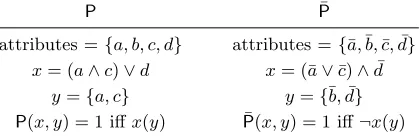
In this section we propose new predicate encodings that are more efficient than some of the encodings proposed previously in [15]. Our encodings are built by ap-plying Theorem 6 to obtain negated encodings and observing that, in some cases, Theorem 3 can be applied to simplify the negated version into a more efficient encoding than the original one. The predicate associated to this new encoding is negated, but if inputs are also negated, the predicate will be equivalent. Fig-ure 2 illustrates this idea. On the left, there is a boolean formula CP-ABE for 4 attributes{a, b, c, d}. On the right side, secret keys and policies are modified so that the negated version is equivalent. The attribute universe is formed by the
negated attributes, secret keys are formed by allnegated attributesdo not appear in the original key as normal attributes, policies are negated and expressed in NNF (Negation Normal Form).
Boolean formulas In [15], the authors propose two predicate encoding (KP and CP versions) for monotonic boolean formulas. The predicate they consider is a particular case of a Linear Secret Sharing scheme [24]. LetX ={0,1}n,Y= Znp×k for somen, k∈N,
P(x, M) = 1 iff 1 0 k−1. . . 0
P P¯
attributes ={a, b, c, d} attributes ={a,¯¯b,¯c,d¯}
x= (a∧c)∨d x= (¯a∨c¯)∧d¯ y={a, c} y={¯b,d¯}
P(x, y) = 1 iffx(y) P¯(x, y) = 1 iff¬x(y)
Fig. 2.Equivalent encodings of a policy usingP(CP-ABE) on the left and ¯P(negated CP-ABE) on the right.
whereMxdenotes the matrixM filtered byx, i.e.,Mxincludes thei-th row of
M iffxi= 1.
It has been shown [28] that for every5 monotonic boolean formula f with attributes from X there exists a matrix M ∈ Y such that for every x ∈ X, f(x)⇔P(x, M). The key-policy predicate encoding from [15] is the following,
sEx= diag(x) 0n,k−1
rEM = In M{2,...,k} kEM = M{1} whereM{1} denotes the first column of matrixM,M{2,...,k} represents the rest of the matrix. We do not include explicit decryption functions sDand rD, but they can be computed efficiently byGaussian elimination.
In the above encoding, the number of elements in secret keys and ciphertexts is always maximal, it equals the number of (possibly duplicated) attributes, even for small policies. Furthermore, the maximum number of and-gates in a policy must be fixed a priori (because it is related the the number of columns in the matrix).
We propose the following improved predicate encoding for (negated) key-policy monotonic boolean formulas6, which is an equivalent predicate if instantia-ted with negainstantia-ted inputs. LetX ={0,1}n andY=
Znp×k,
sEx=In−diag(x) rEM =M> kEM = 1 0 . . .k−1 0 >
In our encoding, the number of columns has been reduced up to half7. Further-more, the size of secret keys is proportional to the complexity of policies. In particular, it is equal to the number of and-gates in the policy (or equivalently, the number ofor-gates in the non-negated version). Note that our improvement also works in the ciphertext-policy case.
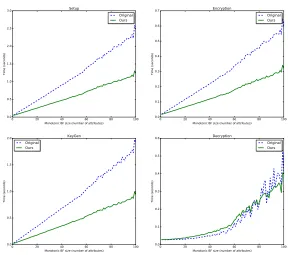
In Figure 3 we present a comparison between our improved encoding for key-policy monotonic boolean formulas and the original one. To this end, we generate random boolean formulas for different sizes, starting from a random set of leaf nodes and combining them with boolean operators ∨and∧. Our tables report on the average time for each algorithm. Our encoding needs 50% less time than
5
where every attribute appears at most once and the number ofand-gatesis lower than k(one could overcome the one-use restriction by considering duplicated attributes) 6
see Appendix D for more details about how we obtained this encoding 7
0 20 40 60 80 100 Monotonic BF size (number of attributes)
0.0 0.5 1.0 1.5 2.0 2.5 3.0
Time (seconds)
Setup
Original Ours
0 20 40 60 80 100
Monotonic BF size (number of attributes) 0.0
0.1 0.2 0.3 0.4 0.5 0.6 0.7
Time (seconds)
Encryption
Original Ours
0 20 40 60 80 100
Monotonic BF size (number of attributes) 0.0
0.5 1.0 1.5 2.0
Time (seconds)
KeyGen
Original Ours
0 20 40 60 80 100
Monotonic BF size (number of attributes) 0.0
0.1 0.2 0.3 0.4 0.5 0.6
Time (seconds)
Decryption
Original Ours
Fig. 3.Improved predicate encoding for boolean formulas vs original encoding
the original algorithms for setup, encryption and key generation. For decryption the performance is similar. All the analyzed schemes were instantiated with the same compiler, therefore all achieve the same level of security (under SXDH assumption). In terms of secret key size, our encoding is smaller in general (in the worst case, when all the gates in the policy areor-gates, key sizes are equal).
Arithmetic span programs. Chen et al. proposed in [15] a predicate encoding forArithmetic Span Programs (ASP). That is, an encoding for the predicateP
defined as follows. LetX =Zn
p,Y =Znp×k×Znp×k, for somen, k∈N; for every
x∈ X and every (Y, Z)∈ Y,
P(x,(Y, Z)) = 1 iff 1 0 . . .k−1 0
∈spanrow hdiag(x)Y +Zi
In [21], Ishai and Wee show how to relateArithmetic Span Programs com-putations of polynomial functions over a finite fieldF, i.e., functionsf :Fn →F that only use addition and multiplication over the field. Therefore, the above predicate can be seen as f(x) = 0, wheref is the polynomial function induced by (Y, Z). Let X =Znp, Y =Znp×k×Znp×k, the original predicate encoding for arithmetic span programs proposed in [15] is the following:
sEx= diag(x) In 0n,k−1
rE(Y,Z)=
In 0n,n Y{2,...,l}
0n,n In Z{2,...,l}
kE(Y,Z)=
Y{1} Z{1}
0 20 40 60 80 100 120 ASP size
0 1 2 3 4 5 6 7 8
Time (seconds)
Setup Original
Ours
0 20 40 60 80 100 120 ASP size
0.0 0.2 0.4 0.6 0.8 1.0 1.2 1.4 1.6 1.8
Time (seconds)
Encryption Original
Ours
0 20 40 60 80 100 120 ASP size
0 1 2 3 4 5 6 7
Time (seconds)
KeyGen
Original Ours
0 20 40 60 80 100 120 ASP size
0.0 0.5 1.0 1.5 2.0 2.5
Time (seconds)
Decryption
Original Ours
Fig. 4.Improved predicate encoding for ASP vs original encoding
We present a more efficient encoding for (negated8) arithmetic span programs:
sEx= diag(x) −In
rE(Y,Z)= Z> Y>
kE(Y,Z)= 1 0 . . .k−1 0 >
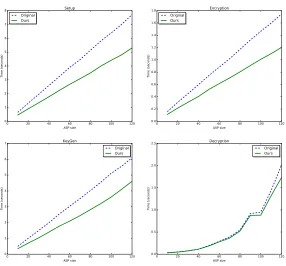
Figure 4 shows the performance of our new encoding for KP-ABE for Arith-metic Span Programs compared to the original encoding from [15]. As we ex-pected, our encoding needs 66% of the time required for the original encoding for setup, encryption and key generation. Additionally, secret key size is halved with our encoding.
6.3 Extra features
In this section we consider new theoretical results that can be proved thanks to our algebraic characterization of α-privacy and can be used to produce new predicate encodings enhanced with extra properties.
Attribute-hiding for boolean formulas. Chen et al. proposed an extension of the compiler in [15] to build weakly attribute-hiding predicate encryption
8
schemes [13, 25]. In a weakly attribute-hiding scheme, the ciphertext attribute xremains secret for unauthorized users, that only learn the fact that their se-cret keys are not valid. This additional compiler needs to be instantiated with
predicate encodingssatisfying additional properties. The following is a definition from [15].
Definition 6 (Attribute-Hiding Encodings).A(s, r, w)-predicate encoding,
(sE,rE,kE,sD,rD) for P : X × Y → {0,1} is attribute-hiding if it verifies the
additional requirements:
x-oblivious reconstruction: sDx,y andrDx,y are independent of x.
attribute-hiding: for all(x, y)∈/P,
w←$ Zw
p;return(sExw,rEyw) ≡ s
$
←Zs
p;r $
←Zr
p;return(s,r)
where≡denotes equality of distributions.
The following theorem relates the second property with our alternative definition of predicate encodings:
Theorem 11 (Algebraic characterization of attribute-hiding).Letp∈N
be a prime, let s, r, w∈Nand let S∈Zs×w
p ,R∈Zrp×w, k∈Zrp. The following
are equivalent:
• w←$ Zw
p;return(Sw, Rw) ≡ s
$
←Zsp;r
$
←Zrp;return(s,r)
• rank
S R
=s+r
Note that for every (s, r, w)-predicate encoding (sE,rE,kE,sD,rD) that is attribute-hiding, there exists an equivalent (s,1, w)-predicate encoding. This is becauserDis independent fromxand thus, we can apply our optimization The-orem 3 with matricesBy =rD>x,y∈Zp1×w,Ax=Is,C=Iw. Therefore, the class of predicates that can be built from attribute-hiding encodings is included in the class of predicates achieved from (s,1, w)-predicate encodings.
Further, note that ourdisjunction andconjunction combinations for predi-cate encodings (Theorems 4 and 5 respectively) preserve the notion of attribute-hiding9. Exploiting this fact, we propose a Policy-Hiding ABE scheme for non-monotonic boolean formulas expressed in DNF (Disjunctive Normal Form). The inner product can be used to encode conjunctions [25]. More concretely, let
y∈ {0,1}n ⊆
Znp. We establish that thei-th attributeaiappears in a secret key foryiffyi= 1. LetS,S¯⊆ {ai}ni=1 be sets such thatS∩S¯=∅,
^
a∈S
a ∧ ^
a∈S¯ ¯
a ⇔10 x>y=|S| where∀i∈[n], x i =
1 if ai∈S
−1 if ai∈S¯
0 otherwise
9
conjunction also preservesx-oblivious reconstruction, while disjunction does not 10
Let U = {a, b, c} be the set of attributes. We consider the predicate encoding for monotonic boolean formulas from [15]. LetX={0,1}3
,Y=Z3p×2, sEx= diag(x) 03,2
rEM = I3 M{2}
kEM = M{1}
The following is the encoding of a key for the formula (a∨c)∧b, enhanced for delegation according to Theorem 12 (withk= 1),
rEM =
1 0 0 1 0 0 1 0 1 0 0 0 1 1 0 0 0 0 0 1
kEM =
1 0 1 0
Let’s assume we want to weaken this key to one for the formulaa∧b∧c. Note that in this case we want to make an update of the matrixM:
M= 1 1 0 1 1 1
!
encodes (a∨c)∧b M0= 1 1 1 0 1 1 1 1 0
!
encodesa∧b∧c
It can be done by multiplyingrEM from the left byA
rE0M =
1 0 0 1 0 1 0 1 0 0 1 0 0 0 0 0
| {z }
A
·
1 0 0 1 0 0 1 0 1 0 0 0 1 1 0 0 0 0 0 1
| {z }
rEM
=
1 0 0 1 1 0 1 0 1 1 0 0 1 1 0 0 0 0 0 0
kE
0
M =A·kEM =
1 0 1 0
Fig. 5. Example of delegation of keys for monotonic boolean formulas. Since A is a linear function, it can be computed in the exponent from the given key.
Observe that the ZIPE predicate encoding from [15, Appendix A.1] can be modified into an attribute-hiding encoding for the predicate P((x, γ),y) = 1 iffx>y=γ(see Appendix E.1).
Therefore, with a disjunction of k predicate encodings like the former we can encode boolean formulas that have at most k disjuncts. Note that the result-ing encodresult-ing is attribute-hiding but it is not x-oblivious. However, without the knowledge of the policy x, one can guess for the disjunct his secret key satis-fies (if any). In this way, a valid key will be enough to decrypt after at most k decryption tries (one for every disjunct).
More formally, we say that a predicate P:X × Y → {0,1} supports delegation if there is a partial ordering onY such that for everyx∈ X, ifP(x, y) = 1 and (yy0), thenP(x, y0) = 1.
Delegation has been considered in [15] as the property of some predicate encodings. We propose a generic method to convert any predicate encoding into one supporting delegation.
Theorem 12 (Delegation). For every(s, r, w)-predicate encoding(sE,rE,kE,
sD, rD)for P:X × Y → {0,1}, for every k∈N,(sE0,rE0,kE0,sD0,rD0) defined
below is a valid (s, r+k, w+k)-predicate encoding for P.
sE0x= sEx 0s,k
rE0y = rE
y 0r,k
0k,w Ik
kE0y= kE
y
0k
sD0x,y=sDx,y rD0x,y =
rDx,y
0k
The additional set of not-null rows inrE0y can be used to weaken the linear span of rEy, what directly modifies the predicate. In particular, this method works really well for monotonic boolean formulas (see Figure 5 for an example).
Acknowledgements We would like to thank Luca Nizzardo, Alejandro Aguirre, Dario Fiore, Romain Gay and Hoeteck Wee for fruitful discussions and their helpful comments about this work. We would also like to thank anonymous reviewers of CRYPTO 2017 for their valuable time and feedback. The work pre-sented here was supported by projects S2013/ICE-2731 N-GREENS Software-CM, ONR Grants N000141210914 and N000141512750.
References
1. S. Agrawal and M. Chase. A Study of Pair Encodings: Predicate Encryption in Prime Order Groups, pages 259–288. Springer Berlin Heidelberg, Berlin, Heidel-berg, 2016.
2. S. Agrawal and M. Chase. Simplifying design and analysis of complex predicate encryption schemes. In J.-S. Coron and J. B. Nielsen, editors,EUROCRYPT 2017, Proceedings, Part I, pages 627–656, Cham, 2017. Springer International Publishing. 3. J. A. Akinyele, C. U. Lehmann, M. D. Green, M. W. Pagano, Z. N. J. Peterson, and A. D. Rubin. Self-protecting electronic medical records using attribute-based encryption. Cryptology ePrint Archive, Report 2010/565, 2010. http://eprint. iacr.org/2010/565.
4. B. Applebaum, B. Arkis, P. Raykov, and P. N. Vasudevan. Conditional disclosure of secrets: Amplification, closure, amortization, lower-bounds, and separations. Elec-tronic Colloquium on Computational Complexity (ECCC), 24:38, 2017.
5. D. F. Aranha and C. P. L. Gouvˆea. RELIC is an Efficient LIbrary for Cryptogra-phy. https://github.com/relic-toolkit/relic.
7. N. Attrapadung. Dual system encryption framework in prime-order groups. Cryp-tology ePrint Archive, Report 2015/390, 2015. http://eprint.iacr.org/2015/ 390.
8. N. Attrapadung and H. Imai. Conjunctive Broadcast and Attribute-Based Encryp-tion, pages 248–265. Springer Berlin Heidelberg, Berlin, Heidelberg, 2009. 9. N. Attrapadung and H. Imai.Dual-Policy Attribute Based Encryption, pages 168–
185. Springer Berlin Heidelberg, Berlin, Heidelberg, 2009.
10. N. Attrapadung and S. Yamada. Duality in abe: Converting attribute based encryp-tion for dual predicate and dual policy via computaencryp-tional encodings. Cryptology ePrint Archive, Report 2015/157, 2015. http://eprint.iacr.org/2015/157. 11. P. S. L. M. Barreto and M. Naehrig. Pairing-friendly elliptic curves of prime order.
Cryptology ePrint Archive, Report 2005/133, 2005. http://eprint.iacr.org/ 2005/133.
12. A. Beimel. Secret-Sharing Schemes: A Survey, pages 11–46. Springer Berlin Hei-delberg, Berlin, HeiHei-delberg, 2011.
13. D. Boneh and B. Waters. Conjunctive, subset, and range queries on encrypted data. In S. P. Vadhan, editor,TCC 2007, volume 4392 ofLNCS, pages 535–554. Springer, Feb. 2007.
14. R. Canetti, S. Halevi, and J. Katz. A forward-secure public-key encryption scheme. Journal of Cryptology, 20(3), 2007.
15. J. Chen, R. Gay, and H. Wee. Improved dual system ABE in prime-order groups via predicate encodings. In Advances in Cryptology – EUROCRYPT 2015, Part II, volume 9057 ofLNCS, pages 595–624. Springer, 2015.
16. J. Chen and H. Wee. Fully, (almost) tightly secure IBE and dual system groups. In R. Canetti and J. A. Garay, editors, CRYPTO 2013, Part II, volume 8043 of LNCS, pages 435–460. Springer, Aug. 2013.
17. J. Chen and H. Wee. Dual system groups and its applications — compact hibe and more. Cryptology ePrint Archive, Report 2014/265, 2014. http://eprint. iacr.org/2014/265.
18. T. T. A. Dinh and A. Datta. Streamforce: outsourcing access control enforcement for stream data to the clouds. InFourth ACM Conference on Data and Application Security and Privacy, CODASPY’14, San Antonio, TX, USA - March 03 - 05, 2014, pages 13–24, 2014.
19. S. Garg, A. Kumarasubramanian, A. Sahai, and B. Waters. Building efficient fully collusion-resilient traitor tracing and revocation schemes. In E. Al-Shaer, A. D. Keromytis, and V. Shmatikov, editors,ACM CCS 10, pages 121–130. ACM Press, Oct. 2010.
20. R. Gay, I. Kerenidis, and H. Wee. Communication complexity of conditional disclo-sure of secrets and attribute-based encryption. InCRYPTO 2015, Part II, LNCS, pages 485–502. Springer, Aug. 2015.
21. Y. Ishai and H. Wee. Partial Garbling Schemes and Their Applications, pages 650–662. Springer Berlin Heidelberg, Berlin, Heidelberg, 2014.
22. F. G. Jongkil Kim, Willy Susilo and M. H. Au. A tag based encoding: An efficient encoding for predicate encoding in prime order groups. Cryptology ePrint Archive, Report 2016/655, 2016. http://eprint.iacr.org/2016/655.
24. M. Karchmer and A. Wigderson. On span programs. InIn Proc. of the 8th IEEE Structure in Complexity Theory, pages 102–111. IEEE Computer Society Press, 1993.
25. J. Katz, A. Sahai, and B. Waters. Predicate encryption supporting disjunc-tions, polynomial equadisjunc-tions, and inner products. In N. P. Smart, editor, EU-ROCRYPT 2008, volume 4965 ofLNCS, pages 146–162. Springer, Apr. 2008. 26. A. B. Lewko. Tools for simulating features of composite order bilinear groups
in the prime order setting. In D. Pointcheval and T. Johansson, editors, EURO-CRYPT 2012, volume 7237 ofLNCS, pages 318–335. Springer, Apr. 2012. 27. A. B. Lewko and B. Waters. New techniques for dual system encryption and fully
secure HIBE with short ciphertexts. In D. Micciancio, editor,TCC 2010, volume 5978 ofLNCS, pages 455–479. Springer, Feb. 2010.
28. A. B. Lewko and B. Waters. Decentralizing attribute-based encryption. In K. G. Paterson, editor, EUROCRYPT 2011, volume 6632 of LNCS, pages 568–588. Springer, May 2011.
29. A. B. Lewko and B. Waters. New proof methods for attribute-based encryp-tion: Achieving full security through selective techniques. In R. Safavi-Naini and R. Canetti, editors, CRYPTO 2012, volume 7417 of LNCS, pages 180–198. Springer, Aug. 2012.
30. Z. Liu and D. S. Wong. Practical Ciphertext-Policy Attribute-Based Encryption: Traitor Tracing, Revocation, and Large Universe, pages 127–146. Springer Inter-national Publishing, Cham, 2015.
31. D. Lubicz and T. Sirvent. Attribute-based broadcast encryption scheme made efficient. In S. Vaudenay, editor,AFRICACRYPT 08, volume 5023 ofLNCS, pages 325–342. Springer, June 2008.
32. A. Sahai, H. Seyalioglu, and B. Waters. Dynamic credentials and ciphertext dele-gation for attribute-based encryption. In R. Safavi-Naini and R. Canetti, editors, CRYPTO 2012, volume 7417 ofLNCS, pages 199–217. Springer, Aug. 2012. 33. A. Sahai and B. R. Waters. Fuzzy identity-based encryption. In R. Cramer, editor,
EUROCRYPT 2005, volume 3494 ofLNCS, pages 457–473. Springer, May 2005. 34. A. Shamir. Identity-based cryptosystems and signature schemes. In G. R. Blakley
and D. Chaum, editors,CRYPTO’84, volume 196 ofLNCS, pages 47–53. Springer, Aug. 1984.
35. F. Wang, J. Mickens, N. Zeldovich, and V. Vaikuntanathan. Sieve: Cryptograph-ically enforced access control for user data in untrusted clouds. In 13th USENIX Symposium on Networked Systems Design and Implementation (NSDI 16), pages 611–626, Santa Clara, CA, Mar. 2016. USENIX Association.
36. B. Waters. Dual system encryption: Realizing fully secure IBE and HIBE under simple assumptions. In S. Halevi, editor,CRYPTO 2009, volume 5677 ofLNCS, pages 619–636. Springer, Aug. 2009.
37. H. Wee. Dual system encryption via predicate encodings. In Y. Lindell, editor, TCC 2014, volume 8349 ofLNCS, pages 616–637. Springer, Feb. 2014.
A
Proofs from main body
Proof (Of Theorem 2). The proof follows from Theorem 1 and the observation that reconstructability of predicate encodings is equivalent toPred, while privacy
Proof (Of Theorem 3).To see correctness of the new encoding, note that for all (x, y)∈P, since
sD>x,y ∈spanrowhAxi ∧ rD>x,y∈spanrow hByi
there existsD0>x,y andrD0>x,y such that
sD>x,y =sD 0>
x,yAx ∧ rD>x,y =rD 0>
x,yBy
Therefore,
sD0>x,y(AxsExC) = (sD>x,ysEx)C= (rD>x,yrEy)C=rD0>x,y(ByrEyC)
rD0>x,y(BykEy) =rD>x,ykEy = 1
To see privacy, note that for every (x, y) ∈/ P, there exists w ∈ spancol hCi such that sExw=0s ∧ rEyw=kEy. Therefore, there also existsw0 ∈Zw
0
p such that
w=Cw0. Note that,
sE0xw0= (AxsExC)w0 =AxsExw=Ax0s=0s0
rE0yw0= (ByrEyC)w0 =ByrEyw=BykEy=kE0y
so algebraic privacy is satisfied.
Proof (Of Theorem 4). Reconstructability can be seen by a simple check based on the reconstructability of the original encodings.
To see privacy, note that P1(x1, y1) ∨ P2(x2, y2) = 0 implies P1(x1, y1) = 0 andP2(x2, y2) = 0 implies. Letw1 andw2 be witnesses of privacy of predicate encodings 1 and 2 respectively. It is easy to check that w> = w>1 w>2
is a
witness of privacy of the transformed encoding.
Proof (Of Theorem 5).A simple check shows reconstructability. To see privacy,
P1(x1, y1) ∧ P2(x2, y2) = 0 implies P1(x1, y1) = 0 or P2(x2, y2) = 0. If the first holds, let w1 be a witness of privacy of the first encoding. Then, w> =
2w>
1 0>w2 −1
is a witness of the algebraic privacy of the transformed encoding. If the second holds, let w2 be a witness of privacy of the second encoding. A valid witness now isw>= 0>w
2 2w > 2 1
.
Proof (Of Theorem 6). It is not difficult to check reconstructability. Privacy holds because whenP(x, y) = 1, we can definew>= −sD>x,y −sD>x,ysEx rD>x,y
which can be checked to be a witness of the algebraic privacy of the transformed
predicate encoding.
Proof (Of Theorem 7).A simple check is enough to verify reconstructability. For privacy, note that when P0(y, x) = 0, we have P(x, y) = 0. Let w be a witness of the algebraic privacy of the original encoding. Now, w0> = −w> 1
is a