Available Online atwww.ijcsmc.com
International Journal of Computer Science and Mobile Computing
A Monthly Journal of Computer Science and Information Technology
ISSN 2320–088X
IMPACT FACTOR: 6.017
IJCSMC, Vol. 6, Issue. 9, September 2017, pg.1 – 7
Study on Different Forms of Wireless Advertising
Rishabh Sinha
1, Dhruva Manik
21, 2Research Scholar (MBA Tech), IT Department, SVKM‟s NMIMS MPSTME, Mumbai (MH, India)
Abstract:
These days, with everything going digital, the advertising world has also adopted this means for the promotion of a brand. Paper brochures and colourful pamphlets were the main source for promoting any brand. They would appear usually inside the newspapers or certain common areas so that the brand marketing is maximized. But with change in technology, these pamphlets and brochures are „loosing‟ their attraction for the customers. Now everything is advertised online, whether it is an advertisement for a flat on rent or a new restaurant‟s opening. The markets have found a wireless or in layman terms, a paperless approach to reach their customers. The number of people on social media has also increased by many folds and also the number of social media platforms has also increased as well. Nearly a decade ago, there was one major social media, Orkut but nowadays Orkut is replaced by Facebook, Instagram, Whatsapp etc. Through these social media platforms companies reach their markets and target their customers for product endorsement. This paper further explains the advantages as well as challenges that is faced in wireless advertising. It also explains how wireless or online advertising has emerged in India over a past decade.
Keywords:
Mobile advertising; Personal nature of m-advertising; Interactive nature of m-advertising; Contextual awareness of m-advertising; Traditional marketing; Social media marketing
I.
Introduction:
With the growing population of the world, the number of mobile device users has also increased significantly. Nearly two decades back, barely anyone had an idea of what mobile was and how it could be used, but now each person has at least one mobile with him. The rich media allows the users to interact with advertisements in a non-intrusive way [1]. The mobile users can get a 360 degree view of any product, or might even trace a store. The better user experience depends on the Internet speed the user gets. Faster the Internet speed is better would be his experience. The rich media technology has provided better user experiences even at lower speeds. The MMS Services or Multi Media Services exists in a large number of devices, providing a good opportunity for the advertisers to reach their customers as these advertisements are stored inside the phone memory and is completely independent of downloading speeds. The growth of mobile phones is growing at a faster rate than the computers [1].
II.
Mobile Usage in India:
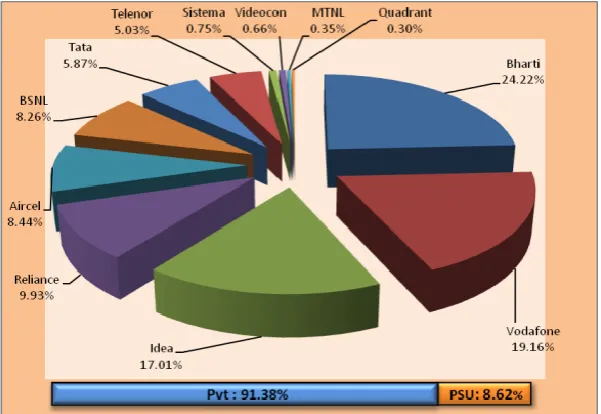
60.11% subscriber share and the rural population contributing by 39.89% of the subscribers share. The IMAI (Internet and Mobile Association of India) in 2013 reported that there are 46 million active mobile Internet users [1]. This report also suggests that the number of Mobile Internet users has surpassed the desktop Internet users by a great margin. According to an another report presented by Associated Chambers of Commerce and Industry in India (ASSOCHAM) in December 2012, it stated that there were only 23.1 million PC Internet users in India at the end of June 2012. In India, there are about 13 mobile operators providing mobile communications. Out of these 13, there are two major public service undertakings or PSUs namely BSNL (Bharat Sanchar Nigam
Limited) and MTNL (Mahanagar Telephone Nigam Limited). The private tele-operators own about 87.78%
of wireless market share and the PSUs own only 12.22% of this market share. At present, the prepaid subscribers account for 96% of the total subscribers in India. Of the 150 million subscribers there were about
87.1 million mobile users in India upon the completion of year 2012 and this number is expected to reach 164.8
million by March 2015, according to the presented by India Media and Industry Entertainment in 2012.
Fig 1: Telecom Industry in India (as of February 2016)
III.
Defining Mobile Marketing:
The Mobile Marketing Association (MMA, 2008) defines Mobile Marketing as “the set of practices that enables the organisations to communicate and engage with their audience in an interactive and relevant
manner through any mobile device or network”[2]
.
According to Scharl, Dickinger and Murphy (2005) have defined mobile marketing as “Using a wireless medium for providing customers with time and location sensitive personalized information that promotes
goods, services and ideas, thereby benefiting all stakeholders”[2].
IV.
Types of Mobile Marketing:
i. SMS Marketing:
Sending short text messages to the potential buyers is one of the oldest forms of mobile marketing technique. The first mobile phones rolled out in the early 90‟s. These phones only received messages and thus SMS marketing was the only option left to the marketers at that time. Even today SMS Marketing remains the most popular mode of mobile marketing because of two reasons. The first reason of using SMS is the fact that short text messages are one of the most popular modes of communication and a majority of people tend to read the SMS that‟s received in no time. The second reason is the fact that the popularity of this mode of marketing is the least expensive one among all the options available for marketing, whether it is a small or a large business.
ii. MMS Marketing:
lines to the TV advertisements. The MMS marketing is expensive as compared to the SMS marketing. Also, the MMS can‟t be received on every phone like the SMS.
iii. Bluetooth Mobile Marketing:
This method of marketing utilises Bluetooth technology for mobile marketing. Bluetooth allows the users to deliver SMS or MMS messages to all the potential buyers within a geographical position at no cost. This method is very popular amongst the locally oriented business. This method also has some drawbacks. The first drawback being that the mobile phone users need to be within a particular distance of the Bluetooth enabled computer. The second one being that these mobiles should accept the marketing messages.
iv. Mobile Internet Marketing:
It is also known as mobile web marketing. The mobile internet marketing involves the usage of World Wide Web and mobile phones. It can be either a pop-out ads or therefore involve optimisation of a website in order to make it search engine as well as mobile friendly. As the number of mobile phone users connecting to the Internet is growing at a faster rate, mobile Internet marketing is one of the fastest growing mobile marketing strategy.
V.
Forms of Mobile Advertising:
i. Online Advertising:
This is one of the most common methods of online marketing. Here, the virtual space is used for putting the marketing messages on the websites in order to attract the customers. The major objective of online marketing is to increase the sales and brand awareness much like the offline marketing [5]. The online advertising is on the same lines as that of TV advertisements in terms of element interruption. But, contrary to the TV advertisements, the online ads don‟t force the recipient to pay attention to these promotional ads; instead it tries to persuade the customer. The reason for this is that online ads are placed on the non-marketing and tend not to appear after regular intervals. The internet users have got the advantage to ignore these advertisements and it depends totally on the user to check it or not.
ii. Email Marketing:
E-mail marketing uses emails for sending promotional messages to the internet users. This method has been considered one of the more effective methods of online marketing. Despite several benefits of email marketing, it suffers from deficiencies. One of the prominent problems of email marketing is that the advertisements received by the mail are often ignored and some clients tend to put these advertisements mails in the spam folder. Some measures need to be taken so that the end receivers don‟t put them in the spam folders. One of the possible solutions is that not to rely on email marketing solely for advertisements. The marketers should employ different marketing channels and other alternates for increasing the success. Another solution to overcome this problem is by the use of permission based email marketing. Permission based marketing was coined by Godin (in 1999) [5]. Under this method, the recipients of the mail are asked for their permission, whether they wish to receive the marketing messages or not from the commercial marketers. Thus, if the receiver of mail tends to accept those mails, then only these mails are sent.
This method of permission based emails would help in promotion of the brand, as the users have got the option to view these mails.
iii. Search Engine Optimization (SEP):
Parikh and Deshmukh (in 2013) have defined search engine optimization as “Search Engine Optimization can be described as a cluster of strategies and techniques used to increase the amount of visitors to a website by obtaining a high ranking placement in the search result page of a search engine.”
The importance of search engine optimization is that the customers, most of the time uses engienes as a major gate for getting aroud the internet. Some marketing techniques have been devised for enhancing the ranks of intended business website in the results of search engines.
iv. Affiliate Marketing:
Affiliate marketing is a major concept in online marketing methods and this refers to the process of gaining commission by promotion of products or services of a different company. In this method, two or more website owners can build relations in order to increase the mutual financial benefits. Affiliation marketing is defined by Brown (in 2009) “A web-based marketing practice, often using automated system or specialized software in which a business rewards their affiliate for each visitor, customer or ale which is brought as a result of affiliate’s marketing efforts. In most of the cases, the reward is monetary in the form of a monthly check. Most well designed affiliate programs are easy to implement, require little or no setup, are free, and can instantly generate a new source of revenue for you”[5].
This method is being used most of the businesses for promotion of products and services offline. The online market extends the prospect of deploying this method dramatically, because of the fact that referrals or affiliates are easy to track online. This method of marketing is widely used for promoting websites and affiliates are easy to track online. This system is also used widely for promoting the websites and affiliates that are compensated for their efforts for attracting every single either of the visitor or subscriber or customers [5]. As the affiliates are based upon the performance, this type of marketing is also known as “performance marketing”.
v. Social Media Marketing:
Social media has played a major role in reforming the human life especially in the 21st century. Social media has given us the confidence to actually express our beliefs, ideas and manner in an absolute new
way [5]. Besides changing the way of conducting our social life social media has also provided the
world of marketing having unprecedented opportunities and also has a huge impact on the corporations, realizing that a correct plan as well as social media strategy is needed for standing out in this fast-paced and changing digital freedom. Social media is useful for small businesses as they increase the competitive edge. This new type of advertising can be defined as “a term that is used to describe the process of boosting website traffic, or brand awareness, through use of social media networking sites.. most of the social media marketing programs usually evolve around creating unique content that attracts attention and encourages the viewer to share it with their friends and contacts on social networks. Your business message spreads from one user to another and impacts with the user in a stronger way because it appears to originate from a trusted source, as opposed to the brand, business or company itself”[5].
The key element of social media marketing is involving users of social networks. If the users or readers of social media come across a suitable content, then it is quite likely that he might share the content with other people in their social circle. If a marketing body is able to make the social media users share their promotional content with others, then it means that the promotions has gained support from a trusted source. As this promotional content is shared by a close friend creates more impact than the content directed by a marketing party. This impact of contents shared by social media network members is high because of the fact that, they are a kind of “word of mouth” that is circulated on the online environment.
vi. Viral Marketing:
Viral marketing is another method of conducting online marketing. It has with time overlapped with social media marketing, because of the fact that is “word of mouth” marketing.
of the similarities that marketers aim to emulate: It is easily passed on. The number of people who have been “infected” grows exponentially.” [5]
It is a new concept that has been developed with the advent of internet. It spreads through the social networks and it is a virtual version of word of mouth marketing. A cheap mode of marketing and there is no need to spend massive amount of money on traditional marketing campaigns. Viral marketing works through encouraging people to share, pass along and forward the marketing message, based on a high rate of pass-along form a user to another user. Thus, harnessing such a powerful instrument, word of mouth and having others to share the products and also sell it, guarantees the success and is even compared with a launching a classical marketing campaign. There are also another means of promotion and building brand awareness which includes images, jokes and e-carts. The campaigns in viral marketing include employing creative digital videos as well.
According to Kirby (in 2006), digital videos are most useful because of the following reasons-
They are small enough to passed from peer to peer through email after downloading is done from multiple distribution and there by encouraging greater user-driven spread
They are trackable post downloading and as they are passed from user to form via email, so they are providing brands with greater campaigns accountability
There is a lesser risk of user interface with the agents
Videos are familiar, are ad-like firm format to users having the added advantage of interactivity
VI.
Advantages of Online Marketing:
There are various advantages of online marketing over the traditional marketing. These are enlisted below-
i. Empowering effect: This is one of the advantages of online marketing which is related to enabling
effect especially on small business as “internet can extent market reach and operational efficiency of small and medium enterprises (SMEs). In fact, internet can create a kind of democratized environments where the marketing has been restructured in such a way that even smaller businesses are given good chance for promoting their products on a larger scale.
Internet is responsible for creating unprecedented opportunities for small businesses to engage in national and international marketing campaigns which have been unaffordable due to the huge amount of resources that are required”.
ii. Elimination of geographic barriers:
One of the key advantages of online marketing is that it removes all geographical limitations from buying and selling practices. Internet allows an unlimited global reach at a very lower cost. Due to the massive cost of traditional media, larger multinational firms found it a challenge to reach its customers on the global level. But because of cost-effective technologies of internet, it has enabled the smaller businesses to prosper at very lower as compared to the traditional marketing strategies. By overcoming these geographic barriers, the marketers are able to present these products and services to different customer groups across the globe, with the basic condition being the easy access to the internet.
iii. 24x7 Availability:
iv. Trackability:
The advantage of online marketing is that it can be tracked. Internet enables the measurement of everything that is taking place on it. The number of clicks that is received by a promotional piece and the amount of website traffic can be measured. This enables the marketer to track the visitors of his/her website and also understand the customer behaviour. Internet has also allowed, the companies to gain knowledge whether the campaigns launched by them are in effect or not, and what kind of customers are interested in their products and from where?
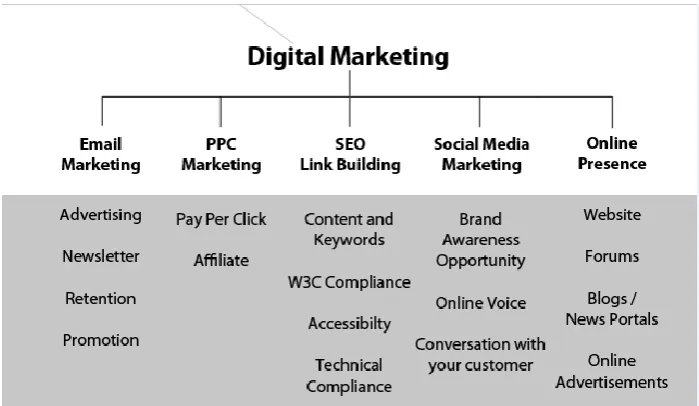
Fig 2: Structure of Digital Marketing
VII.
Challenges Faced by Online Marketing:
i. Integrity Problem:
The concept of integrated marketing has been a central theme of this profession. On the contrary, one of the major problems with these campaigns remains is employing several offline and online promotion channels such as press, brochure, TV, cell-phone, e-mail etc. lack a comprehensive and harmonizing marketing framework [5]. Here each item is used in isolation and is accomplished as a different task and not completely as a component of integrated campaign that is aimed at realization of specified and particular objectives. This deficiency can be compensated by taking a holistic approach which is used for synchronizing different traditional and internet age modes of marketing communications which can be perceived as moments of an integrated structure.
ii. Lack of face-to-face contact:
Lacking personal contact with the customers is a major challenge of online marketing. Internet transactions involve no embodied, personal interaction and this is the reason why some of the users consider electronic modes of providing customer services impersonal and thereby enjoy shopping in a store rather than going online. The customers prefer to talk to the store personnel in a face-to-face way, touch the desired products and even socialize with other customers. The virtual marketplace can‟t provide this feature of shopping offline and hence lacking personal interaction.
iii. Security and Privacy:
above stated privacy and security issues are some of the challenges that a customer faces while doing online marketing.
iv. Lack of Trust:
In today‟s time, despite having a rapid growth in online transactions, people don‟t have full faith and trust on using the electronic methods for paying and the doubt is still there regarding the delivery of purchased items. Also, people have grown a sense of fear of online fraught giving a negative and doubtful attitude towards the online transactions. Trust building should be done and also the customers should be convinced with the fact that the interactions that are taking place in the virtual world are as real and honest as those happening in the real or offline world [5].
VIII.
Conclusion:
Though the wireless advertising has gained popularity over the traditional advertising methods, it still suffers from some major drawbacks. These drawbacks can sometime cause a new business opportunity to lose its customers as stated in the paper. Most of the people have shifted to wireless advertising methods for purchase of goods and services, but still a major portion of the society believes in going to the market to have a look-and-feel of the product by seeing it physically and hence this way are satisfied about the received products and services. Hence, it is completely upto the end user of the product to adopt the method of advertising, whether it is wireless advertising or traditional advertising. For any marketer, what matters the most is customer satisfaction through quality products and services, irrespective of the method of „selling‟ or advertising it.
References:
[1] Pradeep Nair: “Mobile Advertising: The Indian Perspective” (Research Gate, November 2014)
[2] Phumisak Smutkupt, Donyaprueth Krairit, Vatcharaporn Esichaikul: “MOBILE MARKETING: IMPLICATIONS FOR MARKETING STRATEGIES” (IJMM Winter 2010 Vol. 5. No. 2)
[3] Jaana Tähtinen: “Special Features of Mobile Advertising and their Utilization” (Research Gate, January 2006)
[4]Hamed Taherdoost and Neda Jalaliyoon “Traditional Marketing vs E-Marketing” (International Journal of Academic Research in Management Volume 3, Issue 4, 2014)