Available Online atwww.ijcsmc.com
International Journal of Computer Science and Mobile Computing
A Monthly Journal of Computer Science and Information Technology
ISSN 2320–088X
IMPACT FACTOR: 6.017IJCSMC, Vol. 7, Issue. 1, January 2018, pg.1 – 8
AUTHENTICATION USING
MULTIMODAL BIOMETRIC FEATURES
N.Kavitha Devi
M.Sc.,M.Phil.,Assistant Professor, Department of Information Technology,KG College of Arts and Science, Coimbatore
Abstract: Multimodal biometric systems is the consolidated multiple biometric sources, which enable the
recognition performance better than the single biometric modality systems. The information fusion in a
multimodal system can be performed at various levels like data level fusion, feature level fusion, match score
level fusion and decision level fusion. In this paper, we have studied the performance of different fusion
techniques and fusion rules in the context of a multimodal biometric system based on the finger print, hand
geometry, knuckle extraction and speech traits of a user. Experiments showed that these fusion techniques
showed a marked performance serial rule showed comparatively better performance.
Keywords: multimodal biometrics, fusion strategy, data level fusion, Feature level fusion
1. INTRODUCTION
1.1 Authentication
Nowadays with the extending trends of internet and e-commerce people are becoming more and more
connected through electronic network. An electronic network connects individuals, and organizations, etc.
The ability to automatically recognize the identity of individuals is known as person identification or
person authentication. The personal identity is essential for the access of network and reliable
transactions. Person authentication can be performed by different methods like knowledge, token, and
biometric features. Mostly personal identification is performed using following means as text passwords,
used. The main demerit of them is that they can be easily misused or forgotten. When days pass by the
range of services offered grows wider over the electronic devices and internet. It becomes unmanageable
for a person to keep track of the authentication secrets for different services. The alternative which
overcomes all these demerits is the use of biometric features for person authentication. The physiological
and behavioural characteristics of human are said to be biometric feature provided it possesses the
properties of universality, distinctiveness, permanence, collectability, circumvention, acceptability and
performance. Password or card can be shared, forgotten or stolen, but not the biometric features.
1.2 Biometric System
Acquisition of biometric is more complex compared to making combinations of digits or stealing the
card. In this way, biometric is more secure compared to PIN and password. Passwords are desirable to be
different for different applications, but same biometric can be used for most of the applications and hence
avoids book keeping. Any human physiological or behavioral characteristic can be used as a biometric
characteristic (indicator) to make personal identification Some of the commonly used biometric features
include speech, face, signature, finger print, handwriting, iris, DNA, Gait, etc.
1.3 Multimodal Biometric system
Biometric systems based on single source of information are called unimodal systems. multimodal
biometric systems, which combine information from multiple modalities (like face, fingerprint and iris).
Multimodal biometric systems can achieve better performance compared with unimodal systems. The
information from the multiple sources are integrated either in the earlier stage of the process or in the later
stage of the process.
The rest of this paper is organized as follows: Section 2 reviews the supported literature. Section 3
presents a description of the proposed system. Section 4 is illustrated with the experimental results. The
efficiency and effectiveness of the algorithm were discussed. Finally, Section 5 concludes the paper with
enhancement that can be extended.
2. Literature Review
K.Sasidhar et al[17] had examined large face and fingerprint data sets by using various
normalization and fusion techniques. The results of their study showed that the performance of
multimodal biometric system is higher than the unimodal performance system.
A.K. Jain et al[2] emphasis fusion of the multiple modalities at the match score level due to the
Malioutov [7] proposed fusion based on a minimum distance method for combining rankings from
several biometric algorithms.
Kittler et al. [18] compared the various fusion methods and found that the sum rule outperformed
many other methods, Verlinde et al. [8] and Fierrez-Aguilar et al. [9] did the comparison on various
fusion methods. While Fierrez-Aguilar et al. [10] and Gutschoven and Verlinde [11] designed learning
based strategies using support vector machines.
J.P. Baker and D.E. Maurer [13], applied Bayesian belief network (BBN) based architecture for
biometric fusion applications. Bayesian networks provide united probabilistic framework for optimal
information fusion. Bigun et al. [12] developed a statistical framework based on Bayesian statistics to
integrate the speech (text dependent). Hong and Jain associated different confidence measures with the
individual matchers when integrating the face and fingerprint traits of a user [16].
S.Vidhya[1] has studied about preserving the encryption modes.
3. Proposed Work
Here in the proposed work we are applying various fusion techniques for creating a multimodal biometric
system by combining palm print, hand geometry, knuckles and speech of a single person.
3.1 Palm Print and Hand Geometry
The hand geometry and palmprint of a person were extracted. The pose corrected range and intensity
images are processed to locate regions of interest (ROI) for hand geometry and palmprint feature
extraction.
3.1.1 3-D Palmprint
3-D palmprints are being extracted from the range images of the hand offer highly discriminatory
features for personal identification. Features contained in the 3-D palmprint are primarily local surface
details in the form of depth and curvature of palmlines and wrinkles. In this work SurfaceCode 3-D
palmprint representation is employed. This compact representation is based upon the computation of
shape index at every point on the palm surface.
3.1.2 2-D Palmprint
Personal authentication based upon 2-D palmprint has been extensively researched and numerous
approaches for feature extraction and matching are available. Feature extraction techniques based upon
palmprint image and the index of this orientation is binary encoded to form a feature representation
(CompCode). The similarity between two CompCodes is computed using the normalized Hamming
distance.
3.1.3 3-D Hand Geometry
3-D features extracted from the cross-sectional finger segments have previously been shown to be
highly discriminatory and useful for personal identification. For each of the four fingers (excluding
thumb), 20 cross-sectional finger segments are extracted at uniformly spaced distances along the finger
length. Curvature and orientation (in terms of unit normal vector) computed at every data point on these
finger segments constitute the feature vectors. The details of the 3-D finger feature extraction and
matching are discussed.
3.1.4 2-D Hand Geometry
2-D hand geometry features are extracted from the binarized intensity images of the hand. The
hand geometry features utilized in this work include finger lengths and widths, finger perimeter, finger
area and palm width. Measurements taken from each of the four fingers are concatenated to form a feature
vector. The computation of matching score between two feature vectors from a pair of hands being
matched is based upon the Euclidean distance. Another major contribution of this research is the proposed
dynamic fusion strategy to selectively combine palmprint and hand geometry features extracted from the
pose corrected 3-D and 2-D hand.
3.1.5 Dynamic fusion strategy of hand geometry and palmprint
Researches have come up with fusion approaches that can dynamically weight a match score
based upon the quality of the corresponding modality. However, accurately computing the quality of a
biometric feature can be very challenging. Therefore, here a simple but efficient approach for combining
palmprint and hand geometry scores that are simultaneously extracted from the pose corrected range and
intensity images were developed.
3.2.1. Extraction of Knuckles
The finger geometry parameters extracted from the hand images in the previous section are employed
to locate the graylevel pixels belonging to the four individual fingers. The located finger pixels are used to
extract the knuckle regions for feature extraction. A total of six finger geometry features is computed
from each of the fingers, resulting in a total of 24 finger geometry features. These include one finger
features is essential because of their varying ranges and order. Then the knuckles are to be extracted by
using Min-Max normalization and Z-score normalization.
Once the finger regions are segmented, the knuckle regions are located for the extraction of reliable
features. It may be noted that the finger images extracted from each hand image vary in size. Here two
methods for extracting knuckle regions from the segmented fingers are involved.
3. 3 Speaker Feature extraction using fMAPLR
We propose a flexible tying scheme that allows the bias vectors and the matrices to be associated with
different regression classes, such that both parameters are given sufficient statistics in a speaker
verification task. Three sets of parameters are taken, that are 1) the GMM parameter set, 2) the hyper
parameter set, and 3) the fMAPLR parameter set. GMM and hyper parameter sets are estimated on the
background data, and fMAPLR parameter is estimated on the speaker’s data. The hyper parameters and
the GMM parameters are jointly estimated to maximize the likelihood on the background data.
3.4 Fusion techniques
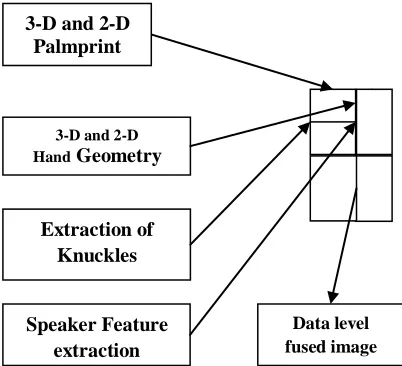
3.4.1 Data level fusion: It is also called as pixel level fusion. It combines several sources of raw data to produce new raw that is expected to be more informative and synthetic than input. It can maintain raw
data as much as possible, but have the disadvantage of processing large numbers of data, costing much
time, requiring the high sensor matching degree, etc. It is the low level fusion. The proposed biometric
data fusion algorithm uses the 3-D and 2-D Palmprint, 3-D and 2-D Hand Geometry, Extraction of
Knuckles, Speaker Feature extraction of an image to generate a single composite multimodal biometric
FIG 1: Fusing different levels in data level
3.4.2 Feature level fusion: The data obtained from each biometric modality is to compute a feature vector. It is intermediate level fusion. It can compress data to make for processing data real time. Due to
the extracted feature have a direct relationship with decision, the result of fusion have more feature
information of decision requirement.
3.4.3 Match Score Level Fusion: The main fusion rules in this level are serial rule, parallel rule, and weighted rule. Based on the advantages of feature level fusion, feature level fusion is applied in this
paper. Serial rule, Sum rule, and weighted Sum rule fusion algorithms are used in feature level fusion.
4. Experimental Results
Table 1 : Results of various Fusion Rules Fusion Rule
False acceptance
rate
False negative rate
False positive rate
True positive rate
True negative rate
SERIAL RULE 10% 2% 1% 3% 4 %
SUM RULE 40% 1% 4-5% 3% 2 %
WEIGHTED SUM RULE 40% 0% 4-5% 3% 3 %
DATA LEVEL FUSION 40% 3% 4-5% 1% 2 %
FEATURE LEVEL FUSION 40% 3% 3-4% 2% 2 %
Speaker Feature extraction
3-D and 2-D
Hand Geometry
Extraction of Knuckles
Data level fused image 3-D and 2-D
The accuracy of the combining palm print, hand geometry, knuckle extraction and speech extraction using
various fusion techniques are illustrated with the graph. The accuracy is higher when serial rule is applied.
The accuracy is lower when data level fusion is applied. Likewise the error rate is lower when applying
serial rule, but it is higher in case of data level fusion.
Normally biometric system can be evaluated by false acceptance rate, false negative rate, false
positive rate, true positive rate and true negative rate. On analyzing the above results application of serial
rule is found to be more effective.
5. Conclusion
Various fusion strategies like serial rule, sum rule, weighted sum rule, data level fusion and feature level
fusion are applied to the palm print, hand geometry, speech and knuckle data. Among those techniques
serial rule outfitted others. We can combine these biometric features using fusion strategies with
encryption in the near future which will enhance the security level.
REFERENCES
1.
Vidhya.S,” A Survey of Format preserving Encryption Modes”, International Journal of
Computer Science and Communication Networks Volume 6, Issue 6, January 2017
2. A. K. Jain, A. Ross and S. Prabhakar, “An introduction to biometric recognition”. IEEE Transactions on Circuits and Systems for Video Technology, vol. 14, pp. 4–20, Jan 2004.
3. A.K. Jain, A. Ross, “Multibiometric systems”. Communications of the ACM, vol. 47, pp. 34-40, 2004. 4. Phillips, P.J., P. Grother R.J. Michaels, D.M. Blackburn and E. Tabassi and J.M. Bone, “FRVT 2002: overview and summary", March 2003.
5. Gokberk, B., A.A. Salah. and L. Akarun, “Rank-Based Decision Fusion for 3D Shape- Based Face Recognition,” LNCS 3546: AVBPA, pp. 1019-1028, July 2005.
6. A. Ross, A.K. Jain, “Multimodal Biometrics: An Overview”, 12th European Signal Processing 0
10 20 30 40 50 60 70 80 90 100
Fusion techniques
A
c
c
u
ra
c
y
7. L. I. Kuncheva, C. J. Whitaker, C. A. Shipp, and R. P. W. Duin, “Is independence good for combining
classifiers?”. in Proceedings of International Conference on Pattern Recognition (ICPR), vol. 2,
(Barcelona, Spain), pp. 168–171, 2000.
8. L. Rukhin, I. Malioutov, “Fusion of biometric algorithms in the recognition problem”. Pattern Recognition Letter, pp. 26, 679–684, 2005.
9. P. Verlinde, G. Chollet, M. Acheroy, “Multimodal identity verification using expert fusion”. Information Fusion, vol. 1 (1), pp. 17-33, 2000.
10. J. Fierrez-Aguilar, J. Ortega-Garcia, J. Gonzalez-Rodriguez, “Fusion strategies in multimodal
biometric verification”. In Proceedings of International Conference on Multimedia and Expo (ICME ’03),
vol.3(6–9), pp. 5–8, 2003.
11. J. Fierrez-Aguilar, “Kernel-based multimodal biometric verification using quality signals”. Biometric Technology for Human Identification, Proceedings of the SPIE, vol. 5404, pp. 544–554, 2004.
12. B. Gutschoven, P. Verlinde, “Multimodal identity verification using support vector machines
(SVM)”.Proceedings of the Third International Conference on Information Fusion, vol. 2, pp. 3–8, 2000.
13. J. Bigun, et al., “Multimodal biometric authentication using quality signals in mobile
communications”. Proceedings of IAPR International Conference on Image Analysis and Processing
(ICIAP), IEEE CS Press, pp. 2–13, 2003.
14. J.P. Baker, D.E. Maurer, “Fusion of biometric data with quality estimates via a Bayesian belief
network”. Proceedings of the Biometric Symposium, Arlington, VA, pp. 21–22, 2005.
15. E.S. Bigun, J. Bigun, B. Duc, S. Fischer, “Expert conciliation for multimodal person authentication
systems by Bayesian statistics”. J. Bigun, G. Chollet, G. Borgefors (Eds.), First International Conference
AVBPA Proceedings, Springer Lecture Notes in Computer Science, vol. 1206, pp. 291–300, 1997.
16. R. Brunelli and D. Falavigna, “Person identification using multiple cues”. IEEE Transactions on Pattern Analysis and Machine Intelligence, vol. 12, pp. 955–966, Oct 1995.
17. L. Hong and A. K. Jain, “Integrating faces and fingerprints for personal identification”. IEEE Transactions on Pattern Analysis and Machine Intelligence, vol. 20, pp. 1295– 1307, Dec 1998.
18. K.Sasidhar1, Vijaya L Kakulapati2, Kolikipogu Ramakrishna3 & K.KailasaRao International Journal of Computer Science & Engineering Survey (IJCSES) Vol.1, No.2, November 2010.