Quark models for mesons
Jialun Ping1,a, Chengrong Deng2, Hongxia Huang1, Fangfang Dong1, Fan Wang3
1Department of Physics, Nanjing Normal University, Nanjing 210097, P.R. China
2School of Mathematics and Physics, Chongqing Jiaotong University, Chongqing 400074, P.R. China 3Department of Physics, Nanjing University, Nanjing 210093, P.R. China
Abstract. With the advance of experiment, many high excited states of meson are identified. It is found that many of them are difficult to fit into conventional qq¯ me-son spectra. Various explanations are proposed. One of them is the four-quark states or molecules of two mesons. In the framework of quark model, by taking into account of multi-body interaction, four-quark states are studied. The results show that the scalar mesons: f0(600),f0(980) andY(2175) can be well described by four-quark states. Fur-thermore, unquenched quark model, which incorporates the four-quark components in the conventionalqq¯ states, is constructed for mesons. By readjusting the model parameters, the model can give a good description of mesons. The model is also used to study the newly discoveredXYZparticles.
1 Introduction
Hadrons (meson and baryon) are the strong interacting systems, which are the main source we get the information of quantum chromodynamics (QCD), the fundamental theory of strong interaction. Because of the complexity and the non-perturbative property of QCD in low-energy region, To get a reliable results for hadrons is still a challenge task for QCD. Although lattice QCD, QCD sum-rule, Dyson-schwinger approach and other non-perturbative method make some impressive progresses recently, the QCD-inspired quark model is still a powerful and common used method to study the properties of hadrons.
In quark models, the naive picture of meson (qq¯) and baryon (qqq) achieved a tremendous success on the properties of hadrons due to the unique color structure of hadrons. However it also limits us to obtain the more information on color properties of QCD. Multiquark system is indispensable to explore the various color structure of QCD [1]. In fact, there are many high Fock components in a meson state in addition toqq¯,
|Mi=|qqi¯ +|qqq¯ qi¯ +|qqgi¯ +|q3q¯3i+· · · (1)
In naive quark model, the effects of high Fock states are renormalized into the parameters. In most case, it is a good approximation, especially for ground state hadrons with heavy quarks. Recently, BaBar, Belle and other collaborations discovered some new charmonium-like states (”XYZ” states) above the open charm threshold, which is difficult to fit into the conventional pictures ofcc¯mesons [2]. A lot of explanations are proposed for ”XYZ” states, tetraquark states, molecular states, hybrid, charmonium, etc. [2].
To unify the description of mesons, the construction of unquenched quark model is needed. In the unquenched approach, the high Fock components are taken into account. The present work is trying to study the charmonium spectrum by including the four-quark component in addition to qq¯ in the calculation.
a e-mail:[email protected]
This is an Open Access article distributed under the terms of the Creative Commons Attribution-Noncommercial License 3.0, which permits unrestricted use, distribution, and reproduction in any noncommercial medium, provided the original work is properly cited.
DOI: 10.1051/
C
The structure of the paper is as follows, Sect. 2 gives a brief introduction of the conventional quark model, the chiral quark model. A string-like quark model is introduce in Sect. 3 and apply to four-quark system. The unquenched four-quark model forcc¯is given in Sect.4. Finally a summary is given in the last section.
2 Constituent Quark Models
The important properties of QCD in the low-energy region are color confinement and the sponta-neous breaking of chiral symmetry. The spontasponta-neous breaking of chiral symmetry leads to that the quarks obtain their constituent masses and interact with each other through the exchange of Goldstone bosons [3]. The color confinement is imitated by introducing color confinement potential and the per-turbative part of QCD is retained by effective one gluon exchange in quark model. Generally the chiral partnerσ-meson is invoked to account for the intermediate-range attraction of nucleon-nucleon inter-action in the chiral quark model and the chiral quark gives a good description of meson spectrum [4]. However, there are some controversies on the use of σ-meson and it is argued recently that theσ -meson exchange used in the chiral quark model can be replaced by the quark delocalization and color screening mechanism [5]. In the following we show that the quark model withoutσ-meson exchange can also describe the meson spectrum well. The model Hamiltonian of theqq¯system (n=2) is
H=
n
X
i=1 mi+
p2
i
2mi
−TC M+
n
X
i>j
(Vi jC+Vi jG+Vi jχ), χ=π,K, η (2)
Vi jπ = g 2
ch
4π m2π
12mimj
Λ2
π
Λ2
π−m2π
mπσi·σj
"
Y(mπri j)−
Λ3
π
m3π
Y(Λπri j)
# 3 X
a=1
Fia·Faj (3)
Vi jK = g 2
ch
4π m2
K
12mimj
Λ2
K
Λ2
K−m2π
mKσi·σj
Y(mKri j)− Λ3
K
m3
K
Y(ΛKri j)
7 X
a=4
Fai ·Faj (4)
Vi jη = g 2
ch
4π m2η
12mimj
Λ2
η
Λ2
η−m2η
mησi·σj
Y(mηri j) − Λ
3
η
m3η
Y(Ληri j)
h
cosθP(F8i ·F
8
j)−sinθP
i , (5)
Vi jG= 1 4αsλ
c i ·λ
c j 1 ri j
−π 2δ(ri j)
1 m2 i + 1 m2 j + 4
3mimj
σi·σj
, (6)
Vi jC =k(ri j2 −∆). (7)
whereTC Mis the center-of-mass kinetic energy,Y(x) is the standard Yukawa function and all symbols
have their usual meaning. The delta function in the one-gluon exchange potential should be regularized because of the finite size of the constituent quark [6], the regularization is flavor dependent [4, 7],
δ(ri j)=
1 4π
1
ri jr20(µ)
e−ri j/r0(µ), (8)
whereµis the reduced mass of theqq¯system andr0(µ)=ˆr0/µand the ˆr0is a model parameter. The model parameters are fixed as follows: theu,d-quark masses are taken as the same and are assumed to be exactly 13of the nucleon mass, namelymu=md=313 MeV, the masses ofπ,K, ηtake
the experimental values, theΛπ,ΛK,Λη,θp,Λ0andµ0are taken the same values as in Ref.[4], namely
Λπ = 4.2 fm−1,ΛK = Λη = 5.2 fm−1,θp=−15◦,Λ0 = 36.98 MeV and µ0 = 0.113 fm. The chiral
coupling constantgchis determined from theπNNcoupling constant through
g2
ch
4π = 3 5
!2g2
πNN
4π m2
u,d
and flavor S U(3) symmetry is assumed, where g
2
ch
4π=0.54. The rest parameters ms,k, ∆,α0 and ˆr0 are determined by fitting ground state meson spectra. An effective scale-dependent strong coupling constant [4] is given by
αs(µ)=
α0
ln µ2+µ2
0 Λ2
0
. (10)
The meson spectra are obtained by solving the following Schr¨odinger equation
" −~
2
2µ∇ 2+
V(r)−E #
ψlm(r)ψcs f =0 (11)
whereψlm is the relative orbital motion wave functions,ψcs f is the color-spin-flavor wave function.
ψlm(r) can be expanded by means of Gaussian functions with different size [8]
φlm(r)= nmax X
n=1
cnNnlrle−νnr 2
Ylm(ˆr). (12)
Gaussian size parameters are taken as geometric progression
νn=
1 r2
n
,rn=r1an−1,a= rnmax
r1 !nmax1−1
. (13)
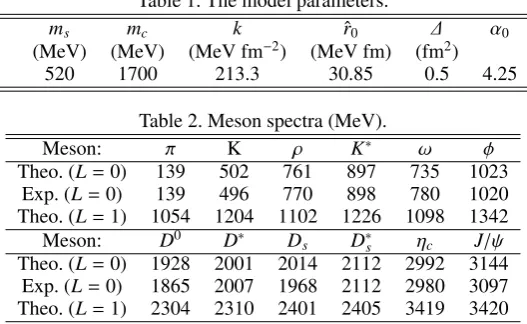
Withr1=0.1 fm,rnmax =2.0 fm andnmax=7, we can obtain converged results. The model parameters and part of the obtained meson masses are shown in the Table 1 and 2, respectively. The more detailed results can be seen in Ref.[9].
Table 1. The model parameters.
ms mc k r0ˆ ∆ α0
(MeV) (MeV) (MeV fm−2) (MeV fm) (fm2)
520 1700 213.3 30.85 0.5 4.25
Table 2. Meson spectra (MeV).
Meson: π K ρ K∗ ω φ
Theo. (L=0) 139 502 761 897 735 1023
Exp. (L=0) 139 496 770 898 780 1020
Theo. (L=1) 1054 1204 1102 1226 1098 1342
Meson: D0 D∗ Ds D∗s ηc J/ψ
Theo. (L=0) 1928 2001 2014 2112 2992 3144 Exp. (L=0) 1865 2007 1968 2112 2980 3097 Theo. (L=1) 2304 2310 2401 2405 3419 3420
From Table 2, one can see that the calculated meson masses are consistent with experimental values. The masses of mesons with orbital angular momentum L = 1 are also given in Table 2. As in other work, the low-lying scalar mesons, f0(600), f0(980),· · ·and most newly observed states Y(2175), X(3872), · · ·, can not be described well in the model. A possible reason is that those states are tetraquark states, which we present in the following section.
3 The String model for tetraquark states
among quarks can be approximated by the following formula [10],
Vqq¯ =−Aqq¯ 1 |rq−rq¯|
+σqq¯|rq−rq¯|+Cqq¯, (14)
Vq3=−Aq3
X
i>j
1 |ri−rj|
+σq3Lmin+Cq3, (15)
Vq2q¯2=−Aq2q¯2
X
i>j
1 |ri−rj| +
σq2q¯2Lmin+Cq2q¯2, (16)
Vq4q¯ =−Aq4q¯
X
i>j
1 |ri−rj|
+σq4q¯Lmin+Cq4q¯, (17)
Lmin=X
i
Li (18)
whereLiis the length of the i-th string which connecting quarks and/or junctions. The universality of
the ”confinement” is shown by
σqq¯ =σq3 =σq2q¯2=σq4q¯ (19)
The Casimir scaling in baryon and meson is justified byAqq¯ =2Aq3.
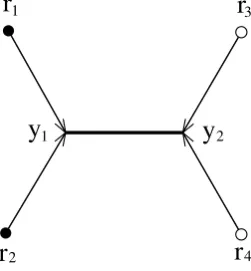
Based on these calculations, a string (flux-tube) model is constructed [1]. For four-quark system, diquark-anti-diquark picture is often used because of the attractive property of diquark [11–14]. Here the picture is used to study the tetraquark state in the flux-tube model. The configuration is shown in Fig.1, where a quark (antiquark) is represented by a solid (hollow) dot,riis (anti)quark’s position,yi
is the junction where three strings (flux tubes) meet. A thin line connecting a quark and a junction represents a fundamental representation, i.e.color triplet, and a thick line connecting two junctions is for a color sextet or other representations, namely a compound string. The different types of string may have different stiffness [15, 16]. The overall color singlet is satisfied by the coupling[qq]
¯ 3[ ¯qq¯]31 and[qq]6[ ¯qq¯]
¯
61, subscripts represent the dimensions of color representations.
In the flux-tube model, the confinement potential of the tetraquark state takes the following form (To simplify the calculation, the length of the string is replaced by the square of the length),
VC =kh(r1−y1)2+(r2−y1)2+(r3−y2)2(r4−y2)2+κd(y1−y2)2 i
, (20)
wherekis the stiffness of the string with the fundamental representation3andkκd is the compound
string stiffness, which can be obtained by [16]
κd= Cd C3
, (21)
whereCdis the eigenvalue of the Casimir operator associated with theS U(3) color representationd of the string,C3= 43,C6= 103 andC8=3.
r
r
r
r
y
y
1
2
3
4
1 2
For the givenri’s, theyi’s are fixed by minimizing the energy of the system. With fixedyi’s and in
the center of mass coordinate, the potential reduces to
VC= k m Q
2 1+Q
2 2+
κd
1+κd
Q23
!
(22)
where the canonical coordinates take the following form
Q1 = r
m
2(r1−r2),
Q2 = r
m
2(r3−r4),
Q3 = r
m
4(r1+r2−r3−r4), (23)
Q4 = r
m
4(r1+r2+r3+r4).
if all quarks have the same mass. Taking into account of the potential energy shift (see Eq.(7) above), the confinement potentialVCused in the present calculation has the following form
VC =k " (r
1−r2)2
2 −∆
!
+ (r3−r4)2
2 −∆
!
+ κd
1+κd
r 1+r2
2 −
r3+r4 2
2 −∆
!#
(24)
Clearly our confinement potential is a multi-body interaction. The Hamiltonian for the four-quark system has the same as Eq.(2) withn=4 and replacing the confinement potential by Eq.(24).
The wave function of the four-quark system is
ΦI JTMT = "
h φG
l1m1(r)Ψs1ms1
i
J1M1
h ψG
l2m2(R)Ψs2ms2
i
J2M2
J12M12
χG LM(X)
#
JTMT Ψ
c1Ψc2
c
Ψ
I1ΨI2
I, (25)
whereIi,siandci,i=1,2 represent isospin, spin and color of diquark and anti-diquark, respectively.
The Jacobi coordinates are defined as
r=r1−r2, R=r3−r4, X=
r1+r2
2 −
r3+r4
2 . (26)
The four-quark state is an overall color singlet with well defined parityP=(−1)l1+l2+L, isospinIand
total angular momentumJT.
The energy of the tetraquark states can be obtained by solving the four-body Schr¨odinger equation
(H−E)ΦI JTMT =0. (27)
To obtain a reliable solution of few-body problem, a high precision method is indispensable. The Gaussian Expansion Method (GEM) [8], which has been proven to be powerful in nuclear and hadron physics, is employed here. In GEM, three relative motion wave functions are written as,
φG l1m1(r)=
n1max X
n1=1
cn1Nn1l1rl1e−νn1r 2
Yl1m1(ˆr) (28)
ψG l2m2(R)=
n2max X
n2=1
cn2Nn2l2Rl2e−νn2R 2
χG LM(X)=
n3max X
n3=1
cn3NLMX
Le−νn3X2Y
LM( ˆX) (30)
The choice of Gaussian size is the same as that of mesons (see Eq.(13). In GEM the calculated results are converged withn1max=10,n2max=10 andn3max=10. Minimum and maximum ranges of the bases
are 0.1 fm and 3.0 fm for coordinatesr,RandX, respectively.
The model is applied to study the tetraquark states:nnn¯ n,¯ n=u,d,sss¯ s¯, etc. Part of the results are shown in Table 3. In obtaining the results, all the possible channels are included. So the model space is generally constructed by several thousands basis functions, for example,Y(2175),IGJPC =0+1−−, the number of basis functions is 2000.
Table 3. Energies for some tetraquark states (MeV).n=u,d. States nnn¯n¯ nnn¯n¯ nsn¯s¯ nsn¯s¯ sss¯s¯ sss¯s¯ IGJPC 0+0++ 0+0++ 1−0++ 1−1−− 0+0++ 0+1−−
Energy 587 1019 1306 1715 1925 2176
Candidate f0(600) f0(980) a0(1450) X(1576) f0(2020) Y(2175) States cnc¯n¯ cnc¯n¯ cnc¯n¯ cnc¯n¯ csc¯s¯ csc¯s¯ IGJPC 0+1+− 0+0−+ 0+0++ 0+1−− 0+0++ 0+1−−
Energy 3776 4020 3644 3978 4038 4292
Candidate X(3872) Y(4008) Y(4260)
From the Table 3, some interesting results are worth to mention. For non-strange tetraquark, the masses of ground state and the first radial excited state with quantum numbersIGJPC=0+0++are 587
MeV and 1019 MeV, which are very close to the experimental values of f0(600) and f0(980). So the scalar meson f0(600) and f0(980) can be identified as tetraquark states in the present calculation, other than theqq P¯ -wave exited states (see Table 2). The same conclusion is also obtained in the study of the lowest-lying scalar mesons by the QCD sum rule [17]. Another interesting state isY(2175), which is observed by Babar Collaboration near the threshold in the process e+e− → φf
0(980) via initial-state radiation [18] and is confirmed by BES collaboration in the processJ/ψ→ηφf0(980) [19]. The Breit-Wigner mass is M = 2.175±0.010±0.015GeV, and width is narrowΓ = 0.058±0.016± 0.020GeV. The quantum numbers are claimed asIGJPC =0+1−−. Various theoretical interpretations have been proposed to explain this resonance, strangeonium hybrid [20]. tetraquark statesss¯s¯[21], S-wave threshold effects [22],φKKsystem [23], etc. In our calculation, A tetraquark state with diquark-anti-diquark structure can describeY(2175) very well. (For comparison, the state in the naive quark model and chiral quark model has much higher mass, 2422 MeV in the naive quark model and 2387 MeV in the chiral quark model.) The mass of the corresponding scalar stateIGJPC =0+0++ofsss¯s¯is calculated to be 1925 MeV, which is a little lower than the mass of scalar meson f0(2020).
By calculation the distance between quarks, we can get the spacial structure of the tetraquark. For stateY(2175), the results are
hr212i=hr234i=1.0fm2 (31)
hr213i=hr214i=hr223i=hr224i=1.5fm2 (32)
r
r
r
r
32 4
1
Obviously, theY(2175) can not be planar, as shown in the Fig. 2.
From Table 3, we can see an interesting phenomenon, Taking as the possible candidates of scaler meson observed experimentally, the ground states contains,cquarks in our model have energies about 100 MeV lower than experiment values, while the excited states are consistent with experiment values. Further study is needed to clarify the situation. The reason may be that the coupling to two-quark state is missing, which the coupling will push the tetraquark state higher.
4 Unquenched Quark Model for Charmonium
To unify the description of meson, the unquenched quark model should be developed, i.e, the high Fock states,q2q¯2,qqg¯ ,q3q¯3,gg,· · ·should be coupled withqq¯to give the meson spectrum. As a first step, we only incorporate the four-quark components in the present work. The meson state reads
|Ψi=a0|ψ0i+ X
BC
Z
cBC(p)|BC;pid3p, (33)
where|ψ0irepresents two-quark state, and|BC;pirepresents four-quark states, which appear as two mesons with relative motion momentump. The meson wavefunction satisfies the following Schr¨odinger equation
H|Ψi=M|Ψi, (34)
The system hamiltonian is
H=H0+HBC+HI. (35)
whereH0is the hamiltonian for two quark state, which acts onψ0only,
H0|ψ0i=M0|ψ0i, (36)
HBCstands for the four-quark hamiltonian, which acts on|BC;pionly.
HBC|BC,pi=EBC(p)|BC,pi, (37)
EBC(PB,PC)= q
M2
B+P
2
B+
q M2
C+P
2
C, (38)
HIcouples two-quark state|ψ0iand four-quark state|BCi. By solving the above Schr¨odinger equation, the mass of meson can be put as
M=M0+∆M, (39)
where∆Mis the mass shift due to the channel coupling,
∆M=X
BC
Z
d3p|hBC|HI|ψ0i| 2
M−EBC+i
. (40)
For the given channelBC, the mass shift
∆MBC
A =−
Z
d3p|hBC|HI|ψ0i| 2
EBC−M+i
=− Z
d3p |M
JL|2
q M2
B+p2+
q M2
C+p2−M
, (41)
The percentage of two-quark state in the physical state of meson can also be obtained,
N2=
1+X
BC
X
JL
Z
d3p |M
JL|2
q M2
B+p2+
q M2
C+p2−M
2 −1
To calculate the transition amplitudeMJL, the3P0 model, also called quark-pair creation model, which is developed to account for the strong decay of hadron [24], is used. In the model, it assumes that quark-antiquark pair are created with vacuum quantum number JPC =0++. The diagrams of all possible decay processA → B+C of meson are shown in Fig.3. In many cases only one of them contributes to the strong decay of meson. The transition operator in the model takes the form,
A
B
C 0++
1
2
4
3
A
B
C 1
2 4
3
0++
Fig.3 The two possible diagrams contributing toA→B+Cin the3P
0model.
HI =−3γ
X
m
h1m1−m|00i Z
dp3dp4δ3(p3+p4)Ym1(
p3−p4 2 )χ
34 1−mφ
34 0 ω
34 0 b
†
3(p3)d
†
4(p4), (43)
whereγ, which is a dimensionless parameter, represents the probability of the quark-antiquark pair created from the vacuum and can be determined by fitting the observed strong decay of hadrons. φ34
0 =(uu¯+dd¯+ss¯)/ √
3, ω340 =(rr¯+gg¯+bb¯)/ √
3 are flavor and color singlet state, respectively. χ34
1,−mis a spin-triplet state.Y m
l (p) ≡ |p| lYm
l (θp, φp) is thelth solid harmonic polynomial that reflects
the momentum-space distribution of the created quark-antiquark pair.b†3(p3),d4†(p4) are the creation operators of the quark and antiquark, respectively.
In general, the mock state is adopted to describe the meson with the spatial wave functionψnALAMLA (p1,p2) in the momentum representation [25].
|A(nA2SA+1LA JAMJA)(PA)i ≡ p
2EA
X
MLA,MS A
hLAMLASAMSA|JAMJAi
× Z
dp1dp2ψnALAMLA(p1,p2)χ 12
SAMS Aφ 12
Aω
12
A|q1(p1) ¯q2(p2)i, (44)
with the normalization conditions
hA(nA2SA+1LA JAMJA)(PA)|A(nA 2SA+1L
A JAMJA)(P
0
A)i=2EAδ3(PA−P0A). (45)
wherenArepresent the radial quantum number of the meson Acomposed ofq1, q2¯ with momentum
p1 andp2. EA is the total energy and PA is the momentum of the mesonA. SA = sq1 +sq2,JA =
LA +SAstand for the total spin and total angular momentum, respectively.LA is the relative orbital
angular momentum betweenq1and ¯q2.hLAMLASAMSA|JAMJAidenotes a Clebsch-Gordan coefficient, andχ12S
AMS A,φ 12
A andω
12
A are the spin, flavor and color wave functions, respectively.
By using the above transition operator and the meson wave functions, The transition matrix ele-ment can be calculated,
hBC|HI|Ai=δ3(PA−PB−PC)MMJAMJBMJC, (46)
whereMMJAMJBMJC is the helicity amplitude ofA →B+C. In the center of mass frame of mesonA,
PA=0, andMMJAMJBMJC can be written as (color factor gives 1/3)
MMJAMJBMJC(P)=γp8EAEBEC X allm’s
hLAMLASAMSA|JAMJAihLBMLBSBMSB|JBMJBi
× hLCMLCSCMSC|JCMJCih1m1−m|00ihχ 14
SBMS Bχ 32
SCMS C|χ 12
SAMS Aχ 34 1−mi
h hφ14
Bφ
32
C|φ
12
Aφ
34 0 i
×IMLA,m
MLB,MLC(P,m1,m2,m3)+(−1)
1+SA+SB+SChφ32
Bφ
14
C|φ
12
Aφ
34 0 iI
MLA,m
MLB,MLC(−P,m2,m1,m3)
with the momentum space integral,
IMLA,m
MLB,MLC =
Z dpψ∗n
BLBMLB( m3
m1+m3P+p)ψ ∗ nCLCMLC(
m3
m2+m3P+p)ψnALAMLA(P+p)Y
m
1(p), (48)
whereP=PB=−PC,p=p3,m3is the mass of the created quarkq3;hχ14SBM S Bχ
32
SCMS C|χ 12
SAMS Aχ 34 1−miand
hφ14
Bφ
32
C|φ
12
Aφ
34
0 iare the overlap of spin and flavor wave functions, respectively.
The flavor overlap can be evaluated directly and the spin overlap can be obtained in terms of Winger’s 9jsymbol,
hχ14
SBMS Bχ 32
SCMS C|χ 12
SAMS Aχ 34 1−mi=
X
S,MS
hSBMSBSCMSC|S MSihSAMSA1−m|S MSi
×(−1)SC+1p3(2SA+1)(2SB+1)(2SC+1)
1 2
1 2 SA 1 2
1 2 1 SBSC S
. (49)
To evaluate the momentum space integral, the space wave function must be fixed. Generally, one takes the simple harmonic oscillator (SHO) approximation for the meson space wave functions. It reads
ΨnLML(p)=(−1)
n(−i)LRL+3 2
s 2n!
Γ(n+L+32)exp − R2p2
2 !
LL+
1 2 n
R2p2YLML(p), (50)
withYLML(p)=|p|LY
LML(Ωp). HereRdenotes the SHO wave function scale parameter, which is fixed by fitting the wave function obtained by solving Sch¨odinger equation of the corresponding meson;p
represents the relative momentum between the quark and the antiquark within a meson;LL+
1 2 n
R2p2 is an associated Laguerre polynomial.
The partial-wave amplitude in Eq.(41) can be related to the helicity amplitude in Eq.(47) via the Jacob-Wick formula [26]
MJL(A→BC)=
√ 2L+1 2JA+1
X
MJB,MJC
hL0J MJA|JAMJAihJBMJBJCMJC|J MJAiM
MJAMJBMJC(P), (51)
whereJ=JB+JC,JA =JB+JC+L,andMJA=MJB+MJC.
Combining Eqs.(41), (49) and (51), the mass shift can be obtained. To be noted that the physical massMalso appears at the right-hand side of Eq.(41), the iteration method should be used here. First by setting M = MA, the mass shift ∆M and the new physical mass are obtained, then substituting
new physical mass in the Eq.(41), the new mass shift is obtained. Continue this process until a stable physical mass is reached.
Recently the mass shifts for charmonium, bottomonium and other mesons have been calculated by several groups [27]. The results show that the mass shifts are rather large, especially for the light mesons. So the contribution from the four-quark components cannot be ignored. Of course, part of the effects can be absorbed by the model parameters. It is very interesting to see that can the un-quenched quark model improve the agreement between theoretical results and the experimental data? In the following, we take charmonium as an example, adjusting the model parameters and re-fitting the experimental data by incorporating the four-quark components in the quark model.
Table 4. The re-adjusted parameters.
mu=md(MeV) ms(MeV) mc(MeV) αs(cc¯) αs(cq¯)
321 587 1758 0.40 0.58
The model parameters of the unquenched quark model for charmonium is listed in Table 4. As a preliminary study, only the masses of quarks and the coupling constantαs of OGE are re-adjusted,
other parameters keep their value in the model without high Fock components. γ = 6.95 andγs =
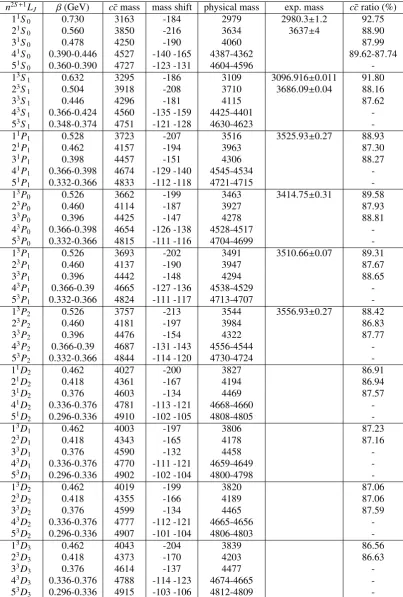
Table 5. The masses of charmoniumcc¯(unit: MeV).
n2S+1L
J β(GeV) cc¯mass mass shift physical mass exp. mass cc¯ratio (%)
11S
0 0.730 3163 -184 2979 2980.3±1.2 92.75
21S0 0.560 3850 -216 3634 3637±4 88.90
31S
0 0.478 4250 -190 4060 87.99
41S0 0.390-0.446 4527 -140 -165 4387-4362 89.62-87.74
51S
0 0.360-0.390 4727 -123 -131 4604-4596
-13S
1 0.632 3295 -186 3109 3096.916±0.011 91.80
23S1 0.504 3918 -208 3710 3686.09±0.04 88.16
33S
1 0.446 4296 -181 4115 87.62
43S1 0.366-0.424 4560 -135 -159 4425-4401
-53S
1 0.348-0.374 4751 -121 -128 4630-4623
-11P1 0.528 3723 -207 3516 3525.93±0.27 88.93
21P1 0.462 4157 -194 3963 87.30
31P1 0.398 4457 -151 4306 88.27
41P1 0.366-0.398 4674 -129 -140 4545-4534
-51P1 0.332-0.366 4833 -112 -118 4721-4715
-13P0 0.526 3662 -199 3463 3414.75±0.31 89.58
23P0 0.460 4114 -187 3927 87.93
33P0 0.396 4425 -147 4278 88.81
43P
0 0.366-0.398 4654 -126 -138 4528-4517
-53P0 0.332-0.366 4815 -111 -116 4704-4699
-13P1 0.526 3693 -202 3491 3510.66±0.07 89.31
23P
1 0.460 4137 -190 3947 87.67
33P1 0.396 4442 -148 4294 88.65
43P1 0.366-0.39 4665 -127 -136 4538-4529
-53P1 0.332-0.366 4824 -111 -117 4713-4707
-13P2 0.526 3757 -213 3544 3556.93±0.27 88.42
23P2 0.460 4181 -197 3984 86.83
33P2 0.396 4476 -154 4322 87.77
43P2 0.366-0.39 4687 -131 -143 4556-4544
-53P2 0.332-0.366 4844 -114 -120 4730-4724
-11D2 0.462 4027 -200 3827 86.91
21D2 0.418 4361 -167 4194 86.94
31D2 0.376 4603 -134 4469 87.57
41D2 0.336-0.376 4781 -113 -121 4668-4660
-51D2 0.296-0.336 4910 -102 -105 4808-4805
-13D1 0.462 4003 -197 3806 87.23
23D1 0.418 4343 -165 4178 87.16
33D1 0.376 4590 -132 4458
-43D1 0.336-0.376 4770 -111 -121 4659-4649
-53D
1 0.296-0.336 4902 -102 -104 4800-4798
-13D2 0.462 4019 -199 3820 87.06
23D2 0.418 4355 -166 4189 87.06
33D
2 0.376 4599 -134 4465 87.59
43D2 0.336-0.376 4777 -112 -121 4665-4656
-53D
2 0.296-0.336 4907 -101 -104 4806-4803
-13D
3 0.462 4043 -204 3839 86.56
23D3 0.418 4373 -170 4203 86.63
33D
3 0.376 4614 -137 4477
-43D3 0.336-0.376 4788 -114 -123 4674-4665
-There are several features of our calculation:
(1) From Table 5, we can see the percentages ofcc¯in the physical states are all around 90%, which are different from the results of the previous work (where the percentage may be as low as 50% inP -wave states). The high percentage ofcc¯is a welcome property, which make our calculation consistent, the higher Fock states,q3q¯3, · · ·can be neglected safely.
(2) The mass shifts for the states with the samen,Lare almost same, which is consistent with other calculation [27, 29].
(3) The experimental masses below theDD¯ threshold are reproduced well, similar to the results of the quenched quark model (only cc¯ component). This means that for the low-lying states, the four-quark contributions can be totally absorbed into the parameters. For the states ψ(3770),ψ(4040), ψ(4160) andψ(4415), the model gives the masses close to experimental data, if these states are taken as 13D1, 33S1, 23D1and 43S1.
(4) For givenJ,L, The mass shifts for smallnis larger than that for largen. This feature leads to that the high states will be pushed higher, which it cannot be absorbed into parameters of the quenched quark model.
(5) As for the new charmonia (XYZparticles) observed in recent years [2], some states can be identified as states in Table 5, some states cannot be allocated due to their possible exotic structures, tetraquark, glueball, molecule, hybrid, etc. [2]. The assignments are listed in Table 6. To keep in mind, these assignments are based on the masses only. To validate the assignments, decay properties calculation of these states needs to be done.
Table 6. The assignments ofXYZstates.
states X(3872) X(3915) Z(3930) X(3940) Y(3940)
assignment 11D2 23P0 23P2 23P1 21P1
mass (MeV) 3827 3927 3984 3947 3963
states X(4140) X(4160) X(4350) Y(4630) Y(4660) assignment 21D
2 21D2 33P2 53S1 43D1
mass (MeV) 4194 4194 4322 4630 4659
5 Summary
The non-relativistic quark model has achieved great success in describing the properties of hadrons, especially for the low-lying states. With advance of experiments, more excited states are observed, the quark model should be developed. Unquenching thequark model is an important step for the develop-ment. How to unquench the quark model is still an open question. In the present work, the commonly used3P0 model is employed and the unquenched quark model is applied to explore the charmonium spectrum. The calculation shows that the effects of including the four-quark component will affect the masses of highly excited states while keeping the agreement between theoretical results and experi-mental data for the low-lying states. The calculation also shows that the higher Fock states,q3q¯3can be neglected safely. The further work on unquenching quark model is to improve the wave functions of created quark-pair, the approximation of plane wave is used at the moment.
Another development of quark model is to study the multi-quark system, where the multi-body interaction may play an important role. Based on the lattice QCD calculation, a string (flux-tube) model is proposed to study the tetraquark system. The calculated results are encouraging, most of the scalar mesons can be described as tetraquark states in the model. An important feature of the model is that an alternative form of color confinement is used. So the multi-quark system is a good place to check the validity of the Casimir scaling [16].
Another problem to be solved is how to coupling the Fock states with different color structures. String model is a good starting point. The mechanism to break and re-join the string needs to clarify.
Acknowledgment
Education of China under Grant No. 20070319007 and the PhD Program Funds of Chongqing Jiaotong University.
References
1. C. R. Deng, J. L. Ping, F. Wang and T. Goldman, Phys. Rev. D82 (2010) 074001.
2. N. Brambilla, S. Eidelman, B. K. Heltsley,et al, Eur. Phys. J. C71 (2011) 1534 and references therein.
3. A. Manohar and H. Georgi, Nucl. Phys. B234 (1984) 189.
4. J. Vijande, F. Fernandez and A. Valcarce, J. Phys. G31 (2005) 481.
5. L. Z. Chen, H. R. Pang, H. X. Huang, J. L. Ping and F. Wang, Phys. Rev. C76 (2007) 014001. 6. R. K. Bhaduri, L. E. Cohler and Y. Nogami, Phys. Rev. Lett. 44 (1980) 1369.
7. J. Weinstein and N. Isgur, Phys. Rev. D27 (1983) 588.
8. E. Hiyama, Y. Kino and M. Kamimura, Prog. Part. Nucl. Phys. 51 (2003) 223. 9. L. Wang, J. L. Ping, Chin. Phys. Lett. 24 (2007) 1195.
10. T. T. Takahashi, H. Matsufuru, Y. Nemoto and H. Suganuma, Phys. Rev. Lett. 86 (2001) 18; T. T. Takahashi, H. Suganuma, Y. Nemoto and H. Matsufuru, Phys. Rev. D65 (2002) 114509; F. Okiharu, H. Suganuma and T. T. Takahashi, Phys. Rev. Lett. 94 (2005) 192001.
11. L. Maiani, F. Piccinini, A. D. Polosaet al, Phys. Rev. Lett. 93 (2004) 21.
12. L. Maiani, V. Riquer, F. Piccinini and A.D. Polosa, Phys. Rev. D72 (2005) 031502. 13. M. Iwasaki and T. Fukutome Phys. Rev. D72 (2005) 094016.
14. G. J. Ding and M. L. Yan, Phys. Lett. B643 (2006) 33.
15. K. Johnson and C.B. Thorn, Phys. Rev. D13 (1976) 1934; C. Semay, Eur. Phys. J. A22 (2004) 353.
16. G. S. Bali, Phys. Rev. D62 (2000) 114503.
17. H. X. Chen, A. Hosaka and S. L. Zhu, Phys. Rev. D76 (2007) 094025.
18. B. Aubertet al[BABAR Collaboration], Phys. Rev. D74 (2006) 091103; Phys. Rev. D76 (2007) 012008; D77 (2008) 092002.
19. M. Ablikimet al[BES Collaboration], Phys. Rev. Lett. 100 (2008) 102003. 20. G. J. Ding and M. L. Yan, Phys. Lett. B650 (2007) 390; B657 (2007) 49. 21. Z. G. Wang, Nucl. Phys. A791 (2007) 106.
22. S. L. Zhu, Int. J. Mod. Phys. E17 (2008) 283.
23. A. M. Torres, K. P. Khemchandani, L. S. Genget al, Phys. Rev. D78 (2008) 074031.
24. L. Micu, Nucl. Phys. B10 (1969) 521; A.Le Yaouanc, L. Oliver, O. Pene and J-C. Raynal, Phys. Rev. D8 (1973) 2223; 9(1974) 1415; 11 (1975) 1272; W. Roberts and B. Silvestr-Brac, Few-Body Syst. 11 (1992) 171; E. S. Ackleh, T. Barnes and E. S. Swanson, Phys. Rev. D54 (1996) 6811; T. Barnes, S. Godfrey and E. S. Swanson, Phys. Rev. D72 (2005) 054026.
25. C. Hayne and N. Isgur, Phys. Rev. D25 (1982) 1944.
26. M. Jacob and G. C. Wick, Ann. Phys. (Leipzig) 7 (1959) 404; Ann. Phys. (N.Y.) 281 (2000) 774. 27. T. Barnes and E. S. Swanson, Phys. Rev. C77 (2008) 055206; Yu. S. Kalashinikova, Phys. Rev.
D72 (2005) 034010; B. Q. Li, C. Meng and K. T. Chao, Phys. Rev. D80 (2009) 014012.
28. H. G. Blundell and S. Godfrey, Phys. Rev. D53 (1996) 3700; D53 (1996) 3712; J. Lu, W. Z. Deng, X. L. Chen and S. L. Zhu, Phys. Rev. D73 (2006) 054012.