Optimized Configuration for OSPF Protocol
to Aggregate Routes using Prim's MST
Algorithm
Prabha Naik, Dr. A Rama Mohan Reddy
Research Scholar, Dept. of Computer Science & Engineering, Rayalseema University, Kurnool, India
Research Guide, Rayalseema University, Prof & HOD, Dept. of Computer Science & Engineering, S V University
Tirupati, India
ABSTRACT: Open Shortest Path First (OSPF) is a most common protocol for routing in the domain of autonomous
system (AS). In large scale networks containing subnets in very large number, two-level hierarchical routing is supported using OSPF routing through OSPF areas. Addresses within the subnet are aggregated, which is a crucial requirement of a large domain of AS scaling resulting in size reduction of the routing table, the size of the database of link state and traffic in the network is reduced to get synchronization in router link-state database. Aggregation of addresses, on the other hand, implies shortest length paths information loss and this leads to the suboptimal routing.
KEYWORDS: Routing, OSPF, LSA traffic, Route Aggregation.
I.INTRODUCTION
OSPF areas and address aggregation play the significant role in routing optimization and network resource consumption as described below:
A. Router Memory
As the area in the AS are not connected directly to a router, the routing table just needs the entries to be presented concerning subnet aggregation instead of individual addresses of the subnet. It can be said that an individual subnet address is stored in a router only when it is connected directly. This smaller sized routing table takes less memory at the routers which are necessary.
B. Cycles of Routing Processes
At each router, the smaller size link-state database is maintained, as it consists of information summary that is related to the subnet of OSPF areas that are not connected directly to the router. Therefore, shortest paths computation cost also substantially decreases.
C. Network Bandwidth
Each OSPF area aggregates the address information which are flooded only in the AS network. Thus it results in OSPF flooding necessary for synchronization of link state database in the AS routers [03].
With the widespread use of computers in all walks of life, the need arose for making the computers communicate with one another to share data and information. It's often impractical for two communication devices to be direct, point to point connected this either because the devices are very far apart or there are a lot of devices to connect to each other at a particular time, so the solution for these problems is to attach the devices to a communication network. The communication network can be categories into wide area networks, local area networks, wireless networks and metropolitan networks. The distinction between categories is regarding technology and application.
For the connection between two devices directly or through a communication network, there must be a path between them and most important is that there must be a protocol to control and manage the communication. TCP/IP model [01] is a protocol suite used in internet network and its architecture consist of layers, each layer has a specific function (include) consist of multiple protocols. The process of routing packets through the network is the function of the network layer in TCP/IP model. The routing protocol consists of routing algorithm which decides the path that the packets will follow to reach the destination. There are multiple routing protocols used in networks each has advantages and disadvantages [08].
The OSPF protocol was developed by the OSPF working group of the Internet Engineering Task Force [11]. OSPF routing protocol used in networks because it has no limitation on hop count, can handle Variable Length Subnet Masks (VLSM), better use of bandwidth, has better convergence (Changes in an OSPF network are propagated quickly), uses multicasting within areas, allows for better load balancing, allows for routing authentication by using different methods of password authentication and after initialization, OSPF only sends updates on routing table sections which have changed, it does not send the entire routing table. When networks become larger, this will introduce more overhead in memory allocation and CPU utilization, but by using areas OSPF networks can be logically segmented to decrease the size of routing tables [12].
1.1. Route Aggregation
Route Aggregation (RA), is one of the methods for replacing a set of routes with a single or common route which is a fundamental mechanism for scalability of the internet [09]. But it is very poorly understood though its importance. There bottom up and top down approaches of route aggregation.
Routing scalability is a primary challenge of the Internet routing system. Route aggregation has performed a critical function toward containing this hassle. This is also called as route summarization[10]; route aggregation is a mechanism generating a summary path from a set of infant routes falling underneath a common parent prefix and single summary route instead of pronouncing all the child routes is advertised. Misuse and Misconfiguration of aggregating the routes may lead to route anomalies like black holes and packet forwarding loop. ISPs encloses the details related to the anomaly incidents of routing and routing configuration because of operational and commercial considerations which are required to shed light on these kinds of incidents. This leads to difficulty in analyzing white box study for assessment of practically accepting the routing anomalies for which contribution of route aggregation is required. Thus researchers switch to methodologies of black box measurement for studying routing anomalies. While this technique can reveal the anomalies inside the wild, it is hard to perceive the basis cause of anomalies [02].
Many queries related to route aggregation are not answered in RFCs. The exact behavior of aggregating the route is determined by the implementation of specific route aggregation with various routing protocols and various vendors. Thus a method for analyzing and reasoning about the route aggregation is required is proposed which involves identification of routing abnormalities which might cause for route aggregation.
We have made the following contributions:
We conducted a set of experiments on route aggregation (RA) behaviours of all major routing protocols (BGP, OSPF, EIRGP, RIP) as implemented by the two leading router vendors (Cisco and Juniper). Our experiments show that the RA behaviours vary significantly across routing protocols and router vendors even for simple network setups.
We propose two router level primitives and incorporate them into a canonical router model. The new model captures the diversity of observed RA behaviours as implemented by different vendors for different protocols.
we explain why the current vendor guidelines fall short in addressing the anomalies. Also, we establish that determining whether a network configuration with route aggregations can result in persistent forwarding loops is NP-complete. Assuming that P is not equal to NP, the problem is intractable. Therefore, we finally present sufficient conditions for the RA primitives to guarantee routing safety. The conditions are independent of routing protocols and work for both Cisco and Juniper designs.
We explore and discuss clean-slate designs for RA. We introduce the notion of negative routes to generalize the concept of routes and show how this new concept can safely reduce the number of routing entries.
II.BACKGROUND
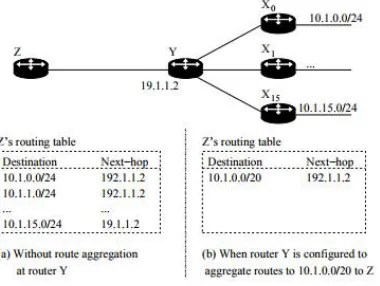
Route aggregation is also known as route summarization which designates the superseding method for a set of routers with a single common route. To illustrate this, let us consider the network as shown in Figure 1. It is assumed that all routes run under a common routing protocol. Each router X (1≤i≤255) Is connected directly to an interface having IP prefix of 10.1.i.0/24. The routing table at the router Y consists of at least 255 entries which are corresponding to the network address from 10.1.1.0/24, 10.1.2.0/24, 10.1.255.0/24. Instead of advertising all 255 prefixes to router z router y combines all the routers into single destination prefix 10.1.0.0/16 and announce it as a single route to z by route aggregation [07].
Figure 1: Route aggregation allows router Y to combine multiple routes (10.1.1.0/24, 10.1.255.0/24) into a single one (10.1.0.0/16).
The router generates and advertises the aggregate route to destination prefix 10.1.0.0/16 by knowing at least one route to a unique prefix, e.g., to 10.1.1.0/24 while configuring to advertise the aggregate route. The more specific prefix is considered to be child prefix and corresponding route as child route. Generally, in a network, some o the child prefix of aggregated prefix are not allocated in subnets and such kind of prefixes as known s unused child or unallocated prefixes. During primary application of route aggregation is used for an increment of internet scalability by reducing the table sizes, While the primary application of route aggregation is to increase the Internet scalability by reducing routing table sizes, route aggregation is also used by operators to fulfill other requirements. For example, by restricting the scope of route advertisements, instabilities at the edge of a network are not propagated into the routing core [04].
III.METHODOLOGY
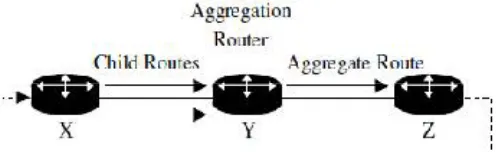
Figure 2: Setup for Experimenting with RA
For instance, the key objectives related to route aggregation is explained RFC 1338 which consists of route information for aggregation and the single route is advertised instead of child prefixes announcement. Several rules are defined by RFC 1338; like(1) based on the longest matching of the prefix forwarding operation is performed. (2) Some packets match only with the aggregate route, but not specific routes. Such kinds of packets are discarded.
3.1 Experiment Setup
The route aggregation is illustrated in Figure 2. The above diagram consists of three routers. The first router X generates the child routes. The number of child routes, child route metrics, the length of their prefixes and protocols are varied and are advertised. The route aggregation is performed by configuring the second router Y. The FIB information of router Y is inspected to check sink route existence and the administrative distance other running processes is varied to obtain the sink routes’ AD value. When the same prefix gets advertisers by multiple routing protocols, the route having lowest AD value is selected for routing, and FIB is installed in it. The third router Z verifies the advertisement and aggregate route metrics. In the domain of routing, router sometimes receives the route it had advertised earlier. It can also be said that the router output may get an impact on its input.
A. Modes of Route Aggregation
There are two modes of route aggregation: auto-summary and manual segmentation. They are further divided into sub classes like interface, area level, BGP AS, router based manual aggregation. In all of these classes, it is necessary for the child route to be present and sufficient condition for the advertisement initiation of route aggregate. However, each type presents different characteristics.
B. Interface
This route aggregation mode allows advertising explicitly configuring aggregate route rather than the child routes in the interfaces.
C. Area/level
In this mode, Link-state routing protocols flood the link state information to each and every participant of the routing process.
D. Router/Instance
With respect to all routing protocols, route aggregation has to be configured consistently. There are three steps of configuration: the first one starts with statements of routing options and then creation of the sink route. Second, statement of policy option defines the export policies for sink route. Third, the export rules apply to the protocols in which sink route has to get advertised. It is necessary for child route to exist in the FIB to become sink route valid and consider the procedure of route selection. The sink route is created per router and advertisement is per instance of routing.
E. Metric of aggregate route
F. Sink Route
Most of the implementations create a sink route automatically upon advertisement of aggregate route. An aggregate route has default AD value which might be higher than routing protocols AD value.
3.2 A Model for Route Aggregation
The current design and implementation for route aggregation in ad-hoc nature are described in the previous section. The results obtained are the motivation for the development of an analytical model to route aggregation reason, which will begin with assumption that functionality can be shortly defined using a small number of simple functions and their interactions with router’s routing components.
Here we describe the unified analytical model. Route aggregation of two router level specific primitives and canonical router model is incorporated. The RA diverse behavior is observed and captured entirely by simple primitives’ action and their interaction among the routing components of other router or same router. The model used to predict the FIB content of router and route advertisements are illustrated.
A. Route Aggregation Primitives
The route aggregation essence lies in the primitives add-sink() and adv-aggro().
add-sink()
The primitive add-sink() considers two input parameters and sink route set for selection of routing procedure is given as obtained. The first parameter is considered as F which is routes set which are present at the router. This set corresponds to routes in either FIB or routing information based protocol. The second parameter considered is aggregate routes set that are configured at the router. The add-sink() primitive demonstrates two characteristics. First sink route is created by knowing a child route of aggregate route configured. Each sink route is assigned to its administrative distance value. E.g, sink routes that are generated from the process of EIGRP routing is set with a default value of AD as 5.
Primitive 1 add-sink(E, A) Inputs
(a) E - FIB router routes E or the Route Information Base (RIB) specific protocol.
(b) A - aggregated routes configured at the router Step.1: S = { }
Step.2: Existing sink routes are removed from E.
Step.3: For each where ∈ do
Step.4: if child route of E exists than
Step.5: AD values are set, and next hop for a is set to NULL Step.6: is added to S
Step.7: If condition Ends here Step.8: for loop Ends here
Step.9: S is presented to procedure of route selection
Second, the position where the primitives will examine the child routes difference presence which is based on implementation. The sink route is created and present only when a child route is present in the RIBout.
adv-aggr()
aggregated routes that are configured on the interface and determines a subset having a single child route present in E, this aggregate route subset is advertised on the interface. The advertised aggregate route metric set by the metric() function specific routing process. For example metric(a: E) will return the maximal metric of all child route of in E
Primitive 2 adv - aggr(E, A) Inputs
(a) Routes obtained from protocols specific RIBout represented by E
(b) Aggregated routes configured on the interface is represented by A
Step.1: Sink routes are removed from E
Step.2: for each where ∈ do
Step.3: if child route is present for in E then Step.4: eliminates all child routes of in E
Step.5: . = ( : );
Step.6: is added to E Step.7: If condition Ends here Step.8: for loop Ends here
Step.9: E is advertised on the interface
3.3 Prim's MST Algorithm
Prim’s algorithm is one of the greedy algorithms that need to find the minimum spanning tree for an undirected weighted graph. This means that the algorithm finds edges subset and tree is formed which involves every vertex; the tree is minimized having lesser weighted edges. The algorithm is operated using building the tree from one vertex at a time; each step adds possible connection which is cheapest from tree to another vertex [05]. The algorithm follows following steps and the respective pseudo code is given below
a. A tree is initialized with a single vertex, which is arbitrarily chosen from the graph.
b. The tree is grown by one edge: among the edges that are connected with a tree to vertices that are not yet present in the tree, the minimum weighted edge is found and is transfer to the tree.
c. The previous step is repeated until all vertices are connected to the tree.
Pesudocode: Prim’s Algorithm
Step 1. Each vertex v of the graph is associated with a number C[v], the connection to v is the cheapest code and an edge E[v], the edge provides the cheapest connection. These values are initialized by setting C[v] to +∞ (or any number is chosen higher than edge weight which is maximum) and edge E[v] is set to special flag value which indicates that no edge is connected to earlier vertices.
Step 2. An empty forest F is initialized and Q set of vertices are not present in F.
Step 3. The steps are repeated till Q becomes empty
1. The minimum possible value of C[v]is found
and vertex v is removed from set Q. 2. The vertex v is added to F and if E[v] is
found as not special flag than E[v] is added to F.
connected to other vertices w. For each edge vw, if vertex w belongs to set Q and vw has a lesser weight than C[w], the following steps are performed:
a. C[w] is set to edge W cost. b. E [W] is set to point to edge vw. Step 4. Return F
IV.RESULTS AND DISCUSSION
The work done is analyzed by considering some quantitative metrics like packet delay variation and throughput.
A. Packet Delay Variations
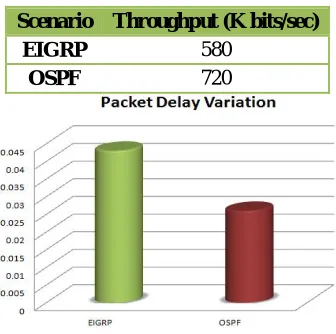
The delay variation is measured by the delay differences in the packets. Table 1 represents the respective packet delay variance values of EIGRP and OSPF. The graphical representation of packet delay variation is depicted in Figure 3.
B. Throughput
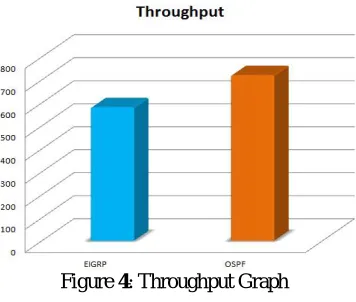
The throughput is the parameters used to check the data packets rate delivered successfully through the channel of the network [06]. The respective throughput analysis of OSPF and EIGRP are presented at Table 2, and there graphical picture is depicted in Figure 4.
Table 1: Table for Packet Delay Variation
Scenarios Packet Delay Variation (ms)
EIGRP 0.043
OSPF 0.026
Table 2: Table Throughput Comparison
Scenario Throughput (K bits/sec)
EIGRP 580
OSPF 720
Figure 4: Throughput Graph
V. CONCLUSION
Address aggregation is critical for scalability in the OSPF areas as it may result in a major decrease in the size of the routing table, link state databases and network traffic need to get synchronized with link state databases. The address aggregation may lead to suboptimal OSPF routing path selection between the source and destination subnet pairs that present for a duration in different areas. In this work, we study RA behaviors and analyze its performance.
REFERENCES
[1] Bernard Fortz and Mikkel Thorup, “Internet Traffic Engineering by Optimizing OSPF Weights”, IEEE, 2000.
[2] Franck Le, Geoffrey G. Xie and Hui Zhang, “On route aggregation”, Proceedings of the Seventh COnference on emerging Networking
EXperiments and Technologies. ACM, 2011.
[3] Yuri Breitbart, Minos Garofalakis, Amit Kumar and Rajeev Rastogi, “Optimal Configuration of OSPF Aggregates”, Bell Laboratories Tech.
Memorandum, 2000.
[4] F. Le, G. G. Xie and H. Zhang, “Understanding Route Aggregation” In Technical Report, Carnegie Mellon University, 2010.
[5] Badri Munier, Muhammad Aleem, Muhammad Arshad Islam, Muhammad Azhar Iqbal and Waqar Mehmood, “A Fast Implementation of
Minimum Spanning Tree Method and Applying it to Kruskal’s and Prim’s Algorithms”, Sukkur IBA Journal of Computing and Mathematical Sciences, Vol. 1, Issue 1, pp. 58-66, 2017.
[6] Anibrika Bright Selorm Kodzo, Ashigbi Franklin Degadzor, Mustapha Adamu Mohammed and Dr. Michael Asante, “Performance Analysis of
Enhanced Interior Gateway Routing Protocol (EIGRP) Over Open Shortest Path First (OSPF) Protocol with Opnet”, International Journal of Advanced Computer Science and Applications, Vol.7, Issue 5, pp. 77 – 82, 2016.
[7] R. White, D. Slice and A. Retana, “Optimal Routing Design”, Cisco Press, 2005.
[8] Anupam Mittal, Ruchi Aggarwal and Sapinder Kaur, “A Survey on Industrial Wireless Sensor Networking Routing Algorithms”, International
Research Journal of Engineering and Technology, Vol. 03, Issue 06, 2016.
[9] Atul Aggrawal and Shelej Khera, “Combat Resource Shortages by Making Stub Area and Route Summarization in OSPF”, International
Journal of Scientific and Research Publication, Vol. 2, Issue 8, 2012.
[10] Haresh N. Patel and Rashmi Pandey, “Extensive Reviews of OSPF and EIGRP Routing Protocols based on Route Summarization and Route
Redistribution”, International Journals of Engineering Research and Application, Vol. 4, Issue 9, pp. 141-144, 2014.
[11] Degadzor F. Asigbe, Adamu M. Mustapha, Collinson C. M. Agbesi, Botchey F. Ephraim, Anibrika S. K. Bright and Somuah Clement,
“Performance Analysis of Interior Gateway Routing Protocol(EIGRP) Over Open Shortest Path First (OSPF) Protocol”, International Journal of Scientific and Technology Research, Vol. 5, Issue 9, 2016.
[12] Muhammad Kashif Hanif, Ramzan Talib, Nafees Ayub, Muhammad Umer Sarwar and Sami Ullah, “OSPF vs EIGRP: A Comparative