ISSN(Online) : 2320-9801
ISSN (Print) : 2320-9798
I
nternational
J
ournal of
I
nnovative
R
esearch in
C
omputer
and
C
ommunication
E
ngineering
(An ISO 3297: 2007 Certified Organization)
Vol. 4, Issue 4, April 2016
Enhancing the Lifetime of Wireless Sensor
Network and Coverage alongside Load
Balancing
Anusha Patel H S1, Dr. S Bhargavi2
M.Tech Student, Dept. of Electronics and Communication, SJCIT, Chikkaballapur, India1
Professor, Dept. of Electronics and Communication, SJCIT, Chikkaballapur, India2
ABSTRACT: One of the essential destinations of wireless sensor network is to give full scope of a detecting field as
far as might be feasible. Numerous errands, for example, object following and combat zone interruption identification require full scope whenever. With the restricted vitality of sensor nodes, sorting out these nodes into a maximal number of subgroups able to do observing every discrete point of interest and after that on the other hand actuating them is a pervasive approach to give better nature of observation. In this paper, advanced maximum connected load-balancing cover tree (MCLCT) algorithm to accomplish full coverage too as base station network of every sensing nodes by progressively framing load-balancing cover trees. Such an undertaking is especially figured as a most extreme cover tree issue, which has been turned out to be nondeterministic polynomial complete. The proposed advanced MCLCT comprises of two segments: 1) advanced low energy adaptive clustering hierarchyLEACH and 2) a probabilistic load-balancing procedure for determining the routing path. Through advanced MCLCT, energy utilization among nodes turns out to be more uniformly because of the enhanced load-balancing which increases the network life time. The simulation results show that the solution performs better than the existing ones.
KEYWORDS: Wireless sensor networks, coverage/connectivity preservation, scheduling, lifetime maximization,
load-balancing, advanced LEACH
I. INTRODUCTION
Wireless Sensor Networks (WSNs) are shaped by associated wireless sensor nodes that each is reduced furthermore, has the capacity of detecting, preparing, and storing environmental data and corresponding with different nodes. High adaptation to non-critical failure, solid versatility, and thorough detecting scope are the fundamental benefits. These benefits permit wireless sensor systems utilized in many applications e.g. home appliances, surveillance, monitoring etc. As of late, WSNs have likewise turned into a critical territory of examination.
With an associated WSN, the data about events detected by every sensor node will be transmitted to the destination BS in a vitality proficient multi-hop way. With a specific end goal to ensure the nature of administration called Quality of Service (QoS) provided by WSNs, accomplishing the particular scope prerequisite and keeping up availability are important. Here, we address the scope issue in conjunction with the network issue.
ISSN(Online) : 2320-9801
ISSN (Print) : 2320-9798
I
nternational
J
ournal of
I
nnovative
R
esearch in
C
omputer
and
C
ommunication
E
ngineering
(An ISO 3297: 2007 Certified Organization)
Vol. 4, Issue 4, April 2016
Thus, network lifetime can be delayed as much as possible. Few among the studies about scheduling, with a specific end goal to make a compelling usage on sensor nodes, sensor nodes are sorted out into a maximal number of cover sets which can be disjoint ones or non-disjoint ones. It is important to equitably impose the burden of traffic on the relay nodes to ensure the connectivity of WSNs, i.e., load balancing must be accomplished [9].
Such an issue with either the disjoint arrangement or the non-disjoint development is demonstrated to fit in with the Non deterministic Polynomial (NP) - Complete issue. More energy is consumed during the transmission of date hence it is important to form Far-Zone using LEACH protocol [10] .The nodes in every cover set can helpfully screen all DPOIs. Through the substitute enactment for these cover sets, the particular coverage necessity and the longer lifetime could be accomplished. In any case, the network prerequisite that is identified with information transmission in a multi-hop WSN is not being considered in recent studies.
II. RELATEDWORK
In remote sensor systems, transfer hub situation has been proposed to enhance vitality productivity.[1] In this paper, the study on two-layered obliged relay nodes arrangement issues is considered, where the transfer nodes can be set just at some prespecified applicant areas. To meet the availability prerequisite, one will need to ponder the associated single-spread issue where every sensor hub is secured by a base station or a relay nodes (to which the sensor hub can transmit information), and the hand-off nodes shape an associated system with the base stations.
As of late have seen a urge for creating genuine applications in connection with WSNs. [2] In some of these applications, for example lookup and alleviation furthermore war zone surveillance, a couple cell nodes will be actualized to in show review a range of interest and/or conduct particular observing employments. Like endeavour one of the locator’s requests between node discourses in this manner supporting system on the web connectivity is vital to the power of WSNs.
Sensing coverage is a key usefulness of Wireless Sensor Networks (WSNs). [3] In any case, it is likewise surely understood that scope alone in WSNs is not adequate, and subsequently organize availability ought to additionally be considered for the right operation of WSNs. In this paper, the issue of k-scope in WSNs such that in every planning round is tended to, each area in an observed field (or basically field) is secured by at any rate k dynamic sensors while every single dynamic sensor are being associated.
A adaptive ant colony algorithm is proposed to beat the untimely union issue in the existing ant colony optimization. The adaptive ant colony is made out of three groups of ants: customary ants, irregular ants and arbitrary ants. Every normal ant seeks the way with the high focus pheromone at the high likelihood, each anomalous ant looks the way with the high fixation pheromone at the low likelihood, and every arbitrary ant arbitrarily looks the way paying little attention to the pheromone fixation. Three gatherings of ants give a decent starting condition of pheromone trails together. [4] As the advancement estimation goes on, the quantity of the irregular ants and the arbitrary ants diminishes progressively. In the late improvement organize, all of ants change to the normal ants, which can quickly think to the ideal ways. Reproduction results demonstrate that the calculation has a decent improvement execution, and can resolve travelling salesperson issue successfully.
ISSN(Online) : 2320-9801
ISSN (Print) : 2320-9798
I
nternational
J
ournal of
I
nnovative
R
esearch in
C
omputer
and
C
ommunication
E
ngineering
(An ISO 3297: 2007 Certified Organization)
Vol. 4, Issue 4, April 2016
Enhancement of lifetime is a basic concern in wireless sensor networks (WSNs) attributable to the restricted availability of energy of every sensor. Arbitrary and thick arrangement of sensors in numerous applications force that some scope repetition in WSNs, which propels strategies to keep away from such excess for broadening the general lifetime of the systems. [6] A successful strategy for this reason for existing is to separate the sensors into a most extreme number of disjoint gatherings called covers, each of which can cover all objectives, so that one and only cover is dynamic whenever. The issue of getting the most extreme number of spreads has been ended up being NP-hard. In this study, an ideal technique is proposed for the issue. Also, as an ideal calculation it guarantees getting a perfect arrangement, however the current heuristic calculations don't. Furthermore, the proposed technique to the K-scope issue, where every objective should be secured by in any event K number of nodes is augmented.
The issue of observing spatial variations, for example, street speeds on interstate, utilizing remote sensors with constrained battery life is being considered. A focal inquiry is to choose where to find these sensors to best foresee the marvel at the unsensed areas. In any case, given the force imperatives, one likewise needs to decide when to initiate these sensors so as to boost the execution while fulfilling lifetime prerequisites. Customarily, these two issues of sensor arrangement and planning have been considered independently; one first chooses where to put the sensors, and after that when to enact them [7].
Existing work on setting extra transfer nodes in remote sensor systems to enhance system network regularly accept homogeneous remote sensor nodes with an indistinguishable transmission span is discussed [8]. Conversely, this paper addresses the issue of sending transfer nodes to give adaptation to internal failure higher system availability in heterogeneous remote sensor systems, where sensor nodes have distinctive transmission radii. Contingent upon the level of wanted adaptation to internal failure, such issues can be sorted as: 1) full blame tolerant transfer node situation, which plans to send a base number of hand-off nodes to set up k(k≥1) vertex disjoint ways between each pair of sensor and/or hand-off nodes and 2) fractional flaw tolerant hand-off node position, which intends to convey a base number of hand-off nodes to build up k(k≥1) vertex-disjoint ways just between each pair of sensor nodes. Because of the diverse transmission radii of sensor nodes, these issues are further muddled by the presence of two various types of correspondence ways in heterogeneous remote sensor systems, in particular, two-route ways, along which remote interchanges exist in both headings; and restricted ways, along which remote interchanges exist in one and only course. Typically, wireless sensor nodes fuelled by batteries are conveyed close to the discrete points of interest (DPOIs) in remote territories. The occasions happening at the areas that are inside the detecting scope gave by every sensor node will be identified. Sensor nodes furnished with remote handsets can give availability between any two nodes or between a node and the BS. With an associated WSN, the data about occasions detected by every sensor hub will be exchanged to the destination BS in a energy effective multi-hop way. So as to ensure the quality of service (QoS) gave by WSNs, accomplishing the particular scope necessity and keeping up network are essential. Here, we address the scope issue in conjunction with the network issue. The combination of load balancing and calculating cover set is well developed along with maintain complete coverage and network lifetime of the WSN [9].
One lack that influences the execution of the LEACH protocol is presence of extensive and little clusters in the network in the meantime. This prompts the decline in lifetime of WSNs. In this paper, the proposed and analysis of the productive enhancement of the network lifetime (Improved FZ-LEACH) that disposes of the above issue by shaping Far-Zone. Far-Zone is a gathering of sensor nodes which are set at areas where their energies are not exactly a limit. The correspondence in the middle of nodes and Sink depends on the energy utilization and the base separation [10].
III.PROPOSEDSYSTEM
ISSN(Online) : 2320-9801
ISSN (Print) : 2320-9798
I
nternational
J
ournal of
I
nnovative
R
esearch in
C
omputer
and
C
ommunication
E
ngineering
(An ISO 3297: 2007 Certified Organization)
Vol. 4, Issue 4, April 2016
the PLB methodology will relegate distinctive probabilities with a specific end goal to additional consistently disseminate the load.
A. Advanced LEACH:
Advanced LEACH over comes the draw backs in the ordinary LEACH algorithm and improves the network lifetime of the network by forming cluster and cluster heads and also Far-zone.
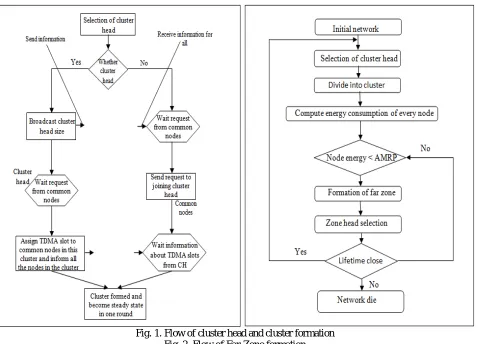
1. Formation of cluster and generation of cluster head: This protocol is further split into set-up phase and steady phase in the set-up phase the cluster is formed and the cluster head is chosen. During the steady-state phase the actual data is sent to sink. In the advanced LEACH algorithm, couple of nodes are haphazardly chosen as cluster heads (CH)s. This part is given to all nodes to adjust the energy scattering of the sensor nodes in the network. Formation of cluster is done using algorithm as shown in the Fig. 1.
Fig. 1. Flow of cluster head and cluster formation Fig. 2. Flow of Far-Zone formation
ISSN(Online) : 2320-9801
ISSN (Print) : 2320-9798
I
nternational
J
ournal of
I
nnovative
R
esearch in
C
omputer
and
C
ommunication
E
ngineering
(An ISO 3297: 2007 Certified Organization)
Vol. 4, Issue 4, April 2016
Where P is the predetermined percent of cluster heads (e.g., P = 0.05), r is the current round, and there will be few nodes that won’t have become cluster head in 1/p round that will be represented by G . Utilizing this threshold, every node will be a cluster head at some round inside 1/P rounds. After 1/P rounds, all nodes are again qualified to b e cluster heads. In advanced LEACH, the ideal number of cluster heads is assessed to be around 5% of the aggregate number of nodes.
Every node that has chosen itself as cluster head for the current round, telecasts an ad message to remaining nodes in the network. All the non-cluster head nodes, subsequent to accepting this notice message, settle on the group to which they will have a place for this round. This decision depends on the received signal quality of the ad messages. Along these lines after cluster head gets all the messages from the nodes that might want to be incorporated into the cluster and in view of the quantity of nodes in the group, the cluster head makes a TDMA schedule and generates every node a period during when it can transmit
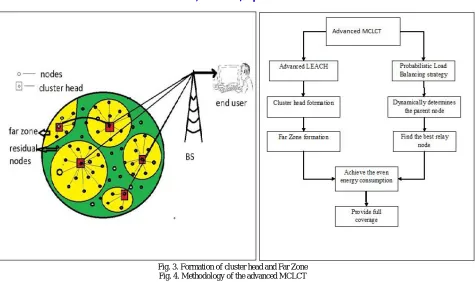
2. Formation of Far-Zone: Maximum energy is consumed by the nodes in transmitting the data over long distances. Hence the advanced LEACH proposes the formation of Far-Zone when there is large area where the clusters are formed by LEACH. The Fig. 2 shows the flow of formation of Far-Zone. After the clusters being formed the cluster which can be a Far-Zone is chosen. Each node in the cluster will telecast its power level to the cluster head to form the Far-Zone. Cluster head will select which cluster can be the Far Zone by analysing the levels of the power of each node. Fig. 3 shows the formation of clusters and cluster head and also Far-zone.
The communication between each cluster is needed to be considered. Let LPi represent the least power level needed by a node say ai , 1≤ i ≤ N to send data to cluster head say b, N represents quantity of nodes in the cluster. Once the cluster head receives the LP of all the nodes in the cluster it was calculate average minimum reachability power (AMRP) with LPi values. The equation to calculate the AMRP is given below
AMRP =∑
After calculating AMRP the node powers has to be compared with AMRP. If they are less than AMRP then they will fall under Far-Zone. After the formation of the Far-Zone it is necessary to select the zone head. This is done purely based on the random selection in which the node may be having highest energy level. After this TDMA slot will be allotted to transmit data to ZH (zone head) later ZH will transmit the date to base station.
ISSN(Online) : 2320-9801
ISSN (Print) : 2320-9798
I
nternational
J
ournal of
I
nnovative
R
esearch in
C
omputer
and
C
ommunication
E
ngineering
(An ISO 3297: 2007 Certified Organization)
Vol. 4, Issue 4, April 2016
Fig. 3. Formation of cluster head and Far Zone Fig. 4. Methodology of the advanced MCLCT
Each cluster has gateway nodes, which is used for intra communications between clusters. Whenever user send requests, a particular gateway will search for response in its cluster nodes/sensor nodes. If it is found then it will send relevant response to the user. Otherwise, it will send request to another gateway. Same process done for that particular cluster, if response is found then it will send that to user otherwise it will continue with another cluster.
Gateway nodes are communicated through duplex link connection; the duplex links between nodes have 2 Mbps of bandwidth and 10 ms of delay. Each node uses a Drop Tail queue, of which the maximum size is 10. And user also connected to different gateways through duplex link. In this way network lifetime as well as load balancing is achieved for the network system.
B. The Probabilistic Load-adjusting (PLB) Strategy
The target of the PLB technique is to perform the load balancing among the nodes by conforming the transmission probabilities. Consider a subjective node si in the level k (i.e., jump check = k). It is expected that it has v parent nodes, which are indicated by the arrangement of Prt(si ) = {sr 1, sr 2, . . . , srv }. The sending probabilities from
si to the parent nodes at τ _ is indicated as:{ ˜P(si , sr 1, τ_), ˜P (si , sr 2, τ_), . . . , ˜P (si , srv, τ_)}, where 0 ≤ ˜P (ci , srq
, τ _) ≤ (1 ≤ q ≤ v), and ˜P (si , sr 1, τ _)+ ˜P (si , sr 2, τ _), . . ., + ˜P (si , srv , τ _) = 1. As indicated by the engineering
ISSN(Online) : 2320-9801
ISSN (Print) : 2320-9798
I
nternational
J
ournal of
I
nnovative
R
esearch in
C
omputer
and
C
ommunication
E
ngineering
(An ISO 3297: 2007 Certified Organization)
Vol. 4, Issue 4, April 2016
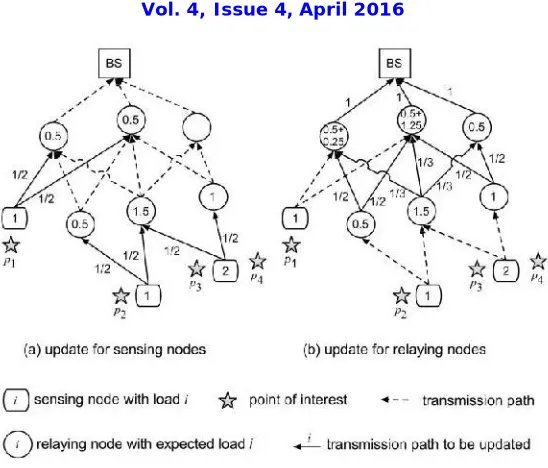
Fig. 5. Illustration of expected load and sending probability
Because of the restricted energy of sensor nodes, it is important to proficiently use their energy, which is particularly vital for the detecting nodes. As indicated by the energy utilization model embraced in this study, the detecting nodes expend the larger part of energy to do transmitting their detected information instead of detecting the DPOIs.
In particular, the energy utilization of nodes spent in transmitting is exponentially corresponding to the Euclidean separation between two sensor nodes. Fig. 5. illustrates the strategy of PLB. That is, the transmission separation ought to be conversely exponentially relative to the sending likelihood, in light of the fact that the shorter transmission way is favoured.
Subsequently, we utilize square of the proportion of node's remaining energy to transmission separation to speak to the heaviness of a one-jump transmission way between a parent node and a youngsters node, i.e., α = 2. In the wake of normalizing the weights of ways, the sending probabilities can be acquired. As indicated by the definition portrayed in, we realize that the more remaining energy a competitor parent node has and the nearer the areas of a node and its applicant parent node are, the higher sending likelihood that the node will transmit its information to its hopeful parent node.
VI. SIMULATION RESULTS
ISSN(Online) : 2320-9801
ISSN (Print) : 2320-9798
I
nternational
J
ournal of
I
nnovative
R
esearch in
C
omputer
and
C
ommunication
E
ngineering
(An ISO 3297: 2007 Certified Organization)
Vol. 4, Issue 4, April 2016
Fig. 6. Graph of load-balancing versus number of nodes
For the simulation purpose 30 nodes are being considered to write the algorithm. As shown in the Fig. 6 the advanced MCLCT i.e. with advanced LEACH outperforms the MCLCT algorithm. Load Balancing is being improved to enhance the network lifetime.
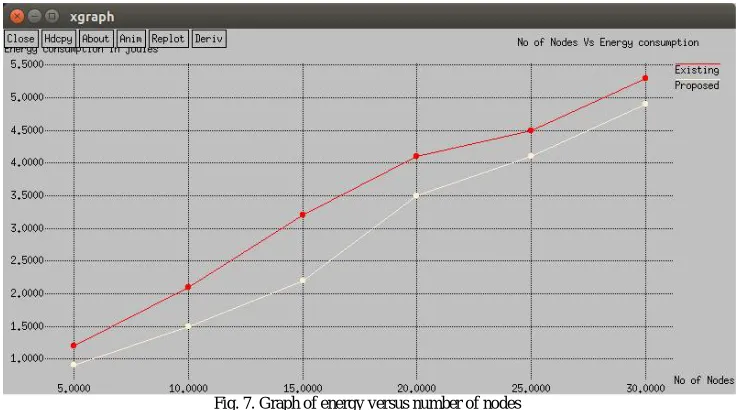
Fig. 7. Graph of energy versus number of nodes
The simulation shown in the Fig. 6 shows that the proposed system consumes less energy compared to the existing system due to increase in the load balancing. This enhances the network lifetime as the energy consumption is less.
VII. CONCLUSION
This paper is mainly concentrating on how to obtain full coverage of network and also provide load-balancing using advanced LEACH and PLB.
ISSN(Online) : 2320-9801
ISSN (Print) : 2320-9798
I
nternational
J
ournal of
I
nnovative
R
esearch in
C
omputer
and
C
ommunication
E
ngineering
(An ISO 3297: 2007 Certified Organization)
Vol. 4, Issue 4, April 2016
increased. Our experimental findings confirm that the combination of the advanced LEACH and the load-balancing algorithm is feasible in maintaining full coverage and increase in network lifetime of WSNs.
REFERENCES
[1] A. Krause, R. Rajagopal, A. Gupta, and C. Guestrin, “Simultaneous optimization of sensor placements and balanced schedules,” IEEE Trans. Autom. Control, Vol. No 56, Issue no. 10, pp. 2390–2405, Oct. 2011.
[2] M. A. Khan, H. Hasbullah, and B. Nazir, “Multi-node repositioning technique for mobile sensor network,” AASRI Procedia, Vol. No 5, pp. 85–91, Oct. 2013.
[3] X. Han, X. G. Cao, E. L. Loyd, and C.-C. Shen, “Fault-tolerant relay node placement in heterogeneous wireless sensor networks,” IEEE Trans. Mobile Computing., Vol. No 9, Issue No. 5, pp. 643–656, May 2010.
[4] Gu Ping , Xiu Chunbo ,Cheng Yi ,Luo Jing , Li Yanqing “Adaptive ant colony optimization algorithm “, IEEE conference on ICMC, Vol. No.4,pp-95-98, July 2014.
[5] D. Yang, S. Misra, X. Fang, G. Xue, and J. Zhang, “Two-tiered constrained relay node placement in wireless sensor networks: Computational complexity and efficient approximations,” IEEE Trans. Mobile Comput., Vol. No 11, Issue No. 8, pp. 1399–1411, Aug. 2012.
[6] H. Liu, X. Chu, Y.-W. Leung, and R. Du, “Minimum-cost sensor placement for required lifetime in wireless sensor-target surveillance networks,” IEEE Trans. Parallel Distrib. Syst., Vol. No 24, Issue No. 9, pp. 1783–1796, Sep. 2012.
[7] H. M. Ammari and S. K. Das, “Centralized and clustered k-coverage protocols for wireless sensor networks,” IEEE Trans. Comput., Vol. 61, Issue No. 1, pp. 118–133, Jan. 2012.
[8] M. Ashouri, Z. Zali, S. R. Mousavi, and M. R. Hashemi, “New optima solution to disjoint set k-coverage for lifetime extension in wireless sensor networks,” IET Wireless Sensor Syst., Vol. No 2, Issue No. 1, pp. 31–39, Mar. 2012.
[9] Chia-Pang Chen, Subhas Chandra Mukhopadhyay, Cheng-Long Chuang, Maw-Yang Liu,and Joe-Air Jiang,” Efficient Coverage and Connectivity PreservationWith Load Balance for Wireless Sensor Networks,” IEEE sensors journal, Vol. No 15, Issue No. 1, January 2015.