ABSTRACT
TILLMAN, MAKIA RAHNELLA. Factors Contributing to the Development of Distance Education through Preliminary Online Training and Identifying Various Levels of Technical Competencies by Online Instructors within the University of North Carolina System. (Under the direction of Dr. Terri E. Varnado.)
teaching online courses. A t-test was conducted to analyze the mean scores among
individuals who received training. The levels of technical competencies were identified with questions comprised of the following categories: (a) technical access, (b) technical
Factors Contributing to the Development of Distance Education through Preliminary Online Training and Identifying Various Levels of Technical
Competencies by Online Instructors within the University of North Carolina System
by
Makia R. Tillman
A dissertation submitted to the Graduate Faculty of North Carolina State University
in partial fulfillment of the requirements for the Degree of
Doctor of Education
Technology Education
Raleigh, North Carolina 2009
APPROVED BY:
_______________________________ ______________________________
Terri E. Varnado V. William DeLuca
Co-Chair of Advisory Committee Co-Chair of Advisory Committee
________________________________ _____________________________
Eric Wiebe Pooneh Lari
DEDICATION
This dissertation is dedicated to all who have prayed, supported, inquired, assisted, and encouraged me throughout this journey. Most importantly, I would like to dedicate this entire project to two wonderful people who left this world too soon, my dear, loving, and remarkable mother, the late Mrs. Gloria Mae Tillman and my handsome, loving, and
BIOGRAPHY
Makia Rahnella Tillman was born on November 22nd in Miami, FL to the greatest parents in the world, Mr. Ernest Robert Tillman and the late Mrs. Gloria Mae Tillman. Makia attended Miami Senior High, Miami, FL where she was accepted into the Teaching Magnet Program. From this experience, Makia began anticipating teaching as a career. After
graduating from Miami-Dade Community College with a major in Education, she pursued a Bachelors of Arts in Education with a minor in American Sign Language at the University of South Florida in Tampa, FL. While at USF, Makia participated in the following
organizations/ programs: (a) American Sign Language Club (served as Vice President from 1998-1999), (b) SCATT- SunCoast Area Teacher Training Program, (c) Kappa Delta Pi International Honor Society in Education, (d) National Residence Hall Honorary (NRHH), and (e) Sigma Lambda Gamma National Sorority, Inc.
Upon completion of the BA degree, Makia moved back to Miami and began working as a Temporary Instructor. During this time, she applied at Florida Atlantic University in Boca Raton, FL where she was accepted and received a Master of Arts in Education with a major in Educational Technology and Research. She had the experience of enrolling in many programming courses where she studied Visual Basic, C++, HTML, amongst other
programming and web design which led her to a new world on teaching and instruction. After graduating with a MA degree, Makia began working in her second common field as a Job Coach/ Communications Assistant for a non-profit organization. In this position, she was able to assist deaf and hard of hearing individuals with employment, serve as an interpreter, a job developer/coach, and employment specialist. In addition, Makia was influenced by a former professor, Dr. Marta Cruz-Janzen to participate & present a paper entitled, Race & Gender in the US Media at the Gender & Class National Conference in New Orleans, LA. Dr. Cruz-Janzen also encouraged Makia to pursue a terminal degree. She [Makia] applied to North Carolina State University and was accepted in the Spring of 2004. While at NC State University, Makia was a research-technology graduate assistant for the African American Cultural Center where she excelled in her marketing and web design skills. Afterwards, she continued utilizing those skills in her current position as an administrative support specialist. In this position, Makia maintains the unit’s website, coordinates new employee orientation, designs online surveys/ evaluations, coordinates meetings, conferences, and workshops and manages the learning management system for North Carolina Cooperative Extension. While working in this position, Makia was able to successfully pass her dissertation defense on Thursday, July 2, 2009.
ACKNOWLEDGMENTS
First, I would like to give thanks, praise, honor, and glory to the great “I AM THAT I AM.” The King of Kings and Lords of Lords; the only wise God-who is my Saviour! I would like to take this opportunity to thank GOD for HIS goodness, HER mercy, and ITS kindness. This journey would have been impossible if it was not for YOU. Throughout this journey, I was able to lean not to my own understanding, but in all my ways I had to acknowledge YOU—for YOU are the source of my life, so thank you once again.
To my loving family—Dad and Mom, I love you both. I thank God for thinking enough of me to bless me with parents like you. To my grand and noble spiritual leader—I thank you meeting me ‘in the air’ and praying for me whenever you heard the call. Thank you!
I would like to give special thanks to Dr. Consuelo Arellano and Dr. Kimberly Weems for taking the time to teach me statistics. I really appreciated your efforts and
willingness to make sure I understood, or had a strong foundation in this area. Thanks goes to Dr. Kyndra Middleton for being that extra pair of eyes when I needed them. You will always be remembered for your efforts and assistance in my pursuit of reaching this level. Thank you so very much. Last, but definitely not least, to Dr. Marta Cruz-Janzen for encouraging me to pursue a doctorate degree. Your efforts, dedication, and support assisted me
tremendously throughout this journey. I thank God for you and I pray that we are able to do some collaborative work together—as colleagues!
TABLE OF CONTENTS
LIST OF TABLES ... x
LIST OF FIGURES ... xiii
Chapter 1: Introduction to the Study ... 1
Background of the Problem ... 1
Faculty Preparedness ... 5
Competencies for DE Faculty ... 5
Statement of the Problem ... 6
Purpose of the Study ... 7
Significance of the Study ... 8
Research Questions ... 9
Assumptions of the Study ... 9
Limitations of the Study... 10
Definition of Terms... 10
Summary ... 13
Chapter 2: Review of Literature ... 15
Origination of Distance Education ... 15
Faculty Involvement and DE Training ... 22
Quality of Online Instruction ... 24
Pedagogical Training ... 25
Faculty Perceptions ... 25
New Roles for Online Instructors ... 27
Facing the Challenge ... 28
Summary ... 29
Chapter 3: Methodology ... 30
Design of the Study ... 30
Pilot Study ... 31
Implementation and Validity ... 32
Methods of the DE Study ... 33
Population and Sampling Procedure ... 33
Procedure ... 33
Instrumentation ... 33
Advantages & Disadvantages of Online Surveys/Questionnaires ... 34
Reliability ... 35
Data Collection Method ... 36
Chapter 4: Findings ... 39
Population Description... 39
Research Question One ... 43
Research Question Two ... 51
Research Question Three ... 55
Research Question Four ... 73
Summary ... 77
Chapter 5: Discussion and Recommendations ... 78
Introduction and Background Problem ... 78
Purpose of the Study ... 79
Significance of the Study ... 79
Research Questions ... 80
Findings and Discussion ... 81
Summary ... 87
Recommendations for Further Research ... 90
REFERENCES ... 92
LIST OF TABLES
Table 2.1 Compilation of Competencies for Online Instructors ... 21
Table 3.1 Cronbach’s Alpha for Instrument Questions based on Individual Categories ... 36
Table 4.1 Summary Statistics for Composite Variables ... 45
Table 4.2 DE Training and Composite Variables ... 46
Table 4.3 Independent Sample Test ... 48
Table 4.4 Analysis of Variance for Technical Composite Variables ... 50
Table 4.5 Assisted Students with Technical Support ... 52
Table 4.6 Assisted Students with Basic Technical Issues ... 53
Table 4.7 Supported Students with Disabilities ... 54
Table 4.8 Composite Analysis for Technical Proficiencies and Assistance ... 55
Table 4.9 DE Training Received Compared to Experience with Internet Tools ... 58
Table 4.10 DE Training Received Compared to Experience with Computer Programs ... 59
Table 4.12 DE Training Received Compared to Experience with the Web ... 61 Table 4.13 DE Training Received Compared to Experience with Printing
from the Web ... 62 Table 4.14 DE Training Received Compared to Experience with Web
Settings ... 63 Table 4.15 DE Training Received Compared to Experience Troubleshooting ... 64 Table 4.16 DE Training Received Compared to Experience using HTML ... 65 Table 4.17 DE Training Received Compared to Experience with LMS
Editing ... 66 Table 4.18 DE Training Received Compared to Managing Student’s
Activities ... 67 Table 4.19 DE Training Received Compared to Experience with Asynchronous
and Synchronous Communication Programs ... 69 Table 4.20 DE Training Received Compared to Managing Operating
Programs ... 70 Table 4.21 DE Training Received Compared to Experience Using Computer
Table 4.24 Knowledge Acquired Post DE Training ... 75 Table 4.25 DE Training & Instructors’ Perceptions to Preliminary Online
LIST OF FIGURES
Figure 4.1 Number of DE Courses Taught ... 39 Figure 4.2 DE Training Received Compared to Number of DE
Courses Taught ... 40 Figure 4.3 DE Training Received Compared to Number of Years
Chapter 1: Introduction to the Study Background of Problem
Distance education (DE) has emerged as an increasingly important component of higher education (National Center for Education Statistics [NCES], 1998). As the world shifts from the Industrial Revolution into the Knowledge Revolution, higher education as a major societal resource is sought to an extent never before witnessed (Oblinger & Verville, 1998). Many institutions support DE programs that provide students with an alternative way of learning. The definition of DE has been refined and redefined over the years (Maguire, 2005). As seen in the evolution of Moore's (1990) DE definitions, DE is described as “all arrangements for providing instruction through print or electronic communications media to persons engaged in planned learning in a place or time different from that of the instructor or instructors” (p. xv). Later, Moore and Kearsley (1996) refined the definition to specify that learning is still planned, but also includes “organizational and administrative arrangements” (p. 2). Other definitions indicated that DE is teaching and learning that occurs
Survey results released by the United States Education Department Press (USEDP, 1999), reported that American colleges expanded dramatically during the online education takeoff of the late 1990s- with more colleges offering additional DE courses and more students taking them (Kiernan, 2003). Between 1995 and 1998, the percentage of higher education institutions offering courses outside the traditional classroom increased by one-third, from 33% to 44% (USEDP). During the academic year of 1997-98, 79% of public four-year institutions offered DE classes specifically. In addition, DE course offerings and
enrollment nearly doubled between the academic years 1994-95 and 1997-98. The fastest growth has been in courses provided over the Internet, jumping from 28% of institutions in 1995 to 60% in 1998 (USEDP).
NCES (1998) estimated an increased enrollment for credited DE courses at 2.9 million in the 2000-01 academic year, up from 1.3 million in 1997-98. This enrollment statistic counted individual enrollments for each course; for example, a student who enrolled in three courses was counted three times (Kiernan, 2003). The USEDP (1999) survey found that public institutions offered DE courses more frequently than did private institutions. Ninety percent of public two-year institutions offered DE courses, compared with 16% of private two-year colleges. Eighty-nine percent of public four-year colleges offered the courses, compared with 40% of private four-year institutions (Kiernan).
new technologies (Kosak, Manning, Dobson, Rogerson, Cotnam, Colaric, et al., 2004). Additionally, faculty need to have some understanding of pedagogy as it relates to distance instruction.It is imperative for online instructors to know how to convert traditional lectures into interactive lessons, which in turn, will encourage students to be active participants (Meyan, Lian, & Tange, 1997). Many educators find themselves considering the role of online instructors as distance learning through online courses increase. Instructors may realize that online instruction is similar yet different from face-to-face learning, requiring new or different skills, and strategies for effective online direction (Heuer & King, 2004). DE faculty must be willing and able to develop new methodologies of teaching that redistribute power, role, and responsibility within the learning community (De Simone, 2006). They must not only develop the necessary competencies to do their work, but must develop a clear understanding of their redefined roles and responsibilities to ensure the success of learning activities carried out at a distance (De Simone).
According to Levy (2003), faculty members are faced with a number of new situations when teaching an online class as opposed to a traditional class that includes the following:
1. the administration or management of online courses; 2. the course layout and design;
3. the best delivery method for the content, such as text, graphics, audio, or video; 4. the various communication methods that the students will use (i.e. email, discussion
boards, and chat room);
5. ways to increase and maintain student involvement; 6. appropriate student assessments for online learning;
7. and a working knowledge of all the technologies being implemented in the online course.
Faculty members need a solid structure of support on which to rely when
implementing online curriculum change. It is vital that this support be continuous from the planning stage through implementation (Kosak, et al., 2004). Collison, Elbaum, Haavind, & Tinker (2000) expressed that “the sage on the stage is replaced with the guide on the side approach wherein the teacher, while an expert, facilitates dialogue so that students learn from each other as much as from her” (p. 208, 211). Many practitioners have noted this shift in emphasis from presentation of content to facilitation of learners and learning (Collis, deBoer, & VanderVeen, 2001).
Faculty Preparedness
The challenge to higher education systems is to provide increased access to
educational opportunities, often with no additional resources. One way for higher education to meet this challenge is by incorporating technology-based DE, which allows for the immediate expansion of educational access and is capable of maintaining cost effectiveness in the long term (Twigg & Oblinger, 1996). Ansah & Johnson (2003) expressed that this is a well-embraced solution except for the omission of one key component: the complexity of adequately preparing the individuals who are directly impacted by such an educational change (i.e., the university administrators, instructional faculty and the students themselves). Palloff and Pratt (2000) noted that the instructor must be trained not only to use technology, but also to shift the way in which they organize and deliver material. Valentine (2002) indicated that misuse of technology could also be a problem for the instructor. This problem may arise from lack of training, instructor's attitudes, or hardware problems. Faculty should learn how to use technology, but not completely rely on the technologies. Instead, they should be able to identify and recognize the strength and weakness of technologies, and select the most appropriate delivery mechanism for their lessons (Gunawardena, 1990). Competencies for DE faculty
A specific set of skills or competencies is needed to teach in an online environment (Smith, 2005). “Competency means a condition or quality of being competent[sic];
individuals know and can do), and allows flexible pathways for achieving the outcomes – making as clear as possible what is to be achieved and the standards for measuring
achievement” (p. 2). The purpose of obtaining various technical competencies is to assure that technical aspects of the online courses are running smoothly and student barriers due to technical components are quickly overcome. As a result, the instructor's actions will help make the technology moderately translucent to the student (Southern University Baton Rouge [SUBR], 2007).
As the number of instructors taking part in online education grew from the early adopter phase into acceptance by the masses, many qualified instructors still had no formal education in the methods of online instruction or facilitation (Varvel, 2007). Additionally, those with training do not have any supplementary training or experience in this area. In order to extend the educational experience beyond the limitations of both time and space, while maintaining interactivity and high quality instruction, effective use of the Internet subdued many perceived limitations of the medium (Varvel).
Statement of the Problem
classroom setting (Northrup, 1998; Moore & Kearsley, 1996). Much of the focus in the DE literature centered on the learner and learning, almost to the exclusion of the teacher and teaching, which led instructors of DE suspended in virtual space (De Simone, 2006).
While receiving DE training, instructors need to know what qualifications they must acquire in order to design and deliver effective online instruction (Yang & Cornelious, 2005). First, instructors need to upgrade their technical skills in order to keep abreast of
technological developments (Volery, 2000). Second, they need to know how to operate the learning platform, troubleshoot with problems online learners may encounter, and design interactive activities and course syllabi (Cuellar, 2002). For this reason, faculty receiving DE training before actually delivering online courses is very crucial (Yang & Cornelious).
Purpose of the Study
The purpose of this study was to determine whether preliminary online training is beneficial to online instructors prior to teaching online courses and whether their levels of technical competencies are affected due to the preliminary training. Other factors may have contributed to the intensified levels of technical competencies (i.e. the number of years teaching online courses, level of degree, etc.), which may influence the knowledge of individuals prior to teaching online courses. The researcher focused primarily on the technological roles and skills needed for online instructors for this study.
Smith (2005) identified competencies instructors need prior, during, and after
competencies and compare it to those who had received DE training prior to teaching online courses.
More specifically, this study will provide a better understanding of several factors that may cause faculty to be unprepared to teach online courses, which may include the following:
1. lack of training;
2. lack of various learning management systems; 3. not enough time to prepare;
4. and more work, less time, etc.).
Significance of the Study
The significance of this study was to identify the technical competency levels and determine the extent to which DE training meets the need of online instructors. Since studies have shown that certain types of training are essential to teach online courses, it is important to provide online instructors with appropriate DE training. Varvel (2007) expressed that many qualified instructors have no formal training in the methods of instruction or
Frye, 1991). Furthermore, online instructors need to prepare a list of skills or competencies to assist with their development of being a competent instructor (Varvel, 2007). “As
communication and information technologies evolve, the roles and competencies necessary to utilize such technologies for instruction are effected” [sic] (Williams, 2000, p. 5). This study focused primarily on the technical competencies compiled from experts in the field.
Research Questions
1. Is DE training provided? If so, was there a difference between the levels of technical competencies from individuals who received or did not receive training prior to teaching online courses?
2. Why is it important for online instructors to have technical support post DE training? 3. What types of technical proficiencies and assistance were acquired post DE training? 4. Do online instructors feel that DE training was beneficial to their teaching needs? If
so, what were the factors contributing to this response? Assumptions of the Study
1. Participants may have limited knowledge of basic Learning Management Systems (LMS) or Course Management Systems (CMS).
2. Each of the fifteen higher education institutions within the University of North Carolina (UNC) System provides a DE program.
4. The names and emails retrieved from the DE representative and institution’s website were current andreliable.
5. Participants completed the online survey honestly and professionally.
Limitations of the Study The following condition was recognized as a limitation:
1. The sample for this study was a selection of instructors who are currently teaching online or hybrid courses at one of the 15 higher education institutions within the UNC system.
Definition of Terms
Advance: To accelerate the growth or progress of; to rise to a higher rank (Merriam-Webster Online Dictionary, 2009).
Asynchronous: A type of communication that occurs with a time delay between steps in the dialog, allowing participants to respond at their own convenience
(http://www.aln.aln.org/alnWeb/aln.htm).
Beginner: One that begins something; an inexperienced person (Merriam-Webster Online Dictionary, 2009).
Course Management Software (CMS): A web- based system that allows for the addition, deployment, and tracking of learning content used for training purposes (Cyber Media Creations, 2005). For the purpose of this study, this term will be used interchangeably with LMS.
Distance Education (DE): The delivery of instruction administered using communication technologies through a type of learning management system in an asynchronous environment where the learner and instructor are not in a face-to-face setting. DE delivery methods
include, but are not limited to videoconferencing, telecourse, broadcast, and CD Rom. For the purpose of this study, online education, and DE will be used interchangeably.
Distance Educator: One who teaches courses in an asynchronous environment using communication technologies through a type of LMS or CMS. For the purpose of this study, distance educator, online educator, online instructor, and online faculty will be used
interchangeably.
Distance Learning: Term often used synonymously with distance education, not strictly correctly since distance education includes teaching as well as learning (Global Distance Education Net, 2003). For the purpose of this study, distance learning and distance education will not be used interchangeably.
Electronic Learning (eLearning): The process of sharing information and creating
knowledge using an electronic medium. eLearning enables massive advances in technology
such as the Internet, LMS, and CDs to create interactive materials that increase productivity
through increased knowledge retention (Cyber Media Creations, 2005).
HTML: A HyperText Markup Language that is used to create documents on the World Wide Web incorporating text, graphics, sound, video, and hyperlinks.
Intermediate: Being or occurring at the middle place, stage, or degree, or between extremes (Merriam-Webster Online Dictionary, 2009).
Learning Management System (LMS): A web- based system that allows for the addition, deployment and tracking of learning content used for training purposes. Typically, a LMS
includes functionality for course catalogs (search/browse functionality), launching courses,
registering new students, tracking current/completed student progress, and assessments
(Cyber Media Creations, 2005). For the purpose of this study, this term will be used interchangeably with CMS.
Online Education: Credit-granting courses or education training delivered primarily via the Internet to students at remote locations, including their homes (U.S. News & World Report, 2007).
Online Learning: An umbrella term used to describe any education or training that occur online (Cyber Media Creations, 2005).
Technical Access: The right to use technical equipment and software for the given medium and the course(Varvel, 2007).
Technical Assistance: Knowledge to aid students with technology provided in the course (Varvel, 2007).
Technical Proficiencies: Knowledge and ability to use computer programs that are typically required in online education to improve learning/teaching, personal productivity, and
information management (Varvel, 2007).
Technology: A broad description is: (1) human innovation in action that involves the generation of knowledge and processes to develop systems that solve problems and extend human capabilities; (2) the innovation, change, or modification of the natural environment to satisfy perceived human needs and wants (International Technology Education Association [ITEA], 2000). For the purpose of this study, the word technology will specifically describe computer technology and communications technology.
Summary
DE has emerged and become a great resource tool for education, learning, and
Chapter 2: Review of Literature Origination of Distance Education
DE originated in the early 1700s to teach writing by mailing students self-instructional texts prepared by a tutor (Holmberg, 1989). In 1680, the Penny Post was established in London by William Dockura (Shanahan, E. & Shanahan, R., 2006) and then incorporated in Great Britain by Isaac Pitman in 1840 (Picciano, 2001). In the 1830s, Sweden, Germany, and Great Britain were known to have correspondence courses. This process included sending a letter with instructions for the cost of a penny. The Penny Post was considered to be one of the most remarkable programs in Great Britain (Picciano). By the mid-nineteenth century, the development of the postal system in the first programs of DE appeared.
In the early 1900s, many American university-level DE programs were designed or revised where significant technological advancements occurred in print and communications technology. The aforementioned technologies added greatly to the ability of DE practitioners to reach their students (Fishman, 2003). Innovations such as high-speed presses, copying equipment, telegraphs, and telephones brought about the annihilation of the space-time-economic boundaries that had traditionally constrained the opportunity to learn. Without such innovations in print technology, many university DE programs that were (primarily based in written correspondence) would not have been possible (Fishman).
and secondary education (Picciano, 2001). With the introduction of new media other than the written word, some universities who offered correspondence instruction made use of the radio to supplement their programs during the 1920s. Later on, with the introduction of television and video, this process developed tremendously; whereas, many universities used television (i.e., Columbia Broadcasting System [CBS] and National Broadcasting Company [NBC]) in distance learning as a method of instruction. However, being private and
commercial in nature, these television companies provided limited support. In the 1970s, Public Broadcasting Services [PBS] contributed in the development of DE and still does today (Picciano).
re-examine the long history of DE. This re-examination will provide ways in which
revolutionary developments, such as virtual classroom and e-mail collaborations have more in common conceptually with early iterations of DE than might be supposed (Fishman). The DE re-examination represents an attempt to identify some of those commonalities, with respect to both ways in which DE technology has functioned in particular historical contexts and to their significance to the field of DE in a more global sense. It is hoped that through such investigations, this process will better shape DE courses to take advantage of the functionalities of new technologies without losing the benefits of DE that have traditionally drawn students and teachers to it (Fishman).
Because technology is the means by which interaction is affected in DE,
The latter half of the twentieth century marked a period in which DE programs began to enjoy significant gains in status, as measured by numbers of students enrolled, percentages of universities offering DE courses, and acceptance of DE programs (MacKenzie,
Christensen, and Rigby, 1968). As perceptions of DE became more positive, DE proponents approached their work with renewed vigor in what some DE scholars termed the era of enthusiasm (Kekerix & Andrews, 1991).
New technologies such as cable, fiber optics, and satellite communications appeared in the 1970s and 1980s that contributed to hours of television services reaching people who needed this education via distance (Picciano, 2001). By the 1990s, DE had emerged to the World Wide Web, electronic mail, and group software. The increased enrollment by millions of students became visible for programs ranging from K-12 to higher education (Hmaidan, 2001).
DE described the interactive transmission of academic content from a central teaching point to electronically connected remote sites (LeBaron & Tellos, 1998). Its delivery methods became very popular in curriculum and instruction at various colleges and universities
(Major & Levenburg, 1997). Keegan (1990) defined the following key characteristics of this field as:
1. The separation of the teacher from the learner(s), 2. The use of technical media, and
1. The emphasis on the design of educational materials, and
2. The central role conferred to learners in the educational process.
The lack of immediacy between instructor and student, such as the design of materials and organization of the teaching or learning process has a profound impact in educational transactions (Moore & Kearsley, 2005). Nevertheless, technology wizardry by itself will not produce desired learning outcomes. Creating and implementing successful learning systems require a thoughtful blend of educational philosophies, new technology, and solid
instructional design (Major & Levenburg, 1997).
The number of students who used online learning technology substantially increased from an estimated 2.3 million students in 2005 to 3.2 million in 2006; universities reported that online learning is critical to long-term strategies (Allen & Seaman, 2006). Palloff and Pratt (2001) reported that almost 90% of institutions with enrollments of 10,000 or more offered some form of Web-based education. Hosie and Schibeci (2005) noted that education and global learning is its own mega trend. Predictions abound regarding the virtual university of the world without any national boundaries (Moe & Blodget, 2000, and Taylor, 2001). There should be no doubt that online learning is vital to all disciplines involved in education in the 21st century (Ternus, Palmer, & Faulk, 2007).
Competency Levels of Faculty
task [instructs] in a given context [digital distance education] using appropriate knowledge, skills, attitudes, and abilities that have adjusted and developed with time and needs” (p.3, ¶ 2) In order to design and deliver effective online instruction, instructors need to know what qualifications are needed to accomplish this task. Most importantly, they need to
upgrade their technical skills in order to keep abreast of technological developments (Volery, 2000), and know how to design interactive activities and course syllabi, operate the learning platform, and troubleshoot problems online learners may encounter (Cuellar, 2002).
Therefore, faculty receiving training before actually delivering online courses is crucial. The competency approach suggested that a minimum level of performance is acceptable rather than
setting a higher bar or striving for a “standard of excellence” (Kerka, 1998, p. 5). However, what
is intended here is an integrated or holistic approach; whereas, one that “sees competence as a
complex combination of knowledge, attitudes, skills, and values displayed in the context of task
performance” (p. 6). Instructors need to know which technology to choose for their course
delivery (Palloff & Pratt, 2001), and be able to translate content from the traditional setting to
online delivery (Moore, Winograd, & Lange, 2001).
Table 2.1
Compilation of Competencies for Online Instructors
Competency/ Roles and Skills Output Process
Administrative Familiar with institutional setting, the legal setting, general institutionalized ethics Personal Involves the overall physical and mental
abilities of the instructor and the
instructor’s intrapersonal cognitive domain Technological
Pedagogical
Social
Planning Skills
Collaboration/ Teamwork Skills Managerial Skills
Data Analysis
Technology independent of pedagogy Involves the design and implementation of instruction
Provides value to social functions (community of practice)
Be clear and well organized
Work with instructors to design courses Manage/supervise distance learning staff and operations
Varvel (2007) compiled a total of 251 competencies for instruction; whereas, Thach and Murphy (1995) identified the top ten competencies of distance education professionals within the United States and Canada that described the importance of both communication and technical skills.
Faculty Involvement and DE Training
The NCES (1998) indicated that about 60% of higher education institutions provided training opportunities for DE faculty. Of the 60% providing special training, about one-fourth required faculty to have training in distance learning technology, 13% required training in curriculum development, and 17% in teaching methods for distance learning (NCES). The NCES did not report the depth or extent of the training provided, which is an important consideration in the issue of instructor preparedness.
Many researchers have reported the importance of faculty training (McKenzie, Mims, Bennett, & Waugh, 2000, and Levy, 2003). The question is what kind of training will qualify instructors to deliver online courses. The instructor must be trained to use the designated software, manage online courses, integrate web sources, and interact with students through the web (Ko & Rossen, 1998). Some online facilitation skills, such as giving positive or negative feedback, encouraging students to become actively involved in online learning, and dealing with disruptive students, could be offered in training programs to prepare qualified online instructors (Hitch & Hirsch, 2001). This training is best offered online, since it
Reciprocally, renewed enthusiasm for DE led to increased experimentation with concurrent developments in the delivery of courses, often with greater reliance on technology (Fishman, 2003). The partnership between DE and technology signaled one of the most identifiable changes in DE since its inception: the beginning of an era in which college-level instruction began to take place without its participants ever meeting in a classroom, and relying entirely upon correspondence-style instruction (Fishman). DE requires technology to bridge the gap between instructor and learner; in doing so, the developments of technology may necessarily affect what is possible and practiced in DE.
Institutional support for DE faculty is essential and should promote motivation and satisfy the needs of faculty (Bower, 2001). Regardless of how innovative faculty can be, they may have concerns towards teaching. Their development must begin and end with an
emphasis upon the enhancement of teaching effectiveness (Harrsch, 2000). Professional development programs must offer faculty tangible benefits before they embrace new approaches (Harrsch). If technology integration is to be a success, faculty and staff
development programs must target individual skill and knowledge, and address contextual factors such as organizational policies and institutional support structures (Edmonds, 1999). Perhaps most importantly, faculty must understand that the use of technologies is a guide to enhance their effectiveness as teachers, and that the integration of technologies is an
Quality of Online Instruction
The attitudes of the administration and instructor carry the most weight to the quality of instruction (Valentine, 2002). A study by Inman & Kerwin (1999) showed that instructors had conflicting attitudes about teaching distance education. The majority of online instructors rated the quality of the course as only equal or lower quality than other classes taught; in any event, they were willing to teach another online course (Inman & Kerwin). Often times it appears that administration believed that technology itself would improve the quality of the class (Valentine). Palloff and Pratt (2000) reminded us that “technology does not teach students; effective teachers do” (p. 4). Additionally, Valentine remarked that the issue is not technology itself, but the design usage and delivery of courses. The quality of instruction is affected by instructors not designing their lessons to take advantage of the technology available. Research suggests that the effectiveness of distance learning is based on
preparation, the instructor’s understanding of students' needs, and an understanding of the target population (Omoregie, 1997). Sherritt (1996) found in her survey of higher education administrators that many of the decision makers viewed distance programs as second rate, a “necessary but deficient form of education” (p. 2). She denoted that this attitude was also found in academic departments that “had no strong mandates to adjust their curriculum and instruction to fit distance learning beyond cursory cooperation”
Pedagogical Training
An online classroom provides the opportunity to establish a community of learners, but the techniques required to facilitate the development of such a community are very different from those that work in the traditional face-to-face classroom (Palloff & Pratt, 2000). Techniques that are effective in the traditional classroom are not necessarily effective in an online environment (White & Weight, 2000). Faculty who are experienced and
successful in traditional classrooms may not intuitively make the transition to the online environment (Harasim, 1990). They need professional development in order to learn what works and what does not work online. Faculty have no time to reinvent the wheel, but do recognize the sooner they learn effective pedagogical techniques for online environments, the more likely their students are to succeed. That is, faculty may not particularly choose to learn by experience. (Pankowski, 2004).
Faculty Perceptions
College administrators increasingly pressure faculty to participate in distance learning and other technology related endeavors. Most faculty, however, have not responded as
of college and university faculty find it challenging to keep abreast of information technology.
Several challenges and barriers identified by researchers for online learning are the change of roles and responsibilities for instructors (Zheng & Smaldino, 2003; Muirhead, 2000), use of technology (Valentine, 2002; Palloff & Pratt, 2000; Berge, 1998; Volery, 2000), interaction with students and the changes in interpersonal relations (Bower, 2001), and academic dishonesty of online learners (Muirhead). O'Quinn & Corry (2002) delineated several factors that may deter faculty from teaching online including a lack of professional prestige, delivery method used, change in faculty role, and lack of monetary support.
For a variety of reasons, faculty (individually or as a whole) resisted efforts to force them into distance learning and as a result, they sought the guidance of union representatives (Bower, 2001). While individual faculty members had individual reasons to oppose
(Bower); thus, fear of appearing incompetent may cause faculty to resist involvement in any activity for which they have not had the proper training, including appearing on camera or conducting class via computer. Faculty may feel they have not been provided adequate DE training or experience to competently manage teaching distance learning courses (Bower). New Roles for Online Instructors
Online education is widely accepted as student-centered education, while traditional education is considered as professor-centered education (Yang & Cornelius, 2005). The shift from a traditional setting to an online environment caused the instructor's role to become more facilitator rather than lecturer. Instructors have many issues concerning online education (Yang & Cornelius). Their primary concern is the shift in their roles and
responsibilities, and adaptation to the change (Kettner-Polley, 1999). The shift in instruction created a role for the instructor to: (a) select and filter information for student consideration, (b) provide thought-provoking questions, and (c) facilitate well-considered discussion (Kettner-Polley).
Facing the Challenge
Muirhead (2000) identified challenges faculty encounter while teaching online courses. The list is as follows: (a) increasing frustration with the reliability of computer technology, (b) working with multiple versions of a software package, (c) providing technology support to students using multiple operating systems, and (d) the absence of mature integrated content development tools. Since the role of instructors in online courses is now to facilitate, mentor, and coach, instructors need to adjust their attitudes towards
technology and new teaching styles to meet the challenge (Volery, 2000).
Deubel (2003) argued that the instructor's attitude, motivation, and true commitment affect much of the quality of online instruction. High quality online instruction encourages discovery, integration, application, and practices. Instructors need to discover students' learning preferences, integrate technology tools, apply appropriate instructional techniques, put them all into practice, and generate the most suitable method of learning for individuals. Students are likely to experience positive learning outcomes when their instructors hold positive attitudes toward online delivery of course content (Deubel). Factors contributing to positive attitudes may include the following: (a) instructor's prior experience teaching online, (b) intellectual change, (c) monetary support or promotion/tenure, (d) availability of online courseware, (e) improved training and facilities, (f) feedback from students, and (g)
obtain the training needed to use required technology, and (c) seek assistance from experienced instructors when needed.
Summary
Chapter 3: Methodology Design of the Study
This study was conducted to examine the need for DE training, identify online instructors’ technical competency levels, determine whether the increased levels of technical competencies resulted from DE training prior to teaching online courses, and identify
whether other factors contributed to the increased levels of competencies based on their technical proficiencies.
A survey was used to collect data (Appendix G). Surveys are used extensively for both descriptive and explanatory purposes, and among all approaches to social research, surveys offer the most effective means of social description. Surveys address a much broader range of research topics than experiments (Simon, 1978). Babbie (2001) explained that surveys may be used for descriptive, explanatory, and exploratory purposes and are the most widely used method for collecting data in the social sciences; especially in sociology and political science (Bradburn & Sudman, 1988). They are predominantly used in studies that have individual people as the unit of analysis. Researchers are increasingly using the web to administer surveys (Gall, Gall, & Borg, 2003).
Quantitative data was collected from a population of online instructors within the UNC System. Varvel (2007) established five competencies for online instructors: (a)
only technological roles and abilities, which are categorized into the following three areas (Varvel).
1. Technical Access 2. Technical Proficiencies 3. Technical Assistance
Categorical groups were compared at 95% confidence level and p=0.05 (Agresti & Finlay, 1997).
Pilot Study
Pilot studies are developed to try-out data collection methods and other procedures (Gall, Gall, & Borg, 2003). This pilot study was conducted to verify the validity of the study and the reliability of the instrument. Furthermore, this study was designed to determine whether preliminary training was received prior to teaching an online course, identify the technical competency levels, and obtain feedback (from pilot participants) on the designed instrument. The instrument was examined to ensure cohesiveness, accuracy, and
comprehension. This process identified problems with the possibility of solving them more easily than when the main study is underway (Gall, Gall, & Borg).
(technical assistance) with a Cronbach’s Alpha of .78. According to (Nunnally, 1978), a 0.7 and above is acceptable. Of the 30 individuals who were notified to participant (via email), 11 completed the online survey (a response rate of approximately 36%) with their additional comments and suggestions. One individual denied participation; one email was
undeliverable; and 17 individuals did not respond. Of the 11 responses, 73% expressed receiving DE training prior to teaching their first online course, all of whom expressed using WebCT Vista/Blackboard as their primary LMS. The estimated average of individuals who received DE training prior to teaching online was 0.74 with a margin of error of plus or minus 0.28. The results indicated that the individuals had a basic understanding of the technical proficiencies. With the amount of information needed to teach online courses, it is evident that some type of training is needed.
Implementation and Validity
Names of online instructors were retrieved by either the DE representative from one of the 15 higher education institutions within the UNC System or the institution’s website. These names were inserted into the statistical software, SPSS 16 where 30 participants were randomly selected to participate in the pilot study (Krejcie & Morgan, 1970). An email was sent to selected participants that detailed their anticipated participation in the study, the importance of the study, and the need for their participation (Dillman, 2007). Included in the email was a link to the online survey with explicit instructions for participants to make
instrument. The respondents did not indicate any identified problems, comments, or suggestions. However, the researcher detected changes needed for the main study (i.e. structure and rearrangement of questions, and modification of words and sentence organization) and made the changes accordingly.
Methods of the DE Study Population and Sampling Procedure
The population of the study included 1,143 instructors currently teaching online-hybrid courses within the UNC system. The institutions within the UNC system were chosen to provide an overview of online instructors across the state of North Carolina, and to obtain findings relative to prospective faculty- instructors who may be interested in teaching online classes. Because of the cost reduction and paper elimination of an online survey, the
researcher surveyed the entire population of online instructors. Procedure
Instrumentation
and Thach & Murphy, 1995) were identified and used to design the instrument for this study. Each research question was formulated based on the three categories. Initially, when
participants received an email link to the online survey, a consent form was attached to the email (Appendix C) for individuals to [electronically] sign the form and return it to the researcher. After the main study was conducted, a few individuals expressed a confidentiality concern, which led to a modification and re-implementation of the study. The researcher then designed an online page (Appendix D) for participants to electronically sign or initial. Upon clicking the submit button, participants were automatically re-directed to the main study which, was a 35-item online survey. Dillman (2007) recommended keeping surveys or questionnaires short and easy. In order to improve response rates, one must design respondent-friendly questionnaires, with carefully organized questions in easy-to-answer formats (Dillman, Sinclair, & Clark, 1993).
Advantages and Disadvantages of Online Surveys/ Questionnaires
The Internet provides ready access across the geographic boundaries and time zones (Schmidt, 1997). Tuten, Urban, and Bosnjak (2002), expressed that there are many
especially when dealing with sensitive topics (e) possibility of increased participation with the aid of dynamic/interactive survey process, and (f) reduction of errors in coding and transcription. On the contrary, Zhang listed four potential problems unique to Internet-based surveys: (a) biased sample and biased return, (b) variation and difficulty in reporting
response rate, (c) impersonalized survey request, and (d) more technical expertise required for survey researchers. Internet-based surveys are still under development and are being enhanced; their full potential appears not yet realized. Internet-based surveys provide great opportunities for researchers; however, pose many challenges to them as well. In spite of the disadvantages, Internet surveys represent an exciting alternative new method for researchers (Abdulla, 2004).
Reliability
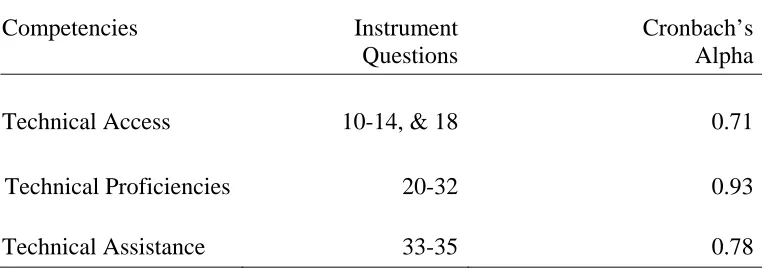
Table 3.1
Cronbach's Alpha for Instrument Questions based on Individual Categories Competencies Instrument
Questions
Cronbach’s Alpha
Technical Access 10-14, & 18 0.71
Technical Proficiencies 20-32 0.93
Technical Assistance 33-35 0.78
Cronbach's Alpha is a numerical coefficient of reliability (Santos, 1999).
Computation of alpha is based on the reliability of a test relative to other tests with the same number of items and measuring the same construct of interest (Hatcher, 1994).
Data Collection Method
concerned about anonymity. The third notification was a follow up email (Appendix F). Dillman (2007) expressed when sending the final notification, the correspondence should not be the same as previous notifications. One should change the overall design and wording of the text. He indicated “this message is one of the strongest forms of personalization,
communicating to respondents that they are indeed receiving individual attention. It
reinforced messages contained in three previous contacts that the respondent is important to the success of the survey” (p. 181).
Data Analysis
Chapter 4: Findings Population Description
The purpose of this study was to determine whether preliminary online training is needed prior to teaching online courses and whether the various levels of technical competencies have an effect on instruction.
The entire population was invited to participate in this study. Each name was
retrieved from either the DE program representative from the higher education institution or institutions’ website. There were a total of 1,143 online instructors. A total of 298 (26%) completed the online survey. The data retrieved was archived in the CALS survey web builder program database, exported to an Excel spreadsheet, and then imported to SPSS for data analysis.
Respondents were asked to report DE courses taught throughout their duration of online teaching (Figure 4.1).
2 28 63 41 33 131 0 20 40 60 80 100 120 140 No Response
0‐1 2‐3 4‐5 6‐7 8+
Res
p
ondents Numbe
r
Figure 4.1 Number of DE courses taught.
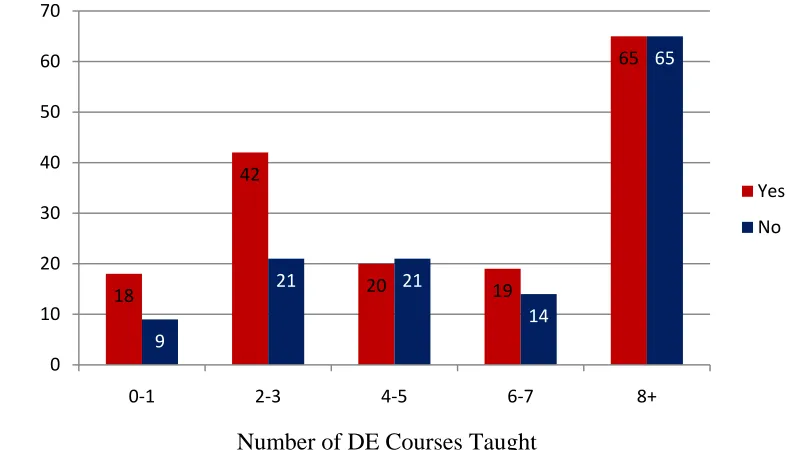
Of the 298 respondents, two (<1%) chose not to respond, 28 (9%) reported teaching (0-1) courses, 63 (21%) taught (2-3) courses, 41 (14%) taught (4-5) courses, 33 (11%) taught (6-7) courses, and 131 (44%) taught (8 or more) courses. Because of the varied categories listed above, there is no way to determine the exact number of courses for the eight or more category. The distinctions between individuals who received or did not receive DE training prior to teaching online courses were compared to the number of DE courses taught (Figure 4.2). 18 42 20 19 65 9 21 21 14 65 0 10 20 30 40 50 60 70
0‐1 2‐3 4‐5 6‐7 8+
Yes No Res p ondents Numbe r
Number of DE Courses Taught
Figure 4.2. DE training received compared to the number of DE courses taught.
teaching online courses that taught between two and three DE courses than those who did not receive training prior to teaching online courses.
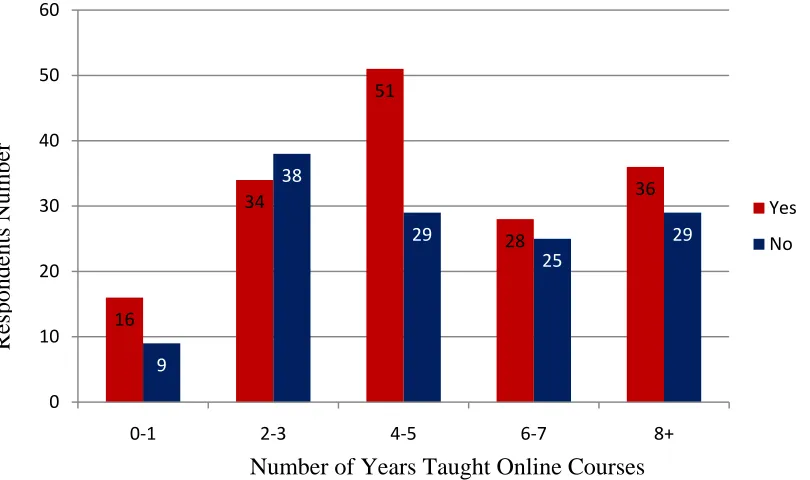
The numbers indicated on each bar specifies the exact number of individuals who responded to the question asking for the number of years each individual taught online courses throughout their duration as an online instructor (Figure 4.3).
Figure 4.3 indicates the number of years teaching online courses from respondents who received or did not receive DE training prior to teaching online courses. Furthermore, there was greater number of responses from individuals who received training that taught between four and five courses than those who did not.
16 34 51 28 36 9 38 29 25 29 0 10 20 30 40 50 60
0‐1 2‐3 4‐5 6‐7 8+
Yes No Res p ondents Numbe r
Number of Years Taught Online Courses
who received training prior to teaching online courses and those who taught between the following categories (4-5), (6-7), and (8+) were calculated. From the following categories, a total of 115 (39%) received training in comparison to 83 (28%) who did not received
training.
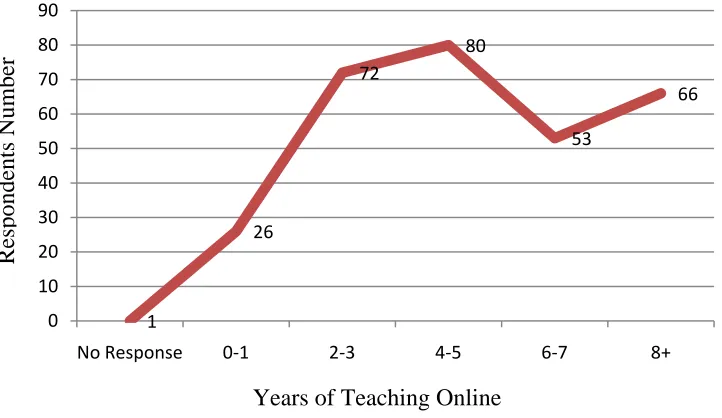
The overall responses of years teaching online courses were recorded (Figure 4.4).
1 26 72 80 53 66 0 10 20 30 40 50 60 70 80 90
No Response 0‐1 2‐3 4‐5 6‐7 8+
Res
p
ondents Numbe
r
Years of Teaching Online Figure 4.4 Number of years teaching online courses.
competencies and identify whether the number of years and courses taught have an effect with online teaching.
Similarly, other demographic questions were asked, such as, age, gender, and level of education. The selections were increments of ten, starting with age 20. Of the categories presented, majority (57%) were fifty or over. A total of 22% fell between the ages of 40-49 and (20%) were between the ages of 30-39. Only 1% reported being between the ages of 20-29 and (7%) chose not to respond. Additionally, a total of 127 males (43%) and 171 females (57%) reported for the gender category. Lastly, the number of respondents who had earned a doctorate degree was unsurprisingly higher (63%) than any other category. Other categories consisted of earning a 4-year degree (1%), one graduate degree (17%), some post-graduate school (10%), and some post-doc experience (9%).
Research Questions
Research Question 1 (RQ1): Was DE training provided? If so, was there a difference between the levels of technical competencies from individuals who received or did not receive training prior to teaching online courses?
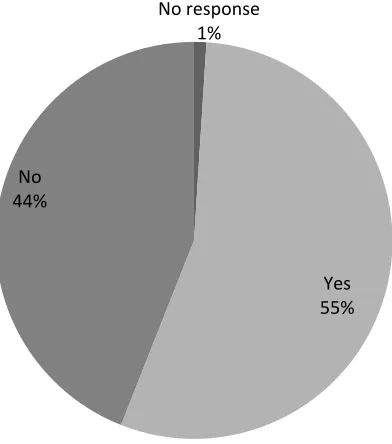
No response 1%
Yes 55% No
44%
Figure 4.5 Respondents that received DE training.
From the 298 respondents that completed the online survey, 165 (55%) reported they had received training prior to teaching online courses. A composite analysis was conducted for each technical competency category (Table 3.1); the categories were based on the
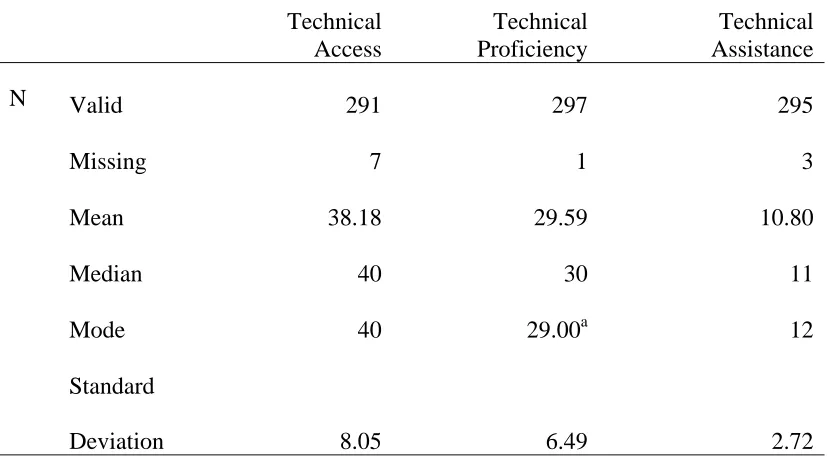
Table 4.1
Summary Statistics for Composite Variables
Technical Access
Technical Proficiency
Technical Assistance
N Valid 291 297 295
Missing 7 1 3
Mean 38.18 29.59 10.80
Median 40 30 11
Mode 40 29.00a 12
Standard
Deviation 8.05 6.49 2.72
a. Multiple modes exist. The smallest value is shown
one can conclude that technical assistance and proficiency were obtained whether training was received or not. In addition, individuals who received training obtained the level of technical proficiency that is efficient enough to teach online courses.
Table 4.2
DE Training and Composite Variables
DE
Training N Mean
Std. Deviation
Std. Error Mean
Technical Access Yes 165 41.50 5.84 0.45
No 124 33.73 8.51 0.76
Technical Proficiency Yes
165 29.41 6.53 0.50
No 130 29.74 6.45 0.57
Technical Assistance Yes 165 10.81 2.84 0.22
No 128 10.81 2.57 0.23
Table 4.3 provides an expanded illustration of collected responses and meaningful statistical data to illustrate the differences between the mean scores of the two groups (i.e. individuals who received training prior to teaching online courses and individuals who did not receive training prior to teaching online courses) for each competency category. The
Levene's Test for Equality of Variances was used to test the homogeneity of variances prior to
the mean comparison test and a pairwise Student t-test was used to compare the means of each
Ho: The means of the two groups are not significantly different.
Table 4.3
Independent Sample Test
Levene's Test for
Equality of Variances t-test for Equality of Means
95% Confidence Interval of the
Difference
F Sig. t df
Sig. (2-tailed)
Composite Variables Lower Upper
12.77 0 9.21 287 0 6.11 9.44
Technical Access Equal
variances assumed
0.04 0.84 -0.44 293 0.66 -1.83 1.17
Technical Proficiency Equal
variances assumed
1.37 0.24 0 291 0.99 -0.63 0.63
Technical Assistance Equal
The above table indicates that the two variances were significantly different, (F = 12.77; df = 1, 287; p < .001) for technical access; however, for technical proficiency (F =.04; df = 1, 293; p=.84) and technical assistance (F = 1.37; df = 1, 291; p=.24) depict that the two variances were not significantly different. Pairwise t-test were carried accordingly; in
addition to, unequal-variances t-test for mean comparison of technical access (t= 8.74; df = 206.25; p =0), and equal-variances t-test for technical proficiency (t =-0.44; df = 293; p =0.66) and technical assistance (t = -0.00; df =291; p =0.99). One can conclude that those who received training prior to teaching online courses acquired the knowledge needed to assist learners with their technical needs. In the remaining two categories (technical proficiencies and technical assistance), there is no difference in their mean scores for individuals who had received training and those who did not.
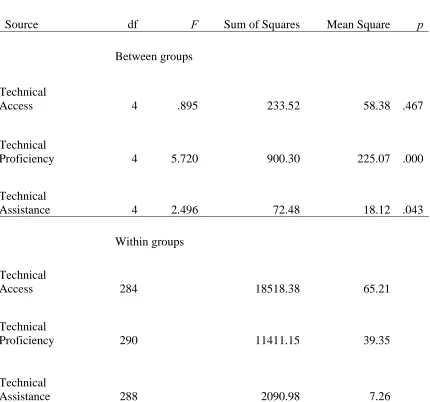
A one-way ANOVA was conducted to compare the means for each composite
Table 4.4
Analysis of Variance for Technical Composite Variables
Source df F Sum of Squares Mean Square p
Between groups
Technical
Access 4 .895 233.52 58.38 .467
Technical
Proficiency 4 5.720 900.30 225.07 .000
Technical
Assistance 4 2.496 72.48 18.12 .043
Within groups Technical
Access 284 18518.38 65.21
Technical
Proficiency 290 11411.15 39.35
Technical
Assistance 288 2090.98 7.26
df = 4, 290; p < .001), the means between groups were statistically significant, which exemplifies that those who received training maintained higher levels of technical
proficiency than those who did not receive training. Technical access (F = .895; df = 4, 288; p =.467), means between groups were not statistically significant and finally, the test for technical assistance (F = 2.49; df = 4, 288; p=.043) showed the means between groups were statistically significant which exemplifies that those who received training received more technical assistance than those who did not receive training prior to teaching online courses.
Research Question 2 (RQ2) stated: Why is it important for online instructors to have technical support post DE training?
Varvel (2007) expressed the importance for online instructors to have some
knowledge of technology support to provide for their students/ learners. “When a program does not have a technology support person or department, even if the instructor does not have the required technical knowledge to directly provide assistance to the students, s/he should be willing and able to direct students towards an answer to their problem” (p. 19). This section falls under the technical assistance category that is illustrated in Tables 4.5-4.7. The
illustrations summarized whether online instructors received technical support during
training and as a result, whether or not knowledge was transferred to their online experience. The respondents answered Likert scale questions with either Strongly Agree, Agree,
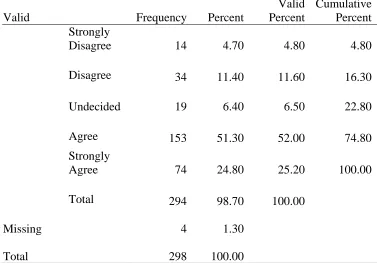
Table 4.5
Assisted Students with Technical Support
Valid Frequency Percent
Valid Percent
Cumulative Percent Strongly
Disagree 14 4.70 4.80 4.80
34 11.40 11.60 16.30
Disagree
19 6.40 6.50 22.80
Undecided
153 51.30 52.00 74.80
Agree
74 24.80 25.20 100.00
Strongly Agree
294 98.70 100.00
Total
Missing 4 1.30
Total 298 100.00
Table 4.6
Assisted Students with Basic Technical Issues
Valid
Frequency Percent Cumulative Percent Valid Percent Strongly
Disagree 9 3.00 3.10 3.10
26 8.70 8.80 11.90
Disagree
16 5.40 5.40 17.30
Undecided
154 51.70 52.40 69.70
Agree
89 29.90 30.30 100.00
Strongly Agree
294 98.70 100.00
Total
Missing 4 1.30
Total 298 100.00
was the importance of supporting students with disabilities. Instructors need to be aware that because they are teaching online courses, it doesn’t mean that their audience is
homogeneous. Table 4.7 depicts their perception of how instructors’ assist individuals with disabilities.
Table 4.7
Supported Students with Disabilities
Valid Frequency Percent
Valid Percent
Cumulative Percent
32 10.70 10.90 10.90
Strongly Disagree
66 22.10 22.50 33.40
Disagree
76 25.50 25.90 59.40
Undecided
91 30.50 31.10 90.40
Agree
28 9.40 9.60 100.00
Strongly Agree
293 98.30 100.00
Total
Missing 5 1.70
Total 298 100.00
learner’s with abilities. The mean scores were calculated for individuals who provided support to students with disabilities to those who received or did not receive training. These scores indicated that there was no significant different between individuals who received training (p =3.05) and those who did not receive training (p =3.05). A total of 76 (26%) was undecided.
Research Question 3 (RQ3) stated: What types of technical proficiencies and assistance were acquired post DE training?
The following table (Table 4.8) reports the level of technical proficiency and assistance based on individuals who received or did not receive online training. Table 4.8
Composite Analysis for Technical Proficiency and Assistance
Composite Variables
Training
Rec'd N Mean
Std. Deviation
Std. Error Mean
165 29.41 6.53 0.51
Technical Proficiency Yes
No 130 29.74 6.45 0.57
165 10.81 2.84 0.22
Technical Assistance Yes
No 128 10.81 2.57 0.23
The following questions that referenced the technical proficiency category from the online survey ranged from item numbers 20-32. These questions focused on how proficient instructors’ are as they utilize the various learning management systems from their
the table displays that there was no significant difference between the mean scores of
instructors’ who provided technical assistance to their students whether training was received (p=10.81) or not (p=10.81) prior to teaching online courses. There were only a total of three questions referencing this particular category which was outlined by Varvel (2007).
Particularly, the mean scores were approximately equal.
A total of 12 questions from the instrument (questions # 20-32) requested for the respondents to identify their level of experience (advanced, intermediate, and beginner) with various technology tools. The following 12 tables will display frequencies of each variable that falls in the technical proficiency category. Additionally, the table compares the various levels of technology to the number of individuals who received or did not receive training prior to teaching online courses.
Table 4.9
DE Training Received Compared to Level of Experience with Internet Tools
DE Training Received
Yes No Total
Level of technical experience with Internet tools Beginner
31 18 49
63.30% 36.70% 100.00%
Intermediate 80 63 143
55.90% 44.10% 100.00%
Advanced 53 49 102
52.00% 48.00% 100.00%
Total 164 130 294
55.80% 44.20% 100.00%
Table 4.10
DE Training Received Compared to Level of Experience with Computer Software Programs
DE Training Received
Yes No Total
Level of experience with computer software programs specifically for online education
Beginner 38 30 68
55.90% 44.10% 100.00%
Intermediate 82 56 138
59.40% 40.60% 100.00%
Advanced 42 43 85
49.40% 50.60% 100.00%
Total 162 129 291
55.70% 44.30% 100.00%