Scholarship at UWindsor
Scholarship at UWindsor
Electronic Theses and Dissertations Theses, Dissertations, and Major Papers
1-1-1986
Self-concept and the influence of social factors in elementary
Self-concept and the influence of social factors in elementary
school high achieving gifted and normally achieving children: A
school high achieving gifted and normally achieving children: A
multidimensional approach.
multidimensional approach.
Cheryl L. Pohlman
University of Windsor
Follow this and additional works at: https://scholar.uwindsor.ca/etd
Recommended Citation Recommended Citation
Pohlman, Cheryl L., "Self-concept and the influence of social factors in elementary school high achieving gifted and normally achieving children: A multidimensional approach." (1986). Electronic Theses and Dissertations. 6133.
https://scholar.uwindsor.ca/etd/6133
This online database contains the full-text of PhD dissertations and Masters’ theses of University of Windsor students from 1954 forward. These documents are made available for personal study and research purposes only, in accordance with the Canadian Copyright Act and the Creative Commons license—CC BY-NC-ND (Attribution, Non-Commercial, No Derivative Works). Under this license, works must always be attributed to the copyright holder (original author), cannot be used for any commercial purposes, and may not be altered. Any other use would require the permission of the copyright holder. Students may inquire about withdrawing their dissertation and/or thesis from this database. For additional inquiries, please contact the repository administrator via email
NOTE TO USERS
This reproduction is the best copy available.
_ ___ __®
UMI
FACTORS IN ELEMENTARY SCHOOL HIGH ACHIEVING GIFTED AND NORMALLY ACHIEVING CHILDREN: A MULTIDIMENSIONAL APPROACH
by
Cheryl L. Pohlman
B.A. University of Windsor, 1979 M.A. University of Windsor, 1983
A Dissertation
Submitted to the Faculty of Graduate Studies through the Department of Psychology
in Partial Fulfillment of the Requirements for the Degree of Doctor of Philosophy at the
University of Windsor Windsor, Ontario, Canada
1986
.)
IN FO RM ATIO N TO USERS
The quality of this reproduction is dependent upon the quality of the copy submitted. Broken or indistinct print, colored or poor quality illustrations and photographs, print bleed-through, substandard margins, and improper alignment can adversely affect reproduction.
In the unlikely event that the author did not send a complete manuscript and there are missing pages, these will be noted. Also, if unauthorized copyright material had to be removed, a note will indicate the deletion.
UMI Microform D C 5 3 2 3 0 Copyright 2009 by ProQuest LLC
All rights reserved. This microform edition is protected against unauthorized copying under Title 17, United States Code.
ProQuest LLC
789 East Eisenhower Parkway P.O. Box 1346
Ann Arbor, Ml 48106-1346
The self-concept of high achieving gifted children was investigated from a multidimensional perspective, examining the influence of the social comparison group employed and the relationship between parents' and teachers' perceptions and children's self-concept. The sample included 61 high achieving gifted children of both sexes enrolled in grades four through eight, participating in a one day per week
segregated enrichment program, their parents and enrichment teachers. A control group consisted of normally achieving peers in regular classrooms matched for grade and sex, their parents and regular
classroom teachers. The results suggested that the gifted group held generally positive self-perceptions but were best distinguished from the regular classroom group by more positive perceptions of ability within the realm of academic performance. Both groups were generally equivalent in their perceptions of ability in the athletic domain, satisfaction with physical characteristics and perceptions of popularity. Gifted children were found almost exclusively to be comparing themselves to regular classroom peers when making self appraisals. Consistent with expectations, children's self-perceptions were positively related to parents' and teachers' perceptions across most self-concept domains, with relatively high congruence among the adults' perceptions within gifted and regular classroom groups.
Differences in perceptions between the adults of the gifted and tegular classroom groups mirrored the distinctions found in the
children's self-perceptions. Perceived parental evaluations were found to be most strongly related to gifted children's general feelings of
ii
theory and the theory of reflected appraisals, raising implications for parents, teachers, programming, and future research.
i n
he earnestly planted a seed of curiosity. The harvest has offered an abundant yield for which I am truly grateful.
My journey through graduate school, particularly completion of the doctoral dissertation, has left me feeling much like a long-distance runner who is challenged by the stiff competition of time and oneself. Although the course transversed was frequently filled with solitude, a quick glance was sufficient to reveal that the sidelines were always occupied by individuals who were so vital in helping me to maintain my pace. Standing at the finish line, a salute to these individuals is in
order.
I wish to extend my most sincere gratitude to Dr. Ann McCabe, my chairperson, for her expertise, invaluable counsel, and tremendous
encouragement during this undertaking. While working with Dr. McCabe I was deeply impressed by the unique harmony of her personal kindness and fine professionalism. Dr. Martin Morf offered a keen attention to detail, both statistically and generally, which served to enhance the quality of
this study. Both Dr. Robert Bolus and Mr. Maurice Daignault, in addition to their kind encouragement, offered excellent suggestions from an
educational perspective, contributing significantly to implications raised by the results of this research. I thank Dr. Michael Pressley for
contributing his time, energy, and insightful suggestions to the final product.
My heartfelt appreciation is extended to the administrators,
principals, teachers, parents, and children who ultimately made this study possible through their involvement and earnest cooperation.
I would not have reached completion of this project without the help and team spirit of my colleagues, friends, and family. I owe a special debt to Kirk Bates for his participation in our "working dyad" and
iv
assistance. More gratitude than I could express in a lifetime is extended to a most remarkable group of women including Nancy Wilkinson, Jody
Waisberg, Anne Robinson, JoAnne Lewicki, and Trish Forrest for their provision of much emotional support, inspiration and practical
contributions. I owe sincere appreciation to Gerry McFadden whose
friendship, time, and valuable suggestions helped me to endure many crises during the course of this work. I also tip my hat to Liz Duffin for
offering her patience and skillful, nimble fingers in the typing of this manuscript under incredible time constraints. A special thank you is also extended to several anonymous individuals for their timely advice and availability.
My family knows how much I deeply appreciate their encouragement, support, tolerance, and understanding of my unavailability for special events during the past year. Words fall.short of expressing the sincere gratitude I extend to Diane and Barbara for their love and interest in my professional pursuits. I owe special thanks to Wayne, not only for his practical assistance, but also for helping me to remain spirited during the final stages of this project. My mother, Nina, has been my strongest ally. Her constant love, nurturance and encouragement have been the
essential ingredients in my completion of a lengthy graduate school education.
Page
ABSTRACT * ii
ACKNOWLEDGEMENTS iv
LIST OF TABLES ix
LIST OF FIGURES xii
Chapter
I INTRODUCTION 1
Models of Self-Concept 4
Self-Concept of Gifted Children 9
Methodological Issues 25
Self-Concept as a Function of Factors in the 28 Social Milieu
The Self-Perception Profile for Children and 39 the Social Support Scale for Children
Teacher Rating Scale 42
Social Comparison Processes 43 Determinants of Global Self-Worth - The 44
Social Support Scale for Children
Specific Purpose 45
Expectations 48
II METHOD 51
Subjects 51
Instruments 56
Procedure 63
Data Analysis 65
H I RESULTS 69
Hypothesis 1— Self-concept differences 69
Preliminary analyses 69
Discrimination between the groups 73 Classification of subjects into groups 74 Supplementary analyses for Hypothesis 1 76
Regression analyses 76
Split random halves classification 77 Analysis of grade differences 77 Hypothesis 2— Gender effects on Self-Concept 79
scores
Hypothesis 3— Social comparison processes 81
vi
Chapter FaBe Hypothesis 4— Parents’ and teachers' 81
perceptions
Effect of teacher demographics on ratings 91 Hypothesis 5— Perceptions of support and self- 117
concepts
Preliminary analyses 117
Supplementary analysis for Hypothesis 5 119
Grade effects 119
Hypothesis 6--Perceived regard vs. actual 124 ratings
IV DISCUSSION 129
Methodological Limitations 142
Conclusions and Recommendations for Future 143 Research
Appendix
A FACTOR PATTERN FOR THE SELF-PERCEPTION PROFILE 147 FOR CHILDREN
B FACTOR PATTERN FOR THE SOCIAL SUPPORT SCALE FOR 149 CHILDREN
C SCORING GRID FOR IDENTIFICATION .OF GIFTED 152 SUBJECTS
D SELF-PERCEPTION PROFILE FOR CHILDREN 154
E ITEM LIST BY SUBSCALE FOR THE SELF-PERCEPTION 159 PROFILE FOR CHILDREN
F SCORING KEY FOR THE SELF-PERCEPTION PROFILE FOR 163 CHILDREN
G INTERCORRELATIONS FOR THE SELF-PERCEPTION PROFILE 165 FOR CHILDREN
H TEACHER RATING SCALE 167
1 SOCIAL SUPPORT SCALE FOR CHILDREN . 169
J ITEM LIST BY SUBSCALE FOR THE SOCIAL SUPPORT 172 SCALE FOR CHILDREN
K SCORING KEY FOR THE SOCIAL SUPPORT SCALE FOR 175 CHILDREN
vxx
Appendix Page
L CENTROID LOCATION FOR GIFTED AND REGULAR CLASS 177 GROUPS ON THE DISCRIMINANT FUNCTION
M SUMMARY OF UNIVARIATE ANALYSIS OF VARIANCE FROM 179 DISCRIMINANT ANALYSIS
N SUMMARY OF REGRESSION ANALYSES 181
0 PLOT OF THE RESIDUALS FOR GROUP MEMBERSHIP FROM 184 REGULAR REGRESSION ANALYSIS
P RESPONSES FOR REFERENCE GROUP FOR THE SIX 186 SUBSCALES OF THE SELF-PERCEPTION PROFILE FOR
CHILDREN
Q SUBSCALE RELIABILITIES FOR PARENT/TEACHER RATING 190 FORMS
REFERENCES 192
VITA AUCTORIS 203
Table 1 2 3 4 5 6 7 8 9 10 11 12 13 14 15 16 17 Page
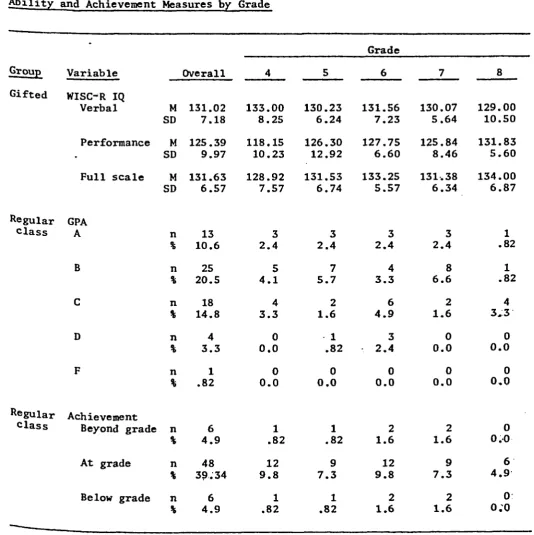
Mean Age of Child Subjects by Grade, Sex and Group 54 Ability and Achievement Measures by Grade 55 Number of Parent and Teacher Subjects by Demographic 57 Category and Group
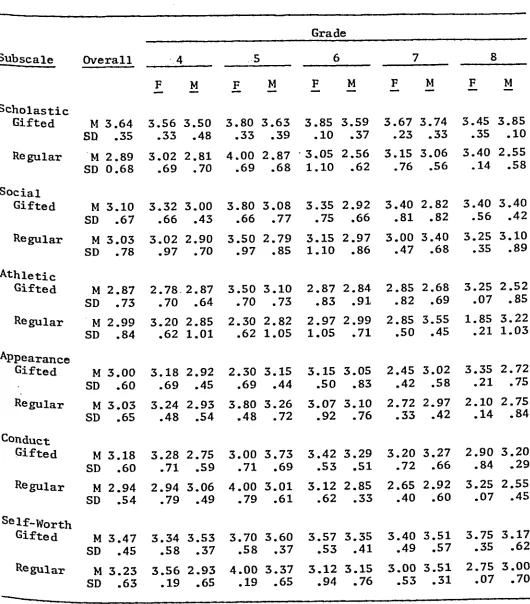
Mean Scores and Standard Deviations for Self-Perception 70 Profile for Children Subscales
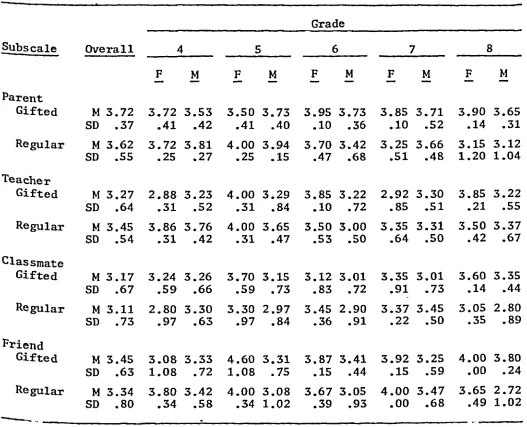
Mean Scores and Standard Deviations for Social Support 71 Scale for Children
Mean Scores and Standard Deviations for Subscales of the 72 Parent/Teacher Rating Form
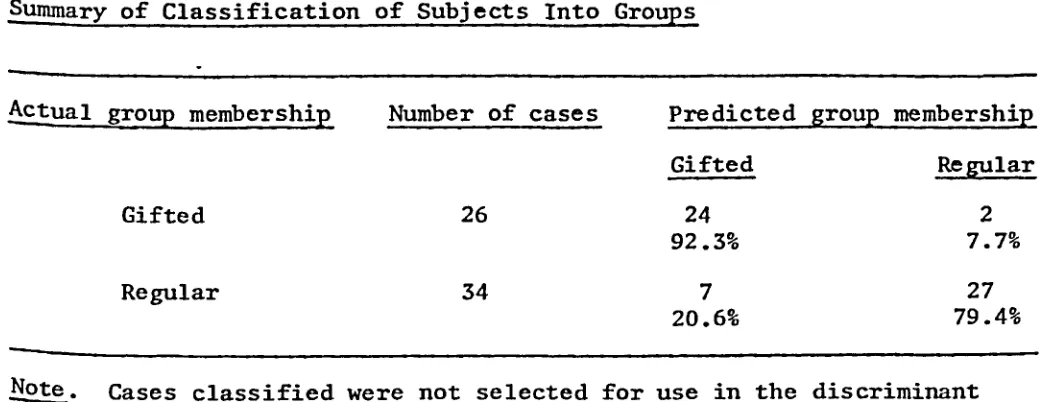
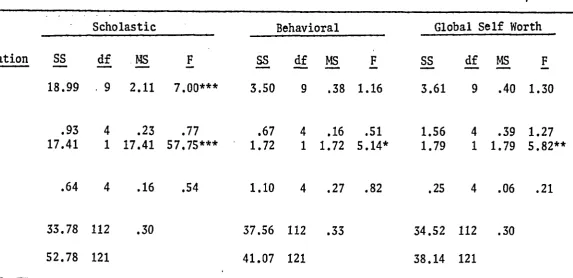
Summary of Classification of Subjects Into Groups 75 Summary of Classification of Subjects Into Groups 78 Summary of Analysis of Variance on Grade and Group for 80 the Scholastic Competence, Behavioral Conduct and Global
Self-Worth Subscales
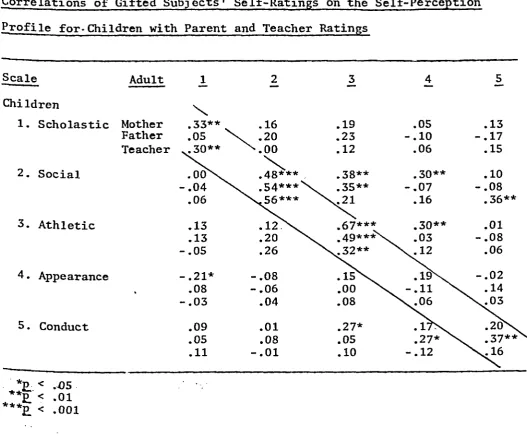
Correlations of Gifted Subjects' Self-Ratings on the Self- 83 Perception Profile for Children with Patient and Teacher
Ratings
Correlations of Parent with Teacher Ratings for the Gifted 84 Sample
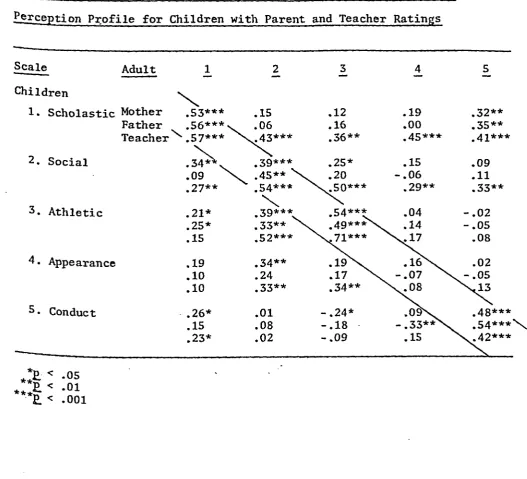
Correlations of Regular Class Subjects' Self-Ratings on 86 the Self-Perception Profile for Children with Parent and
Teacher Ratings
Correlations of Parent with Teacher Ratings for the 87 Regular Class Sample
Summary of Subscales where Significant Congruence was 89 Indicated Between Children’s Self-Ratings and Adult
Ratings
Summary of Subscales where Significant Congruence was 90 Indicated Between Adult Ratings
Summary of Analysis of Variance on Adult Rater and Group 92 for the Scholastic Conqpetence Subscale
Summary of Analysis of Variance on Adult Rater and Group 93 for the Social Acceptance Subscale
ix
Table
18 Summary of Analysis of Variance on Adult Rater and Group for the Physical Appearance Subscale
19 Summary of Analysis of Variance on Adult Rater and Group for the Behavioral Conduct Subscale
20 Direction of Mean Differences for Adult Rater and Group on the Parent/Teacher Rating Form Subscales
21 Mean Scores for Subscales of the Teacher Rating Form by Teacher Demographics
22 Summary of Analysis of Variance on Teacher Sex and Teacher Group for the Scholastic Competence Subscale 23 Summary of Analysis of Variance on Teacher Sex and
Teacher Group for the Physical Appearance Subscale
24 Summary of Analysis of Variance on Teacher Qualifications and Teacher Group for the Scholastic Competence Subscale 23 Summary of Analysis of Variance on Teacher Qualifications
and Teacher Group for the Physical Appearance Subscale 26 Summary of Analysis of Variance on Teacher Qualifications
and Teacher Group for the Behavioral Conduct Subscale 27 Summary of Analysis of Variance on Teacher Experience and
Teacher Group for the Scholastic Competence Subscale
28 Summary of Analysis of Variance on Teacher Experience and Teacher Group for the Social Acceptance Subscale
29 Summary of Analysis of Variance on Teacher Experience and Teacher Group for the Physical Appearance Subscale
30 Summary of Analysis of Variance on Teacher Experience and
Teacher Group for the Behavioral Conduct Subscale
Summary of Analysis of Variance on Sex and Group for the Social Support Scale for Children-Friend Subscale
32 Correlations of Global Self Worth Subscale with Social Support for Children Subscales for the Gifted Sample 33 Correlations of Global Self Worth Subscale with Social
Support for Children's Subscales for the Regular Sample
Reproduced with permission of the copyright owner. Further reproduction prohibited without permission.
Table
34 Summary of Analysis of Variance on Grade and Group for the Social Support Scale for Children-Parent Subscale 35 Summary of Analysis of Variance on Grade and Group for
the Social Support Scale for Children-Teacher Subscale 36 Comparison of Mean Correlations Between Actual Ratings
of Self-Concept with Correlations Between Perceived Support and Global Self-Worth
xi
Reproduced with permission of the copyright owner. Further reproduction prohibited without permission.
Page
122
123
Figure
1
2
3
4
5
6
7
Mean scores on Scholastic Competence subscale for mother (M),- father (F), teacher (T) for each group
Mean scores on Physical Appearance subscale for mother (M), father (F), teacher (T) for each group
Mean scores on the Social Acceptance subscale for teachers with less experience (<20 years) and more experience (>20 years) for each teacher group
Mean scores on the Physical Appearance subscale for teachers with less experience (<20 years) and more experience (>20 years) for each teacher group
Mean scores on the Behavioral Conduct subscale for teachers with less experience (<20 years) and more experience (>20 years) for each teacher group
Mean scores on the Parent subscale at each grade level for each group
Mean scores on the Teacher subscale at each grade level for each group
xii
Page
98
99
113
114
116
125
126
INTRODUCTION
In a recent chapter exploring processes involved in children's self-concept formation, Harter (1985a) has noted that in the present decade the self has been resurrected as a legitimate psychological construct. Renewed interest has been expressed by a variety of authors from
numerous orientations including developmentalists, social learning theorists, cognitive-attributional theorists, and educational
Psychologists. Continuing in the spirit of this current revival, some of the mysteries of the self present in intellectually gifted children were investigated in the present study.
Most authors in the general literature on self-concept agree that self-concept is an important variable in processes of learning and development (Coopersmith, 1967; Cotton, 1983; Felker, 1974; Mack, 1983; Wylie, 1979; Yanamoto, 1972; Yawkey, 1980). According to Mack (1983),
"Each phase of development provides particular tasks and arenas of human relationships out of which the sense of self and self-regard emerge11
(P- 13). The importance of self-concept in the learning environment has been addressed by several authors. In reviewing the history of
educational thinking as it relates to self-esteem, Geraty (1983) has noted that recently educators have become increasingly aware of the relationship between self-esteem and school achievement. Both Purkey
(1970) and Wylie (1979) in their comprehensive reviews of studies which have investigated this relationship concluded that a correlation between
Self-concept aca(jemic achievement does exist, and that positive
self-1
concept is generally associated with good academic achievement. Indeed, in Purkey's (1968) view, outside of the home, the school plays the second most important role in the formation of the self.
In recent years increased concern regarding social-emotional adjustment (with self-concept as one aspect of this domain) has been directed toward one particular group of children within the learning environment, specifically, the intellectually gifted. Altman (1983) has noted that since the classic longitudinal investigations of Lewis Terman and his associates (Terman, 1925; Terman 8 Oden, 1947, 1959), the
literature in gifted education has traditionally maintained that gifted children are superior in their social-emotional adjustment relative to their non-gifted peers. However, Altman and others (e.g., Tidwell, 1980, Webb, Tolan § Meckstroth, 1982) have described what appears to be a
recent shift, or reevaluation of thinking among professionals in gifted education and related disciplines. Concerns have been expressed by several authors (e.g., Altman, 1983; Kaplan, 1983; Lajoie § Shore, 1981; Schauer, 1976) about the particular psychosocial problems faced by
gifted youngsters and their school adjustment, for example, feelings of alienation, self-critical feelings, perfectionism, development of
realistic self-concepts. Tidwell (1980) has suggested that the increased concern may be due, in part, to changes in the composition of the gifted population. Acceptance of an expanded concept of giftedness and the adoption of multidimensional approaches for identification have
w
resulted in a population which is more heterogeneous in most respects than was previously the case.
Many authors in the literature claim that society needs the
contribution of well-integrated, highly functioning gifted individuals
and Franks and Dolan (1982) have argued that most definitions of
giftedness tend to emphasize cognitive functions, but in order for these individuals to approach maximum intellectual capacity, their social-emotional, physical and intuitive functioning must also be well developed. Several authors (Hall, 1978; Kaplan, 1983) have been
relatively more specific by suggesting that if the gifted are to become fully functioning individuals they require assistance in identifying and accepting all aspects of their personalities. In this regard, the
particular task of developing accurate and realistic self-concepts has been viewed as crucial. Indeed, in groups of gifted children who achieve far below their potential capabilities (i.e., gifted underachievers), unfavourable self-concepts and low self esteem have frequently been cited as contributing factors (Fine 5 Pitts, 1980; Saurenman 6 Michael, 1980; Whitmore, 1980).
The present investigator was interested in the self-concept of high achieving gifted children in terms of their own self-perceptions and factors that might have an impact on these perceptions, including the role of social comparison processes; significant others' perceptions of their competency; and the children*s perceptions of-the attitudes which significant others hold towards the self.
In this chapter the prevailing models of self-concept and their ass°ciated measurement strategies will be briefly reviewed. Secondly, research relevant to the self-concept of gifted children will be
Presented, noting the differential application of various self-concept models and other methodological issues related to the inconsistencies
found in this body of literature. Finally, research addressing some of
of a recently developed instrument designed to measure self-concept and influencing factors, that is, the Self-Perception Profile for Children
(Harter, 1985b), will be presented.
Models of Self-Concept
A number of different conceptual models of the self-concept have been put forth, each associated with a different strategy of measurement. Harter (1985a) has provided an excellent review of the prevailing models ^ d attempts made at operationalizing self-concept.
In presenting the numerous models of self-concept, Harter (1985a) has outlined one conceptual approach which maintains that self-concept is a unitary construct rather than one broken down into distinct subparts. Coopersmith (1967) is a notable advocate of this approach. He has concluded that if children make distinctions about their self-worth in different areas of experience, these distinctions are made within the existing, overall general appraisal of self-worth. In keeping with the cuidimensional approach, self-concept is assessed by presenting a number of items tapping a range of content, for example, school, family, peers, self, and general social activities, and a total or aggregate score is obtained by summing across all items, giving them equal weight. It is assumed that the total score or measure of general self-worth reflects one's sense of self across different life domains.
Some theorists and investigators have challenged the unidimensional model asserting that it may mask important distinctions children make across the various domains in their lives (e.g., Harter, 1985a;
Mullener
§
Laird, 1971). Thus, a second model conceptualizes self-concept as multidimensional in nature. Mullener and Laird (1971) founda significant trend with age toward greater differentiation among five separate domains when used to evaluate the self. The domains include social responsibility, achievement needs, intellectual skills,
interpersonal skills, and physical skills. Similarly, Harter (1985b) employed factor analytic procedures to document that children, age eight and older, make distinctions between five separate domains when
evaluating the self. Her domains axe slightly different than those of Mullener and Laird and include scholastic competence, athletic competence, social acceptance, physical appearance, and behavioral conduct. In the Multidimensional approach the self is thus depicted as a profile of evaluative judgements across specific domains.
Although the measurement strategies of Harter (1985b) and Mullener Laird (1971) clearly reflect an underlying model of self-concept that ls Multidimensional in nature, Harter (1985a) has indicated that the Mature of the underlying model is more ambiguous in several other Measurement approaches that superficially appear to be reflective of a Multidimensional model of self-concept. Closer inspection of these
additional measures suggests underlying models which fall somewhere in between unidimensional and multidimensional approaches. Specifically,
these measures include the Piers-Harris Self Concept Scale (Piers, 1969), the Sears Concept Inventory (Sears, 1966), and the Tennessee Self-Concept Scale (Fitts, 1965). With regard to the Piers-Harris and Sears Scales, in their initial model, self-concept was conceptualized as
^^dimensional. However, based on logical analysis only, Sears proposed nine distinct subtests, inferring that each constitutes a differential
aspect of self-concept. Subsequent factor analytic studies of the Piers-Harris Scale (Michael, Smith S Michael, 1975; Piers, 1969) have revealed
instrument was not designed to tap specific domains, low loadings and cross loadings appear in the factor structure. Based on the results of their multitrait-multimethod study of the Sears and Piers-Harris Scales, Winne, Marx and Taylor (1977) concluded that the representation of self-concept obtained by these inventories appeared more unitary in nature. Similarly, the Tennessee Self-Concept Scale supposedly provides several separate self-regard scores based on "rows" and "columns" of the test format. Wylie (1974) has indicated that discriminant uses of these scores are unjustified due to overlap of row and column items, in
addition to rather high row intercorrelations (with no item overlap) and column intercorrelations (with no item overlap). A more unidimensional aPproach is also suggested by the total self-regard score which is
aggregate in nature.
Hierarchical models of the self constitute a third approach to the Self-concept. In these models self-concept represents a superordirtate Category under which various subcategories of the self are organized in an ^ncreasingly differentiated fashion. For example, in the model
espoused by Shavelson, Hubner, and Stanton (1976), self-concept is placed at ^ e apex followed by the first-order categories of academic and non-academic self-concept. These general domains undergo further
differentiation where academic self-concept is subdivided into a variety °f specific school subjects, and non-academic self-concept is divided into social, emotional, and physical self-concept categories. Continued
subdivision of these second-order categories occurs at lower levels of analysis. Other hierarchical models include those of Epstein (1973) and L Ecuyer (1981). Like the Shavelson et al. model, these models begin
the self-concept in a more or less differentiated manner.
Harter -(1985a) has noted that although hierarchical models appear to he valuable in terms of providing an understanding of the organizational structure of the self, they present problems with regard to their
operationalization. Some of the difficulties she has described include: construct ambiguity in terms of whether or not lower order factors
represent discrete factors, and the nature of the manner in which they combine to form higher order factors; certain domains may be more
important to one’s overall sense of self, yet most models have not
generated psychometric instruments which permit differential weighting of domains; and, finally, questions regarding whether or not the particular hierarchical structure conceptualized by the model actually reflects the phenomenological network of constructs which defines the self-concept for
"the individual, for example, do we carry with us an academic self-concept, per se?
A fourth model of self-concept, best reflected in the work of Rosenberg (1979), emphasizes global self-worth. This model advocates that the individual’s general sense of self-worth is important over and above the evaluative judgements made in the specific domains of one’s life, it is important to note that this model does not conceptualize global self-worth as an aggregate or additive combination of responses to discrete items like the Coopersmith (1967) model. Rosenberg has
indicated that various discrete elements of the self are most likely Weighted, hierarchized and combined in a very complex manner, of which the individual is probably unaware. Hence, Rosenberg does not empirically investigate the specific bases on which global self-worth is constructed.
itself by means of a unidimensional measure which taps the degree to
which one is satisfied with o ne’s life, feels one has good qualities, has a positive attitude toward oneself or feels useless, thinks one is a
failure, etc. Wylie, in her (1979) review of extant self-concept
measures, has indicated that Rosenberg's scale is rather impressive in that such high reliability estimates have been obtained with only a 10 item scale, and that the scale has yielded numerous relationships
supporting its construct validity.
A fifth approach to the self-concept, which represents a combination of several of the themes previously described, can be found in the work °f Harter (1985a). Her approach emphasizes the need to take into account ^ d assess both the multidimensional nature of domain specific judgements and one's sense of global self-worth. She has identified five specific domains that children employ when making self-judgements about their competency/adequacy, the domains named earlier under multidimensional
aPproaches. In addition, a separate subscale in her instrument, the Self-Perception Profile for Children (Harter, 1985b), taps the child's general sense of self-worth in a direct manner similar, but not identical, to
that of Rosenberg (1979). In contrast to Rosenberg, however, Harter has _ sought to empirically examine the determinants or antecedents of the
global self-worth judgement. Based on the theoretical formulations of dames (1892) and Cooley (1909), respectively, she has identified two
Critical antecedents which both strongly influence the level of
children's global self-worth, specifically, the degree to which one is successful in specific domains deemed important, and one's perceptions of the attitudes which significant others hold towards the self. In general,
9
Harter’s approach is appealing in that it seems to provide a more rich and differentiated picture of the self-concept, both conceptually and empirically, in contrast to other models. A more detailed description of the psychometric properties of her scale and relevant research will be presented in a later section.
Having reviewed the major models and measurement approaches to the self-concept, one can conclude that there is considerable variation in their heuristic and empirical appeal. Perhaps more important, with such a broad spectrum of conceptions about the structure and organization of the self-concept, it is imperative that researchers make some attempt to specify the nature of the particular model that guides their investigations. Whatever model is adopted, it would also seem essential that it be
examined through the use of measures which are sensitive and
Psychometrically sound. The research on the self-concept of gifted children is one domain in which a variety of self-concept models have been employed with little clear delineation of theoretical assumptions and limited utilization of relevant published conceptual and practical methodological/measurement guidelines. This issue will be addressed more specifically in the following section.
Self-Concept of Gifted Children
It would seem almost aphoristic that children with high intelligence, academic capability and creativity would hold positive self-perceptions ln a technological society where the pursuit of excellence is so highly valued by the current Zeitgeist. Contemporary research supports this motion where the majority view is that gifted children appear to generally have very positive self-concepts (Brauch Lehman & Erdwins, 1981; Coleman 8 Baits, 1983; Karnes 8 Wherry, 1981; Kelly § Colangelo, 1984; O'Such,
Twyla 5 Havertape, 1979; Tidwell, 1980; Yates, 1976). Exceptions to this general finding have been reported primarily for underachieving gifted children who have evidenced lower self-concept functioning on a variety of measures (Bailey, 1971; Kanoy, Johnson 5 Kanoy, 1980;
Saurenman 6 Michael, 1980; Whitmore, 1980).
The present investigator was interested primarily in the self-concept °f high-achieving gifted children. Relevant research in this area
generally offers a positive picture of self-concept functioning but some inconsistency is apparent across the various studies. Such inconsistency may be due in part to the differential utilization of models of
self-concept and their associated measurement strategies in the various studies. To date, this issue has not been addressed in the gifted
literature. Many studies have employed a !unidimensional model with self-concept typically measured by an aggregate score (e.g., Bracken, 1980; Coleman § Fults, 1982; Dean, 1977; Harty, Adkins 5 Hungate, 1984; Karnes 6 Wherry, 1981; Tidwell, 1980). Although there are some exceptions (e.g.,
Karnes § Wherry, 1981; Tidwell, 1980), generally these studies have failed to report higher measures of self-concept among their gifted
sample in comparison to normative groups. In contrast, a growing number °f studies, which have utilized multidimensional conceptual approaches focusing particularly on academic and social self-concepts of gifted children, have tended to report differences in these particular domains between gifted children and their non-gifted age mates, not necessarily in favour of the gifted group (Brown 6 Karnes, 1982; Colangelo 6
Pfleger, 1978; Kelly 6 Colangelo, 1984; Milgram 5 Milgram, 1976; Ross § Parker, 1980). Hence, part of the discrepancy in research
findings may be an artifact of the particular model and associated method of measurement employed, with unidimensional measures of self-concept masking important distinctions that gifted children might make across
specific domains in their lives. These distinctions, particularly in the academic and social domains, become more apparent when a multidimensional measurement strategy is utilized. Additional complexity in interpretation
of results is added by the tendency for some investigators (e.g., Ross 5 Parker, 1980; Winne, Woodlands 5 Wong, 1982) to confound unidimensional and multidimensional models within a single study by utilizing
^idimensional self-concept scales like those of Coopersmith (1967) and Sears (1966) as if they were multidimensional in nature. Typically, items are re-combined and coded to form subscales or "higher-order
factors" based on logical analysis only. Thus, the measurement problems encountered in this type of study preclude unequivocal interpretation of the data.
Given the problem of unidimensional versus multidimensional
aPproaches, in reviewing the relevant literature on self-concept in high achieving gifted children, it seemed logical to initially separate the studies into two groups based on the particular model of self-concept employed. However, it is important to note that there are additional methodological difficulties, some of which are common to studies
regardless of the differences in conceptual approach. These will be addressed in a later section.
Several studies adopting a unidimensional approach have examined
eg) X *
“concepts of gifted children in comparison to those of non-gifted normative groups employed in the standardization of the particular self-concept instrument utilized in the study.
In a study conducted by Bracken (1980), self-concept, attitudes towards learning, and peer relationships, in terms of the child's own perception of his/her interaction with peers, were examined among a group
of intellectually gifted children in the fifth grade and compared to normative data for the particular instruments employed as measures. The
gifted group was administered three self-report attitudinal questionnaires in a Likert scale format entitled Self-Concept, Attitude Toward Learning, and Peer Relations. Significant differences between the gifted and
normative group were found only on the Attitude Toward Learning Scale, where the gifted exhibited more favourable attitudes toward learning. With regard to the absence of higher self-concepts for the gifted group, Bracken suggested that because the gifted were homogeneously grouped in the study, they may have perceived themselves as average relative to
their gifted peers, thus providing more modest self-appraisals. Although the reference group employed may certainly have influenced self-concept scores, it is difficult to arrive at this conclusion in the Bracken study as no direct test of the reference group utilized in making self-aPpraisals was conducted.
Several other studies which have employed non-gifted normative comparison groups have reported results similar to those of Bracken
(1980). Both Dean (1977) and Tidwell (1980) administered the Coopersmith Self-Esteem Inventory to groups of gifted children, and compared their scores to those of the normative standardization group provided by Coopersmith (1967). Despite sample differences between the two studies
terms of age, grade, and IQ level, the results of both indicated that the self-concepts of the gifted group did not differ significantly from Coopersmith's (1967) normative sample. However, Tidwell (1980) had also
administered the Piers-Harris Children's Self-Concept Scale to her group and reported that their mean scores were significantly higher than those of the comparable normative group provided by Piers (1969).
Interestingly enough, Karnes and Wherry (1981), employing the Piers-Harris Children's Self-Concept Scale with gifted children in the fourth through seventh grade, also reported higher self-concept scores for the gifted group in comparison to the normative standardization group.
From the studies reviewed thus far, it appears that inconsistent results have been obtained when the self-concepts of gifted children
utilizing unidimensional measures are compared to normative standardization groups who are chronologically similar and of average IQ. Some of the
contradictory findings may be attributable to the differences in the method of measurement employed, but a more significant contribution to
the discrepancies may involve differences between the gifted and standardization groups in subject, setting, and sampling variables.
A number of studies within the unidimensional approach have
directed their efforts towards investigating other factors which might acc°unt for the inconsistencies reported on the self-concept of gifted children. Primarily, these studies have focused on the influence of factors in the social environment in which the gifted reside. Borrowing from social comparison theory (Festinger, 1954), the studies have
investigated the influence of the instructional environment on the self-concept of gifted children, with particular emphasis on the reference group gifted children employ when making self-appraisals. Social comparison theory asserts that in forming estimates of self-worth, in fhe absence of objective standards of comparison, similar individuals are more likely to be selected as bases for social comparison. Hence, the
theory would suggest that gifted children residing in a more homogeneous environment where the capabilities of all individuals are roughly
comparable, would utilize their g i f t e d p e e r s as the reference group, view themselves as more typical, and thus generate lower scores on
self-concept measures. In contrast, within a regular classroom the capabilities °f the gifted child are likely exceptional and should result in higher
self-concept scores. The typical design employed in the studies
investigating this area involves the comparison of self-concept measures obtained on a group of gifted children in a fully or partially segregated class to those obtained on a comparable group of high achieving grade peers remaining in regular classrooms.
In an investigation by Coleman and Fults (1982) self-concept scores, as measured by the Piers-Harris Cftildreni'-ss Self-Concept Scale of fourth, fifth and sixth grade gifted students who participated in a one day p er week segregated enrichment program, were compared to those of high-achieying children who had been nominated for the program, but did not meet eligibility requirements. While the gifted group had higher IQs, both groups were above the 90th percentile on academic achievement tests.
•TTt
e scores of the high-achieving children who remained exclusively in the regular classroom were found to be systematically higher than those of their gifted counterparts.
In a second study, Coleman and Fults (1983) examined the
self-concept scores (Piers-Harris) of fourth grade gifted students during the course of their participation in a partially segregated, one day per week, enrichment program. When the sample was divided at the mean Total IQ 1Tvto children with higher or lower IQ scores, systematic differences between the two groups were evidenced, in that higher IQ children had
higher self-concepts than their somewhat less capable classmates. In addition, the self-concepts of higher IQ children increased with length of time in the program, while the self-concept scores for lower IQ
children declined to some extent.
On the basis of their two investigations, Coleman and Fults (1983) have suggested that preadolescent gifted children judge their capabilities in relation to others in their immediate environment. When segregating gifted children into a more homogeneous setting, the process may result in lower self-concept reports for some children, especially in comparison to the scores of their even more capable peers. The findings of these authors lend support to the results of an earlier study by Stopper (1979) Who reported that gifted Students in a self-contained program revealed
lower self-concept scores than heterogeneously placed gifted youngsters. Four additional studies investigating the influence of instructional environment and social comparison processes on self-concept of gifted children have not reported significant findings, thus providing
contradictory evidence to that of Coleman and Fults (1982, 1983) and Stopper (1979). Interestingly enough, both Karnes and Wherry (1981) and Maddux, Scheiber, and Bass (1982) employed the same instrument as Coleman and Fults (1982, 1983). Karnes and Wherry (1981) reported no significant ^fterences in self-concept scores between groups of fourth through
seventh grade gifted children enrolled in gifted programs and those not enrolled, although self-concept scores of the entire sample were higher than the normative standardization group. Similarly, Maddux et al.
(1982) compared scores on the Piers-Harris Scale of three gifted groups ln t^le fourth and fifth grades: one group involved in a totally
segregated classroom; one group involved in a three hour-per-day "pull
out" enrichment program; and the third group composed of gifted children in regular classes who were not selected for participation. This third group was comparable to the first and second gifted groups in terms of sex, grade and IQ within +1 standard error of measurement. No significant differences in self-concept between the three groups at any grade level were found; however, gifted students in the sixth grade, regardless of program, were reported to have higher self-concept scores than the
standardization sample. Lastly, Kolloff and Feldhusen (1984) and Harty, Adkins and Hungate (1984) found no evidence that self-contained programs °r more heterogeneous (pull out) settings might lead to lower
self-concept scores.
In ascribing the particular social reference group employed as a Slgnificant influence on gifted children's self-concepts, the results in the literature are equivocal at best. One serious, rather surprising Methodological limitation present in all of the studies reviewed is the failure to obtain direct information on the particular social comparison group employed. Simply stated, no subjects have been directly asked who they were comparing themselves to, when they were thinking about what they were like. Consequently, to date, the investigations in this area have not directly tested the hypotheses put forth by social comparison
theory, rendering most results, and hence the influence on self-concept, as rather uninterpretable.
Qae additional study, falling within the category of unidimensional approaches to self-concept, employed a rather unique research design in aomparison to the majority of studies examining the self-concept of gifted children. Brauch Lehman and Erdwins (1981) have noted that
virtually all previous studies investigating self-concept have employed
same-aged peers or normative data for comparisons. The authors reasoned that since gifted children have frequently been found to function
intellectually several years ahead of their chronological peers, they may also be more similar to their mental age-mates in their social-emotional Sanctioning. A group of gifted third graders were compared with groups °f average IQ third and sixth grade students on the California Test of Personality and the Children's Social Attitude and Values Scales. Each °f these measurements contained a subscale which assessed self-concept. Although other indices of social-emotional adjustment were tapped by the instruments, for the purposes of the present review only the results pertaining to the self-concept subscales will be considered. The reader
is referred to Brauch Lehman and Erdwins for a more exhaustive account. On the Self-Esteem subscale of the Social Attitudes and Value Scale, signiflcant differences between the gifted group and the average IQ
groups were obtained where the gifted exhibited more positive feelings about themselves than either their chronological or mental age-mates. With regard to the Sense of Personal Worth subscale on the Personality inventory, both the gifted and sixth graders scored higher than the third graders, but did not differ from each other. The latter finding suggests that with some measures of self-concept, the gifted may be more
c°mparable to their mental age-mates than their chronological age-mates. Although generalizations are not warranted on the basis of a single study, °ertainly interesting implications are raised regarding the most
aPpropriate comparison group to employ in studies investigating self-c°ncept of gifted children.
It might be helpful at this point to briefly summarize the
^ *
erature on self-concept of gifted children where unidimensional
investigations which have examined the self-concept of gifted children in comparison-to normative data are equivocal at best. Studies employing the Piers-Harris self-concept scale and the associated normative data have more consistently reported higher self-concepts for the gifted group
in comparison to studies employing the Coopersmith Scale where no significant differences have been reported. A number of studies have investigated the impact on self-concept of the immediate reference group employed by gifted children when making self-judgements. Although
several studies have suggested that gifted children in more homogeneous settings compare themselves to their gifted peers with resulting lower estimates of self-concept, a number of investigations have failed to offer any evidence that homogeneous or more heterogeneous (pull out) settings lead to lower self-concepts. One particular problem in this area of research has been the absence to date of any direct test of the reference group employed by gifted children when making self-judgements, rendering the available results as questionable at best. Finally, one investigation has raised questions regarding the appropriate comparison group to employ (i.e., age-mates vs. mental age-mates) when assessing self-concept of gifted children, by providing evidence that with some measures of self-concept gifted children were found to be more comparable to their mental age peers than to their chronological age peers.
As previously indicated, a growing number of studies investigating the self-concept of gifted children have employed more multidimensional approaches. However, many of the self-concept measures employed in these studies can be questioned on the grounds of how adequately they measure the construct of self-concept in a multidimensional manner. Some
investigators have chosen to employ several unidimensional measures tapping different domains that gifted children may utilize when making self-judgements. To date, a multidimensional measurement with sound Psychometric properties has not been utilized when investigating the self-concept of gifted children.
Several studies have focused on the importance of perceptions that the gifted hold about their ability to succeed in academic subjects, that is, academic self-concept. Building on the moderate correlation
C-50) reported in the general literature between academic self-concept and school achievement (Torshen, 1969), Colangelo and Pfleger (1978) sought to investigate the perceptions that gifted children hold about their academic capabilities given their relative success in the school onvironment. Administering the Brookover Self-Concept of Ability Scale
(Brookover, 1962) to a group of gifted students in grades 9 through 12, the authors reported high academic self-concepts for the group, and c°ncluded that "students recognized as gifted are aware of their
academic abilities and have developed self-concepts consistent with their •awareness and past successes" (p. 11). Despite the positive findings
reported by these investigators, it is important to note that no control group Was employed providing information about the academic
self-concepts of conparable, perhaps less capable grade mates.
Consistent with the results of Colangelo and Pfleger (1978), Brown and Karnes (1982) investigated component parts of self-concept for gifted children in grades two through nine, by identifying those items onithe
6rs"Harris Scale which were most representative of gifted students. tems loading on factors entitled by Piers (1969) as Intellectual and Ch°°l Status, and Happiness and Satisfaction were consistently endorsed
Reproduced with
by 90% of the sample as being representative of themselves. Brown and Karnes (1982) concluded that the gifted children perceived themselves as smart, happy, -and behaviourally competent. Another interesting finding in this study was that the group responded with greater variability to factors involving popularity, anxiety and physical attributes.
Some researchers (e.g., Ross § Parker, 1980) have noted that much attention has been given to intellective factors and academic self-concept, with little emphasis placed on another important facet of gifted children’s self-concept, specifically, their social self-concept. Ross and Parker (1980) administered the Sears Self-Concept Inventory to groups of fifth through eighth graders identified as gifted. Re
grouping items from the various subscales logically identified by Sears (1969) into a Social Self-Concept Scale and an Academic Self-Concept Scale, they reported significantly higher academic than social self concept scores for the entire group, with no sex or grade differences on either scale. In accounting for the discrepancy between self-concept scores, Ross and Parker suggested that gifted children may tend to focus roost of their attention on academic areas and that they may also tend to be less comfortable with peers, experiencing ambivalence in determining their place in the peer group. Although this investigation presents rather interesting findings regarding several components of the self-concept of gifted children, two methodological limitations warrant cautious interpretation of the results. Firstly, the procedure of generating the two self-concept scales employed from factors which
themselves have only been identified by logical analyses is questionable. Secondly, as no control group was employed, we cannot conclude that the academic/social self-concept discrepancy is unique to gifted students.
On balance, Ross and Parker (1980) did suggest that the discrepancy found in their study required investigation in the general school population.
-Indeed, Kelly and Colangelo (1984) have recently conducted a study where academic and social self-concepts were compared between three groups in grades seven through nine: one group identified as gifted, a second group identified for special learning needs; and a third group of general students participating in the regular school program. Both the Tennessee Self-Concept Scale (designated as a measure of social self esteem) and the Academic Self-Concept Scale were administered with the wale students in the gifted group scoring significantly higher than males
in the general or special learning needs group on the total score
eight subscales of the Tennessee Self-Concept Scale, and on the Academic Self-Concept Scale. Although gifted males were reported as holding higher academic and social self-concepts compared to their non-gifted age-mates, there were no within-group comparisons made. Hence, no information on discrepancies between the two facets of self-concept measured can be gleemed. In addition, the failure to find differ between the three groups of female students on any of the measures was not addressed. This particular finding is especially relevant in view of ®n earlier study by Milgram and Milgram (1976) where total score and subscales of the Tennessee Self-Concept Scale were compared between two groups of Israeli boys and girls in grades four to eight: one
intellectually gifted; the other consisting of nongifted grade-mates m regular classes. As a group the gifted showed more positive self-concept with significantly higher total scores. Gifted girls evidenced
equivalent adjustment to gifted boys and better adjustment than nongifted
Reproduced with
girls. Additional support for this overall result was suggested by the finding that the gifted group was less defensive, less contradictory, and less extreme in their self-reports.
Not all differences favoured the gifted group in the Milgram and Milgram (1976) study. One rather interesting finding was that nongifted children had more positive self-concepts with regard to body image
(Physical Self). Secondly, decreasing scores with age for the gifted in some dimensions of self-concept were noted. In comparison to gifted seventh graders, nongifted seventh graders described themselves in more Positive terms (Identity subscale), and reported greater feelings of Personal worth/self confidence (Personal Self). Milgram and Milgram
(1976) suggested that in older gifted children, the discrepancy between their abilities and interests and those of their age peers may increase with a resulting lack of gratifying interactions. Subject to resentment °r isolation, such shifts in sentiment might contribute to changes in some dimensions of self-concept without altering the basically favourable picture.
Two additional studies employing comparative designs similar to that °f Kelly and Colangelo (1984) have provided increased support to previous Positive findings on the academic self-concept of the gifted, but failed to generate any further clarification with regard to the inconsistent findings on social self-concept. A complex study conducted by Winne, Woodlands and Wong (1982) employed randomly formed groups of fourth- to seventh-grade gifted, normal, and learning disabled students to
lnvestigate the comparability of representations of self-concept across groups for the Sears and Coopersmith inventories, and mean
differences across the groups on self-concept subscales. On the basis of
Permission o f the copyright owner. Farther reproduof
some rather complicated statistical procedures, subscale representations of the self-concept construct were judged comparable across groups. Following the- recoding and summation of items to form subscales on the Coopersmith inventory and employing the logical subscales on the Sears inventory, these authors reported more favourable academic self-concept subscales for the gifted over the other groups. However, on the Sears scale, the learning disabled children, slightly but significantly, exceeded gifted children on physical and social facets of self-concept. The authors suggested that although this latter result may reflect a tendency for learning disabled students to over-rate their social
Popularity, it may equally reflect that self-concept in a general sense, ls COI“pensatory. Learning disabled students lose in comparison to
gifted students in academic self-concept, but Hie itxade-otfif may he - -reversed in social and physical/athletic comparisons.
Finally, a study by Chovan and Morrison (1984) - provided supporting evidence to the results of Brown and Karnes (1982) reported earlier. Utilizing the Piers-Harris scale as a multidimensional measure, Chovan and Morrison (1984) found higher self-concepts for groups of 9 through
year old gifted and high achievers on the Intellectual and School Status subscale and the Behaviour subscale in comparison to groups of learning disabled and educable mentally retarded.
Putting methodological difficulties aside, the studies reviewed, which have employed more multidimensional approaches to the measurement °f self-concept^ consistently report higher academic self-concepts for Sifted children in comparison to a wide variety of their less able age-®ates and grade-mates. As a group, gifted children seem to hold more Positive perceptions of their ability within the realm of scholastic
Performance. Outside of the academic component of self-concept,
inconsistent results and greater variability among gifted children have been reported-for other components investigated. A clear consistent Picture regarding the nature of their self-judgements in the social and Physical domains does not emerge from the literature; however, the
tendency has been toward equivalent or lower self-judgements relative to less able grade-mates and age-mates.
In summary, the majority of studies comparing high achieving gifted children to their less able peers (whether actually or normatively) on various self-concept measures, seem to suggest that gifted children in general hold more positive self-concepts. However, a clear, consistent Pattern of characteristics describing such functioning does not emerge
from the literature. Some studies demonstrate higher self-concepts relative to normative data while others do not; the influence of the immediate environment on self-concept in the form of reference groups employed for comparison processes is deemed as significant in some
studies, while others report little influence of this factor; the nature °f the self-concept construct appears to differ across the various
studies examined; some studies employing identical instruments directly contradict each other. At best, the literature can be described as inconsistent, and therefore, difficult to interpret.
Some of the inconsistency in the studies reviewed may be attributed the different models and methods of self-concept measurement employed, differences in the nature of the comparison group utilized, or differences ln experimental rigor. To date, the major methodological difficulties encountered in this body of literature have not been formally addressed.
°Se ^thodological issues not previously discussed will be presented n ext.
Methodological Issues
Pew investigators examining the self-concept of high achieving gifted children have addressed the seemingly pervasive problems in this body of research, some of which may have contributed to contradictory and
equivocal results. Many of the methodological issues that will be
Presented in conjunction with this particular area of investigation have been raised by various authors about the body of research on self-concept
general (Harter, 1985a; Wylie, 1974).
One area of particular difficulty involves the criteria employed to identify gifted subjects. As several authors have noted, identification °f the gifted is complicated by extreme diversity of viewpoints on
definitions of giftedness and methods of identification (Borthwick, Dow, Levesque £ Banks, 1980; Hagen, 1980). Consequently, in the studies
investigating self-concept among the gifted, there is little consistency ln criteria employed, and they are often vague or undefined. As a result, contradictory research results may be reflective^df variations in group composition.
Some authors (e.g., Harter, 1985a) have suggested that the structure 3T1 /I
content of the self-concept may undergo developmental change. Hie empirical findings of Montemayor and Eisen (1977) and Rosenberg (1979) revealed that generally children shift their focus from the use of more simple behavioural descriptors of the self in early childhood, to traits ln m iddle childhood, and to higher order abstractions in adolescence. Hence, there is an additional possibility that differences in the research results on self-concept of the gifted may be reflective of
erences in age and developmental level of the subjects employed. Several difficulties in researching this area are related to