University of Windsor University of Windsor
Scholarship at UWindsor
Scholarship at UWindsor
Electronic Theses and Dissertations Theses, Dissertations, and Major Papers
2019
Building Teams of Experts using Integer Linear Programming
Building Teams of Experts using Integer Linear Programming
Sagarika Narendra Khandelwal University of Windsor
Follow this and additional works at: https://scholar.uwindsor.ca/etd
Recommended Citation Recommended Citation
Khandelwal, Sagarika Narendra, "Building Teams of Experts using Integer Linear Programming" (2019). Electronic Theses and Dissertations. 7713.
https://scholar.uwindsor.ca/etd/7713
This online database contains the full-text of PhD dissertations and Masters’ theses of University of Windsor students from 1954 forward. These documents are made available for personal study and research purposes only, in accordance with the Canadian Copyright Act and the Creative Commons license—CC BY-NC-ND (Attribution, Non-Commercial, No Derivative Works). Under this license, works must always be attributed to the copyright holder (original author), cannot be used for any commercial purposes, and may not be altered. Any other use would require the permission of the copyright holder. Students may inquire about withdrawing their dissertation and/or thesis from this database. For additional inquiries, please contact the repository administrator via email
BUILDING A TEAM OF EXPERTS USING INTEGER LINEAR
PROGRAMMING (ILP)
By
Sagarika Khandelwal
A Thesis
Submitted to the Faculty of Graduate Studies through the School of Computer Science in Partial Fulfillment of the Requirements for
the Degree of Master of Science at the University of Windsor
Windsor, Ontario, Canada
2019
BUILDING A TEAM OF EXPERTS USING INTEGER LINEAR
PROGRAMMING (ILP)
by
Sagarika Khandelwal
APPROVED BY:
______________________________________________ J. Wu
Department of Electrical and Computer Engineering
______________________________________________ A. Mukhopadhyay
School of Computer Science
______________________________________________ J. Chen, Advisor
School of Computer Science
iii
DECLARATION OF ORIGINALITY
I hereby certify that I am the sole author of this thesis and that no part of this thesis has been published or submitted for publication.
I certify that, to the best of my knowledge, my thesis does not infringe upon anyone’s copyright nor violate any proprietary rights and that any ideas, techniques, quotations, or any other material from the work of other people included in my thesis, published or otherwise, are fully acknowledged in accordance with the standard referencing practices. Furthermore, to the extent that I have included copyrighted material that surpasses the bounds of fair dealing within the meaning of the Canada Copyright Act, I certify that I have obtained a written permission from the copyright owner(s) to include such material(s) in my thesis and have included copies of such copyright clearances to my appendix.
iv ABSTRACT
v
DEDICATION
Dedicated to Lord Krishna, my baba Satyanarayan Khandelwal, my dear papa
Narendra Khandelwal, my beloved mumma Namrata Khandelwal, my beautiful
sisters Komal & Anjali, my adorable nephew Vivaan
vi
ACKNOWLEDGEMENTS
I owe a debt of gratitude to Dr. Chen, for the vision and foresight which inspired me to conceive the thesis work. As my teacher and mentor, she has taught me more that I could ever give her credit for here. I am thankful to my thesis committee members, Dr. Mukhopadhyay and Dr. Wu for providing me extensive personal and professional guidance which help me lean a great deal about both scientific research and life in general.
vii
TABLE OF CONTENTS.
DECLARATION OF ORIGINALITY ... iii
ABSTRACT ... iv
DEDICATION ... v
ACKNOWLEDGEMENTS ... vi
LIST OF TABLES ... x
LIST OF FIGURES ... xi
CHAPTER 1 INTRODUCTION ... 1
1.1 Overview ... 1
1.2 Motivation ... 3
1.3 Problem and Solution Outline ... 3
1.4 The scope of the thesis ... 5
1.5 Structure of the thesis ... 6
CHAPTER 2 BACKGROUND STUDY ... 7
2.1 Overview of the research ... 7
2.1.1 Data Mining ... 7
2.1.2 Team formation ... 8
2.1.3 Cluster Hire ... 8
2.2 Fundamental Concepts ... 11
2.2.1 Linear Programming ... 11
2.2.2 Integer Linear Programming(ILP) ... 12
2.3 Application of Linear Programming ... 13
2.3.1 Example of Integer Linear Programming ... 15
2.4 Algorithm ... 17
2.4.1 Exact Algorithm ... 18
2.4.2 Heuristic Algorithms ... 20
viii
2.5.1 Team formation Problem and cost functions for best team formation in Social
Networks ... 21
2.5.2 Social Network an important factor for efficient team formation ... 22
2.5.3 Genetic Algorithm for team formation ... 22
2.5.4 Team formation problem solved using various techniques ... 23
2.5.5 Clustering Technique for Team Formation Problem ... 24
2.5.6 Online Team formation in Social Networks ... 24
2.5.7 Cluster Hiring Problem ... 25
2.6 Problem Statement ... 26
CHAPTER 3 IMPLEMENTATION DETAILS ... 30
3.1 Notations used in ILP ... 30
3.2 ILP model for maximized profit ... 31
3.2.1 Justification of the ILP ... 33
3.3 ILP model with maximum profit and minimum communication cost ... 34
3.4 Heuristic Algorithm for Cluster Hire Problem... 36
3.4.1 Cluster Hire Algorithm for maximized profit and collaborative team ... 37
3.4.2 Sample data set observations ... 40
CHAPTER 4 RESULT AND ANALYSIS ... 43
4.1 Heuristic vs Cluster Hire Profit Model (10,000 Nodes) ... 47
4.1.1 Total Profit vs Budget ... 47
4.1.2 Number of Projects completed vs Budget ... 49
4.2 Heuristic vs Cluster Hire Profit and Communication Cost Model (50 Nodes) ... 50
4.2.1 Total Communication Cost vs Budget ... 50
4.2.2 Total Profit vs Budget ... 51
4.3 Discussion ... 52
CHAPTER 5 CONCLUSION AND FUTURE WORK ... 56
5.1 Conclusion ... 56
5.2 Future Work ... 56
REFERENCES/BIBLIOGRAPHY... 58
ix
x
LIST OF TABLES
Table 1 Notations in ILP ... 31
Table 2 Expert Attributes ... 41
Table 3 Project Attributes ... 41
Table 4 Variable Size ... 46
xi
LIST OF FIGURES
Figure 1 Data Mining ... 8
Figure 2 Cluster Hire ... 10
Figure 3 ILP using Branch and Cut solver ... 20
Figure 4 Social Network of Experts ... 27
Figure 5 Heuristic Algorithm for Cluster Hire Problem ... 39
Figure 6 Sample Network of Experts ... 40
Figure 7 Comparison between budge and profit with project size 20 ... 48
Figure 8 Comparison between budge and profit with project size 10 ... 48
Figure 9 Number of completed projects vs budget (10 projects) ... 49
Figure 10 Number of completed projects vs budget (20 projects) ... 49
Figure 11 Communication cost vs Budget (08 Projects) ... 50
Figure 12 Communication cost vs Budget (05 Projects) ... 51
Figure 13 Profit vs Budget (05 Projects) ... 51
Figure 14 Profit vs Budget (08 Projects) ... 52
Figure 15 Problem Size Vs Memory Size ... 54
1
CHAPTER 1
INTRODUCTION
1.1Overview
One of the most common problems studied in today's world is that of efficient resource allocation and scheduling. Discovering a team of experts through a recruitment process, the recruiter seeks for a team that can accomplish the tasks within a deadline and the team so hired is cost-effective.
A project is a well-designed and planned approach to collaborate with individuals to achieve organizational aims and company targets. Each project consists of various task and activities that need experts who have deep expertise and skill necessary to perform that task. Organizations need such a team of experts who possess the right skills for the smooth delivery of the project. This problem where we seek to discover a team of experts such that all the skills required for a project are covered is called Team Formation Problem(TFP)
Cluster Hiring Problem involves the hiring of individuals for a given set of projects such that the hired experts hold all the skills required by this set of projects. Also since each expert has its own cost (i.e. salary) we make sure we hire individuals within a budget allocated for this set of projects. The CLUSTER HIRE problem was first introduced by Golshan et al. [13], where they provide an overview of the problem through the online labor market websites like Freelancer.com and Guru.com
2
be exceeded in the process of hiring the group of experts. In other words, the sum of the salary of the individuals hired for the set of the project should not exceed the company’s defined budget. Such setting helps in maximizing the profit of the organization.
Grouping experts who have worked together in previous projects, helps in faster completion of a project as well as in producing qualitative outcomes. Assuming that there exists a communication channel among the experts, communication cost between two experts can be calculated based on the prior work experience. If any two experts have previously worked together in the past, then it is believed that they have a better frequency of communication compared to experts who are introduced in the team for the first time. Having a good frequency provides many benefits like the quality of work and effectively meeting the deadline of the projects. Also, grouping individuals with minimal or no communication between them can increase the expense of the project thereby decreasing the revenue obtained from the project. Determination of the communication cost depends on the need of the project. Eventually, organizations look out for teams that give more profit to the projects.
Working capacity of an expert is another important parameter while hiring an expert for multiple projects. The recruiting managers also make sure that the employee’s capacity is not exhausted in the process of hiring experts that generated the most revenue for the organization. Each expert is associated with maximum capacity he/she can offer. The combination of communication cost between two experts and the capacity of each expert helps in providing multiple feasible teams from which a team that produces the maximum profit can be obtained.
3
1.2Motivation
In the immersing world of technology, many companies are growing worldwide where the owners need to select a team of experts with the collective expertise required to benefit from various opportunities that have been identified within the market that the company targets [13]. In this context, it is important to make efficient resource allocation so that certain objectives of the organization,such that meeting the organizations’ lawful and social commmitments with respect to the systhesis of its workforce can be achieved.
Another relevant motivation comes from the online labor market websites such as Freelancer and Guru where they get multiple projects from multiple remote locations. At first, the freelancers work independently but later with the increase in project size and complexity; these experts collaborate to form a consulting company which receives projects, skills and the number of individuals required for the projects. For each skill required for a project, the consulting company hires experts to fulfill the set of demanded tasks. There is a budget defined by the financial department for hiring experts for the project and hence the total salary of all the experts should be less than or equal to the budget. The goal of the company is to earn the most profit by completion of the projects.
To overcome the above-described problem, people have proposed many ways of
discovering the most collaborative team for a single project and a profit-maximizing team for a set of projects which consists of the most collaborative experts
1.3Problem and Solution Outline
4
We study the cluster hire problem, with the following assumptions
1. Each expert possesses a set of skills.
2. Experts have workload capacity indicating how many maximum number of skills can be assigned.
3. Each expert has an associated hiring cost associated. The hiring cost is calculated only once. That is, an expert can be assigned to a number of projects and can perform a number of skills based on his/her working capacity.
4. There is a set of projects, each having certain skills and the number of experts having that skill needed to complete the project.
5. The social network amongst the experts, retrieved from previous work experience. The experts are connected in a network which is modeled as a graph. Each expert is associated with a node of the graph. An edge connects two experts in the graph with edge weight representing the strength of collaboration between two experts obtained from prior collaboration in the past. When the experts are not connected, the weight is assigned by the sum of weight on the shortest path between the two experts. The least the communication cost the most collaboration among the experts. For example, if there are two pairs of experts where the first pair of experts have worked in ten projects in the past, and the other pair of experts have worked in nine projects in the past, then the former experts will be selected since they tend to have better frequency i.e communication cost compared to the latter pair of experts. We model the communication cost among the team members using the sum of distances between each pair of experts in the group.
For completing a given set of projects, we are provided with a predetermined budget to be spent on hiring experts. We first solve the problem of hiring the group of experts for a set of projects considering the team to be the most collaborative and producing the maximum profit.
5
1.4The scope of the thesis
Kargar et al. [2] study the team formation problem, which is a subclass of Cluster Hiring problem. They propose a new formulation to calculate the communication cost between two experts called the sum of distance function. In their study, they all provide a detailed analysis on the computational complexity, approximation of the problem solution to the optimal solution as well as heuristic solutions. They demonstrate the efficacy of their approach by carrying out experiments on real datasets of experts and demonstrated their advantages and baselines.
Meet et al.[14] first studied cluster Hiring problem in a network, where they aim at hiring a group of experts for a set of projects which produces the maximum profit in which each project has an associated revenue, amount associated, which is obtained when the project completes. In their paper, they also study various attributes associated with a team and its members such as collaboration between two experts, the capacity of an individual expert, a salary of the experts. They also make sure that the hiring cost of the experts is within the budget assigned by the financial department of the company. They further propose two greedy algorithms and their results were obtained through experiments done on a large graph of experts.
We propose to solve the cluster hiring problem with a slightly extension to the one proposed in the work. In our setting, we have a set of projects, each having skills and the number of experts required per skill for project completion. Our aim here is to maximize the profit earned by the summation of the revenue associated with each project. Furthermore, we modify our proposed solution so that it produces maximized profit and also selects experts that have the most collaboration among each other.
6
1.5Structure of the thesis
7
CHAPTER 2
BACKGROUND STUDY
2.1Overview of the research
2.1.1 Data Mining
The process of discovering hidden patterns in huge data sets using methods like machine learning, statistics, and database systems is called Data Mining. It is one of the subfields of computer science and statistics with an overall goal to extract information from data set and transform the information into a well-described structure for further use. Data mining helps in extracting important insights from the data; this is commonly known as Knowledge Data Discovery. To keep up with the pace of data generation, it is needed to have good data mining technique to discover interesting patterns to analyze the trend. Depending on these trends an organization might enhance the decision-making process to generate more revenue or attract more customer for its business. Applying such techniques are costly and may not be affordable to every type of business. People choose different techniques based on the nature of the data and that is what determined the fate of these companies.
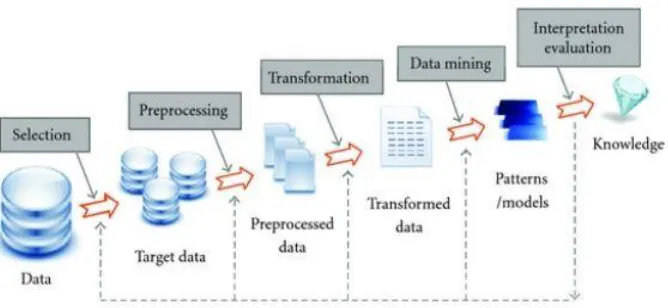
Knowledge Discovery in Database is done in step by step procedure: [6] • Data Cleaning: In this step, the noise, and inconsistent data are removed. • Data Integration: In this step, multiple data sources are combined.
• Data Selection: In this step, the data relevant to the analysis task are retrieved from the database.
• Data Transformation: In this step, data is transformed or consolidated into forms appropriate for mining by performing summary or aggregation operations.
• Data Mining: In this step, intelligent methods are applied to extract data patterns. • Pattern Evaluation: In this step, data patterns are evaluated.
8 Figure 1 Data Mining
2.1.2 Team formation
The concept of team formation is to hire a set of experts who hold expertise in one or more skills that is needed for completion of a project, which will give benefit to an institution upon its completion. This helps organizations to complete projects undertaken and also helps experts strengthen their skills and position in the company by performing well. The main idea behind this concept is to gather individuals having expertise in the skills required for successful completion of the project. Selection of individuals to work in a team can be made in various ways using different constraints and factors. For instance, a team benefits from the similarities in the background among the team members. This can help decrease any conflicts or miscommunication. Having few differences can also help reduce the amount of time it takes to become an effective working group since it is less needed to adjust individual working styles. Also, bringing more diversified skilled individuals helps to broaden the thinking and working perspectives bringing the room to flexibility and idea generation.
2.1.3 Cluster Hire
9
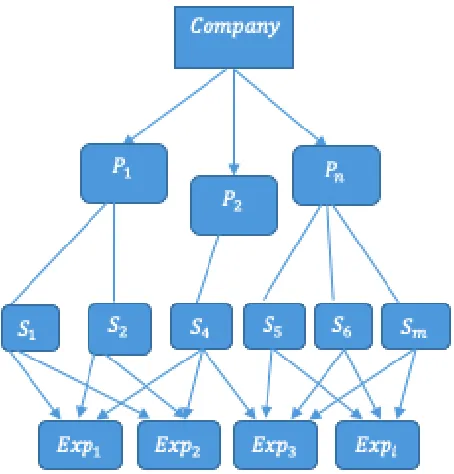
The selection process is influenced by various factors such as budget assigned for the set of projects, profit earned on each project’s completion, communication cost between the experts in the team, working capacity of each, etc. This concept is getting wide
acceptance and importance in the market given that more organizations are working in a project driven environment nowadays. Also, hiring a set of individuals that covers various projects is better than hiring a fixed set of individuals for each project. This approach ultimately helps bring down the Budget factor
Factors to be kept in mind while forming a team
1)Budget
Budget is an upper limit monetary quantity applied by the company towards the hiring cost of individuals for a set of projects. The goal of the organization is to select a team of experts in a way that the budget is not overspent.
2) Experts and their attributes
Expert’s Skills: Each expert or individual in the job market or working in a company is known for his expertise in a particular set of skills. We aim at selecting individuals for the projects depending on the skills the experts can bring along with them, that will help in producing a faster and better outcome for the project.
Expert’s cost: Each expert demands some monetary benefit in return of the skills he/she provides. We need to keep in mind that the sum of the hiring cost of the experts selected should not be greater that the budget assigned for hiring a team for a set of projects
10
Experts’ collaboration cost: In this special setting, we also make sure that the experts selected have the best collaboration, that is the communication frequency between them. We use their prior collaboration and instances when the two individuals worked together, to calculate the communication cost between them. Forming such a team of experts helps in reducing the overhead time spent in understanding each other’s’ background etc.
Figure 2 Cluster Hire
3)Project and their attributes
Project’s Skills: Each project consists of predefined skills required to produce the desired output. We seek for individuals who have good level of expertise in the skills required by the project.
11
Project’s Revenue: Keeping all the above factors in mind , the group of experts selected for each project helps in producing revenue for the project. Each project has a
predetermined revenue (monetary profit) associated to it, which the company obtains after successful completion of the project.
The aim of our approach is to assign enough experts for the set of projects to obtain the maximum profit. While doing so we make sure all the above-mentioned constraints are not violated and the team formed is the most collaborative.
2.2Fundamental Concepts
2.2.1 Linear Programming
Linear Programming is a mathematical model used for solving decision problems having many decision variables that are limited by a set of constraints. For a linear program the constraints and objective functions are required to be linearly related to the variables of the problem.
Linear Programming Terminology
1.DECISION VARIABLE: These variables determine the quantity that the decision makers would like to determine. Typically, their optimal values are determined with the optimization method. In general, the decision variables are represented using the algebraic notations like
𝑥1 , 𝑥2 , 𝑥3 , 𝑥4… … 𝑥𝑛
2.CONSTRAINTS: A constraint is an inequality or equality defining limitations on decisions. In general, an LP is said to have m linear constraints that can be stated as
∑𝑛𝑖=1𝑎𝑖𝑗 𝑥𝑖 ≤ 𝑏𝑖 𝑓𝑜𝑟 𝑗 = 1 … … 𝑚
3.OBJECTIVE FUNCTION: The objective function minimizes or maximizes the
quantitative criterion such as cost, profit, utility, or yield. The general linear objective function can be written as 𝑍 = ∑𝑛𝑖=1𝑐𝑖 𝑥𝑖
12
𝑥𝑖 ≤ 𝑢𝑖 𝑓𝑜𝑟 𝑖 = 1 … . . 𝑛
When a simple upper bound is not specified for a variable, the variable is said to be unbounded from above
5.NONNEGATIVITY RESTRICTIONS: In most practical problems, the variables are required to be nonnegative;
𝑥𝑖 ≥ 0, 𝑓𝑜𝑟i=1…. 𝑛
This special kind of constraint is called a no negativity restriction.
6.COMPLETE LINEAR PROGRAMMING MODEL: Combining the aforementioned components into on single statement gives:
Minimize 𝑍 𝑍 = ∑𝑛𝑖=1𝑐𝑖 𝑥𝑗
Subject to
∑𝑛𝑖=1𝑎𝑖𝑗 𝑥𝑖 ≤ 𝑏𝑖 𝑓𝑜𝑟 𝑗 = 1 … … 𝑚
0 ≤ 𝑥𝑖 ≤ 𝑢𝑖 𝑓𝑜𝑟 𝑖 = 1 … 𝑛
The constraints, including the non-negativity and simple upper bounds, define the feasible region of a problem.
2.2.2 Integer Linear Programming(ILP)
Linear Programming (LP) is a mathematical programming approach where the problem is modeled to find either a minimization or a maximization solution to a function, given certain constraints. Integer Linear Programming (ILP) is a branch of Linear Programming that restricts all the variables of the model to be only integers. A general Integer linear programming model can be represented as
𝑀𝑎𝑥 𝑐𝑥
𝐴𝑥 = 𝑏 ……... (2)
13
All entries of 𝑐, 𝐴 and 𝑏 are assumed integer. Equation 2 provides one possible formulation of an ILP problem. Alternatively, we have minimization problem or problems with inequality constraints.
Minimization problems can be translated to a maximization problem simply by using the following notation [18]
−𝑚𝑖𝑛 (−𝑓(𝑥)) = 𝑚𝑎𝑥(𝑓(𝑥))
Inequality constraints can be converted into equality by adding auxiliary variables. For example
𝑎𝑥 <= 𝑏 𝑐𝑎𝑛 𝑎𝑙𝑠𝑜 𝑏𝑒 𝑑𝑒𝑛𝑜𝑡𝑒𝑑 𝑎𝑠 𝑎𝑥 + 𝑠 = 𝑏,
𝑎𝑛𝑑 𝑎𝑥 >= 𝑏 𝑐𝑎𝑛 𝑎𝑙𝑠𝑜 𝑏𝑒 𝑑𝑒𝑛𝑜𝑡𝑒𝑑 𝑎𝑠 𝑎𝑥 − 𝑡 = 𝑏
The variables s and t are known as slack or surplus variables.
An important special case of the ILP problem is called binary ILP problem described by
𝑀𝑎𝑥 𝑐𝑥
𝐴𝑥 = 𝑏 ………. (2)
𝑥 ≥ 0 𝑏𝑖𝑛𝑎𝑟𝑦
Here, 𝑥 binary means 𝑥𝑖=0 or 𝑥𝑖=1 for all 𝑖
2.3Application of Linear Programming
Integer Linear Programming has found its way as one of the leading methods to find optimal solutions in the field of Operation research. Well known problems like resource allocation, task assignment, resource scheduling can be solved using Integer Linear Programming techniques. Below are some of the classic set of applications where ILP has created a benchmark as a problem solver.
14
or profit generation. The process of identifying patterns and meaningful insights from the large dataset is called data mining. Data mining techniques help organizations generate revenue and make concrete decisions on the basis of discoveries and predictions made using the data. Linear Programming provides techniques to identify such pattern and make data more sensible and useful for prediction and analysis. The process of Integer Linear programming involves formulating an ILP model for the problem, using decision variables and constraints which are supplied to the objective function.
2)Manufacturing: ILP is one of the most widely used mathematical approach used in the manufacturing industry for resource allocation and profit maximization. Resource planning is important for the manufacturing industry which requires proper planning of the optimal mix of products that are needed to be manufactured. One of the most common ILP techniques that help in resource planning and manufacturing is a simplex method which uses the concept of slack variables, tableaus and pivot variables for finding the optimal solution to an optimization problem
3)Transportation optimization: The transportation systems depend on linear programming for getting solutions that give cost and time efficient results. Almost all transportation systems treat scheduling of shipments, passengers and in-time delivery as their key priorities. Airlines apply linear programming techniques by setting the cost and travel demand as factors to maximize their profits. In a same way, bus transport officials use LP for scheduling routes and allocating drivers. Optimization using ILP surges efficient decision making and reduces expenses.
15
2.3.1 Example of Integer Linear Programming
Capital Budgeting Problem
A firm has n projects to undertake but, because of budget restrictions, not all can be selected.
Project 𝑗 has a present value of 𝑐𝑗, and required an investment of 𝑎𝑖𝑗 in the time period i, where 𝑖 = 1 … . . . , 𝑚. The capital available in time period 𝑖 is 𝑏𝑖. The problem of maximizing the total present value subject to the budget constraints can be written as [11]
Maximize ∑𝑛𝑗=1𝑐𝑗 𝑥𝑗
Subject to
∑𝑚𝑗=1𝑎𝑖𝑗 𝑥𝑗 ≤ 𝑏𝑖 𝑓𝑜𝑟 𝑖 = 1 … … 𝑚
0 ≤ 𝑥𝑗 ≤ 𝑢𝑗 𝑓𝑜𝑟 𝑗 = 1 … 𝑛
where 𝑥𝑗=1 if the project 𝑗 is selected and 𝑥𝑗=0 if the project 𝑗 is not selected
The fixed charge problem
In general, the cost of an activity is a special nonlinear function of the activity level 𝑥 given by
𝑓(𝑥)={𝑑 + 𝑐𝑥 𝑖𝑓 𝑥 > 0 0 𝑖𝑓 𝑥 < 0
If 𝑑 > 0 and f is to be minimized, we have the problem
subject to
min 𝑐𝑥 + 𝑑𝑦 𝑥 ≥ 0 𝑥 − 𝑣𝑦 ≤ 0
𝑦 = 0,1
16
The plant location problem
Consider n customers, the 𝑗 − 𝑡ℎ one requiring 𝑏𝑗 units of a commodity. There are m locations in which plants may operate to satisfy the demands.
There is a fixed charge of 𝑑𝑖 for opening plant 𝑖, and the unity cost of supplying customer
𝑗 from plant is 𝑐𝑖𝑗. The capacity of plant 𝑖 is ℎ𝑖.
The ILP model formulated is
The knapsack problem
Suppose n different types of scientific equipment are taken into consideration for the inclusion on a space vehicle. Let 𝑐𝑗 be the scientific value per unit of 𝑎𝑗 the weight per unit of the j-th type. If the total weight limitation is b, the problem of maximizing the total value of the equipment taken is
Maximize 𝑍 ∑𝑚𝑗=1𝑐𝑗 𝑥𝑗
Subject to
∑𝑛𝑗=1𝑎𝑗 𝑥𝑗 ≤ 𝑏
𝑥𝑗 ≥ 0, 𝑖𝑛𝑡𝑒𝑔𝑒𝑟
17
2.4Algorithm
The Algorithms used for Integer Linear Programming Problems rely on two basic concepts:
1. LP Relaxations
Removing the integrality constraints from the Integer Linear Program is called relaxation. This allows the variables of the ILP model to take on non-integral values. For example,
𝑥𝑖 𝜖 {0,1} can be replaced by two continuous variable, for 𝑥𝑖 ≥ 0 and 𝑥𝑖 ≤ 0
respectively. Hence the resulting relaxation for the Integer Linear Programing problem is a Linear Program. This technique will help transform the NP-Hard optimization problem to a related problem which is solvable in polynomial time providing near- optimal solution to the original problem. LP relaxation can be used to gain information about the solution to the original integer program.
2. Bounds
LP relaxation technique solves the ILP problem and provides LP solution which gives an upper bound to the integer linear problem. The ILP problem is solved to find the best solution in the feasible region that produces a result near the upper bound obtained by LP relaxations.
There are three main types of Algorithms used for Integer Linear Programming
a) Exact Algorithm:
Classical approaches to exactly solve a combinatorial optimization problem are called exact algorithm. They do guarantee to find an optimal solution but may take an exponential number of iterations. Some of the examples of exact algorithms popularly known are cutting planes, branch and bound and dynamic programming
b) Heuristic Algorithms
18 c) Approximation Algorithms
These are the algorithms that provide suboptimal solution in polynomial time together with a bound on the degree of sub-optimality.
2.4.1 Exact Algorithm
2.4.1.1 Branch and Bound Algorithm
Branch and Bound Algorithm uses a ‘divide and conquer’ approach to explore the set of feasible solutions. Its uses the concept of bounds on the optimal cost in order to avoid exploration on the entire feasible integer solutions. The algorithm consists of systematic enumeration of multiple solutions, which is similar to a rooted tree. Each branch of this tree is explored, which represents subsets of the solution set. Before selecting any branch, it checks the value with the upper and lower bounds on the optimal solution, and is discarded if it cannot produce a better solution than the best one found so far by the algorithm.
The steps that the algorithm uses to determine the optimal integer solution for an ILP model can be listed as follows [8]
1. Find the optimal solution to the linear programming model with the integer restrictions relaxed.
2. At node 1, let the relaxed solution be the upper bound and the rounded-down integer solution be the lower bound.
3. Select the variable with the greatest fractional part for branching. Create two new constraints for this variable reflecting the partitioned integer values. The result will be a new ≤ constraint and a new ≥ constraint.
4. Create two new nodes, one for the ≤ constraint and one for the ≥ constraint.
5. Solve the relaxed linear programming model with the new constraint added at each of these nodes.
19
7. If the process produces a feasible integer solution with the greatest upper bound value of any ending node, the optimal integer solution has been reached. If a feasible integer solution does not emerge, branch from the node with the greatest upper bound.
8. Return to step 3.
Some of the disadvantages of the Branch and Bound algorithm are
1. Branching into sub problems and then solving them resulted in heavy computational time
2. Branching on the node with the smallest bound increased the storage space
3. Running time grows exponentially with the size of the problem but small moderate problems can be solved in reasonable time
To overcome the abovementioned limitations and disadvantages Branch and Cut algorithm was introduced which is explained in detail below.
2.4.1.2 Branch and Cut Algorithm
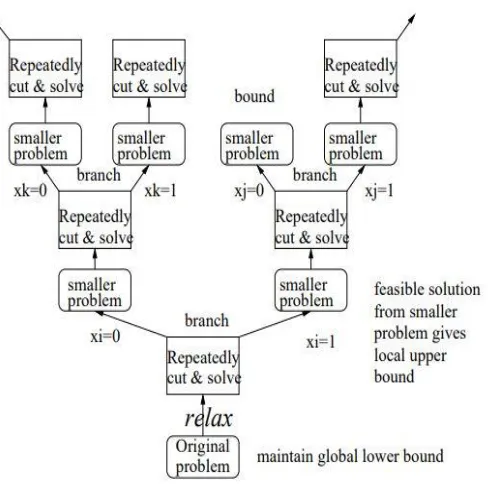
Branch and Cut method [15] is one of the most powerful and successful algorithm for solving integer linear programming problems. It is an exact algorithm consisting of a cutting plane method and a branch and bound algorithm. The branch and cut algorithm uses two techniques
1.Cutting Planes: To solve an ILP, first the relaxation of the problem is considered to cut away parts of the polytope by adding new constraints to bring the best integer solution. In order to cut the planes, the valid inequality of the ILP which causes violation is studied and then separated.
2.Branch and bound: All variables are arranged similar to an enumeration tree, then this tree is partially traversed to compute global lower bounds and local upper bounds, which are used to avoid parts of the trees that do not produce the optimal solution.
20
Figure 3 ILP using Branch and Cut solver
2.4.2 Heuristic Algorithms
The term heuristic is used for algorithms that find the best solution among all possible solutions, but they do not assure that the best solution is found. The approach tries to find near to optimal or an optimal solution in some case. Depending on the heuristic logic used, the algorithm decides which branch should be followed in order to reach the best possible solution for the given problem. The decision is made depending upon the available information in each step.
The only drawback of this approach is that it compromises with the optimality, accuracy of the result returned by the algorithm and completeness. The advantage of using this approach is that it provided quick results, although the optimality of the result obtained by the algorithm cannot be guaranteed.
21
algorithm(NN) in which we start by randomly picking a city and then finding the closest city. The remaining cities are then visited until the closest city is found. Following are the steps of the NN algorithm.
1.Start at a random vertex from the given set of vertices.
2.Determine the shortest distance that connected the current vertex and an unvisited vertex V
3.Make the current vertex, the unvisited vertex
4.Make V as the visited vertex
5.Note the distance travelled
6.Terminate if no other unvisited vertices remain
7.Repeat step 2 to 5
This algorithm is heuristic such that it does not take into account the possibility of better steps being excluded due to the selection process.
2.5Literature Review
2.5.1 Team formation Problem and cost functions for best team formation in
Social Networks
22
known as the leaderdistance function which computes the sum of shortest path between the leader and each expert in the project. We use the above sumofdistance function and translate the team formation problem into a mathematical model using Integer Linear Programming approach.
2.5.2 Social Network an important factor for efficient team formation
Effective team organization is strongly related to the structure that is considered for team formation to accomplish complex tasks. The author Matthew et. al. [3] prove how such social structures play a vital role in task completions and successful completion of project work. Each project and team is modeled by a subgraph where the set of vertices represent the expert that has the collective skills required for the fulfillment of the tasks involved. They then run experiments to study the network effects on the real-world data and shows how social network amongst the team members affect the team performance
The dynamics of group formation is studied by authors Lars et. al. [4], where they consider three parameters: membership, growth, and evolution, for analyzing the evolvement of large groups in an organization/community. They study how various factors influence the desire of an individual to join a community and how companies perform research on these factors for their scalability. It is said in this paper that the willingness of a person to join a community depends upon the number of individuals he is friends with, in that organization. Decision-tree techniques are used to identify the most prominent determinants influencing such social group. They further device a novel methodology that measures the incoming and outgoing of individuals from one community to another depending on their level of interest in a particular topic. The experiment and results are obtained by running the proposed method on DBLP dataset.
2.5.3 Genetic Algorithm for team formation
23
papers published by these authors. The authors Chien et. al.[5] focus on assigning a good team manager on the basis of analyzing the knowledge he/she has and selecting other team members such that there exist a good synergy required for successful and timely completion of the project. Since it is an NP-hard non-linear problem, a genetic algorithm is proposed for problem-solving
2.5.4 Team formation problem solved using various techniques
The author Adil et. al. [7] in this paper proposes an optimization model consisting of objective functions limited to constraints based on the criteria that drive the best team selection for a project. They study various human and nonhuman factors that affect the health of a project and formulate the subjects that drive the decisions for the formation of a team. The mathematical model aims at maximizing the compatibility among the team members based on factors such as the cost of the expert, team size, budget allocated for the team, number of activities involved in the project etc. The fuzzy objectives and constraints are then translated to the simulated annealing algorithm which produces the desired output.
In [16], the author Xinyu et. al. solves the team formation problem considering various approaches. Each approach uses different applications for forming a team of experts.
1. R-TF Algorithms: This approach was used to hire a team of well-known experts for the purpose of reviewing a paper.
2. Steiner-TF algorithm: This algorithm suggested that the team of reviewers hired can give diversified results, as the reviewers come from a wide range of background.
3. SD-TF algorithms: The author’s suggested that this approach can be used to hire experts seeking a rise in their positions and are new to the industry. 4. LD-TF algorithms: It makes sure that while assigning experts to skills, the
working capacity of the experts is not overloaded
24
2.5.5 Clustering Technique for Team Formation Problem
Team Formation Problem(TFP) in social network has been studied widely by many authors and researchers. Many techniques were proposed to solve TFP, for discovering experts that could cover all the tasks required for a project and that the team formed is the most collaborative. With this objective Kalyani et al. [17] in their paper propose clustering technique for grouping set of experts in form of a cluster such that the cluster points consist of experts that hold the skills required for the project. They’ve adopted weighted SCAN algorithm, which is an enhanced version of SCAN i: e Structural Clustering Algorithm to solve TFP with minimum communication cost. The communication cost is the cost associated between two experts on the basis of their past collaboration or prior work experience in one or more projects. The basic idea of their technique is to identify clusters, hubs and outliers in the network of experts where every node represents the expert and the edge weights define the communication cost. They first approach the problem by finding the pool of experts that can cover the skills required for the project. Then, they search for the highly connected expert among all experts and declare it as the core. The cluster is then expanded from the core to the neighboring nodes i: e from densely connected nodes to loosely connected nodes. The cluster is expanded till the threshold range of communication cost is reached. Comparison of weighted scan is done with other greedy, genetic, random and exact algorithm and present the analysis of the results achieved.
2.5.6 Online Team formation in Social Networks
25
2.5.7 Cluster Hiring Problem
26
strategy to score projects that have high profit, the set of experts required to complete the project are cheap and the set of experts selected are able to communicate well. They further run experiments on real dataset and present the efficiency of their approach when compared with the random algorithm.
2.6Problem Statement
Let 𝐸 = {𝑒1, 𝑒2, 𝑒3, … . . 𝑒𝑛} denote a set of n experts and S ={𝑠1, 𝑠2, 𝑠3, … . . 𝑠𝑚} denote the m skills. All symbols used in this thesis are summarized in Table 1. Each expert i possesses a set of skills and we use 𝐶𝑆𝑖𝑢 is whether expert i possesses skill u by 𝐶𝑆𝑖𝑢. Each expert 𝑖
holds a monetary cost(salary) to perform task associated to the project he is assigned. This is measured by dollar value denoted by 𝐶𝑖. In this setting we also use a set of projects 𝑃 =
{𝑝, 𝑝2, 𝑝3, … . . 𝑝𝑘} . Each project also consists of required skills and the number of experts needed per skill in order to successfully complete the project. This set is represented using
𝑃𝑆𝑅𝑢𝑝 for a project 𝑝 . Also, each expert 𝑖 can offer his/her expertise at most 𝐶𝑎𝑝𝑖 times (i:e., capacity of expert i). This is because our aims are to assign experts skill in such a way that they don’t get overloaded when assigned to multiple projects. Hence, each expert has a maximum capacity to participate. We add this as a constraint to our ILP model.
Definition 1: Group of Experts
Given a set of n experts E, a set of m skills S, and set of k projects P, a group of experts’ E is able to complete a subset of projects P, if the following holds.
1. An expert e is assigned to perform the required skills s for p. 2. The number of experts assigned per skill should be the same as the
demand r of the skill s for each project p, where the same expert e cannot perform the same skill s in the same project p twice
3. Each expert e, should not be assigned more than𝐶𝑎𝑝𝑖 skills 4. The sum of 𝐶𝑖 among those selected should be less than budget B
5. The total communication cost is the lowest, meaning they have the highest collaboration.
27
connected to each other via edge weight with the weight denoting the communication cost between these two individuals. The communication cost is extracted from the prior collaboration in the past (i.e. participation in a same project). In this setting, the edge weight denotes the strength of collaboration between the experts. The smaller the communication cost i.e. the edge weight, the stronger the prior collaboration between the experts. For an instance if two experts have participated in four prior projects, their communication cost would be less than that of the experts who have collaborated for prior two projects. When no collaboration is presented between experts the weight of the shortest path between them in G is taken to determine the communication cost between them. Similar to the previous understanding for most collaboration, the shortest the distance between the individuals the maximum the two experts can collaborate. Here, we aim to choose a group of experts which have minimized communication cost among them.
Example of a social network graph of Experts
Figure 4 Social Network of Experts
Definition 2: Communication cost
The communication cost between two experts, 𝑖 and 𝑗 is calculated in a similar way as given by Kargar et. al [2] known as the Sum of Distance function represented as below,
𝐶𝐶(𝐸) = ∑|𝐸|𝑖=1∑|𝐸|𝑗=𝑖+1𝐷𝑖𝑠𝑡(𝑒𝑖, 𝑒𝑗)
28
Definition 3: Profit of the projects:
Given a set of projects P, the profit received when completing these projects is defined as follows:
𝑃𝑟𝑜𝑓𝑖𝑡(𝑃) = ∑|𝑃|𝑝=1𝑅𝑒𝑣𝑒𝑛𝑢𝑒(𝑝)
where revenue function 𝑅𝑒𝑣𝑒𝑛𝑢𝑒(𝑝) maps each project with an integer number denoting a dollar amount obtained by completing the project.
For performing the set of projects, we are also provided a predefined budget B. While selecting the set of projects that provide maximum profit, we also make sure that the total hiring cost which is the salary of each expert is within the budget allocated for the set of projects.
In our study, we provide two ILP models, one that returns group of experts with maximized profit and another selecting a subset of projects that return maximum profit and have minimum communication cost amongst the experts selected to perform the project
Problem 1: Given set of n experts E, set of m skills S, a set of k project P we are interested in choosing a group of experts E’ and a subset of projects in P’ so that the following objective is maximized:
𝑃𝑟𝑜𝑓𝑖𝑡(𝑃′) = ∑|𝑃𝑝=1′| 𝑅𝑒𝑣𝑒𝑛𝑢𝑒(𝑝)
Problem 2: Similar to problem statement 1, we propose to solve the cluster hiring in social network where we choose a group of experts E’ and a subset of projects in P’ in P, such that the following objective is maximized:
𝑃𝑟𝑜𝑓𝑖𝑡(𝐸′, 𝑃′) = ∑|𝑃′|𝑝=1𝑅𝑒𝑣𝑒𝑛𝑢𝑒(𝑝)− ∑ ∑|E′| 𝑗=𝑖+1𝐷𝑖𝑠𝑡(𝑒𝑖, 𝑒𝑗) |E′|
𝑖=1
29
We explain in detail about the ILP models and heuristic algorithm later in Chapter 3
Theorem 1 Problem 1 is NP-hard
Proof 1 Finding a group of experts to cover a subset of projects P and maximizing Profit(P) under the given budget B is proved to an NP-hard problem in kargar et al.[2] Since the objective of the present problem 1 is linearly related to 𝑃𝑟𝑜𝑓𝑖𝑡(𝑝), the present
30
CHAPTER 3
IMPLEMENTATION DETAILS
In this chapter, we propose two different strategies for finding a group of experts which produces maximized profit and has the most collaborative team of experts, i.e. having minimized communication cost. The first strategy is using a heuristic approach which is greedy and covers the highest profitable project in each iteration. While in the second approach we use ILP solvers which gives an exact solution to the given problem and finds the best feasible group of experts from the available input graph of nodes. We further create two ILP models, one which produces maximum profit i.e. covers projects with highest profit, and the other which covers profitable projects as well as selects experts that have the highest collaboration with other experts in the project.
As previously stated, our main objective behind this study is to find a group of experts which covers maximum projects under given budget such that the group of experts selected has the maximum collaboration when deployed to work for the selected subset of projects.
In our study, we suggest two models
a) The model aims at selecting the group of experts with the objective of covering projects which produce maximum profit.
b) In this scale, the above model also picks experts based upon their collaboration with other project members at the same time covering project with high profit returns.
3.1Notations used in ILP
31
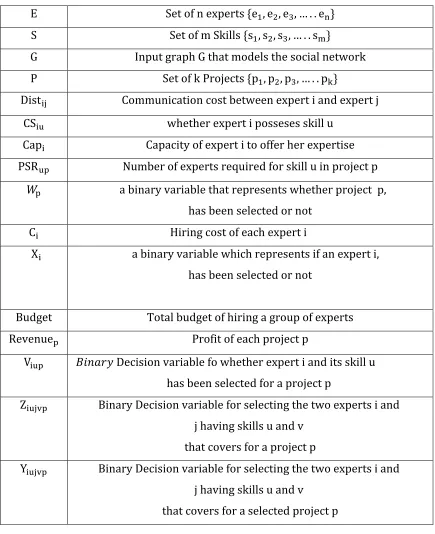
Table 1 Notations in ILP
3.2ILP model for maximized profit
We first present the ILP model which returns the group of experts covering a subset of projects which produce maximum profit and do not guarantee the experts to have good collaboration amongst each other. In the description below, we show the objective function
E Set of n experts {e1, e2, e3, … . . en}
S Set of m Skills {s1, s2, s3, … . . sm}
G Input graph G that models the social network
P Set of k Projects {p1, p2, p3, … . . pk}
Distij Communication cost between expert i and expert j
CSiu whether expert i posseses skill u
Capi Capacity of expert i to offer her expertise
PSRup Number of experts required for skill u in project p
𝑊p a binary variable that represents whether project p,
has been selected or not
Ci Hiring cost of each expert i
Xi a binary variable which represents if an expert i,
has been selected or not
Budget Total budget of hiring a group of experts
Revenuep Profit of each project p
Viup 𝐵𝑖𝑛𝑎𝑟𝑦 Decision variable fo whether expert i and its skill u
has been selected for a project p
Ziujvp Binary Decision variable for selecting the two experts i and
j having skills u and v
that covers for a project p
Yiujvp Binary Decision variable for selecting the two experts i and
j having skills u and v
32
and the set of constraints. The constraint number with sub notations are used to describe the expert skill and project combination.
Objective Function:
𝑚𝑎𝑥𝑖𝑚𝑖𝑧𝑒 ∑k (Wp × Revenuep)
p=1 (3.1) Subjected to:
1.
The value of the binary variable Viupis 1 when it matches the value set in the input CSiu, otherwise is set to value 0∀u ∈ S, ∀i ∈ E ∑k Viup
p=1 ≤ CSiu (3.2)
2.
For all the projects covered, the number of experts selected should not be lessthan the number of experts demanded by each skill of that project
∀p ∈ P, ∀u ∈ S ∑ni=1 Viup ≥ PSRup × Wp (3.3)
3.
The expert selected should not be assigned a number of skills more than its working capacity. The capacity is provided as an input to the ILP model∀𝑖 ∈ 𝐸 ∑mu=1∑kp=1Viup ≤ Capi (3.4)
4.
Expert i is assigned to some project for some skill whenever there exists a project p and a skill u that he/she is assigned to,∀p ∈ P, ∀u ∈ S , ∀i ∈ E, Xi ≥ Viup (3.5)
5. The sum of value of Viupfor every project and skills should be greater than or equal to the value of Xi
∀𝑖 ∈ 𝐸 Xi ≤ ∑mu=1∑kp=1Viup (3.6)
6.The sum of the hiring cost of the experts should be less than the given budget
33
3.2.1 Justification of the ILP
As explained earlier, the aim of our algorithm is to cover highest profitable projects under a given budget constraint. The objective function is thus to maximize the profit calculated by the summing up the revenue of each selected project Wpwhose value is 1. Constraint 3.2, corresponds to the value of the binary variable Viupbeing 1, if an expert i is assigned to skill u in project k only if the expert possesses skill u. In constraint 3.3, we make sure that for every project and the skill associated to that project, we hire exactly the same number of experts as demanded per skill listed in the input PSRup . This also sets the value of variable Wpas 1 shows whether the project has been covered and assigns the experts holding the skills and demand of the number of experts required. Constraint 3.4 is provided to make sure that the sum of the Viup variable for each project and skills for the project should be less than or equal to the working capacity Capifor expert i, which is given as an input to our model. In our setting, we also want to make sure that the hiring cost of an expert is deducted only once from the budget no matter how many skills and in how many projects the same expert is assigned. To make sure this happens, we include constraints 3.5 and 3.6. Constraint 3.5 makes sure that the sum of experts in Xi should be greater than or equal to the value of Viupfor each project, skill and expert. Basically, we make sure that Xi
value is set to 0 for every expert in Viup whose value is 0. On the other hand, Xi value should be less than or equal to the sum of every projects and skill. This is to assure that the value of Xiis set to 1,if expert i is assigned to any project for any skill. In 3.7, we sum the salary of all the selected experts to make sure it is less than or equal to the given budget which is given as an input to the model.
All of the above explained constraints ensure the below attributes to solve the cluster hiring are taken into consideration
1)A same expert is not assigned more than once to the same skill in the same project
2) Hiring cost of the expert is subtracted only once from the given budget given that an expert can perform up to n number of skills in m number of projects
34
3.3ILP model with maximum profit and minimum communication cost
The ILP given below is proposed for solving the Cluster Hire problem in the social network. We choose to work using ILP technique, since it goes through all the possible solution nodes to return the best solution for the given objective function. Here, we also prove the scalability of the existing model by showing how the ILP model for cluster hiring with maximized profit can be modified to include the communication cost feature ensuring the group of experts selected return maximized profit and have good communication amongst each member in the project he/she is assigned to
Objective function:
∑ ∑ ∑ ∑ ∑m (Wp × Profitp) − (𝐷𝑖𝑠𝑡𝑖𝑗 × Yiujvp)
u≠v m
u=1 n
j=1 n i=1 k
p=1
(3.8)
Subjected to:
1.
The value of the binary variable Viupis 1 only when expert i possesses skill u∀u ∈ S, ∀i ∈ E ∑kp=1Viup ≤ CSiu
(3.9)
2.
For any project covered, the number of experts selected for this project should be equal to the number of experts demanded by each skill of that project∀p ∈ P, ∀u ∈ S ∑ni=1 Viup ≥ PSRup × Wp
(3.10)
3.
The expert selected should not be assigned skills more than its working capacity. The capacity is provided as an input to the ILP model∀𝑖 ∈ 𝐸 ∑mu=1∑kp=1Viup ≤ Capi (3.11)
4.
The value of Viupshould be less than or equal to the value of Xi∀p ∈ P, ∀u ∈ S , ∀i ∈ E, Xi ≥ Viup
(3.12)
35
∀𝑖 ∈ 𝐸 Xi ≤ ∑ ∑k Viup
p=1 m
u=1
(3.13)
6.
The sum of the hiring cost of the experts should be less than the given budget∑ni=1 Ci× Xi ≤ Budget
(3.14)
7.
To calculate the communication cost between two experts we write the below constraints. Since we need to multiply the two variables Viup and Vjup which would make the model non-linear we linearize it using the general technique, by introducing the third variable Ziujvpas explained below:∀p ∈ P, ∀u ∈ S , ∀i ∈ E
Ziujvp ≤ Viup (3.15)
Ziujvp ≤ Vjup (3.16)
Ziujvp ≥ Viup+ Vjup− 1
(3.17)
8.
We introduce Yiujvp variable to make sure communication cost is calculated only among the experts within the project selected.
∀p ∈ P, ∀u ∈ S , ∀i ∈ E
Yiujvp ≤ Ziujvp (3.18)
Yiujvp ≤ Wp (3.19)
Yiujvp ≥ Ziujvp+ Wp− 1 (3.20)
36
ILP model. The new set of constraints added from 3.15 to 3.20 are mainly to calculate the distance/communication cost between the experts. Constraint 3.15 to 3.16 is the linearize form for Viup* Vjup. Since this equation would have made the model non-linear, we used the standard way of decomposing multiplication of variables to the above set of equations. Thus Ziujvpvalue is set to 1 when there exists a communication cost between experts i and j with skills u and v respectively. Also, further here we calculate the communication cost amongst members of each selected project. Again, the original equation Ziujvp * Wpp was decomposed to linear equations using standard technique introducing the variable Yiujvp
This model for ILP takes care of an additional feature, the which is communication cost, which helps make better hiring decisions for cluster hiring in social network. It ensures all the previously mentioned attributes of cluster hiring with one more attribute to select the individuals which have prior collaboration with other experts in the project and hence performs project tasks with collaboration and co-operation with increased synergy.
3.4Heuristic Algorithm for Cluster Hire Problem
In this section, we introduce our heuristic algorithm for solving the Cluster Hiring problem with the demanded project skill’s demand, i.e. specific number of experts needed per skill per project along with the intent to hire a group of experts that are collaborative and produce maximum profit. The algorithm is designed so to cover as many profitable projects with in the given budget. We assign the score to each uncovered project in each iteration to choose the project which gets the highest score with the hope that our algorithm returns the highest profit.
The score for finding the highest profitable project is designed keeping in mind these intuitions:
1. We want to choose the set of experts that are less expensive, such that they cover all the skills required by the project and the budget is not overspent on a single project.
37
3. Choose the project which returns the highest profit.
We structure the scoring function that takes into account a combination of all the above intuitions. Hence at each iteration, for each uncovered project p, we find a set of experts to cover the required skills for p. Our goal is to select those subsets of experts that cover all the skills and experts demanded per skill per project and also, that no expert covers the same skills more than once for the same project demanding more than one individual to perform the same skill. The algorithm thus aims to find the subset of experts that have minimized hiring and communication cost. In each iteration, we find the set of experts that can cover the project. At the start, we have an empty set; hence, for the skill which appears in the first iteration of the project, we find and assign the expert which covers the skill in the least expense. After the first expert is selected, we then select the experts who have both minimum cost and minimum communication cost with each member in the team selected so far in the project. We then use our scoring function as mentioned below to rank the projects to select the one with the highest profit return
𝑃𝑟𝑜𝑓𝑖𝑡(𝑝) = 𝑅𝑒𝑣𝑒𝑛𝑢𝑒(𝑝) – 𝑚𝑖𝑛{𝐶𝑒 + 𝐶𝑜𝑚𝐶𝑜𝑠𝑡(𝑒, 𝑒’) }
Here 𝑒, 𝑒’ represent neighbouring experts in the same project. Our equation thus aims to choose the subset of projects and the team of experts, that produces maximum profit.
The heuristic algorithm is our solution to the cluster hiring problem where we give certain inputs to our algorithm like the graph G with nodes representing experts’ along with project attributes like profit per project, skills required by each project, number of individuals required per skill per project.
3.4.1 Cluster Hire Algorithm for maximized profit and collaborative team
38
Output: Team of experts for subset of projects along with their skills, maximized profit under given budget B
39
Cluster Hire algorithm for maximized profit and collaborative team
1. min_cost = MAX_VALUE, budget = 0, temp_team(p) = Ø, min_cost_expert = 0, exp_cost = 0 , highest_profit = 0
2. 𝐖𝐡𝐢𝐥𝐞 (budget < B and P ≈ Ø) 𝐝𝐨
3. 𝐖𝐡𝐢𝐥𝐞 (p € P) 𝐝𝐨
4. 𝐖𝐡𝐢𝐥𝐞 (s € PSR(p)) 𝐝𝐨
5. 𝐖𝐡𝐢𝐥𝐞 (r € PSR(p)) 𝐝𝐨
6. 𝐖𝐡𝐢𝐥𝐞(e€ E) 𝐝𝐨
7. 𝐈𝐟 e holds the skill s belonging to p && Cap(e) > 0 𝐭𝐡𝐞𝐧
8. exp_cost = C(e)
9. 𝐢𝐟 ( exp_cost < min_cost and temp_team(p) = Ø) 𝐭𝐡𝐞𝐧
10. min_cost_expert = e
11. min_cost = C(e)
12. 𝐞𝐥𝐬𝐞
13. 𝐟𝐨𝐫 𝐚𝐥𝐥 e’ € temp_team 𝐝𝐨
14. exp_cost = exp_cost + Dist(e, e’)
15. 𝐢𝐟 (exp_cost < min_cost)
16. min_cost = exp_cost
17. min_cost_expert = e
18. temp_team(p). add(e, s)
19. temp_profit(p) = Revenue(p) – min_cost
20. 𝐢𝐟 (temp_profit(p) > highest_profit(p))
21. final_team(p) = temp_team(p)
22. 𝐟𝐨𝐫 all e in final_team(p) 𝐝𝐨
23. budget = budget − C(e)
24. 𝐮𝐩𝐝𝐚𝐭𝐞 Cap(e), C(e)
25. 𝐫𝐞𝐦𝐨𝐯𝐞 p from P
26. 𝐫𝐞𝐭𝐮𝐫𝐧 final_team, budget
40
3.4.2 Sample data set observations
We now illustrate the output produced by all the three approaches, to see the difference between the decision-making process of the algorithms given the same set of sample input.
Skills: {AI, DB, ML, IR}
Experts: {Expert0, Expert1, Expert2, Expert3} Social Network amongst the experts:
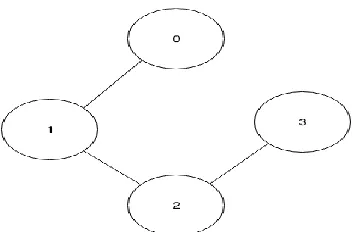
Expert 0<-> Expert 1, Expert 2 Expert 1 <-> Expert 0, Expert 2 Expert 2<->Expert 1, Expert 3 Expert 3<->Expert 2
Figure 6 Sample Network of Experts Given Budget: 500
Projects Covered: Project 1, Project 2, Project 3
Experts Selected: Expert 0, Expert 1, Expert 2, Expert 3 Output from ILP model with maximized profit
Project 1: {AI: Expert 0, DB: Expert 0, Expert 2, ML: Expert 1} Project 2: {ML: Expert1, Expert 2, IR: Expert 3}
41
Output from ILP model with maximized profit and minimized communication cost
Project 1: {AI: Expert 0, DB: Expert 0, Expert 2, ML: Expert 1}
Project 2: {ML: Expert2, Expert 3, IR: Expert 3}
Project 3: {AI: Expert 0, IR: Expert 2}
Budget Exhausted: 0
Table 2 Expert Attributes
Output from Heuristic Algorithm
Project 2: {ML: Expert1, Expert 2, IR: Expert 2}
Project 3: {AI: Expert 1, IR: Expert 2}
Budget Exhausted: 260
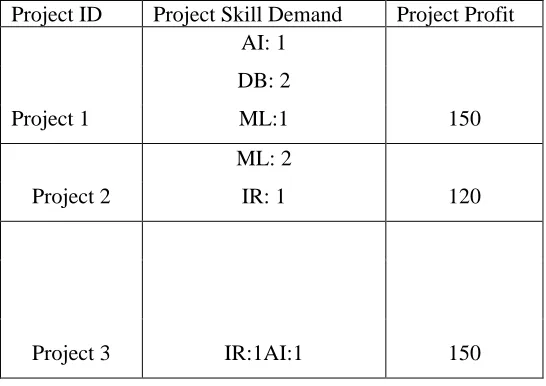
Table 3 Project Attributes
Expert ID Expert Skill Expert Cost Expert Capacity
Expert0 AI, DB 150 3
Expert1 AI, ML 120 2
Expert2 DB, AI, ML, IR 120 3
Expert3 ML, IR 110 4
Project ID Project Skill Demand Project Profit
Project 1
AI: 1
DB: 2
ML:1 150
Project 2
ML: 2
IR: 1 120
42
All the three algorithms provide results as per their design logic. The ILP with maximized profit makes sure to select experts first with less salary and more capacity when their skill matches with the skill required by the project.
43
CHAPTER 4
RESULT AND ANALYSIS
In this chapter, we evaluate the performance of our proposed algorithms to find the best team of experts for the problem of cluster hiring in a network of experts. The ILP formulation evaluated in this research generates better results which are relatively close to optimal, when compared to heuristic solutions. The primary objective of this thesis is to study and compare the impact of ILP formulation when applied on Cluster Hiring Problem which is NP-Hard in nature.
We formulated two ILP models as described in Chapter 3 to generate solutions for finding a group of experts which satisfy all the constraints provided. The first model produces a group of experts which covers projects which return maximum profit. Second ILP model produces the most collaborative team along with the maximum profit which is formulated by adding additional constraints and objective function used for calculating the communication cost. This gives ILP model a room for flexibility and scalability of the problem domain.
This implies that for each group of expert, the ILP models evaluate
1. The maximum profit that the group of experts return
2. The group of experts selected fall in the feasible region. That is, satisfy all the constraints required for the problem solution.
The objective of the model is that the total profit should be the maximum and the team formed should be the most collaborative.