TACTICAL STEPS FOR E-GOVERNMENT DEVELOPMENT
Dwi AD Putra1, Kamarul Azmi Jasmi2, Bushrah Basiron2, Miftachul Huda2, Andino Maseleno1, Shankar K.3, Nur Aminudin1
1
Department of Information System, STMIK Pringsewu, Lampung, Indonesia
2
Universiti Teknologi Malaysia, Malaysia
3
School of Computing, Kalasalingam Academy of Research and Education, Krishnankoil, India
Corresponding author E-mail: [email protected]
ABSTRACT
Information is a valuable commodity in the era of globalization to be mastered in order to improve the competitiveness of an organization. This is evident from the various applications of Information and Communication Technology (ICT) that appear in some local governments. But the fact is that the utilization of ICT has not yet had a significant impact on the productivity of district government. One of the dominant causes is the lack of synchronization of the objectives of district governement activities with the purpose of activities undertaken by the government using Information Technology to provide services to the community (e-Government) itself. This paper discusses the tactical steps of e-Government development based on the theory of various agencies that have implemented e-Government and will produce optimal results.
Keywords: government, e-government, information technology
I. INTRODUCTION 1.1BACKGROUND
Information and Communication Technology is one of the fastest growing technologies. The rapid development of ICT will open opportunities and challenges to create, to access, to process, and to utilize accurate information. Information is a very valuable commodity in the era of globalization to be mastered in order to improve the competitiveness of an organization (including local government) on an ongoing basis.
In this technological era, it is time for the government to implement development using information technology to accelerate the development process. Information and communication technology promises efficiency, speed of information delivery, global reach and transparency. Therefore, in this era of regional autonomy to realize a good governance government one of its efforts is to use information and communication technology. Another term that is more popular is e-Government.
Responding to the challenge, the Government of Responding to the challenge, the Government of the Republic of Indonesia has initiated a policy to utilize ICT to build Electronic Government for Good Governance which is integrated from the regional government to the central level. The goal is that the ICT infrastructure to be built can be used together to coordinate by all agencies, both at the center and in the region.
The government policy is stated in the form of Presidential Instruction No. 3 of 2003 and the Decree of the Minister of Communication and Information on e-Government Development which is a manifestation of the government's desire in an effort to push the Indonesian nation towards Knowledge-based Society. Presidential Instruction No. 3 of 2003 on "national policies and strategies for the development of e-Government of Indonesia" among others contains socialized guides.
Along with the development of information and communication technology, human life activity in various sectors is experiencing a change of 3.7% since the last 5 years.
Public service sector undertaken by the government, the development of Information and Communication Technology has spawned a model of public services conducted through e-Government. Bureaucratic and rigid government services are eliminated through the use of e-Government to be more flexible and more International Journal of Pure and Applied Mathematics
Volume 119 No. 15 2018, 2251-2258
ISSN: 1314-3395 (on-line version)
url:http://www.acadpubl.eu/hub/ Special Issue
http://www.acadpubl.eu/hub/
user-centric oriented (CDT).
Government offers public services accessible 24 hours, anytime, and from wherever users are. E-Government also allows public services are not done face-to-face so that services become more efficient. Aware of the benefits of E-Government, the government of Indonesia since 2003 has issued a policy in every region throughout the archipelago.
Realizing the great benefits of Information Technology Government of Pringsewu Regency has been initiated to build ICT network as one of solution to overcome barrier of limited access between regions. The initiative of ICT network development started from Pringsewu. Office of Electronic Data Management is authorized and responsible for conducting research and development activities and management of Information Technology. The result of the online infrastructure development in Pringsewu District Government is carried out gradually starting from Pringsewu to be completed to expedite the system of government with some solutions that will be done such as tactical steps in e-Government development at district government of Pringsewu.
1.2 FORMULATION OF THE PROBLEM
The policy that was born by the government in 2003 as an E-Government development initiative seems to have yielded quite encouraging results.
The policy that emerged as an e-Government development initiative was well received by government agencies in Indonesia, especially the district government of Pringsewu. For that it can be formulated problem as follows.
1. Required a capable Information System of conveying information about potential village data as well as indicators of investment opportunities in the hope of being able to invite investors to invest. 2. The potential of the village and the change of data in the village, so that it can quickly be obtained and
uptodate.
3. An information system is needed for the administration management of the village apparatus. 4. Developing online infrastructure to all villages in Pringsewu District to be maximally utilized, in order
to promote the potential of villages in the hope of incoming investors.
5. Able to provide complete information about the institution or region for economic progress and regional development, and improvement of service process performance (increased effectiveness and productivity).
1.3 OBJECTIVES AND BENEFITS OF RESEARCH
The benefit of this research is to provide input and findings on the application of E-Government in Pringsewu District Government, so it is expected that the findings in the form of obstacles and obstacles that arise from the application of tactical steps E-Government can help the government of Pringsewu Regency realize good Government.
II. LITERATURE REVIEW
The World Bank Group [9] defines e-Government as "an effort to utilize and utilize telematics to improve government efficiency and effectiveness, provide better service to the community, provide access to information to the public more broadly, government is more accountable and transparent to society ".
The Ministry of Communications and Informatics provides the definition of e-government as an application of Internet-based information technology and other digital devices managed by the government for the purpose of delivering information from government to the public, business partners, employees, business entities and other institutions on-line.
Electronic Government is a process of government system by utilizing ICT (information, communication and technology) as a tool to facilitate communication process and transactions to citizens, business organizations and between government agencies and their staff. So that can be achieved efficiency, effectiveness, transparency and government responsibility to the community.
The concept of E-Government development determines the development priorities of E-Governments of a government agency, concerning Government to Government (G2G), Governmentto Business (G2B) and Governmentto Citizen (G2C) relationships, Readiness for E-Government success [6].
1. Infrastructure legal / legal. There is a need for a legal tool to ward off digital crime, as well as to protect the privacy, security of data / information and individual digital transactions, companies and institutions.
2. Institutional Infrastructure. There needs to be a special agency that handles E-Government that provides information services to the public including digital services.
3. Human Resource Infrastructure (HR). Personnel system needs to be developed to be able to attract
qualified human resources professionals in the field of telematics to participate in government e-Government.
4. Technology Infrastructure. Although the technology required relativ expensive, but the opportunity of cooperation with the private sector should be developed in building technology infrastructure to support E-Government.
2.1 BENEFITS OF E-GOVERNMENT
1. E-Government improves efficiency. ICT helps improve the efficiency of bulk processing tasks and public administration operations. Internet-based applications can save data collection and transmission, and provide information and communications with customers. Significant future efficiency is done through a process of data sharing between governments.
2. E-Government improves service. Adopting customer focus is at the core of the current reform agenda. A successful service is built on understanding customer needs. Customer focus implies that users do not need to understand the structure and government relationships to interact with the government. The Internet can help achieve this goal by bringing the government into an integrated organization that delivers online services smoothly. As with all services, E-Government services must also be developed based on user demand and value.
3. E-Government helps achieve specific policy outcomes: ICT can help stakeholders share information and ideas, to then contribute in determining policy outcomes.
4. E-Government contributes to economic policy objectives: E-Government helps reduce corruption, promotes openness and confidence in government, and contributes to economic policy objectives. 5. E-Government is a major contributor to reform: The majority of countries are facing issues of
modernization and public management reform. The current development means that the reform process must be sustainable.
6. E-Government helps build trust between the Government and its citizens: Building trust between the government and its citizens greatly fundamental for good governance.
ICT can help build trust by enabling citizen involvement in policy processes, promote open and accountable governments and help prevent corruption. In addition, if the limits and challenges are addressed properly, e-Government can help to list the voice of the people to be debated more broadly. This process is done by utilizing ICT to encourage citizens to provide constructive advice on public issues and assess the impact of technology implementation to open policy processes.
E-Government improves transparency and responsibility. ICT helps improve transparency in decision-making processes by decision-making it easier for information to be accessible - publishing debates and meetings, budgets and expenditures, results and governmental reasons for taking important decisions [5].
2.2 SUPERIOR CHARACTERISTICS OF E-GOVERNMENT
1. Vision and Implementation: have a vision since the beginning and implementation mechanism is good / right.
2. User-Oriented / Citizen-based: in general, in the development of organized e-government, with published information considering the way government was drafted in early work and providing services physically. In superior e-government, services to the public or citizens are designed with consideration of the will and ways of thinking of the general public, not based on the workings of government institutions. In communicating with the Government through e-government, people do not need to know the organizational structure and governance.
3. Using Community Relationship Management (CRM): Public relation shifts like public relations in service firms, using user information management, marketing, minimizing duplication of information gathering and user behavior profiles in order to predict the needs in the future.
4. Volume and Complexity / complexity: able to handle large volumes of information with high complexity (but still comfortable and simple or not complicated for users).
5. Use of Portal as one entrance: make it easier for users / citizens by not need to visit the site of each agency, just one site as entrance to get all the services [6].
2.3 STEPS OF E-GOVERNMENT LOGGING
Based on the development of E-Government in various countries, especially in Pringsewu District, it can be obtained a lesson learned from good practices and bad practices that each country experienced. If lesson learned is combined with existing theory, then it can be proposed a methodology of e-Government development that can be used as a guide for the environment of local government in Indonesia.
According to the Center for Democracy and Technology and InfoDev, the E-Government implementation process is divided into 3 (three) stages that are independent of each other. The stages must be done
International Journal of Pure and Applied Mathematics Special Issue
regularly and each stage must explain the purpose of E-Government. The three stages, among others, are: 1. Publish, that is the stage of using information technology to expand access to government information,
for example by making information site in every institution, preparation of human resources, socialization of information site both for internal and for public, and easy access facility preparation. This is commensurate with Agarwal's theory, which is stage 1 of e-Government development. 2. Interact, namely expanding public participation in government, for example by way of making the site
interactive with the public, as well as the interface that is connected with other institutions. It is equivalent to level 2 and 3 of the development of e-Government.
3. Transact, which provides online government services, for example by making public transactions service site, as well as interoperability of applications and data with other institutions. It is commensurate with levels 4 and 5 of the development of e-Government.
In order for these three stages to be implemented properly, then there must be a guarantee of high commitment from the leadership of the local government, in terms of can be governors, regents, or mayors. In addition, the implementation of e-Government must consider some of the conditions of electronic service priority given, the condition of the infrastructure owned, the current condition of service activities, and the condition of the budget and human resources owned. To that end, in the development of Government, proposed a form of organization of e-Government development activities [2].
2.4 OBSTACLES ENCOUNTERED
In addition to the proposals for the progress and development of Government in Indonesia, e-Government also faces various obstacles such as:
1. The lack of awareness in making telematics decisions. 2. The scarcity of qualified human resources
3. The lack of infrastructure telecommunication 4. Internet rates are still expensive and inadequate. 5. Penetration of PC is still low.
6. Lack of public interest.
7. Lack of local government socialization.
All the above obstacles need to be considered in developing and implementing e-Government. But the above obstacles are not absolute to be an excuse because apart from all the obstacles above the most important is how to use existing facilities to perform the stages of e-Government implementation to improve government performance in serving the community.
When we consider the performance of e-Government (e-Gov) in Indonesia during the last 5 years, it can be seen that up to now communication between the government and the community is still one way. This means that the role of e-Government has not been felt by the public because the community has not been maximized in accessing existing information.
III. DESIGN METHOD
Stages of Waterfall Method 1. Needs Analysis
This step is an analysis of system requirements. Data collection in this stage can do a research, interview or literature study. Systems analyst will dig as much information from the user so that it will create a computer system that can perform tasks desired by usertersebut. This stage will generate user requirment documents or can be said as data related to the user's desire in making the system. It is this document that will be a reference system analyst to translate into a programming language.
2. System Design
Stages where the pouring of mind and system design to the solution of existing problems by using system modeling tools such as data flow diagrams (diagram data flow), entity relationship diagram (diagram entity relationship) as well as structure and discussion of data.
3. Writing the Program Code
Writing code or coding is a translation design in a language that can be recognized by the computer.
Performed by the programmer who will translate the transaction requested by the user. This stage is the real step in working on a system. In the sense that the use of computers will be maximized in this stage. After the coding is complete it will be testing the system that has been made earlier. The purpose of testing is to find errors on the system and then be corrected.
4. Program Testing
The final stage in which the new system is tested its ability and effectiveness so that the system deficiencies and weaknesses are found and then the review and improvement of the application becomes better and better.
5. Program Implementation and Maintenance
The software that has been submitted to customers will definitely change. The change could be due to an error because the software must adapt to a new environment (peripheral or new operating system), or because customers need functional development [5].
IV. ANALYSIS OF DESIGN AND IMPLEMENTATION
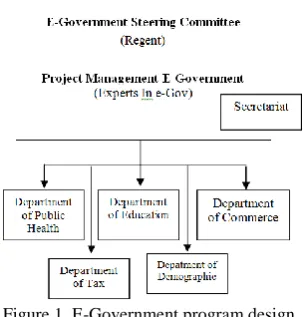
Based on the condition of e-Government program design, for the development of e-Government in its implementation which can be seen in the figure 1 below.
Figure 1. E-Government program design
Some fundamental obstacles then lead to the implementation of e-Government is not as expected. The causes of low e-Government implementation are:
1. Low Political Will from the government itself.
2. The Old Paradigm of Bureaucratic Apparatus in Indonesia.
3. Information technology, especially web and email is just a tool to help us in completing the job alone. 4. One indicator of E-Gov implementation failure is the inability of the bureaucratic apparatus to
maintain the web portal to keep up date. The project paradigm is still embedded in the heads of the apparatus, so the implementation of E-Gov is in accordance with the Inpres 2003.
5. Availability of resources.
With the Internet usage rate of only 4% of the total population of Indonesia, this policy will not be effective if it is not accompanied by other policies, namely the information access granting policy to the village level as well as policies to increase knowledge for the population.
V. CONCLUSIONS AND SUGGESTIONS 5.1. CONCLUSION
Based on the above description can be concluded that the need for commitment from local leaders for the development of E-Government rooted in the change of work culture from traditional to electronic by utilizing information technology devices. This is in line with the main objective of E-Government development that wishes to improve the quality of service to the public or to the entire community, which in turn will improve the welfare of the community through increased efficiency, effectiveness and productivity of Regency Government.
International Journal of Pure and Applied Mathematics Special Issue
5.2. SUGGESTION
With the E-Government is expected to be one of the breakthrough alternatives in providing better public services and become the main information resource for the government in the framework of providing information that is strategic.
REFERENCES
[1]. Agarwal, P.K., "Portals: the path to everything:' Government Technology, March, www.govtech.net September 2013
[2]. Bastian. Perkembangan E-Government di Indonesia. Sinar harapan 2003
[3]. Center for Democracy and Technology (CDT) and InfoDev, "E-Government Handbook: Part 1 - The Three Phases of E-Governmenf, http://www.cdt.org/egov/handbooypartl.shtml, September 2013. [4]. Hasibuan, Zainal A., Harry Budi Santoso. Standardisasi Aplikasi E-Government Untuk Instansi
Pemerintah. Paper e- Indonesia Initiatives Forum 2005.
[5]. Hasibuan, Zainal, A. Pengembangan Prototipe Kerangka Aplikasi E-Government, Studi Kasus: Sistem Informasi Kependudukan. Paper e-Indonesia Initiatives Forum 2006.
[6]. Heeks, Richard. 2001. Understanding e-Governance for Development. i-Government Working Paper Series, Paper No. 11, Institute for Development Policy and Management, University of Manchester
[7]. Inpres RI Nomor 3 Tahun 2003, Kebijakan dan Strategi Nasional Pengembangan E-Government.
[8]. Kepmen Komunikasi dan Informasi Nomor 57/Kep/M.Kominfo/12/2003, Panduan Penyusunan Rencana Induk Pengembangan E-Government.
[9]. The World Bank Group, "A Definition of E-
Governmenf\http://wwwl.worldbank.org/publicsector/egov/definition.htm [online] September 2013. [10].Rosli, M.R.B., Salamon, H.B., and Huda, M. (2018). Distribution Management of Zakat Fund:
Recommended Proposal for Asnaf Riqab in Malaysia. International Journal of Civil Engineering and Technology 9(3), pp. 56–64.
[11].Aminin, S., Huda, M., Ninsiana, W., and Dacholfany, M.I. (2018). Sustaining civic-based moral values: Insights from language learning and literature. International Journal of Civil Engineering and Technology. 9(4), 157-174.
[12].Maseleno, A., Pardimin, Huda, M., Ramlan, Hehsan, A., Yusof, Y.M., Haron, Z., Ripin, M.N., Nor, N.H.M., and Junaidi, J. (2018a). Mathematical Theory of Evidence to Subject Expertise Diagnostic.
ICIC Express Letters, 12 (4), 369 DOI: 10.24507/icicel.12.04.369
[13].Maseleno, A., Huda, M., Jasmi, K.A., Basiron, B., Mustari, I., Don, A.G., and Ahmad, R. (2018b). Hau-Kashyap approach for student’s level of expertise. Egyptian Informatics Journal, doi.org/10.1016/j.eij.2018.04.001.
[14].Maseleno, A., Huda, M., Siregar, M., Ahmad, R., Hehsan, A., Haron, Z., Ripin, M.N., Ihwani, S.S., and Jasmi, K.A. (2017). Combining the Previous Measure of Evidence to Educational Entrance Examination. Journal of Artificial Intelligence 10(3), 85-90.
[15].Huda, M., & Teh, K. S. M. (2018). Empowering Professional and Ethical Competence on Reflective Teaching Practice in Digital Era. In Dikilitas, K., Mede, E., Atay D. (Eds). Mentorship Strategies in Teacher Education (pp. 136-152). Hershey, PA: IGI Global. doi: 10.4018/978-1-5225-4050-2.ch007 [16].Huda, M., Teh, K.S.M., Nor, N.H.M., and Nor, M.B.M. (2018a). Transmitting Leadership Based Civic Responsibility: Insights from Service Learning. International Journal of Ethics and Systems, 34(1), 20-31.
[17].Huda, M., Maseleno, A., Muhamad, N.H.N., Jasmi, K.A., Ahmad, A., Mustari, M.I., Basiron, B. (2018b). Big Data Emerging Technology: Insights into Innovative Environment for Online Learning Resources. International Journal of Emerging Technologies in Learning 13(1), 23-36. doi:10.3991/ijet.v13i01.6990
[18].Huda, M., Maseleno, A., Teh, K.S.M., Don, A.G., Basiron, B., Jasmi, K.A., Mustari, M.I., Nasir, B.M., and Ahmad, R. (2018c). Understanding Modern Learning Environment (MLE) in Big Data Era. International Journal of Emerging Technologies in Learning. 13(5), 71-85. doi: 10.3991/ijet.v13i05.8042
[19].Huda., M. & Sabani, N. (2018). Empowering Muslim Children’s Spirituality in Malay Archipelago: Integration between National Philosophical Foundations and Tawakkul (Trust in God). International Journal of Children's Spirituality, 23(1), 81-94.
[20].Huda, M., Jasmi, K. A., Mustari, M. I., Basiron, B., Mohamed, A. K., Embong, W., ... & Safar, J. (2017g). Innovative E-Therapy Service in Higher Education: Mobile Application Design. International Journal of Interactive Mobile Technologies, 11(4), 83-94.
[21].Huda, M., Siregar, M., Ramlan, Rahman, S.K.A., Mat Teh, K.S., Said, H., Jamsari, E.A., Yacub, J., Dacholfany, M.I., & Ninsiana, W. (2017j). From Live Interaction to Virtual Interaction: An Exposure on the Moral Engagement in the Digital Era. Journal of Theoretical and Applied Information Technology, 95(19), 4964-4972.
[22].Anshari, M., Almunawar, M. N., Shahrill, M., Wicaksono, D. K., & Huda, M. (2017). Smartphones usage in the classrooms: Learning aid or interference?. Education and Information Technologies, 22(6), 3063-3079.
[23].Huda, M., Sabani, N., Shahrill, M., Jasmi, K. A., Basiron, B., & Mustari, M. I. (2017a). Empowering Learning Culture as Student Identity Construction in Higher Education. In A. Shahriar, & G. Syed (Eds.), Student Culture and Identity in Higher Education (pp. 160-179). Hershey, PA: IGI Global. doi:10.4018/978-1-5225-2551-6.ch010
[24].Huda, M., Jasmi, K. A., Hehsan, A., Shahrill, M., Mustari, M. I., Basiron, B., & Gassama, S. K. (2017b). Empowering Children with Adaptive Technology Skills: Careful Engagement in the Digital Information Age. International Electronic Journal of Elementary Education, 9(3), 693-708. [25].Huda, M., Shahrill, M., Maseleno, A., Jasmi, K. A., Mustari, I., & and Basiron, B. (2017c).
Exploring Adaptive Teaching Competencies in Big Data Era. International Journal of Emerging Technologies in Learning, 12(3), 68-83.
[26].Huda, M., Jasmi, K. A., Basiran, B., Mustari, M. I. B., & Sabani, A. N. (2017d). Traditional Wisdom on Sustainable Learning: An Insightful View From Al-Zarnuji's Ta 'lim al-Muta 'allim. SAGE Open, 7(1), 1-8.
[27].Huda, M., Jasmi, K. A., Embong, W. H., Safar, J., Mohamad, A. M., Mohamed, A. K., Muhamad, N. H., Alas, Y., & Rahman, S. K. (2017e). Nurturing Compassion-Based Empathy: Innovative Approach in Higher Education. In M. Badea, & M. Suditu (Eds.), Violence Prevention and Safety Promotion in Higher Education Settings (pp. 154-173). Hershey, PA: IGI Global. doi:10.4018/978-1-5225-2960-6.ch009
[28].Huda, M., Jasmi, K. A., Alas, Y., Qodriah, S. L., Dacholfany, M. I., & Jamsari, E. A. (2017f). Empowering Civic Responsibility: Insights From Service Learning. In S. Burton (Ed.), Engaged Scholarship and Civic Responsibility in Higher Education(pp. 144-165). Hershey, PA: IGI Global. doi:10.4018/978-1-5225-3649-9.ch007
[29].Huda, M., Maseleno, A., Jasmi, K. A., Mustari, I., & Basiron, B. (2017k). Strengthening Interaction from Direct to Virtual Basis: Insights from Ethical and Professional Empowerment. International Journal of Applied Engineering Research, 12(17), 6901-6909.
[30].Huda, M., Haron, Z., Ripin, M. N., Hehsan, A., & Yaacob, A. B. C. (2017l). Exploring Innovative Learning Environment (ILE): Big Data Era. International Journal of Applied Engineering Research, 12(17), 6678-6685.
[31].Huda, M. (2018). Empowering Application Strategy in the Technology Adoption: Insights from Professional and Ethical Engagement. Journal of Science and Technology Policy Management. doi.org/10.1108/JSTPM-09-2017-0044.
International Journal of Pure and Applied Mathematics Special Issue