
University of Windsor University of Windsor
Scholarship at UWindsor
Scholarship at UWindsor
Electronic Theses and Dissertations Theses, Dissertations, and Major Papers
2011
Study of the Added Mass of Cylinders and Spheres
Study of the Added Mass of Cylinders and Spheres
Shelagh Fackrell
University of Windsor
Follow this and additional works at: https://scholar.uwindsor.ca/etd
Recommended Citation Recommended Citation
Fackrell, Shelagh, "Study of the Added Mass of Cylinders and Spheres" (2011). Electronic Theses and Dissertations. 458.
https://scholar.uwindsor.ca/etd/458
This online database contains the full-text of PhD dissertations and Masters’ theses of University of Windsor students from 1954 forward. These documents are made available for personal study and research purposes only, in accordance with the Canadian Copyright Act and the Creative Commons license—CC BY-NC-ND (Attribution, Non-Commercial, No Derivative Works). Under this license, works must always be attributed to the copyright holder (original author), cannot be used for any commercial purposes, and may not be altered. Any other use would require the permission of the copyright holder. Students may inquire about withdrawing their dissertation and/or thesis from this database. For additional inquiries, please contact the repository administrator via email
STUDY OF THE ADDED MASS OF CYLINDERS AND SPHERES
By
Shelagh A. Fackrell
A Dissertation
Submitted to the Faculty of Graduate Studies
Through Mechanical, Automotive and Materials Engineering
In partial fulfillment of the requirements for the Degree of Doctor of Philosophy
at the University of Windsor
Windsor, Ontario, Canada
2011
ii
STUDY OF THE ADDED MASS OF CYLINDERS AND SPHERES
By:
Shelagh A.Fackrell
Approved by:
_____________________________________________________ Dr. J. A. McCorquodale, External Examiner
Civil and Environmental Engineering Department, University of New Orleans
_____________________________________________________ Dr. R. Balachandar, External Department Reader
Civil and Environmental Engineering Department, University of Windsor
_____________________________________________________ Dr. D. Ting, Internal Department Reader
Mechanical, Automotive and Materials Engineering Department, University of Windsor
_____________________________________________________ Dr. A. Fartaj, Internal Department Reader
Mechanical, Automotive and Materials Engineering Department, University of Windsor
_____________________________________________________ Dr. G.W. Rankin, Advisor
Mechanical, Automotive and Materials Engineering Department, University of Windsor
_____________________________________________________ Dr. Z. Pasek, Chair
iii
Author’s Declaration of Originality
I hereby certify that I am the sole author of this thesis and that no part of this thesis has
been published or submitted for publication.
I certify that, to the best of my knowledge, my thesis does not infringe upon anyone’s
copyright nor violate any proprietary rights and that any ideas, techniques, quotations, or any
other material from the work of other people included in my thesis, published or otherwise, are
fully acknowledged in accordance with the standard referencing practices. Furthermore, to the
extent that I have included copyrighted material that surpasses the bounds of fair dealing within
the meaning of the Canada Copyright Act, I certify that I have obtained a written permission
from the copyright owner(s) to include such material(s) in my thesis and have included copies of
such copyright clearances to my appendix.
I declare that this is a true copy of my thesis, including any final revisions, as approved
by my thesis committee and the Graduate Studies office, and that this thesis has not been
iv
Abstract
The added mass for cylinders and spheres is examined for unidirectional constant
acceleration.
In the case of cylinders, a numerical model is developed to determine the forces acting on
the cylinder. The results of the model are compared to published experimental results and
demonstrated to be a reasonable representation of the forces of an accelerating fluid acting on a
stationary cylinder. This model is then used to investigate the effect of a constant non-zero
velocity before the constant acceleration portion of the flow. Two different non-zero initial
velocities are used as well as three different constant unidirectional accelerations and three
different diameters. All sets of numerical experiments are shown to produce results that
correlated very well when presented in terms of dimensionless forces and dimensionless
distance. Two methods are presented for splitting the total force into unsteady drag and added
mass components. The first method is based on the linear form of the equation that relates the
dimensionless force, added mass, unsteady viscous drag and the dimensionless displacement.
The slope includes the unsteady drag coefficient and the y-intercept includes the added mass
coefficient. The second method, the Optimized Cubic Spline Method (OCSM), uses cubic
splines to approximate the added mass coefficient and the unsteady drag coefficient variation
with dimensionless distance. The parameters are optimized using the method of least squares.
Both methods are compared with the experimental results. The OCSM produces better results
therefore it is applied to the numerical experiment results.
The added mass coefficient for the initial portion of the acceleration of a sphere is
studied experimentally using a high speed camera to determine the displacement of the sphere
and subsequently the acceleration of the sphere. From the acceleration data and a mathematical
model of the process, the dimensionless force on the sphere is calculated. The added mass is
then determined using two approaches. For the first case the viscous drag is neglected and in the
second case viscous drag is included by applying the OCSM. For small values of dimensionless
distance, both methods produce added mass values close to those predicted by potential flow
v
Dedication
“前人栽树,后人乘凉”
“One generation plants the trees, and another gets the shade”
Chinese Proverb
This dissertation is dedicated to
Linton, Nicholas and Akira.
As well as
vi
Acknowledgements
I would like to take this opportunity to thank my advisor, Dr. Gary W. Rankin, for his
support, knowledge and guidance. His understanding and patience have been invaluable through
this whole process.
I would also like to thank Andy Jenner for his help and his wonderful advice that saved
both time and money. A thank you should also go to Kohei Fukuda who always seemed to be
walking by when I needed an assistant to help me do the actual experiments. I give thanks to my
fellow PhD student Mehrdad Shademan who was sent just in time for me to benefit from his
experience in CFD.
I would also like to thank Dr. William Altenhof for letting me use his high speed camera.
vii
Table of Contents
Author’s Declaration of Originality iii
Abstract iv
Dedication v
Acknowledgements vi
List of Figures x
List of Tables xii
Nomenclature xiii
Chapter 1 - Introduction 1
1.1 Background/Literature Review 2
1.1.1 Experimentally/Numerically Determining Added Mass 4
1.2 Summary of Literature Review 9
1.3 Objectives of this Study 10
1.3.1 Study of Cylinders 10
1.3.2 Study of Spheres 11
Chapter 2 - Numerical Investigation of the Added Mass of Cylinders Subjected to a Constant
Acceleration after an Initially Steady Flow 12
2.1 Governing Equations 13
2.2 Physical Geometry, Computational Domain and Mesh 15
2.3 Boundary Condition 17
2.4 Numerical Aspects of the Model 18
2.5 Validation of Model and the Parameters 19
2.5.1 Grid Convergence 19
2.5.2 Choice of Turbulence Model 21
2.5.3 Time Step Independence 23
2.5.4 Three-dimensional versus Two-dimensional Model Geometry 24
2.5.5 Further Comparison of Numerical Model with Experimental Data 26
2.6 Numerical Experiments 30
2.6.1 Equations for Cylinder Starting from Non-zero Constant Velocity 31
2.6.2 Results and Discussion for Cylinder Starting from Non-zero Constant Velocity 34
viii
2.7.1 Equation of a Line Method 37
2.7.2 Application of ELM 38
2.7.3 Optimized Cubic Spline Method 39
2.7.4 Application of OCSM 43
2.7.5 Discussion of ELM and OCSM 44
2.7.6 Application to Fluent Data 45
Chapter 3 - Experimental Study of Added Mass of a Sphere Falling from Rest in a Stationary
Fluid 47
3.1 Dimensionless Force Formulation for a Sphere 47
3.2 Experimental Equipment 51
3.3 Experimental Procedure 56
3.3.1 Calibration 56
3.3.2 Experiments 57
3.4 Image Processing Procedure 59
3.4.1 Acceleration Calculations 60
3.5 Results and Discussion for Sphere 64
3.6 Determining Added Mass and Unsteady Drag for a Sphere 66
3.6.1 Assume No Drag 66
3.6.2 Application of the Optimized Cubic Spline Method to Spheres 67
Chapter 4 – Summary and Conclusions 70
4.1 Summary of Numerical Investigation of the Added Mass of Cylinders 70
4.2 Summary of Experimental Study of Added Mass of Spheres 72
4.3 Conclusions 72
4.3.1 Cylinder Study 72
4.3.2 Sphere Study 73
Bibliography 75
Appendix A – User Defined Function 81
Appendix B – Uncertainty Analysis 82
B.1 Uncertainty for Gravitational Acceleration 82
B.2 Uncertainty for Weight minus Buoyancy Force 83
ix
B.4 Uncertainty in Determining C using Curve Fits for Acceleration 86
B.4.1 Curve Fit Equations 86
B.4.2 Uncertainty in Acceleration 88
B.4.3 Uncertainty in C 91
B.5 Uncertainty in s/d 93
x
List of Figures
Figure 2.1: Schematic of the physical flow field. 16
Figure 2.2: Mesh of solution region. 17
Figure 2.3: Comparison of different grid configurations (experimental data from Sarpkaya and
Garrison [13]). 20
Figure 2.4: Comparison of different Fluent turbulence models (experimental data from Sarpkaya
and Garrison [13]). 22
Figure 2.5: Comparison of different time steps (experimental data from Sarpkaya and Garrison
[13]). 23
Figure 2.6: Comparison of three-dimensional and two dimensional simulation results
(experimental data from Sarpkaya and Garrison [13]). 25
Figure 2.7: Comparison of experimental and numerical results (experimental data from Sarpkaya
and Garrison [13]). 26
Figure 2.8: Streamlines of numerical experiments for diameter = 0.0127 m at various times (first
graph shows the value that corresponds to the diagram (green square), numerical results (red
line) and experimental results from Sarpkaya and Garrison[13] (blue line), second graph shows
the y-wall shear stress over the cylinder, red arrows indicate point of separation). 29
Figure 2.9: Comparison of 3D numerical simulation with 3D numerical simulation using
physical parameters of experimental set up by Sarpkaya and Garrison[13]. 30
Figure 2.10: Numerical results for different initial velocities (experimental data from Sarpkaya
and Garrison [13]). 35
Figure 2.11: Numerical results for different accelerations (experimental data from Sarpkaya and
Garrison [13]). 36
Figure 2.12: Numerical results for different diameters (experimental data from Sarpkaya and
Garrison [13]). 36
Figure 2.13: Added mass coefficient (purple line) and unsteady drag coefficient (green line)
using Equation of a Line Method (ELM) applied to experimental data, compared with results
from Sarpkaya and Garrison[13] using vortex technique. 39
Figure 2.14: Schematic representation of the nodes used in Optimized Cubic Spline Method. 40
Figure 2.15: Added mass coefficient (purple line) and unsteady drag coefficient (green line)
xi
results from Sarpkaya and Garrison[13] using vortex technique (square markers represent the
knots). 44
Figure 2.16: Added mass coefficient (purple line) and unsteady drag coefficient (green line)
using Optimized Cubic Spline Method (OCSM) applied to numerical data, compared with results
from Sarpkaya and Garrison[13] using vortex technique (square markers represent the knots). 46
Figure 3.1: Diagram of forces acting on a sphere. 48
Figure 3.2: Picture of experimental equipment for spheres falling from rest. 51
Figure 3.3: Schematic of experimental set up a) side view, b) front view. 52
Figure 3.4: Release mechanism for falling sphere. 54
Figure 3.5: Picture of Fastec high speed camera. 55
Figure 3.6: Pictures from .avi file. a) beginning of run, b)midway through run, c)end of run 59
Figure 3.7: Images cropped and transformed using threshold function. The red arrows indicate
the measurements taken. a)beginning of run, b) midway through run, c)end of run. 60
Figure 3.8: Acceleration calculations. 61
Figure 3.9: Acceleration curves for 58 runs for d/do = 1, a/g=0.43 (do=0.0254 m, g=9.81 m/s2). 62
Figure 3.10: Acceleration curves for 52 runs for d/do = 0.75, a/g = 0.82 (do=0.0254 m, g=9.81
m/s2). 63
Figure 3.11: Acceleration curves for 57 runs for d/do = 1, a/g = 0.82(do=0.0254 m, g=9.81 m/s2).
63
Figure 3.12: C curves for three different sets of spheres with error bars representing the
uncertainty. 65
Figure 3.13: Added mass with the assumption of no drag. 67
Figure 3.14: OCSM applied to sphere data (dotted line indicates extrapolated data, squares
xii
List of Tables
Table 2.1: Under-Relaxation Factors used in numerical simulations 18
Table 2.2: Mesh information for grid convergence study. 19
Table 3.1: Properties of the spheres. 53
xiii
Nomenclature
𝑎 acceleration
𝑏 y intercept (equation of a line) 𝐶 dimensionless force
𝐶𝑐𝑎𝑙 calculated value of the dimensionless force 𝐶𝐷 unsteady drag coefficient
𝐶𝑀 added mass coefficient
𝐶𝑚𝑒𝑎𝑠 measured value of the dimensionless force 𝐷𝑜 reference diameter = 0.0254 m
𝑑 diameter
𝑑0 − 𝑑4 values of the y axis for each knot for the unsteady drag coefficient curve F force
𝐹𝑟𝑒𝑙 force relative to the beginning of acceleration 𝐹0 force at the beginning of acceleration
𝑓"(𝑥𝑖) second order derivative at xth position
𝑓(𝑥𝑖) function at xth position
𝐿 length of cylinder
𝑀 mass
𝑚 slope of a line 𝑀𝑎𝑑𝑑 added mass
𝑀𝑎𝑑𝑑,𝑡ℎ𝑒 theoretical added mass
𝑚0− 𝑚4 values of the y axis for each knot for the added mass coefficient curve 𝑠 displacement
𝑠0 displacement relative to the beginning of acceleration 𝑠𝑖 displacement at the ith data point
𝑡 time
𝑡𝑖 time at the ith data point 𝑉 velocity
𝑉𝑟𝑒𝑙 velocity relative to the beginning of acceleration 𝑉𝑜 velocity at the beginning of acceleration
𝑦+ dimensionless wall distance
Greek Letters
𝜌 density
xiv 𝑦𝑃 distance from the closest point P to the wall 𝜇 viscosity
1
Chapter 1
- Introduction
The force exerted by a fluid on a bluff body has been of interest to researchers and
designers for many years. The complexity of the research has ranged from the simple
static case to complicated accelerating cases. In terms of general interactions between a
bluff body and the surrounding fluid, the simplest form occurs when both the body and
the fluid are not moving. The interaction in this case is only a pressure force but no shear
force; the net effect is the buoyancy force. The interaction becomes more complicated
when either the bluff body or the fluid moves at a steady rate. In this situation, there is an
additional force due to the viscous shear. This combines with the pressure forces that are
different from those for the static case and results in a drag force along the direction of
the flow and in the opposite direction. The interaction is even further complicated by the
addition of unsteady velocity in either the fluid or the body. When considering an
unsteady velocity flow situation the fluid particles around the object generate yet another
force. The inertia associated with the fluid particles change the pressure and shear
distributions when compared to the steady flow case. This additional force is, in reality,
a fluid inertia force.
Initial work in this area was done by Du Buat[1]. Du Buat performed a series of
experiments on spheres accelerating in water and air, in which he noticed that the forces
could not be accurately described by Newton’s Second Law,
𝐹 = (𝑀)𝑎. (1.1)
In the case of an object accelerating through a stationary media the missing force
is the inertia force of the fluid being accelerated out of the way of the moving object. In
the case of an accelerating fluid over a stationary object it represents the difference
between the inertia force of the fluid with and without the presence of the object[2].
Du Buat found that the inertial force was proportional to the acceleration. This
means that for an object of mass M, undergoing acceleration, a, another mass, Madd,
2
𝐹 = (𝑀 + 𝑀𝑎𝑑𝑑)𝑎. (1.2)
The addition of an "added mass" term has become a standard approach to
handling this additional force.
1.1 Background/Literature Review
One of the earliest methods of theoretically estimating the added mass of an
object was the use of potential flow theory which does not take into account the effect of
viscosity or compressibility. There are several text books such as those by Yih[3],
Lamb[4] and Birkhoff[5] which contain a theoretical development of the added mass for
basic geometries. There is also a large amount of work that has been done on a wide
variety of more complicated geometries as documented by Kennard[6], Brennen[2],
Patton[7] and Keulegan and Carpenter[8].
When considering flow over a complicated geometry, the problem becomes
extremely complex. The complication is due to the fact that added mass forces can arise
in one direction due to motion in a different direction (translational or rotational). For an
arbitrary motion, an object has six degrees of freedom; three translational and three
rotational. For each component of acceleration of the object there is a relationship to the
inertial forces imposed on the fluid by this acceleration, i.e. acceleration in one direction
may cause an inertial force in another direction. This relationship is usually expressed in
the form of a 6x6 added mass tensor. There are possibly 36 different scalar values that
are required to describe the added mass. Thankfully, it is not usually necessary to deal
with all 36 elements. Through proper choice of the origin and use of geometric
symmetry the number of elements can usually be reduced to something more reasonable.
This is one of the main reasons for the extensive use of cylinders and spheres in the
literature in this field of study, including the present work.
The assumptions of inviscid, irrotational and incompressible flow raise the
question of how reasonable the approximation is and in what range it can be used for a
3
formation of a wake which is known to greatly affect the drag and inertial forces acting
on the object. According to Sarpkaya and Isaacson[9], the added mass will vary with the
shape and volume of the wake as well as its rate of change. The treatment of viscosity can
be included in theoretical work with varying degrees of success. Sarpkaya[10] placed
vortices in his potential flow solution in order to simulate the effect of viscosity. The use
of potential flow to determine the added mass has also been extended to include more
complicated flow dynamics such as that by Villaggio[11] for deformable cylinders.
When dealing with real fluids there are two main approaches used to treat the drag
and added mass forces on the bodies. Some researchers, such as Bird[12], use a
pseudo-steady drag (the unpseudo-steady drag is taken as the pseudo-steady state drag at the corresponding
instantaneous velocity) along with a constant (potential flow value) for the added mass.
Others, such as Sarpkaya[10], Sarpkaya and Garrison[13] and Garrison[14] show that the
unsteady drag force (proportional to the square of the instantaneous velocity) differs from
the pseudo-steady value and the added mass force (proportional to acceleration) also
changes with time.
The use of a pseudo-steady drag and constant Potential flow value for added mass
has been shown, by Bird[12], to require an additional Basset history force to completely
account for all effects of acceleration. The history force is the force associated with the
change in the flow pattern over time. When an object moves from one position to
another, the flow field does not instantaneously adjust. This concept was first introduced
by Basset[15, 16]. The mathematical nature of the force does not allow easy application
to practical situations. It is also unknown as to what range of motion this term is
applicable. Sarpkaya’s view that there are just two forces, drag and the inertia, which
both change with time, is a simpler approach that inherently accounts for the Basset
history term [12].
For the special case of a sinusoidal relative motion between the flow and object, it
can be mathematically shown that the history term is zero. This was a concept introduced
by Morison et al[17]. Morison was interested in the forces exerted by waves on
submerged cylindrical objects. The Morison equation utilizes the principle that the drag is
proportional to the square of velocity while the added mass is proportional to the
4
1.1.1 Experimentally/Numerically Determining Added Mass
Historically, two distinctly different approaches have been developed for
experimentally determining the added mass of an object. These will be referred to as the
indirect force measurement approach and direct force measurement approach. These
methods will be discussed more fully in the following paragraphs in connection with their
application to cylinders and spheres.
The first of two techniques in the category of the indirect force measurement
approach is most suited for determining the added mass of groups of irregular objects
such as rubble mounds with high blockage effect such as the work presented by
Hannoura[18] and Hannoura and McCorquodale[19, 20]. This approach uses the head
loss across the objects by measuring the pressure difference across the objects as well as
the velocity upstream of the object. The pressure difference can be used to determine the
head loss over the test section. The pressure difference across the objects for accelerated
flow is compared to the steady flow pressure difference across the same set of objects.
The difference between the steady and unsteady resistance is considered as the
acceleration head for the object and is proportional to the added mass of the objects.
Although this is a good technique when trying to determine the added mass of a group of
objects, it is most useful when the majority of the test area is blocked, hence a large
pressure difference can be measured. This type of measurement also requires that the
velocity profile before and after the object be fairly uniform. For a cylinder or sphere in a
similar flow situation the wake is not uniform which would require pressure
measurements at more than one place along the velocity profile. For these reasons this
type of measurement is not considered for use in the current study.
The second indirect force measurement approach makes use of the velocity field
and its derivatives to determine the forces acting on an object. This technique is of
interest because of recent developments in Particle Image Velocimetry (PIV) which
makes it possible to determine the instantaneous velocity at a large number of points
throughout a flow field. Noca[21] and Noca et al[22] derived three different equations for
5
velocities and derivatives of velocity at different locations within the region. His
"impulse" method required information on the instantaneous velocity and derivative
(vorticity) field throughout the volume. The "momentum" method required the
instantaneous velocity field while his "flux" method only required instantaneous velocity
information on the boundary enclosing the region. He conducted experiments on
accelerating circular cylinders which indicated a self-consistency in the results among the
three methods. However, he was not able to obtain independent force measurements and
could not determine the accuracy of the methods.
Although the main focus of his work is the derivation of a term used to measure
the force, a small section was included which specified the equations needed to calculate
the added mass in terms of the velocity field. Although showing promise in
two-dimensional flow situations, the technique would be difficult, if not impossible to apply
in three-dimensional cases such as spheres. Hence, no further consideration is given to
velocity field methods in this dissertation.
The direct force method is the traditional approach to determining added mass. It
consists of measuring the components of the total force acting on the object subjected to
an accelerated motion with the use of a force transducer and then splitting the total force
into the appropriate components (i.e. drag and added mass force). It is common practice
to accelerate the fluid and have the object stationary in added mass research as this is
closer to the scenario encountered in offshore structure design. This, however, presents a
problem when comparing the results to an accelerating object in a stationary fluid. When
the fluid is accelerated, as opposed to the object, there is an added pressure that the
moving fluid exerts on the object. Determining the fluid’s inertia force requires that this
be taken into account. The added pressure of the accelerated fluid will result in an
“added mass” that consists of the actual added mass plus the mass of the fluid displaced
by the object. The added mass coefficient (actual added mass divided by the theoretical
added mass) for a circular cylinder is two for an inviscid, irrotational flow in which the
fluid is accelerating and one for an inviscid, irrotational flow in which the fluid is
stationary and the object is accelerating.
Researchers also have chosen to study simple motions since it is very difficult, if
6
resulting added mass. The two most common simple motions are sinusoidal oscillation
and unidirectional translation.
In the case of sinusoidal motion of the object (or the fluid) the total force on the
object is measured and then split into its components; added mass and drag. The drag is
assumed to be proportional to the square of the velocity component and the added mass is
assumed to be proportional to the acceleration component of the measured force
calculated at the discrete positions of the prescribed sinusoidal motion. For sinusoidal
motion the Basset history term is mathematically shown to be equal to zero which yields
a more manageable relationship. This is the approach that Morison et al [17] took when
determining the added mass for cylinders in a sinusoidal wave. The data were analyzed
and separated into drag and added mass by looking at the measured forces at two phases
in the cycle, one when the velocity is zero and one when the acceleration is zero.
Morison et al [17] were able to show that during the phase of the cycle when velocity is
zero, the force represents the inertial component of the total force. During the phase
when the acceleration is zero the force represents the unsteady drag of the force. Many
experimentalists, such as Keulegan and Carpenter [8], have modified the original
Morison equation in order to have a better representation of actual forces. Keulegan and
Carpenter[8] added a remainder function to account for the difference between the
computed values and observed values. Other researchers have also used a similar
approach for oscillating cylinders as well as spheres with a variety of techniques to
account for any discrepancy between calculated and observed values in a variety of flow
situations[23-42]. One of the other reasons for the popularity of conducting experimental
work using an oscillating cylinder/sphere is that sinusoidal motion is a common
approximation for modeling wave forces. This becomes important for the application of
designing offshore structures, which is the most common application requiring accurate
added mass information. Some problems associated with this method are: difficulty in
measuring the instantaneous velocity and acceleration instead of simply deriving them,
several flow regimes exist based on the combinations of experimental parameters chosen
(i.e. the Reynold’s number based on the frequency, the Keulegan-Carpenter number)
which are complicated to quantify, and results are not readily transferable to general
7
It can be argued that the case of unidirectional acceleration gives results that are
more easily transferable to general motion due to the fact that any general variation can
always be separated into small steps of constant acceleration.
There is a relatively limited amount of research that has been reported on
unidirectional acceleration for both cylinders and spheres. The most comprehensive body
of work for cylinders is that done by Sarpkaya[10], Sarpkaya and Garrison[13] and
Garrison[14]. It includes data on unidirectional, constant acceleration of fluid over a
stationary cylinder in terms of a dimensionless force and a dimensionless distance. The
experiments included several different diameters and accelerations which showed
excellent correlation. This set of experiments also used flow visualization to determine
the size and strength of the vortices in the wake region. These measurements were then
applied to the formulations originally developed by Sarpkaya [10] which allowed the
force to be split into the unsteady drag and the inertia components. There are a few other
variations of this research: Keim[43] experimented with cylinders of different lengths but
did not separate the resulting force into drag and inertia components; Sarpkaya[44]
accelerated cylinders and flat plates to a constant velocity (added mass was constant); and
McLain[45] and McLain and Rock[46] experimented on an underwater manipulator,
determining the added mass using a vortex technique. Bird[12] also performed
experiments for unidirectional accelerating and decelerating cylinders, however the
acceleration was not a constant. The scenarios in this set of experiments included
acceleration from rest, deceleration to rest, acceleration from one constant velocity to
another and reversal of flow. The added mass was assumed to be the theoretical value
derived from potential flow while the drag was calculated using pseudo-steady drag. The
remainder of the measured force was considered to be the history force.
The most comprehensive work for spheres undergoing unidirectional constant
acceleration was that of Moorman[47]. Moorman used a photographic method for
determining the time and distance required for a sphere to reach terminal velocity. In
order to determine an appropriate equation to predict this particular aspect of accelerated
flow Moorman used a constant potential flow value of added mass. There were several
8
harmonic component to the fluid and Hamilton and Courtney[49] who studied the effect
of a solid boundary on the accelerating sphere.
Engineers and designers are depending more on numerical approaches in order to
reduce the need for expensive experimental apparatus. This is a growing area of research
in the field of unsteady flow, but there is still a limited amount of material that is
specifically directed toward the added mass of an object in a unidirectional, constant
acceleration. The work that is the most closely related to the present study is the work by
Wang and Dalton [50] for impulsively started flow over cylinders .
Numerical studies that are directly comparable to Moorman’s experimental results
are also available. Ferreira and Chhabra [51], Chang and Yen[52] and Guo[53] were
interested in determining the time and distance required for a sphere to reach terminal
velocity and they used Moorman’s experimental results for comparison. In these papers
there is no focus on the beginning of the flow and determining the added mass is not the
main goal.
The issue of splitting the total force into the drag and inertia terms has been
resolved in two fundamentally different ways. The first method, employed by Bird [12],
uses the pseudo-steady drag and the theoretical (potential flow) value of the added mass.
These two terms are added together and then subtracted from the total force in order to
determine the value of the Basset history term. The assumption made in this first method
is that the instantaneous velocity governs the drag as if it were in a steady flow situation.
The second method splits the force into an unsteady drag (different than the value at the
same steady velocity) plus an unsteady added mass force, as done by Sarpkaya and
Garrison[13]. The assumptions made in this method are: drag is proportional to the
square of the velocity, added mass is proportional to the acceleration and the total force is
simply a linear summation of the drag and inertial components. One of the other
important contributions by Sarpkaya and Garrison[13] is the development of a
dimensionless force (C) which is the measured force in the direction of the flow divided
by fluid inertia force (Madd x acceleration). This form of the dimensionless force uses the
acceleration instead of the conventional velocity and is shown to be the dimensionless
group that is required to collapse the data The method employed by Sarpkaya and
9
coefficients. This method has the inherent problem of identifying the coefficients. The
equation relates the added mass and drag coefficients to the force, but there is only one
equation for two unknowns. Sarpkaya[9] attempted to solve this problem by assuming
the coefficients were constant over a short period of time. Thus a system of two
equations and two unknowns were solved, however the results were very noisy.
McLain[45] and McLain and Rock[46] developed a method of curve fitting using a
polynomial cubic spline with non-linear optimization for the case of an underwater
manipulator oscillating in a fluid. The technique helped to overcome the problem with
noise.
1.2 Summary of Literature Review
A review of the literature regarding added mass and the resulting inertial force
indicates that considerable effort has been made, over many years, to identify ideal
(potential) flow values for a variety of shaped objects. Spheres and circular cylinders
have been the focus of most of the research papers in the literature due to the single
added mass coefficient required as a result of symmetry in addition to their important
practical applications. In practical usage these potential flow theory values of added
mass continue to be applied in the equations used to describe the forces acting on objects
in general acceleration situations in real fluids in spite of their questionable accuracy. The
Basset force term, which is required in this case, is often neglected.
Experimental research is limited to simple types of relative motion of the object
and the fluid due to the complexity involved with handling the general acceleration
variation in real fluids. The most common simple types of motion are sinusoidal and
constant unidirectional acceleration. The sinusoidal variation has direct application to
wave forces of water on offshore structures. Research on this topic is quite well
advanced but is limited to the application mentioned.
There is a relatively limited amount of research regarding constant unidirectional
acceleration of flow over circular cylinders. It has been found that the added mass values
determined using potential flow theory accurately describe the values found during the
10
the Reynolds number of the flow is extremely small during that time which would tend to
imply that viscous effects are important, however, during that time the relative flow
between the fluid and object, and hence the shear stress, has not had time to establish.
The case of a constant relative acceleration from an initially non-zero relative velocity
needs further study. It is clear that the usual thought process involved with steady flows
cannot be applied when considering unsteady flow situations.
Although there has been research work reported on spheres falling from rest, most
of these studies were concerned with the time required to reach terminal velocity. A
fundamental study, similar to that of Garrison[14] and Sarpkaya and Garrison[13] for the
circular cylinder, is missing in the literature.
1.3 Objectives of this Study
The overall objectives of the present study are to extend the state of the art in the
field of added mass in the following ways; to extend the research in the area of
unidirectional constant acceleration of an initially stationary fluid over a stationary
circular cylinder to include flows with a small initial velocity (Re < 40) and to provide
new experimental data for that of a sphere falling from rest with a constant acceleration
in a stationary medium. This work, therefore, is limited to applications where the
Reynolds number is quite small. An application example in the case, of the circular
cylinder is the approximation to insect motion by Kikuchi and Mochizuki[55] while the
acceleration of bubbles in a liquid as described by Brennen[56] is a good example of low
Reynolds flows associated with spheres. The specific objectives in each of these cases are
given in the following.
1.3.1 Study of Cylinders
1) To develop a numerical model to simulate the forces exerted by a fluid, which
11
2) To investigate the case of a circular cylinder subjected to an initially steady
flow followed by a constant unidirectional acceleration using computational
fluid dynamic techniques and compare with the potential flow values. The
initial steady state values are limited to the laminar flow regime.
3) To develop an analysis technique similar to the dimensionless technique of
Sarpkaya’s to separate the drag force and the force due to inertia (or added
mass) in the case mentioned above.
1.3.2 Study of Spheres
The experiments presented in this dissertation explore the added mass values at
the beginning of the accelerated flow immediately after a sphere is released from rest.
1) To experimentally study spheres of different density, falling in a stationary fluid
to determine the added mass at different values of acceleration.
2) To develop a dimensionless technique similar to Sarpkaya's that can be applied to
the sphere undergoing constant acceleration.
3) To determine the added mass of a sphere using simplifying assumptions and
12
Chapter 2
- Numerical Investigation of the Added Mass
of Cylinders Subjected to a Constant Acceleration after
an Initially Steady Flow
The numerical study presented in this section involves a determination of the
added mass of a circular cylinder subjected to an initially constant velocity followed by
constant acceleration. A numerical model is developed for this purpose and used to
conduct numerical experiments. The error that results in using the potential flow value of
added mass is of particular interest.
The chapter begins with a description of the governing equations that are being
solved numerically. This is followed by a description of the physical geometry being
modeled and its computational approximation. A discussion of the boundary conditions
and the details involved in obtaining the numerical solution using the commercial
software package Fluent are given next. Considerations made in determining the final
form and parameters for the model are then presented for the case of a constant
acceleration from a condition of rest. The results are then validated by comparison with
existing experimental results for this case.
Numerical experiments for determining the fluid forces acting on a circular
cylinder experiencing a constant velocity followed by a constant acceleration are then
presented. The results are presented in a dimensionless form which is an extension of that
used by Sarpkaya[9].
Finally, two methods of separating the total dimensionless force into the drag and
inertial components are presented, evaluated using existing experimental results and then
13
2.1 Governing Equations
The commercial software package used to solve the acceleration of fluid over a
stationary cylinder is Fluent 6.3.26. The pressure based solver is used because it was
originally developed for low velocity incompressible flow, which gives it an advantage in
the current flow situation; incompressible flow which begins from rest[57]. PISO
(Pressure-Implicit with Splitting of Operators) is a pressure based segregated algorithm
that is highly recommended for transient flow[57]. Segregated solvers will solve for each
individual fluid parameter for each cell using the pressure and mass flux across each cell
face then move on to the next fluid variable. After all the variables are solved with the
current pressure and mass flux across each cell face, the solution is checked for
convergence. If convergence is not satisfied then the process is repeated.
The basic governing equations are the conservation of mass
𝜕𝜌
𝜕𝑡 + ∇ ∙ 𝜌𝑢𝑖 = 0, (2.1)
and the conservation of momentum,
𝜕
𝜕𝑡(𝜌𝑢𝑖) + ∇ ∙ (𝜌𝑢𝑖𝑢𝑗) = ∇p + ∇(τ̿) + ρ 𝑔⃗⃗ . (2.2)
where ρ is the density, u is the component of the velocity in the ith and jth direction, p is
the pressure, τ̿ is the stress tensor and g is the gravitational acceleration.
These equations apply to laminar flow, for which there are no fluctuating
components superimposed on the mean velocities or pressures. However, turbulent flow
is characterized by fluctuations in the velocities and pressures at each point. Fluent uses
Reynolds Averaged Navier Stokes (RANS) equations in order to reduce the
computational expense of trying to resolve the entire range of turbulence fluctuations.
The instantaneous velocities used in Equation 2.1 and Equation 2.2 are replaced by a
14
𝑢𝑖 = 𝑢̅𝑖 + 𝑢𝑖′ (2.3)
where 𝑢̅𝑖 is the mean component and 𝑢𝑖′ is the fluctuating component. Substituting the
mean and fluctuating velocities for the velocities in Equation 2.1 and 2.2 and averaging
gives
𝜕𝜌
𝜕𝑡 + ∇ ∙ 𝜌𝑢̅𝑖 = 0 (2.4)
and 𝜕 𝜕𝑡(𝜌𝑢̅𝑖) + 𝜕 𝜕𝑥𝑗(𝜌𝑢̅𝑖𝑢̅𝑗) = 𝜕
𝜕𝑥𝑖p̅ + 𝜕 𝜕𝑥𝑗[μ ( 𝜕𝑢̅𝑖 𝜕𝑥𝑗 + 𝜕𝑢̅𝑗 𝜕𝑥𝑖 − 2 3𝛿𝑖𝑗
𝜕𝑢̅𝑙 𝜕𝑥𝑙)]
+ 𝜕
𝜕𝑥𝑗(−𝜌𝑢̅̅̅̅̅̅)𝑖′𝑢𝑗′
(2.5)
where −𝜌𝑢̅̅̅̅̅̅𝑖′𝑢𝑗′ are the Reynold’s stress terms. The Reynold’s stress terms represent the
mean transport of momentum caused by the turbulent velocity fluctuations. These
additional Reynold’s stresses cause a closure problem i.e. in the case of incompressible
flow, there are four equations and ten unknowns (four mean variables and six Reynold’s
stress terms). In order to overcome this, Fluent uses what is called the Boussinesq
approach where the Reynold's stresses are assumed to be related to the mean flow
velocity gradients with the same form as in the laminar flow case, except that a turbulent
viscosity is used instead of the fluid viscosity. The closure problem, hence reduces to
specifying a relation for the turbulent viscosity. This is accomplished using turbulence
models which involve the solution of one or more model transport equations which may
be either algebraic or differential equations, the details of which are provided in the
literature [52]. Many of the models also assume that the Reynold's stresses are isotropic,
which is not true in general. The turbulent transfer equations involve coefficients which
have been empirically determined. No references that deal with the effect that
acceleration has on the coefficients could be found in the literature and hence, these
15
2.2 Physical Geometry, Computational Domain and Mesh
The numerical model simulates a water tunnel in which cylinders of varying sizes
(0.0127 m -0.0254 m in diameter) are placed. The water is initially allowed to achieve a
steady downward flow and then is accelerated. The special case of zero initial velocity is
also considered in order to evaluate the model using existing experimental data.
A complete and unobstructed velocity field is required to gather the necessary
data for the determination of added mass and hence, a domain is chosen slightly larger
than that normally recommended for bluff body simulations. The distances from the inlet
and outlet to the cylinder are chosen in order to reduce the influence of these boundaries
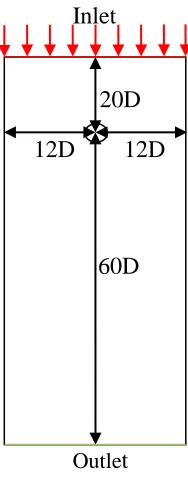
on the velocity field as shown in Figure 2.1. An upstream dimension of 20 diameters is
considered an adequate distance to allow for the natural adjustment of the flow
approaching the object from that given at the inlet boundary. A downstream dimension
of 60 diameters is considered adequate to include the steady flow wake effects caused by
the cylinder. Since the cylinder and the wall were both assigned a no-slip boundary
condition a distance of 12 diameters from the centre of the cylinder to the wall was
considered sufficient in order to avoid any effects of the wall on the cylinder. This
dimension is larger than that used experimentally by Garrison[14] and Sarpkaya and
Garrison[13] in order to produce an accurate steady state result for the value of the drag
force. Use of the original experimental dimensions was investigated and found not to
have an influence on the solution for simulations that have a constant uniform
acceleration starting from rest. However when the flow was started from an initial
velocity other than rest the experimental dimensions caused inaccurate forces to be
16
Figure 2.1: Schematic of the physical flow field.
Both the sides of the flow region as well as the cylinder are defined as walls. The
side walls are placed sufficiently far away from the cylinder as to not interfere with the
flow around it. It is expected, however, that there will be very high gradients around the
cylinder and in the wake region; hence a finer mesh is desired in these areas. In order to
realize the higher density meshes and still have a manageable mesh size, the fluid region
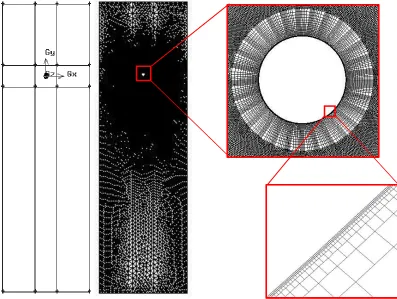
is divided into nine regions as shown in Figure 2.2. The region surrounding the cylinder
has the highest density mesh. The mesh density then decreases as it moves away from
the cylinder. All grids considered consisted of a structured mesh attached to the cylinder
wall that extended at least 10% of the cylinder diameter into the flow field. The mesh
attached to the structured mesh was an unstructured mesh that had a high density in the
wake region in order to resolve any gradients that are present at the edge of the wake.
Special attention must be paid to the boundary layer around the cylinder. Since
this is a flow with an adverse pressure gradient, the near wall region must be resolved
adequately to resolve the laminar region extremely close to the wall. This requires that
the y+ value be close to one. The y+ value is defined as
𝑦+ = 𝜌𝑢𝜏𝑦𝑃
𝜇 (2.6)
20D
60D 12D 12D
Inlet
17
where 𝑢𝜏 is the friction velocity, yp is the distance from the node point, P, closest to the
cylinder wall, ρ is the density of the fluid and µ is the viscosity of the fluid at point P.
The proper range of y+ for the cylinder wall is achieved using the Fluent y+ adaptation
function. This function splits, in half, the cells that do not meet the criteria in height and
width. This effectively doubles the number of nodes around the cylinder.
Figure 2.2: Mesh of solution region.
2.3 Boundary Condition
The vertical walls as well as the cylinder surface are set to the no-slip boundary
condition. The inlet boundary condition is defined by a User Defined Function (UDF)
(See Appendix A). For purposes of model testing the UDF is a constant acceleration in
the direction normal to the inlet boundary (-y direction) starting from an initial zero
velocity. This UDF is modified for the numerical experiment section which is described
18
outlet. Since the outlet is a considerable distance from the cylinder, this is a reasonable
assumption to make.
2.4 Numerical Aspects of the Model
According to the Fluent documentation [57] and Jones and Clarke[58] an
appropriate turbulence model for a bluff body is the k-omega SST (Shear-Stress
Transport) model due to its ability to handle the adverse pressure gradient that results in
boundary layer separation. Since the entire model includes flow with a varying velocity
over a wide range, the flow field could include both laminar and turbulent regions
therefore the transitional flow option is used in the k-omega SST turbulence model.
Second order solvers are chosen for the Pressure, Momentum, Turbulent Kinetic
Energy and Specific Energy dissipation equations. Quadratic Upstream Interpolation for
Convective Kinetics (QUICK)[57] is also used since it is found to have negligible
difference compared to other second order solvers. Pressure-Implicit with Splitting of
Operators (PISO)[57] is used for the pressure-velocity coupling method since this is a
transient flow situation. The under-relaxation factors used for the simulations can be
found in Table 2.1.
Under-Relaxation Factor
Pressure 0.3
Density 1
Body Force 1
Momentum 0.5
Turbulent Kinetic Energy 0.8
Specific Dissipation 0.8
Turbulent Viscosity 1
19
Default settings are used for the convergence criterion except for the steady
velocity simulations used in the numerical experiments. For steady velocity simulations
a convergence criteria with a residual of 1e-6 is used.
2.5 Validation of Model and the Parameters
This section begins with a comparison of the different factors that affect the
accuracy of the two-dimensional solution. These factors or parameters are selected to
ensure that the model yields an accurate solution in a reasonable period of time.
2.5.1 Grid Convergence
In order to get an accurate simulation, the gradients around the cylinder must be
resolved adequately. The most important factor in determining whether a grid is able to
resolve the high gradients on the surface of the cylinder is the height of the first layer of
cells next to the cylinder wall. Although a number of grid configurations are studied,
three are chosen in order to demonstrate the important factors associated with a
successful mesh. Table 2.2 gives more detailed information about the three meshes that
are considered when determining grid convergence.
1st Cell Height Total No. of Cells
Nodes Around
the Cylinder
Mesh 1 1.961e-6 m 178001 13775
Mesh 2 3.132e-6 m 206043 937
Mesh 3 3.924e-6 m 149666 9600
Table 2.2: Mesh information for grid convergence study.
It is critical that this first layer be very small, however this high level of mesh
20
of achieving this high mesh density near the surface and still have a manageable number
of cells in the whole mesh is to use Fluent’s mesh adaptation feature in order to have a
resulting y+ value of approximately 1. This is the technique that is used in the
simulations used in this case.
Figure 2.3: Comparison of different grid configurations (experimental data from Sarpkaya and Garrison [13]).
Figure 2.3 shows the dimensionless force (as described in Section 1.1.1) versus
the dimensionless distance moved by the cylinder for the three different meshes
compared to the experimental results from Sarpkaya and Garrison[13]. As can be seen
from Figure 2.3 the case with the largest height of cell next to the cylinder boundary
shows oscillation beginning at an s/d value of around 12. By decreasing the first cell
height by approximately 1e-6 m (i.e. from 3.924e-6 m to 3.132e-6 m) the oscillation is
delayed to values of s/d greater than 20 and hence do not appear on the graph. However,
decreasing the first cell height by another 1e-6 m does not change the results. It is
decided that the simulations use a first cell height of 2e-6 m to ensure the high velocity
gradients are resolved.
It is also observed from Figure 2.3 that the number of cells around the cylinder is
not a good indication of the reliability of the mesh. The cylinder with the least number of
cells around the cylinder (Mesh 2) still performed well compared to the medium density
21
one whereas the aspect ratio for Mesh 2 is around 4. Mesh 1 is used in the remainder of
the simulations.
It should be noted that there is a discrepancy between the numerical and
experimental results in the form of a “hump” at lower values of s/d. This will be
discussed in detail in Section 2.5.5.
2.5.2 Choice of Turbulence Model
Several turbulence models are available in Fluent 6.3.26 including Laminar,
Spalart-Allmaras, k-epsilon, k-omega and RSS. As stated in Section 2.4, according to the
literature[57, 58] the most appropriate model is the k-omega SST turbulence model. This
is due to its superior treatment of the viscous near wall region in addition to accounting
for the effects of stream-wise pressure gradients. The SST version also accounts for the
transport of turbulent shear stresses. In addition, Fluent has incorporated a (transitional)
low- Reynolds number version of this model which applies when fine grids are utilized.
These features are important in accurately modeling the boundary layer separation
process which is of paramount importance in obtaining good results for flow over bluff
bodies. The other models are, however, considered here to verify their lack of
applicability. In each case, all other conditions regarding the numerical model are kept
constant except the turbulence model. Both the k-epsilon and the RSS models utilize the
enhanced wall function which is used in the simulations for comparison. This allows the
use of a wall function that can be more appropriately used for a near wall region that
includes a consideration of a laminar sub-layer, buffer region, and fully-turbulent outer
region. Since the transitional flow option is used for the k-omega model, the same guide
lines as for the enhanced wall function apply. The inlet turbulence conditions are
specified using a turbulence intensity and a turbulence length scale. The values of the
turbulence intensity considered for the inlet boundary condition are 1%, 2% and 5%. A
value of 10% for the turbulence intensity is considered very high and a value of 1% is
generally considered low(from Fluent User’s Manual[57], Section 7.2.2). Although
several different values for these two conditions were tested there was little effect on the
22
far enough away from the cylinder for any effects to have been dissipated by the time the
flow reaches the cylinder. Another consideration is the difference in the turbulence from
the beginning of the flow (at rest) and the end of the simulation (moderate turbulence).
The value of the turbulent length scale was based on the recommended value as
determined from the equation
𝑙 = 0.07𝐿. (2.7)
where l is the turbulent length scale and L is the characteristic length which in this case is
the diameter of the cylinder.
Figure 2.4: Comparison of different Fluent turbulence models (experimental data from Sarpkaya and Garrison [13]).
Figure 2.4 shows the dimensionless force results for the turbulence models tested
as well as the experimental results for comparison. From Figure 2.4 several things can be
observed about the different turbulence models. The laminar model shows the
occurrence of vortex shedding very early on in the simulation while the others do not.
The experimental results of Sarpkaya do not indicate such a vortex shedding (fluctuations
in the force measurement) and hence this model is unrealistic. The k-epsilon model
shows a much lower value of C than the other models and, therefore not desirable.
Although the Spalart-Allmaras model seems to show similar results to the k-omega and
Reynolds Stress models for higher values of s/d, the initial value of C is closer to five
23
so the use of this model is also discounted. The two remaining models, k-omega and
Reynolds Stress, show excellent agreement with each other with only a slight difference
at higher values of s/d (>18) and hence both are considered to be equally applicable. The
Reynolds Stress model requires a longer computational time than the k-omega model,
therefore the k-omega model is chosen as the turbulence model for the remainder of the
simulations.
2.5.3 Time Step Independence
A 2D model with a first layer height of 2e-6 m, using a k-omega SST turbulence
model is run with several different time steps in order to determine the optimal time step.
Figure 2.5: Comparison of different time steps (experimental data from Sarpkaya and Garrison [13]).
The time step is initially chosen such that the fluid, at its maximum velocity, does
not pass through more than one cell boundary within the time step. This is determined to
be approximately 0.0001 s. The time step is then decreased and increased from this value
by a factor of 10 to determine if any change in the solution is apparent. As indicated in
Figure 2.5, when the time step increases (0.001 s) the small oscillations are not present.
24
when the time step is decreased (0.00001 s) there is little change to the solution.
Therefore a time step of 0.0001 s is used for the remainder of the simulations.
2.5.4 Three-dimensional versus Two-dimensional Model Geometry
The computational time required for a two-dimensional numerical solution of the
flow field is considerably less than that for a three-dimensional numerical solution simply
because of the reduction in the number of cells that need to be determined. The important
point to consider is whether the two-dimensional assumption reduces the accuracy of the
solutions to an unacceptable level. In this regard, a comparison is made between
solutions for a three-dimensional and a two-dimensional representation of the flow field
in question.
The width and height of the fluid domain remain the same for both cases. The
length of the cylinder (for three-dimensional case) is the same as the width of the fluid
domain and the cylinder extends all the way to the end walls which are given the no slip
boundary condition. Similar to the two dimensional simulation, the three dimensional
simulation uses y+ adaptation to produce the small first cell height that is required for an
accurate solution. In order to keep the number of nodes reasonable enough for a 12 CPU
computer to complete a solution, the y+ is adapted in order to obtain a value of four
which is still within the range suggested as acceptable by the Fluent User’s Manual [57]
and considerably reduces the number of nodes that are generated. The value of the
acceleration is 9.81 m/s2 and the boundary conditions as well as flow parameters (i.e.
k-omega SST turbulence solver, time step of 0.0001secs, and relaxation factors as
25
Figure 2.6: Comparison of three-dimensional and two dimensional simulation results (experimental data from Sarpkaya and Garrison [13]).
The results of this comparison are shown in Figure 2.6 and demonstrate that there
is little difference between the two results for the lower values of s/d. For the range
0<s/d<9, the maximum difference between the two results is less than 6%. The
maximum difference is 18.6% which occurs at s/d = 12.9. From Figure 2.6 it can be seen
that the three dimensional simulation begins to oscillate due to early (pre-mature) onset
of vortex shedding. This presents itself in the simulation data as a wave in the C value.
The experimental data does not show this wave in the C data which suggests that the 2D
simulation, which does not indicate the vortex shedding, is a closer representation of the
experimental results. The maximum difference occurs when the oscillation for the three
dimensional results is at a maximum compared with a two dimensional simulation that is
not oscillating. The difference between the two simulations occurs at higher values of
s/d, which is outside the range of interest for the remainder of the work, therefore no
further modification done on the 3 dimension model to reduce the oscillations (i.e.
reducing the y+ further). In terms of computational time a three dimensional simulation
takes approximately 15 days with a computer with a Intel(R) Core™ i7 CPU
[email protected] 3.33 GHz processor, 600 GB RAM and a 64-bit Operating System
while the two dimensional simulation takes less than six hours on the same computer. 1
10
0.1 1 10
C
s/d
C (2D)
C (3D)
26
In the present study it is the time immediately after the acceleration begins that is
of particular interest, therefore, it is important to have an accurate and efficient solution
in the region 0<s/d<5. Hence, the use of 2D simulations can be justified in view of the
drastically reduced simulation times with comparable accuracy.
2.5.5 Further Comparison of Numerical Model with Experimental Data
Having established grid independence, the appropriate turbulence model and the
appropriate time step, the results will be compared to the experimental work of
Garrison[14] and Sarpkaya and Garrison [13] over the range of s/d of interest. Although
both curves in Figure 2.7 have been seen previously on various figures, it is advantageous
to present them again in order to emphasis the results and aid in further discussion.
Figure 2.7: Comparison of experimental and numerical results (experimental data from Sarpkaya and Garrison [13]).
The comparison of the experimental work with the CFD work, presented in
Figure 2.7, shows a reasonable agreement. It can be seen that there is a slight “hump” in
the CFD results when compared to the experimental results for values of s/d in the range
(1.3<s/d<4). It can also be seen that the CFD results do not compare as well as the value
27
hence this is not considered to be a problem. The "hump”, however, is an interesting
phenomenon and will be investigated in more detail in the following paragraph.
Figure 2.8 shows the streamlines for various values of s/d throughout the duration
of the “hump”. Along with the streamline diagrams is a graph showing the numerical
results (red line) and the experimental results (blue line) with a green square that
indicates the position that corresponds to the streamline diagram. The third graph for
each set is the y-wall shear stress of the cylinder with respect to the x position. This
graph is used to determine the separation point. The shear stress changes from positive to
negative when separation occurs. It should be noted that the shear stress also changes
sign due to recirculation. The start of the “hump” does not coincide with the formation of
the large vortices in the wake of the cylinder. It does, however, coincide with the
formation of the smaller vortices located just after the separation points.
The streamline diagrams also include red arrows that indicate the approximate
point of separation. It can be seen that the point of separation quickly recedes back to
approximately 90o due to the formation of the smaller secondary vortices. When
examining the experimental visualization results of Garrison[14], there does not seem to
be a distinct set of secondary vortices at similar values of s/d. These results are
consistent with the fact that the numerical results have a higher drag force. It appears that
this is due to the premature recession of the separation point which in turn is due to the
over estimation of the secondary vortex development in size and strength. The premature
recession of the separation point increases the amount of drag on the cylinder, which in
turn produces a higher force in the direction of the flow. This difference exists both in the
two-dimensional as well as the three-dimensional solutions.
Another difference in the simulation compared to the experimental work is the
difference in the slope at intermediate values of s/d. This may be due to the symmetry of
the attached vortices. According to Sarpkaya and Garrison[13], asymmetry of the
attached vortices occurs around an s/d value of 3. From Figure 2.8, however, there does
28
a) time = 0.056 s, s/d = 1.211, Separation =105.49O from leading edge
b) time = 0.063 s, s/d = 1.533, Separation = 100.31O from leading edge
29
d) Time = 0.083 s, s/d = 2.661, Separation = 91.65O from leading edge
e) Time = 0.093 s, s/d = 3.340, Separation = 89.70O from leading edge
f) Time = 0.103 s, s/d = 4.097, Separation = 87.98O from leading edge
Figure 2.8: Streamlines of numerical experiments for diameter = 0.0127 m at various times (first graph shows the value that corresponds to the diagram (green square), numerical results (red line) and experimental results from Sarpkaya and Garrison[13] (blue line), second graph shows the y-wall shear
30
In order to further investigate possible reasons for the formation of the "hump"
two additional geometries are studied. The first tank has width to diameter ratio twice as
large as the original and the second has exactly the same geometry as that of Sarpkaya
and Garrison[13] to see if blockage contributes to the differences. Figure 2.9 shows there
is no difference between the solutions which demonstrates that there is no evidence that
blockage effect is smoothing out the “hump” in the experimental results.
Figure 2.9: Comparison of 3D numerical simulation with 3D numerical simulation using physical parameters of experimental set up by Sarpkaya and Garrison[13].
2.6 Numerical Experiments
Now that the CFD methodology has been verified, it is possible to use it as a tool
to perform numerical experiments which would have otherwise been very costly and
physically difficult to perform. Another advantage to using CFD for this type of study is
the ability to accurately determine the forces at very low values of s/d. It is difficult to
obtain experimental data at the beginning of accelerated flow due to the small forces that
are involved.
Most of the available work on added mass for unidirectional constant acceleration
![Figure 2.3: Comparison of different grid configurations (experimental data from Sarpkaya and Garrison [13])](https://thumb-us.123doks.com/thumbv2/123dok_us/1443555.1176858/35.612.143.508.151.372/figure-comparison-different-grid-configurations-experimental-sarpkaya-garrison.webp)
![Figure 2.4: Comparison of different Fluent turbulence models (experimental data from Sarpkaya and Garrison [13])](https://thumb-us.123doks.com/thumbv2/123dok_us/1443555.1176858/37.612.144.507.230.451/figure-comparison-different-fluent-turbulence-experimental-sarpkaya-garrison.webp)
![Figure 2.5: Comparison of different time steps (experimental data from Sarpkaya and Garrison [13])](https://thumb-us.123doks.com/thumbv2/123dok_us/1443555.1176858/38.612.144.507.301.520/figure-comparison-different-time-steps-experimental-sarpkaya-garrison.webp)
![Figure 2.6: Comparison of three-dimensional and two dimensional simulation results (experimental data from Sarpkaya and Garrison [13])](https://thumb-us.123doks.com/thumbv2/123dok_us/1443555.1176858/40.612.144.506.69.287/figure-comparison-dimensional-dimensional-simulation-experimental-sarpkaya-garrison.webp)
![Figure 2.7: Comparison of experimental and numerical results (experimental data from Sarpkaya and Garrison [13])](https://thumb-us.123doks.com/thumbv2/123dok_us/1443555.1176858/41.612.143.507.343.561/figure-comparison-experimental-numerical-results-experimental-sarpkaya-garrison.webp)
![Figure 2.8: Streamlines of numerical experiments for diameter = 0.0127 m at various times (first graph shows the value that corresponds to the diagram (green square), numerical results (red line) and experimental results from Sarpkaya and Garrison[13] (blue line), second graph shows the y-wall shear stress over the cylinder, red arrows indicate point of separation).](https://thumb-us.123doks.com/thumbv2/123dok_us/1443555.1176858/44.792.72.659.105.486/streamlines-numerical-experiments-corresponds-numerical-experimental-garrison-separation.webp)
![Figure 2.9: Comparison of 3D numerical simulation with 3D numerical simulation using physical parameters of experimental set up by Sarpkaya and Garrison[13]](https://thumb-us.123doks.com/thumbv2/123dok_us/1443555.1176858/45.612.145.510.214.433/comparison-numerical-simulation-numerical-simulation-parameters-experimental-sarpkaya.webp)
![Figure 2.10: Numerical results for different initial velocities (experimental data from Sarpkaya and Garrison [13])](https://thumb-us.123doks.com/thumbv2/123dok_us/1443555.1176858/50.612.140.512.110.332/figure-numerical-results-different-velocities-experimental-sarpkaya-garrison.webp)