University of Windsor University of Windsor
Scholarship at UWindsor
Scholarship at UWindsor
Electronic Theses and Dissertations Theses, Dissertations, and Major Papers
2011
An Efficient Fault-Tolerant method for Distributed Computation
An Efficient Fault-Tolerant method for Distributed Computation
Systems
Systems
Samaneh Navabpour
University of Windsor
Follow this and additional works at: https://scholar.uwindsor.ca/etd
Recommended Citation Recommended Citation
Navabpour, Samaneh, "An Efficient Fault-Tolerant method for Distributed Computation Systems" (2011). Electronic Theses and Dissertations. 333.
https://scholar.uwindsor.ca/etd/333
This online database contains the full-text of PhD dissertations and Masters’ theses of University of Windsor students from 1954 forward. These documents are made available for personal study and research purposes only, in accordance with the Canadian Copyright Act and the Creative Commons license—CC BY-NC-ND (Attribution, Non-Commercial, No Derivative Works). Under this license, works must always be attributed to the copyright holder (original author), cannot be used for any commercial purposes, and may not be altered. Any other use would require the permission of the copyright holder. Students may inquire about withdrawing their dissertation and/or thesis from this database. For additional inquiries, please contact the repository administrator via email
An Efficient Fault-Tolerant method for Distributed
Computation Systems
by
Samaneh Navabpour
A Thesis
Submitted to the Faculty of Graduate Studies
through the School of Computer Science
in Partial Fulfillment of the Requirements for
the Degree of Master of Science at the
University of Windsor
Windsor, Ontario, Canada
2009
An Efficient Fault-Tolerant method for Distributed Computation Systems
by
Samaneh Navabpour
APPROVED BY:
__________________Jonathan Wu_________________ Dr. Jonathan Wu
Department of Electrical and Computer Engineering
__________________ Yung Tsin __________________ Dr. Yung Tsin
School of Computer Science
_________________ Jessica Chen __________________ Dr. Jessica Chen, Advisor
School of Computer Science
____________________ Dan Wu ___________________ Dr. Dan Wu, Chair of Defense
School of Computer Science
Author’s Declaration of Originality
I hereby certify that I am the sole author of this thesis and that no part of this thesis has
been published or submitted for publication.
I certify that, to the best of my knowledge, my thesis does not infringe upon anyone’s
copyright nor violate any proprietary rights and that any ideas, techniques, quotations, or
any other material from the work of other people included in my thesis, published or
otherwise, are fully acknowledged in accordance with the standard referencing practices.
Furthermore, to the extent that I have included copyrighted material that surpasses the
bounds of fair dealing within the meaning of the Canada Copyright Act, I certify that I
have obtained a written permission from the copyright owner(s) to include such
material(s) in my thesis and have included copies of such copyright clearances to my
appendix.
I declare that this is a true copy of my thesis, including any final revisions, as approved
by my thesis committee and the Graduate Studies office, and that this thesis has not been
Abstract
Fault tolerance is one of the most important features required by many distributed
systems. We consider the efficiency issues of constructing distributed computing systems
that can tolerate Byzantine faults. The well-recognized technique is to introduce
replicated computation and derive the correct results through a voting mechanism. While
this technique is applied to each computation request individually, we believe that by
considering multiple requests at the same time in a distributed environment, we can
greatly improve its efficiency. This is based on the observations that computation
requests may be ordered in a different way for computation at different nodes, and the
verdict of the correct result for one request may imply the correct result for another
request. We propose to exploit a suitable solution to improve the efficiency of the
existing technique to avoid unnecessary computation and unnecessary message
exchanges among distributed processes.
We consider Peer-to-Peer architecture which is one of the well-known and fast growing
architectures for distributed systems. The voting mechanism however may be either
Dedication
I want to dedicate my master thesis to my loving family, for their endless support and
unconditional love; Specially my mother, “Mahshid”, for sacrificing her happiness for
Acknowledgements
I would like to take this opportunity to thank my supervisor, Dr. Jessica Chen, for her
endless support, invaluable guidance, and consistent encouragements and patience.
Without her help, I could have never come this far and accomplish the work presented in
this thesis.
In addition, I would like to thank my internal and external readers, Dr. Yung H. Tsin and
Dr. Jonathan Wu for their valuable and helpful comments and suggestions on this thesis.
I want to specially thank our graduate secretary, Mandy Turkalj for her consistent help
and endless smiles even on cloudy days.
In the end I want to take the time to thank my loving family. I want to thank my father,
Hamidreza, and my mother, Mahshid, for their endless support and sacrifices to help me
achieve my Master degree. I want to thank my sister, Sanieh, for being the shoulder I
could cry on, and my brother, Ali, for constantly reminding me that nothing is worth
Table of Contents
Author’s Declaration of Originality... ii
Abstract ... iv
Dedication ... v
Acknowledgements... vi
List of Tables ... viii
List of Figures ... ix
Chapter 1. Introduction ... 1
Chapter 2. Related Work... 7
Chapter 3. Problem Definition and Our Solution ... 27
Chapter 4. Implementation... 39
4.1 The functions of each node ... 39
4.2 The functions of the voting center ... 41
Chapter 5. Method Evaluation ... 46
5.1 Evaluation settings ... 47
5.1.1 Evaluating the amount of computation saving... 49
5.1.2 Evaluating the amount of time saving ... 57
5.2 Evaluating the tradeoff... 68
Chapter 6. Conclusion and Future Work ... 71
References... 74
List of Tables
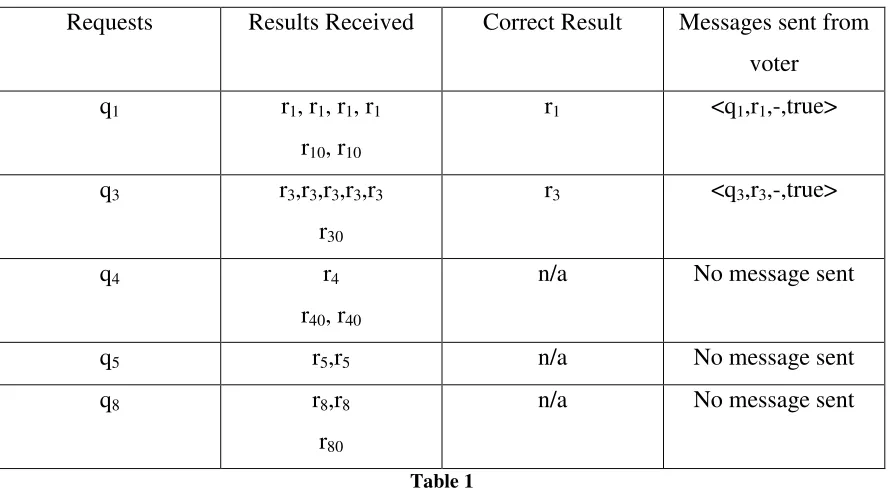
Table 1 ... 35
Table 2 ... 38
Table 3 ... 42
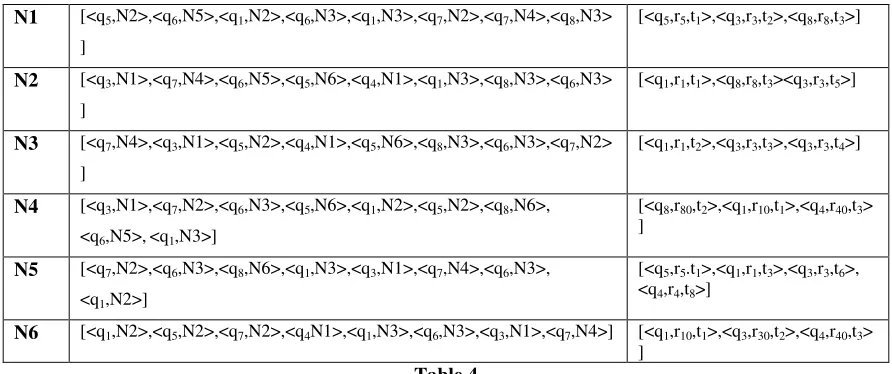
Table 4 ... 43
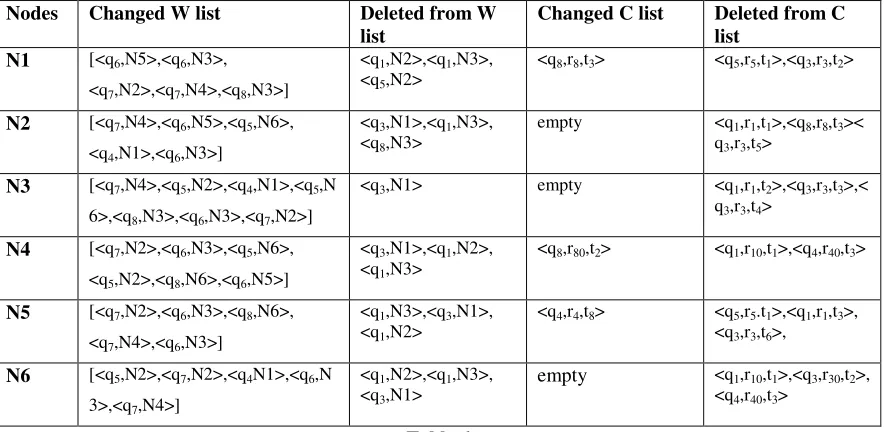
Table 5 ... 44
Table 6 ... 44
Table 7 ... 45
List of Figures
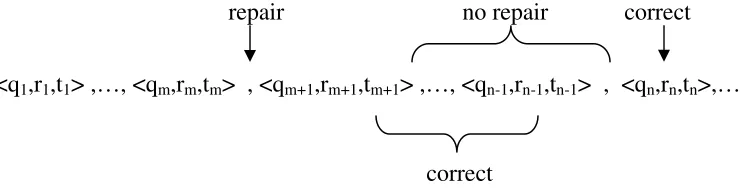
Figure 1 Observation 1... 30
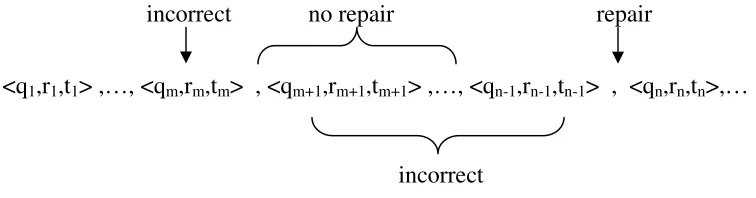
Figure 2 Observation 2... 31
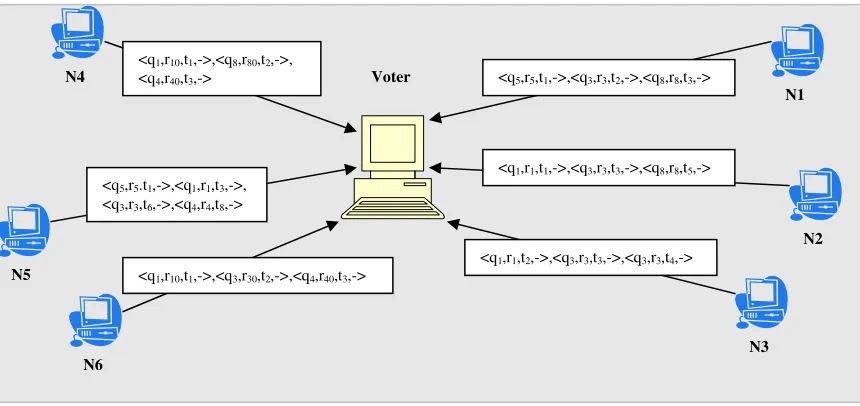
Figure 3 Requests sent in the system ... 34
Figure 4 Results sent to the voter... 34
Figure 5 Results sent by the voter... 36
Figure 6 Using Proposition 1 and 2 ... 37
Figure 7 Number of redundant computations avoided in the system ... 51
Figure 8 Percentage of computation saving... 52
Figure 9 Average number of redundant computation avoided ... 54
Figure 10 Voter functionality... 54
Figure 11 Average number of total computation saving ... 56
Figure 12 Average of total time saving... 61
Figure 13 Average time saving in each node... 63
Figure 14 Average time saving ... 64
Figure 15 Average time saving in each node... 66
Figure 16 Average amount of total time saving... 67
Figure 17 Ratio of total computation saving to additional messages ... 69
Chapter 1. Introduction
From a consumer’s point of view, an ideal system should always be reliable and
available [32].
• Reliability is the likelihood that a system will remain operational despite of
failures for the duration of a mission. Very high reliability is most important in
critical applications such as the space shuttle or industrial control, in which failure
could mean loss of life [32].
• Availability expresses the fraction of time a system is operational despite failures.
It is important to note that a system with high availability may in fact fail.
However, its recovery time and failure frequency must be small enough to
achieve the desired availability. High availability is important in many
applications, including airline reservations and telephone switching, in which
every minute of downtime translates into significant revenue loss [32].
An absolutely reliable and available system is very often impossible in practice, because
customers will allow for only a certain amount of time and money to spend for this
feature, restricting system developers with finite resources to achieve reliability. As a
consequence, we as consumers of technology and computers have regularly encountered
failures, either in the form of a software crash, a hardware failure, or a power loss, etc.
Systems may fail for many reasons [32]: (i) It may have been specified erroneously,
leading to an incorrect design; (ii) It may contain a fault that manifests only under certain
conditions that were not tested; or (iii) It may fail due to some unexpected environment
change. In some cases these failures are just annoyances while in some other cases, they
result in significant loss. The latter has become more common than the former as today’s
societies are becoming more and more dependent on computer systems.
Over the years, the industry and academia have presented and used various techniques to
best approximate an ideal system with limited resources. Such techniques and
maintenance of a system, the two most common ones being reliability and availability
[32].
Fault tolerant techniques are generally designed specifically for two types of systems:
distributed and centralized. A major difference is that in distributed systems individual
components may fail without affecting the functionality of the entire system. This very
characteristic complicates the design and implementation of fault tolerant techniques for
distributed systems. For this reason, the development of effective and efficient distributed
fault tolerant systems has been the focus of many pieces of research work. It is also the
topic of this thesis.
A fault tolerant distributed system can be defined as [30]:
1. a system whose behavior is well-defined in case of component failure;
2. a system capable of masking the fault in case of component failure.
Component failures are typically categorized as [30]:
1. crash or omission failure: When a component does not respond to a request or
does not show any sign of liveness in a certain period of time.
2. timing failure: When a response is correct but untimely: either early or late.
3. a byzantine failure: When the response to a request is incorrect or the
component’s functionality deviates from its specification. We will be considering
this type of faults in this thesis.
When designing a fault tolerant method to mask faulty behavior, it is important to see
what faulty behavior the systems are capable of handling. Furthermore, since the
recovery of the system is dependent on the likely failure behavior, one has to extend the
specification of the nodes to incorporate their failure behavior (failure semantics) which
can usually be specified in the same way as the specification of the semantics of the
One of the most common methods used to tolerate faults in distributed systems is
replication. Two types of replication techniques are commonly used in distributed systems:
1. temporal replication: In this method, a single component executes a job/computation multiple times. When a component fails to complete a
computation correctly because of any of the failures mentioned above, it will be
required to do the computation some more times until it completes the
computation correctly.
2. spatial replication: In this method, components of the systems are replicated (with possibly different versions of it) through out the system. The replicas can reside
on a single physical machine or can be spread out among a number of physical
machines. Note that a component in the system is logically mapped to a single
node despite its physical location. Here, a computation is executed by a number of components, either in parallel or sequentially, until a correct result for the
computation can be achieved. In this thesis, we will consider spatial replication.
Although with a powerful replication manager, availability can be guaranteed to a high degree, replication alone cannot provide reliability. The methods designed to achieve
reliability can be put into two groups: consensus/fault detection methods and fault detection/recovery methods.
The first group aims at finding the correct result of a computation from among a group of
variant results presented from different replicas/redundant computation executions. Consequently, when the correct result is found, faulty results are discarded and the faulty
nodes which produced these results are detected and guided towards recovery. The most
common aspects in this category include:
• a voter: the results from the replicas/redundant computations are analyzed by a
voter. Each voter has a policy which defines which results are correct and which are not. This policy is dependant on the replication type, components, computation type, etc. of the system. In this case, the component(s) which have
• comparison of messages: faulty nodes are detected via the messages they send. When a node shows different behaviors and sends out different messages for the
same situation, this node is detected as faulty. This method is typically used in
systems with spatial redundancy to find the correct result of a computation.
• testing: a testing method is capable of detecting faults in a node. The testing method on a node is designed based on the semantics of the computations this
node execute.
The second group does not consider isolating faulty behavior. Instead, they focus on
detecting faulty behavior in the system and dictating recovery guidelines for the faulty
node. Testing and comparison of messages are part of this category as well.
In this thesis, we consider the consensus/fault detection methods. Our focus is to advance the existing voter techniques.
The basic tasks to achieve fault tolerance include:
1. replicate components: to replicate a same component throughout the system. 2. consensus/fault detection: to find the correct result of a computation, detect the
faulty nodes, and discard incorrect results.
3. recovery: having faulty nodes detected, recovery steps are followed and the nodes are denied from further activity in the system until they are recovered.
The application of the above techniques is slightly different in stateful and stateless
distributed systems. For stateful systems, if different non-faulty components/nodes
execute a same set of requests in different orders, their states will deviate from each
other, leading to different results. As a consequence, guaranteeing that all non-faulty
nodes execute the same set of requests in the same order is vital for providing fault
tolerance. We assume that the components of each node are stateless.
It can be seen that fault tolerance introduces considerable overhead in terms of the cost of
resource requirements and computation time. Although the owners and consumers of a
overhead. Therefore designing and implementing an efficient fault tolerant method is of
great importance. The overhead of fault tolerant methods is determined mainly in terms
of
• the cost of the addition resources required,
• the additional time consumed for computation and analysis.
The cost of additional resources and computation time can be reduced in different ways:
• reducing the number of messages passed around, so that the cost of the needed
network bandwidth can be reduced. When fewer messages are passed around,
the system requires less bandwidth to function. Therefore the system becomes
not only less expensive, but also more scalable and more efficient in wide area
networks.
• reducing the number of replicas, so that the amount of hardware needed for the
replicas to reside on can be reduced. When the number of replicas increases, the
hardware required for the replicas increases as well. Therefore when fault
tolerance can be guaranteed with a smaller number of replicas, the cheaper fault
tolerant system can be developed while keeping scalability at the same time.
• reducing the time complexity of the computation and analysis, so that we will
need less computation resources (CPU units, I/O devices etc.). When the time
complexity of the computations is reduced, we consume fewer amounts of CPU
units within each node. As a consequence, a more scalable and less time
consuming fault tolerant system can be achieved.
This thesis aims at introducing an efficient distributed fault tolerant computation system,
where the components are stateless. With respect to efficiency, we reduce the cost of
additional recourses and the additional time consumption by:
1. reducing the number of computations and analysis,
When a node is faulty, the majority of its computation results are incorrect. We assume
that when a node becomes faulty, all of its computations are incorrect. Under this
assumption,
1. when a node completes a computation incorrectly, we can conclude, without
further computation, that all the results of the computations after this point (until
its latest recovery) are incorrect.
2. when a node completes a computation correctly, we can conclude, without further
computation, that all the results of the computations before this point (after its
most recent recovery) are correct.
Making use of these observations, we further improve the efficiency of the existing
methods by reducing the time complexity to find the correct results and reducing the
number of computations needed to detect faulty nodes.
The continuing of this thesis is divided into the following Chapters: In chapter 2 we
present the related works which have focused on developing efficient distributed fault
tolerant systems. In chapter 3 we present the problem which has motivated our work. In
chapter 4 we present our solution and algorithm. In chapter 5 we present the evaluation of
Chapter 2. Related Work
In the following, we give a brief overview of the groundbreaking work in optimizing
fault tolerant distributed systems.
The existing work on optimizing fault tolerant methods in distributed computation
systems mainly focuses on the optimization of the following three aspects [18]:
• the protocol which orders the requests in stateful fault tolerant systems;
• the method which finds the correct result of a request;
• the method which detects faulty nodes.
Since the focus of this thesis is in stateless distributed systems, we are not concerned with the ordering of the requests. In stateful distributed systems, on the other hand, developing an efficient protocol for the ordering of the requests is of great importance. The most widely used protocol for establishing similar ordering of requests in all the nodes is
Castro’s BFT protocol [7]. The BFT ensures that:
1. all non-faulty replicas execute the same requests in the same order while less than
one third of the nodes are faulty (have crashed or have byzantine behavior);
2. a node (user) will always choose the correct result for a request.
BFT places the replicas in a hierarchy, which is referred to as a view. In a view, there is a special replica serving as the primary and the others are backups. The structure of a view can change when the primary is found faulty.
BFT has three phases to atomically multicast requests to the replicas in a view. The three
called pre-prepare. When a backup receives the pre-prepare message, it enters the
prepare phase by multicasting a prepare message to all the other replicas. The prepare
message denotes that the backup has agreed to assign sequence number n to q in the current view. In the next step each replica waits until it has received 2f matching prepare messages regarding sequence number n and request q. Here f represents the maximum number of faulty nodes. At this point a replica is assured that a group of 2f replicas have agreed to assign number n to q in the current view. To this point BFT ensures that all non-faulty replicas have the same total ordering of requests in the same view, but it can
not ensure that all nodes have the same total ordering of requests across view changes.
The commit phase solves this problem. Each replicamulticasts commit messages to notify others that it has completed the prepare phase. Then each replica collects messages until it has a group of 2f +1 commit messages regarding sequence number n in a view v. At this point it is said that the request is committed and safe to be executed. The commit
phase guarantees that there is a group of 2f+1 replicas which know that a group of 2f
replicas have accepted to assign number n to q in a certain view and are ready to execute
q.
The view change protocol provides liveness by allowing the system to make progress
when the primary fails [7]. When a backup suspects the primary of the current view v to be faulty, it enters view v+1 and multicasts a view change message to all replicas. Replicas collect view changemessages for view v+1 and send acknowledgments for view
v+1 to the new primary. The new primary collects view change acknowledgments and
the view change happens when the new primary has 2f+1 view changeacknowledgement
messages. In the end Castro et al proved that their protocol preserves safety and liveness.
In addition they noted that their method only works when 3f+1 replicas are active in the system and their method suffers from excessive message passing.
Amir et al presented a more efficient request ordering protocol [4] compared to BFT [7]
grouped into sites. Each site can have at most 3f+1 nodes. Here f represents the maximum number of faulty nodes. In each site one node is chosen as the representative to
conduct the three phases of the BFT protocol within the site. In addition, one site is
chosen as the leading site to achieve total ordering of the requests among all the sites
using the BFT protocol. When the representative of a site or the leading site shows faulty
behavior, a new node and a new site is assigned to these positions respectively. The
changes made to these positions are similar to the view change in BFT. This method
reduces the message complexity for wide area networks from O(n2) in BFT to O(s2). Here
n is number of nodes, s is the number of sites and s<<n. Consequently their method increases the system's ability to scale.
In a more advanced work, Amir et al presented a new protocol (Blink) used between the
sites to enhance performance in wide-area systems [5]. This new protocol establishes a
reliable virtual communication link between the sites. This communication protocol
discards the need for redundant message sending and allows a site to consume
approximately the same wide-area bandwidth as a single physical node. The advantages
of this method compared to their previous work [4] are: (i) The use of BLink increases
performance by decreasing the number of redundant message passing in comparison to
their previous work which typically requires (f + 1)2 redundant message sends; (ii) The new system achieves high performance in terms of time complexity and outperforms their
previous work by a factor of 4 when running in a system with the same number of faulty
nodes. The problem of this method is that it exposes weak nodes to the malicious ones
and does not provide confidentiality.
In addition to Amir’s work [4,5], Kotla et al also presented a method [19] which
optimizes BFT [7] by reducing the number of messages sent and decreasing the time
consumed to find the correct result of a request. Unlike Amir’s [4] work, replicas respond
optimistically accept the order proposed by the primary and send the result immediately
to the user. This causes a reduction in the number of message passing but the replicas can
become temporarily inconsistent with one another. The users can detect these
inconsistencies and help direct the replicas to converge to a single total ordering of
requests. In their protocol, a user sends a request to the primary, then the primary
forwards the request to the replicas, and the replicas execute the request after completing
the prepare phase. Afterwards the replicas send their results to the user. Each message containing a result is appended with history information. This history information
represents the current state of the state machine of the replica sending back the result. The
user will eventually accept a result if one of the two conditions holds: 1. it receives 3f + 1
(f is the number of faulty nodes) similar results with matching history information; 2. it receives between 2f + 1 and 3f similar results with matching history information. The user sends a commit message to the replicas. Once 2f +1 replicas acknowledge receiving a commit message, the user accepts the result.
Since the requests may not be executed in the same order in all the replicas, the state of
the correct replicas may diverge, and they may send different responses to the user.
Therefore when a specific result is accepted, the history information appended to this
result is forwarded to the replicas so they would update their current state to the one
represented by the history information. This method reduces the number of messages used in BFT by 3.7 times and speeds up the time to achieve the correct result of a request
to 2.7 times. The authors noted that their method is near optimal.
Unlike the previous work [19, 4, 5] focused on reducing the number of messages, Yin et
al optimized the BFT [7] protocol by reducing replication costs. Their method [33] can
tolerate f number of faults by only requiring 2f+1 number of active replicas, while all the previous work presented require 3f+1 active replicas. Their method separates the
protocol to order the requests (ordering nodes) are different from the nodes which
actually execute the requests (replicas). Therefore, by separating these nodes, only 2f+1
replicas are needed to execute a request while still guaranteeing fault tolerance. In
addition to reducing the number of replicas needed, their method solves the
confidentiality problem in Amir’s BLink protocol [5]. To achieve confidentiality, a
privacy firewall is placed between the replicas and the ordering nodes. This firewall
discards the results in minority and only forwards the result in majority to the user and
the ordering nodes. This method prevents the ordering nodes and the user to find the
faulty nodes.
In their protocol, a node (user) sends a request to the ordering nodes and they assign a
sequence number to it. The assignment of the sequence number is achieved by the
execution of the BFT protocol. When the order of the request is determined, it is
forwarded to the replicas to be executed. When a replica receives a new request, it checks
the request’s sequence number sn with the sequence number sn’ of the last request it calculated. If sn =sn’+1 then the replica will calculate it; otherwise it will wait until it has calculated all the requests with a sequence number sn’’ that sn<sn’’<sn’. After calculating a result for the request, the node will send it to the privacy firewall. The
firewall chooses the result in majority as the correct one and sends it to the user.
Although separating the agreement from the execution reduces the number of replicas
needed, it increases the time the user has to wait to receive the correct result of its
request.
Similar to Yin [33], Correia also presented an efficient ordering protocol [8] which can
mask f faulty nodes by using only 2f+1 replicas. Unlike Yin’s [33] work, this protocol is not based on BFT but its performance is similar to Yin’s protocol. To achieve the same
ordering of requests in all the nodes, they make use of a centernode which is responsible for the ordering of requests. In this protocol, a node (user) sends a request to one of the
When each replica has received the request, they hash the request and send the hash to
the center. When the center receives f+1 similar hashes it assigns the hashed request a sequence number and forwards it to the replicas. When a replica receives the sequence
number of the request it executes the request in its given order. When a replica finishes
the execution of the request, it sends the result to the user. Then the user waits for f + 1
identical results from different replicas until it declares the result as correct.
As mentioned, although the efficiency of ordering protocols is not an issue for us,
detecting faulty nodes and finding the correct result of each request is of utmost
importance in both stateless and stateful fault tolerant systems. The techniques used for developing fault detection and finding correct results are similar in both stateless and
stateful distributed systems.
The most common technique to detect faulty nodes is the use of tests. A test is designed to be capable of identifying faults in the nodes. Traditionally, a central node was responsible for conducting the tests and informing non-faulty nodes of the faulty ones
which it had recently detected [9]. This central node is a single point of failure which is
inconvenient for distributed systems. To adopt the traditional testing method with the
current distributed computation systems, Hosseini et al presented a distributed fault detection method [15, 16]. In this method, any node can test a subset of other nodes for
the presence of failures. The information used by a node to produce its fault diagnosis is
the result produced by its own tests along with information passed to it indicating the results of the tests performed by other nodes.
all messages received from Pj in the interval between the two tests as correct and will use them to produce new diagnosis information. Although this method prevents a single point
of failure in fault detection, it works under the assumption that a node cannot repair itself
before its faultiness is diagnosed by another node. This assumption is very strong and not realistic.
Albini et al optimized Hosseini’s [15] distributed diagnosis method by reducing the
number of tests. In their protocol, the nodes are grouped in clusters. One of the nodes is
assigned as the tester of each cluster [10] and each cluster contains N/2 nodes. Here N
represents the total number of nodes. In each cluster, the tester tests all the nodes in the
cluster and produces fault diagnosis information about each of them. At each testing
interval, each tester of a cluster tests the testers of other clusters in addition to the nodes
in its own cluster. When a tester j finds another tester i as fault-free, tester j asks tester i
to send it the diagnostic information i has collected about its cluster. On the other hand, if the tester i is found faulty, tester j informs the nodes in the cluster to change their tester. When all the tests have been conducted, another protocol is run in the system which
creates a graph whose vertices are the fault-free nodes and there is an edge directed from
a vertex a to a vertex b, if nodea has tested nodeb and has found it to be fault-free. Then the protocol finds the shortest paths between any vertex i and vertex j in the graph. The protocol keeps the edges in the shortest paths and deletes the rest. Then it propagates the diagnosis information of a node i to a node j through the nodes on i’s shortest path to j. This protocol runs until the diagnosis information of all the nodes has been propagated.
Since the testing method produces a great deal of additional network traffic, Kihlstrom et
al presented a new family of fault detectors [17] which does not require the use of tests and is suitable for consensus problems [12]. In this method, they assume that each node
has the capability of predicting the result for each request it sends out because it is
detectors, they consider three arrays in each node: one array representing all nodes that
are faulty (byz), one array representing all nodes that are suspicious of having crashed down (outp) and another array representing messages the node is expecting to receive
(exp). In the first step, when a node sends out a request to a node α, it turns on a timer. If the timer expires, the node appends α to outp and saves the details of the expected result in exp. When a node receives the result from α, it checks if the result meets its prediction. If it does, the node will accept the result; otherwise it adds the node to byz. Afterwards, it checks if the node is in the outp list. If so, it deletes it from the list and deletes the expecting result from α from the exp as well. In addition, it increases the timer for α for sending back a result. Every time one of the lists outp and byz gets updated, the node sets them to other nodes. When a node receives the outp and byz lists from other nodes, it adds the nodes in these lists to its own outp and byz lists. By passing around these two lists, all the nodes achieve a common view towards the system. Although their system
presumably does not make use of tests, their assumption that each node can predict the
correct result is very unrealistic. Therefore this method is not practical although it is more
efficient than the testing technique.
Typical fault detection methods make use of excessive tests which only serve the purpose
of finding the location and characteristics of a fault. These methods introduce a great deal
of overhead into the system. Unlike previous techniques, we established a method which
can eliminate the need for excessive test. It not only detects fault but also find the correct
result to a request as well.
Finding the correct result of a request is a major issue in both stateless and stateful fault
tolerant systems. The correct result to a request can be found in a centralized manner or a
distributed manner. In this thesis, we use a centralized technique to find the correct result
of requests. We will refer to the centralized technique as central decision making
The most widely used centralized decision making mechanism is the voting algorithm.
As mentioned, these algorithms mask incorrect results produced by faulty nodes, and
prevent their propagation through out the system. These voting algorithms have been
classified by Latif-Shabgahi [21] based on their functionality: generic voters, hybrid
voters and purpose-built voters.
Generic voters [21] calculate the final result for a computation by only using the results received from nodes. These algorithms have fault detection capability and are also able to
create warnings when they cannot make a decision. Note that in cases where a
computation can have multiple correct results, these voters are inadequate. The best
known of these voters is the majority voter. The majority voter chooses the correct result from among the variant input results, where at
(n+1)/2
inputs have the same value. Inthis thesis, we have adopted a majority voter as well. Because of its ability to detect
faults, we chose this voter to integrate fault detection and finding the correct result.
Another well known generic voter is the median voter. This voter selects the mid-value of the variant input results as the final result. This voter can produce the correct result when
a maximum
(n+1)/2
input results are incorrect. Although this voter can handle caseswhere a computation can have multiple correct results, it does not have fault detection
capability. In addition this voter has a higher probability to produce incorrect results
compared to the majority voter.
Hybrid voters [21] use additional information such as the reliability level of nodes, on-line diagnosis information of the nodes, or other various probabilistic information to
improve their performance. These voters optimize genetic voters and produce more
accurate results compared to them. The best known voter is the weighted average voter
which calculates the weighted average of the input results. The weights can be
predetermined or can be dynamically assigned. Typically, these weights represent the
possibility of the input result being faulty. A well known voting algorithm which uses
the majority voter. In their method, the number of times a node has produced the correct
result is computed. The nodes with the most produced correct results are considered as
most reliable and the nodes with the least produced correct results are considered as the
least reliable. In their method, a majority voter with a predefined voting threshold α is
used. If the majority of n nodes produce results with a difference of α of each other, based on a majority voter, all of the n nodes are producing the correct result, and the voter should choose one of these results as the correct one. Previously, majority voters
randomly choose the final result from the set of correct results, but by considering the
reliability of the nodes, this voter can be improved. Instead of randomly choosing the
final output, the voter can choose the result of the node with the highest reliability as the
correct result.
Voting algorithms incorporating prediction and smoothing [21] are another group of hybrid voters. These voters are suitable for cyclic systems in which there exists some
relationship between the result in one cycle and the result in the next. Knowledge of this
relationship between successive results is used in this class of voters. A well known voter
in this group is the smoothing voter. This voter extends the majority voter by adding an acceptance test. This test indicates a node as faulty if the node executes the same request
twice and there is an excessive difference between the two results it produces. These
voters are used in systems where one computation is executed several times by the nodes.
When a decision cannot be made by simple majority voting, the smoothing voter chooses
the input result closest to the previous output produced by the voter as the final result for
the current computation. We do not make use of the voters in this category because we
have assumed that all the computations in the system are non-cyclic. Since our method is
independent of the type of computations (cyclic or non-cyclic), our method can be simply
adapted to systems with cyclic computations.
these voters [22]. It is not important how the diagnosis information is created; the
important factor to know about this information is that they present the percentage of
fault in each node. The authors present a limit for diagnosis information: any node with
diagnosis information higher than this limit is considered reliable. They present four
ways on how this diagnosis information can be used to optimize voting performance:
The diagnosis information of nodes is handled independently from the results returned. In
this case, the voter finds the final output by only using the input results. Then the voter
uses the diagnosis information to produce warning in the case when the diagnosis
information show severe damages in the node whose result is chosen as the final output.
The voter chooses the output result based on the input results and the diagnosis
information of the node. The diagnosis information is used to validate the output result.
This method can work in two ways: (i) the voter finds the output result and if among the
nodes which have given the correct result, there is a node whose diagnosis information is
higher than the limit, the final result is validated; otherwise the voter produces a warning.
(ii) the second way is similar to the previous one. The difference is that in the case where
none of the nodes with the correct result has a diagnosis information higher than the limit,
the result returned by a node with the highest diagnosis information is validated and
chosen as the output.
The node with the highest diagnosis information is found and its result is chosen as the
output result. In this case, the voter is nothing more than a selection function.
The voter uses the diagnosis information to improve the method it uses to find the output
result. These voters use the diagnosis information of each node to weigh its result
returned. The higher the diagnosis information is, the more weight the result has.
In some cases, designing a voter specialized for a specific application domain can result
in more optimal results. These voters are referred to as Purpose-built voters [21]. These voters are customized based on the characteristics of the application. Some sample of
customized majority voter. Stepwise negotiating voter [21]: It integrates the majority voter and standby redundant systems. A standby system halts a number of its components when the voter can not make a decision. When the voter finds a result, the halted
components will continue functioning again. The Stepwise voter behaves as if it were a
majority voter if it can find the output result; but if it cannot, the system degrades to a
standby system. The expedient voter [21] is used in multi-stage software systems. In these systems, each software is not considered as one unit; instead it is subdivided into
components and the voter produces an output once enough number of components has
produced a result. It has been seen that this voter works considerably faster than the case
where the software is considered as one unit.
Although a voter is a less complicated method to find a correct result compared to a
distributed architecture, a distributed architecture is more compatible with distributed
computation systems.
Finding the correct result to a request in a distributed manner can be generalized to the
byzantine agreement problem. The byzantine agreement protocol tries to arrange all the non-faulty nodes to agree on the value of a certain entity [20]. For example, the
correctness of a node (is it faulty of not), the result of a request, the order of the requests,
etc. Lamport’s protocol is the most well known byzantine agreement protocol [20]. It is
round optimal in the sense that the number of rounds the protocol runs until an agreement
is reached is optimal. By agreement we mean that all the nodes accept a common result as the correct one of a request. In their method, when a server calculates a request, it
signs the result and sends the result to other nodes. When a node receives a result from
the server it logs it and then signs the result and forwards it to all the other nodes. When
the node receives a signed result which is not equal to the result it originally received
from the server, it adds the newly received result to its log. If the signed result has not
been signed by all the nodes yet, the node will sign it and forward it to others. Otherwise,
has logged. If more than one result is signed by the server, it can define the server as
faulty and discard all the results. Otherwise, in the case that there is only one result
signed by the server, the node chooses that as the correct result of its request. This
protocol can tolerate faults up to one third of the nodes. Their method has exponential
message complexity therefore making it impractical.
One of the early and well known work presented in optimizing Lamport’s [20] protocol is
Lynch et al [24]. They were capable of changing Lamport’s protocol in a way that its
message complexity were polynomial. In the first step, when a node receives a result
from the server, it signs the result and forwards it to the other nodes. When a node
receives a signed result for another node, it saves the result in its log. When the number
of matching signed results exceed f+1, the node signs the result and sends it to the other nodes. Here f is the number of faulty nodes. When a node receives 2f+1 number of signed results from distinct nodes, it will send out a commit message indicating that it has accepted the result. When a node receives 2f+1 commit messages, it will then use the result. Unlike Lamport’s protocol, this methods is practical since it has a polynomial
message complexity.
In addition to Lynch’s [24] work, Fitzi also introduced a byzantine agreement protocol
with a polynomial message complexity in terms of the number of nodes [13]. In their
method, the protocol has two phases: information gathering and data convergence. Each
node has a tree where each vertex represents the result returned by a node. The root
vertex represents the result returned by the server and each vertex shows a result returned
by a node. The result in a vertex for a node denotes that this is the result that the server
returned to the node. For instance, a vertex i.j.α, denotes that a node i says that node j
says that the server returned the value α to it.
The information gathering phase has multiple rounds. In the first round, the server sends
send their trees to each other. Each node will update its tree using the trees it has
received. After each round of information gathering, in the data convergence stage, if the
difference between the data received by another node and the result in the root node is
smaller than σ then the result is untouched; otherwise it is set to ┴ which is a value out of
the possible result range. Vertices with the ┴ value are noted as faulty. The updated tree
is sent out in the next round of information gathering. In this step, to reduce their message
complexity to polynomial, they prune their tree by deleting vertices from nodes which
seem to have crashed or are faulty. Therefore messages are only sent to nodes assumed to
be fault-free. The execution of these two phases continues for a predefined number of
times. Although this method runs in polynomial time, it is not an optimal solution.
Feldman presented an optimal byzantine agreement method [11] which can reach agreement in synchronous systems if the number of faulty nodes is smaller than one third
of the total number of nodes; and if the system is asynchronous, agreement can be
achieved if the number of faulty nodes is smaller than one fourth of the total number of
nodes. Their protocol guarantees that: 1. if a value is produced by a non-faulty node,
other non-faulty nodes will agree on the value; 2. if a value is produced by a faulty node
and a non-faulty node agrees on the value, other non-faulty nodes may or may not agree
on it. In the first step, when a node produces a value, it sends the value to the other nodes.
In the next step, all the nodes share their received values with each other. Then each node
is given a random number from 0 to n (total number of nodes). The node with the least
number chooses n-f values from those other nodes have shared with. Here f is the number of faulty nodes. This node chooses values close to the one it originally received and sends
its chosen values to other nodes. When the nodes receive the chosen values, they
calculate the average of the chosen values. If the average has a difference smaller than α
from the original value they received, they will consider the average as the correct result
for the request. Otherwise the node will discard the received values. In this case, although
cryptography complexity, in 1-t/n of the times, the agreement cannot be achieved.
Hardekopf et al presented a new family of byzantine consensus protocols [14]. His protocol is not based on the traditional Lampton protocol [20] and can reach agreement in
constant time just like Feldman’s [11] protocol. In this work, the author combines
byzantine agreement with a central decision making mechanism. Every node calculates
the result for a computation request independently and sends its results to other nodes.
Every time a node receives a result from another node, it runs its central decision making
mechanism (typically a voter) to see if it can find the correct result. When the central
mechanism finds the result, the node sends it to a shared memory and a timer in the
memory starts to count down. If a result resides in the memory, it is over-written by the
new result. In the next steps, when a central mechanism of a node finds a result, it checks
its result with the one in the shared memory. If its result is equal to the one in the shared
memory, the node does nothing; otherwise it replaces the old result in the shared memory
with its own and forwards its result to other nodes based on Lynch’s byzantine agreement
protocol. When the timer of the memory reaches zero, the result in the memory is sent to
the user. The authors have shown that their algorithm has an average O(1) complexity in
relation with the number of nodes.
Hardekopf further on advances their method to avoid the use of shared memory [14]. In
the new method, each node calculates a result for a computation request and saves the
hash of its result. In the next step, the node sends its result to other nodes based on the
byzantine agreement protocol. When a node receives a result, it checks it with its own
result, if they are similar, the node creates a hash of the received result and sends it back
to the sender. This hash is called an endorsement. It shows that a node has calculated the
same result. When a node receives an endorsement, it runs its central mechanism (voter)
to see if it can find the correct result based on the received endorsements. If the voter can
find a result, the node forwards it to the node which requested the computation. The
number of nodes.
In addition to the above pieces of work, Sobe also aimed at optimizing the process of
finding the correct result by reducing the number of messages passed around [31]. Sobe
reduced the message complexity by eliminating the messages containing information
about the correctness of a result. These messages are piggybacked on the messages
containing requests and results. Although their method reduces the number of messages,
it introduces new problems: a node must wait for the next message to arrive until it can
find out that a previous result it has received is correct or not. This message can take a
great deal of time to arrive, therefore introducing unnecessary wait. Sobe tried to solve
this problem by allowing the nodes to make use of the result. If later on the result is
found incorrect, the node must rollback all the calculations it has done based on the
result. This is not a very convenient solution because an incorrect result can be
propagated to other nodes. Therefore those nodes must be notified and must rollback as
well. In this situation the effect of an incorrect result can be similar to a ripple effect.
Therefore repairing the system can be very costly and time consuming.
All the previous work presented have been designed and evaluated in traditional
distributed computation systems. Today, a great deal of distributed computing is being
carried out by web services. These services are incapable of handling the presented fault
tolerant mechanisms because of the heavy computations embedded in them. Therefore
new fault tolerant mechanisms need to be presented for web services.
Zhao presented a fault tolerant method for stateful web services [34] based on the BFT
[7] protocol presented by Castro [7]. This method adopts BFT to the web service
architecture by reducing the number of message passing and message processing. As in
BFT, a service request can only be executed when the three phases (pre-prepare, prepare,
replicas which execute the request send back the result, in this method a replica only logs
the result and does not send it to the client until the replica becomes a primary after a
view change. If the primary becomes faulty, the user will accept an incorrect result since
only the primary sends back the results. To solve this problem, if the client uses a central
decision mechanism (such as voter), the client must wait for f+1 (f is the number of faulty nodes) view changes until it can find the correct result for a request. This number of view
change may take a great amount of time.
Merideth et al [24] pointed out that traditional fault tolerant methods are not suitable for
web service architecture because stateful web services are typically multi-tier, in the
sense that a web service can be dependent on other web services, therefore creating a
multi-tier infrastructure [24]. They show that Zhao’s [34] method only supports fault
tolerance in the first tier. Therefore a method is needed to advance fault tolerance to the
remaining tiers as well. In their architecture a web service is replicated on levels one and
two but web services on the third tier and above is provided by only one node. In their
method a node (user) sends its request to the replicated web services using the BFT [7]
protocol. In the next step each replica sends a request to each web service β which it is
dependent on. Each web service β executes the service after receiving f+1 requests for it and then sends back the result to the requesting replicas. When the requesting replicas
receive the result, each replica checks its result from β with the other replicas. If it
matches the majority of the results, the replica uses the result from β to compute the final
output for the user’s request. Similar to BFT, the user waits for f+1 similar results before accepting it as the correct one. In this method, since the web services on the third tier and
above are provided by one node, it can suffer from unavailability if a node in these tiers
crash.
In addition, they present spatial and temporal redundancy techniques for establishing
stateless fault tolerant web services [24]. In spatial redundancy, they use fault masking
on different machines, only one web service (called the primary web service) provides
the requested service at a time. A redundancy manager is considered to check the
correctness of the primary by repeatedly testing it. If a service shows to be faulty, the
redundancy manager discards the result from the web service and allocates another web
service as the primary and resends the request to the new primary.
In temporal redundancy, a second attempt at a request is repeatedly initiated until the
correct result is obtained. With this technique, a service has no physical replicas. At first,
a node (user) sends a request to the web service and waits for the result. When the user
receives the result, it tests the web service. If it shows to be faulty, it will resend the
request to the web service again and again until the web service shows to be fault-free.
Since each web service is stateless, the only way to make such a service fault tolerant is
to retry to use it until it gives the correct result.
As for stateless web services, Santos et al presented a fault tolerant method which is
independent of a protocol which established fault tolerance [28]. The authors argued that
methods such as Zhao’s [34] and Meredith’s [24] are against the methodology of web
services: they should be interoperable and independent of various technologies and
platforms. Their newly proposed method uses technologies such as XML, SOAP, UDDI,
etc used by all web services. In their method, they considered a central node which is
responsible for invoking service replicas, analyzing the results for each request and
detecting faults. In the first step, a node (user) sends its request to the central node which
forwards the request to all the replicas. When a replica finishes the execution of the
request, it sends back the results to the central node so it will use its voter to find the
correct one. Since the voter does not play the role of a fault detector, the central node has
other components to detect faults. These components test the replicas periodically to
check if they are faulty or not and take the faulty replicas out of the system. Their method
suffers from the excessive network traffic caused by tests carried out by the fault
greatly delays the time to reach a result. Our method uses a similar technique to find the
correct result of a request but avoids additional message passing for fault detection by
incorporating fault detection capabilities into our voter.
Our method is capable of tolerating f faults with only 2f+1 replicas, similar to Yin’s [33] and Correia’s [8] protocols. Since our method is designed for stateless fault tolerant
services, it is not based on the BFT [7] protocol: we are not concerned about the ordering
of the requests. As a result, our method only makes use of replicas and not ordering nodes
[7]. Consequently, we only need 2f+1 replicas for executing the requests, resulting in a more efficient protocol compared to BFT [7] and Amir’s [4, 5] protocol in terms of the
number of active replicas needed.
Our method integrates fault detection techniques with the techniques to find the correct
result of a request. Our fault detection method is similar to Hosseini’s [14, 15]. The major
difference is that each node diagnoses itself as faulty and does not rely on other nodes to
find its faultiness. Therefore we do not have to make use of their strong assumption that
no node can repair before being diagnosed by other nodes. The method we use to find the
correct result is similar to Santos [28], but our central node does not have separate
components to test for faulty nodes. The voter in the central node is a genetic voter (the
majority voter). At this stage a simple genetic voter was enough for us to achieve our
goals. In our method, a voter can find the correct result in an amount of time less than
that by the genetic voters, and thus increases the performance. To our understanding, all
the voters presented have the same approximate speed when having f faulty nodes in the system. But unlike Santos [28], the voter in our central node can not only find the correct
result, but also detect faulty nodes. With the use of this method, the messages sent out in
the system are used both for finding the correct result and detecting faulty nodes,
therefore eliminating the need for additional messages to detect faults. The message
complexity of our method is equal to the state-of-the-art efficient fault detection methods
Chapter 3. Problem Definition and Our Solution
Although fault tolerant mechanism can help diagnose and mask faults to enable critical
systems to function without explicitly showing errors, they normally demand for a great
deal of extra computational time and additional system resources. The overhead that a
fault tolerant mechanism introduces can make a system very costly to operate. In
particular, a fault tolerant system can become inappropriate for highly interactive and
time sensitive applications because of the additional time it takes to achieve fault
tolerance. Therefore, there has been much concern about reducing the overhead of the
fault tolerant mechanisms.
There are several ways that fault tolerant mechanism can introduce overhead:
• requiring additional resources and computation power to calculate the result of a request. As mentioned before, the basic technique to establish fault tolerance is
redundant computation which requires that a request be computed in multiple nodes. Therefore it is clear that more resources are needed to establish a fault
tolerant system;
• requiring additional computation power for the voting and test method. These methods diagnose and mask faulty results by analyzing the data, taking into
account the identities of the nodes, the results they have returned, etc. Additional
computation power is consumed to carry out such analyses.
• requiring additional time to mask faulty results and find the final result for a computation request. In regular (i.e. non-fault-tolerant) systems, a request is
computed by only one node and its result is used by the user at this node. In fault
tolerant systems, on the other hand, a request is computed by multiple nodes and
a single result is derived using the results computed by multiple nodes.
Therefore, considering that different nodes have different computational speeds,
from slow PCs to high speed frameworks, the time to derive the final result
increases, as the user should wait for more than one node to calculate the request.
In addition, after the results are acquired, a certain amount of time is consumed to
As it can be seen, by considering such additional computation time, the time to
reach a result for a request is largely increased compared to that for regular
systems.
• sending additional messages over the network. To achieve fault tolerance, additional information about the identities of the nodes, the requests, the related
results etc. need to be passed among different nodes.
o As the system uses redundant computation, a request is sent to multiple
nodes instead of only one, introducing new messages.
o Consequently, each node has to send back its result to the voter. This
introduces a group of additional messages.
o When the system uses weighted voters, the voters make use of the
information about the nodes, such as their fault percentage, their
probability of becoming faulty, etc. For such information to be sent to the
voter, another group of messages are introduced into the system.
As it can be clearly seen, to reach fault tolerance in the system, lots of messages have to
be introduced.
Critical systems in need of fault tolerance are usually time sensitive systems, such as space crafts and nuclear reactors, where the time to get a result is vital for the system to
properly function. Therefore, it is highly desirable that these systems do not spend too
much additional time for applying a fault tolerant method to find the correct result of a
request: It is quite important that the amount of time to mask faults is well-controlled so
that the correct result can be reached in time. For instance, consider a space craft in which
its sensors detect a solar storm. The fault tolerant method takes a considerable amount of
time to diagnose the incorrect sensor data and chose the final result sent back from the
sensors indicating that a solar storm is coming. Therefore the space craft cannot take
appropriate actions in time and it is dislocated from the earth’s orbit by the solar storm.
sent back from a space satellite. In a regular mode, this station makes use of two high
speed computational frameworks to analyze the data. To achieve fault tolerance, suppose
that the data need to be analyzed by ten high speed computer frameworks and their
results are checked by a fault tolerant method in another high speed framework to find
faulty results and choose a final one. This fault tolerant method requires 11 frameworks
to analyze each data sent back from the satellite, which is a considerable amount of
computation overhead. As such systems make use of very expensive computing
resources, avoiding any additional computations is highly desired.
Although the overhead introduced by fault tolerance cannot be completely avoided, it can
be reduced by using well-studied methods that take into account the time complexity and
resource (network bandwidth, memory space, computational power, etc) use.
This thesis focuses on developing an efficient fault tolerant method. Our goals are as follows:
1. reducing the time to reach a result for a request: we consider reducing the time to reach a correct result by reducing the time to diagnose and mask faults.
2. reducing the consumption of computational power to calculate requests: we consider eliminating those computations that do not affect the decision of the final
result for that request.
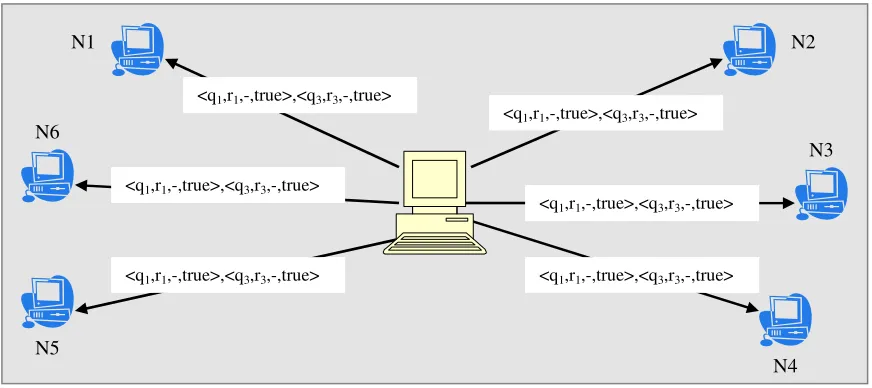
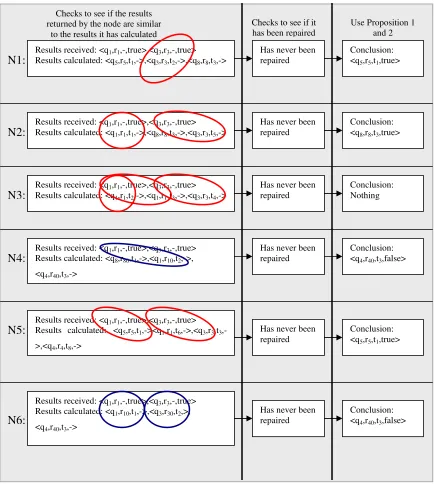
We assume that thesystem considered has a central voter in the sense that it collects the results calculated by every node and chooses a final result using quorum-based voting
mechanism.
Different nodes can provide different services. For example, node A can process requests
q1 and q2 while node B can process requests q1, q3, and q4.
We assume that each node can process a predefined set of requests and we assume that all nodes have the knowledge about which other nodes are capable of processing which