Simulation Study and Prevention of AODV
against Gray Hole Attack on Random
Topologies in VANETs
Pratheeksha Hegde N, Rashmi Naveen
M.Tech Student, Department of ISE, NMAM Institute of Technology, Karnataka, India
Assistant Professor, Department of ISE, NMAM Institute of Technology, Karnataka, India
ABSTRACT:Vehicular adhoc networks (VANETs) is a rising technology with a special class of MANET. It does not have any fixed infrastructure. Communication among vehicles is between vehicles and roadside infrastructure. So security is a significant area for VANET. For authentication purpose, lowers the performance and bandwidth is high. And availability of network must be obtained when a node sends any essential information to other node. The aim of this paper is to give an overview of VANETs with special effects of Gray Hole attack in Adhoc on demand distance vector Routing (AODV) protocol based on VANETs. We have used different performance metrics for Gray Hole attack in VANETs. To simulate this attack NS-2.34 has been used widely.
Keywords:VANETs, AODV, Gray Hole attack, initial vector, MD5.
I. INTRODUCTION
VANET is not same as MANET in the characteristic of higher mobility, privacy requirements etc [1]. The idea of VANET is to make available communication between vehicles to get better road condition and make driving safer. Every vehicle needs an OBU (On-Board Units) through which vehicles can communicate with each other as well as with RSU (Roadside unit) connected to a network so that it uses services including internet access that is accessible to vehicles. Since VANET maintains essential information, they should pursue with security necessities like privacy, confidentiality, integrity to provide secure communication against attacker node [2]. Attacker node not only affects the driver’s privacy but also cooperate safety of traffic. Hence, widespread researches are carried out to provide security in VANETs. During the communication in VANETs the identity of drivers should be uncovered since it utilizes this data to introduce the attack with fake identities and by no means had get caught which is the aim of providing security and privacy in VANETs. Identities of vehicle and driver have to make known to RSU to communicate with them. So security and privacy should be carefully handled so that opponent cannot misuse them.
This paper is structured as follows: In Section II, background and related work are discussed. In Section III, we have brief explanation on proposed methodology and in section IV we have explained experimental results analysis and finally we have concluded the paper in section V.
II. BACKGROUND AND RELATED WORK
A. OVERVIEW OF AODV
B. ROUTING ATTACK AGAINST VANET
Gray Hole Attack
Here an attacker node acts as a normal node which is similar to Black Hole attack [4]. So it is not easy to detect Gray Hole attack, due to this type of behavior since it acts as a normal node. Gray Hole attack is also called node misbehaving attack. Each node preserves routing table that stores the data of neighbor node, which is path to destination. This attack has two dissimilar phases. In first, attacker node performs AODV protocol having valid path to destination. In second, the nodes drop irregular packets with specific opportunity. When packets are not dropped, the Gray Hole attacker act as normal node then it switches to its malicious behavior.
C. RELATED WORK
In [5] author has taken a MANET consisting of related type of nodes. Every node will wander or remain fixed in a location for a random time. A node may connect or go away from network any time. The node carries out peer-to-peer communication over wireless multi hop channel. We assumed that for the use of differentiation, every node contains distinctive nonzero identity and all the association in network are considered to be bi-directional. The proposed mechanism will not consider operation of promiscuous mode of interfaces of nodes. To process the transit packets, promiscuous mode may not put on further computation overhead and energy utilized but it will be insufficient where nodes set with directional antenna. At dissimilar points of time in the network there may be many Gray Hole nodes and these attacker nodes might assist with each other to disturb the communication in network. To identify any attacker in the network, proposed mechanism involves recognition & eradication technique. If attacker node is detected, notification for sending messages to every node excluding attacker, so that it can be inaccessible to make use of any network. Mechanism consists of local irregularity security actions which is call upon consecutively.
III. PROPOSED METHODOLOGY
Description of Proposed Algorithm:
A message digest of 128 bit from the sender is taken as a message input of any length. In sender side, message is being entered and decrypted message is obtained by the receiver. Here Initial Vector is circulated among every node in a network. Message is hashed using SHA1 hashing algorithm to produce a key. Then input string is encrypted using MD5 encryption algorithm. Message is encrypted along with generated key by SHA1 hashing algorithm, to get encrypted message. The encrypted message is attached with packet and sends to the receiver. In receiver side, primarily we decapsulate the packet and get the encrypted message. The original message is obtained when plain text is decrypted using MD5 decryption algorithm.
Algorithm: In sender side,
Step 1: Key and node id is concatenated to get initial vector
Step 2: Input string is taken as the message input
Step 3: The Initial Vector and message is hashed to attain message digest key
Step 4: Check this condition if (! gray hole attack)
else
attacker_module ( )
Step 5: The original message is displayed
Step 6: end
IV. EXPERIMENTS AND RESULTS
The proposed cryptographic algorithm is implemented with NS 2.34. Performance metrics are calculated from trace file using the AWK script. In this section the simulation results are shown in the form of line graphs. We have selected control packets with respect to number of nodes and buffer size as the simulation parameter to evaluate the performance.
Control packets:
It is total number of route request and route reply packets consumed by a protocol.
a) Simulation parameters:
The following parameters from Table 1 are used for network simulation.
TABLE 1: SIMULATION PARAMETERS Parameters Values
Simulator NS 2.34
Routing Protocol AODV
Traffic produced CBR
Number of Nodes 20
Simulation time 100s
Network area 1000m x 1000m
b) Control packets versus number of nodes:
TABLE 2: CONTROL PACKETS VERSUS NUMBER OF NODES ON AODV Number of
nodes
AODV Gray Hole attack
AODV with prevention
5 220 151 449
10 255 175 525
15 255 175 525
Fig 1: Control packets versus number of nodes
From the Fig 1, it shows that control packets in the presence of attacker nodes with and without prevention mechanism on AODV protocol. It is evident that AODV after using the proposed scheme has a higher value of control packets with respect to number of nodes. It can be observed from the graph that using proposed approach increases control packet by reducing the packet drops in the network.
c) Control packets versus buffer size:
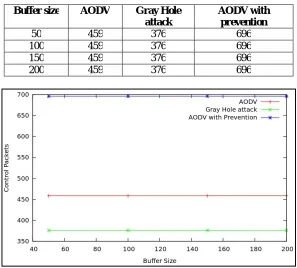
TABLE 3: CONTROL PACKETS VERSUS BUFFER SIZE ON AODV
Buffer size AODV Gray Hole attack
AODV with prevention
50 459 376 696
100 459 376 696
150 459 376 696
From the Fig 2, it shows that control packets in the presence of attacker nodes with and without prevention mechanism on AODV protocol. It is evident that AODV after using the proposed scheme has a higher value of control packets with respect to buffer size. It can be observed from the graph that using proposed approach increases control packet by reducing the packet drops in the network.
V. CONCLUSION
In this paper, performance analysis of Gray Hole attack using routing protocol on randomly generated scenarios is studied. The parameters like control packets with regard to number of nodes and buffer size are used for analysis. The simulation study and analysis of Gray Hole attack in control packets indicates that it degrades the network performance to very large extent in the presence of attacker using AODV. Here first we have focused on the detection of Gray Hole attack and then RC4-MD5 prevention mechanism is implemented. In future we can add few more attacks and performance of network can be compared with and without attacker. And also try to implement prevention mechanism for those attacks.
VI. REFERENCES
1. M.A. Razzaque, Ahmad Salehi S., and Seyed M. Cheraghi, “Security and Privacy in Vehicular Ad-Hoc Networks: Survey and the Road Ahead”, Springer-Verlag Berlin Heidelberg, Vol No 2, Issue No 4, pp.107-132, 2013.
2. Mohammed Saeed Al-kahtani, “Survey on Security Attacks in Vehicular Ad hoc Networks (VANETs)”, pp 1-9, 2012.
3. V.Jigisha, Ch.Sudersan Raju, Dr.Ch.Balaswamy, “The comparison between OLSR and AODV routing protocols for Vehicular Adhoc Networks”, International Journal of Advanced Research in Computer and Communication Engineering, Vol No 4, Issue No 3, pp 467-470, 2015.
4. Shani Makwana, Krunal Vaghela , “Detection and Elimination of Gray Hole Attack using Dynamic Credit based Technique in MANET”, International Journal of Computer Applications, Vol No 125, Issue No 4, pp 1-6, 2015.
5. Onkar V. Chandure, Prof. V. T. Gaikwad, “A Mechanism for Recognition & Eradication of Gray Hole Attack using AODV routing protocol in MANET”, International Journal of Computer Science and Information Technologies (IJCSIT), Vol No 2, Issue No 6, pp 2607- 2611, 2011.
BIOGRAPHY
1) Pratheeksha Hegde N is a PG Scholar in the Information Science Department, NMAM Institute of Technology. She received her B.E degree in Information science and engineering from NMAM Institute of Technology Nitte. Her research interests are wireless network and adhoc sensor network.