Real Time Extreme Point Detection HGR
Methods using Raspberry Pi
Anu V Nair, Minu George
M. Tech Student, Dept. of ECE, VJCET, Kerala Technological University, Vazhakulam, Ernakulam, Kerala, India
Assistant Professor, Dept. of ECE, VJCET, Kerala Technological University, Vazhakulam, Ernakulam, Kerala, India
ABSTRACT: Many vision based applications use fingertips to track or manipulate gestures. As human express his feelings mainly with hand expressions, gesture identification is a natural way to pass signals to the machine. Here a novel, time efficient algorithm has been described for fingertip detection. This work requires no glove, sensors or colour strips to detect the fingertips. This method is invariant to hand movement and in pre-processing it cuts only hand palm from the full image. Hence further computation would be much faster than processing the full image. HSV colour space based skin filter would be applied on the images for hand segmentation. Here extreme point detection method is using for hand gesture recognition. Recognizing the gestures in real time is the main objective of this work.
KEYWORDS: Human Computer Interface, Skin Filter, Image Segmentation, Fingertip Detection, Extreme Point Detection Method.
I. INTRODUCTION
Hand Gesture Recognition (HGR) is a very popular and effective way used for the human machine communication. It has been used in many applications including embedded systems, vision based systems and medical applications. In HGR, fingertip detection is an important part if image base models are being used. HGR systems face many problems in skin segmentation due to luminance and intensity in images. The fingertips detection models mostly have assumption about the hand direction; this restricts the natural expression of humans. Processing time is another key factor in image based processing algorithms.
Here focusing on movement invariant fingertip detection of natural hand. This work requires no glove, sensors or colour strips to detect the fingertips. The only assumption is that user will show the hand to system, facing the palm to the system while the direction of hand is not restricted. User is free to show hand in any direction as naturally hands move. This study proposes a method to automatically recognize the hand gestures which could be used to control any device in automated home. In this paper, we focus on real time vision based hand gesture recognition and HSV colour space based skin filter would be applied on the images for hand segmentation.
II. BACKGROUND WORK
A lot of work has been done in this area for dynamic hand gesture recognition using fingertip detection. A survey on fingertip based methods could be found out in [4]. There are several limitations in existing approaches. Garg [6] used 3D images in his method to recognize the hand gesture, but this process is complex and also not time efficient. The Processing time is one of the very critical factors in real time applications [12]. Aznaveh [2] presented a RGB vector based method for skin detection in images. Yang [20] analyses the hand contour to select fingertip candidates, then finds peaks in their spatial distribution and checks local variance to locate fingertips. This method is not invariant to the orientation of the hand. There are other methods, which are using directionally Variant templates to detect fingertips [9][15]. Few other methods are dependent on specialized instruments and setup like the use of infrared camera [10], stereo camera [20], a fixed background [5][14] or use of markers on hand. This paper describes a novel method of motion patterns recognition generated by the hand without using any kind of sensor or marker.
Generally image based models work on pixel by pixel and do hand Segmentation and work only on region of interest. However most hand segmentation methods can’t do a clearly hand segmentation under some conditions like fast hand motion, cluttered background, poor light condition [7]. If the hand segmentation is not valid, then detection of fingertips can be questionable. Researchers [10][11][16] used infrared camera to get a reliable segmentation. Few researchers [5][7][8][17][18] in their work limit the degree of the background clutter, finger motion speed or light conditions to get a reliable segmentation. Raheja [14] and few others also used 3D mapping using specialized device like KINECT for hand segmentation. Some of fingertip detection methods can’t localize accurately multidirectional fingertips. Researchers [3][5][17] assumed that the hand is always pointing upward to get precise localization.
III. PROPOSED SYSTEM
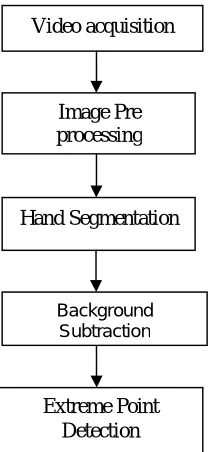
In proposed system, we are implementing a new method for hand gesture recognizing. Here, an advanced processor board Raspberry pi (ARM) is used for processing the data i.e. for recognizing hand gesture from real time video. Here user, show that hand in front of pi camera connected to the board, then camera captures this video then we adjust the hand in frame and HSV colour space based skin filter would be applied on the images for hand segmentation. The block diagram of the extreme point detection method work is given in Figure 1.
Fig 1: block diagram of the extreme point detection method
Video acquisition
Image Pre processing
Hand Segmentation
Background Subtraction
Hand gesture recognition involves three important phases: The detection and segmentation part is to detect hands and segment the corresponding image regions from the background.
A.Image Pre-processing: The aim of pre-processing is an improvement of the image data that suppresses the unwanted distortion or enhances some image features important for further processing.
B. Hand Segmentation: Skin color detection is the most popular method for segmentation for its simplicity and convenience. Color space selection is a key factor for skin color detection. Since the RGB color space is sensitive to lighting conditions. So RGB is converted to HSV color [2]
C. Background subtraction: Background subtraction is a method for segmenting the foreground. It compares the current image with the background image and extracts the foreground. We use an image morphology algorithm that performs image erosion and dilation to eliminate noise. Erosion trims down the image area where hand is not present and dilation expands the area of the image pixels which are not eroded.
D.Contour extraction: We use in this step the cvFindContours function from OpenCV to find the contour of the hand. This function will return a pointer to a sequence containing all the points regarding the hand contour. By the way, we have found out that the best results are obtained by retrieving only the external contour as well as the points that represent the end of horizontal, vertical and diagonal segments, which are compressed to reduce the number of points to be successively processed.
E. Extreme Point Detection Method: In this method we are calculating the size of objects in images along with measuring the distances between them. Find the extreme left, right, top, and bottom (x, y)-coordinates along a contour, like in the fig 2:.Finds the smallest coordinate (i.e., the “left” value) in the entire contour array largest x-coordinate (i.e., the “right” value) in the contour array using the argmini() and argmax() function.
xl = tuple(cnt[cnt[:, :, 0].argmin()][0])
xr = tuple(cnt[cnt[:, :, 0].argmax()][0])
yt = tuple(cnt[cnt[:, :, 1].argmin()][0])
yb = tuple(cnt[cnt[:, :, 1].argmax()][0])
Contours have various features like area, perimeter, momentsetc. which can be used for various applications. Contour Area is the area of the object is found with the help of moments. Area is calculated by zero order moment.
Compute the center of the contour M = cv2.moments(c)
cX = int(M["m10"] / M["m00"]) cY = int(M["m01"] / M["m00"])
1. Boundary Rectangles
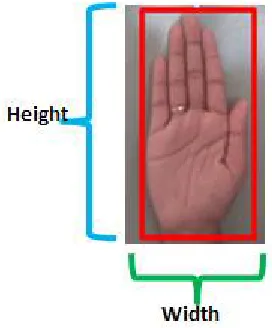
The ‘boundary rectangle’ structure is used for finding posture and position of the hands. When the hands are segmented, an imaginary rectangular region is drawn outside of each hand. The boundaries are simply calculated by finding the positions of the minimum and maximum skin pixels in both vertical and horizontal. Fig 3illustrates a sample boundary rectangle with a red mark.
Fig 3: Boundary Rectangle
2.Automated home control application
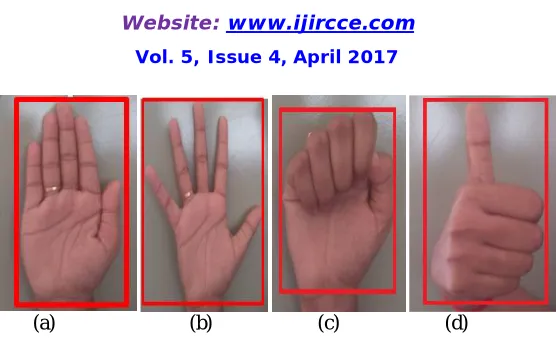
Since hand gestures have long been serving as an essential communication medium in human society, we believe that they can also play an equally important role in the computerized world. This section introduces a series of new applications of vision based hand gesture recognition in recent years to give an indication of its prospect in the future. Home automation control panel using a Raspberry Pi 3 B model, four Relay Channels and extension board. This is a very cheap home automation system and to control any four devices. Here, four gestures are used to controlon or off condition of four devices.
IV. HARDWARE IMPLIMENTATION
Fig 4: Raspberry Pi
V. SOFTWARE REQUIREMENTS
Operating system:Raspbian (Debian), Language: Python2.7, Platform:OpenCV (Linux-library)
PYTHON Python is an easy to learn, powerful programming language. It has efficient high-level data structures and a simple but effective approach to object-oriented programming. The Python interpreter is easily extended with new functions and data types implemented in C or C++ (or other languages callable from C). Python is also suitable as an extension language for customizable applications.The operating system under which the proposed project is executed is Raspbian which is derived from the Debian operating system. The algorithms are written using the python language which is a script language. The functions in algorithm are called from the OpenCV library. OpenCV is an open source computer vision library, which is written under C and C++ and runs under Linux, Windows and Mac OS X. OpenCV was designed for computational efficiency and with a strong focus on real-time applications. OpenCV is written in optimized C and can take advantage of multi-core processors. The OpenCV library contains over 500 functions that span many areas in vision, including factory product inspection, medical imaging, security, user interface, camera calibration, stereo vision, and robotics. Because computer vision and machine learning often go hand-in-hand, OpenCV also contains a full, general-purpose Machine Learning Library (MLL).
VI. RESULT AND IMPLEMENTATION
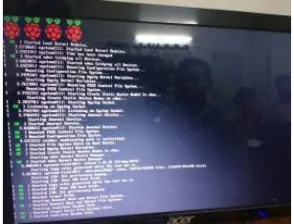
Once configured, the pi can be operated from its own peripherals or another computer connected over the internet.As a desktop, these materials are required Pi 3 Starter kit -or- Pi 3/2 Accessory Kit and your own PiUSB Mouse, USB Keyboard, HDMI monitor/TV/adapted VGA.Fig.5 shows the software booting diagram. The project “Hand Gesture recognition “in extreme point detection method in raspberry pi” has been successfully designed and tested. It has been developed by integrating features of all the hardware components and software used. Hand gesture recognition using extreme point detection method to control any four devices and its on and off condition. It is shown in fig 6 by using gesture 1,gesture 2, gesture 3 and gesture 4 in python programming language.
(a) (b) (c) (d)
Fig 6: Extreme point method Hand gestures. (a)gesture1,(b)gesture2,(c)gesture3 and (d)gesture 4
VII. CONCLUSION AND FUTURE WORK
Hand Gesture recognition algorithm is relatively robust and accurate. Here we have discussed a fast and efficient extreme point detection method for fingertips detection which will be used in our project to “Automated home controlling” using hand gestures. Considering the relative infancy of research related to vision based gesture recognition remarkable progress has been made. To continue this momentum it is clear that further research in the areas of feature extraction, classification methods and gesture representation are required to realize the ultimate goal of humans interfacing with machines on their own natural terms.
REFERENCES
[1] JagdishLalRaheja and Karen Das,Fingertip Detection: A Fast Method with Natural Hand, International Journal of Embedded Systems and
Computer Engineering. Vol. 3, No. 2, July, pp 85-88.2011.
[2] Aznaveh, M.M., Mirzaei, H., Roshan, E., Saraee, M., A new color based method for skin detection using RGB vector space, Conference on
Human System Interactions, pp.932-935, 25-27 May 2008
[3] Brown, T., Thomas, R. C. Finger tracking for the Digital Desk. Proceedings of First Australasian User Interface Conference (AUIC 2000), pp.11-16, Canberra, Australia 2000.
[4] Chaudhary, A., Raheja, J.L., Das, K., Raheja, S"A Survey on Hand Gesture Recognition in context of Soft Computing", Published as Book Chapter in “Advanced Computing” CCIS, Springer Berlin Heidelberg, Vol. 133, pp. 46-55,2010.
[5] Crowley, J. L., Berardand F., Coutaz, J. Finger Tacking As an Input Device for Augmented Reality. Proceedings of. International Workshop
on Automatic Face and Gesture Recognition, pp.195-200, Zurich, Switzerland.1995
[6] Garg, P., Aggarwal, N., Sofat, S, Vision Based Hand Gesture Recognition. World Academy of Science, Engineering and Technology, vol. 49.
pp. 972-977,2009.
[7] Hardenberg, C. V., Berard,. Bare hand human computer interaction. Proceedings of the ACM workshop on Perceptive user interfaces, pp.1-8,
Orlando, Florida, USA.2001.
[8] Keaton, T., Dominguez, S. M., Sayed, A. H, SNAP & TELL: a multimodal wearable computer interface for browsing the environment.
Proceedings of Sixth International Symposium on Wearable Computers, (ISWC 2002), pp.75–82, Seattle, WA, USA 2002.
[9] Kim, J. M., Lee, W. K. Hand shape Recognition using fingertips. In the proceedings of fifth International Conference on Fuzzy Systems and
Knowledge Discovery, pp.44-48, Jinan, Shandong, China,2008.
[10] Oka,K., Sato, Y., Koike, H. Real time Tracking of Multiple Fingertips and Gesture Recognition for Augmented Desk Interface Systems.
Proceedings of the Fifth IEEE International Conference on Automatic Face and Gesture Recognition (FGR.02), pp.411–416, Washington, D.C., USA. May, 2002.
[11] Oka, K., Sato, Y., Koike, H. Real time fingertip tracking and gesture recognition. Computer Graphics and Applications, IEEE, Vol. 22, Issue 6.
pp.64–71,2002..
[12] Ozer, I. B., Lu, T., Wolf, W. Design of a Real Time Gesture Recognition System: High Performance through algorithms and software. IEEE
Signal Processing Magazine, pp.57-64,2005.
[13] Raheja, J.L., Das, K., Chaudhary, a. “An Efficient Real Time Method of Fingertip Detection”, Proceedings of 7th International Conference on
Trends in Industrial Measurements and Automation (TIMA 2011), CSIR Complex, Chennai, India, 6-8 Jan, 2011, pp. 447-450.
[14] Raheja, J.L., Chaudhary, A., Singal, K. “Tracking of Fingertips and Centre of Palm using KINECT ” The 3rd IEEE International Conference on
Computational Intelligence, Modelling and Simulation (CimSim 2011) Langkawi, Malaysia, 20-22 Sep 2011, pp. 248- 252.
[15] Sanghi, A., Arora, H., Gupta, k., Vats, V. B. . A Fingertip Detection and Tracking System as a Virtual Mouse, a Signature Input Device and an
Application Selector. Seventh International Conference on Devices, Circuits and Systems, pp.1-4, Cancun, Mexico,2008.
[16] Sato, Y., Kobayashi, Y., Koike,.H, Fast tracking of hands and fingertips in infrared images for augmented desk interface. Proceedings of Fourth
[17] Tomita, A., Ishii. R. J. (1994). Hand shape extraction from a sequence of digitized grayscale images. Proceedings of tweenth International Conference on Industrial Electronics, Control and Instrumentation, IECON '94, vol.3, pp.1925– 1930, Bologna, Italy.1994
[18] Wu, Y., Shan, Y., Zhangy, Z., Shafer, S. VISUAL PANEL: From an ordinary paper to a wireless and mobile input device. Technical Report,
MSRTR 2000, Microsoft Research Corporation,2000.
[19] Yang, D., Jin, L.W., Yin, J., and Others. An effective robust fingertip detection method for finger writing character recognition system. Proceedings of the Fourth International Conference on Machine Learning and Cybernetics, pp. 4191–4196, Guangzhou, China,2005
[20] Ying H., Song, J., Renand, X., Wang, W. Fingertip Detection and Tracking Using 2D and 3D Information. Proceedings of the seventh World
Congress on Intelligent Control and Automation, pp.1149-1152, Chongqing, China,2008.
BIOGRAPHY
Anu V Nairis a M Tech student in the Electronics and communication Engineering Department, Viswajyothi College of Engineering and Technology, Kerala Technological University. She completed her Bachelor of Technology from Anna University, Chennai. Her research interests are Image Processing, embedded systems, Verilog, etc.