ISSN(Online): 2320-9801
ISSN (Print): 2320-9798
I
nternational
J
ournal of
I
nnovative
R
esearch in
C
omputer
and
C
ommunication
E
ngineering
(An ISO 3297: 2007 Certified Organization)
Vol. 4, Issue 8, August 2016
Data Collection Scheme in Multi Sink for
Wireless Sensor Networks
B.Nathiya1, N.Kohila2
Full Time M.Phil Scholar, Department of Computer Science, Vivekanandha College of Arts and Sciences for Women,
Elayampalayam, Tiruchengode, Namakkal, India1
Assistant Professor, Department of Computer Applications, Vivekanandha College of Arts and Sciences for Women,
Elayampalayam, Tiruchengode, Namakkal, India2
ABSTRACT: Sensor devices are used to collect the environment information. Wireless Sensor Network (WSN) is constructed with a set of data collection units. Base station, sinks and sensor devices are used in the WSN. Power resources, bandwidth and storages are the limitations of the sensor devices. Sink nodes are used to collect data from a group of sensor devices. Many to one traffic pattern based data collection model increases the transmission load to a set of nodes. The traffic pattern based network load problem is referred as hotspot problem. Energy efficient communication protocols and multi-sink systems are used to handle hotspot problems. Static and mobility based sink placement schemes are used to handle data collection process. Mobile sinks are used to increase the network lifetime with delay constraints. Random mobility and controlled mobility models are used in the mobile sinks. In random mobility the sinks are moved randomly within the network. The sinks are deterministically moved across the network is referred as controlled mobility. The network lifetime is managed with the number of nodes and delay values. The Delay bounded Sink Mobility (DeSM) problem is initiated under sensor node allocation to sinks. A polynomial-time optimal algorithm is used for the origin problem. Extended Sink Scheduling Data Routing (E-SSDR) algorithm is used to schedule sink nodes. The mobile sink scheduling scheme is enhanced to support large size networks. Distributed scheduling algorithm is applied to schedule nodes with high scalability. The scheduling scheme is tuned for multiple sink based environment. Delay and energy parameters are integrated in the sink scheduling process.
KEYWORDS: WSN, DeSM, E-SSDR, MINLP.
I. INTRODUCTION
Sensor nodes can be imagined as small computers, extremely basic in terms of their interfaces and their components. They usually consist of a processing unit with limited computational power and limited memory, sensors, a communication device, and a power source usually in the form of a battery. Other possible inclusions are energy harvesting modules, secondary ASICs, and possibly secondary communication devices. the base stations are one or more distinguished components of the WSN with much more computational, energy and communication resources. They act as a gateway between sensor nodes and the end user.
II. WIRELESS SENSOR NETWORK
`A wireless sensor network (WSN) is a wireless network consisting of spatially distributed autonomous devices using sensors to cooperatively monitor physical or environmental conditions, such as temperature, sound, vibration, pressure, motion or pollutants, at different locations. The development of wireless sensor networks was originally motivated by military applications such as battlefield surveillance. However, wireless sensor networks are now used in many civilian application areas, including environment and habitat monitoring, healthcare applications, home automation, and traffic control.
ISSN(Online): 2320-9801
ISSN (Print): 2320-9798
I
nternational
J
ournal of
I
nnovative
R
esearch in
C
omputer
and
C
ommunication
E
ngineering
(An ISO 3297: 2007 Certified Organization)
Vol. 4, Issue 8, August 2016
The envisaged size of a single sensor node can vary from shoebox-sized nodes down to devices the size of grain of dust, although functioning 'motes' of genuine microscopic dimensions have yet to be created.
III. DATA COLLECTION USING MOBILE SINKS
In the past decades, wireless sensor network (WSN), one of the fastest growing research areas, has been attracted a lot of research activities. Due to the maturity of embedded computing and wireless communication techniques, significant progress has been made. Typically, a WSN consists of a data collection unit (also known as sink or base station) and a large number of sensors that can sense and monitor the physical world, and thus it is able to provide rich interactions between a network and its surrounding physical environment in a real-time manner. However, as long as the sink and sensor nodes are static, this issue cannot be fully tackled. First, we propose a unified framework that covers most of the joint sink mobility, data routing, and delay issue strategies. Based on this framework, we develop a mathematical formulation that is general and captures different issues. However, this formulation is a mixed integer nonlinear programming (MINLP) problem and is time consuming to solve directly. Therefore, instead of tackling the MINLP directly, we first discuss several induced sub problems, for example, sub problems with zero/infinite delay bound or connected sink sites (sink sites are connected if for any two sites there exists a path that connects them and each edge of that path meets the delay constraint). We show that these sub problems are tractable and present optimal algorithms for them. Then, we generalize these solutions and propose a polynomial-time optimal approach for the origin DeSM problem. We show the benefits of involving a mobile sink and the impact of network parameters (e.g., the number of sensors, the delay bound, and so on.) on the network lifetime. Furthermore, we study the effects of different trajectories of the sink and provide important insights for designing mobility schemes in real-world mobile WSNs. Our main contributions are the following:
1. We provide a unified formulation of DeSM, which is general and practical. We discuss sub problems of DeSM and offer efficient algorithms for them to guide the design of our algorithm for the origin DeSM.
2. We generalize algorithms for subproblems and present an optimal algorithm with polynomial complexity for the DeSM. 3. We study the effects of different trajectories of the sink and provide important insights via extensive simulations.
IV. DATA CAPTURE PROCESS
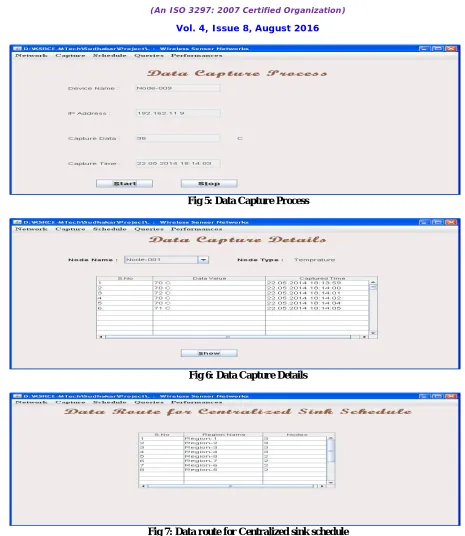
The Environment monitoring and data sensing is carried out under the data capture process.the Captured data values are updated into the local storages. Captured data values are updated with time details. The data values are transferred to the sink node.multiple methods are available for capturing data from unstructured documents (letters, invoices, email, fax, forms etc)! The list of methods identified below is not exhaustive but it is a guide of the appropriate usage of each method when addressing business process automation projects.As well as considering the method of data capture, due consideration of the origins of the documents(s) that need to be captured must happen, to see if the documents are available in their original electronic format which, has the potential to massively increase data capture accuracy and remove the need for printing and scanning
ISSN(Online): 2320-9801
ISSN (Print): 2320-9798
I
nternational
J
ournal of
I
nnovative
R
esearch in
C
omputer
and
C
ommunication
E
ngineering
(An ISO 3297: 2007 Certified Organization)
Vol. 4, Issue 8, August 2016
IV. DISTRIBUTED SCHEDULING
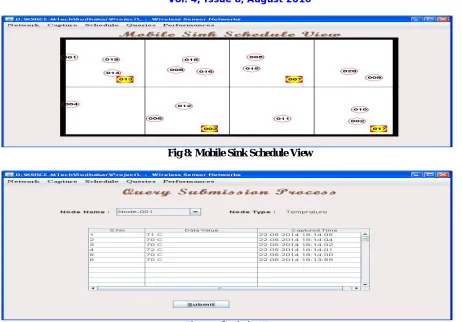
Distributed scheduling is designed for the multiple sink nodes. Sink movement is planned with sink coverage and network region details. Distributed sink scheduling algorithm is used for sink movement plan. Region based sink movement model is used in the system. The shared resources in a distributed system have enabled a new set of workloads to coexist: sequential, interactive, and parallel jobs. This new workload and this environment require new approaches for fairly and efficiently allocating resources to competing users. In this paper, several approaches on scheduling and co scheduling are presented. Besides performance, fairness is a very important requirement for the scheduling approaches. However, its explicit defining processes need co scheduling, and poor fairness makes it unsuitable to the distributed system, which implicitly recommends cooperated scheduling and an acceptable fairness.
V. PERFORMANCE ANALYSIS
To this end, they study the delay-bounded sink mobility problem (DeSM) of WSNs. They assume that WSNs are deployed to monitor the surrounding environment and the data generation rate of sensors can be estimated accurately. They constrain the mobile sink to a set of sink sites. First, they propose a unified framework that covers most of the joint sink mobility, data routing, and delay issue strategies. Based on this framework, they develop a mathematical formulation that is general and captures different issues. However, this formulation is a mixed integer nonlinear programming (MINLP) problem and is time consuming to solve directly. They show that these sub problems are tractable and present optimal algorithms for them. Then, they generalize these solutions and propose a polynomial-time optimal approach for the origin DeSM problem. They show the benefits of involving a mobile sink and the impact of network parameters on the network lifetime. Furthermore, they study the effects of different trajectories of the sink and provide important insights for designing mobility schemes in real-world mobile WSNs. The main contributions are the following:
They provide a unified formulation of DeSM, which is general and practical. They discuss sub problems of DeSM and offer efficient algorithms for them to guide the design of algorithm for the origin DeSM.
They generalize algorithms for sub problems and present an optimal algorithm with polynomial complexity for the DeSM.
They study the effects of different trajectories[18] of the sink and provide important insights via extensive simulations.
They are three types of Analysis:
Network Delay Analysis
Response Time Analysis
Network Lifetime Analysis
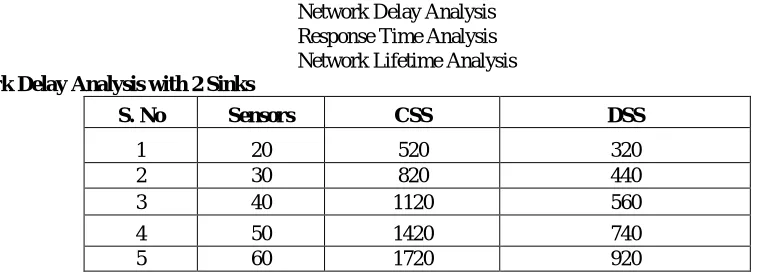
Network Delay Analysis with 2 Sinks
S. No Sensors CSS DSS
1 20 520 320
2 30 820 440
3 40 1120 560
4 50 1420 740
5 60 1720 920
Table 1: Network Delay Analysis between Centralized Sink Schedule (CSS) and Distributed Sink Schedule (DSS) Schemes with 2 Sinks
ISSN(Online): 2320-9801
ISSN (Print): 2320-9798
I
nternational
J
ournal of
I
nnovative
R
esearch in
C
omputer
and
C
ommunication
E
ngineering
(An ISO 3297: 2007 Certified Organization)
Vol. 4, Issue 8, August 2016
Network Delay Analysis with 4 Sinks
S. No Sensors CSS DSS
1 20 520 160
2 30 820 220
3 40 1120 280
4 50 1420 400
5 60 1720 460
Table 2: Network Delay Analysis between Centralized Sink Schedule (CSS) and Distributed Sink Schedule (DSS) Schemes with 4
VI. PROPOSED SYSTEM:
Sink nodes are used in the wireless sensor networks to handle data collection and transmission process. Extended Sink Scheduling Data Routing (E-SSDR) is used to schedule sinks. The Delay bounded Sink Mobility (DeSM) is solved with centralized and distributed scheduling schemes. The scheduling scheme is adapted to support multi sink based data collection mechanism. The mobile sink scheduling scheme is enhanced to support large size networks. Distributed scheduling algorithm is applied to schedule nodes with high scalability.
0 500 1000 1500 2000
20 30 40 50 60
520
820
1120
1420
1720
320 440 560
740 920 N e tw o rk D e la y (M Se c) Sensors
Network Delay Analysis between Centralized Sink
Schedule (CSS) and Distributed Sink Schedule (DSS)
Schemes with 2 Sinks
CSS DSS 0 500 1000 1500 2000
20 30 40 50 60
520
820
1120
1420
1720
160 220 280
400 460 N e tw o rk D e la y (M Se c) Sensors
Network Delay Analysis between Centralized Sink Schedule
(CSS) and Distributed Sink Schedule (DSS) Schemes with 4
Sinks
CSS
ISSN(Online): 2320-9801
ISSN (Print): 2320-9798
I
nternational
J
ournal of
I
nnovative
R
esearch in
C
omputer
and
C
ommunication
E
ngineering
(An ISO 3297: 2007 Certified Organization)
Vol. 4, Issue 8, August 2016
Advantages:
• Energy consumption is minimized
• Suitable for single and multiple mobile sink environment • Scheduling overhead is reduced
• Data collection latency is reduced
Fig 2: Network Setup
Fig. 3 Coverage and Energy Details
ISSN(Online): 2320-9801
ISSN (Print): 2320-9798
I
nternational
J
ournal of
I
nnovative
R
esearch in
C
omputer
and
C
ommunication
E
ngineering
(An ISO 3297: 2007 Certified Organization)
Vol. 4, Issue 8, August 2016
Fig 5: Data Capture Process
Fig 6: Data Capture Details
ISSN(Online): 2320-9801
ISSN (Print): 2320-9798
I
nternational
J
ournal of
I
nnovative
R
esearch in
C
omputer
and
C
ommunication
E
ngineering
(An ISO 3297: 2007 Certified Organization)
Vol. 4, Issue 8, August 2016
Fig 8: Mobile Sink Schedule View
Fig 9: Submission Process
VII. CONCLUSION
Sink nodes are used in the wireless sensor networks to handle data collection and transmission process. Extended Sink Scheduling Data Routing (E-SSDR) is used to schedule sinks. The Delay bounded Sink Mobility (DeSM) is solved with centralized and distributed scheduling schemes. The scheduling scheme is adapted to support multi sink based data collection mechanism. Energy consumption is minimized in the data collection scheme. The scheduling scheme is suitable for single and multiple mobile sink environment. Scheduling overhead is reduced in the multi sink model. Data collection latency is reduced in the sensor networks.
REFERENCES
[1]. Lu, R, Lin, X, Zhu, H, Liang, X and Shen, S Jan. 2012, ‘Becan: A Bandwidth-Efficient Cooperative Authentication Scheme for Filtering Injected False Data in Wireless Sensor Networks’, IEEE Trans. Parallel and Distributed Systems, Vol. 23, No. 1.
[2]. Ota, k, Dong, M, Cheng, Z, Wang, J, Li, X and Shen, X July 2013, ‘Oracle: Mobility Control in Wireless Sensor and Actor Networks’, Computer Comm., Vol. 35, pp. 1029-1037, 2012.
[3]. Roberto Di Pietro, Gabriele Oligeri, Claudio Soriente and Gene Tsudik July 2013, ‘United We Stand: Intrusion Resilience in Mobile Unattended WSNs’, IEEE Transactions On Mobile Computing, Vol. 12, No. 7.
[4]. Shi, Y and Hou, Y.T 2008, ‘Theoretical Results on Base Station Movement Problem for Sensor Network’, Proc. IEEE INFOCOM.
[5]. Wang, Y, Wu, F and Tseng, Y 2012, ‘Mobility Management Algorithms and Applications for Mobile Sensor Networks’, Wireless Comm. Mobile Computing, Vol. 12, pp. 7-21.
[6]. Wenbo Zhao and Xueyan Tang April 2013, ‘Scheduling Sensor Data Collection with Dynamic Traffic Patterns’, IEEE Transactions On Parallel And Distributed Systems, Vol. 24, No. 4.
[7]. Xiaodong Wang, Xiaorui Wang, Guoliang Xing, Jinzhu Chen, Cheng-Xian Lin and Yixin Chen August 2013, ‘Intelligent Sensor Placement for Hot Server Detection in Data Centers’, IEEE Transactions On Parallel And Distributed Systems, Vol. 24, No. 8.
[8]. Yi Zhang, Kristian Lum and Jun Yang May 2013, ‘Failure-Aware Cascaded Suppression in Wireless Sensor Networks’, IEEE Transactions On Knowledge And Data Engineering, Vol. 25, No. 5.