University of Windsor University of Windsor
Scholarship at UWindsor
Scholarship at UWindsor
Electronic Theses and Dissertations Theses, Dissertations, and Major Papers
2018
An Exploratory Study on Chinese Students Studying in Canada on
An Exploratory Study on Chinese Students Studying in Canada on
“2?2” Joint Programs
“2?2” Joint Programs
Chiyu Wang
University of Windsor
Follow this and additional works at: https://scholar.uwindsor.ca/etd
Recommended Citation Recommended Citation
Wang, Chiyu, "An Exploratory Study on Chinese Students Studying in Canada on “2?2” Joint Programs" (2018). Electronic Theses and Dissertations. 7404.
https://scholar.uwindsor.ca/etd/7404
This online database contains the full-text of PhD dissertations and Masters’ theses of University of Windsor students from 1954 forward. These documents are made available for personal study and research purposes only, in accordance with the Canadian Copyright Act and the Creative Commons license—CC BY-NC-ND (Attribution, Non-Commercial, No Derivative Works). Under this license, works must always be attributed to the copyright holder (original author), cannot be used for any commercial purposes, and may not be altered. Any other use would require the permission of the copyright holder. Students may inquire about withdrawing their dissertation and/or thesis from this database. For additional inquiries, please contact the repository administrator via email
AN EXPLORATORY STUDY ON CHINESE STUDENTS STUDYING IN CANADA ON “2+2” JOINT PROGRAMS
By Chiyu Wang
A Thesis
Submitted to the Faculty of Graduate Studies through the Faculty of Education in Partial Fulfillment of the Requirements for
the Degree of Master of Education at the University of Windsor
Windsor, Ontario, Canada
AN EXPLORATORY STUDY ON CHINESE STUDENTS STUDYING IN CANADA ON “2+2” JOINT PROGRAMS
By Chiyu Wang
APPROVED BY:
_______________________________________________ Y. Wang
Department of Economics
_______________________________________________ J. G. Bayley
Faculty of Education
______________________________________________ Z. Zhang, Advisor
Faculty of Education
AUTHOR’S DECLARATION OF ORIGINALITY
I hereby certify that I am the sole author of this thesis and that no part of this thesis has
been published or submitted for publication.
I certify that, to the best of my knowledge, my thesis does not infringe upon anyone’s
copyright nor violate any proprietary rights and that any ideas, techniques, quotations, or any
other material from the work of other people included in my thesis, published or otherwise,
are fully acknowledged in accordance with the standard referencing practices. Furthermore,
to the extent that I have included copyrighted material that surpasses the bounds of fair
dealing within the meaning of the Canada Copyright Act, I certify that I have obtained
written permission from the copyright owner(s) to include such material(s) in my thesis and
have included copies of such copyright clearances to my appendix.
I declare that this is a true copy of my thesis, including any final revisions, as approved
by my thesis committee and the Graduate Studies office, and that this thesis has not been
ABSTRACT
In response tothe trend of globalization and internationalization,the Chinese
government opened the education market to allow foreign institutions to operate in the
Educational Service Trade, especially in higher education. As a result, a significant number
of joint education programs between China and Canada came into being in the last decade.
The “2+2” Type, which is considered a typical mode, is the focus of this study. The aim of
this research is to understand perspectives, expectations, and experiences of Chinese students
who are participating in “2+2” joint programs at Canadian Universities.
The research was conducted with eight participants who were enrolled in the “2+2” joint
programs of the China University of Petroleum. Surveys and interviews were employed for
data collection. The findings provide useful suggestions for “2+2” joint programs students
and administrators of cooperative universities; thus, such programs can be promoted and
ACKNOWLEDGEMENTS
First, I wish to express heartfelt gratitude and thanks to Dr. Zuochen Zhang, who
inspired and encouraged me to explore the idea of international education. I would also like
to acknowledge all my committee members: Dr. Jonathan Bayley and Dr. Yuntong Wang. I
thank them for all their patience and guidance, which has been very important for me as an
international student doing research for the first time.
Second, I appreciate my mother and my husband, whose efforts and support are what
provided me with the opportunity for further education. Without love and support from them,
this thesis could have not been completed.
Lastly, I wish to express my gratitude to all the participants. Their support and
cooperation in completing the survey and interview were crucial. I am very appreciative that
TABLE OF CONTENTS
AUTHOR’S DECLARATION OF ORIGINALITY………...………Ⅲ
ABSTRACT………...………..IV
ACKNOWLEDGEMENTS………...….……….…...…...Ⅴ
LIST OF TABLES………...……….…….……….……..…..…….…....…Ⅷ
LIST OF APPENDICES………....………...Ⅸ
CHAPTER ONE INTRODUCTION……….1
1.1 Background………..1
1.2The Aims of the Research...4
1.3Theoretical Framework………5
1.4Outline of Chapters………..6
CHAPTER TWO LITERATURE REVIEW………...………. 7
2.1 Internationalization in Higher Education……….7
2.2 Challenges for Chinese International Students………7
2.2.1 language………8
2.2.2 academic………...8
2.2.3 culture………...………...10
2.2.4 communication………..………..10
2.2.5 social life………..………...11
2.3 The Differences between “2+2” Joint Programs Students and “Other” International Students………...…………..………12
2.4 Limitations of Previous Research………….….………...……….13
CHAPTER THREE RESEARCH METHODOLOGY…………..………..15
3.1 Research Questions………..………...15
3.2 Research Site and Participants………..………..15
3.3 Data Collection Procedures……….17
3.3.1 questionnaire……..……….……….17
3.3.2 semi-structured interview………...……….18
3.4 Data Analysis Procedures………..……….19
CHAPTER FOUR FINDINGS………....………...……….20
4.1 Survey Data: The Basic Information of Participants……….………20
CHAPTER FIVE DISCUSSION AND CONCLUSION……….………41
5.1 The Current Situation of Cooperative Education……..……….41
5.2 The Challenges and Suggestions………..….……….42
5.3 Implications………..…..………...……….45
5.4 Limitations…………...………..…..………...……….45
REFERENCES………..…..……….47
APPENDICES………...…..……….55
LIST OF TABLES
Table 1……….……….22
LIST OF APPENDICES
Appendix A……….…...………..55
Appendix B………....………..57
Appendix C………...….………..58
Appendix D………...…….………..60
Appendix E……….………..62
CHAPTER ONE
INTRODUCTION
1.1Background
Since joining the World Trade Organization (WTO) in 2001 and in response to
globalization and internationalization, the Chinese government has opened the education
market to allow foreign institutions to operate in the Educational Service Trade, especially in
higher education (Knight, 2004). With the development in various professions, there has been
increasing demand for high quality educational resources and, as a result, a significant
number of joint education programs between China and foreign nations came into being in
the last decade (Huang, 2006).
The purpose of Chinese-foreign cooperation in education is to introduce advanced
education resources that provide Chinese students the opportunity to receive various types of
post-secondary education (Healey, 2008). The main form of the Chinese-foreign cooperation
is to set up cooperative projects, which can be understood as the “two-campus” model, where
students complete their first part of education at their home universities in China, and the
second part at a foreign university. For students who are enrolled in the joint programs, their
course credits can be transferred between the Chinese university and the foreign university
(Huan, 2015). This kind of collaboration seems to be a win-win solution for the students,
In the last decade, the Chinese government has encouraged such collaboration. The
Regulations of the People’s Republic of China on Chinese-Foreign Cooperation in Running
Schools, which is promulgated by the State Council (2003) asserts that
The State encourages Chinese-foreign cooperation in running schools to which
high-quality foreign educational resources are introduced. The State encourages
Chinese-foreign cooperation in running schools in the field of higher education and
vocational education, and encourages Chinese institutions of higher learning to
cooperate with renowned foreign institutions of higher learning in running schools.
(Chapter 1, Article 3)
With the deepening of education reforms and the internationalization of education, the
number of Chinese-Foreign cooperation programs increased from only two joint programs in
1995 to 745 in 2004 (Ministry of Education, 2004). Consequently, the number of Chinese
students who were willing to study abroad increased from 2.1 million in 2002 to 3.4 million
in 2009 (Choudaha & Chang, 2012). Regarding foreign university partners, “most of them
are from the countries and regions with developed economies and advanced technology”
(Mok & Xu, 2006, p. 401). Almost 50% of the cooperative universities are from America,
Australia, and United Kingdom (Yang, 2008). However, in recent years, the number of joint
programs cooperating with Canada has been increasing rapidly (Huang, 2006).
Canada has more than 90 universities and 120 colleges (Duan, 2008), most of which are
public institutes. Canadian values prioritize quality of education; thus, the Chinese Ministry
Canada, the internationalization of higher education has become the consensus and direction
of the whole society. The Association of Universities and Colleges of Canada (2007)
published report pointed out that China has been the biggest source of international students
in Canada since 2001. Until 2009, the number of enrolled full-time Chinese international
students in Canadian universities was about 87,000, accounting for 43% of the total number
of international students (Choudaha & Chang, 2012). At the same time, many joint programs
have been initiated between China and Canada, and multiple approaches to these programs
have been employed. According to Huang (2006), the cooperation can be categorized into the
following three major types: the “1+3” Type, the “2+2” Type, and the “3+1” Type.
“1+3” Type: Chinese students study for one year in local campuses, then after being
admitted, these students can go to Canadian campuses for advanced studies.
“2+2” Type: In this type, Chinese students study for the first two years at their Chinese
institutions, then they move on to the partner campuses to complete the second part of
their studies.
“3+1” Type: Chinese students complete the first three years at institutions in China, then
they continue their studies on Canadian campuses in the final year. (p. 28)
According to Knight (2011), the joint programs are very popular and have five key
benefits for the participating students: 1) they reduce foreign education expenses up to
30-60% than the students who study fours year in overseas universities, 2) they allow
students to earn degrees from both universities, 3) they allow students to return home
international experiences for students, and 5) they allows cooperating countries to offer more
overseas employment opportunities for students. These types of international cooperation
programs are met with great favour by parents and students in China.
Huan (2015) observes that the “2+2” Type is the most common. When compared to the
other formats, the “2+2” Type gives students enough time to adapt to the campus life in both
countries. Therefore, this study focuses on the “2+2” Type, as it is more common.
1.2 Aims of the Research
Adapting to an unfamiliar place can be difficult; consequently, many international
students face challenges outside of their home countries. Yang (2008) notes that Chinese
international students are one of the international groups that experience high levels of
challenges when adapting to a foreign educational system and culture. With the increasing
number of joint programs entering the field and Chinese students going to Canadian
universities, it is essential for Chinese and Canadian cooperative universities to clearly
understand how satisfied these students are with their programs, learning, and life
experiences.
The aim of this research is to understand the perspectives, expectations, and experiences
of Chinese students who are participating in “2+2” joint programs at Canadian Universities
(Zhou & Zhang, 2014). Based on the findings, the researcher hopes to provide useful
suggestions for cooperative Chinese/Canadian post-secondary programs and their joint
1.3 Theoretical Framework
Most international students suffer from “cultural shock” (Zhou, Jindal-Snape, Topping
& Todman, 2008, p. 63) because of the many changes experienced during their studies in
overseas universities. As Figure 1 demonstrates, these changes can be attributed to the
acculturation process, and the intercultural adaptation can be divided into two categories:
“psychological adjustments” (Ward, Leong & Low, 2004, p. 142), which relates to the mental
health and overall well being of the migrants; and “sociocultural adjustment” (Oguri &
Gudykunst, 2002, p. 589), which relates to the behavioural and cognitive factors that are
associated with effective performance during cross-cultural transition.
Figure 1. The acculturation process (Ward, Bochner & Furnham, 2001, p. 44)
The acculturation process can offer valuable experiences, but can also be problematic. It
can be positive, leading people toward an explicit life trend and helping them to improve
and adapting to a new cultural or conforming to new social expectations, the process can also
have negative consequences (Dasen, Berry, & Sartorius, 1988).
1.4 Outline of Chapters
The first chapter outlines the background of joint programs in China and the reasons
why many students and parents choose the “2+2” Type programs. It also presents the aims of
the research and what aspects the researcher focuses on. The second chapter concentrates on
a review of relevant literature. It focuses on three tasks: classifying the challenges that
international students face, including language, academic, cultural, communication, and
social problems; comparing the differences between “2+2” joint programs students and other
international students; and identifying the limitations of previous research. In the third
chapter, the researcher explains the research methodology, including the research questions,
research method, sample selection, data collection, and data analysis procedures. The results
and findings from a combination of a questionnaire and interviews are presented in the fourth
chapter, and the fifth chapter discusses the results and findings are provides suggestions for
cooperative universities and “2+2” joint programs students. It also contains a conclusion,
CHAPTER TWO
LITERATURE REVIEW
2.1 Internationalization in Higher Education
Internationalization in higher education appears to be a reflection of globalization
(Qiang, 2003). Knight (1994) defined internationalization in higher education as “the process
of integrating an international or intercultural dimension into the teaching, research, and
service functions of the institution” (p. 34). Knight (2003) later wrote that internationalization
was defined as “the process of integrating an international, intercultural, or global dimension
into the purpose, functions, or delivery of post-secondary education” (p. 12).
International cooperation in higher education is not a new. From the Middle Ages to the
end of the 17th century, there were arguments for “the use of a common language, and of a
uniform program of study and system of examination to promote mobility of students and
scholars and exchange of ideas” (Knight & de Wit, 1995, pp. 6-7). Since then, various
driving forces have led to universities to form links with each other across national borders.
2.2 Challenges for Chinese International Students
For most Chinese international students, studying in overseas universities can be a
significant life event that involves numerous changes. Many studies have explored the
experiences, challenges, and barriers that Chinese international students face when attending
such institutions. These difficulties include, but are not limited to, language, academic,
2.2.1 Language
Although all of the Chinese students must get a certain score in TOEFL, IELTS, or other
language tests before they can be admitted to overseas universities, because China is a
non-English speaking country, they still cannot communicate in English as well as most
native speakers (Zhou, 2010). Mellish and Pan (2008) found that for some Chinese
international students, the language issue has become a vicious circle. If a student has
language problems, this student will lose his or her confidence when speaking English and
will be too shy to participate in class discussions or communication with others, which
further inhibits their English-language development and further lowers one’s self-efficacy.
Another language issue for Chinese international students is that the way they speak is
structured by the thought processes and the linguistic patterns of their own languages (Liu,
2015). When non-native speakers speak English, they will be interfered by the English
expression (Bloom, 2014; Myles, 2002; Odlin, 1989), which is why many Chinese students
speak or write English in ‘Chinglish’, or Chinese English. According to Pan et al (2008),
“host-language proficiency not only influences the academic work of overseas students, but
also affects their social lives and understanding of the host culture” (p.227).
2.2.2 Academic
Chinese students are often regarded as diligent learners (Jin & Cortazzi, 1998) because
they seek to satisfy the expectations of their teachers and parents; however, Volet and
Renshaw (1996) suggest that China’s teacher-centered pedagogy has socialized Chinese
consequently seldom question what they learn or volunteer in-class contributions. Therefore,
lack of active participation or involvement in class is one of the factors that cause academic
difficulties for Chinese students. Upton (1989) suggests that most Chinese students are when
an instructor’s pedagogical approach relies on discussion, Chinese students are at a distinct
disadvantage as more are uncomfortable with participating. This identifies an important issue
during the process of adjusting in US colleges. Most Chinese students feeling that they are
lost in classroom discussions when the instructors students employ colloquialisms speak
about issues outside of the course content (Sun, Sangweni, Chen, & Cheung, 1999, p. 243).
Holmes (2004) states that the most common reason for the low participation is that Chinese
students lack critical thinking in the academic activities. According to Sun, Sangweni, Chen,
and Cheung (1999), Chinese students studying in western countries indicated that the reason
they keep silence in class was because they had not yet adapted to western academic
environment.
For most Chinese students at foreign universities, plagiarism can be a serious problem.
Students from Asian countries are often unfamiliar with expectations regarding academic
integrity acknowledging material from other sources; thus, they unintentionally commit
plagiarism (Volet & Renshaw, 1996). Huan (2015) suggests that tart of the reason for this
may be that many Chinese international students lack academic writing skills, for example,
paraphrase, and quote. Drawing on educational and cultural perspective, Todd (1997)
suggests “Plagiarism itself can be discouraged by the use of oral presentations, both as a
176). Thus, attention should be given to students' lack of familiarity with concepts that are
culturally conditioned.
2.2.3 Culture
Cultural differences may be the most constant and difficult problem for all international
students, especially Chinese students. This is because China has a long history, and Chinese
cultures have been in existence for thousands of years (Keightley, 1996). In traditional
Chinese culture, every student is socialized to believe that being successful and diligent is
important. “Confucian philosophy views education as important job prospects and even more
important as a means for building one’s character. Influenced by this philosophy, Chinese
family values and socialization experiences emphasize the need to succeed educationally”
(Yan & Berliner, 2009, p. 941). The expectations prescribed by this philosophy places a
significant amount of pressure on Chinese students who enroll in a foreign higher education
system. Zhang and Carrasquillo (1992) state that “Requirements and expectations of
performance and upward mobility, guilt on the need to respect the sacrifice and duty of
parents, respect for education and social compare with other Chinese family in terms of
specific educational outcomes are all the values or practices in typical Chinese families” (p.
7).
2.2.4 Communication
Yan and Berliner (2009) state that Chinese students are not likely to ask for help from
When asked the reason for Chinese students’ unwillingness to present problems to their
advisors, most of the respondents attribute that characteristic to the Chinese culture. In
China, those workers who express the fewest problems are valued more. They are seen
as more intelligent and hardworking. Chinese students’ willingness to demonstrate their
effort and devotion to work, however, has exactly the opposite effect on their
supervisors. (p. 942)
For Chinese students, diligently working by themselves is a normal phenomenon (Balcetis,
Dunning & Miller, 2008). However, in most Western cultures, individual work and teamwork
are equally important, and teamwork, which plays an important role in both an individual’s
life and an organization’s success (Kirugi, 2015), is often more important.
The second communication problem is intercultural communication. Several studies
indicate that there is relatively little contact between overseas and domestic students. In the
United Kingdom, only 15% of Chinese students said they had friends who were native to the
United Kingdom and 43% international students in the United Kingdom had no way to get to
know local students (“A Model of Shock,” n.d.). In Germany, one survey found that about
four out of five international students complained about limited contact with their lecturers
and domestic students at the university (Heublein, 2014).
2.2.5 Social life
In many aspects, international students experience isolation and loneliness when they
are studying overseas. Russell, Rosenthal and Thomson (2010) investigated 900 international
stress levels. Sawir et al. (2008) found that one third of Chinese international students
reported cultural loneliness. Cultural loneliness occurs when a person experiences loneliness
while immersed in a foreign culture and that this loneliness leaves them feeling as though
they are not understood and are unable to understand cultural meanings (van Staden &
Coetzee, 2010). Rokach and Brock (1997) state that this cultural loneliness facilitates social
inadequacy, alienation, interpersonal and self-alienation, which collectively leads to
emotional distress. Likewise, Oei and Notowidjojo (1990) found that international students
are significantly more likely to experience moderate to severe clinical depression and
loneliness.
2.3 The Differences between “2+2” Joint Programs Students and “Other” International
Students
The international students discussed in this study were undergraduate students enrolled
in “2+2” joint programs. The differences between these students and “other” international
students can be categorized in the following three aspects:previous experiences, current
situation, and future outlook.
Previous experiences
These two types of students have different educational experiences prior to their
entrance to an overseas university as international students. After graduating from high
school, “other” international students go to oversees universities as international students
directly, while the ““2+2” joint programs students take the national entrance exam (Gaokao)
two years before they move on to an overseas university. The first two years provide the
“2+2” students a buffer time to prepare for the next two yeas, but for the “other” international
students are exposed to the local culture and educational system at the beginning of their
university life. Therefore, “other” international students have much more time to adapt to
modes of Western educational practice than the joint programs students.
Current situation
When the “2+2” joint programs students first arrive at overseas universities, the other
international students have already familiarized themselves with the local life. Under the
circumstances, the “2+2” students have to take classes with other international students and
adapt the new environment at the same time, which would be a challenge to concentrate on
both the sides.
Future outlook
Compared with “other” international students, some “2+2” joint programs students may
delay graduation because of the credit transfer problem and language issue, which means that
some of them may not complete the second part study in two years.
2.4 Limitation of Previous Research
With the internationalization and the cooperation between Chinese and foreign
universities, the number of “2+2” joint programs students have increased dramatically.
However, previous research focuses on presenting a comprehensive overview of the
challenges faced by Chinese international students and there is limited literature that deals
Chinese students’ learning in the United States and Australia, with limited research involving
Canada. Therefore, this study explores the problems that Chinese students in “2+2” programs
in Canadian universities face with the hope that the findings can help Chinese “2+2” joint
CHAPTER THREE
RESEARCH METHODOLOGY
3.1 Research Questions
In order to understand how participants perceive the “2+2” joint programs students at
Canadian universities, the research questions investigated what students expect from their
programs, what they experienced during the programs, and what they want to recommend for
all Chinese joint program students and universities. The research questions are as follows:
1. What were the “2+2” joint programs students’ expectations before going to Canada?
2. How do the “2+2” joint programs students’ perceive their experiences while studying
at Canadian universities?
3. What are the “2+2” joint programs students’ suggestions for the programs?
3.2 Research Site and Participants
The China University of Petroleum is located in Qingdao, Shandong Province. The
reasons for choosing this university as the research site are as follows: 1) it is one of the
Project 211 universities. The Project 211 of the National Key Universities was initiated in
1995 by the Ministry of Education of the People's Republic of China with the intent of raising
the research standards of high-level universities and cultivating strategies for socio-economic
development (Li, 2004); 2) it is a comprehensive university that stresses the importance of
international cooperation. According to the official website of China University of Petroleum,
since 2004, the China University of Petroleum has already established cooperation and
Great Britain, Russia, and other 30 countries and regions, the “2 + 2” joint programs of China
University of Petroleum have been established to cooperate with United States and Canada
since 2008 and by 2014, the total number of cooperation schools was thirty-three, including
eleven Canadian universities; 3) it is the only university that granted permission for the
researcher to do the study about “2+2” joint programs.
All participants were students who had already finished one year of study in Canada,
which means they had at least one-year life experience at Canadian campus. This may
include a fourth-year students or students who graduated. Therefore, the eligible population
was students who registered in September 2015 or September 2014. After getting the
approval from the Research Ethics Board (REB) of the University of Windsor, the researcher
contacted the International Cooperation and Exchange Office of China University of
Petroleum and asked them to forward an e-mail including a questionnaire and an invitation
letter to all the eligible students. Based on the data from the official website of China
University of Petroleum, the registered number of “2+2” joint programs students at Canadian
universities has been over 40 students each year since 2014. Thus, the number of eligible
students should have been at least 80 (N=80). All 80 students were contacted and invited to
participate in the study by an email invitation. The researcher’s e-mail address was included
in the e-mail so that “2+2” joint programs students who were interested in participating could
easily contact the researcher. The target number of participants was 10 (n=10), which
represented 12% of the eligible population. However, due to the fact that data collection was
frequently as when if they were in school at the time. In addition, based on the information
provided by International Cooperation and Exchange Office of China University of
Petroleum, the actual number of students registered in “2+2” joint programs students in
Canadian cooperative universities in the last two yeas were less than the expectation.
Therefore, the expected participant number was not achieved. Eight participants were invited.
To reduce the bias and error of the sample, variables such as the students’ gender, the time of
going abroad, and discipline were controlled.
3.3 Data Collection Procedures
In this qualitative research, two data gathering techniques were employed: a survey
questionnaire and a semi-structured interview. The purpose of using two kinds of data
collection was to gain detailed information from participants. The questionnaire (Appendix A)
and the interview questions (Appendix B) were available both in English and Mandarin,
because Chinese is the first language for the participants and some of them might prefer using
Chinese for the questionnaire, the interview, or both.
3.3.1 Questionnaire
All eight participants received a survey questionnaire that contained some basic
questions relating to demographic information, such as name, age, gender, year of study,
major, their range of TOEFL or IELTS score, and whether they took any ESL lessons in
Canadian. This information could provide clarity regarding participants’ perspectives in the
3.3.2 Semi-structured interview
The semi-structured interview was designed to be a one-time in-depth conversation as
prescribed by Legard, Keegan, and Ward (2003). The questions focused on gaining in-depth
data to understand whether and how participants adjusted themselves to the new living and
learning environment and perspectives of the joint programs. Considering the participants
were in different schools, the interviews were conducted through WeChat—a software
program that is widely used by Chinese students—and the time for interviews was scheduled
based on participants’ availability. The participants were interviewed individually to ensure
that they felt relaxed and comfortable. To conform to the recommendations of Legard et al.
(2003), the researcher, who designed the questions, conducted the interview to collect general
information from the participants and lead the discussion toward detailed responses related to
the study’s topic. The interviews were recorded with digital voice recorders, which were
transcribed and translated when necessary to text by researcher. During the interview, the
researcher guided and allowed the participants to express their views freely.
According to Louise and While (1994), there are five key advantages to using a personal
interview as the method for data collection:
It can compensate for low response rates typical of questionnaires; it is ideal for
exploring participants’ attitudes, values, and motives; it allows the research to evaluate
the respondents’ answers with respect to validity by recording non-verbal gestures,
which is especially help when exploring sensitive issues; it allows the researcher to
ensures that respondents do not receive assistance when preparing their responses. (p.
329)
3.4 Data Analysis Procedures
Caudle (2004) states that qualitative data analysis refers to the process of organizing and
responsibly presenting data collected from sources, which may include interviews or on-site
observations, which is particularly applicable to the current study, as well as documents. For
the current study, the researcher analyzed the data from the questionnaire and semi-structured
interview. The data analysis followed a four-step process outlined by Miles and Huberman
(1984): 1) data reduction was conducted and data was organized; 2) data was categorized into
concepts; 3) the data was reread and the themes summarized; 4) the implications were
CHAPTER FOUR
FINDINGS
Eight participants were involved in this study and they were asked to fill out a
questionnaire and answer questions through a semi-structured interview about their
experiences in “2+2” joint programs at participating Canadian universities.
All the participants were from the “2+2” joint programs of the China University of
Petroleum and already had at least one year of experience at Canadian universities. When the
questionnaire and the interview took place, seven participants were enrolled in Canadian
universities, and one participant had already graduated. During data analysis, pseudonyms
were given to the eight participants by the researcher: Abby, Bella, Cara, Daisy, Elaine, Faith,
Galen, and Hank.
4.1 Survey Data: The Basic Information of Participants
Abby, a female, was studying at York University when the data were collected. She
majored in accounting, her entry IELTS score was 5.5, and she had taken ESL lessons in
Canada for six months.
Bella, a female, was studying at York University at the time of data collection. She was
an accounting major, her entry IELTS score was 5.0, and she had taken ESL lessons for
twelve months.
Cara, a female, had graduated from the University of Waterloo. Her major was
mechanical engineering, her entry IELTS score was 6.0, and she had taken ESL lessons for
Daisy, a female, was studying at the University of Manitoba when the data were
collected. Her major was accounting, her entry IELTS score was 5.5, and she had taken ESL
lessons for six months.
Elaine, a female, was studying at the University of Prince Edward Island when the data
were collected. She majored in economics, her entry IELTS score was 5.5, and she had taken
ESL lessons for three months.
Faith, a female, was studying at the University of Waterloo when the data were collected.
Her major was accounting, her entry IELTS score was 5.5, and she had taken ESL lessons for
eight months.
Galen, a male, was studying at York University when the data were collected. He
majored in human resource management, his entry IELTS score was 5.5, and he had taken
ESL lessons for six months.
Hank, a male, was studying at University of Victoria when the data were collected. His
major was mechanical engineering, his entry IELTS score was 6.0, and he had taken ESL
lessons for three months.
Of the eight participants, six were females and two were males. When the data were
collected, seven were in the “2+2” joint programs of China University of Petroleum and one
had graduated. The participants were from five different Canadian university partners, which
accounts for about 45% of the total number of cooperating universities in Canada. The four
majors—accounting, mechanical engineering, human resource management, and
“2+2” joint programs students’ English level, the participants were asked to provide their
entry IELTS score range and whether they took any ESL lessons. The answer shows that all
the participants’ entry IELTS score was in the range of 5.0 - 6.0. This means that the eight
participants (100%) did not meet the language requirement of direct admission, which is
IELTS overall score of 6.5. Therefore, they all took ESL lessons for periods ranging from
three to twelve months. The information presents in Table 1.
Name Gender Home University
Canadian University
Major IELTS Score
ESL Lessons
Abby F China
University of Petroleum
York University
Accounting 5.5 6 months
Bella F Above York University
Accounting 5.0 12 months
Cara F Above University of Waterloo
Mechanical Engineering
6.0 4 months
Daisy F Above University of Manitoba
Accounting 5.5 6 months
Elaine F Above University of Prince Edward Island
Economics 5.5 3 months
Faith F Above University of Waterloo
Accounting 5.5 8 months
Galen M Above York University
Human Resource Management
5.5 6 months
Hank M Above University of Victoria
Mechanical Engineering
6.0 3 months
4.2 Semi-structured Interview Data
In order to meet the aims of the research, the data were presented in the order of the
interview questions.
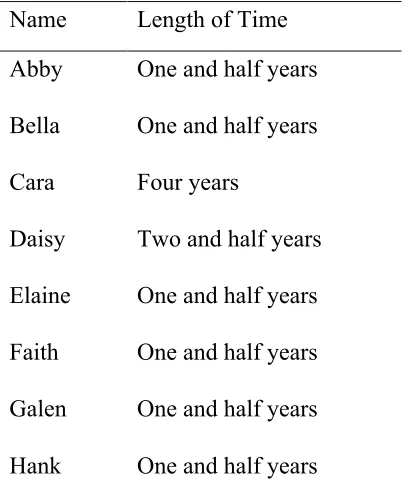
1. “How long have you been or studied in Canada?”
When the data were collected, Cara had graduated from a Canadian university and had
secured a job in Canada. At the time of the study, she had been in Canada for four years and
had taken three years to complete the second part of her studies in a Canadian university.
Daisy, who was studying in university, had been in Canada for two and half years. The other
six participants, who were still studying in their respective universities, had been in Canada
for one and half years (Table 2).
Name Length of Time
Abby One and half years
Bella One and half years
Cara Four years
Daisy Two and half years
Elaine One and half years
Faith One and half years
Galen One and half years
Hank One and half years
Table 2 The Length of Time in Canada
2. “Why did you choose to come to Canada to study?”
reasons were given by the participants: Canada’s wide selection of universities offering
“2+2” joint programs, its universities’ positive reputation, safety, lower costs, Canada’s
immigration policy, and the country’s social environment.
The primary reason for coming to Canada was that it offers a wide selection of
universities that offer 2+2Type joint programs, including: University of Waterloo, University
of Alberta, University of Saskatchewan, University of Manitoba, University of Victoria, Saint
Mary's University, Memorial University of Newfoundland, York University, Trent University,
University of Prince Edward Island, and Thompson Rivers University.
Likewise, many came to Canada because of Canada’s reputation for quality of education.
Several participants noted that they believe that Canadian education is superior. Abby stated
that she came to Canada because, outside of American ivy-league schools, Canadian schools
have, “for many years… been considered the best in the world” and “Canadian universities
are recognized and acknowledged by other countries as being the best.”
Safety was also an important factor. Daisy said comparing several countries and that
Canada is safer than America. Hank had the same opinion: “My family was a little concerned
about the firearm control issue, so the teacher recommended universities in Canada.”
Canada was also favoured because it is more reasonably priced than in other countries.
Most participants believed that Canadian universities offered a similar or higher quality
education at a lower cost.
Canada was also appealing because its immigration policy for international students is
chose Canada because they could get a work permit after graduation, which means they had a
chance to work and immigrant here in the future.
The final consideration was social environment. Canada is a diverse multicultural
country, and according to Cara, “It is more ideal and friendly in terms of natural environment,
people, political climate, and racial recognition.”
3. “What were your expectations before coming to Canada?”
Before leaving China, the participants already had some preconceived notions for
Canadian lives. They all shared the expectations of Canada, but nothing related to the “2+2”
joint programs.
Bella, Cara, Elaine, and Galen did not have any expectations except that they would
complete their degrees. In addition, Abby hoped to experience nature, because she is a travel
enthusiast: “I didn’t actually picture an expectation before I left China because I was kind of
looking forward to any unexpected events in my life, but I did hope that I could finish my
degree successfully and get to see as many fantastic nature views as I could.” Daisy, who is
an outgoing girl, shared her expectations as well: “I think I was too young to have an
expectation of my life in Canada, but I know Canada is a multicultural country, so I hoped to
make some friends from different countries while here, and I think being in an English
speaking country is a good way to improve my English skills and learn about different
cultures.” Faith likewise offered her thoughts: “My expectation was mainly about the
professional academic system, and I hoped to finish the degree as soon as possible.” Hank
residency in Canada.
4. “If you were asked to list three negative and three positive things you
experienced during your study in Canada, what would they be?”
For participants, studying abroad and living in another country made an enormous
difference to their lives. Each had many new experiences. According to data, their
experiences with relation to the “2+2” joint programs was both negative and positive.
Negative Experiences
There are a number of negative experiences associated with the “2+2” joint programs,
including language barriers, course credit transfers, rapid acculturation, living expenses,
domestic chores, transportation, and the postal service.
Language barriers
It is no surprise that language is the most significant issue for many international
students, including the students of the “2+2” joint programs. Some participants said that they
had communication barriers with their professors and peers in class. Cara, who had graduated
from university, recalled her first year’s experiences:
When I first came here, I took ESL lessons for four months. The accent and
language speed of the teacher in language school didn’t differ much from my foreign
language teacher in China, and I passed the ESL exam successfully. I thought I would
not have serious language issues at least in learning; however, this idea totally
disappeared on the first class in university. During the two hours of the class, I could not
after that class. During that time, I had to borrow my classmate’s notes to catch up and
learned by myself what the professor had taught that day. The teaching assistant was a
domestic student: I wish I could ask him for help, but I could not communicate with him
smoothly. This kind of situation lasted the whole first semester. (WeChat Interview)
Here, Cara demonstrates that even students who test well in language may struggle, and
highlights two common issues: the struggle to understand native-language speakers in lecture,
and the reluctance to seek help from native speaking support staff like teaching assistants.
Moreover, Daisy, who majored in accounting, noted that she failed a mid-term exam
because she misunderstood the questions. After that, she realized that she had to dedicate
more time to learning English. Hank added that language barriers often created awkward
situations in informal occasions:
Once, I wanted to get off a bus, but I was unfamiliar with the road there, so I needed to
ask the bus driver where I could get off. Then, I blurted out a sentence ‘where I could
get out of the car? ’, I did not realize my mistake until my friend corrected me. (WeChat
Interview)
Course credit transfers
Another issue for participants was course credit transfers. In the first two years of the
“2+2” joint programs, students must complete 60 credits at the China University of
Petroleum. Then they move to the partner campuses to complete the second part of their
studies. In principle, at least 80% of credits should be transferred to the partner universities in
some instances it may be less. The explanation students receive is that some of the credits
they have earned at the China University of Petroleum, such as English and physical
education, are not part of the curriculum in the partner university programs. Hank described
the experience:
Actually, only 36 of my credits were transferred. At the China University of Petroleum,
I had many IELTS courses, and I understand that the curriculum was good for
improving my English skills; however, credits for these courses could not be transferred
to partner universities, and this situation will lead to delayed graduation or make-up
lessons in summer session. (WeChat Interview)
Daisy expressed similar concerns:
My timetable is in a complete mess because of the credit transfer issue. I am taking the
classes for junior year now, and during summer session, I have to take some classes at
extra expense for the freshman and sophomore years because not all my credits were
transferred. As a consequence, the cost of my education is increasing. (WeChat
Interview)
Cara, a participant who had graduated from university, noted that she spent three years
completing the second part of her degree, including four months for language learning. She
observed that it is impossible for most students in the “2+2” joint programs to complete the
second part in two years. Thus, the “2+2” joint programs might more aptly be referred to as
“2+X” joint programs. The “X” means unknown. This issue leads to excess time, costs, and
Rapid acculturation
In terms of Canadian teaching approaches, most participants considered the sudden
change difficult to adapt to in a short period. Galen shared an example:
The Chinese education model is known as a ‘teacher-centered’ classroom, and I have to
admit the model had disadvantages. However, I got used to it after experiencing the
Chinese education model for over ten years. At the Canadian university, I have to adapt
to a different teaching style while still learning new material for my program. Actually, I
have great difficulty doing this. Therefore, I am at an academic disadvantaged compared
to domestic students and other international students who went to overseas universities
directly after high school. I hope my situation is temporary. (WeChat Interview)
Group work was also a challenge for participants. They reported that they had to learn
how to cooperate with group members, especially with the students who were the native
English speakers. Hank shared an example:
I found that the professors in Canadian classes preferred group work, which happens
very rarely in Chinese universities. My major is Mechanical Engineering, and there are
not many Chinese people in my class. Because of my poor oral communication and
limited relevant experience, I could hardly participate in my group, so I felt very bad.
(WeChat Interview)
Living expenses
Compared with school dormitories, the fees of renting a house with friends is more
students, they all live in student residence in China, so they lack experience of renting
off-campus housing and living on their own. Daisy shard her experience:
I rented a room online with a Chinese landlord before I came here. The landlord sent me
some pictures, a location, and a price for the room, then I signed a rental agreement with
the landlord and paid 3 months’ rent: two of them were a deposit, and one was my first
month’s rent. After arriving, I discovered that the other three roommates were students
from another country. To be honest, at first, I was secretly delighted because I thought it
was a chance to force myself to speak English. But about one month later, the delight
was gone. My three roommates ignored me most of the time; they even didn’t talk with
me. More importantly, they were party-lovers; they held parties almost weekly, and the
music was loud. I tried to communicate this situation with my landlord, but nothing
changed. Two months later, I moved out to live with my Chinese friends. However, the
landlord refused to return the deposit to me. She said I was ending the lease for personal
reasons unrelated to her business. During that time, from my opinion, the most
important thing was to settle down as soon as possible because I needed to focus on my
studies. So, I just let it go. After that, I knew, according to The Residential Tenancies
Act of Manitoba (See Appendix E), that the landlord has no right to ask for such a large
deposit. (WeChat Interview)
Domestic chores
Studying abroad means leading an independent life, which includes cooking. Most
for Chinese international students. Elaine’s experience is typical of many Chinese
international students:
I never cooked before I came here. Before I went to university, I lived at home and my
parents cooked for me everyday. For my two-years at university in China, I lived in
school dormitory and ate at school canteens. During the early months in Canada, I
solved the issue by frequenting Chinese restaurants and eating pizza and fried chicken
wings, which led to high daily costs. (WeChat Interview)
Transportation
Abby, Bella, Hank and Faith all expressed similar issues with respect to transportation:
international and local flights and railway costs in Canada are too expensive, compared with
America and Europe, the trips between points of interest were generally very long; and public
transit system was inefficient caused significant stress.
Postal service
Students were also dissatisfied with the postal service. Cara observed that only a limited
number of items can be shipped to Canada, and Western online shopping systems are not as
well developed as Chinese sites like Taobao (a Chinese online shopping website similar to
eBay and Amazon). She also noted that shipped was expensive and that returns proved
inconvenience.
Positive Experiences
Though participants outlined several negative experiences, they also noted a number of
In terms of academic study, Faith said that the ESL lessons provided a transition period
that allow her to for the school courses:
During the language program, I met many classmates who came from different
backgrounds and majors. The language teacher taught us plenty of academic knowledge,
which is helpful for my present and will be helpful in future study, especially how to
write the academic papers and how to do presentations. (WeChat Interview)
Some participants expressed that experiencing a new mode of education was positive. Daisy
thoughts:
Studying in Canada has been a good opportunity to be trained and encouraged to be
critical and logical, especially for group work as the discussion atmosphere in
small-sized groups offered less hierarchical structures and more platforms to
communicate with academic colleagues and professors. (WeChat Interview)
Bella said that students “are from various regions and backgrounds” and that “meeting and
talking with them” instilled her with a broader worldview.
Abby, who was classmates with Bella in China University of Petroleum and was
admitted by the same Canadian university, also has positive experiences in Canada:
Bella and I were very excited when we both got the offers from the same university.
After the visa had been approved, we went online to rent a house. We consulted some
students who had renting experiences in Canada, and they familiarized us with Canadian
landlord and tenant law. It is an experience for us to consider aspects of laws and
Some participants thought that Canadians were nice and helpful, which made them
relaxed in an unfamiliar country. They also met some excellent and important friends in
Canada and shared happiness and frustrations with each other.
5. “According to your observation, what are the differences between China and
Canada in terms of the academic environment?”
The participants identified four differences associated with academic environment
between China and Canada, as follows: teaching methods, learning purposes, evaluations
methods, and cultural freedoms
Teaching methods
In respect to teaching methods, Abby explained that in China, if teachers incorporated a
theory into their pedagogical approach that did not suit the students, they would simply
expect the students to conform to the theory. In Canada, teachers used diversified teaching
methods in class, like role-playing, and group work. She observed that there were likewise
differences with respect to lectures: in China, teachers lecture while students are busy taking
notes; in Canada, teachers allow students more freedom to be truly involved while they
lecture. Daisy shared a similar opinion:
In Canada, instructors tend to let students learn on their own. Instructors will instruct
students by giving lectures and providing study seminars to assist students of their
achievement, but they will not tell the students what the answer is and how to come to
this answer. The way they guide students will make students think more. (WeChat
These differences in pedagogical approaches underscored the differences between China’s
teacher-centered approach, and Canada’s student-centered learning style.
Learning purposes
Just as there are differences in pedagogical approaches between the two countries, there
are also differences with respect to the purpose of learning. In China, education is more like a
competition. Due to the large amount of students, not everyone gets a chance to continue
their studies at a higher level, which makes the atmosphere very tense. Hank notes that most
students in China care about their grades more than the content they learned. The way
Chinese students get high marks relies on rote memory, and many of them may not think
further or deeper of the questions. In Canada, however, Hank notes that one of the most asked
questions was “Why?” and they even liked to challenge the truth. This underscores China’s
exam-oriented approach, which contrasts with the more diverse assessment methods
employed in Canada.
Evaluations methods
The methods of evaluation and examination also differ. Elaine offered some of her
observations on these differences:
In China, after entering universities, most students will slack off in study. When I
attended a Chinese university, the key to graduating was earning high marks on your
final exams at the end of every semester. The ordinary performance did not paly an
important role in summative evaluation, and if we failed in the exams, we could be
beginning, and the pressure of study seems to be higher in Canada, especially for
international students. There are many after-class projects that require extra efforts,
which hold major portions of the final scores. If we fail in course in Canada, we have to
retake it. (WeChat Interview)
This again underscores the difference between the diverse assessment methods that define the
Canadian classrooms, and the exam-oriented approach embraced by China’s Confucian
pedagogical approach.
Cultural freedoms
Cultural freedom was also identified as a key difference. Galen noted that “In Canada,
students have better resources to access latest research findings and larger space to think and
present their ideas”. In China, many resources, such as Google, and YouTube are blocked.
Consequently, students have far less access to academic resources. In Canada, however, the
expanded access to resources allows for more thorough research.
6. “How would you comment on the “2+2” joint programs?”
Three participants did not reply to this question, and others showed two viewpoints.
Some participants considered the “2+2” joint programs a good choice to study in
overseas universities. In the first two years, they already had a basic concept of university
campus life, although there were various problems. They could adapt to the study and living
environment as soon as possible after arriving in Canada. They thought the programs offered
an opportunity for them to experience different cultures, learn in an advanced academic
However, some participants expressed that they would have preferred to go abroad in
their first year of study. They thought the “2+2” joint programs seemed to be a waste a time.
Galen articulated this view:
I don’t like the 2+2 approach at present. I need to take extra time for my language
lessons and the courses cannot be transferred. At the same time, I have to adapt to all
new things. It is a waste of my time. Compared with this, I’d prefer to go abroad in the
first year, or finish the four-year courses in home country university. (WeChat
Interview)
7. “What organizations/groups have you joined in Canada?”
For this question, only two students had relevant experiences. One took part in a video
game club organized by Chinese Students And Scholars Association (CSSA); the other
joined a pet club organized by WeChat Group. The rest of them did not participate in any
organizations or groups.
8. “Do you have any close native-English-speaking friends?”
Of the eight participants, only three of them—Abby, Cara, and Faith—had close
native-English-speaking friends. The rest stayed in Chinese social circles, which did not help
them assimilate in the Western culture.
Those who did not develop native-English-speaking friend explained why they had not
formed such friendships. Hank observed, “Chinese students tend to flock together, especially
in a foreign land due to the English skill and culture gap.” Elaine said, her roommates were
I am still in China. I wanted to make some new friends from other countries and join the
school clubs, but I was a bit intimidated to communicate with them and I did not have the
extra time to take under the pressure of intense study.”
9. “How many times do you communicate with your family every week? Any
changes between the first year you got here and later on?”
For Chinese international students, the primary ways of communication with relatives
overseas was WeChat. Some of the participants also made phone calls to communicate with
grandparents, which is more convenient for the aged. According to the answers, four of them
talked with their family one or twice a week, two of them two or three times per month, and
the remaining two talked with family nearly once a day.
10. “What do you think your Chinese and Canadian universities could do to help
Chinese “2+2” joint programs students make better adjustments?”
When asked about improving the “2+2” joint programs, the participants offered five
suggestions: unifying the curriculum, discipline diversity, acculturation workshops, English
language support, and pre-departure preparation.
Unified curriculum
Participants felt that the curriculum between the partnering schools should be unified.
Hank observed that
Credit transfer is a very important part in “2+2” joint programs. If the credits cannot be
transferred smoothly and completely, it will cause problems in course selection, time of
Canadian partner universities, the credits will be transferred more than the current
situation and we will not worry about spending extra time and money on the second part
of study. (WeChat Interview)
This viewed was supported by Elaine and Galen, and as noted, the lack of consistency often
means that Chinese international students spend more time and money at the foreign
institution.
Discipline diversity
Some participants pointed out that the choice of majors is limited. Bella thought that the
majority of majors were only focusing on business, economics, and engineering in “2+2”
joint programs, and she hoped the cooperating universities could increase the number of
choices, especially in art, law, and news media. This could allow the joint program students
to have the same options as other international students.
Acculturation workshops
Abby suggested that while at Canadian partner universities, “It would be useful to
provide some workshops and seminars focused on teaching the Chinese international students
about the differences between Chinese and Canadian culture, academic studies, and health
insurance.” She also stated that, for the newcomers, information is the key to being able to
quickly adapt to their new life.
English language support
According to participants, in order to improve the English skills of joint programs
suggested that the professors must provide more opportunities for Chinese international
students, especially for joint programs students who just came to Canada. Such efforts may
make them feel comfortable enough to express their opinions in class or communicate with
professors.
Pre-departure preparation
Some participants noted that the China University of Petroleum should inform the
students about the potential challenges and issues that students may face in Canada in
advance. Hank offered his insights on this subject:
I hope we can have this relevant information on our official school website, including
the challenges we are going to face and some relevant guidelines. It will help the
students to prepare better. (WeChat Interview)
11. “What advice would you give others who are coming to Canada to study in
“2+2” joint programs?”
Based on their own experiences, the eight participants collectively offered suggestions
for the upcoming “2+2” joint programs students that focus on four themes: academic
diligence, resource utilization, goals, andindependence.
Academic diligence
They suggest that incoming students should be prepared to make more efforts to study
English from the first day that they plan to go abroad to study as mastering English is the
easiest way to adjust quickly and become successful faster in Canada.
Participants also suggest that incoming students make the most of the resources
provided by universities, such as the library, writing support, part-time jobs, and the
professors’ office hours. They also recommend making more domestic friends and
communicating more with professors.
Establishing goals
The data also suggests that incoming students should have a clear idea as to what they
want to accomplish. In particular, students who are purely interested in pursuing academic
achievement should consider the rankings of the universities. Higher rankings generally mean
better education. For those students who come to Canada for any other reasons, they should
consider whether they want to simply study in Canada and leave, or eventually work in
Canada and become immigrants. Finding a job in Canada could be quite challenging,
especially for international students. Thus, for the students who want to stay and thrive in
Canada after graduation, it is best to prepare a long-term plan.
Independence
Lastly, the participants recommend that incoming students be fully prepared to live
independently. They should prepare themselves emotionally to live and study in a country
that is totally different from their homeland. They must believe in themselves, and be
confident that they can solve problems by themselves. Moreover, if they feel stressed out at,
which is understandable, they should talk with someone they trust to ease their minds. Cara
offers a maxim on this subject: “You cannot run the full marathon in one breath; take a break