GILL, ALEXANDER. Essays on Securitization. (Under the direction of Drs. Douglas K. Pearce and Nora Traum).
Securitization, the creation and sale of bonds backed by loans, has become an increasingly important method of financial intermediation in the past three decades. This dissertation attempts to further our understanding of the causes and consequences of the rise of securitization. To answer the question of why securitization exists, Chapter 2 explores the history and develops the theory of securitization. Securitization arose in the United States from a confluence of private and public actions. The theory of securitization simply states that the institution, where it exists, provides positive net benefits to market participants. It is unlikely that securitization can persist without some form of public support to overcome the informational costs it imposes.
These costs largely arise due to asymmetric information. Asset-backed securities (ABS) can reflect adverse selection (if issuers securitize relatively risky loans) and moral hazard (if originators shirk due diligence in anticipation of sale and servicers shirk monitoring). Chapter 3 reviews the evidence for asymmetric information in securitization, analyzes commonly proposed solutions, and argues for the formation of public ABS markets. It provides a synthesis of current theory regarding the choice of due diligence effort under securitization.
by Alexander Gill
A dissertation or thesis submitted to the Graduate Faculty of North Carolina State University
in partial fulfillment of the requirements for the degree of
Doctor of Philosophy
Economics
Raleigh, North Carolina 2019
APPROVED BY:
_______________________________ _______________________________ Douglas K. Pearce Nora Traum
Committee Co-chair Committee Co-chair
_______________________________ _______________________________ Lee A. Craig Karlyn Mitchell
iii I wish to thank the members of my committee for their able assistance and patience. All remaining errors are my own.
iv
LIST OF TABLES ... …ix
LIST OF FIGURES ... x
Chapter 1: Introduction ... 1
Chapter 2: The History and Theory of Securitization ... 6
2.1: Introduction ... 6
2.2: History ... 7
2.3: Theory ... 19
2.3.1: Risk ... 20
2.3.2: Public Policy ... 23
2.3.3: Institutions ... 24
2.3.4: Incentives and Information ... 26
2.3.5: Macroeconomic Risk ... 30
2.4: Conclusion ... 33
Chapter 3: Securitization and Asymmetric Information ... 35
3.1: Introduction ... 35
3.2: Evidence... 36
3.3: Theory ... 43
3.4: Public ABS Exchange ... 50
3.5: Conclusion ... 53
Chapter 4: Securitization, Central Banking, and Credit Cycles ... 55
4.1: Introduction ... 55
4.2: Model ... 57
4.2.1: Overview ... 57
4.2.2: Firms ... 59
4.2.3: Financial Intermediaries ... 61
4.2.4: Households... 65
4.2.5: Central Bank ... 66
4.2.6: Constraints and Equilibrium Conditions... 68
4.3: Simulation ... 70
4.3.1: Changes in Productivity ... 72
4.3.2: Changes in the Policy Rate ... 75
4.4: Discussion ... 77
4.5: Conclusion ... 80
Chapter 5: Conclusion ... 82
References ... 85
v
Table 4.1 Traditional Bank’s Balance Sheet ... 63
Table 4.2 Securitizer’s Balance Sheet ... 63
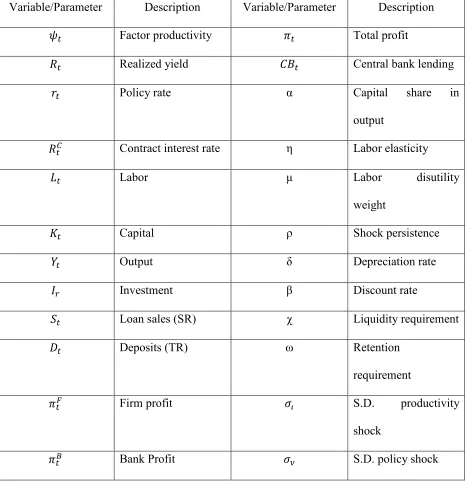
Table 4.3 Summary of Variables and Parameters ... 67
vi
Figure 2.1 MBS Issuance ... 13
Figure 2.2 MBS Outstanding ... 14
Figure 2.3 ABS Issuance Excluding MBS ... 16
Figure 2.4 ABS Outstanding Excluding MBS ... 17
Figure 2.5 Securitized Portion of Total Lending in Selected Credit Markets ... 19
Figure 4.1 Model Timeline ... 59
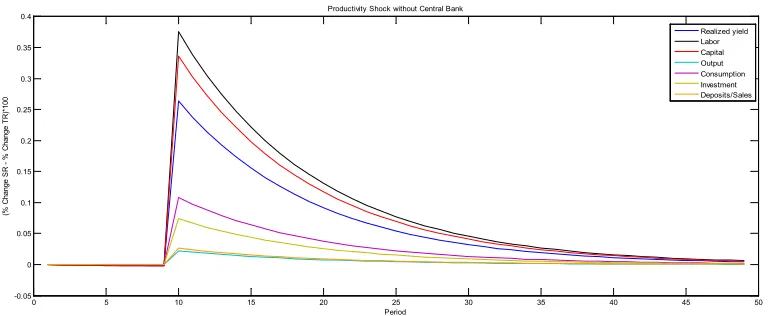
Figure 4.2 Productivity Shock to SR Regime, ineffective MP ... 73
Figure 4.3 Productivity Shock to TR Regime, ineffective MP ... 73
Figure 4.4 Model Comparison ... 73
Figure 4.5 Differences between Responses to Productivity Shocks, effective MP ... 75
Figure 4.6 Response of SR to Policy Shock ... 75
Figure 4.7 Response of TR to Policy Shock ... 76
1
CHAPTER 1: Introduction
Securitization is the transformation of non-security assets into securities. Usually the term denotes the transformation of a pool of loans into bonds. Loans are originated directly or purchased from third parties, pooled, and then tranched according to the deal structure and the ratings received on the issue. The bonds are then sold to third parties, and the loans collateralizing the bonds are removed from the issuer's balance sheet. This method of financial intermediation is, in its modern form, not more than 60 years old, which means that it is an exceedingly recent development in credit markets dominated by fractional reserve systems since the Italian Renaissance beginning six centuries ago. Furthermore, securitization did not become a nonnegligible portion of any credit market in the U.S. or Europe other than for mortgages until the 1990s. Research from that decade is therefore focused on understanding the contours of this new system that was and probably still is in the process of supplanting traditional fractional reserve lending systems, under which loans are funded by deposits.
2 underwriting and deal structuring heuristics? How is collateral seizure best accomplished subsequent to default, and to whom and how are those rights recorded and changed?
By 2007 and 2008, it was almost unanimously agreed that extreme volatility in credit markets was traceable to ABS, most specifically MBS backed by subprime mortgages, where “subprime” indicates the credit quality of the mortgagors. Moreover, many construed the unfolding crisis as “systemic” rather than indicating a large shock to credit markets or a temporary and infrequent interruption to an otherwise sound system of financial intermediation. Two themes are common from this period and the literature immediately after it: (1) Moral hazard and adverse selection play important roles in ABS issuance and account for its lack of stability. (2) ABS issuers are able to lever loan issuance to a greater extent than traditional banks, creating more exposure to risk and also leading to “leverage cycles,” whereby the necessity of delevering in bad times makes bad times even worse and vice versa. These themes together indicate what could fairly be called the conventional wisdom on securitization, especially among policymakers and researchers. ABS issuance is subject to asymmetric information problems and inadequate regulation, and it is for these reasons that the process contributed to, exacerbated, or even caused the financial crisis of 2007 and 2008.
3 ABS markets, then develops a theoretical account of three commonly proposed revisions to rules governing securitization practices in order to address these perceived problems. The possible informational benefits of public ABS exchanges are also examined. Stable ABS markets require aligning the incentives of loan originators and ultimate lenders that adjustments to the structural implementation of securitization may accomplish.
4 always accounted for by market participants whether or not a crisis is unfolding. This feature of the model allows an analysis of the changed nature of monetary policy transmission as credit markets become more saturated with ABS.
There is also no leverage or information asymmetries in the model presented -- both traditional banks and ABS issuers are equity-less and exist in a moneyless economy. Both bank types are fully owned and controlled by households. So increased volatility is not the result of increased leverage or information asymmetry under securitization regimes but rather solely due to the distinct effects of regulations on the two types of banks' profit-maximizing decisions. The analysis does not rule out leverage cycles or other accounts of volatility in securitization markets, but it does show that an explanation of high volatility in ABS markets does not necessarily have to rely on leverage cycles. This point is important because it indicates that forcing ABS issuers and traditional banks to adhere to the same maximum leverage requirements may not eliminate the observed relatively high volatility of ABS markets.
6
CHAPTER 2: The Theory and History of Securitization
2.1 -- Introduction
Securitization refers to the creation of bonds from homogenous pools of loans. Loans are originated and/or purchased and pooled, then bonds backed by the cash flows from the loan payments are sold to investors. These bonds are generally referred to as “asset-backed securities” (ABS).1 In this chapter, “securitization" is defined as (i) pooling loans and (ii) issuing bonds backed by those loans. Recent regulatory changes require ABS issuers to retain at least 5% of the credit risk in ABS they issue, but prior to 2014, issuers were allowed to sell 100% of loan pools and retain no credit risk on sold bonds.2
The use of securitization to fund loans marks a significant shift in banking methods in use since the 15th century. From the Italian Renaissance until the mid-1990s, banks funded loans with deposits and generally held loans on balance sheet until maturity. From the mid-1990s until the Great Recession, U.S. and European credit markets funded increasing shares of mortgages, credit card loans, car loans, and student loans with ABS issuance. The shift is a change not only in the source of credit but in the incentives facing loan originators, who no longer depend on the absence of loan defaults for profit. Proponents of securitization point to perceived reductions of risk to investors (and consequent lower interest rates facing borrowers), tax and regulatory advantages to issuers, increased liquidity, and the ability it grants to government to channel credit to politically favored groups. Detractors point to asymmetric information problems inherent in securitization, the perceived role of ABS in the Great Recession of 2007-09, and increased costs of resolving
1 Frank J. Fabozzi's edited volumes provide overviews of various forms of asset-backed securities. See Bhattacharya and Fabozzi (1996), Fabozzi (2002, 2006), Fabozzi and Mann (2012), Fabozzi and Jacob (1998), and Fabozzi and Kothari (2008).
7 defaults due to the opaqueness of ABS markets. These issues, among others, will be discussed in more detail below.
Modern methods of securitization were fully developed about 30 years ago, but many of the “most basic and pressing questions" about securitization remain unanswered (Gorton and Metrick 2013, 58). Perhaps chief among them is the question of why securitization exists. An answer would provide an historical account of securitization's emergence as well as an explanation of the institution's persistence in terms of the positive net benefits it provides market participants and policymakers. To that end, the next section traces the development of securitization and securitization-like institutions in the U.S. and shows that modern securitization is the result of government policies intended to favor certain groups of debtors and the rational responses of market participants to those policies. The subsequent section evaluates the theoretical tradeoffs in securitization for market participants.
2.2 -- History
Most historical descriptions of securitization (e.g., Hu 2011) begin in 1968, when the Government National Mortgage Association (Ginnie Mae or GNMA) first guaranteed a pool of residential mortgages,3 but attempts to create bonds out of collections of mortgages date back at least to the late 19th century in the U.S. and Europe. Snowden (2010) documents the use of covered mortgage bonds (which differ from today's mortgage-backed securities (MBS) in that collateral was held by the seller rather than transferred to investors) for over two centuries in Europe, as well as attempts to copy such institutions in the U.S. as early as the 1880s for farm mortgages. These early European structures were not true securitizations because the bonds were still backed by the credit of the issuing institution. These institutions are best described as public-private partnerships
8 channeling credit to underserved groups of borrowers, namely those without access to urban credit markets.
Similarly, early securitization-like schemes in the U.S. were attempts to bridge geographic distance between Midwestern farms and eastern centers of finance. The Federal Farm Loan Act of 1916 created a semi-private system of joint-stock mortgage banks that had to satisfy federal regulatory requirements but were not formally backed by the credit of the federal government. The resulting Federal Land Banks, modeled on the German Landesbanken, imposed interest rate ceilings on farm mortgages and issued farm mortgage-backed bonds.4 This system accounts for the first securitizations in the U.S. under the definition used in this work in that some mortgage-backed bonds issued were removed from lender balance sheets and became the complete liability of the borrower. The Wilson Administration, like the later FDR Administration for residential mortgages, wanted to allow borrowers (voters) access to the capital available to large corporations in securities markets. Farm mortgage securitization continued in the 1920s but failed to provide stable credit to the underserved agricultural sector, displaying many of the apparent weaknesses of modern securitization, including steadily weakening underwriting standards and frequent defaults. When the Great Depression arrived, the federal government began assuming these failing banks' liabilities (Goetzmann and Newman 2010). These developments led to a federal ban on private securitization in the Securities Act of 1934. Like other bonds, MBS must be registered with the SEC prior to public sale.
The key conclusions of historical studies of securitization schemes are that (i) the history of securitization begins well before 1968, contrary to most accounts and (ii) the informational problems associated with securitization have always been present and misunderstood. Snowden
9 (1995, 294), after a painstaking review of securitization's prehistory concludes, “[e]very [securitization-like] structure...that appeared before 1930 failed...There is always some limit to the amount of default risk that can be absorbed in a privately financed securitization structure...[before] the severe informational problems that are inherent in mortgage securitization appear in full force."
The present form of securitization began to emerge because of the creation of the Federal National Mortgage Association (FNMA or Fannie Mae) in 1938 and the formalization of the use of credit rating agencies in secondary bond markets in 1934. These institutions proved critical to the development of a new market in residential mortgage-backed securities (RMBS). Securitization of other assets (credit card receivables, car loans, student loans, etc.) arose decades after mortgage securitization and does not currently display the high market share held by RMBS.5 Fannie Mae was created to help current and future homeowners afford mortgages despite the dire economic conditions of the 1930s. FNMA sponsored mortgages directly over the following three decades, but in 1968, Congress split FNMA into two private (the modern-day Fannie-Mae) and the Federal Home Loan Mortgage Corporation (FHLMC or Freddie-Mac) and one public (GNMA) entities, all tasked with increasing liquidity in mortgage markets. GNMA began guaranteeing qualifying mortgages with the full faith and credit of the U.S. Government. FNMA and FHLMC are government-sponsored enterprises (GSEs), chartered by Congress but owned by shareholders,
10 but enjoy the implicit backing of the federal government. Beyond the credit enhancement derived from government guarantees, packaging the securities into pools and issuing securities backed by the pools would also make the mortgages more salable, especially to institutional investors such as pension funds and insurance companies interested in maintaining diversified portfolios. Over the next decade and a half, nearly all mortgage-backed security issuance was done under implicit (from Fannie Mae or Freddie Mac) or explicit (from Ginnie Mae) government guarantees.
The first private mortgage securitization was completed by Bank of America and Salomon Brothers in 1977. Lewis S. Ranieri, an infamous executive at Salomon Brothers at this time (who also coined the word “securitization" and is a major subject of Michael Lewis's 1989 bestseller Liar's Poker), was instrumental in this deal. In a speech 17 years later (and after leaving Salomon Brothers), Ranieri (1996, 33) recalled, “Unfortunately, the victory of creating the [private] first pass-through7 mortgage-backed security was followed by a total failure of the issue." The failure was due to a counterproductive legal environment in which the regulatory and tax statuses of the bonds were not clear. Many potential investors were precluded from buying the securitized mortgages by state-level regulations derived from prior experience with widespread failures of securitized farm mortgages in the Great Depression, despite the attractive yields on government-guaranteed debt. In order for financial intermediaries to take advantage of the government's support of residential mortgages, some adjustments to the legal code were required.
Private mortgage securitization began in earnest after the Tax Reform Act of 1986 (hereafter, the Act). Prior to the Act, an institution invested in MBS was required to pay taxes on
6 Although FNMA and FHLMC are technically GSEs, both have been under the conservatorship of the Federal Home Finance Agency since 2008.
11 the income derived from those securities, and savers (institutional clients, e.g. pensioners and annuity holders) were required to pay taxes on income from institutional intermediaries. In other words, income from MBS was double-taxed before ultimate investors (savers) could spend it. In the same manner, direct mortgages (those made by lender institutions and held on their balance sheets) became subject to double taxation if interest income is not retained by the company but instead distributed to shareholders. The Act created the Real Estate Mortgage Investment Conduit (REMIC), a pass-thru entity restricted to holding mortgages, and exempted it from federal taxation, allowing mortgage originators to securitize mortgages by creating a REMIC to hold a loan pool and issuing regular (debt) interests (i.e., bonds) backed by the pool to investors, usually through large financial intermediaries. Although it was technically possible to securitize loans without incurring double taxation before the Act, ambiguities in tax and corporate law prior to the Act effectively precluded investment in securitized products (Alexander, Ferst, and McCauley 1997, Gorton and Metrick 2012). Ranieri was instrumental in the creation of the Act and other key legislation. In the same 1995 speech, he stated:
In 1981, I realized that we needed to bring to final resolution the two sets of long-term problems that were stunting the mortgage market: the tax problem and the legal investment problem that the agencies had not resolved completely.8 I needed to take the legislative route and convince Congress to adopt legislation permitting the capital markets to meet the nation's housing needs more efficiently and effectively. I enlisted some help, Shannon Fairbanks from the White House and Bernie Carl, a respected Washington lawyer. We developed two pieces of proposed legislation: the Secondary Mortgage Market Enhancement Act of 1984 (SMMEA),
12 a doing-business bill that would preempt state laws for rated mortgage securities
and make them a legal investment for almost all investors; and a new section of the Tax Code, Trust for Investments in Mortgages (TIMS). We spent two and one-half years lobbying for these sister bills. Finally, SMMEA was passed by Congress. Our Act is cited in the “Investment Section" of every mortgage securities issue as the source of the state law preemption.
Unlike SMMEA, our tax bill was not passed by Congress. It was defeated primarily by Andy Furer, an analyst at Treasury, who opposed the bill because he could not determine our intentions. Given that I do not easily accept defeat, my reaction to the Treasury's opposition was to hire Andy Furer. With the assistance of this brilliant tax analyst, we rewrote the previous bill to meet his objections. The bill was finally passed after two more years of lobbying as part of the Tax Reform Act of 1986. Our legislation created a new tax vehicle called Real Estate Mortgage Investment Conduits, commonly called REMICs.
SMMEA solved our investment problems, and the creation of REMICs gave us our own private provision in the tax code...We won total flexibility.
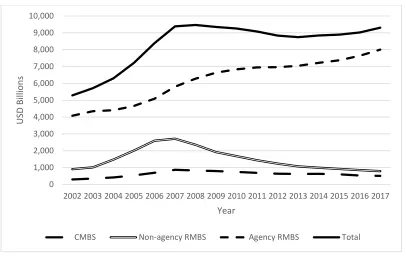
13 Figures 1.1 and 1.2 show nominal MBS issuance over 1996-2017 and MBS outstanding for the period 2002-2017, respectively. Private commercial mortgage-backed security (CMBS) issuance began in 1994 after being spearheaded by the Resolution Trust Corporation in the early 1990s, and RMBS grew with mortgage debt and the support of the “agencies” GNMA, FNMA, and FHLMC. Thus both CMBS and RMBS issuance steadily increased until the onset of the Great Recession. Thereafter, private MBS issuance fell precipitously and has yet to recover. Private CMBS issuance peaked in 2007 at $240.5 billion, fell to $17.3 billion in 2008, and was
Figure 2.1: MBS Issuance. Source for Figures 2.1 and 2.2: Securities Industry and Financial Markets Association, U.S. Mortgage-Related Issuance and Outstanding
0.0 500.0 1,000.0 1,500.0 2,000.0 2,500.0 3,000.0 3,500.0 4,000.0
U
SD B
ill
io
ns
Year
14 Figure 2.2: MBS Outstanding
only $97.7 billion in 2017. Non-agency RMBS issuance peaked in 2006 ($1.3 trillion), fell to $52.7 billion in 2008, and totaled $126.3 billion in 2017. These declines in issuance were sufficient to decrease the outstanding amounts of RMBS and CMBS over 2008-2013 and 2007- 2017, respectively. RMBS outstanding has increased since 2013 primarily due to agency issuance, as clearly shown by overlap of total and agency RMBS issuance since 2008 in Figure 2.1, though non-agency issuance increased year-over-year in 2017, and issuance through October 2018 has already exceeded that total by $38 billion.
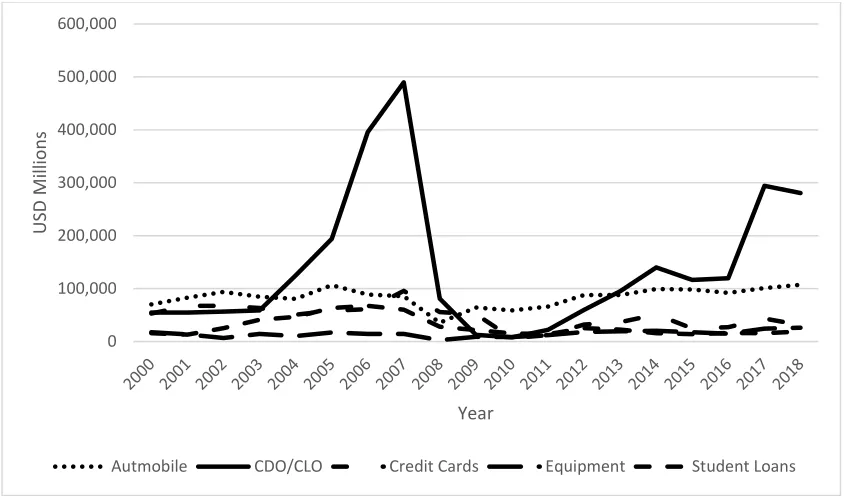
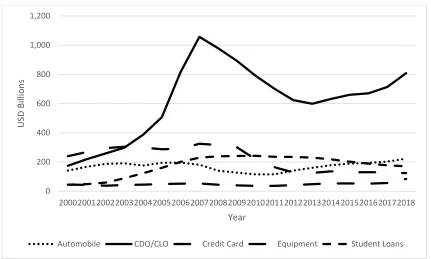
Figures 2.3 and 2.4 show non-mortgage-related ABS issuance and outstanding nominal amounts, respectively, for various asset classes since 2000. Collateralized debt obligations (CDOs) and collateralized loan obligations (CLOs) are ABS that can include non-mortgage loans in addition to mortgages.9 CDOs may include existing ABS.10
9 Depending on the content of the asset pool backing a CDO, CDOs are ABS in some cases and derivatives in others.
10 The pooling and sale of existing ABS is called “re-securitization.”
0 1,000 2,000 3,000 4,000 5,000 6,000 7,000 8,000 9,000 10,000
2002 2003 2004 2005 2006 2007 2008 2009 2010 2011 2012 2013 2014 2015 2016 2017
U
SD B
ill
io
ns
Year
16 Figure 2.3: ABS Issuance Excluding MBS. Source: Securities Industry and Financial Markets Association, U.S. Asset-Backed Securities Issuance and Outstanding
Securitization saturation for major credit markets other than residential mortgages peaked in 2006 (automobile loans) or 2007 (commercial mortgages and student loans) and declined thereafter. Securitization of credit card receivables peaked in 2002.11 None of the markets other than residential mortgages currently display saturation ratios above 20%. RMBS outstanding comprises 72.7% of total residential mortgage debt in the U.S. These data strongly suggest that securitized credit markets are faltering in the absence of some sort of public support for securitization, in this case in the form of GSE-backed issues of RMBS. CMBS, for instance, enjoys all the tax and regulatory advantages (further discussed below) enjoyed by RMBS, but GSEs do not purchase, originate, guarantee, or issue MBS backed by commercial mortgages. Notably,
11 Securitization saturation in revolving consumer credit markets declined sharply in 2009 in the midst of significant deleveraging by consumers. The decline in total credit card debt exceeding the decline in credit card receivables outstanding, suggesting loans that were not securitized were more likely to be paid than those securitized during that period.
0 100,000 200,000 300,000 400,000 500,000 600,000
U
SD M
ill
io
ns
Year
17 agency RMBS are exempt from the 5% retention requirement, another factor that may be supporting RMBS issuance.
The history of securitization indicates that securitization did not arise independently of political motives and that the development of the private market in the U.S. did not occur until after the federal government created a variety of special provisions to make the practice attractive to potential market participants. This experience in the U.S. and Europe does not inspire confidence in the wisdom of using bond issuance to fund loans to individuals and small firms. Attempts to create secondary markets for farm and residential mortgages all failed prior to the creation of Fannie Mae in 1938. GSEs comprised 100% of the U.S. secondary mortgage market until the 1970s. A rapid expansion of private issuance in the 1990s and 2000s ended in
Figure 2.4: ABS Outstanding Excluding MBS. Sources: Securities Industry and
Financial Markets Association, U.S. Mortgage-Related Issuance and Outstanding; Board
of Governors of the Federal Reserve System releases: “G.19 Consumer Credit” and
“Mortgage Debt Outstanding”
0 200 400 600 800 1,000 1,200
2000200120022003200420052006200720082009201020112012201320142015201620172018
U
SD B
ill
io
ns
Year
18 the Great Recession and the collapse of securitization for all but residential mortgages. Thus, to date, there is no evidence of a private ABS market able to withstand credit market fluctuations, leaving aside for now the question of whether those fluctuations are due to endogenous or exogenous causes. So the question arises of why anybody would create and participate in ABS markets. The following section identifies the perceived net benefits of securitization to market participants in order to explain the existence and (perhaps unimpressive) persistence of securitization.
Figure 2.5: Securitized Portion of Total Lending in Selected Credit Markets
Sources: Securities Industry and Financial Markets Association, U.S. Mortgage-Related Issuance and
Outstanding; Board of Governors of the Federal Reserve System releases: “G.19 Consumer Credit” and
“Mortgage Debt Outstanding” 0%
10% 20% 30% 40% 50% 60% 70% 80% 90%
2002 2003 2004 2005 2006 2007 2008 2009 2010 2011 2012 2013 2014 2015 2016 2017 2018
Sat
ur
at
ion
Year
Automobile Credit Card Student Loans
19
2.3 -- Theory
Why would a bank choose to securitize its loans rather than hold them on its balance sheet? Why would an investor purchase ABS rather than whole loans or bank stock? Ultimately, an economic explanation of securitization must show how the benefits of this form of financial intermediation outweigh the costs for market participants. The history reviewed in the previous section leaves open the question of whether securitization would exist or persist without government intervention, and many of the benefits of securitization discussed below are created by taxes and regulatory structures. There are costs and benefits of securitization however implemented as well as costs and benefits associated with any particular structural implementation.
What are the benefits and costs of securitization for market participants? Borrowers get lower interest rates and better terms via access to bond markets, though they may lose important features of traditional loans like the ability to negotiate with lenders while in delinquency. Policymakers get credit for lowering the cost of credit to large blocks of voters. Investors get the opportunity to invest in a diverse pool of loans in liquid asset form. Issuers of ABS get fees, commissions, and the spread between their short-term cost of credit and the yield on assets held in their securitization pipeline. They also no longer have to raise deposits to fund loans but can use bridge loans and the proceeds from previous sales to fund originations. Finally, securitization also allows financial intermediaries to engage in tax and regulatory arbitrage.
20
2.3.1 -- Risk
Perhaps the most universally cited advantage of securitization is that it diminishes risk borne by investors through increasing diversification.12 Risk is the chance of loss, and diversification lowers the volatility of a portfolio’s return (as long as the pooled assets do not co-vary perfectly), not the likelihood of negative returns. The mere pooling of loans does nothing to affect the chance of loss to lenders in the aggregate due to the “adding up” constraint. Unless the act of pooling introduces some new factor of correlation between the loans that did not exist prior to pooling, or the selection mechanism for choosing loans for the pool causes the individual loan performances to co-vary, the benefits of investing in ABS are identical to the well-known benefits of investment diversification. The overall risk associated with the asset pool is not changed by securitization, but the risk faced by individual investors is lowered relative to investing in whole loans.
So it is generally uncontroversial to argue that securitization limits risk to investors who otherwise would not have been able to invest in a large pool of similar assets while the performance of each asset is at least partially independent of the performance of other loans in the pool. This logic supported all of the securitization schemes discussed above. There are three reasonable positions on this issue of independence. First, one may make the assumption that all loans are independent and remain so when pooled. Second, one may assume that loans are not independent and that pooling the loans does not affect this covariance. Third, one may assume that loans are independent but that the act of pooling introduces common factors to the pooled loans that cause
21 them to co-vary in some systematic and significant way.13 (The position that they co-vary until pooled is ruled out as unreasonable.) If one adopts either of the first two positions, it is clear that securitization will lower risk evaluations of individual investors. The third position, however, would lead investors to higher risk estimates and offset some of the risk-reduction-through-diversification effects that make securitized assets seem so attractive to investors.
The ability to subordinate payments to certain classes of bondholders is also widely viewed as a distinct advantage of securitization with regard to risk. Specifically, “payment waterfalls" that specify that senior bondholders are paid in full prior to junior bondholders receiving any remuneration shield investment-grade bondholders from losses they would have incurred under a system that allocates delinquencies on a pro rata basis. ABS are divided into different tranches and arranged in a payment queue. Payments received from borrowers are distributed to the (most senior) tranche highest in the payment waterfall, then to the next most senior tranche, until all loan payments have been distributed. Any payment shortfalls thus accrue to the junior tranches at the end of the queue. Subordination shifts but does not reduce risk facing investors in the pool. Investors in lower tranches accept more risk in return for yield, while senior bondholders make the opposite exchange. Recall that loan pools are homogenous mixtures of loans, so the loans backing the different tranches of a given ABS issue are the same. The disparate ratings and yields assigned to the tranches reflect the investor’s place in the payment waterfall, not underlying credit quality. Assuming diverse risk preferences, the ability to separate expected losses in this manner could improve investor welfare. Securitization also shifts risk from originator to investor as well as among investors in a single ABS issue, which is also welfare-improving to the extent that
22 originators and lenders do not coincide. There are numerous other arrangements, conventions, and practices in securitization markets that are viewed as credit enhancing, like letters of credit behind specified bond tranches and escrow provisions in large loans in the pool. REMIC provisions, though strict in requiring only mortgage assets in the pool, are highly flexible (as Ranieri brags above). Issuers can effectively create new credit enhancements as needed to market bond issues. These are all similar to credit enhancements used by balance sheet lenders.
The analysis thus far has focused on default risk, but other categories of risk are thought to be affected by securitization, like prepayment and counterparty risk. Prepayment risk poses a significant issue for RMBS investors. Large institutional investors hold the bulk of outstanding ABS according to Federal Reserve Flow of Funds data. Insurance companies and pension funds are not only concerned with absolute returns but the specific intertemporal character of their investment returns. A loan that pre-pays denies the lender interest income over the period from payoff to originally scheduled maturity and causes an unexpected mismatch between assets and liabilities, like annuity and pension payments, to these investors. It is not surprising, therefore, that prepayment provisions are commonly included in mortgage contracts intended to be securitized. A collateralized mortgage obligation, or CMO, addresses prepayment risk by tranching issues according to prepayment, rather than payment, priority.
23
2.3.2 – Public Policy
Because of the perceived effect of securitization on risk, an investor would not purchase a whole mortgage while the same investor would deploy that amount of monetary capital to invest in a diversified pool of mortgages. Securitization can therefore be used as a method to intermediate loans across geographic distance and other dimensions of saver/investor heterogeneity.14 Securitization is also viewed as a way to increase total lending, especially to borrowers in economically disadvantaged or politically favored (i.e. homeowners and farmers) groups. Other types of government support for favored groups of debtors may account for increased lending, but the development and support of securitization by GSEs has at least coincided with a boom in mortgage lending.15
A proper empirical account of the strength of these effects is difficult to complete. RMBS must be excluded from the analysis because of the government support for that market. Even in the CMBS market, the empirical effect of introducing securitization is not clear. Brian and William (2002), for instance, find evidence that commercial mortgage spreads (over Treasury yields) declined over the first years of CMBS issuance (as CMBS market share was steadily increasing) but spiked during the Russian debt crisis (1998), and the commercial mortgage market nearly tripled in size from 1990 to 2010.16 Over the same period, nominal GDP increased approximately two-and-one-half times. An et al. (2009) measure gains from securitization on the order of an 11-20 basis point lower yield on commercial mortgage backed securities versus commercial mortgages held on banks' balance sheets. This suggests that securitization increases issuance and
14 Berrospide, Black, and Keeton (2013) found that residential mortgages were more dispersed after the introduction of widespread securitization and that the practice likely mitigated spillovers from markets more to markets less affected by the financial crisis.
15 Naranjo and Toevs (2002) attribute decreased credit spreads and volatility in residential mortgage markets to GSE participation.
24 lowers yields but is not conclusive. To date there is no empirical investigation of the effects of securitization on mortgage interest rates that controls for government intervention, known shocks to credit markets in history, and the tax and regulatory advantages of ABS in the United States.
2.3.3 -- Institutions
There are also tax, regulatory, and legal benefits to securitization. Current securitization practices allow a wide range of possibilities to change equity investments into debt investments for tax purposes. Additionally, most extant special purpose vehicles, commonly used to hold ABS, are explicitly exempt from federal taxation and provide legal certainty with regard to tax liability. In effect, securitization provides a way for investors to avoid all but personal income taxes (and capital gains and losses if they don't hold the ABS until maturity) on their investments.
Some other legal conventions are also unambiguously favorable to securitization. Sold ABS are not considered legally or financially connected to the issuer in any way after an arms-length sale. Various state and federal laws ensure the “bankruptcy remoteness" of the securitized asset from its original issuer. This fact is crucial to ABS investors. If one purchases a bond which subsequently performs as expected, yet the issuer files bankruptcy, an investor clearly has an interest in keeping his or her bonds out of the bankruptcy proceedings. Current laws and regulations shield investors from “clawback," whereby the creditors of the bankrupt issuer convince the court that previously sold securities should be taken from buyers in order to pay creditors. If clawback is prohibited by law, then ABS investors are not subject to any counterparty risk arising from the financial situation of the issuer.
25 generally call for lower leverage on the back of progressively lower quality assets held on a balance sheet. Securitization provides a tool to shift risk with regard to certain held asset classes, allowing more flexibility underneath given regulatory requirements (Acharya, Schnabl, and Suarez 2013). Holding credit-enhanced ABS can allow a financial institution to hold a fraction of the equity on hand that would be required to hold the underlying assets themselves. For example, under the Basel III Accord,17 the risk weight18 applied to commercial mortgages is 100% while the weight applied to investment grade commercial mortgage-backed securities (CMBS) is 20 to 50%. In a typical CMBS transaction, 70-90% of the loan pool is rated investment grade. Though specific transactions will differ, a bank can expect to avoid about 25% of the regulatory capital requirement for commercial mortgages by transforming the loans into CMBS (author's calculation from CMBS averages in An and Deng (2007)). Moreover, re-securitization (pooling existing ABS as collateral for new issues of ABS) allows the process described above to be repeated. Re-securitization allows issuers to create investment-grade tranches of CDOs out of junk-rated tranches of existing MBS by creating a new payment waterfall with senior tranches at the head of the new payment queue. Securitization gives market participants the ability to structure their assets in order to minimize capital requirements, and regulatory arbitrage is thought by some researchers to be the driving force of ABS issuance in practice.19
Securitization may increase the cost of seizing collateral if, as it is often accused of doing, it creates an opaque chain of title (Oppenheim and Trask-Kahn 2012, Levintin 2013, Kruger 2018).
17 In this context the latest rules refer to Basel II (http://www.bis.org/publ/bcbs128.pdf, pp. 126-127 and p. 24). 18 When determining how much Tier-1 capital they are required to hold under the Basel Accords (“regulatory capital"), banks sum exposures to various asset classes based on risk ratings, or weights, set by the regulations. A higher risk weight denotes higher perceived riskiness of an asset (and requires higher equity reserves). Residential mortgages, typically backstopped by sovereigns in various forms, have a risk weight of 35%.
26 Even if the ownership of the first-loss piece can be determined, coordination problems are likely to arise if the foreclosure right is shared among multiple investors.21 The ability of bond holders to determine whether they have a right of foreclosure has been further undermined by re-securitization as well as the practice of using ABS to collateralize repurchase agreements (repos), which should transfer ownership of the ABS and associated rights to the lender for the duration of the repo.
2.3.4 – Incentives and Information
Securitization also spares loan originators and securitizers credit risk relative to balance-sheet lenders. Passing the credit risk directly onto investors may incentivize banks to take advantage of information asymmetries and promote more risk-taking and over-lending. The market structure, moreover, increases the informational distance between savers and borrowers, intensifying any underlying asymmetric information problems and allowing increased opportunity for fraud.22 The presence of institutionalized moral hazard23 in securitization markets is widely accepted by academics24 and practitioners alike.25 Because they pay the costs of collateral and loan due diligence prior to marketing the securities, ABS book-runners (financial intermediaries) can manipulate third party due diligence providers, such as appraisers and rating agencies, to report information such that issuer profit is maximized and risks facing investors are possibly
20 A first-loss piece is the lowest-tranche portion of an ABS issue that is “in the money" (can expect at least partial payment given current defaults). It usually carries the right of foreclosure.
21 See Piskorski, Seru, and Vig (2010) and the citations in their footnote 7.
22 Nadauld and Sherlund (2013), Berndt and Gupta (2009), Keys et al. (2010), and Agarwal, Chang, and Yavas (2012) find some evidence of adverse selection and a decreased incentive to screen in prime mortgage markets. See also Maddaloni and Peydro (2011) and Ivashina (2009).
23 Some construe “moral hazard" as applicable to actions taken after a contract is executed and use “adverse selection" to refer to actions prior to contract formation. As used in this chapter, “moral hazard" arises whenever a decision-maker does not face the full costs of his or her decisions, regardless of whether these actions occur before or after a sale of securities. Or one may simply view the relevant contract in some contexts as the origination of the loan rather than the sale of the bond. In other words, there are two relevant contracts.
27 misleadingly conveyed. Appraisers, environmental and engineering inspectors, and zoning attorneys depend on satisfying intermediaries, not investors, to earn profit. Credit rating agencies (CRAs) are particularly susceptible to manipulation because they rate asset pools prospectively and (because of Securities and Exchange Commission regulations regarding the public marketing of ABS)26 depend on giving one of the most favorable ratings in order to earn fees.27 Book-runners typically “shop" asset pools to at least three CRAs in order to receive the most favorable, rather than the most accurate, credit ratings. Employees at both types of institutions (financial intermediaries and CRAs), including those specifically tasked with ascertaining and controlling risk, are commonly paid on deal volume (Acharya and Naqvi 2012). Furthermore, the interaction of regulations and the issuer-pay model likely leads to inflated credit ratings. There is strong evidence that ratings-based regulations have led to large increases in the volume of highly-rated securities (Opp, Opp, and Harris 2013). Issuers may also expect government bailouts in the event of failure.28
Fund managers at pension funds, insurance companies, and other institutional buyers of ABS are commonly paid on the basis of a risk-adjusted return. They are given targets for the amount of funds to be allocated, the return to be earned on allocated funds, and the risk profile of investments undertaken. The risk is typically measured and defined in regulations in terms of ratings. The fund managers are incentivized to accept over-rated securities to the detriment of the savers they ultimately represent. Regulators are subject to capture by regulatees because of
26 Ratings by a nationally recognized (by the Securities and Exchange Commission) statistical rating agency are required in order to obtain a “shelf registration” for the investment-grade portion of a pool. A shelf registration allows public marketing of the securities for three years. Over-the-counter transactions do not require ratings. 27 White (2010) provides an overview of the popular conception of the rating agenices’ role in the credit crisis, focusing on the problems associated with the issuer-pay model. See also Bar-Isaac and Shapiro (2013), He, Qian, and Strahan (2011), Jiang, Stanford, and Xie (2012), Becker and Milbourne (2011), Cohen and Manuszak (2013), Doherty, Kartasheva, and Phillips (2012), and Bolton, Freixas, and Shapiro (2012).
28 discordant payment and talent levels across the institutions. Borrowers, especially those taking non-recourse loans, are incentivized to overstate metrics that feed into collateral value.30 The question of the effect of securitization on underwriting standards is relatively well studied and is further discussed below.
Securitization arguably increases the efficiency of matching savers and borrowers by bringing small loans into public capital markets and because of the flexibility it allows to assign cash flows to different portions of the issue. This is especially true when securitization is completed under the REMIC provisions of the Act. Issuers can offer investors a range of yields, maturities, prepayment provisions, and other bond metrics from the same pool. Through interest rate swaps, issuers may even sell fixed-rate bonds backed by floating rate mortgages and vice versa.
If efficiency is construed in terms of accurate informational transfer between lenders and borrowers, securitization has possibly led to decreases in efficiency.31 The most common suggestion for curtailing asymmetric information in securitization markets prior to 2010 was to force book-runners to retain a portion of the asset pool in some form or another and thus subject themselves to risks arising from inappropriate underwriting. Provisions requiring issuers to retain at least 5% of the risk associated with securitized loan pools (subject to numerous lobbyist-authored caveats) were signed into law as part of the Dodd Frank Wall Street Reform and Consumer Protection Act of 2010 (Title IX, Section D). Forcing issuers to absorb 5% of a pool will mitigate asymmetric information, but issuers will still not face the full consequences of
29 This particular problem could be mitigated by paying individual regulators a portion of fines they are able to impose on market participants.
30 Interestingly, Allen and Gale (2000) argue that investor-borrowers misleading bank-lenders about collateral values can lead to bubbles.
29 originating loans that subsequently default under this system. Except for agency MBS, issuers are no longer able to completely remove loan pools from their balance sheet. This regulation reflects a widespread belief that pure securitization schemes whereby issuers relieve themselves of all credit risk after issue result in excessive risk-taking.
There are other proposals to limit asymmetric information problems in ABS markets. Hartman-Glaser, Piskorski, and Tchistyi (2012) propose a system of remuneration to ABS issuers that uses the fact that most ABS that default do so within two years of issuance. Thus ABS issuers, they recommend, should be compensated on a two-year delay.32 Berndt and Gupta (2009) call for the creation of a public ABS exchange that would strengthen transaction tracking and the accuracy and intensity of reputation effects. Cohen et al. (2017) propose the use of blockchain technology to administer and track ABS transactions. Although an exchange or blockchain will help decrease the legal costs of collateral seizure and publicly expose issuers with below-average performance histories, the moral hazard facing ABS issuers will remain. Ultimately, any securitization structure must feature some moral hazard facing issuers, but this fact does not exclude the possibility of mature and relatively stable securitized credit markets.33
There is no strong evidence for the presence of widespread fraud in ABS markets, though casual observation of recent events has led many commentators to decry the high levels of perceived fraud among various market participants, including but not limited to mortgage underwriters and rating agencies.34 The implicit presumption is securitization provides opportunities for fraud beyond those available to traditional lenders. Since securitization removes
32 This policy might suffer from the ease with which ABS issuers can use special loan provisions, like prefunded escrows for loan servicing, to ensure that loans default after ABS issuers are paid.
33 Perhaps self-governing associations of market participants, discussed in Chapter 3, would work. For examples of associations of market participants overcoming substantial difficulties in rule enforcement, see Benson (1989), Leeson (2007), and Skarbek (2010).
30 the pooled assets from the issuer's balance sheet, it relieves the issuer of credit risk and the buyer of counterparty risk. It is therefore plausible that the nature of securitization itself incentivizes fraud more than traditional banking practices. It is not clear, however, with the possible exception of residential mortgage-backed securities (RMBS), that outright fraud is or was widespread or critical to observed market outcomes.
2.3.5 – Macroeconomic Risk
ABS markets have frequently been blamed for causing and/or exacerbating the recent credit crisis. Taking as given that fluctuations in credit markets affect the real economy,35 there are strong reasons to believe that this blame is well deserved. Many economists blame a decline in housing prices for the crisis and argue that securitization exacerbated fluctuations in mortgage markets in various ways.36 Others propose that the asymmetric information inherent in securitization accounts for a decline in underwriting standards that subsequently caused a spike in mortgage defaults.37 Another prominent strand of thought argues that securitization, by allowing banks to increase leverage, intensifies and creates “leverage cycles," previously studied in slightly different contexts.38 Those debates are addressed in subsequent chapters.
Some ABS collateral, like commercial mortgages, do not fully amortize at maturity, meaning that borrowers frequently require a new loan to pay off an existing one. If credit conditions are bad when the “balloon payment" (the unamortized principal balance at maturity) is
35 See Bordo and Haubrich (2010) for an outstanding historical account of the real effects of credit cycles. For an account of the real effects of credit market fluctuations over the past three major cycles in the U.S., see Jermann and Quadrini (2009). Schlarisk and Taylor (2009) provide the best historical narrative of credit expansions preceding large busts in modern economies.
36 See e.g. Feldstein (2007), Brunnermeier (2009), and Rosengren (2010).
37 See Nadauld and Sherlund (2013), Keys et al. (2010), Berndt and Gupta (2009), Benmelech, Dlugosz, and Ivashina (2012), Agarwal, Chang, and Yavas (2012), An, Deng, and Garbiel (2009), and Gertler, Kiyotaki, and Queralto (2012).
31 due, the ABS will typically default, potentially triggering a widespread credit crisis. Acharya, Gale, and Yorulmazer (2011) show how the rollover risk associated with non-amortizing ABS collateral can give rise to market freezes or “sudden stops." ABS issuers also commonly use “bridge loans," short term loans that provide a bridge from the time of origination to the time of sale, to finance originations of ABS collateral rather than relatively expensive equity or deposits. Gorton and Metrick (2012) trace the transmission of the crisis from subprime ABS to other ABS products linked to subprime products through short-term repos used by bookrunners for bridge financing, arguing that the reliance on short term debt to fund loans turned a subprime crisis into a wider credit crisis. Ivashina and Sharfstein (2010) provide empirical evidence that banks decreased lending during the crisis to a greater extent the more they relied on short-term financing, rather than deposits, to fund loans. Furthermore, the moral hazard arising from bailout expectations can lead profit maximizing banks to rely more heavily on short term debt than they otherwise would (Gertler, Kiyotaki, and Queralto 2012). Recent empirical research has presented evidence that lenders’ financial condition has less of an effect on credit supply after the advent of securitization (Loutskina and Strahan 2009, Uzun and Webb, 2007).
32 There is evidence that securitization has allowed banks to skirt regulations and capital requirements and that this feature was a major cause of the financial crisis. Acharya and Richardson (2011), Acharya, Schnabl, and Suarez (2013), Han, Park, and Pennacchi (2014), and Ambrose, Lacour-Little, and Sanders (2005) all argue that regulatory arbitrage, as opposed to risk transfer, is the primary driver of non-agency ABS issuance. These asset movements provided regulatory cover but did not, in fact, shift risk away from the financial sector, as regulators presumably intended (Acharya, Schnabl, and Suarez 2013). Ratings-based regulations have preceded large increases in the volume of highly-rated securities, which can incentivize investors to be uninformed and can subject credit markets to periodic collapse. Opp, Opp, and Harris (2013), Hanson and Sunderem (2013), and Anderson, Capozza, and Van Order (2011) present evidence that underwriting standards declined steadily and suggest that moral hazard facing issuers was not adequately priced. Ratings quality is countercyclical (Bar-Isaac and Shapiro 2013), but it is difficult to distinguish whether declining rating quality leads to cycles or whether cycles influence ratings quality. If there is a steady decline in ratings due to shopping over booms, subsequent default rates above expectations may be due to inflated ratings, an exogenous (to credit markets) shock, or both. Large issuers are granted more favorable ratings, possibly suggesting the importance of rating shopping (He, Qian, and Strahan 2011).
33 high-quality credit with securitization while funding low-quality credit with deposits, which are insured (Greenbaum and Thakor 1987).
2.4 -- Conclusion
The initial justification for securitization schemes in the U.S. has always been to channel credit to mortgagors. The existence and magnitude of net benefits of securitization are still debatable and ultimately depend on the regulatory structure of ABS. Issuers and originators are relieved of credit risk and the necessity of raising deposits to fund originations. They also benefit from the regulatory arbitrage opportunity afforded by ABS. Risk is transferred from originators to investors and allocated among investors. Policymakers are able to use securitization systems to subsidize credit to chosen groups of borrowers. These benefits are offset by higher legal administrative costs when underlying loans default, worsening informational asymmetries between originators and investors (the subject of Chapter 3), and a possible contribution of ABS to credit cycles (the subject of Chapter 4). From the perspective of investors, the gains from (i) avoiding counterparty risk, (ii) increasing diversification, and (iii) improving efficiency outweigh the costs in the form of (i) credit risk arising from moral hazard on the “originate-to-distribute" lending model and (ii) difficulty of ABS collateral seizure upon default.
Long-lasting securitization markets have never been observed absent intervention by government, usually in the form of credit guarantees. Even the most successful examples of private securitization markets in history were susceptible to collapse. Nearly 43% of RMBS was nonagency backed in 2005 and 2006. In 2013, well over 99% of RMBS was issued by government-sponsored or backed enterprises,39 which are exempt from the 5% retention requirement. This fact implies that ad hoc policy innovations have been necessary to sustain ABS markets. Policymakers
35
CHAPTER 3: Securitization and Asymmetric Information
3.1 - Introduction
Asset-backed securities (ABS) markets pose asymmetric information problems. Loan originators may adversely select loans for sale and may shirk screening and monitoring (due diligence) efforts on loans originated for sale. Though issuers may take reputational effects into account, the lack of a central exchange means ABS typically lack a clear market price and all of the information it entails, and collateral lacks a clear chain of title. Unless mechanisms are in place to fully transmit the costs of defaults to issuers, due diligence performed on loans originated to hold and those originated for sale will differ.
Each stage of the securitization process presents an asymmetric information problem. Borrowers can embellish credit and collateral quality in order to garner more favorable loan terms.40 Originators and issuers can overstate the quality of loans and pools for sale. Third-party due diligence providers, including ratings agencies, are paid by issuers (the so-called “issuer-pay” model), so they are also incentivized to optimistically appraise ABS credit quality. Fund managers at pension funds, insurance companies, and other institutional buyers of ABS are typically compensated on the basis of risk-adjusted expected returns, not realized returns, so they, like issuers, are shielded from the costs of future defaults (except in their capacity as taxpayers).41 Executives at large firms may expect bailouts in the event of failure. Credit market participants face these incentives in the absence of securitization, though. The asymmetric information problem introduced by securitization is the separation of the originator from the ultimate lender.
40 Borrowers may also prepay residential mortgages to the detriment of residential mortgage-backed securities. This particular information asymmetry is not clearly and closely related to originator’s due diligence effort and is hence beyond the scope of this chapter.
36 The asymmetric information problem created by securitization is the same as that created by any loan sale. The loan originator may increase profits by shirking due diligence or monitoring. Theoretically, if the ABS seller is able to shed any credit risk via securitization, the returns to screening and monitoring loans originated for sale will be lower than on loans originated to hold. Empirical analyses reviewed below compare the performance of securitized and retained loans and find a negative relationship between the originator’s choice to sell and credit quality, although some studies have found the reverse. Those researchers finding higher credit quality among sold loans account for their results by pointing to reputation effects and the regulatory arbitrage opportunity ABS provides issuers. Despite the mixed empirical evidence, the analysis in Sections 3.3 and 3.4 presume asymmetric information is present and important in securitization markets.
This chapter proceeds as follows. Section 3.2 reviews the empirical evidence for asymmetric information in ABS and syndicated loan markets and shows that the evidence is mixed but generally indicative of the presence of adverse selection and moral hazard. Section 3.3 summarizes various existing approaches with a simple model, concisely reproduces their results, and clarifies the conclusions drawn from existing research. The model allows us to explore the relationship between risk transfer through securitization and the choice of the optimal amount of due diligence to perform prior to origination. The unifying theory offered here illustrates the problems described in Section 3.2 and demonstrates the need for a public ABS exchange, analyzed in section 3.4. Section 3.5 concludes.
3.2 - Asymmetric Information in Securitization – Evidence
37 mortgage markets decreased as securitization became more prevalent. Agency RMBS must be backed solely by qualifying residential mortgages (QRMs), which require mortgagors to have a minimum FICO score of 620. Keys et al. (2010) exploited this QRM criterion and looked at the performance of residential mortgages with borrower credit scores just above and below the threshold. Those mortgages that barely qualify are much easier to securitize than those that narrowly miss the threshold, but the credit quality of the loans is essentially the same, so differences in performance should be indicative of differential screening on loans originators expect to securitize. Surprisingly, they found that loans originated just below the threshold significantly outperformed those that did qualify for agency support, strongly suggesting that originators apply less due diligence effort to loans they expect to sell. Bubb and Kaufman (2014) point out that this approach cannot distinguish between the effect on originators of the expectation of securitization from the effect of the expectation of agency support. Although this objection is technically correct, almost all QRMs are securitized, and private (i.e. non-agency) RMBS issuance is negligible, so Keys et al. (2010) can plausibly conflate QRM status and securitizability. Nadauld and Sherlund (2013) investigated subprime mortgage originations over 2003-2005 and found a significant relationship between the extent of securitization and the origination of subprime mortgages, implying that originators’ expectation of loan sales influences their willingness to extend credit to risky borrowers.
38 final claim on whether adverse selection applies would require an evaluation of which risk poses greater losses to issuers. Contrary to other studies, the authors find no evidence of adverse selection in subprime mortgage markets. The authors argue that, since GSEs control default risk but not prepayment risk, lenders channel relatively lower quality mortgages into the unsupported portion of the market. On the contrary, Elul (2016) looks at prime mortgage origination in 2005 and 2006 and does find that securitized loans become delinquent 30% more frequently than non-securitized loans, however.
Not all studies find evidence for adverse selection in ABS markets, however. Krainer and Laderman (2014) examined mortgages originated over 2000-2007 and found that securitized loans were ex ante riskier (in terms of measurable characteristics like loan-to-value ratios and borrower income) than retained loans but ex post performance was the same. Over the same period, Albertazzi et al. (2015) find that securitized mortgages in Italy, where RMBS markets are newer than in the U.S. but similarly structured, outperformed non-securitized loans and hypothesized that reputation effects explained the observation, but these effects dissipate once issuers establish their reputations (over 5-7 years). Ambrose, Lacour-Little, and Sanders (2005) find that securitized loans originated in the U.S. in the late 1990s outperformed non-securitized loans. Like Agarwal, Chang, and Yavas (2012), they do find evidence of adverse selection in prepayment risk, but not in default risk. Since loans with lower default risk are more likely to be QRMs, they recognize that their results may depend on the relationship between QRM status and the likelihood of being securitized. Among those loans securitized, non-agency MBS did default at a higher rate than agency MBS.
39 then a risk premium on securitized loans should be observable. An, Deng, and Gabriel (2011) compare the market yields of conduit (originated solely to be securitized) and portfolio (originated to be held on balance sheet but later securitized) commercial mortgage loans in the 1990s and early 2000s and find that conduit lenders get a premium, suggesting adverse selection of securitized loans among those firms that do hold some loans on balance sheet. Since conduit lenders are assumed to gather less private information about loans than portfolio lenders, market prices appear to account for asymmetric information. Benmelech, Dlugosz, and Ivashina (2012) argue that adverse selection is less pronounced among securitized corporate loans and that this fact is due to originators' typical practice of retaining a portion of each loan in this market, lending credence to the rationale of retention requirements provided for by the Dodd-Frank Wall Street Reform and Consumer Protection Act of 2010 that requires issuers to retain 5% of each issue, further explained below. Similarly, Ivashina (2009) shows that interest rate spreads on syndicated loans vary inversely with the lead originator’s retained share. Berndt and Gupta (2009) compare default rates on syndicated loans sold in secondary markets to those retained by originators and found a 9% higher default rate on sold loans. As discussed further in the next section, the share of loan pools retained by the issuer should be directly related to the credit quality of the loans being sold if the originator’s due diligence effort affects the chances of default. The lower the lead originator’s retained share in a syndicated loan, the higher the credit spread is above comparable rates.
40 The Great Recession featured the first defaults of AAA-rated ABS in history. Many researchers have investigated whether CRAs, like originators, failed to perform appropriate due diligence on ABS. The logic of the registration requirement is that CRAs will provide a check on bond issuers’ incentives to misreport information and due diligence effort, but under the issuer-pay model, there is no mechanism to impose costs on CRAs for overrating securities. In fact, since CRAs rate ABS prospectively, issuers typically go “ratings shopping” by sending new issues to at least three CRAs and selecting the most favorable two. CRAs therefore expect to increase revenue, rather than incur costs from reputational damage, by embellishing credit quality (White 2010). Moreover, the NRSRO designation is a barrier to entry, so CRAs are partially shielded from competition from more scrupulous potential competitors (White 2013). The theoretical implications of ratings shopping are well established.42
Competition among CRAs under the present regulatory structure should lead to inflated ratings and an increase in the volume of highly rated securities. Regulations protect CRAs from reputational consequences, assure the most aggressive two CRAs earn the business of ABS issuers, and also provides issuers a “trusting clientele” (Bolton, Freixas, and Shapiro (2012), p. 87). ABS investors (or rather their agents, investment fund managers) are commonly requiredto take ratings into account in their investment decisions. Minimum capital requirements facing financial institutions and state-level regulations governing the risk management of pension and insurance funds, the largest buyers of ABS, measure risk according to ratings, possibly increasing the prevalence of uninformed investors (Opp, Opp, and Harris 2013, Hanson and Sunderam 2013).
Originally, the two largest rating agencies, Moody’s Investors Services (Moody’s) and Standard and Poor’s Financial Services (S&P), who maintained an effective duopoly in securities
41 ratings until the first decade of this century, depended on investors to subscribe to their ratings to earn revenue. The proliferation of technology to copy and disseminate information increased free-ridership and forced both Moody’s (in 1970) and S&P (in 1974) to transition to issuer-pay systems. Jiang, Stanford, and Xie (2012) show that Moody’s ratings are higher than S&P’s over 1970-1974, and S&P’s ratings rise to match Moody’s ratings after 1974. The increase in S&P’s ratings was most significant precisely “for bonds with greater potential conflicts of interest under the new revenue model, i.e., for bonds that likely pay higher fees or have greater incentives to attain a higher rating.” (p. 620)
In the first decade of this century, the market share of Fitch Ratings (“Fitch”) increased significantly. Multiple researchers have exploited this shift in market concentration to investigate the effects of ratings competition in ABS markets. Becker and Milbourne (2011) find that Fitch’s increased market share decreased the accuracy of ratings (measured relative to realized yields and defaults) of issuers of corporate debt. Subordination ratios (the percentage of the ABS that are rated below investment-grade and hence “subordinate” to investment-grade tranches) for commercial mortgage-backed securities issued from 2002-2007 fell as Fitch’s market share increased (Cohen and Manuszak 2013). This result suggests that CRAs relaxed their standards in response to the increase in competition. Subsequent performance of these CMBS precludes the possibility that the shift in subordination ratios reflected improved credit quality. 43 If CRAs did competitively embellish credit quality to earn revenue from issuers over this period, then we should find a negative relationship between issuer market share and subordination ratios for similar
42 securitizations. He, Qian, and Strahan (2011) analyzed non-agency MBS issuance over 2000-2006 and found that large issuers were indeed granted more favorable ratings (lower subordination ratios) than small issuers. Issuers are particularly sensitive to issuer size in RMBS, as two issuers in the U.S. (J.P. Morgan Chase and Wells Fargo) currently account for over 65% of issuance.