181
Earthquake Prediction Using Neural Network
Backpropagation Algorithm
Dr. K. Mohankumar1, K. Sangeetha2 Assistant Professor1, Research Scholar2
PG & Research Dept. of Computer Science, Rajah Serfoji Govt.College, Thanjavur, TN. Email:[email protected]
,
[email protected]2Abstract- In this world, earthquake is a major catastrophe which creates huge amount of loss in living non living things. The prediction of an earthquake is an important task in seismology. Artificial neural network plays an important role in prediction of earthquake. Neural network architecture were created with different input layer and hidden layers with BFGS Quasi-Newton, Levenberg Marquardt algorithms. The input layer was developed with the parameters of historical earthquake data taken from IMD (India Meteorological Department). The earthquake event such as date, latitude, longitude, depth, magnitude and mathematically converted seismic indicators based on Gutenberg–Richter’s inverse law are used in the input layers of the neural network. The developed neural network was trained with set of data items using different algorithms and analyzed the accuracy with the software tool MATLAB. While comparing the results, the performance of the Levenberg Marquardt algorithm with back propagation produced a high ability and more accuracy in prediction. The aim of this paper is to find the best algorithm which gives better performance in earthquake prediction.
Keywords: Seismology, Neural network, Back propagation.
1. INTRODUCTION
Artificial neural network is a parallel distributed computational model based on the functions and structure of biological neural networks. The fundamental processing elements of neural networks are called artificial neurons. Network architecture organized with nodes and layers in feedback connection manner. Each connection strength with the numerical value which is called weight[1]. Knowledge is acquired by the network from its location through a learning process. The learning process agreed by learning algorithm, and achieve with various synaptic weights [2].
Earthquakes are one of the scariest natural disasters, result of a sudden release of energy in the earth’s crust that creates seismic waves. Prediction of earthquake is the foremost task in the seismology and also caring in saving human life and economy of most of the countries. Various researchers used the computational and mathematical models for the prediction of earthquake. Now a day the neural network algorithms are used to develop the multiple prediction models. Past earthquake data taken as the input and construct the feed-forward network with Backpropagation algorithm with various learning methods. Recently, the authors presented a study on earthquake prediction using various neural network algorithms [3].
The main objective of this paper is to evaluate the accuracy of the prediction algorithm using various neural network architectures using Back propagation. In this paper section 2 summarize review of the neural network prediction system. Section 3 provides the neural network algorithms and their learning methods.
Section 4 explains the algorithm employed in the prediction methodology. Section 5 includes the result and discussion and Section 6 gives the conclusion of this work.
2. REVIEW OF NEURAL NETWORK
PREDICTION SYSTEM
Many researchers are using data mining techniques to detect and forecast the natural disasters like flood, cyclones, earthquakes and tsunamis. Clustering and classification algorithms with historical data find out the prediction pattern and recognize the similar pattern[4].The support vector machine with different kernel functions predict the catastrophe flood[5]. The neural network system extracts the data through learning process and analyzes nonlinear structures. Thus, the neural network is effective to predict the earthquake [6].
182 G. Asencio-Corte´s et al. propose the EQP-ANN
model for the prediction of earthquakes of medium– large magnitude in Tokyo city with five consecutive datasets for the year 2015, earthquakes with magnitude larger than 5.0 and for a temporal horizon of seven days. The effectiveness of this methods are compared to other well-known and powerful methods and conclude EQP-ANN reached better results[10].The hybrid Neural network prediction model with Support Vector Regressor (SVR) and Enhanced Particle Swarm Optimization (EPSO) performed the training and testing effectively with improved results in Hindukush, Chile, and Southern California region[11].
3. NEURAL NETWORK
A neural network consists of simple processing units, the neurons, and directed, weighted connections between those neurons. The strength of a connection between two neurons i and j is referred to as Wi,j
,which is called weight[12].
1.1. Backpropagation algorithm
Backpropagation is one of the most commonly used neural network learning algorithm. The backpropagation algorithm executes learning on a multilayer feed-forward neural network. It iteratively learns using a set of weights for prediction. A multilayer feed-forward network consists of an input layer, one or more hidden layers, and an output layer[13].
Fig.1. A multilayer feed-forward neural network
In the above Fig. 1., a feed-forward neural network is a computational graph whose nodes are computing units and whose directed edges transmit the information from node to node. Each computing element is able to evaluate a single prehistoric input data. The neural network consists of a group of functions, which transform an input to output vector which is called a network function. Each function has a specific operation and initializes the weights and biases in the network. The network errors are calculated based on the weights and biases. The
algorithm can be decomposed in to following four steps:
i) Feed-forward computation
ii) Backpropagation to the output layer iii) Backpropagation to the hidden layer iv) Weight updates [14].
1.2. Learning Paradigm
The learning paradigm consists of number of training algorithm with the optimal combination of weights. These are BFGS Quasi-Newton, Levenberg Marquardt algorithms.
3.2.1.Quasi-Newton Method (BFGS)
The BFGS (Broyden-Fletcher-Goldfarb-Shanno) Quasi-Newton method is an alternative to the conjugate gradient methods for fast optimization. Newton’s method frequently converges faster than conjugate gradient methods. The weight update for the Newton’s method is:
– (1)
In Eq. (1) Ak is the Hessian matrix of the performance
index at the present values of the weights and biases. The value of gk is the gradient of the error with respect to the weight vector. Whenever the value of Ak is large, it is very complex and time consuming to
compute the value of Wk+1. The new weight Wk+1 is
calculated using a gradient and the current weight Wk[15].
3.2.2.Levenberg–Marquardt Method
Levenberg–Marquardt Backpropagation is a network training function called trainlm that updates weight and bias values according to Levenberg–Marquardt optimization. Levenberg–Marquardt Backpropagation is the fastest back propagation algorithm and is highly proposed as a first-choice supervised algorithm. The Levenberg–Marquardt algorithm was calculated to make it less complex and it is avoid to compute the Hessian matrix and approaches towards second-order training speed.
The Hessian matrix can be approximated as: H = JTJ The gradient can be computed as: g = JTe
183
2. PREDICTION METHODOLOGY
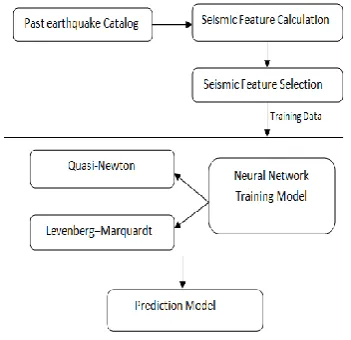
The parameters of past earthquake data are trained by backpropagation algorithms using the software tool MATLAB. The following Fig. 2 represents the prediction model using Levenberg–Marquardt and Quasi-Newton algorithms.
2.1. Earthquake catalog
The historical earthquake data of India for the time period from 2012 to 2017 collected from IMD (India Meteorological Department) taken for the prediction problem. The catalog consists of 968 earthquakes recorded in India. Table 1 shows the preliminary data such as Date, latitude, longitude, Depth and Magnitude of earthquake [17].
Table 1. IMD Earthquake Sample
Date Latit. Lon. Dept
h
Ma g
Region
1/1/201 2
23.5° N
91.8°
E 12 4.2 Tripura
1/3/201 2
13.1° N
92.5°
E 10 5
Andama n& Nicobar 1/5/201
2
26.2° N
92.2°
E 13 3.8
Assam
1/6/201 2
29.0° N
95.5°
E 33 4
Arunach al Pradesh 1/6/201
2
30.4° N
79.2°
E 10 3.7
Uttaranc hal ... ….. …. …. …. …..
12/6/17 35.5
°N
77.6
°E 35 5.4
Jammu& Kashmir
17/11/1 7
30.1 °N
95.1
°E 10 6.4
Arunach al Pradesh
28/12/1 7
30.4 °N
79.2
°E 33 4.7
Uttrrakha nd
2.2. Calculation of Seismic Features
[image:3.595.81.257.191.361.2]The Seismic features are mathematically calculated from a catalog using formulas [18].This study carried out by using eight seismic indicators taken as input given in the Table 2.
Table 2. Seismic indicators -input for neural network
Indicators Description
T Time Span over the last n events Mmean Mean Magnitude of last n events
dE Energy release
b Gutenberg-Richter law’s b value η Sum of mean square derivation
Mexpected Difference between maximum
observed and occurred earthquake c Deviation from mean time
Class
Magnitude Interval such as Mag <3.0 = Class 1 3.1<=Mag<=4.0 = Class 2 4.1<=Mag<=5.0 = Class 3 5.1<=Mag<=6.0 = Class 4 6.1<=Mag = Class 3
2.3. Neural network Training model
The feed forward BackPropagation neural network consists of input layer, hidden layer and output layer. MATLAB has been used to train and test the prediction model. The Quasi-Newton and Levenberg– Marquardt (LM) algorithm is used to train the model with various training parameters. The seven input data with class values represented in Table 2 are fed into the input layer of neural network model in Fig. 3. The calculation is continued until it reaches the output layer. The error value is calculated using the difference between the predicted output value and the target value. In the Backpropagation calculation, the error value obtained in the previous phase is used to modify the weight factors of each neuron in the output layer, then the hiddenlayer.
The completion of one Feed-forward and Back propagation calculation for each data set is called one Fig. 2. Prediction model
184 epoch [19].The feed forward calculations uses the
Eq.(2) and Eq.(3) to compute the value of the neurons.
I
j
W
ijO
i
j (2)
j
I j
e
O
1
1
(3)
Where, Ij = net input.
Wij = Weight of the connection from I to J.
Oi = output of unit I from previous layer.
Θj = Bias of the unit
Oj = Output of the activation function.
The purpose of the training is to get the predicted magnitude of the given input parameters. Here the seismicity parameters from the year 2012-2016 are taken as training data and the seismicity parameter of the year 2017 as test data. Finally the mean average value of the output is accounted for the prediction. The below Table 3 give the description of the architecture and training parameter of neural network with Levenberg–Marquardt and Quasi-Newton algorithms.
Table 3. Architecture and training parameters
Architecture &Training Parameter
Description
Number Of Layers 3
Number of Neuron Input layer 8,Hidden layer 10,Output layer 1
Activation Function Tan-Sigmoid
Learning Rule Levenberg–Marquardt and Quasi-Newton algorithms.
Epochs 1000
3. RESULT and DISCUSSION
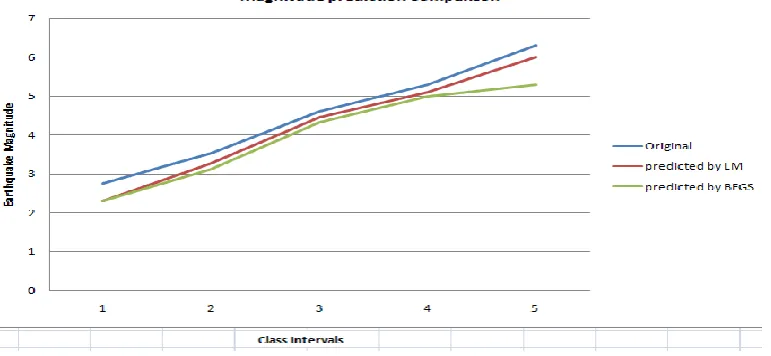
The computed value of backpropagation with the Levenberg–Marquardt and Quasi-Newton algorithms trained and predicted magnitude values are compared with the original recorded value in India for 2017.Table 4 shows the original and predicted magnitudes and Table 5 shows the success rate of the magnitude prediction by both algorithms.
Table 4. Original Recorded Magnitude and predicted Magnitude for 2017
Class Mag.
Range
Original recoded value for 2017
Predicted by LM
Predicted by BFGS
Quasi-Newton
1 <3.0 2.76 2.31 2.3
2 3.1 -4.0 3.53 3.283 3.13
3 4.1 –
5.0 4.6 4.45 4.32
4 5.1 –
6.0 5.3 5.1 5
5 6.1-7.0 6.3 6 5.3
6 Above
7.0 0 0 0
In class 1 the original recorded value is 2.76. The predicted value of Levenberg–Marquardt and Quasi-Newton algorithms are 2.31 and 2.3.The success rate of the prediction in both ways are 83.7% and 83.3% . In class 2 the original recorded value is 3.53. The predicted value of Levenberg–Marquardt and Quasi-Newton algorithms are 3.28 and 3.13.These both predicted values are less than the original recorded value. The success rate of the prediction in both ways is 90.1% and 88.6%. In class 3 and class 4 is having the less predicted values than the original. In class 5 the original recorded value is 6.3. The predicted values are 6.0 and 5.3.The success rate of the prediction in both ways are 95.2% and 84.1%.
Table 5. Success rate of Prediction using Levenberg– Marquardt and Quasi-Newton algorithms.
class Magnitude
Prediction Success rate -LM
Magnitude Prediction Success rate –
BFGS Quasi
1 83.7 83.3
2 90.1 88.6
3 96.7 93.9
4 96.2 94.3
5 95.2 84.1
Success rate 92.38% Failure rate 7.62%
Fig.4. Prediction accuracy-LM algorithm
Success rate 89% Failure rate 11%
185 The following Fig.4 and Fig.5 show the overall
success and failure prediction rates of the algorithms. Fig. 6 shows the prediction comparison chart, proves that the LM algorithm prediction accuracy nearly equal to the original recorded magnitude values.
4. CONCLUSION
In this work the backpropagation neural network have been constructed with the Levenberg–Marquardt and BFGS Quasi Newton algorithms to predict the earthquake magnitude in India. Each of the two neural networks can be realized and trained by MATLAB tool in effective way. The selected earthquake parameters are used to train our new neural network model and the results are tabulated. The prediction accuracy of the Levenberg–Marquardt (LM) and BFGS Quasi Newton algorithms are compared and Levenberg–Marquardt (LM) algorithm gives more accurate prediction result than the BFGS Quasi Newton.
REFERENCES
[1] Jacek,M.; Zurda,(1999): “Introduction to Artificial Neural Systems”.West publishing company, USA, pp. 2–3.
[2] Simon Haykin,(2009): “Neural Networks and Learning Machines”.Pearson prentice Hall publication, pp. 2.
[3] Mohankumar, K.; Sangeetha, K.(2018): “ A Study on Earthquake Prediction Using Neural network Algorithms”. International Journal of Computer Sciences and Engineerings”, 6(10), pp. 200-204.
[4] Shaganpreet kaur; Chinu (2018): “Comparative Analysis of Data Mining Techniques”. International journal of Computer Science and Engineering, 6(4), pp. 301-304.
[5] Mohankumar,K.;Sangeetha,K.(2018):
“Performance analysis on Decision Tree and SVM Classification with reference to flood occurrences in India”. International Journal of Advanced Research in computer Science, 9(2) pp.478-483.
[6] Emad Amar; Tawfik Khattab; Fatma Zada,(2014): “Intelligent Earthquake prediction System Based on Neural network”.World Academy of Science,Engineering and Technology International Journal of Civil and Environmental Engineering, 8(12) , pp.874-878.
[7] Narayanakumar, S.; Raja, K. (2016): “A BP Artificial Neural Network Model for Earthquake Magnitude Prediction in Himalayas, India”.Circuits and Systems,Scientific research publishing, 7, pp.3456-3468.
[8] Maria Moustra; Marios Avraamides;Chris Christodoulou(2011): “Artificial neural network for earthquake prediction using time series magnitude data or Seismic Electric Signals”. Expert Systems with application, Elesvier, 38(12), pp.15032-15039.
[9] Khawaja M. Asim; Muhammad Awais,F.; Martı´nez–A´lvarez (2017): “Seismic activity prediction using computational intelligence techniques in northern Pakistan”. Springer Acta Geophysica, 65(5), pp.919-930.
[image:5.595.122.508.103.281.2]186 Neural computing and Applications, 28(5),
pp.1043-1055.
[11] Asim, K.M.; Idris, A.; Iqbal, T.; Martinez Alvarez,F.(2018): “Earthquake prediction model using support vector regressor and hybrid neural networks”. PLOS ONE, 13(7), pp.1-22.
[12] David Kriesel(2005): “A Brief Introduction to Neural networks”. dkriesel.com, pp. 33, 2005. [13] Jaiwei Han; Micheline Kamber (2006): “Data
Mining Concepts and Techniques”.Elsevier Publication, India, pp. 327.
[14] Rojas,R.(1996): “Neural Networks”,Springer-Verlag,Berlin. pp. 155.
[15] Dao, V.N.P.; Vemuri, V.R. (2002): “A performance comparison of different back propagation neural networks methods in computer network intrusion detection”. Differential Equations and Dynamical Systems. 10(1&2) pp 201–214.
[16] Bindu Garg; Neha Kirar; Suraj Menon; Tanya Sah (2016):“A performance comparison of different back propagation neural networks methods for forecasting wheat production”.CSI transaction on ICT,Springer 4(2-4), pp.305-311. [17] http://www.imd.gov.in
[18] Asim, K. M.; Martínez-Álvarez, F.; Basit, A.; Iqbal, T. (2017):“Earthquake magnitude prediction in Hindukush region using machine learning techniques”. Springer Natural Hazards, 85(1), pp.471-486.