Abductive Explanation-based Learning Improves Parsing Accuracy and
Efficiency
Oliver Streiter
Language and Law, European Academy, Bolzano, Italy
Abstract
Natural language parsing has to be accu-rate and quick. Explanation-based Learn-ing (EBL) is a technique to speed-up pars-ing. The accuracy however often declines with EBL. The paper shows that this accu-racy loss is not due to the EBL framework as such, but to deductive parsing. Abduc-tive EBL allows extending the deducAbduc-tive closure of the parser. We present a Chi-nese parser based on abduction. Exper-iments show improvements in accuracy and efficiency.1
1 Introduction
The difficulties of natural language parsing, in gen-eral, and of parsing Chinese, in particular, are due to local ambiguities of words and phrases. Extensive linguistic and non-linguistic knowledge is required for their resolution (Chang, 1994; Chen, 1996). Dif-ferent parsing approaches provide difDif-ferent types of knowledge. Example-based parsing approaches of-fer rich syntagmatic contexts for disambiguation, richer than rule-based approaches do (Yuang et al., 1992). Statistical approaches to parsing acquire mainly paradigmatic knowledge and require larger corpora, c.f. (Carl and Langlais, 2003). Statisti-cal approaches handle unseen events via smoothing. Rule-based approaches use abstract category labels.
1
This research has been carried out within Logos Gaias project, which integrates NLP technologies into a Internet-based natural language learning platform (Streiter et al., 2003).
Example-based parsing generalizes examples dur-ing compilation time, e.g. (Bod and Kaplan, 1998), or performs a similarity-based fuzzy match during runtime (Zavrel and Daelemans, 1997). Both tech-niques may be computationally demanding, their ef-fect on parsing however is quite different, c.f. (Stre-iter, 2002a).
Explanation-based learning (EBL) is a method to speed-up rule-based parsing via the caching of ex-amples. EBL however trades speed for accuracy. For many systems, a small loss in accuracy is accept-able if an order of magnitude less computing time is required. Apart from speed, one generally rec-ognizes that EBL acquires some kind of knowledge from texts. However, what is this knowledge like if it does not help with parsing? Couldn’t a system improve by learning its own output? Can a system learn to parse Chinese by parsing Chinese? The pa-per sets out to tackle these questions in theory and practice.
1.1 Explanation-based Learning (EBL)
Explanation-based learning techniques transform a general problem solver (PS) into a specific and op-erational PS (Mitchel et al., 1986). The caching of the general PS’s output accounts for this transfor-mation. The PS generates, besides the output, a doc-umentation of the reasoning steps involved (the ex-planation). This determines which output the system will cache.
cached solutions are rarely re-used, the cost-benefit ratio is negative.
The accuracy of the derived PS is generally be-low that of the general PS. This may be due to the EBL framework as such or the deductive base of the PS. Research in abductive EBL (A-EBL) seems to suggest the latter: A-EBL has the potential to acquire new knowledge (Dimopoulos and Kakas, 1996). The relation between knowledge and accu-racy however is not a direct and logical one. The
U-shaped language learning curves in children
ex-emplifies the indirect relation (Marcus et al., 1992). Wrong regular word forms supplant correct irregu-lar forms when rules are learned. We therefore can-not simply equate automatic knowledge acquisition and accuracy improvement, in particular for com-plex language tasks.
1.2 EBL and Natural Language Parsing
Previous research has applied EBL for the speed-up of large and slow grammars. Sentences are parsed. Then the parse trees are filtered and cached. Sub-sequent parsing uses the cached trees. A com-plex HPSG-grammar transforms into tree-structures with instantiated values (Neumann, 1994). One hash table lookup of POS-sequences replaces typed-feature unification. Experiments conducted in EBL-augmented parsing consistently report a speed-up of the parser and a drop in accuracy (Rayner and Samuelsson, 1994; Srinivas and Joshi, 1995).
A loss of information may explain the drop of ac-curacy. Contextual information, taken into account by the original parser, may be unavailable in the new operational format (Sima’an, 1997), especially if partial, context-dependent solutions are retrieved. In addition, the set of cached parse trees, judged to be ”sure to cache”, is necessarily biased (Streiter, 2002b). Most cached tree structures are short noun phrases. Parsing from biased examples will bias the parsing.
A further reason for the loss in accuracy are incor-rect parses which leak into the cache. A stricter filter does not solve the problem. It increases the bias in the cache, reduces the size of the cache, and evokes the utility problem.
EBL actually can improve parsing accuracy (Stre-iter, 2002b) if the grammar does not derive the parses to be cached via deduction but via abduction.
The deductive closure2 which cannot increase with EBL from deductive parsing may increase with ab-ductive parsing.
2 A Formal View on Parsing and Learning
We use the following notation throughout the paper:
(function applied to
yields x),
(relation applied to
yields x).
and
represent tuples and sets respec-tively. The prefix denotes the cardinality of a col-lection, e.g. ! "$#
&% .
Uppercase variables stand for collections and lowercase variables for elements. Collections may contain the anonymous variable' (the variable_in PROLOG). Over-braces or under-braces should fa-cilitate reading: (*)+(
, -/. 0
#
1%32
(
, -/. 0
#
.
A theory 4 is 65
879 ;:
where : is a set of rules< .
5
and7 are two disjoint sets of attributes
=
and > (e.g.
5
?$@ACBD@A?E "?$FHG!<JIK?E JL
7
?NMONIK?E "?JP>RQSQS?E
). A rule is written as <
H
=
or<
TU=
. A rule specifies the rela-tion between an observable fact and an attribute
=
assigned to it. V is the set of observable data with eachTWXV being a tuple
=
;>
.3
Y
is the set of data classified according to4 , with Z3
H
=
. ,> and
=
may have an internal struc-ture in the form of ordered or unordered collections of more elementary ,> and
=
respectively.
Transferring this notation to the description of parsing, 4 is a syntactic formalism and : a gram-mar. 5
is the union of syntax trees and morpho-syntactic tags. V is a corpus tagged with
5
. 7 cor-responds to a list of words, phrases or sentences (the surface strings). Y
is a treebank, a cache of parse trees, or a history of explanations.
Z\[!]"^"_a`b c
=d[!e;_ ;>Rf
`ag!`Rhb`
=ji^;`a`
(1)
2.1 Parsing:k
l
ZKm$`an
A parser defines a relation between V and
Y
(c.f. 2). Parsing is a relation between and a subset of
Y
(c.f. 3).
k
l
V
Y
(2)
2
The deductive closure of the set of axiomso is the setp
which can be proved from it.
3
k ZqmC`an (3)
Simplifying, we can assume that k is defined as the set of rules, i.e. k
Vr Y
: . A spe-cific parserk is derived by the application ofs to the training material (e.g. Y
): s t
Y
u
k . The set of possible relationss isv . Elements ofv are caching (no generalization), induction (hypothesis after data inspection) and abduction (hypothesis during classi-fication). Equation (5) describes the cycle of gram-mar learning and gramgram-mar application.
s l Y k (4) s Y e fxw ;
, -y. 0
z l V Y mC`an (5)
2.1.1 Memory-based Parsing
k is based on memory if
s SZ!;{ Z Z <C ;<
. | in (6) is the trivial formalization of caching. Parsing proceeds via recalling } defined in (7). The cycle of grammar learning and parsing
}
|
is defined in (8): The training materialZqn yields the parsing outputZ n
.4 | d~ =n C~J =jn
, -y. 0
(6) } C~ d~ =n (7)
parsing ~
. 0/,
-learning} from
Z
. 0y,
|
. 0y,
C~J =jn ;l d~ ~ = n
, -y. 0
(8)
2.1.2 Deduction-based Parsing
Let jG!Q8G! \G be a function which replaces one or more elements of a collection by a named variable or ' . k is a deductive inference if < is obtained from an induction (a reduction of with the help of
jGQ8G/ ;G ). The following expressions define induction
(9), deduction (10) and the inductive-deductive cycle
lR (11):
4We use subscripts to indicate the identity of variables. The
same subscript of two variables implies the identity of both vari-ables. Different subscripts imply nothing. The variables may be identical or not identical. In memory-based parsing, learning material and parsing output are identical.
+ c =n ;> n = ~
, -/. 0
jG!Q8G! \G l =jn ;> n
, -y. 0
] a = ~
, -/. 0
^ " (9) l =jn ;> g
, -y. 0
e =n ;> g = ~ (10) parsing$
. 0/,
-
. 0y,
=n ;> n = ~ =jn ;> g ; c =n ;> g = ~ (11)
2.1.3 Abduction-based Parsing
Abduction, defined as
. 0/, -lSZ!;u
is a run-time generalization which is triggered by a concrete
to be classified. We separate
and for presen-tation purpose only.5 The relation may express a similarity, a temporal or causal relation. (12) and the cycle of
lu
(13) define abduction.
lSZ/{
SZ!
< (12)
parsingC
. 0/,
-learning from
Z
. 0y,
- = g ;> g = ; e\ . 0y,
=
;>
= ;>
, -y. 0 e
=j^
(13) Abduction subsumes reasoning by analogy. Ab-duction is an analogy, if describes a similarity. Reasoning from rain to snow is a typical analogy. Reasoning from wet street to rain is an abductive reasoning. For a parsing approach based on analogy c.f. (Lepage, 1999).
5Abduction is a process of hypothesis generation.
2.2 Learning: ;
s
;
;
In this section, we formalize EBL. We mechanically substitute s in the definition of EBL by |¡ ¢ ¢ to show their learning potentials.
A learning system changes internal states, which influence the performance. The internal states of k are determined by Y
and v . We assume that, for a givenk , v remains identical before and after learn-ing. Therefore, the comparison of
Y
(before learn-ing) with Y£
Zqm$`Rn
(after learning) reveals the ac-quired knowledge.
We define EBL in (14).
s
Y
;
is the parser before learning. This parser applies to and yields ZqmC`an
, formalized as
s Y ;¤
. The new parser is the application ofv to the union of
Y and Z mC`an . k m$`Rn¥ s Yr ; s l Y ; , -y. 0
z!¦R§¨
, -y. 0
©
ªq« ¬ ;
(14)
From two otherwise identical parsers, the parser with Z® =je ¢' =
not present in the other has a greater deductive closure. The cardinality of =je ¢' = W Y
reflects an empirical knowl-edge. The empirical knowledge does not allow to conclude something new, but to resolve ambigui-ties in accordance with observed data, e.g. for a sub-language as shown in (Rayner and Samuelsson, 1994). Both learning techniques have the potential of improving the accuracy.
2.2.1 Learning through Parsing
A substitution ofv with|¡ ¢ ¢ reveals the trans-formation ofZ e
f¯w to ZqmC`an
. We start with caching and recalling (Equation 15).
k mC`an° | Zq± | SZq±; , -y. 0
±8
, -y. 0
²
(15)
Parsing
±
with the cache ofZ
±
yieldsZ
±
. The de-ductive closure is not enlarged. Quantitative rela-tions with respect to change in
Y
. IfZq±
is not cached twice, memory-based EBL is idempotent.6
6
Idempotence is the property of an operation that results in the same state no matter how many times it is executed.
EBL with induction and deduction is shown in (16). Here the subscripts merit special attention:
=jg ;>
is parsed from Z³ =g ;> g = ~
. This yields ZqmC`an´ =g ;> = ~ . In-tegratingZ mC`an
into C changes the empirical knowl-edge with respect to =
and >. If the empirical knowledge does not influence
, D-EBL is idem-potent. The deductive closure does not increase as =jg ¢' = ~ W Y . k m$`anµ& =jg ;> g = ~ ¶ ;¡· =jg ;> g = ~
, -y. 0
; =g ;> ;
, -y. 0
¸ ]¢¹ ± ¸ ] / (16) Abductive EBL (EBL) is shown in (17). A-EBL acquires empirical knowledge similarly to D-EBL. In addition, a new
= ¢' =^ is ac-quired. ThisZKm$`an
may differ fromZ e
f¯w with respect to =
and/or =^
. In the experiments in A-EBL we reported below,=
rº 1= g
and= ^ 1=
holds. k m$`anµ =jg ;> g = ¶ ;» =jg ;> g =
, -y. 0
, -y. 0
learning l = J ;>
, -y. 0 e\
;
, -y. 0
¸ ] ± ¸ ]K¼ (17)
2.2.2 Recursive Rule Application
Parsing is a classification task in which=
W
5
is assigned toTWV . Differently from typical classifi-cation tasks in machine learning, natural language parsing requires an open set 5
. This is obtained via the recursive application of : , which unlike non-recursive styles of analysis (Srinivas and Joshi, 1999) yields 5
(syntax trees) of any complexity. ThenHG!Q8G/ ;G is applied to
5
so that jG!Q8G! \G
S½¾ can be matched by further rules (c.f. 18). With-out this reduction, recursive parsing could not go be-yond memory-based parsing.
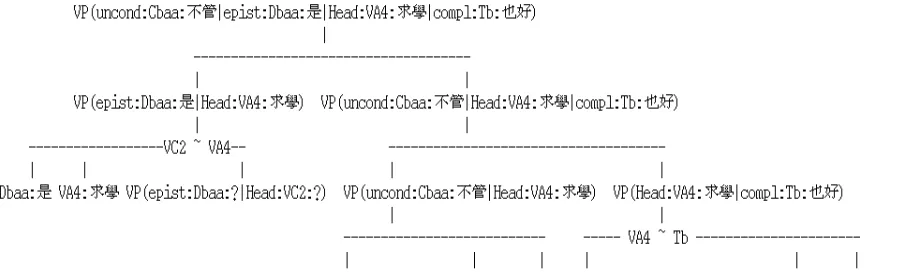
Figure 1: An explanation produced by OCTOPUS. At the top, the final parse obtained via deductive substi-tutions. Abductive term identification bridges gaps in the deduction (XÀ Y). The marker ’?’ is a graphical shortcut for the set of lexemes!>
inZ .
The function HG!Q8G/ ;G defines an induction and re-cursive parsing is thus a deduction. Combinations of memory-based and deduction-based parsing are de-ductions, combinations of abduction-based parsing with any another parsing are abductions.
Macro Learning is the common term for the
com-bination of EBL with recursive deduction (Tade-palli, 1991). A macro <
hb]
^;e
is a rule which yields the same result as a set of rules :ÂÁ with
Ã:rÁÅÄ
%
and < h*]
^\eÇÆ
W:ÂÁ does. In terms of a grammar, such macros correspond to redundant phrases, i.e. phrases that are obtained by composing smaller phrases of : . Macros represent shortcuts for the parser and, possibly, improved likelihood es-timate of the composed structure compared to the estimates under independency assumption (Abney, 1996). When the usage of macros excludes certain types of analysis, e.g. by trying to find longest/best matches we can speak of pruning. This is the contri-bution of D-EBL for parsing.
3 Experiments in EBL
3.1 Experimental purpose and setup
The aim of the experiments is to verify whether new knowledge is acquired in A-EBL and D-EBL. Sec-ondly, we want to test the influence of new knowl-edge on parsing accuracy and speed.
The general setup of the experiment is the follow-ing. We use a section of a treebank as seed-corpus (
Y
_R`È`
w ). We train the seed-corpus to a corpus-based parser. Using a test-corpus we establish the parsing
Figure 2: The main parsing algorithm of OCTO-PUS. The parser interleaves memory-based, deduc-tive, and abductive parsing strategies in five steps: Recalling, non-recursive deduction, deduction via chunk substitution, first with lexemes, then without lexemes and finally abduction.
ɾÊ6ËSÌÂÍJÎSÏDСÑÓÒ
#1recalling from POS (a) and lexeme (i)
RETURNÔ IF (ÔÕÖ
Ê6ËSÌÂÍJÎSÏDСÑ
)
#2deduction on the basis of POS (a)
RETURNÔ IF (ÔÕØ×
ËSÌÂÍNÎٸСÑ
)
#3deductive, recursive parsing with POS and lexeme
# Substitutions are defined as in TAGs (Joshi, 2003) IF (ËSÌrÍ!ÚSÛ"Ü
ªyÝ ÎÏÞÚ8Û;Ü
ªyÝ ÐÎ\ÌÂÍ
¼
«¨ ÜNÎSÏ
¼
« ¨ ÜuСÑ
Õ
ß\à¢áÈâ Ô\ãCäCåjæ
ÊçËSÌÂÍNÎ8ÏСÑ
)Ò
RETURN
á
ä
ß;áÈâ
Ï
â
ä
â
ÏÞè
å
ÊçË
# deduction
ɾÊ6ËSÌÂÍÚSÛ;Ü ªqÝ
Î8ÏÞÚ8Û;Ü ªyÝ
Î;СÑaΠɾÊ6ËSÌÂÍ
¼
«
¨ ÜCÎÏ
¼
«
¨ ÜÑÐ
)é
#4adeductive recursive parsing with lexeme,
#4bcompared to abductive parsing
IF (ËSÌrÍ ÚSÛ"Ü
ªyÝ Î8Ï Ú8Û;Ü
ªyÝ ÐÎÈÌÂÍ
¼
Ǭ
Ü
ÎSÏ
¼
Ǭ
Ü
СÑ
Õ
ß\à¢áÈâ Ô\ãCäCåjæ
ÊçËSÌÂÍNÎÙСÑ
)Ò
RETURNÍ!ê¢ëqìí
¹
Ê
(
î ÊçËSÌÂÍNÎSÏDСÑ
, #abduction
á
ä
ß;áÈâ
Ï
â
ä
â
ÏÞè
å
ÊçË
#deduction
ɾÊ6ËÍ!Ú8Û;Ü ªqÝ
Î8ÏÞÚSÛ"Ü ªyÝ
ÑaΠɾÊ6ËÍ
¼
«
¨ Ü$Î8Ï
¼
«
¨ÜdÑ
))é
#5abduction as robust parsing solution
RETURNî ÊçËSÌÂÍNÎ8ÏСÑ
Figure 3: Abductive parsing with k-nn retrieval and adaptation of retrieved examples.
î ÊçËSÌÂÍNÎSÏDСÑEÒ
RETURN Íï/Í"ð
â
Í
â
ÏÞè
å
Ê Ëñ/Ï âSà
ê
ß
Ï8òÍóôÏë
å
Ê
Ë
æ
ò
åJå òê
à\â ê¢Ï
à
ñ/ÍóJÊ6ËSÌrÍNÎ8ÏDСÑ8Ñ8Ñ
é
accuracy and speed of the parser (G!F
=
QõB
=
;G
k
ö9iÞ`È_Ria;
(recall,precision,f-score,time)). Then, we parse a large corpus (k
öc»
Z
mC`an
). A filter criterion that works on the explanation ap-plies. We train those trees which pass the filter to the parser (s
÷ _R`È`
w
ZqmC`an
µ
k
m$`Rn ). Then the parsing accuracy and speed is tested against the same training corpus (G!F
=
QB
=
\G
k
m$`Rn£ ö9iÞ`È_Ria;
(recall,precision,f-score,time)).
Sections of the Chinese Sinica Treebank (Huang et al., 2000) are used as seed-treebank and gold stan-dard for parsing evaluation. Seed-corpora range be-tween 1.000 and 20.000 trees. We train them to the parser OCTOPUS (Streiter, 2002a). This parser integrates memory- deduction- and abduction-based parsing in a hierarchy of preferences, starting from
1 memory-based parsing, 2 non-recursive deductive
parsing, 3 recursive deductive parsing and 5 finally abductive parsing (Fig. 2).
Learning the seed corpora (s øSZ
Rù;ù;ù //
#;ùqúù;ù;ù
) results in k
Rù;ù;ù //
k
#;ùqúù;ù;ù . For each k W
k Rù;ù;ù //
k #;ùqúù;ù;ù
, a POS tagged corpus V with
®V
ø%$ûNû
ûNûNû
is parsed, producing the corpora
Y
e¢üþý8ý8ý //
Y
e;ÿSýý8ý8ý
. The corpus used is a subset of the 5 Million word Sinica Corpus (Huang and Chen, 1992).
For every W+V the parser produces one parse-tree ZX
H
=
and an explanation. The expla-nation has the form of a derivation tree in TAGs, c.f (Joshi, 2003). The deduction and abduction steps are visible in the explanation. Filters apply on the ex-planation and create sub-corpora that belong to one inference type.
The first filter requires the explanation to contain only one non-recursive deduction, i.e. only pars-ing step 2. As deductive parspars-ing is attempted after memory-based parsing (1),>
g
º
>~ holds.
A second filter extracts those structures, which
are obtained by parsing step 4a or 5 where only one POS-labels may be different in the last char-acters (e.g.
?
=
Iq?
?
=HZ
? ). The re-sulting corpora are Y
eKüþý8ý8ý
¨
«
¨ Ü¢Ú //
Y
e;ÿSýý8ý8ý
¨
«
¨ Ü"Ú and
Y
e¢üþý8ý8ý í ¨Ü"Ú
//
Y
e;ÿSýý8ý8ý í¨ Ü"Ú .
3.2 The Acquired Knowledge
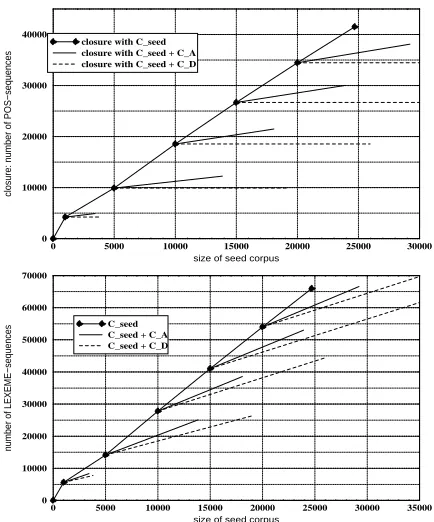
[image:6.595.313.530.377.638.2]We want to know whether or not new knowledge has been acquired and what the nature of this acquired knowledge is. As parsing was not recursive, we can approach the closure by the types of POS-sequences from all trees and their subtrees in a corpus. We con-trast this with to the types of lexeme-sequences. The data show that only A-EBL increases the closure. But even when looking at lexemes, i.e. empirical knowledge, the A-EBL acquires richer information than D-EBL does.
Figure 4: The number of types of POS-sequences as approximation of the closure with÷ _R`È`
w , A-EBL and D-EBL. Below the number of type of LEXEME-sequences.
0
5000 10000 15000 20000 25000 30000
size of seed corpus
0 10000 20000 30000 40000
closure: number of POS−sequences
closure with C_seed closure with C_seed + C_A closure with C_seed + C_D
0
5000 10000 15000 20000 25000 30000 35000
size of seed corpus 0
10000 20000 30000 40000 50000 60000 70000
number of LEXEME−sequences
C_seed C_seed + C_A C_seed + C_D
Figure 5: The proportion of top-NPs and top-VP(S) in abduced and deduced corpora.
0
5000 10000 15000 20000
size of seed corpus
0.00 20.00 40.00 60.00 80.00
% top−NP in C_D % top−NP in C_A % top−VP in C_D % top−VP in C_A % top−NP standard % top−VP standard
3.3 Evaluating Parsing
The experiments consist in evaluating the parsing accuracy and speed for each
Y
_R`È`
w
ÂY eKüþý8ý8ý
¨
«
¨ Ü¢Ú //
Y
_a`a`
w
rY e;ÿSýý8ý8ý
[image:7.595.73.290.118.254.2]í¨ Ü"Ú .
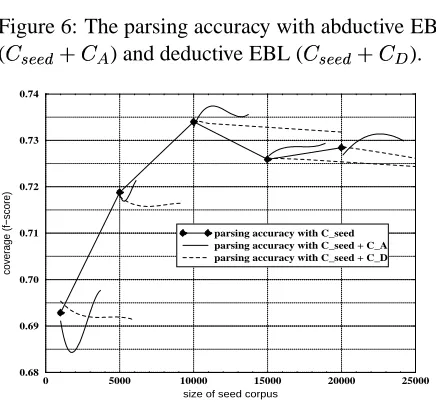
Figure 6: The parsing accuracy with abductive EBL (÷ _a`a`
w{) ÷
) and deductive EBL (÷ _a`a` w{)
÷ ).
0
5000
10000
15000
20000
25000
size of seed corpus 0.68
0.69 0.70 0.71 0.72 0.73 0.74
coverage (f−score)
parsing accuracy with C_seed
parsing accuracy with C_seed + C_A
parsing accuracy with C_seed + C_D
[image:7.595.73.291.346.547.2]
We test the parsing accuracy on 300 untrained and randomly selected sentences using the f-score on un-labeled dependency relations. Fig. 6 shows parsing accuracy depending on the size of the seed-corpus. The graphs show side branches where we introduce the EBL-derived training material. This allows com-paring the effect of A-EBL, D-EBL and hand-coded trees (the baseline). Fig. 7 shows the parsing speed in words per second (Processor:1000 MHz, Mem-ory:128 MB) for the same experiments. Rising lines indicate a speed-up in parsing. We have interpolated and smoothed the curves.
Figure 7: The parsing time with A-EBL (÷ _a`È` w¾) ÷
) and D-EBL (÷ _R`È` w{)
÷ ).
0
5000
10000
15000
20000
25000
size of seed corpus 44.00
46.00 48.00 50.00 52.00 54.00
words per second
parsing speed with C_seed
parsing speed with C_seed + C_A
parsing speed with C_seed + C_D
The experimental results confirm the drop in pars-ing accuracy with D-EBL. This fact is consistent across all experiments. With A-EBL, the parsing ac-curacy increases beyond the level of departure.
The data also show a speed-up in parsing. This speed-up is more pronounced and less data-hungry with A-EBL. Improving accuracy and efficiency are thus not mutually exclusive, at least for A-EBL.
4 Conclusions
Explanation-based Learning has been used to speed-up natural language parsing. We show that the loss in accuracy results from the deductive basis of parsers, not the EBL framework. D-EBL does not extend the deductive closure and acquires only em-pirical (disambiguation) knowledge. The accuracy declines due to cached errors, the statistical bias the filters introduce and the usage of shortcuts with lim-ited contextual information.
Alternatively, if the parser uses abduction, the de-ductive closure of the parser enlarges. This makes accuracy improvements possible - not a logical con-sequence. In practice, the extended deductive clo-sure compensates for negative factors such as wrong parses or unbalanced distributions in the cache.
References
Steven Abney. 1996. Partial Parsing via Finite-State Cas-cades. In Proceedings of the ESSLLI ’96 Robust
Pars-ing Workshop.
Rens Bod and Ronald M. Kaplan. 1998. A probabilistic corpus-driven model for lexical-functional analysis. In
COLING-ACL’98.
Michael Carl and Philippe Langlais. 2003. Tuning gen-eral translation knowledge to a sublanguage. In
Pro-ceedings of CLAW 2003, Dublin, Ireland, May, 15-17.
Hsing-Wu Chang. 1994. Word segmentation and sen-tence parsing in reading Chinese. In Advances in the
Study of Chinese Language Processing, National
Tai-wan University, Taipei.
Keh-Jiann Chen. 1996. A model for robust Chinese parser. Computational Linguistics and Chinese
Lan-guage, 1(1):183–204.
Yanis Dimopoulos and Antonis Kakas. 1996. Abduc-tion and inductive learning. In L. De Taedt, editor,
Ad-vances in Inductive Logic Programming, pages 144–
171. IOS Press.
Chu-Ren Huang and Keh-Jiann Chen. 1992. A Chi-nese corpus for linguistics research. In COLING’92, Nantes, France.
Chu-Ren Huang, Feng-Yi Chen, Keh-Jiann Chen, Zhao-ming Gao, and Kuang-Yu Chen. 2000. Sinica tree-bank: Design criteria, annotation guidelines and on-line interface. In M. Palmer, M. Marcus, A. K. Joshi, and F. Xia, editors, Proceedings of the Second Chinese
Language Processing Workshop, Hong Kong, October.
ACL.
Aravind K. Joshi. 2003. Tree-adjoining grammars. In R. Mitkov, editor, The Oxford Handbook of
Computa-tional Linguistics. Oxford University Press, Oxford.
Yves Lepage. 1999. Open set experiments with direct analysis by analogy. In Proceedings NLPRS’99
(Nat-ural Language Processing Pacific Rim Symposium),
pages 363–368, Beijing.
Gary F. Marcus, Steven Pinker, Michael Ullman, Michelle Hollander, John T. Rosen, and Fei Xu. 1992.
Overregularization in Language Learning. Mono-graphs of the Society for Research in Child Develop-ment, 57 (No. 4, Serial No. 228).
Steven Minton. 1990. Quantitative results concerning the utility problem of explanation-based learning.
Ar-tificial Intelligence, 42:363–393.
Tom S. Mitchel, R. Keller, and S. Kedar-Cabelli. 1986. Explanation-based generalization: A unifying view.
Machine Learning, 1(1).
G¨unter Neumann. 1994. Application of explanation-based learning for efficient processing of constraint-based grammars. In The 10th Conference on Artificial
Intelligence for Applications, San Antonio, Texas.
Manny Rayner and Christer Samuelsson. 1994. Corpus-based grammar specification for fast analysis. In
Spoken Language Translator: First Year Report, SRI
Technical Report CRC-043, pg. 41-54.
Khalil Sima’an. 1997. Explanation-based leaning of partial-parsers. In W. Daelemans, A. van den Bosch, and A. Weijters, editors, Workshop Notes of
the ECML/ML Workshop on Empirical Learning of Natural Language Processing Tasks, pages 137–146,
Prague, Czech Republic, April.
Bangalore Srinivas and Aravind K. Joshi. 1995. Some novel applications of explanation-based learning to parsing lexicalized tree-adjoining grammars. In 33th
Annual Meeting of the ACL, Cambridge, MA.
Bangalore Srinivas and Aravind K. Joshi. 1999. Su-pertagging: An approach to almost parsing.
Compu-tational Linguistics, 25(2):237–265.
Oliver Streiter, Judith Knapp, and Leonhard Voltmer. 2003. Gymn@zilla: A browser-like repository for open learning resources. In ED-Media, World
Con-ference on Educational Multimedia, Hypermedia & Telecommunications, Honolulu, Hawaii, June, 23-28.
Oliver Streiter. 2002a. Abduction, induction and memo-rizing in corpus-based parsing. In ESSLLI-2002
Work-shop on ”Machine Learning Approaches in Computa-tional Linguistics”, pages 73–90, Trento, Italy, August
5-9.
Oliver Streiter. 2002b. Treebank development with de-ductive and abde-ductive explanation-based learning: Ex-ploratory experiments. In Workshop on Treebanks and
Linguistic Theories 2002, Sozopol, Bulgaria,
Septem-ber 20-21.
Prasad Tadepalli. 1991. A formalization of explanation-based macro-operator learning. In IJCAI, Proceedings
of the International Joint Conference of Artificial In-telligence, pages 616–622, Sydney, Australia. Morgan
Kaufmann.
Chunfa Yuang, Changming Huang, and Shimei Pan. 1992. Knowledge acquisition and Chinese parsing based on corpus. In COLING’92.
Jakub Zavrel and Walter Daelemans. 1997. Memory-based learning: Using similarity for smoothing. In W. Daelemans, A. van den Bosch, and A. Weijters, ed-itors, Workshop Notes of the ECML/ML Workshop on