54
Formulation And Evaluation Of Mouth Dissolving Tablet
Of Cefixime Trihydrate
Umme Rumana U.G
1, Ansari Yaasir Ahmed
2, Dr.G.J Khan
3, Shoeb Quazi
4, Syed Abdul Azeem
5,
1,2,4,5Lecturer at Jamia college of Pharmacy, Akkalkuwa, Nandurbar-425415, Maharashtra3
Principal Ali Allana college of pharmacy, Akkalkuwa, Nandurbar-425415, Maharashtra
Abstract- Mouth Dissolving Tablets have started gaining popularity and acceptance as new drug delivery systems, because they are easy to administer. Recent development in mouth dissolving technology mainly works to improve the disintegration quality of these delicate dosage forms without affecting their integrity. The purpose of the present investigation was to increase dissolution rate of cefixime trihydrate (class-IV drug). For the preparation of cefixime trihydrate mouth dissolving tablets Superdisintegrants, Indion 414, crosscarmellose Sodium, Kyron T-314, crospovidone used in varying concentrations 4%, 5% and 6% and diluent. In an attempt to construct a statistical model for the prediction of disintegration time and % drug release. Tablets were evaluated for friability, hardness, weight variation, disintegration, drug content and in vitro dissolution. Tablets showed an enhanced dissolution rate compared to pure cefixime trihydrate.
Index Terms- Cefixime trihydrate, Mouth Dissolving Tablets, Superdisintegrants, Indion 414, crosscarmellose Sodium, Kyron T-314, crospovidone.
1. INTRODUCTION
In recent years, the mouth dissolve tablet has attracted the interest of many researchers. These tablets are expected to dissolve or disintegrate in the oral cavity without drinking water. The disintegrated mass can slide down smoothly along the esophagus with the help of saliva, so even people who have swallowing or chewing difficulties can take it with ease. The basic approach used in the development of mouth dissolving tablets is the use of superdisintegrants (Omaima A. et al, 2006).
Cefixime trihydrate is beta lactam antibiotics and an orally active third generation cephalosporin highly active against Enterobacteriaceae, H.influenzae. It is longer acting and used for respiratory, urinary and biliary infections. Cefixime trihydrate is class IV drug so it has solubility and bioavailability problem. All cephalosporins are bactericidal in nature. Cefixime trihydrate interferes with the synthesis of bacterial cell wall by inhibiting transpeptidases so that cross linking does not takes place (Martindale, 34th edition, Merck Index, 14th edition).
The dissolution of a drug can also be influenced by disintegration time of tablets. Faster disintegration of tablet results in a faster dissolution. Most commonly used methods to prepare fast dissolving tablets are; freeze-drying, tablet moulding and direct compression methods. Main advantages of direct compression are low manufacturing cost and high mechanical integrity of tablets. Therefore, direct compression appears to be better option for manufacturing of tablets. The purpose of the present investigation was patient compliance by increasing dissolution rate of cefixime trihydrate.
2. MATERIALS AND METHODS Materials:
The gift sample of Cefixime Trihydrate (Maxheal Pharmaceuticals, MIDC, Satpur, Nashik) was kindly received. Crospovidone, Crosscarmellose sodium, Kyron T-314 and Microcrystalline cellulose (Research Lab Fine Chem Industries, Mumbai) were kindly received. Indion 414 (SD Fine Chem. Ltd, Mumbai) was kindly received. All other reagents were of analytical grade.
Methods:
2.1 Compatibility Study Of Drug And Excipients:
It is very important parameter to study compatibility of drug and polymers under the experimental condition before the formulation. It is therefore necessary to confirm that the drug does not react with the polymer and excipients under experimental condition and affected the shelf life of product. This is confirmed by Infrared light absorption scanning spectroscopy, Drug Content and Solubility Study.
FTIR spectrum
In FTIR absorption spectrum sample was prepared by mixing the drug with KBr uniformly by dispersion technique and filled in to the die cavity of sample holder and an IR spectrum was recorded using FTIR spectrometer over the range of 400 to 4000 cm-1 at a resolution of 2 cm-1. (Ahmed Abd Elbary et al, 2012).
2.2 Characterization Of Drug, Excipients And Reference Mixture
FTIR studies
55
IR spectrum was recorded using IR spectrometer over the range of 400 to 4000 cm-1 at a resolution of 2 cm-1. (Swati Changdeo Jagdale et al., 2012 and P.J. Salústio et al.)
UV spectroscopic study
Complex formation between Cefixime trihydrate and Excipients was studied by the UV spectroscopic method. 10 mg amounts of Cefixime trihydrate was weighed accurately and dissolved in 100 ml of distilled water, diluted suitably and spectra of drug recorded at 287 nm. The same method was used for Excipients and spectra is recorded at 287 nm. The change in the absorbance of drug in the complexes was recorded. (Swati Changdeo Jagdale et al., 2012 and P.J. Salústio et al.)
In-vitro dissolution studies
Drug release studies were performed in triplicate at 37 ± 0.5 0C employing USP apparatus II at 75 rpm. The dissolution study was carried out in two dissolution media (Phosphate buffer of pH 6.8 and double distilled water). Dissolution studies were performed on pure drug (10 mg) and the complexes containing an equivalent amount of the drug. Aliquots of the periodically withdrawn samples (1 mL) were analyzed spectrophotometrically at 280 nm, and replaced with an equal volume of plain dissolution medium. (Swati Changdeo Jagdale et al., 2012)
2.3 Formulation Of Mouth Dissolving Tablets
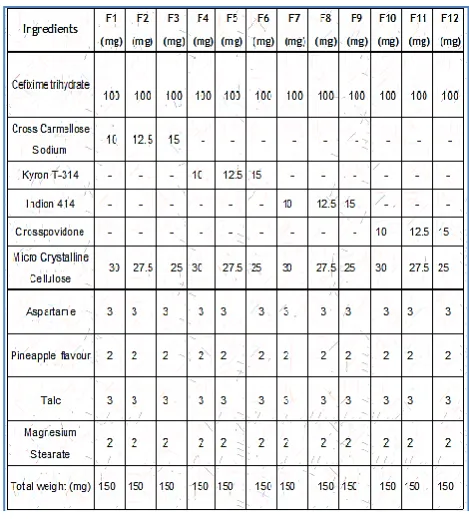
[image:2.595.316.551.104.364.2]The tablet was prepared by direct compression method containing 100 mg of Cefixime trihydrate. Drug was taken and pass through the # 40. Diluents, superdisintegrants, sweetener and flavor were passed through # 40. All above ingredients were mixed and blended properly. Magnesium stearate was passed through # 40 and mixed properly with above blend. Powdered lubricated blend was compressed into tablet by Rimek, minipress- 2nd DL 09 station Tooling machine using B9, 10 mm round flat punches. (Shirse Prabhakar et al., 2012.
Table 1
Composition of trial Batches
2.4 Evaluation Of Mouth Dissolving Tablets
Tablets from all the formulation were subjected to following quality control test.
Tablet Thickness
Tablet thickness is an important characteristic in reproducing appearance and also in counting by using filling equipment. Some filling equipment utilizes the uniform thickness of the tablets as a counting mechanism. Ten tablets were taken and their thickness was recorded using digital caliper. (Vineet Bhardwaj et al., 2010)
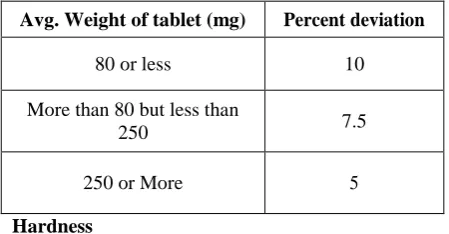
Weight Variation
56
Table 2
Specification for uniformity of weight as per IP
Hardness
Hardness of tablet is defined as the force applied across the diameter of the tablet in the order to break the tablet. The resistance of the tablet to chipping, abrasion or breakage under condition of storage transformation and handling before usage depends on its hardness. Hardness of the tablet of each formulation was determined using Pfizer hardness tester. (Honey Goel et al., 2008 and Garala Kevin C. et al., 2008)
Friability
It is measured of mechanical strength of tablets. Friabilator was used to determine the friability by following procedure. A preweighed tablet was placed in the Friabilator. It consists of a plastic-chamber that revolves at 100 rpm, dropping those tablets at a distance of 6 inches with each revolution. The tablets were rotated in the Friabilator for at least 4 minutes. At the end of test tablets were dusted and reweighed, the loss in the weight of tablet is the measure of friability and is expressed in percentage as(Honey Goel et al., 2008 and Garala Kevin C. et al., 2008)
%Friability = loss in weight / Initial weight x 100
Disintegration Time:
The tablet was placed in a glass petridish of 10 cm diameter containing 20 ml of distilled water. The time taken for total disintegration of the tablet in to particles was noted down. The test was repeated for total of 3 tablets. (Mohit Mangal et al., 2012)
Wetting Time:
The wetting time of the tablets can be measured using a simple procedure. Twice folded circular tissue papers of 10 cm diameter was placed in a petridish with a 10 cm diameter. 10 ml of pH 6.8 phosphate buffer. A tablet is carefully placed on the surface of the tissue paper. The time required for phosphate buffer to reach upper surface of the tablet is noted as a wetting time. (Hisakadzu Sunada et al., 2002 and Karthikeyan M et al., 2011)
Water Absorption Ratio:
A piece of tissue paper folded twice was placed in a small Petri dish containing 6 ml of pH 6.8 phosphate buffer. A tablet was put on the tissue paper and
allowed to completely wet. The wetted tablet was then weighed. Water absorption ratio, R was determined using following equation. (Hisakadzu Sunada et al., 2002)
R = 100 ×(Wa –Wb)/Wa
Where, Wa = Weight of tablet after water absorption Wb = Weight of tablet before water absorption.
In vitro dispersion time
In vitro dispersion time was measured by dropping a tablet in a 10 ml measuring cylinder containing 6 ml of buffer solution simulating saliva fluid (pH 6.8) at 37 ± 0.5º C and the time required for complete dispersion was determined. (S Furtado et al., 2008)
Content Uniformity
The content uniformity of the prepared formulas orodispersible tablets was performed by taking ten tablets and assayed individually. The requirement for this test is met if the amount of ingredient in each of the ten tablets lies within the range of 95%-102%. (Ehsan Ali Mohamed et al., 2013 and Honey Goel et al., 2008)
Powder 20 tablets. Transfer accurately weighed powder equivalent to 100 mg of Cefixime,to 100 ml vol. flask add 75 ml of pH 7.0 phosphate buffer and sonicate. Dilute with pH 7.0 phosphate buffer to volume mix and centrifuge. Transfer 5.0 ml of the clear supernatant to a second 100 ml vol. flask dilute with pH 7.0 phosphate buffer to volume and drug content was determined at 230 nm by UV spectrophotometer. (S. C. Arora et al., 2010)
In-vitro drug release study
The release rate of Cefixime trihydrate from rapid disintegrating tablet was determined by using USP dissolution testing apparatus II (paddle type). The dissolution test was performed using 900 ml of 1.2 acid buffer, at 37±0.50C and 75 rpm. A sample (1 ml) of the solution was withdrawn from the dissolution apparatus every 3 min for 18 min and the samples were replaced with fresh dissolution medium. The samples were filtered through whatmann filter paper. Absorbance of these solutions was measured at 280 nm using UV spectrophotometer. Cumulative percent drug release was calculated by using an equation obtained from a standard curve. (Ashwini.G. kini et al., 2011)
Parameter of in-vitro dissolution test
Apparatus : USP Type – II (paddle) Volume of medium : 900 ml
Avg. Weight of tablet (mg) Percent deviation
80 or less 10 More than 80 but less than
250 7.5
57
Temperature : 37 ± 0.5oC Paddles Speed : 75 rpm
Dissolution medium used : 1.2 Acid Buffer Aliquot taken at each time interval : 1 ml Time interval : 3 min. Dilution factor :10
2.5 Stability Study
The tablets of best formulation were subjected to stability studies. Stability testing of the final drug product was carried out as mentioned in the ICH guidelines for stability testing of the drug products. India being in the zone 4 of the climatic zone classification, the real time stability studies were carried out at 30±2 C0 and 70±5% RH. The orally dispersible tablets were subjected to the accelerated stability testing at the temperature of 40°C±2 C and 75±5% RH for 3 months. The samples were withdrawn from the stability chambers after 1 month, 2 month and 3 months and studied for physical characteristics like any color change, visual defects, hardness, dissolution, disintegration and assay. The data so obtained was compared with the initial data of the tablets. (Ahmed Abd Elbary et al., 2012 and Jashanjit Singhet al., 2008)
3. RESULTS AND DISCUSSION
[image:4.595.304.511.250.397.2]3.1 Compatibility Study Of Drug And Excipients
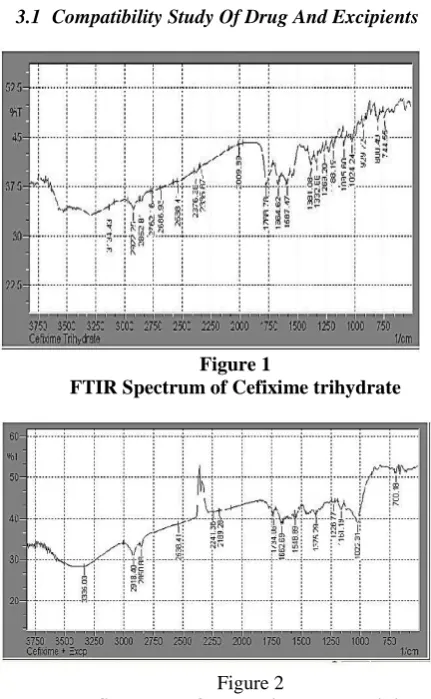
Figure 1
FTIR Spectrum of Cefixime trihydrate
Figure 2
FTIR Spectrum of Drug with other excipient
The pure cefixime trihydrate displays a peak of NH-Stretching at 1587.47 cm-1 and the complex of drug + excipients display a peak of NH-Stretching at 1548.89 cm-1. Another peak observed at 1768.78 cm-1 of C=O Stretching while in complex it was observed at 1734.06 cm-1. The peak of -O-C Stretching was observed at 1024.24 cm-1 while in complex it was observed at 1022.31 cm-1. This result suggested that there was no chemical interaction between drug and
excipients.
3.2 Characterisation Of Drud And Excipients:
3.3 FTIR Of Drug
Figure 3
[image:4.595.64.280.390.740.2]FTIR Spectrum of Cefixime trihydrat
Figure 4
FTIR Spectrum of Drug with other excipient
FTIR spectra shows…
Cefixime trihydrate… 1587.47, 1768.78, 1024.24, 1664.62, 2852.81, 3134.43,
2922.25 cm-1
Drug with excipients… 1548.89, 1734.06, 1022.31, 1161.19, 1662.69, 2850.88,1375.29 cm-1
Shifting of FTIR spectral band of Cefixime trihydrate NH- Str 1587.47 cm-1 to 1548.89
[image:4.595.310.521.450.615.2]58
Also shifting of BCD band-O-C Str 1020.38 cm-1 to 1022.31 cm-1 and C-C Str 1159.26 cm-1 to 1161.19 cm-1.
No shifting occurs in C-H Str 2850.88 cm-1, but there was a reduction in peak intensity of drug peaks which was obscured by the cyclodextrin peak indicating formation of complexes.
3.4 Uv Spectroscopic Study
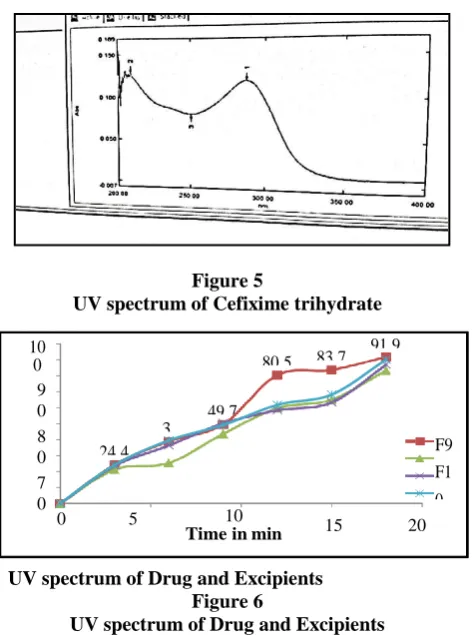
[image:5.595.68.306.206.524.2]UV spectrum of Cefixime trihydrate
Figure 5
UV spectrum of Cefixime trihydrate
UV spectrum of Drug and Excipients Figure 6
UV spectrum of Drug and Excipients
The UV spectra of Cefixime trihydrate solution in the presence of Excipients is shown in Figure 6.10. There was no shift in the λmax of Cefixime trihydrate in the presence of Excipients. The spectra of complexes showed a diminution in absorbance at 287 nm. The induced change in absorbance is attributed, primarily, to the mixing of excipients. The changes in peak intensity are assumed to result from changes in the solvent microenvironment. The observed reduction in peak intensity may result from the formation of mixture.
3.5 Preformulation Study Of Trial Batch
The results of the pre compression evaluation are given in Table 3. The values of Hausners ratio were found to be in the range of 23.02o to 29.50o. All the formulation shows the angle of repose within 30o. This indicates good flow property of the blends.
The Bulk density and Tapped density for all the formulations varied from 0.6010 gm/cm3 to 0.6787 gm/cm3 and 0.6976 gm/cm3 to 0.7894 gm/cm3. There was no large difference found between Bulk density and Tapped density. This result helps in calculating the % compressibility of the powder. The compressibility for all the formulation lies within the range of 6.93% to 15.79%. All formulations were showing good compressibility.
The results of the pre compression evaluation are given in Table 3. The values of Hausners ratio were found to be in the range of 23.02o to 29.50o. All the formulation shows the angle of repose within 30o. This indicates good flow property of the blends.
[image:5.595.318.550.352.747.2]The Bulk density and Tapped density for all the formulations varied from 0.6010 gm/cm3 to 0.6787 gm/cm3 and 0.6976 gm/cm3 to 0.7894 gm/cm3. There was no large difference found between Bulk density and Tapped density. This result helps in calculating the % compressibility of the powder. The compressibility for all the formulation lies within the range of 6.93% to 15.79%. All formulations were showing good compressibility.
Table 3
Preformulation Study of Trial Batch For mul atio ns Bul k Den sity (gm/ cm3)
Ta ppe d den sity (gm /cm 3 ) An gle of Rep ose( o ) Ha usn er’s Rat io % Po ros ity Voi d Vol ume (ml) Com press ibilit y Inde x (%)
F1 0.65
21 0.75 0 29. 50 0.8 694 13. 05 3
13.0 5
F2 0.63
82 0.71 42 28. 73 0.8 935 10. 64 2.5
10.6 4
F3 0.64
65 0.69 76 27. 97 0.9 267 7.3
3 1.7 7.33
F4 0.64
93 0.69 76 24. 09 0.9 307 6.9
3 1.6 6.93
F5 0.60
10 0.71 09 23. 54 0.9 016 9.8
3 2.3 9.83
F6 0.63
55 0.70 42 25. 90 0.9 024 9.7
5 2.3 9.75
F7 0.66
07 0.77 31 23. 02 0.8 546 14. 54 3.3
14.5 4
F8 0.65
78 0.78 12 23. 54 0.8 420 15. 79 3.6
15.7 9
F9 0.67
87 0.78 94 23. 98 0.8 597 14. 03 3.1
14.0 3
F10 0.66
66 0.75 75 24. 67 0.8 8 12.
00 2.7 12.0
0
F11 0.64
37 0.70 09 27. 25 0.9 183 8.1
6 1.9 8.16
F12 0.65
78 0.73 17 25. 27 0.8 990 10. 09 2.3
10.0 9 10 0 9 0 8 0 7 0 6 0 5 0 4 0 3 0 2 0 1 0 0 91.9 2 80.5 7 83.7 8 49.7 1 3 9 24.4 2 F9 F1 0 F1 1 F1 2 0 5 10
59
3.6 Evaluation Of Cefixime Trihydrate Mdt
[image:6.595.306.557.110.394.2]Evaluation of Trial Batch of Cefixime trihydrate
Figure 7
% Drug Release of Trial Batch in 1.2 pH
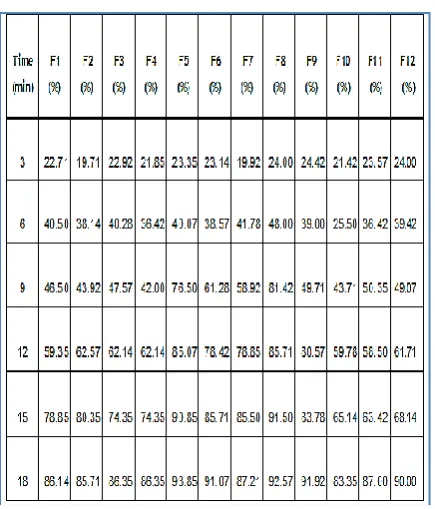
[image:6.595.81.287.142.259.2]Four different superdisintegrants such as croscarmellose sodium, kyron T- 314, indion 414 and crospovidone in varying concentrations 4%, 5% and 6% were used. These twelve batches were evaluated for % drug release, hardness and disintegration time. Out of twelve batches drug release of F5 showed 93.85%, DT was found to be 26±2.572 seconds, so F5 was selected as a final batch. From the study it was clear that kyron T-314 in 5% gives the good results, increase or decrease in the concentration leads to slow disintegration of the tablet as well as % drug release.
Table 4
% Drug Release of Trial Batch in 1.2 pH
Table 5
DT and Hardness of Trial Batch
4. CONCLUSION
The dissolution rate of Cefixime trihydrate was successfully enhanced. The enhancement of the dissolution rate helped toward providing rapid onset of action of the drug. Fast- dissolving tablet also helped toward the enhancement of dissolution rate.
Based on the findings of various tests it can be concluded that,
Preformulation studies of Cefixime trihydrate and Excipients were performed. The FTIR analysis revealed that the polymer used were compatible with Cefixime trihydrate. Powder flow property of the blend showed the good flow property.
The trial batches of Mouth dissolving tablets of Cefixime trihydrate were successfully prepared and evaluated. The tablets were prepared by direct compression method using different synthetic superdisintegrant such as croscarmellose sodium, kyron T-314, indion 414 and crospovidone in varying concentration 4%, 5% and 6%.
The relative efficiency of these superdisintegrants to improve the disintegration and dissolution rates of tablets was in order, Kyron T-314 > Indion 414 > Crospovidone > Crosscarmellose sodium.
Among all formulation, Formulation containing Kyron T-314 was fulfilling all the parameters satisfactorily. It has shown excellent in vitro disintegration, in vitro dissolution time.
In vitro release studies that almost 90% of drug was release from all the formulation were within 15
Evaluati on Paramet
er
F1 F2 F3 F4 F5 F6
DT (sec)(SD
) n=3
40± 1.66 4
38± 1.75
35± 1.90
35±3. 874
26±2. 572
18±1. 925
Hardnes s Kg/cm2 (SD) n=3
2.5± 1.20 9
2.2± 1.80 9
2.4± 1.26 0
2.3±1 .315
2.2±1 .376
2.2±1 .809
DT (sec)(SD
) n=3
32±2 .084 6
22± 3.04 7
19± 3.53 6
45±1. 477
29±2. 302
24±2. 753
Hardne ss Kg/cm2 (SD) n=3
2.4± 1.26 0
2.2± 1.37 6
2.3± 1.31 5
2.4±1 .260
2.3±1 .315
2.2±1 .376
%
D
r
ug
R
e
le
a
[image:6.595.73.291.477.732.2]60
minute. Formulation FK8 showed faster drug release i.e. 92.14 % within 12 min in comparison to other formulation.
Stability studies were conducted for the FK8 formulation at 40oC/75% RH for 3 months. Best formulation batch FK8 found to be stable.
5. REFERENCES
[1] Ashwini.G. kini, Mudit dixit and Parthasarthi k kulkarni, A novel technique to enhancing the bioavailability of Itraconazole using freeze Drying, Elixir Bio. Phys. 34 (2011), 2432-2435.
[2] Ehsan Ali Mohamed Dr. Shaimaa N. Abd Al Hammid, Formulation and Evaluation of Rosuvastatin Orodispersible Tablets, International Journal of Pharmacy and Pharmaceutical Sciences, (2013), Vol 5, Suppl 2.
[3] Garala Kevin C., Ekshinge Vinit B., Jarag Ravindra J. and Shinde Anil J., Fast- disintegrating aceclofenac tablets: formulation development using simplex lattice design, Thai Journal of Pharmaceutical Sciences. 32 (2008), 77-81.
[4] Gilbert S. Banker, Christopher T. Rhods, Text Book of Modern Pharmaceutics, Fourth Edition, Revised and Expanded. pp 607-625
[5] Hisakadzu Sunada, Yunxia Bi, Preparation, evaluation and optimization of rapidly disintegrating tablets, Powder Technology, 122 (2002), 188–198.
[6] Honey Goel, Nishant Vora and Vikas Rana, A Novel
Approach to Optimize and Formulate Fast Disintegrating Tablets for Nausea and Vomiting, AAPS PharmSciTech, September (2008), Vol. 9, No. 3
[7] Honey Goel, Nishant Vora and Vikas Rana, A Novel
Approach to Optimize and Formulate Fast Disintegrating Tablets for Nausea and Vomiting, AAPS PharmSciTech, September (2008), Vol. 9, No. 3.
[8] Indian Pharmacopoeia 2007, Government of India Ministry of Health & Family Welfare, Published By The Indian Pharmacopoeia Commission, Ghaziabad, Volume 1st, 177-183, 477, 505.
[9] Jashanjit Singh, Anil K. Philip and Kamla Pathak, Optimization Studies on Design and Evaluation of
Orodispersible Paediatric Formulation of
Indomethacin, AAPS PharmSciTech, March
(2008),Vol. 9, No. 1, DOI: 10.1208/s12249-007-9018-4.
[10]Karthikeyan M, Umarul Mukhthar AK, Megha M, Shadeer Hamza P, Formulation of Diclofenac tablets for rapid pain relief, Asian Pacific Journal of Tropical Disease, (2011),S308-S311.
[11]Martindale, the Complete Drug Reference, thirtyfourth edition, Edited by Sean C. Sweetman, 172-173.
[12]Meghana S. Kamble, Krunal K. Vaidya, Pravin P. Aute and Rohini P. Chavan, Development and Evaluation of Mouth-Dissolving Tablet of Taste-Masked Amlodipine Besylate For the Treatment of Hypertension, International Journal of Pharmaceutical, Chemical and Biological Sciences, (2012), 3(1), 55-62.
[13]Mohit Mangal, Sunil Thakral, Manish Goswami and Nishant Thakur, Comparison Study Between Various Reported Disintegrating Methods for Fast Dissolving Tablets, African Journal of Basic & Applied Sciences, (2012) 4 (4): 106-109.
[14]Omaima A. Sammour, Mohammed A. Hammad, Nagia A. Megrab and Ahmed S. Zidan, Formulation and Optimization of Mouth Dissolve Tablets Containing Rofecoxib Solid Dispersion, AAPS PharmSciTech (2006); 7 (2) Article 55.
[15]P.J. Salústio, G. Feio, J.L. Figueirinhas, H.M. Cabral-Marques, P.C. Costa, J.F. Pinto, Release profile of ibuprofen in _cyclodextrin complexes from two different solid dosage forms by University of Lisbon.
[16]S Furtado, R Deveswaran, S Bharath, BV Basavaraj, S Abraham and V Madhavan, Development and characterization of orodispersible tablets of famotidine containing a subliming agent, Tropical Journal of Pharmaceutical Research, December (2008); 7 (4): 1185-1189.
[17]S. C. Arora, P.K. Sharma, Raghuveer Irchhaiya, Anurag Khatkar, Neeraj Singh and Jagbir Gagoria, Urea Based Inclusion Compounds of Cefixime trihydrate for the Improvement of Pharmaceutical Characteristics, Inernational Journal of Drug Development & Research, April-June 2010, 2(2):404-411.
[18]Shirse Prabhakar, Formulation and Evaluation of Fast Dissolving Tablet of Cyclodextrin Inclusion Complexed Water Insoluble Drug: Glimipiride, IJARP 3(3), May-Jun (2012), 465-470.
[19]Swati Changdeo Jagdale, Vinayak Narhari Jadhav, Aniruddha Rajaram Chabukswar, Bhanudas Shankar Kuchekar, Solubility enhancement, physicochemical characterization and formulation of fast-dissolving tablet of nifedipine- betacyclodextrin complexes, Brazilian Journal of Pharmaceutical Sciences, jan./mar.(2012), Vol. 48, N.1.
[20]Thorsteinn Loftsson, Ma´ Sson, Marcus E. Brewster, Self-Association of Cyclodextrins and Cyclodextrin Complexes, Journal of Pharmaceutical Sciences, the American Pharmacists Association, May (2004), Vol. 93, No. 5.
61
[22]Vineet Bhardwaj, Mayank Bansal and P.K. Sharma, Formulation and Evaluation of Fast Dissolving Tablets of Amlodipine Besylate Using Different Super Disintegrants and Camphor as Sublimating Agent, American-Eurasian Journal of Scientific Research,(2010), 5 (4): 264-269.