E f f i c i e n t L i n e a r L o g i c M e a n i n g
A s s e m b l y
V i n e e t G u p t aC a e l u m R e s e a r c h C o r p o r a t i o n N A S A A m e s R e s e a r c h C e n t e r
M o f f e t t F i e l d C A 9 4 0 3 5 vgupt a@pt olemy, a r c . nasa. gov
J o h n L a m p i n g X e r o x P A R C 3 3 3 3 C o y o t e H i l l R o a d P a l o A l t o C A 9 4 3 0 4 U S A
l a m p i n g ~ p a r c , x e r o x , com
1 I n t r o d u c t i o n
The "glue" approach to semantic composition in Lexical-Functional G r a m m a r uses linear logic to assemble meanings from syntactic analyses (Dalrymple et al., 1993). It has been compu- tationally feasible ill practice (Dalrymple et al., 1997b). Yet deduction in linear logic is known to be intractable. Even the propositional ten- sor fragment is NP complete(Kanovich, 1992). In this paper, we investigate what has made the glue approach computationally feasible and show how to exploit t h a t to efficiently deduce underspecified representations.
In the next section, we identify a restricted p a t t e r n of use of linear logic in the glue analyses we are aware of, including those in (Crouch and Genabith, 1997; Dalrymple et al., 1996; Dal- rymple et al., 1995). And we show why t h a t fragment is computationally feasible. In other words, while the glue approach could be used to express computationally intractable analyses, actual analyses have adhered to a p a t t e r n of use of linear logic t h a t is tractable.
The rest of the paper shows how this pat- tern of use can be exploited to efficiently cap- ture all possible deductions. We present a con- servative extension of linear logic t h a t allows a reformulation of the semantic contributions to b e t t e r exploit this p a t t e r n , almost turning t h e m into Horn clauses. We present a deduction algo- r i t h m tbr this formulation that yields a compact description of the possible deductions. And fi- nally, we show how t h a t description of deduc- tions can be turned into a compact underspeci- fled description of the possible meanings.
T h r o u g h o u t the paper we will use the illus- trative sentence "every gray cat left". It has fu~('tional structure
,1, pRED Liav
PRED ~CAT'1
f: SUBJ g: SPEC 'EVERY'and semantic contributions leave :Yx. go-,~x --o fo,,~ leave(x)
cat :Vx. (go VAR)--~x --o (g, RESTR)-,~ cat(x)
g r a y :VP. [Vx. (go VAR)--~x --o (go RESTR)--~ P(x)] --o [Vx. (go v a R ) ~ x
-o (go RESTR)"--,gray(P)(x)] e v e r y :VH~/~, S.
[Vx. (go v a R ) ~ x -o (go R ~ S T R ) ~ ( X ) ] ®[Vx. go-.*x --o n-.~s(x)]
--o H',~ every(R, S)
For our purposes, it is more convenient to fol- low (Dalrymple et al., 1997a) and separate the two parts of the semantic contributions: use a l a m b d a t e r m to capture the meaning formulas, and a type to capture the connections to the f-structure. In this form, the contributions are
l e a v e : Ax.leave(x) : gz --o f~
c a t : /~x.cal(x): (go VAR) --o (ga RESTR) g r a y : A]:'.Ax.gray(P)(x) :
((go vaa) -~ (go nESTR))
-o (go vaR) -o (Jo RESTa)
e v e r y : A R . A S . e v e r y ( R , S) :VH. (((go Vaa) -o (go aESTa))
®(go --~ H))
--oH
et al., 1997a), adding the two s t a n d a r d rules for tensor, using pairing for meanings. For the types, the system merely consists of the linear logic rules for the glue fi'agment.
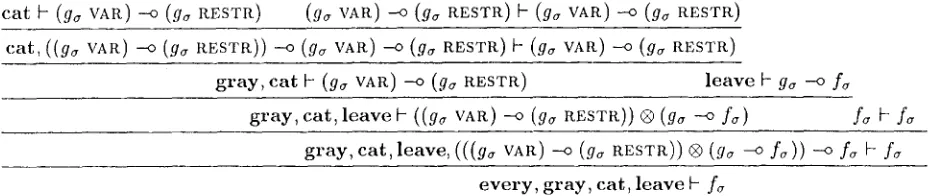
We give the proof for our example in Figure 2, where we have written the types only, and have o m i t t e d the trivial proofs at the top of the tree. The meaning evc'ry(gray(cat),left ) may be as- sembled by putting the meanings back in ac- cording to the rules of O and rl-reduction.
M : A b e A : I ' ' A w h e r e l~:I ~ , , j A~/~
I ' , M :A[B/A'] ~c 1?
F, M : V X . A Pc R
I" Pc N : A
F , P , Q , A t - c R F , Q , P , A P c R
r Po M: A[Y/X] ,n¢w)
F bc M : V X . A (}
l,:_k, fla'.A/ : A - o II Pc R
lleW)
F ~-c Aa:.M : A -o B
I',M : . I , N : / 3 P R F P M : A A ~ - N : B
r , < M , N > : A,> B le r,5 - <M,N> : A G B
Figure 1: The system C. M , N are meanings, and x, y are meaning variables. A , B are types, and X, Y are type variables. P, Q, R are fornm- las of the kind M : A. I ' , A are multisets of formulas.
2 S k e l e t o n r e f e r e n c e s a n d m o d i f i e r ref- e r e n c e s
The terms t h a t describe atomic types, terms like g~ and (g~ VAlt), are s e m a n t i c structure refer-
~ n c ~ , the type atoms t h a t connect the semantic assembly to the syntax. There is a p a t t e r n to how they occur ill glue analyses, which reflects their function in the semantics.
Consider a particular type a t o m in the ex- ample, such as g~. It occurs once positively in the contribution of "every" and once negatively in the contribution of "leave". A slightly more complicated example, the type (go I~ESTR) oc- curs once positively in the contribution of "cat", once negatively in the contribution of "every", and once each positively and negatively in the contribution of "gray".
T h e p a t t e r n is that every type a t o m occurs once positively in one contribution, once nega- tively in one contribution, and once each posi-
tively and negatively in zero or more other con- tributions. (To make this generalization hold, we add a negative occurrence or "consumer" of re, the final meaning of the sentence.) This pat- tern holds in all the glue analyses we know of, with one exception t h a t we will treat shortly. We call the independent occurrences the skele- ton occurrences, and the occurrences t h a t occur paired in a contribution modifier occurrences.
The p a t t e r n reflects the functions of the lex- ical entries in LEG. For the type t h a t corre- sponds to a particular f-structure, the idea is that, the entry corresponding to the head mMces positive skeleton contribution, the e n t r y t h a t subcategorizes for the f-structure makes a neg- ative skeleton contribution, and modifiers on the f-structure make both positive and negative modifier contributions.
Itere are the contributions for the example sentence again, with the occurrences classified. Each occurrence is m a r k e d positive or negative, and the skeleton occurrences are underlined.
leave eat
gray
every
g._Ga- --o fc, +
(qa V A R ) - --0 (ga I{~ESTR') +
+ aES a) -) --o (ga V A R ) - --o (go RESTR) + VH. (((ga VAR) + --o (g~ RF, STR)- )
--o H - ) )
---o H +
cat ~- (g, van) -o (g. RESTa) (~, van) --o (a. nESTa) F- (g. WR) --o (g, aEs'ra) (:at, ((ga VAR) --o (ga RESTR.)) --o (g~r VAIl.) --O (ga RESTR) 1"-
(go
VAR) ---o (g~r RESTR)gray, eat i- (gq VAIl,) ---o (g~, RESTR) leave F- go ---o f~ gray, c . t , l e a v e ~- ((g~ van) -o (go aESTk)) ® (g~ --0 to) f~ ~- f~
gray, cat,leave, (((go VAn) --o (g~ RESTR)) ® (go --~ fo)) --o f~ F- f~ e v e r y , gray, eat, leave ~- fo
Figure 2: Proof of "Every gray cat left", omitting the l a m b d a terms explore them.
The idea is to do a preliminary deduction in- volving just the skeleton, ignoring the modifier occurrences. This will be completely determin- istic and linear in the total length of the for- mulas. Once we have this skeletal deduction, we know t h a t the sentence is well-formed and has a meaning, since modifier occurrences es- sentially occur as instances of the identity ax- iom and do not contribute to the type of the sentence. T h e n the system can determine the meaning terms, and describe how the modifiers can be a t t a c h e d to get the final meaning term. T h a t is the goal of the rest of the paper.
3 C o n v e r s i o n t o w a r d h o r n c l a u s e s
The first hurdle is t h a t the distinction between skeleton and modifier applies to atomic types, not to entire contributions. The contribution of "every", for example, has skeleton contributions for g~, (.q~ V i a ) , and (g~ aESTR), but modifier contributions for H. Furthermore, the nested implication structure allows no nice way to dis- entangle the two kinds of occurrences. W h e n a deduction interacts with the skeletal g¢ in the hypothetical it also brings in the modifier H.
If the problematic hypothetical could be con- vetted to Horn clauses, then we could get a bet- ter separation of the two types of occurrences. We can approximate this by going to an in- dexed linear logic, a conservative extension of the system of Figure 1, similar to Hepple's sys- tem(Hepple, 1996).
To handle nested implications, we introduce the type constructor A { B } , which indicates an A whose derivation m a d e use of B. This is sim- ilar to Hepple's use of indices, except t h a t we indicate dependence on types, rather than on in-
dices. This is sufficient in our application, since each such type has a unique positive skeletal occurrence.
We can eliminate problematic nested impli- cations by translating t h e m into this construct, in accordance with the following rule:
For a nested hypothetical at top level that has a mix of skeleton and modifier types:
M : ( A -o B) --o C replace it with
x : d , M : ( B { A } - - o C )
where x is a new variable, and reduce complex dependency formulas as follows:
1. Replace A{B - o e } with A { C { B i } . 2. Replace (A -o B ) { C } with A -o 13{C}.
The semantics of the new type constructors is captured by the additional proof rule:
F , x : A ~ - M : B F , x : A ~- )~x.M : B { A }
The translation is sound with respect to this rule:
T h e o r e m 1 I f r is a set of sentences in the unextended system of Figure 1, A is a sentence in that system, and F ~ results from r by applying the above conversion rules, then F t- A in the system of Figure 1 iff F ~ ~- A in the extended system.
[image:3.612.70.537.85.183.2]the form 8 , M , or S --o M , where ,5 is pure skeleton and 3,4 is pure modifier. Furthermore, 3,4 will be of the form A - o A, where A may be a formula, not just an atom. In other words, the t y p e of the modifier will be an identity axiom. The modifier will consume some meaning and produce a modified meaning of the same type.
In our example, the contribution of "every", can be t r a n s f o r m e d by two applications of the nested hypothetical rule to
e v e r y :AR.AS'.every( g, 3) :
vu. (g~ aESTR){(~ v.R)}
-o H { go } ---o tt x :(go
v,r¢)
Y :go
Here, the last two sentences are pure skele- ton, producing (g~ VAtt) and g~, respectively. The first is of the form ,5" --o jr4, consuming (g~ aESTR), to produce a pure modifier.
While the rule for nested hypotheticals could be generalized to eliminate all nested implica- tions, as Hepple does, that is not our goal, be- cause that does remove the combinatorial com- bination of different modifier orders. We use the rule only to segregate skeleton atoms fl'om mod- ifier atoms. Since we want modifiers to end up looking like the identity axiom, we leave them in the A --o A form, even if A contains further ilnplications. For example, we would not apply the nested hypothetical rule to simplify the en- try for g r a y any further, since it is already in the form A - o A.
Ifandling intensional verbs requires a more precise definition of skeleton and modifier. The type part of an intensional verb contribution looks like (VV.(h~ ---o F ) --o F ) - o g~ --o f~ (Dalrymple et al., 1996).
First, we have to deal with the small technical problem that the VF gets in the way of the nested hypothetical translation rule. This is easily resolved by introducing a skolem constant, S, turning the type into ((h~, --o S) --o ,5') - o g~ --o f~. Now, the nested hypothetical rule can be applied to yield (h~ --o S) and ,5'{S{h~}} --o g~ --o f~.
But now we have the interesting question of whether the occurrences of the skolem constant, S, are skeleton or modifier. If we observe how S resources get produced and consumed in a de- duction involving the intensional verb, we find that (ho --o S) produces an S, which may be
modified by quantifiers, and then gets consumed by S { S { h ¢ } } - o ga --o f~. So unlike a modifier, which takes an existing resource from the envi- ronment and puts it back, the intentional verb places the initial resource into the environment, allows modifiers to act on it, and then takes it out. In other words, the intensional verb is act- ing like a combination of a skeleton producer and a skeleton consumer.
So just because an a t o m occurs twice in a contribution doesn't make the contribution a modifier. It is a modifier if its atoms must in- teract with the outside, rather than with each other. Roughly, paired modifier atoms function as f --o f , rather than as f ® f_k, as do the S atoms of intensional verbs.
Stated precisely:
D e f i n i t i o n 2 A s s u m e two occurrences of the same type atom occur in a single contribution. Convert the formula to a normal f o r m consist- ing of just ®, ~ , and ± on atoms by converting subformulas A -o B to the equivalent A ± :2 B, and then using D e M o w a n ' s laws to push all ± 's down to atoms. Now, if the occurrences of the same type atom occur with opposite polarity and the connective between the two subexpressions in which they occur is ~ , then the occurrences are modifiers. All other occurrences are skeleton.
For the glue analyses we are aware of, this def- inition identifies exactly one positive and one negative skeleton occurrence of each t y p e among all the contributions for a sentence.
4 E f f i c i e n t d e d u c t i o n o f u n d e r s p e c i f i e d r e p r e s e n t a t i o n
Lexical contributions in indexed logic: l e a v e :
c a t : g r a y : e v e r y ~ : e v e r y 2 : e v e r y 3 :
,~x.leave(x) : ga -o fa
)~x.cat(x): (ga VAR) --o (ga RESTR)
: vAR) --o RESTR)) --0 VAR) --o RESTR) )~R.,~S.every(R, S ) : VZ. (y~ RESTR){(y~ VAR)} ---o H{g~} -o H
x
vAR)
Y :g~
The following can now be proved using the extended system:
g r a y F- ,\P.,~x.gray(P)(x) : ((gz VAR) --o (g~ RESTR)) ---O
(ga VAR) -o (gcr RESTR)
e v e r y 2 , c a t , e v e r y 1 t- ,~S.every()~x.cat(x), S ) : VH. II{go} -o He v e r y 3 , l e a v e ~- leave(y) : f~
Figure 3: Skeleton deductions for "Every gray cat left". the example sentence, the results are shown in
Figure 3.
These skeleton deductions provide a compact representation of all possible complete proofs. Complete proofs can be read off from the skele- ton proofs by interpolating the deduced modi- fiers into the skeleton deduction. One way to think about interpolating the modifiers is in terms of proof nets. A modifier is interpolated by disconnecting the arcs of the proof net that connect the type or types it modifies, and recon- necting t h e m t h r o u g h the modifier. Quantifiers, which t u r n into modifiers of type VF.F -o F,
can choose which type they modify.
Not all interpolations of modifiers are le- gal. however. For example, a quantifier must outscope its noun phrase. The indices of the modifier record these limitations. In the case of the modifier resulting from "every cat",
VH.H{g~} --o H, it records t h a t it must outscope "every cat" in the {g~}. The in- dices determine a partial order of what modi- fiers must outscope other modifiers or skeleton terms.
In this particular example, there is no choice about where modifiers will act or what their rel- ative order is. In general, however, there will be choices, as in the sentence "someone likes every cat", analyzed in Figure 4.
To summarize so far, the skeleton proofs pro- vide a compact representation of all possible de- ductions. Particular deductions are read off by interpolating modifiers into the proofs, subject to the constraints. But we are usually more in- terested in all possible meanings t h a n in all pos-
sible deductions. Fortunately, we can e x t r a c t a compact representation of all possible meanings from the skeleton proofs.
We do this by treating the meanings of the skeleton deductions as trees, with their arcs an- n o t a t e d with the types t h a t correspond to the types of values t h a t flow along the arcs. Just as modifiers were interpolated into the proof net links, now modifiers are interpolated into the links of the meaning trees. Constraints on what modifiers must outscope become constraints on what tree nodes a modifier must dominate.
Returning to our original example, the skele- ton deductions yield the following three trees:
RESTR) /
~ tgaJ
leavelf
a STR) I
grayj
RESTR)
cat
[ga
(go. VAR) ;
] t~: VAR)
''-ORESTR)
y
leave(y) AS.every(~x.cat(x), S) ~P.Ax.gray(P)(x)
Notice t h a t higher order a r g u m e n t s are reflected as s t r u c t u r e d types, like (g~ VAR) -o (go RESTR). These trees are a compact description of the possible meanings, in this case the one possible meaning. We believe it will be possible to translate this rep- resentation into a UDRS representation(Reyle, 1993), or other similar representations for ambiguous sentences.
The functional structure of "Someone likes every cat".
P B, ED
S U B J
f:
OBJ
The lexical entries after
~LIKE'
h:[Pf~.
'~OM~ONE']
[
t'RsD 'cAT' ]
g:SPEC ~EVER,Y ~
conversion to indexed form: like :
e a t :
s o m e o n e 1 :
s o m e o n e 2 : e v e r y l :
e v e r y 2 : e v e r y 3 :
ax.ay.like(x,y) : (h~
® g~) --oL
Ax.~at(x) : (g~ vAR) --o
(g~
aSSTR)
z : h a
AS.some(person, S) :VH. lI{ha} --o It
)~R.~S.eve,'y(R, Z) : VII. (ga Rt~STR){(ga VAIt)} ---o II{g~} --o II X : (ga VAR)
Y : g a
From these we can prove:
s o m e o n e 1 , e v e r y 3 , like ~- like(z, y) : fo
s o m e o n e 2 ~- AS.some(person, S) : VH. H{ha} -o H
e v e r y 2 , c a t , e v e r y 1 ~- AS.every(cat, S) : VII. H{g~} -o H
Figure 4: Skeleton deductions for "Someone likes every cat" modifier's tyt)e indicate that a l a m b d a abstrac-
tion is also needed. So, when "every cat" mod- ifies the ,~entence meaning, its antecedent, in- s t a n t i a t e d to f~{g~} indicates that it l a m b d a a b s t r a c t s over the variable a n n o t a t e d with g~ and replaces the term a n n o t a t e d fa. So the re- sult is:
cvery /g e VAR)
--~o/
~y
~
,~.~T%... \
.-~ f~
c a t le(tve
(gcr VAR) !, ;.(/cr
Similarly "gray" can modify this by splicing it into the line labeled (g~ VAa) - o (g~ P~SSTR) to yield (after ~-reduction, and removing labels on the arcs).
If~
every/
\
gray leave
l
e a t
This gets us the expected meaning
every(gray(eat), leave).
In some cases, the link called for by a higher order modifier is not directly present in the tree, and we need to do A-abstraction to support
it. Consider the sentence "John read llamlet quickly". We get the following two trees fi'om the skeleton deductions:
read
g /
\h~
John Hamlet read(John, Hamlet)
I g ~ - o fo quickly
Ig~-~ f~
AP.Ax.quickl y( P )( x )
There is no link labeled go --o f~ to be modi- fied. The left tree however may be converted by A-abstraction to the following tree, which has a required link. The @ symbol represents k ap- plication of the right subtree to the left.
LI-
go --° f~//~',.~¢
Ax. John
tf,
read
g~
\h~
x Hamlet
derspecified representation. Furthermore, the introduction is unavoidable, as the link will be present in any final meaning.
5 A n a p h o r a
As mentioned earlier, anaphoric pronouns present a different challenge to separating skele- ton and modifier. Their analysis yields types like f~ -o (f~ ® g~) where g~ is skeleton and f~ is modifier. We sketch how to separate them.
We introduce another type constructor
(B)A,
informally indicating that A has not been fully used, but is also used to get B.This lets us break apart an implication whose right hand side is a product in accordance with the following rule:
For an implication that occurs at top level, and has a product on the right hand side that mixes skeleton and modifier types:
Ax.<2ig, N ) : d --o (B ® C)
replace it with
Ax.M : (C)A --o B,
N : C
The semantics of this constructor is captured by the two rules:
M1 : A I ~ . . . , M ~ :
An ~-
M : AM1 : ( B ) A , , . . . , M n : (B)An ~- M : (B)A
F, M1 : ( B ) A ,
Me : B ~ - N : C
F I, M ~ : A , M ~ : B ~ - N I : C
where the primed terms are obtained by replacing free x's with what was applied tothe Ax. in the deduction of
(B)A
With these rules, we get the analogue of The- orem 1 for the conversion rule. In doing the skeleton deduction we don't worry about the
(B)A
constructor, but we introduce constraints on modifier positioning that require that a hy- pothetical dependency can't be satisfied by a deduction that uses only part of the resource it requires.6 A c k n o w l e d g e m e n t s
We would like to thank Mary Dalrymple, John Fry, Stephan Kauffmann, and Hadar Shemtov for discussions of these ideas and for comments on this paper.
R e f e r e n c e s
Richard Crouch and Josef van Genabith. 1997. How to glue a donkey to an f-structure, or porting a dynamic meaning representation into LFG's linear logic based glue-language semantics. Paper to be presented at the Sec- ond International Workshop on Computa- tional Semantics, Tilburg, The Netherlands, January 1997.
Mary Dalrymple, John Lamping, and Vijay Saraswat. 1993. LFG semantics via con- straints. In
Proceedings of the Sixth Meeting
of the European ACL,
pages 97-105, Univer- sity of Utrecht. European Chapter of the As- sociation for Computational Linguistics. Mary Dalrymple, John Lamping, FernandoC. N. Pereira, and Vijay Saraswat. 1995. Lin- ear logic for meaning assembly. In
Proceed-
ings of CLNLP,
Edinburgh.Mary Dalrymple, John Lamping, Fernando C. N. Pereira, and Vijay Saraswat. 1996. In- tensional verbs without type-raising or lexical ambiguity. In Jerry Seligman and Dag West- erst£hl, editors,
Logic, Language and Com-
putation,
pages 167-182. CSLI Publications, Stanford University.Mary Dalrymple, Vineet Gupta, John Lamp- ing, and Vijay Saraswat. 1997a. Relating resource-based semantics to categorial seman- tics. In
Proceedings of the Fifth Meeting on
Mathematics of Language (MOLS),
SchlossDagstuhl, Saarbriicken, Germany.
Mary Dalrymple, John Lamping, Fernando C. N. Pereira, and Vijay Saraswat. 1997b. Quantifiers, anaphora, and intensionality.
Journal of Logic, Language, and Information,
6(3):219-273.Mark Hepple. 1996. A compilation-chart method for linear categorical deduction. In
Proceedings of COLING-96,
Copenhagen. Max I. Kanovich. 1992. Horn programming inlinear logic is NP-complete. In
Seventh An-
nual IEEE Symposium on Logic in Computer
Science,
pages 200-210, Los Alamitos, Cali- fornia. IEEE Computer Society Press. Uwe Reyle. 1993. Dealing with ambiguities by