95
MESHCHORD BASED PEER-TO-PEER RESOURCE
SHARING IN WIRELESS MESH NETWORK
J.DEEPIKA
1Assistant Professor 1
Department of Information Technology 1 Sona College of Technology, Salem 1
Anna University 1
Abstract-The Chord protocol is used for resource sharing in wired networks, existing work utilize the peculiar features of wireless
mesh networks i.e., availability of a wireless infrastructure network, and the one hop broadcast nature of wireless communication. The proposed work improves the performance of Meshchord protocol by reducing the message overhead. The hash table is used for retrieving the location awareness information and indicates to the Media access control (MAC) layer for transition of peer messages or sharing of resources among the nodes within the transmission range of the network. Indexing is performed on the hash table to reduce the response time of peer queries. The performance evaluation is done to specialization of the Meshchord protocol is measured in terms of the message overhead, query resolution, query response and successful join ratio.
Index Terms: Location Awareness, Resource Sharing, Multiple Application, Message Overhead.
1. INTRODUCTION
Wireless Mesh Network is used for the deployment of new
wireless communication and the networking technologies. The Wireless Mesh Network provides various very useful applications and services for clients accessing the network such as to share the cost of broadband internet access and also to realize innovative services for the community, such as sharing of community related resources, live broadcast of local events, distributed backup systems, and so on.
Wireless Mesh Network is a communications network made up of radio nodes organized in a mesh topology. Wireless Mesh Networks consist of mesh clients, mesh routers and gateways. The coverage area of the radio nodes working as a single network is sometimes called a mesh cloud. The right for accessing this mesh cloud is reliant on the radio nodes working in accord with one another in order to
create a network of radio nodes.
2. RELATED WORK
Network coding is a new transmission paradigm that proved its strength in optimizing the usage of network resources. Network coding can improve the performance of the file sharing application, but not as in wired networks. The main reason is that nodes over wireless cannot listen to different neighbors simultaneously [2]. Nevertheless, one can get more from network coding if the information transmission is made more diverse inside the network. Varying the loss rate over wireless links and adding more sources.
Distributed Hash Table (DHT) approaches have been
used to solve the problem of realizing distributed peer-to-peer resource sharing. These DHT approaches have been designed
and optimized for operation in wired networks and issues such as limited bandwidth, node mobility, are not relevant. Distributed hash table (DHT) have proven to be an efficient and scalable approach to distributed content storage and access. The Distributed hash table and mobile ad-hoc networks share key characteristics in terms of self organization, decentralization, redundancy requirements, and limited infrastructure [9].
At the proxy tier, Two tier sensor storage architecture (TSAR) employs a novel multi-resolution ordered distributed index structure, the Interval Skip Graph, for efficiently supporting spatio-temporal and value queries. At the sensor tier, TSAR supports energy-aware adaptive summarization that can trade off the cost of transmitting metadata to the proxies against the overhead of false hits resulting from querying a coarse-grain index [6].
The extension or modification of the existing Peer-to-Peer (P2P) approaches does work efficiently on Mobile ad-hoc networks (MANET). A standard technique used to improve performance of P2P algorithms when used in wireless networks is cross layering i.e., taking advantage of information delivered from lower layer protocols (network layer) when constructing the logical links between peers.
The locality is enforced as much as possible, i.e., peers which are close in the overlay topology should be as close as possible also in the physical network topology. In the dynamic wireless networks, traditional routing mechanisms perform poorly, since they are based on proactive dissemination of routing information. In the scalable routing concept, nodes are logically organized in a virtual ring and proactively maintain routes at the presence of any node failure in network.
96
improved. Wireless Mesh networks present a potential advantage with respect to Mobile Ad-hoc Networks for a successful realization of scalable peer-to-peer approaches, namely the presence of the stationary, wireless infrastructure that can be used by mobile clients to communicate with each other. The existing Meshchord design utilizes the cross layering to extract information from the network layer. But in proposed work to improve performance the information is extracted from the MAC layer. The work is aimed to exploit the wireless advantage that is 1-hop broadcast nature of wireless communications to possibly capture packets which are not destined to a certain peer node u, but for which u possesses relevant information.
The idea of cross layering technique is useful in improving the information retrieval performance and in increasing the number of successful join operations in large and highly dynamic networks.
The mobility of the nodes in network considerably impairs the performance of Chord consistency, with a dramatic effect on information retrieval performance even at moderate mobility; the percentage of successful queries is reduced simultaneously. The proposed specialization Meshchord can be successfully applied in the wireless mesh network, where the P2P
application coexists.
3. SYSTEM METHODOLOGY
The proposed systems presents a scalable Meshchord scheme for P2P resource or file sharing to be done for multiple applications and increases the number of messages being transmitted in the network. Also it reduces the message overhead for P2P applications. The Meshchord scheme for Wireless Mesh Network is used for quantifying application layer performance degradation on coexistence of multiple applications in Peer to Peer overlay and to reduce message overhead induced by applications during file sharing.
The efficient retrieval of the information on resource location is done by exploiting the capability of setting and managing a direct mapping between the resource ID and the node which maintains information about its location so as to speed up the search process. The meshchord protocol is to exploit the wireless advantage such as the 1-hop broadcast nature of wireless communications to possibly capture packets which are not destined to a certain peer node u, but for which u possesses relevant information.
This technique proves in improving the information retrieval performance and in increasing the number of successful join operations in highly dynamic networks, while only marginally increasing the total number of packets circulating in the network.
The meshchord has the potential to provide satisfactory performance in a mixed application environment, where the peer to peer application coexists with different types of application layer traffic.
3.1 Wireless mesh network peer-to-peer application
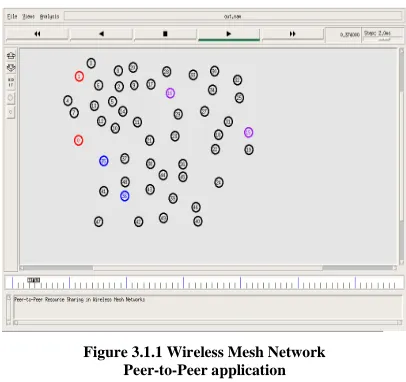
The Wireless Mesh Network involves the application of successful realization of scalable P2P approaches. Mesh network has been formed. Any node in the network can act as both client and server according to need of resources since peer to peer applications have been used. The mobile clients in the network use these applications for file sharing or resource sharing. In the proposed work the distributed hash table is used by every peer node in the network for evaluating the location of the resources in network.
Figure 3.1.1 Wireless Mesh Network Peer-to-Peer application
The indexing is done in the hash table for providing faster lookup and also to reduce the response time of the queries generated by peer nodes in network. The communication takes place between the nodes within the transmission range of the peers which involves in communication. The two tier architecture for file or resource sharing is assumed in peer nodes wireless mesh network.
The lower tier of the architecture is made of mobile mesh clients, which provide the content or the resources to be shared in this system. The upper tier of the architecture is composed of stationary mesh routers, which can implement a Distributed Hash Table (DHT) and that is used to locate file or resources within the network. The routers are assumed stationary and plugged, but they can be switched on or off during network lifetime.
97
The stabilize operation is performed to make updates of the Distributed Hash Table (DHT) and beacon broadcast messages have been emitted by the nodes in the network to indicate their presence in the network. This stabilize operation must be frequently done in the highly dynamic network so that the current status of the network is maintained. The stabilize operation is done for every thirty seconds in the network.
3.2 Chord operations and location awareness
Location awareness is used for the identification of the node position in the network where the required resource has been stored. When the client node wants resource for its execution then the particular node will check the distributed hash table. This table acts as the pointer and will store the details of the resources in the network and its location.
The required resource node will get the IP address of the node which contains the resources. Location awareness is designed to map neighboring peers to close by IDs in the unit ring. The idea is to exploit locality, and to assign peers which are close in the physical network with close-by IDs in the unit ring. Most of the messages are exchanged between a peer and its successor or predecessor in the unit ring. This location awareness is very effective in reducing message overhead.
The reduction can be as high as to twenty percent in the almost static scenario, while it sometimes may differ in the highly dynamic networks.
The proposed framework Meshchord implements the operation of Chord as reference to the standard wired network. Then mapping of predecessor (u)’s and successor (u)’s IDs to peers which are physical neighbors of u are performed.
Also assigning of the remaining u’s physical neighbors faraway IDs in the unit ring. The Chord is implemented based on the lookup operation. The lookup operation is invoked at any peer to find the IP address of the peer with its respective ID. Lookup operations are used both for query resolution and for overlay maintenance. To speed up lookup operations, every peer maintains a table of distinct peers.
Figure 3.2.1 Location Awareness
Join or leave operations are carried out by each peer maintaining its predecessor’s ID in the Chord ring. When a lookup operation is invoked at peer and the operation that is invoked cannot be resolved locally, a message is sent to the peer with largest ID in the network which can be resolved.
3.2.1 Dynamic joining and leaving peers
When a new peer p joins the network, it first needs to initialize its predecessor and finger table. This is done by sending requests to any peer currently joining the network peer p is aware of (called hook peer). Then, the finger tables and predecessor pointers of currently active peers must be updated to account for the new peer joining the network. Finally, peer p must contact its successor s in the ring so that the key range previously managed by s can be split with p.
Figure 3.2.1.1 Chord Operations
In case no (active) hook peer can be found, the join operation fails, and the peer cannot join the Chord overlay. When an existing peer p leaves the network, it first informs its predecessor and successor in the ring about its intention of leaving the network, so that the finger tables and predecessor pointers are changed accordingly; then, peer p transfers to its successor the key range it is responsible for.
Finally, in order to deal with dynamic network conditions, each active peer in the network periodically performs a Stabilize operation, which verifies and possibly updates the content of the finger table and predecessor pointer.
3.3 Meshchord peer-to-peer multiple applications
98
available in the MAC layer due to the 1-hop broadcast communication occurring in wireless networks.
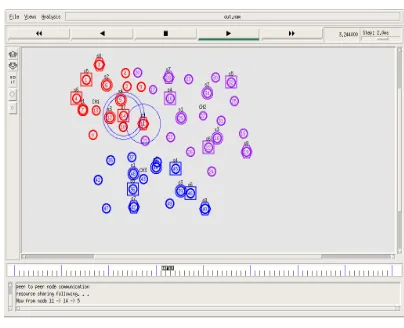
The concept of cross layer is that a peer captures packets for which it owns relevant information. The cross layering is able to resolve a lookup request, is physically close to the peer invoking the lookup operation, while they are far away in the unit ring. The applications are to be executed one by one since only limited numbers of messages are to be transmitted in the network.
Figure 3.3.1 Resource sharing within a single application
The proposed work exploits multiple applications to be
executed. The message overhead is reduced without
compromising any of application layer performance. The large number of messages does not cause congestion and the performance is improved.
This result in reducing message overhead since the single application overhead executed in the cluster relatively will be less when compared with the overhead produced by the entire network. Three applications have been deployed in this wireless mesh network.
They are Transmission Control Protocol (TCP), User Datagram Protocol (UDP) and the File Transfer Protocol (FTP). The TCP is a process to process that is program to program connection oriented protocol. The prior connection establishment is done before communication takes place. This is also reliable since when a message has been send along the TCP socket and the message will be reached to the destination unless connection established is failed completely.
The acknowledgment method is used to ensure the reach of the required message. The ordering of the messages sent is maintained until the message is reached at the destination. The UDP is a connectionless and unreliable protocol. There is no connection establishment made before communication between nodes in the network. This protocol is used for transferring of messages which is less sensitive and which require only request response communications.
The acknowledgment is not been send to ensure the arrival of the message and so this provides unreliable transmission. The FTP used to bulk of data or files from one host to another in the network. FTP uses two connections between
hosts. One connection is used for data transfer and other connection is used for control information. The control connection remains open during entire session. But separate data connection is used for each file transfer.
3.4 Cross application communication
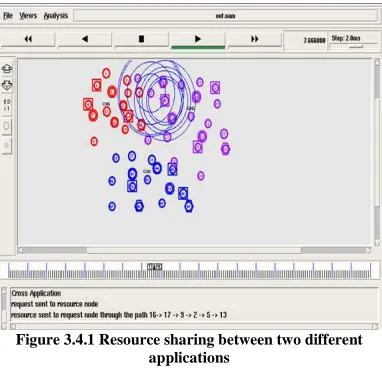
In this wireless mesh network three applications are deployed within each cluster. But this forms only the logical separations to be maintained in the network for the ease of identification of the resources with the help of its type. The Transmission control protocol (TCP), User datagram protocol (UDP) and File Transfer Protocol (FTP) applications are deployed between the peer nodes in wireless mesh network. The resources are logically separated in the network and deployed in each application.
There may be situations for which a process need resource that may belong another application. Only when the resource request is resolved the task is completed successfully. This can also be accomplished for the efficient resource sharing among the nodes in the network. The application interface will provide the request to be resolved and the transmission will take place with other node that belongs to different application. The transmission or the communication between nodes may take place only on the chord links. The messages are passed to the destination on the one hop broadcast nature communication basis. If the messages cannot be transmitted when the signals are blocked, then the intermediate nodes will capture the packets and transmit the packets later when the route to the destination is not blocked. By doing this the information retrieval performance has been increased and occurring of data loss is reduced.
99
Figure 3.4.1 Resource sharing between two differentapplications
If the messages cannot be transmitted when the signals are blocked, then the intermediate nodes will capture the packets and transmit the packets later when the route to the destination is not blocked. By doing this the information retrieval performance has been increased and occurring of data loss is reduced.
4. PERFORMANCE OF THE MESHCHORD
The final part of the proposal describes the performance of Wireless Mesh Network in the part of file or resource sharing. The performance metrics used for comparison with the existing Meshchord are message overhead, query resolution time, query response time and successful join ratio. The performance of Wireless Mesh Network Peer to Peer file or resource sharing location awareness map neighboring peers to nearby IDs in the unit ring.
The ID mapping function works on mapping of the predecessor and successor IDs to peers which are physical neighbors and assign the remaining peer node physical neighbors faraway IDs in the unit ring.
In the presence of location-aware peer ID assignment, cross layering is beneficial to the performance of the P2P application. The cross layering is used to extract information from MAC layer. The Meshchord for multiple peer to peer applications is successful in implementing the file or resource sharing applications in wireless mesh networks.
With packet-level simulations, Meshchord reduces message overhead to 25% and improve the throughput to nearly 15% for multiple applications in P2P resource / file sharing. It also improves the information retrieval performance.
The performance evaluated of Chord and of the proposed
specialization Meshchord on mesh networks using Network Simulator-2. The contribution of location awareness and MAC cross layering on Chord performance, only location awareness is implemented in one Chord version and in another Chord version only MAC cross-layering is implemented.
Two network topologies such as Grid, random uniform are considered in the simulation. The scalable source routing algorithms can be used in combination with the P2P algorithms. For instance, the extensive simulation results reported and show that Virtual Ring Routing displays performance similar to the Dynamic Source Routing in the stationary networks of the moderate size.
A certain number of queries are generated during Chord lifetime. Queries are generated uniformly over time. The results of four different sets of simulations, focusing on the effect of increasing the number n of peers, changing the number of join or leave events in the simulated time interval, changing the query rate, and different types of background traffic, on Meshchord performance.
In general, Meshchord performance appears to be relatively resilient to the presence of background traffic even when multiple applications are executed without reducing the performance of application layer at dynamic conditions in network which is not provided in the case of Chord design.
5. CONCLUSION
The proposed specialization of the basic Chord approach called Meshchord exploits peculiar features of Wireless Mesh Networks such as location awareness and 1-hop broadcast nature of wireless communications to improve performance. Also the proposed system is to be utilized for implementing the file or resource sharing applications in wireless mesh networks.
From the basic Chord design, the proposed Meshchord protocol provides reduction in message overhead, and improvement in information retrieval performance. This performance allows an effective realization of the P2P overlay also under dynamic network conditions and in presence of considerable background traffic.
The improved Meshchord allows coexisting of multiple applications without any performance degradation of the application layer.
The message overhead is reduced when high numbers of messages have been transmitted in the network and also avoids congestion. The response time of queries are reduced since the faster lookup operations are performed and applications are executed concurrently. Thus the Meshchord provide an effective peer-to-peer resource sharing in Wireless Mesh Network and increase the performance level.
REFERENCES
[1] Claudia canali, Maria Elena Renda, Paolo Santi and Simone Burresi (March 2010) ‘Enabling Efficient Peer to Peer Resource Sharing in Wireless Mesh Networks’ IEEE Transactions on Mobile Computing, VOL. 9, NO. 3.
100
Study’ Proc. IEEE Int’l Symp.World of Wireless, Mobile and Multimedia (WoWMoM).
[3] Caesar, M. Castro, M. Nightingale, E.B O’Shea, G. and Rowstron, R. (2006) ‘Virtual Ring Routing: Network Routing Inspired by DHTs’ Proc. ACM SIGCOMM, pp. 351-362.
[4] Conti, M. Gregori, E. and Turi, G. (May 2005) ‘A Cross-Layer Optimization of Gnutella for Mobile Ad Hoc Networks’ Proc. ACM MobiHoc.
[5] Cramer, C. and Fuhrmann, T. (2006) ‘Performance Evaluation of Chord in Mobile Ad Hoc Networks’ Proc. ACM Int’l Workshop Decentralized Resource Sharing in Mobile Computing and Networking (MobiShare), pp. 48-53.
[6] Desnoyers, P. Ganesan, D. and Shenoy P. (Nov. 2005) ‘TSAR: A Two Tier Sensor Storage Architecture Using Interval Skip Graphs’ Proc. ACM Conf. Embedded Networked Sensor Systems (SenSys).
[7] Fuhrmann, T. (2005) ‘Scalable Routing for Networked Sensors and Actuators’ Proc. IEEE Comm. Soc. Conf. Sensor and Ad Hoc Comm. Networks (SECON), pp. 240-251.
[8] Galluccio, L. Morabito, G. Palazzo, S. Pellegrini, M. Renda, M.E and Santi, P. (June 2007) ‘Georoy: A Location-Aware Enhancement to Viceroy Peer-to-Peer Algorithm’ Computer Networks, vol. 51, no. 8, pp. 379-398.
[9] Gotz, S. Landsiedel, O. and Wehrle, K. (2006) ‘Towards Scalable Mobility in Distributed Hash Tables’ Proc. IEEE Conf. Peer-to-Peer Computing.
[10] Conti, M. Delmastro, F. Passarella, A. and (2006) ‘XScribe: A Stateless, Cross-Layer Approach to P2P Multicast in Multi-Hop Ad Hoc Networks’ Proc. ACM Int’l Workshop Decentralized Resource Sharing in Mobile Computing and Networking (MobiShare), pp. 6-11.
[11] Johnson, D.B and Maltz, D.A (1996) ‘Dynamic Source Routing in Ad Hoc Wireless Networks’ Mobile Computing, vol. 353, pp. 153181.