Integrated Annotation for Biomedical Information Extraction
Seth Kulick and Ann Bies and Mark Liberman and Mark Mandel
and Ryan McDonald and Martha Palmer and Andrew Schein and Lyle Ungar
University of Pennsylvania
Philadelphia, PA 19104
skulick,bies,myl
@linc.cis.upenn.edu,
[email protected],
ryantm,mpalmer,ais,ungar
@cis.upenn.edu
Scott Winters and Pete White
Division of Oncology,
Children’s Hospital of Philadelphia
Philadelphia, Pa 19104
winters,white
@genome.chop.edu
Abstract
We describe an approach to two areas of biomedical information extraction, drug opment and cancer genomics. We have devel-oped a framework which includes corpus anno-tation integrated at multiple levels: a Treebank containing syntactic structure, a Propbank con-taining predicate-argument structure, and an-notation of entities and relations among the en-tities. Crucial to this approach is the proper characterization of entities as relation compo-nents, which allows the integration of the entity annotation with the syntactic structure while retaining the capacity to annotate and extract more complex events. We are training statis-tical taggers using this annotation for such ex-traction as well as using them for improving the annotation process.
1
Introduction
Work over the last few years in literature data mining for biology has progressed from linguistically unsophisti-cated models to the adaptation of Natural Language Pro-cessing (NLP) techniques that use full parsers (Park et al., 2001; Yakushiji et al., 2001) and coreference to ex-tract relations that span multiple sentences (Pustejovsky et al., 2002; Hahn et al., 2002) (For an overview, see (Hirschman et al., 2002)). In this work we describe an ap-proach to two areas of biomedical information extraction, drug development and cancer genomics, that is based on developing a corpus that integrates different levels of se-mantic and syntactic annotation. This corpus will be a resource for training machine learning algorithms useful for information extraction and retrieval and other data-mining applications. We are currently annotating only
abstracts, although in the future we plan to expand this to full-text articles. We also plan to make publicly available the corpus and associated statistical taggers.
We are collaborating with researchers in the Division of Oncology at The Children’s Hospital of Philadelphia, with the goal of automatically mining the corpus of can-cer literature for those associations that link specified variations in individual genes with known malignancies. In particular we are interested in extracting three entities (Gene, Variation Event, and Malignancy) in the follow-ing relationship: Gene X with genomic Variation Event Y is correlated with Malignancy Z. For example, WT1 is
deleted in Wilms Tumor #5. Such statements found in the
literature represent individual gene-variation-malignancy observables. A collection of such observables serves two important functions. First, it summarizes known relationships between genes, variation events, and ma-lignancies in the cancer literature. As such, it can be used to augment information available from curated pub-lic databases, as well as serve as an independent test for accuracy and completeness of such repositories. Second, it allows inferences to be made about gene, variation, and malignancy associations that may not be explicitly stated in the literature, both at the fact and entity instance lev-els. Such inferences provide testable hypotheses and thus future research targets.
The other major area of focus, in collaboration with researchers in the Knowledge Integration and Discov-ery Systems group at GlaxoSmithKline (GSK), is the ex-traction of information about enzymes, focusing initially on compounds that affect the activity of the cytochrome P450 (CYP) family of proteins. For example, the goal is to see a phrase like
Amiodarone weakly inhibited CYP2C9, CYP2D6, and CYP3A4-mediated activities
with Ki values of 45.1–271.6
and extract the facts
amiodarone inhibits CYP2C9 with Ki=45.1-271.6 amiodarone inhibits CYP2D6 with
Ki=45.1-271.6 amiodarone inhibits CYP3A4 with
Ki=45.1-271.6
Previous work at GSK has used search algorithms that are based on pattern matching rules filling template slots. The rules rely on identifying the relevant passages by first identifying compound names and then associating them with a limited number of relational terms such as inhibit or inactivate. This is similar to other work in biomedical extraction projects (Hirschman et al., 2002).
Creating good pattern-action rules for an IE problem is far from simple. There are many complexities in the dif-ferent ways that a relation can be expressed in language, such as syntactic alternations and the heavy use of co-ordination. While sufficiently complex patterns can deal with these issues, it requires a good amount of time and effort to build such hand-crafted rules, particularly since such rules are developed for each specific problem. A corpus that is annotated with sufficient syntactic and se-mantic structure offers the promise of training taggers for quicker and easier information extraction.
The corpus that we are developing for the two differ-ent application demands consists of three levels of anno-tation: the entities and relations among the entities for the oncology or CYP domain, syntactic structure (Treebank), and predicate-argument structure (Propbank). This is a novel approach from the point-of-view of NLP since pre-vious efforts at Treebanking and Propbanking have been independent of the special status of any entities, and pre-vious efforts at entity annotation have been independent of corresponding layers of syntactic and semantic struc-ture. The decomposition of larger entities into compo-nents of a relation, worthwhile by itself on conceptual grounds for entity definition, also allows the component entities to be mapped to the syntactic structure. These entities can be viewed as semantic types associated with syntactic constituents, and so our expectation is that au-tomated analyses of these related levels will interact in a mutually reinforcing and beneficial way for development of statistical taggers. Development of such statistical tag-gers is proceeding in parallel with the annotation effort, and these taggers help in the annotation process, as well as being steps towards automatic extraction.
In this paper we focus on the aspects of this project that have been developed and are in production, while also trying to give enough of the overall vision to place the work that has been done in context. Section 2 dis-cusses some of the main issues around the development
of the guidelines for entity annotation, for both the on-cology and inhibition domains. Section 3 first discusses the overall plan for the different levels of annotation, and then focuses on the integration of the two levels currently in production, entity annotation and syntactic structure. Section 4 describes the flow of the annotation process, including the development of the statistical taggers men-tioned above. Section 5 is the conclusion.
2
Guidelines for Entity Annotation
Annotation has been proceeding for both the oncology and the inhibition domains. Here we give a summary of the main features of the annotation guidelines that have been developed. We have been influenced in this by pre-vious work in annotation for biomedical information ex-traction (Ohta et al., 2002; Gaizauskas et al., 2003). How-ever, we differ in the domains we are annotating and the design philosophy for the entity guidelines. For exam-ple, we have been concentrating on explicit concepts for entities like genes rather than developing a wide-range ontology for the various physical instantiations.
2.1 Oncology Domain
Gene Entity For the sake of this project the defini-tion for ”Gene Entity” has two significant characteristics. First, ”Gene” refers to a composite entity as opposed to the strict biological definition. As has been noted by oth-ers, there are often ambiguities in the usage of the en-tity names. For example, it is sometimes unclear as to whether it is the gene or protein being referenced, or the same name might refer to the gene or the protein at dif-ferent locations in the same document. Our approach to this problem is influenced by the named entity annota-tion in the Automatic Content Extracannota-tion (ACE) project (Consortium, 2002), in which “geopolitical” entities can have different roles, such as “location” or “organization”. Analogously, we consider a “gene” to be a composite en-tity that can have different roles throughout a document. Standardization of ”Gene” references between different texts and between gene synonyms is handled by exter-nally referencing each instance to a standard ontology (Ashburner et al., 2000).
provides us with an evoked entity representing the spe-cific instance of a gene.
Variation Events as Relations Variations comprise a relationship between the following entities: Type (e.g.
point mutation, translocation, or inversion), Location
(e.g. codon 14, 1p36.1, or base pair 278), Original-State (e.g. Alanine), and Altered-State (e.g. Thymine). These four components represent the key elements necessary to describe any genomic variation event. Variations are often underspecified in the literature, frequently having only two or three of these specifications. Characterizing individual variations as a relation among such compo-nents provides us with a great deal of flexibility: 1) it al-lows us to capture the complete variation event even when specific components are broadly spaced in the text, often spanning multiple sentences or even paragraphs; 2) it pro-vides us with a convenient means of tracking anaphora between detailed descriptions (e.g. a point mutation at
codon 14 and summary references (e.g. this variation);
and 3) it provides a single structure capable of capturing the breadth of variation specifications (e.g. A- T point mutation at base pair 47, A48- G or t(11;14)(q13;32)).
Malignancy The guidelines for malignancy annotation are under development. We are planning to define it in a manner analogous to variation, whereby a Malignancy is composed of various attribute types (such as developmen-tal stage, behavior, topographic site, and morphology).
2.2 CYP Domain
In the CYP Inhibition annotation task we are tagging three types of entities:
1. CYP450 enzymes (cyp)
2. other substances (subst)
3. quantitative measurements (quant)
Each category has its own questions and uncertain-ties. Names like CYP2C19 and cytochrome P450
en-zymes proclaim their membership, but there are many
aliases and synonyms that do not proclaim themselves, such as 17,20-lyase. We are compiling a list of such names.
Other substances is a potentially huge and
vaguely-delimited set, which in the current corpus includes
grape-fruit juice and red wine as well as more obviously
bio-chemical entities like polyunsaturated fatty acids and
ery-thromycin. The quantitative measurements we are
di-rectly interested in are those didi-rectly related to inhibition, such as IC50 and K(i). We tag the name of the measure-ment, the numerical value, and the unit. For example, in the phrase ...was inhibited by troleandomycin (ED50 = 1
microM), ED50 is the name, 1 the value, and microM the
unit. We are also tagging other measurements, since it is easy to do and may provide valuable information for future IE work.
3
Integrated Annotation
As has been noted in the literature on biomedical IE (e.g., (Pustejovsky et al., 2002; Yakushiji et al., 2001)), the same relation can take a number of syntactic forms. For example, the family of words based on inhibit occurs commonly in MEDLINE abstracts about CYP enzymes (as in the example in the introduction) in patterns like A
inhibited B, A inhibited the catalytic activity of B, inhibi-tion of B by A, etc.
Such alternations have led to the use of pattern-matching rules (often hand-written) to match all the rele-vant configurations and fill in template slots based on the resulting pattern matches. As discussed in the introduc-tion, dealing with such complications in patterns can take much time and effort.
Our approach instead is to build an annotated corpus in which the predicate-argument information is annotated on top of the parsing annotations in the Treebank, the re-sulting corpus being called a “proposition bank” or Prop-bank. This newly annotated corpus is then used for train-ing processors that will automatically extract such struc-tures from new examples.
In a Propbank for biomedical text, the types of
in-hibit examples listed above would consistently have their
compounds labeled as Arg0 and their enzymes labeled as Arg1, for nominalized forms such as A is an inhibitor of
B, A caused inhibition of B, inhibition of B by A, as well
the standard A inhibits B. We would also be able to la-bel adjuncts consistently, such as the with prepositional phrase in CYP3A4 activity was decreased by L, S and F
with IC(50) values of about 200 mM. In accordance with
other Calibratable verbs such as rise, fall, decline, etc., this phrase would be labeled as an Arg2-EXTENT, re-gardless of its syntactic role.
A Propbank has been built on top of the Penn Tree-bank, and has been used to train “semantic taggers”, for extracting argument roles for the predicates of interest, regardless of the particular syntactic context.1
Such semantic taggers have been developed by using machine learning techniques trained on the Penn Prop-bank (Surdeanu et al., 2003; Gildea and Palmer, 2002; Kingsbury and Palmer, 2002). However, the Penn Tree-bank and PropTree-bank involve the annotation of Wall Street Journal text. This text, being a financial domain, differs in significant ways from the biomedical text, and so it is
1
The Penn Propbank is complemented by NYU’s Nom-bank project (Meyers, October 2003), which includes tagging of nominal predicate structure. This is particular relevant for the biomedical domain, given the heavy use of nominals such
necessary for this approach to have a corpus of biomed-ical texts such as MEDLINE articles annotated for both syntactic structure (Treebanking) and shallow semantic structure (Propbanking).
In this project, the syntactic and semantic annotation is being done on a corpus which is also being annotated for entities, as described in Section 2. Since semantic tag-gers of the sort described above result in semantic roles assigned to syntactic tree constituents, it is desirable to have the entities correspond to syntactic constituents so that the semantic roles are assigned to entities. The en-tity information can function as type information and be taken advantage of by learning algorithms to help charac-terize the properties of the terms filling specified roles in a given predicate.
This integration of these three different annotation lev-els, including the entities, is being done for the first time2,
and we discuss here three main challenges to this corre-spondence between entities and constituents: (1) entities that are large enough to cut across multiple constituents, (2) entities within prenominal modifiers, and (3) coordi-nation.3
Relations and Large Entities One major area of con-cern is the possibility of entities that contain more than one syntactic constituent and do not match any node in the syntax tree. For example, as discussed in Section 2, a variation event includes material on a variation’s type, lo-cation, and state, and can cut not only across constituents, but even sentences and paragraphs. A simple example is
point mutations at codon 12, containing both the nominal
(the type of mutation) and following NP (the location). Note that while in isolation this could also be considered one syntactic constituent, the NP and PP together, the ac-tual context is ...point mutations at codon 12 in
duode-nal lavage fluid.... Since all PPs are attached at the same
level, at codon 12 and in duodenal lavage fluid are sis-ters, and so there is no constituent consisting of just point
mutations at codon 12.
Casting the variation event as a relation between dif-ferent component entities allows the component entities to correspond to tree constituents, while retaining the ca-pacity to annotate and search for more complex events. In this case, one component entity point mutations
cor-2
An influential precursor to this integration is the system de-scribed in (Miller et al., 1996). Our work is in much the same spirit, although the representation of the predicate-argument structure via Propbank and the linkage to the entities is quite different, as well as of course the domain of annotation.
3
There are cases where the entities are so minimal that they are contained within a NP, not including the determiner, such as
CpG site in the NP a CpG site. entities. We are not as concerned
about these cases since we expect that such entity information properly contained within a base NP can be associated with the full base NP.
responds to a (base) NP node, and at codon 12 is corre-sponds to the PP node that is the NP’s sister. At the same time, the relation annotation contains the information re-lating these two constituents.
Similarly, while the malignancy entity definition is cur-rently under development, as mentioned in Section 2.1, a guiding principle is that it will also be treated as a relation and broken down into component entities. While this also has conceptual benefits for the annotation guidelines, it has the fortunate effect of making such otherwise syntax-unfriendly malignancies as colorectal adenomas
contain-ing early cancer and acute myelomonocytic leukemia in remission amenable for mapping the component parts to
syntactic nodes.
Entities within Prenominal Modifiers While we are for the most part following the Penn Treebank guide-lines (Bies et al., 1995), we are modifying them in two important aspects. One concerns the prenominal mod-ifiers, which in the Penn Treebank were left flat, with no structure, but in this biomedical domain contain much of the information - e.g., cancer-associated autoimmune
antigen. Not only would this have had no annotation
for structure, but even more bizarrely, cancer-associated would have been a single token in the Penn Treebank, thus making it impossible to capture the information as to what is associated with what. We have developed new guidelines to assign structure to prenominal entities such as breast cancer, as well as changed the tokenization guidelines to break up tokens such as cancer-associated.
Coordination We have also modified the treebank an-notation to account for the well-known problem of enti-ties that are discontinuous within a coordination structure - e.g., K- and ras, where the entities are K-ras and
H-ras. Our annotation tool allows for discontinuous entities,
so that both K-ras and H-ras are annotated as genes.
Under standard Penn Treebank guidelines for tokeniza-tion and syntactic structure, this would receive the flat structure
NP
K- and H-ras
in which there is no way to directly associate the entity
K-ras with a constituent node.
We have modified the treebank guidelines so that K-ras and H-ras are both constituents, with the ras part of K-ras represented with an empty category co-indexed with ras in H-ras:4.
4
NP
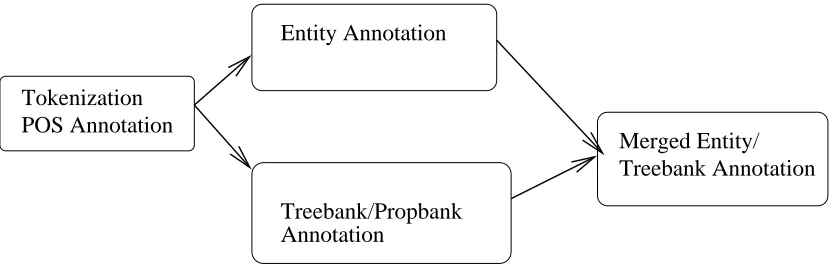
We are currently annotating MEDLINE abstracts for both the oncology and CYP domains. The flowchart for the annotation process is shown in Figure 1. Tokenization, POS-tagging, entity annotation (both domains), and tree-banking are in full production. Propbank annotation and the merging of the entities and treebanking remain to be integrated into the current workflow. The table in Fig-ure 2 shows the number of abstracts completed for each annotation area.
The annotation sequence begins with tokenization and part-of-speech annotating. While both aspects are simi-lar to those used for the Penn Treebank, there are some differences, partly alluded to in Section 3. Tokens are somewhat more fine-grained than in the Penn Treebank, so that H-ras, e.g., would consist of three tokens: H, -, and ras.
Tokenized and part-of-speech annotated files are then sent to the entity annotators, either for oncology or CYP, depending on which domain the abstract has been chosen for. The entities described in Section 2 are annotated at this step. We are using WordFreak, a Java-based linguis-tic annotation tool5, for annotation of tokenization, POS,
and entities. Figure 3 is a screen shot of the oncology do-main annotation, here showing a variation relation being created out of component entities for type and location.
In parallel with the entity annotation, a file is tree-banked - i.e., annotated for its syntactic structure. Note that this is done independently of the entity annotation. This is because the treebanking guidelines are relatively stable (once they were adjusted for the biomedical do-main as described in Section 3), while the entity defini-tions can require a significant period of study before sta-bilizing, and with the parallel treatment the treebanking can proceed without waiting for the entity annotation.
However, this does mean that to produce the desired integrated annotation, the entity and treebanking annota-tions need to be merged into one representation. The con-sideration of the issues described in Section 3 has been carried out for the purpose of allowing this integration of the treebanking and entity annotation. This has been completed for some pilot documents, but the full merging remains to be integrated into the workflow system.
5
http://www.sf.net/projects/wordfreak
As mentioned in the introduction, statistical taggers are being developed in parallel with the annotation effort. While such taggers are part of the final goal of the project, providing the building blocks for extracting entities and relations, they are also useful in the annotation process itself, so that the annotators only need to perform correc-tion of automatically tagged data, instead of starting from scratch.
Until recently (Feb. 10), the part-of-speech annotation was done by hand-correcting the results of tagging the data with a part-of-speech tagger trained on a modified form of the Penn Treebank.6 The tagger is a
maximum-entropy model utilizing the opennlp package available athttp://www.sf.net/projects/opennlp. It has now been retrained using 315 files (122 from the oncology domain, 193 from the cyp domain). Figure 4 shows the improvement of the new vs. the old POS tag-ger on the same 294 files that have been hand-corrected. These results are based on testing files that have already been tokenized, and thus are an evaluation only of the POS tagger and not the tokenizer. While not directly comparable to results such as (Tateisi and Tsujii, 2004), due to the different tag sets and tokenization, they are in the same general range.7
The oncology and cyp entity annotation, as well as the treebanking are still being done fully manually, although that will change in the near future. Initial results for a tag-ger to identify the various components of a variation re-lation are promising, although not yet integrated into an-notation process. The tagger is based on the implementa-tion of Condiimplementa-tional Random Fields (Lafferty et al., 2001) in the Mallet toolkit (McCallum, 2002). Briefly, Condi-tional Random Fields are log-linear models that rely on weighted features to make predictions on the input. Fea-tures used by our system include standard pattern match-ing and word features as well as some expert-created reg-ular expression features8. Using 10-fold cross-validation
on 264 labelled abstracts containing 551 types, 1064
lo-6
Roughly, Penn Treebank tokens were split at hyphens, with the individual components then sent through a Penn Treebank-trained POS tagger, to create training data for another POS
tag-ger. For example (JJ York-based)is treated as (NNP
York) (HYPH -) (JJ based). While this works rea-sonably well for tokenization, the POS tagger suffered severely from being trained on a corpus with such different properties.
7
The tokenizer has also been retrained and the new tokenizer is being used for annotation, although although we do not have the evaluation results here.
8
e.g., chr|chromosome
Merged Entity/
Treebank Annotation
Tokenization
Entity Annotation
POS Annotation
Treebank/Propbank
Annotation
Figure 1: Annotation Flow
Annotation Task Start Date Annotated Documents Part-of-Speech Tagging 8/22/03 422
Entity Tagging 9/12/03 414 Treebanking 1/8/04 127
Figure 2: Current Annotation Production Results
Tagger Training Material Token Instances Old Sections 00-15 Penn Treebank 773832
New 315 abstracts 103159
Tagger Overall Accuracy Number Token Instances Accuracy on Accuracy on Unseen in Training Data Unseen Seen
Old 88.53% 14542 58.80% 95.53%
New 97.33% 4096 85.05% 98.02%
(Testing Material: 294 abstracts from the oncology domain, with 76324 token instances.)
Figure 4: Evaluation of Part-of-Speech Taggers
cations and 557 states, we obtained the following results:
Entity Precision Recall F-measure
Type 0.80 0.72 0.76 Location 0.85 0.73 0.79 State 0.90 0.80 0.85 Overall 0.86 0.75 0.80
An entity is considered correctly identified if and only if it matches the human labeling by both category (type, location or state) and span (from position a to position b). At this stage we have not distinguished between initial and final states.
While it is difficult to compare taggers that tag different types of entities (e.g., (Friedman et al., 2001; Gaizauskas et al., 2003)), CRFs have been utilized for state-of-the-art results in NP-chunking and gene and protein tagging (Sha and Pereira, 2003; McDonald and Pereira, 2004) Currently, we are beginning to investigate methods to identify relations over the varia-tion components that are extracted using the entity tagger.
5
Conclusion
We have described here an integrated annotation ap-proach for two areas of biomedical information extrac-tion. We discussed several issues that have arisen for this integration of annotation layers. Much effort has been spent on the entity definitions and how they relate to the higher-level concepts which are desired for extraction. There are promising initial results for training taggers to extract these entities.
Next steps in the project include: (1) continued anno-tation of the layers we are currently doing, (2) integra-tion of the level of predicate-argument annotaintegra-tion, and (3) further development of the statistical taggers, includ-ing taggers for identifyinclud-ing relations over their component entities.
Acknowledgements
The project described in this paper is based at the In-stitute for Research in Cognitive Science at the Uni-versity of Pennsylvania and is supported by grant EIA-0205448 from the National Science Foundation’s Infor-mation Technology Research (ITR) program.
We would like to thank Aravind Joshi, Jeremy Lacivita, Paula Matuszek, Tom Morton, and Fernando Pereira for their comments.
References
M. Ashburner, C.A. Ball, J.A. Blake, D. Botstein, H. But-ler, J.M. Cherry, A.P. Davis, K. Dolinski, S.S. Dwight, J.T. Eppig, M.A. Harris, D.P. Hill, L. Issel-Tarver, A. Kasarskis, S. Lewis, J.C. Matese, J.E. Richardson, M. Ringwald, G.M. Rubin, and G. Sherlock. 2000. Gene ontology: Tool for the unification of biology.
Nature Genetics, 25(1):25–29.
Ann Bies, Mark Ferguson, Karen Katz, and Robert Mac-Intyre. 1995. Bracketing guidelines for Treebank II Style, Penn Treebank Project. Tech report MS-CIS-95-06, University of Pennsylvania, Philadelphia, PA.
Linguistic Data Consortium. 2002. Entity de-tection and tracking - phase 1 - EDT and metonymy annotation guidelines version 2.5 20021205. http://www.ldc.upenn.edu/Projects/ACE /PHASE2/Annotation/.
Carol Friedman, Pauline Kra, Hong Yu, Michael Krauthammer, and Andrey Rzhetsky. 2001. Genies: a natural-language processing system for the extraction of molecular pathways from journal articles. ISMB
(Supplement of Bioinformatics), pages 74–82.
R. Gaizauskas, G. Demetriou, P. Artymiuk, and P. Wil-lett. 2003. Bioinformatics applications of information extraction from journal articles. Journal of
Bioinfor-matics, 19(1):135–143.
U. Hahn, M. Romacker, and S. Schulz. 2002. Creating knowledge repositories from biomedical reports: The MEDSYNDIKATE text mining system. In
Proceed-ings of the Pacific Rim Symposium on Biocomputing,
pages 338–349.
Lynette Hirschman, Jong C. Park, Junichi Tsuji, Limsoon Wong, and Cathy H. Wu. 2002. Accomplishments and challenges in literature data mining for biology.
Bioin-formatics Review, 18(12):1553–1561.
Paul Kingsbury and Martha Palmer. 2002. From Tree-bank to PropTree-bank. In Proceedings of the 3rd
Interna-tional Conference on Language Resources and Evalu-ation (LREC2002), Las Palmas, Spain.
John Lafferty, Andrew McCallum, and Fernando Pereira. 2001. Conditional random fields: Probabilistic models for segmenting and labeling sequence data. In Proc.
18th International Conf. on Machine Learning, pages
282–289. Morgan Kaufmann, San Francisco, CA.
Andrew Kachites McCallum. 2002. Mal-let: A machine learning for language toolkit. http://mallet.cs.umass.edu.
Ryan McDonald and Fernando Pereira. 2004. Identify-ing gene and protein mentions in text usIdentify-ing conditional random fields. In A Critical Assessment of Text
Min-ing Methods in Molecular Biology workshop. To be
presented.
Adam Meyers. October, 2003. Nombank. Talk at Auto-matic Content Extraction (ACE) PI Meeting, Alexan-dria, VA.
Scott Miller, David Stallard, Robert Bobrow, and Richard Schwartz. 1996. A fully statistical approach to natural language interfaces. In Aravind Joshi and Martha Palmer, editors, Proceedings of the
Thirty-Fourth Annual Meeting of the Association for Compu-tational Linguistics, pages 55–61, San Francisco.
Mor-gan Kaufmann Publishers.
Tomoko Ohta, Yuka Tateisi, Jin-Dong Kim, and Jun’ici Tsuji. 2002. The GENIA corpus: An annotated corpus in molecular biology domain. In Proceedings of the
10th International Conference on Intelligent Systems for Molecular Biology.
J. Park, H. Kim, and J. Kim. 2001. Bidirectional in-cremental parsing for automatic pathway identification with combinatory categorial grammar. In Proceedings
of the Pacific Rim Symposium on Biocomputing, pages
396–407.
J. Pustejovsky, J. Castano, and J. Zhang. 2002. Robust relational parsing over biomedical literature: Extract-ing inhibit relations. In ProceedExtract-ings of the Pacific Rim
Symposium on Biocomputing, pages 362–373.
Fei Sha and Fernando Pereira. 2003. Shallow parsing with conditional random fields. In Proceeds of Human
Language Technology-NAACL 2003.
Mihai Surdeanu, Sanda Harabagiu, John Williams, and Paul Aarseth. 2003. Using predicate-argument struc-tures for information extraction. In Proceedings of
ACL 2003, Sapporo, Japan.
Yuka Tateisi and Jun-ichi Tsujii. 2004. Part-of-speech annotation of biology research abstracts. In
Proceed-ings of LREC04. To be presented.
A. Yakushiji, Y. Tateisi, Y. Miyao, and J. Tsujii. 2001. Event extraction from biomedical papers using a full parser. In Proceedings of the Pacific Rim Symposium