Improved-Edit-Distance Kernel for Chinese Relation Extraction
Wanxiang Che
School of Computer Sci. and Tech. Harbin Institute of Technology
Harbin China, 150001 [email protected]
Jianmin Jiang, Zhong Su, Yue Pan IBM CRL
Beijing China, 100085 {jiangjm, suzhong, panyue}@cn.ibm.com
Ting Liu
School of Computer Sci. and Tech. Harbin Institute of Technology
Harbin China, 150001 [email protected]
Abstract
In this paper, a novel kernel-based method is presented for the problem of relation extraction between named entities from Chinese texts. The ker-nel is defined over the original Chi-nese string representations around par-ticular entities. As a kernel func-tion, the Improved-Edit-Distance (IED) is used to calculate the similarity be-tween two Chinese strings. By em-ploying the Voted Perceptron and Sup-port Vector Machine (SVM) kernel ma-chines with the IED kernel as the clas-sifiers, we tested the method by extract-ingperson-affiliationrelation from Chi-nese texts. By comparing with tradi-tional feature-based learning methods, we conclude that our method needs less manual efforts in feature transformation and achieves a better performance.
1 Introduction
Relation extraction (RE) is a basic and impor-tant problem in information extraction field. It extracts the relations among the named enti-ties. Examples of relations areperson-affiliation, organization-location, and so on. For example, in the Chinese sentence “ IBM
” (Gerstner is the chairman of IBM Corpora-tion.), the named entities are (people) and IBM (organization). The relation between them isperson-affiliation.
Usually, we can regard RE as a classification problem. All particular entity pairs are found from a text and then decided whether they are a relation which we need or not.
At the beginning, a number of manually en-gineered systems were developed for RE prob-lem (Aone and Ramos-Santacruz, 2000). The automatic learning methods (Miller et al., 1998; Soderland, 1999) are not necessary to have some-one on hand with detailed knowledge of how the RE system works, or how to write rules for it.
Usually, the machine learning method repre-sents the NLP objects as feature vectors in the feature extraction step. The methods are named feature-based learning methods. But in many cases, data cannot be easily represented explicitly via feature vectors. For example, in most NLP problems, the feature-based representations pro-duce inherently local representations of objects, for it is computationally infeasible to generate features involving long-range dependencies. On the other hand, finding the suitable features of a particular problem is a heuristic work. Their ac-quisition may waste a lot of time.
Haussler (1999) and Watkins (1999) proposed a new kernel method based on discrete structures respectively. Lodhi et al. (2002) used string ker-nels to solve the text classification problem. Ze-lenko et al. (2003) used the kernel methods for extracting relations from text. They defined the kernel function over shallow parse represen-tation of text. And the kernel method is used in conjunction with the SVM and the Voted Percep-tron learning algorithms for the task of extracting person-affiliationandorganization-location rela-tions from text.
As mentioned above, the discrete structure ker-nel methods are more suitable to RE problems than the feature-based methods. But the string-based kernel methods only consider the word forms without their semantics. Shallow parser based kernel methods need shallow parser sys-tems. Because the performance of shallow parser systems is not high enough until now, especially for Chinese text, we cannot depend on it com-pletely.
To cope with these problems, we propose the Improved-Edit-Distance (IED) algorithm to cal-culate the kernel (similarity) function. We con-sider the semantic similarity between two words in two strings and some structure information of strings.
The rest of the paper is organized as follows. In Section 2, we introduce the kernel-based machine learning algorithms and their application in nat-ural language processing problems. In Section 3, we formalize the relation extraction problem as a machine learning problem. In Section 4, we give a novel kernel method, named the IED kernel method. Section 5 describes the experiments and results on a particular relation extraction problem. In Section 6, we discuss the reason why the IED based kernel method yields a better result than other methods. Finally, in Section 7, we give the conclusions and comments on the future work.
2 Kernel-based Machine Learning
Most machine learning methods represent an ob-ject as a feature vector. They are well-known feature-based learning methods.
Kernel methods (Cristianini and Shawe-Taylor, 2000) are an attractive alternative to feature-based methods. The kernel methods retain the original
representation of objects and use the object only via computing a kernel function between a pair of objects. As we know, a kernel function is a similarity function satisfying certain properties.
There are a number of learning algorithms that can operate using only the dot product of exam-ples. We call them kernel machines. For in-stance, the Perceptron learning algorithm (Cris-tianini and Shawe-Taylor, 2000), Support Vector Machine (SVM) (Vapnik, 1998) and so on.
3 Relation Extraction Problem
We regard the RE problem as a classification learning problem. We only consider the relation between two entities in a sentence and no rela-tions across sentences. For example, the
sen-tence “ IBM
” (President Bush met Gerstner, the chair-man of IBM Corporation.) contains three enti-ties, (people), (people) and IBM
(organization). The three entities form two candidateperson-affiliationrelation pairs:
-IBM and -IBM . The
con-texts of the entities pairs produce the examples for the binary classification problem. Then, from the context examples, a classifier can decide
-IBM is a realperson-affiliationrelation but -IBM is not.
3.1 Feature-based Methods
The feature-based methods have to transform the context into features. Expert knowledge is re-quired for deciding which elements or their com-binations thereof are good features. Usually these features’ values are binary (0 or 1).
The feature-based methods will cost lots of la-bor to find suitable features for a particular appli-cation field. Another problem is that we can either select only the local features with a small win-dow or we will have to spend much more training and test time. At the same time, the feature-based methods will not use the combination of these fea-tures.
3.2 Kernel-based Methods
string form of objects and consider the similarity function between two objects. For the problem of the person-affiliation relation extraction, the ob-jects are the context aroundpeopleand organiza-tion with a fixed window size w. It means that we getwwords around each entity as the samples in the classification problem. Again considering
the example “ IBM
”, withw = 2, the object for the pair (people) and IBM (organization) can
be written as “ ORG PEO ”
Through the objects transformed from the origi-nal texts, we can calculate the similarity between any two objects by using the kernel (similarity) function.
For the Chinese relation extraction problem, we must consider the semantic similarity between words and the structure of strings while comput-ing similarity. Therefore we must consider the kernel function which has a good similarity mea-sure. The methods for computing the similarity between two strings are: the same-word based method (Nirenburg et al., 1993), the thesaurus based method (Qin et al., 2003), the Edit-Distance method (Ristad and Yianilos, 1998) and the statis-tical method (Chatterjee, 2001). We know that the same-word based method cannot solve the prob-lem of synonyms. The thesaurus based method can overcome this difficulty but does not con-sider the structure of the text. Although the Edit-Distance method uses the structure of the text, it also has the same problem of the replacement of synonyms. As for the statistical method, it needs large corpora of similarity text and thus is difficult to use for realistic applications.
For the reasons described above, we propose a novel Improved-Edit-Distance (IED) method for calculating the similarity between two Chinese strings.
4 IED Kernel Method
Like normal kernel methods, the new IED nel method includes two components: the ker-nel function and the kerker-nel machine. We use the IED method to calculate the semantic similarity between two Chinese strings as the kernel func-tion. As for the kernel machine, we tested the Voted Perceptron with dual form and SVM with a customized kernel. In the following subsections,
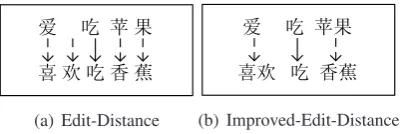
(a) Edit-Distance (b) Improved-Edit-Distance
Figure 1: The comparison between the Edit-Distance and the Improved-Edit-Edit-Distance
we will introduce the kernel function, the IED method, and kernel machines.
4.1 Improved-Edit-Distance
Before the introduction to IED, we will give a brief review of the classical Edit-Distance method (Ristad and Yianilos, 1998).
The edit distance between two strings is de-fined as: Theminimumnumber of edit operations necessary to transform one string into another. There are three edit operations, Insert, Delete, and Replace. For example, in Figure 1(a), the edit dis-tance between “ (like apples)” and “
(like bananas)” is 4, as indicated by the four dotted lines.
As we see, the method of computing the edit distance between two Chinese strings cannot re-flect the actual situation. First, the Edit-Distance method computes the similarity measured in Chi-nese character. But in ChiChi-nese, most of the char-acters have no concrete meanings, such as “ ”, “ ” and so on. The single character cannot ex-press the meanings of words. Second, the cost of the Replace operation is different for different words. For example, the operation of “ (love)” being replace by “ (like)” should have a small cost, because they are synonyms. At last, if there are a few words being inserted into a string, the meaning of it should not be changed too much. Such as “ (like apples)” and “
(like sweet apples)” are very similar.
Based on the above idea, we provide the IED method for computing the similarity between two Chinese strings. It means that we will use Chinese words as the basis of our measurement (instead of characters). By using a thesaurus, the similarity between two Chinese words can be computed. At the same time, the cost of the Insert operation is reduced.
the thesaurus resource to compute the similarity between two Chinese words. In CiLin, the se-mantics of words are divided into High, Middle, and Low classes to describe a semantic system from general to special semantic. For example: “ (apple)” isBh07, “ (banana)” isBh07, “ (tomato)” isBh06, and so on.
The semantic distance between word A and word B can be defined as:
Dist(A, B) = min
a∈A,b∈Bdist(a, b)
whereAandBare the semantic sets of word A and word B respectively. The distance be-tween semantic a and b is: dist(a, b) = 2 ∗ (3−d), whered means that the semantic code is different from the dth class. If the seman-tic code is same, then the semanseman-tic distance is 0. Therefore, Dist( ) = 0 and
Dist( ) = 2.
Table 1 defines the variations of the edit dis-tance on string “AB” after doing various edit op-erations. Where, “∗” denotes one to four words, “A” and “B” are two words which user inputs. X’ denotes the synonyms of X.
Table 1: The Variations of Edit-Distance with AB Rank Pattern
1 AB
2 A∗B
3 AB’; A’B 4 A∗B’; A’∗B 5 A’; B’
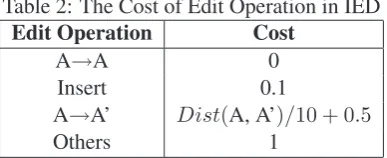
According to Table 1, we can define the cost of various edit operations in IED. See Table 2, where “→” denotes the delete operation.
Table 2: The Cost of Edit Operation in IED Edit Operation Cost
A→A 0
Insert 0.1
A→A’ Dist(A, A’)/10 + 0.5
Others 1
By the redefinition of the cost of edit opera-tions, the computation of IED between “
” and “ ” is as shown Figure 1(b), where the Replace cost of “ ”→“ ” is 0.5
and “ ”→“ ” is 0.7. Thus the cost of IED is 1.2. Compared with the cost of classical Edit-Distance, the cost of IED is much more appropri-ate in the actual situation.
We use dynamic programming to compute the IED similar with the computing of edit distance.
In order to compute the similarity between two strings, we should convert the distance value into a similarity. Empirically, the maximal similarity is set to be 10. The similarity is 10 minus the improved edit distance of two Chinese strings.
4.2 Kernel Machines
We use the Voted Perceptron and SVM algorithms as the kernel machines here.
The Voted Perceptron algorithm was described in (Freund and Schapire, 1998). We used SVMlight(Joachims, 1998) with custom kernel as the implementation of the SVM method. In our experiments, we just replaced the custom kernel with the IED kernel function.
5 Experiments and Results
In this section, we show how to extract the person-affiliation relation from text and give some experimental results. It is relatively straightforward to extend the IED kernel method to other RE problems.
The corpus for our experiments comes from Bejing Youth Daily1. We annotated about 500 news with named entities ofPEOandORG. We selected 4,200 sentences (examples) with both PEO andORG pairs as described in Section 3. There are about 1,200 positive examples and 3,000 negative examples. We took about 2,500 random examples as training data and the rest of about 1,700 examples as test data.
5.1 Infection of Window Size in Kernel Methods
The change of the performance of the IED kernel method varying while the window sizewis shown in Table 3. Here the Voted Perceptron is used as the kernel machine.
Our experimental results show that the IED kernel method got the best performance with the highest F-Score when the window size w =
2. Aswgrows, theP recision becomes higher. With smallerw’s, theRecallbecomes higher.
5.2 Comparison between Feature and Kernel Methods
For the feature-based methods implementation, we use the words which are around thePEOand theORGentities and their POS. The window size isw(See Section 3). All examples can be trans-formed into feature vectors. We used the regular-ized winnow learning algorithm (Zhang, 2001) to train on the training data and predict the test data. From the experimental results, we find that when
w = 2, the performance of feature-based method is highest.
The comparison of the performance between the feature-based and the kernel-base methods is shown in Table 4.
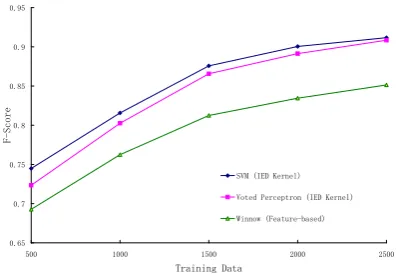
Figure 2 displays the change of F-Score for different methods varying with the training data size.
Figure 2: The learning curve (ofF-Score) for the
person-affiliationrelation, comparing IED kernel
with feature-based algorithms
Table 3: The Performance Effected byw w P recision Recall F-Score
1 66.67% 92.68% 77.55% 2 93.55% 87.80% 90.85% 3 94.23% 74.36% 83.12%
Table 4: The Performance Comparison
P recision Recall F-Score
Regularized Winnow 75.90% 96.92% 85.14% Voted Perceptron 93.55% 87.80% 90.85% SVM 94.15% 88.38% 91.17%
From Table 4 and Figure 2, we can see that the IED kernel methods perform better for theperson-affiliationrelation extraction problem than for the feature-based methods.
Figure 2 shows that the Voted Perceptron method gets close to, but not as good as, the per-formance to the SVM method on the RE problem. But when using the method, we can save signifi-cantly on computation time and programming ef-fort.
6 Discussion
Our experimental results show that the kernel-based and the feature-kernel-based methods can get the best performance with the highestF-Scorewhen the window sizew = 2. This shows that for re-lation extraction problem, the two words around entities are the most significant ones. On the other hand, withwbecoming bigger, theP recision be-comes higher. And withwbecoming smaller, the
Recallbecomes higher.
From Table 4 and Figure 2, we can see that the IED kernel methods perform very well for theperson-affiliationrelation extraction. Further-more, it does not need an expensive feature selec-tion stage like feature-based methods. Because the IED kernel method uses the semantic similar-ity between words, it can get a better extension. We can conclude that the IED kernel method re-quires much fewer examples than feature-based methods for achieving the same performance.
For example, there is a test sentence “
IBM ” (Chairman
Hu Jintao met the CEO of IBM Corporation). The feature-based method judges the -IBM
as a person-affiliation relation, because the context around and IBM is similar with the context of theperson-affiliationrelation. However, the IED kernel method does the correct judgment based on the structure information. For this case the IED kernel method gets a higher pre-cision. At the same time, because the IED kernel method considers the extension of synonyms, its recall does not decrease very much.
time. Therefore, it becomes a key problem to im-prove the efficiency of the computing of the ker-nel function.
7 Conclusions
We presented a new approach for using kernel-based machine learning methods for extracting re-lations between named entities from Chinese text sources. We define kernels over the original rep-resentations of Chinese strings around the partic-ular entities and use the IED method for comput-ing the kernel function. The kernel-based meth-ods need not transform the original expression of objects into feature vectors, so the methods need less manual efforts than the feature-based meth-ods. We applied the Voted Perceptron and the SVM learning method with custom kernels to ex-tract theperson-affiliationrelations. The method can be extended to extract other relations between entities, such as organization-location, etc. We also compared the performance of kernel-based methods with that of feature-based methods, and the experimental results show that kernel-based methods are better than feature-based methods.
Acknowledgements
This research has been supported by National Natural Science Foundation of China via grant 60435020 and IBM-HIT 2005 joint project.
References
Chinatsu Aone and Mila Ramos-Santacruz. 2000. Rees: A large-scale relation and event extraction system. InProceedings of the 6th Applied Natural Language Processing Conference, pages 76–83.
Niladri Chatterjee. 2001. A statistical approach for similarity measurement between sentences for EBMT. InProceedings of Symposium on Transla-tion Support Systems STRANS-2001, Indian Insti-tute of Technology, Kanpur.
N. Cristianini and J. Shawe-Taylor. 2000. An Intro-duction to Support Vector Machines. Cambridge University Press, Cambirdge University.
Yoav Freund and Robert E. Schapire. 1998. Large margin classification using the perceptron algo-rithm. InComputational Learning Theory, pages 209–217.
David Haussler. 1999. Convolution kernels on dis-crete structures. Technical Report UCSC-CRL-99-10, 7,.
Thorsten Joachims. 1998. Text categorization with support vector machines: learning with many rele-vant features. InProceedings of ECML-98, number 1398, pages 137–142, Chemnitz, DE.
Huma Lodhi, Craig Saunders, John Shawe-Taylor, Nello Cristianini, and Chris Watkins. 2002. Text classification using string kernels. J. Mach. Learn. Res., 2:419–444.
Jiaju Mei, Yiming Lan, Yunqi Gao, and Hongxiang Yin. 1996. Chinese Thesaurus Tongyici Cilin (2nd Edtion). Shanghai Thesaurus Press, Shanghai.
Scott Miller, Michael Crystal, Heidi Fox, Lance Ramshaw, Richard Schwartz, Rebecca Stone, Ralph Weischedel, and the Annotation Group. 1998. Algorithms that learn to extract information– BBN: Description of the SIFT system as used for MUC. InProceedings of the Seventh Message Un-derstanding Conference (MUC-7).
S. Nirenburg, C. Domashnev, and D.J. Grannes. 1993. Two approaches to matching in example-based ma-chine translation. In Proceedings of the Fifth In-ternational Conference on Theoretical and Method-ological Issues in Machine Translation, pages 47– 57, Kyoto, Japan.
Bing Qin, Ting Liu, Yang Wang, Shifu Zheng, and Sheng Li. 2003. Chinese question answering sys-tem based on frequently asked questions. Jour-nal of Harbin Institute of Technology, 10(35):1179– 1182.
Eric Sven Ristad and Peter N. Yianilos. 1998. Learn-ing strLearn-ing-edit distance. IEEE Transactions on Pat-tern Analysis and Machine Intelligence, 20(5):522– 532.
Stephen Soderland. 1999. Learning information ex-traction rules for semi-structured and free text. Ma-chine Learning, 34(1-3):233–272.
Vladimir N. Vapnik. 1998. Statistical Learning The-ory. Wiley.
Chris Watkins. 1999. Dynamic alignment kernels. Technical Report CSD-TR-98-11, 1,.
Dmitry Zelenko, Chinatsu Aone, and Anthony Richardella. 2003. Kernel methods for relation ex-traction. J. Mach. Learn. Res., 3:1083–1106.