Proofread Sentence Generation as Multi-Task Learning
with Editing Operation Prediction
Yuta Hitomi1 Hideaki Tamori1 Naoaki Okazaki2 Kentaro Inui3 1Media Lab, The Asahi Shimbun Company
2 Tokyo Institute of Technology
3Tohoku University, RIKEN Center Advanced Intelligence Project
{hitomi-y1, tamori-h}@asahi.com, [email protected] [email protected]
Abstract
This paper explores the idea ofrobot ed-itors, automated proofreaders that enable journalists to improve the quality of their articles. We propose a novel neural model of multi-task learning that both gener-ates proofread sentences and predicts the editing operations required to rewrite the source sentences and create the proofread ones. The model is trained using logs of the revisions made professional editors re-vising draft newspaper articles written by journalists. Experiments demonstrate the effectiveness of our multi-task learning ap-proach and the potential value of using re-vision logs for this task.
1 Introduction
There is growing research interest in automatic sentence generation (Vinyals et al., 2015; Rush et al.,2015;Sordoni et al.,2015). Coincidentally (or inevitably), media companies have increas-ingly attempted to createrobot journaliststhat can automatically generate content, mostly using data from limited domains (e.g., earthquakes, sports and stockmarkets) (Clerwall,2014;Carlson,2015;
Dorr,2016). In this paper, we explore the idea of robot editors, i.e., automated proofreaders that en-able journalists to improve the quality of their ar-ticles.
The most closely related field to the topic of this paper is grammatical error correction (Dale and Kilgarriff,2011;Dale et al.,2012;Ng et al.,2013,
2014). However, this task handles only gram-matical errors, whereas proofreading encompasses a variety of tasks:grammatical error correction (GEC), spell checks, simplification, fact check-ing, standardization, compression, paraphrascheck-ing, etc. Another task, the automated evaluation of
sci-entific writing shared task (Daudaravicius et al.,
2016), has the goal of automatically evaluating scientific writing. The focus of this shared task was the binary classification problem of detecting sentences that need improvement. Although the corpus used contained qualitative improvements, the shared task did not tackle high-quality sen-tence generation.
This paper investigates the task of proofread sentence generation (PSG) using logs of the revi-sions made by professional editors to draft news-paper articles written by journalists. The goal of this research is to explore a computational model for improving text quality. To this end, we pro-pose a novel multi-task learning approach that both generates proofread sentences and predicts the editing operations involved in rewriting the source sentences to create the proofread ones.
The contributions of this research are three-folds: (i) This is the first study to explore an en-coderdecoder architecture for PSG. (ii) We show that our proposed multi-task learning method can outperform a state-of-the-art baseline method for GEC. (iii) We also examine the benefits and issues of using revision logs for PSG.
2 Method
Given a source sentence (sequence of words) x1,· · ·, xm, this study addresses the task of
gener-ating the proofread sentencey1,· · · , yn, wherem
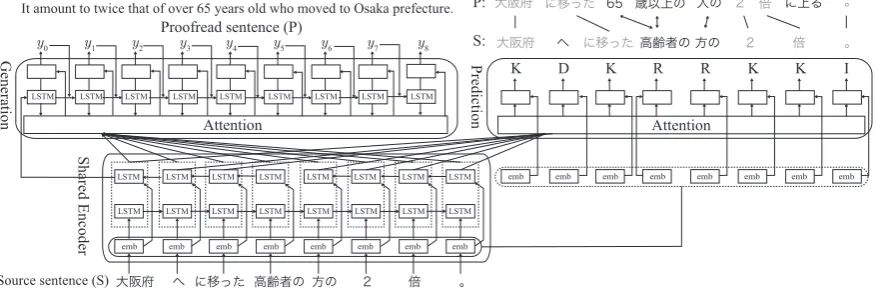
andn denote the number of words in the source and proofread sentences, respectively. Usually, proofreading does not change the content of the input text significantly, and changes only small parts of the text. Thus, detecting source sentence spans that require revision is an important PSG sub-task. This paper explores a multi-task learn-ing approach that both generates proofread sen-tences and predicts the editing operations required.
Attention Attention
K D K R R K K I
It is twice that of the elderly who moved to to Osaka prefecture.
It amount to twice that of over 65 years old who moved to Osaka prefecture.
Generation
P:
S:
Prediction
LSTM
LSTM
LSTM LSTM LSTM LSTM LSTM LSTM LSTM
LSTM LSTM LSTM LSTM LSTM LSTM LSTM
LSTM LSTM LSTM LSTM LSTM LSTM LSTM LSTM LSTM
emb emb emb emb emb emb emb emb
Source sentence (S)
Proofread sentence (P)
Shared Encoder
emb emb emb emb emb emb emb emb
y0 y1 y2 y3 y4 y5 y6 y7 y8
Figure 1: Overview of the neural network model for generating proofread sentences and predicting editing operations via multi-task learning. Boxes labeled ‘emb’ denote word embeddings.
Inspired by work on multi-task learning in neu-ral networks, we implement multi-task learning as an end-to-end neural network with a shared source sentence encoder (Figure 1). The network gener-ates proofread sentences and predicts editing op-erations.Although these two tasks solve the same problem, we believe that these two neural network models focus on different aspects of the data. The generation model considers the source sentence as a whole ( although it may also include an attention mechanism), whereas the prediction model looks at the local contexts of words in order to correct functional word usage, incorrect spellings, and so on. This is why we have designed the proposed method using a multi-task learning approach.
2.1 Generating proofread sentences using an encoderdecoder model with attention
Following recent work on GEC (Yuan and Briscoe,2016), we use an encoder-decoder model with global attention (Luong et al.,2015) to gen-erate proofread sentences. We use bi-directional Long Short-Term Memory (LSTM) to encode the source sentences. LSTMs recurrently compute the memory and hidden vectors at time step s ∈ {1,· · ·, m}using those at time steps−1ors+ 1
and the wordxsin the source sentence, as follows:
[−→hs;−→cs] =−−−−→LSTM(xs,[−→hs−1;−→cs−1]), (1) [←h−s;←−cs] =←−−−−LSTM(xs,[←−hs+1;←−cs+1]). (2)
Here,csandhsrepresent the memory and hidden
vectors, respectively, at time steps. The encoder
output is a concatenation of the hidden vectors:
e
hs= [−→hs;←h−s]. (3)
The decoder computes the memory and hidden vectors at time step t ∈ {1,· · · , n} using those at time stept−1 and the (predicted) wordwt as
follows:
[ht;ct] =−−−−→LSTM(wt,[ht−1;ct−1]). (4)
Here, we seth0 =←h−1andc0 =01. Fort >1, we
feed theyt−1 predicted at the previous time step
back as the input wordwtof the decoder.
The decoder predicts the wordytat time stept
using a softmax layer on top of the vector¯htwith an integrated attention mechanism:
logp(y|x) = t X
n=1
logp(yt|y<t,x), (5)
p(yt|y<t,x) = softmax(Woht¯ ), (6) ¯
ht = tanh(Wr[vt;ht]), (7) vt = X
s
αt(s)hs,e (8)
αt(s) = exp(h
|
tWahse ) P
s0exp(h|tWahse 0) . (9)
Here, vt represents a vector computed by the
at-tention mechanism at time stept, andαt(s)is an
attention score computed at decoding time stept by looking at the source word at encoding time steps.
1The reason for using←−h
1 instead ofhe1 is to speed up
2.2 Editing-operation prediction as a sequential labeling task
In addition to performing sentence revision, we propose to simultaneously undertake an addi-tional task: editing-operation prediction. For-mally, given a source sentence x1,· · · , xm, this
task predicts the sequence of editing operations z1,· · · , zmrequired to obtain the revised sentence
y1,· · · , yn, where each editing operationzikeeps
(K), deletes (D), inserts (I), or replaces (R) the word xi. This task resembles grammatical error
detection.
As explained in Section 3.1, the revision logs do not provide supervised training data for the edit-ing operations, only pairs of source and proof-read sentences. We therefore created pseudo su-pervised training data by running the diff pro-gram on the word sequences of the source and proofread sentences. There are cases where multi-ple sequences of primitive editing-operations can be derived from a pair of sentences. The perfor-mance may be improved if the best operation se-quence. However, we leave this direction out of scope of this paper. To obtain an editing-operation sequence that was the same length as the source sentence (m), we labeled I labels to the words im-mediately following the positions where the actual insert operations were required.
We reuse the vectorehsfor wordxsin the source
sentence (Equation 3) to predictzs:
logp(z|x) =Xm s=1
logp(zs|z<s,x), (10)
p(zs|z<s,x) = softmax(Wltanh(hie )). (11) Liu and Liu(2016) proposed a grammatical er-ror detection method that considers intra-attention. We also explored this approach by replacing the softmax function in Equation 11 with the follow-ing one:
p(zs|z<s,x) = softmax(Wlu¯t) (12) ¯
ut = tanh(Ws[xt;ut]) (13)
us = X
i
βs(i)ehs (14)
βs(i) = exp( e
h|shie )
P
i0exp(he|sehi0)
(15)
Here,us represents a vector computed by the
at-tention mechanism at time steps, andβs(i)is an
attention score computed at time stepsby looking at the source word at time stepi∈ {1,· · · , m}.
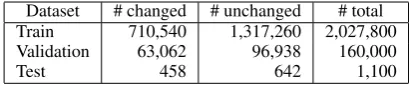
Dataset # changed # unchanged # total Train 710,540 1,317,260 2,027,800 Validation 63,062 96,938 160,000
Test 458 642 1,100
Table 1: The Numbers of instances in each dataset.
2.3 Training
Given a training datasetD, we minimize the fol-lowing multi-task learning loss function:
− X
(x,y,z)∈D
{logp(y|x) + logp(z|x)}. (16)
We also consider a loss function that weights the sub-task loss (Zhang et al.,2014):
− X
(x,y,z)∈D
{logp(y|x) +λlogp(z|x)}. (17)
Here, λ(0 ≤ λ ≤ 1) denotes the weight given to the editing-operation prediction errors, learned through gradient descent. In contrast to conven-tional multi-task learning, which maximizes per-formance for all tasks, our primary goal is to opti-mize the main task which is why we have created a loss function that weights the sub-task differently. 3 Experiments
3.1 Dataset
We used a corpus of Japanese newspaper arti-cles where professional editors at a media com-pany had rewritten draft articles (written by jour-nalists) to create proofread (published) ( Ta-mori et al., 2017). The dataset consists of 2,209,249 sentence pairs in total: 810,227 pairs were changed during the revision process, and 1,399,022 pairs were left unchanged. To focus on revisions within sentence boundaries, we excluded revisions involving sentence splitting or merging. This dataset reflects the real work done by the company to improve the quality of its newspaper articles. The revisions came in a variety of forms, from syntactic changes, such as GEC and spelling normalization to content-level changes, such as elaboration and fact checking. Table 1 shows the number of instances in the training, validation, and test sets.
We split the sentences into words using Sen-tencePiece2 to efficiently reduce the vocabulary
2https://github.com/google/sentencepiece
Dataset Model GLEU Prec Recall F0.5(M2) WER BLEU
Gen 70.14 * * * 24.90 74.02
All pairs Gen + Pred 70.47 * * * 24.23 75.37
Gen + Pred Attn 70.68 * * * 23.90 74.48 Gen + Pred Attn + W 70.57 * * * 37.24 54.76 Gen 67.74 22.27 6.12 14.23 36.74 64.23 Changed pairs Gen + Pred 68.10 23.14 5.59 13.37 35.67 66.29
Gen + Pred Attn 68.63 24.89 6.28 14.84 35.55 65.31 Gen + Pred Attn + W 67.01 36.59 13.30 26.59 48.91 45.82
Gen 86.72 * * * 16.47 82.69
Unchanged pairs Gen + Pred 87.34 * * * 15.51 83.33
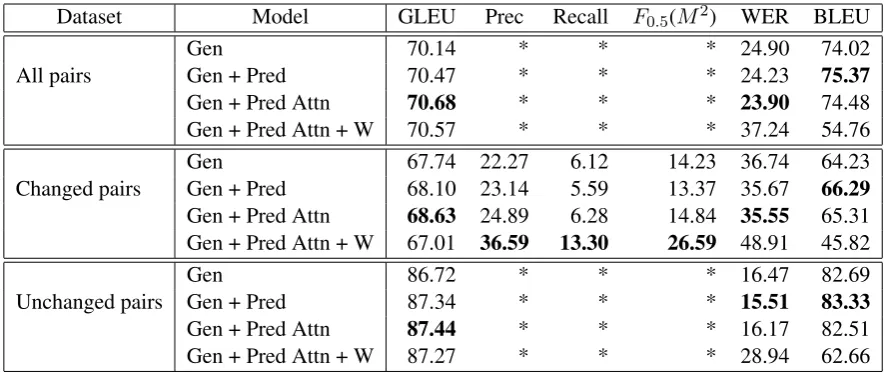
Gen + Pred Attn 87.44 * * * 16.17 82.51 Gen + Pred Attn + W 87.27 * * * 28.94 62.66 Table 2: Performance of the proposed and baseline methods. The asterisks ‘*’ indicate performance values that are unavailable because the precision and recall for unchanged pairs are always 0 and 100.
size. We used proofread sentences (published newspaper articles) to train SentencePiece. Vo-cabulary sizes for the input and output layers were 32,661 and 32,630, respectively. Our model can be trained without unknown words.
3.2 Experimental setup
The batch size was set to 100 and, improve com-putational efficiency, each batch consisted of sen-tences of the same length. The dimensionality of the distributed representations (word embeddings and hidden states) to was 300. The model parame-ters were trained using Adam. Following Jozefow-icz et al.(2015), forget gate bias was initialized to 1.0, and the other gate biases were initialized to 0. In addition, we used dropout (at a rate of 0.2) for the LSTMs. Breadth-first search was used for decoding, with a beam width of 10 (Yuan,2017).
Six measures were utilized to evalu-ate the performance of the PSG model: GLEU (Napoles et al., 2015)3, precision, re-call, M2 score (Dahlmeier and Ng,2012), Word
Error Rate (WER) (Jurafsky and Martin, 2008), and BLEU (Papineni et al.,2002). These measures are often used in GEC and machine translation research. Note that the precision, recall, and M2 score measures excluded words appearing
in both the source and proofread sentences from evaluation (Dahlmeier and Ng,2012).
3.3 Results
Table 2 shows the performance of the proposed method according to the above metrics. Two
vari-3The hyperparameterλof GLEU was set to1.
ants of the proposed method were used: “Gen + Pred” used Equation 11 (without the atten-tion mechanism for predicting edit operaatten-tions), whereas “Gen + Pred Attn” used Equation 12 (with the attention mechanism), and “Gen + Pred Attn + W” used Equations 12 and 17 (weighting the sub-task losses). For comparison, we also re-port the performance of a baseline method “Gen” used only an encoder-decoder model (described in Section 2.1) without multi-task learning.
The multi-task learning models outperformed the baseline encoder-decoder model for all met-rics. The use of intra-attention for predicting editing-operations was also effective, except for the BLEU metric and the WER for unchanged pairs. Unlike BLEU, GLEU includes a mecha-nism for penalizing incorrect ‘reluctant’ revisions (copying words from the source sentences) and rewarding correct ‘aggressive’ revision (adding words that do not appear in the source sentences). We can therefore infer that “Gen + Pred with Attn” model was more aggressive in changing words in the source sentences than “Gen + Pred” model.
The table also shows the models’ performances for changed/unchanged sentence pairs. As ex-pected, the performance metrics for unchanged pairs are higher than those for changed pairs. The low recall values for changed pairs indicate that it is difficult to predict words that do not appear in the source sentences.
However, we can see that weighting sub-task losses improved precision, recall, and M2 score
over-learning the sub-task. That said, the other met-rics decreased because the model made changes in many places where no editing was required.
3.4 Discussion
In this section, we discuss issues with the pre-sented method and dataset. The prepre-sented method was not good at inserting words, particularly when the editor had appended new information to the sentence, as in the following example.
• Source: Soon it will have been six months since the law was established.
• Proofread: On the 19th, it will have been six months since the law was establishedlast September.
It is difficult for a computational model to in-sert the phrases “on the 19th” and “last Septem-ber”. We found that 132 of the 366 changed pairs (28.8%) in the test set included new information. Although this kind of editing improves the quality of the article, it is unrealistic to handle this situa-tion using an encoder-decoder model. It may be useful to separate these pairs from the dataset in future.
We also observed instances in which editors merged pieces of information from multiple sen-tences, particularly so as to yield more concise sentences, as in the following example.
• Source: A meeting where people who heve lost their families to cancer discuss ... .There are ten members in their 30s to 70swho have lost their families to cancer.
• Proofread: A meeting where people who have lost their families to cancer discuss ... .There are ten members in their 30s to 70s.
As a result, it may be worth exploring not only discarding instances where additional information has been added to the proofread sentences but also building a model that considers other sentences appearing near the source sentence.
We also noticed cases where the sentences out-put by the model provide good revisions but did not match to the reference sentences, such as the following.
• Source: The reserve players tackle it franti-callyso they won’tmiss the chance.
• Proofread: The reserve players tackle it fran-ticallyso as not tomisstheopportunity.
• System output: The reserve players tackle it franticallyso as not tomissthe chance. As has often been discussed in the literature on machine translation, summarization, and GEC, es-tablishing a good evaluation metric is an ongoing research issue.
4 Conclusion
In this paper, we have presented a novel multi-task learning approach for combined PGS and editing-operation prediction. Experimental results show that our approach was able to outperform the base-line for all metrics. The experiments also show that newspaper article revision logs can provide promising supervised training data for the model. We plan to continue exploring ways of creating good-quality articles in the future.
Acknowledgments
We thank the anonymous reviewers for their sug-gestions. We also thank Takafumi Ochiai and Yosuke Fukada for their contribution to storing the dataset.
References
Matt Carlson. The robotic reporter. Digital Journal-ism, 3(3):416–431, 2015.
Christer Clerwall. Enter the robot journalist. Journal-ism Practice, 8(5):519–531, 2014.
Daniel Dahlmeier and Hwee Tou Ng. Better evalua-tion for grammatical error correcevalua-tion. In Proceed-ings of the 2012 Conference of the North American Chapter of the Association for Computational Lin-guistics: Human Language Technologies (NAACL 2012), pages 568–572, 2012.
Robert Dale and Adam Kilgarriff. Helping our own: The HOO 2011 pilot shared task. InProceedings of the 13th European Workshop on Natural Language Generation (ENLG 2011), pages 242–249, 2011. Robert Dale, Ilya Anisimoff, and George Narroway.
HOO 2012: A report on the preposition and deter-miner error correction shared task. InProceedings of the Seventh Workshop on Building Educational Applications Using NLP, pages 54–62, 2012. Vidas Daudaravicius, Rafael E Banchs, Elena
Use of NLP for Building Educational Applications, pages 53–62, 2016.
Konstantin Nicholas Dorr. Mapping the field of algo-rithmic journalism. Digital Journalism, 4(6):700– 722, 2016.
Rafal Jozefowicz, Wojciech Zaremba, and Ilya Sutskever. An empirical exploration of recur-rent network architectures. In Proceedings of the 32nd International Conference on Machine Learn-ing (ICML-15), pages 2342–2350, 2015.
Daniel Jurafsky and James H. Martin. Speech and Language Processing : an introduction to natural language processing, computational linguistics, and speech recognition. Prentice Hall, 2008.
Zhuoran Liu and Yang Liu. Exploiting unlabeled data for neural grammatical error detection. CoRR, abs/1611.08987, 2016.
Minh-Thang Luong, Hieu Pham, and Christopher D. Manning. Effective approaches to attention-based neural machine translation. In Proceedings of the 2015 Conference on Empirical Methods in Natural Language Processing (EMNLP 2015), pages 1412– 1421, 2015.
Courtney Napoles, Keisuke Sakaguchi, Matt Post, and Joel Tetreault. Ground truth for grammatical er-ror correction metrics. InProceedings of the 53rd Annual Meeting of the Association for Computa-tional Linguistics and the 7th InternaComputa-tional Joint Conference on Natural Language Processing (ACL-IJCNLP 2015), pages 588–593, 2015.
Hwee Tou Ng, Yuanbin Wu, and Christian Hadiwinoto. The CoNLL-2013 shared task on grammatical error correction. InProceedings of the Seventeenth Con-ference on Computational Natural Language Learn-ing: Shared Task (CoNLL Shared Task 2013), pages 1–12, 2013.
Hwee Tou Ng, Siew Mei Wu, Ted Briscoe, Christian Hadiwinoto, Raymond Hendy Susanto, and Christo-pher Bryant. The CoNLL-2014 shared task on grammatical error correction. InProceedings of the Eighteenth Conference on Computational Natural Language Learning: Shared Task (CoNLL Shared Task 2014), pages 1–14, 2014.
Kishore Papineni, Salim Roukos, Todd Ward, and Wei-Jing Zhu. BLEU: a method for automatic evaluation of machine translation. InProceedings of 40th An-nual Meeting of the Association for Computational Linguistics (ACL 2002), pages 311–318, 2002.
Alexander M. Rush, Sumit Chopra, and Jason Weston. A neural attention model for abstractive sentence summarization. In Proceedings of the 2015 Con-ference on Empirical Methods in Natural Language Processing (EMNLP 2015), pages 379–389, 2015.
Alessandro Sordoni, Michel Galley, Michael Auli, Chris Brockett, Yangfeng Ji, Margaret Mitchell, Jian-Yun Nie, Jianfeng Gao, and Bill Dolan. A neural network approach to context-sensitive gener-ation of conversgener-ational responses. InProceedings of the 2015 Conference of the North American Chap-ter of the Association for Computational Linguis-tics: Human Language Technologies, pages 196– 205, Denver, Colorado, May–June 2015. Associa-tion for ComputaAssocia-tional Linguistics.
Hideaki Tamori, Yuta Hitomi, Naoaki Okazaki, and Kentaro Inui. Analyzing the revision logs of a japanese newspaper for article quality assessment. InProceedings of the 2017 EMNLP Workshop: Nat-ural Language Processing meets Journalism, pages 46–50, Copenhagen, Denmark, September 2017. Association for Computational Linguistics.
Oriol Vinyals, Alexander Toshev, Samy Bengio, and Dumitru Erhan. Show and tell: A neural image cap-tion generator. In the IEEE Conference on Com-puter Vision and Pattern Recognition (CVPR 2015), 2015.
Zheng Yuan. Grammatical error correction in non-native English. Technical Report 904, University of Cambridge, Computer Laboratory, 2017.
Zheng Yuan and Ted Briscoe. Grammatical error correction using neural machine translation. In
Proceedings of the 2016 Conference of the North American Chapter of the Association for Computa-tional Linguistics: Human Language Technologies (NAACL-HLT 2016), pages 380–386, 2016. Zhanpeng Zhang, Ping Luo, Chen Change Loy, and