Transfer Learning across Low-Resource, Related Languages
for Neural Machine Translation
Toan Q. Nguyen and David Chiang Department of Computer Science and Engineeering
University of Notre Dame
{tnguye28,dchiang}@nd.edu
Abstract
We present a simple method to improve neural translation of a low-resource lan-guage pair using parallel data from a re-lated, also low-resource, language pair. The method is based on the transfer method of Zoph et al., but whereas their method ignores any source vocabulary overlap, ours exploits it. First, we split words using Byte Pair Encoding (BPE) to increase vocabulary overlap. Then, we train a model on the first language pair and transfer its parameters, includ-ing its source word embeddinclud-ings, to another model and continue training on the second language pair. Our experiments show that transfer learning helps word-based trans-lation only slightly, but when used on top of a much stronger BPE baseline, it yields larger improvements of up to 4.3 BLEU.
1 Introduction
Neural machine translation (NMT) (Sutskever et al.,2014;Bahdanau et al.,2015) is rapidly prov-ing itself to be a strong competitor to other statisti-cal machine translation methods. However, it still lags behind other statistical methods on very low-resource language pairs (Zoph et al.,2016;Koehn and Knowles,2017).
A common strategy to improve learning of low-resource languages is to use low-resources from re-lated languages (Nakov and Ng,2009). However, adapting these resources is not trivial. NMT of-fers some simple ways of doing this. For example,
Zoph et al.(2016) train aparentmodel on a (pos-sibly unrelated) high-resource language pair, then use this model to initialize a child model which is further trained on a low-resource language pair. In particular, they showed that a French-English
model could be used to improve translation on a wide range of low-resource language pairs such as Hausa-, Turkish-, and Uzbek-English.
In this paper, we explore the opposite sce-nario, where the parent language pair is also low-resource, but related to the child language pair. We show that, at least in the case of three Turkic lan-guages (Turkish, Uzbek, and Uyghur), the origi-nal method ofZoph et al.(2016) does not always work, but it is still possible to use the parent model to considerably improve the child model.
The basic idea is to exploit the relationship between the parent and child language lexicons. Zoph et al.’s original method makes no assump-tion about the relatedness of the parent and child languages, so it effectively makes a random as-signment of the parent-language word embed-dings to child-language words. But if we assume that the parent and child lexicons are related, it should be beneficial to transfer source word embeddings from parent-language words to their child-language equivalents.
Thus, the problem amounts to finding a repre-sentation of the data that ensures a sufficient over-lap between the vocabularies of the languages. To do this, we map the source languages to a common alphabet and use Byte Pair Encoding (BPE) ( Sen-nrich et al.,2016) on the union of the vocabularies to increase the number of common subwords.
In our experiments, we show that transfer learn-ing helps word-based translation, but not always significantly. But when used on top of a much stronger BPE baseline, it yields larger and statisti-cally significant improvements. Using Uzbek as a parent language and Turkish and Uyghur as child languages, we obtain improvements over BPE of 0.8 and 4.3 BLEU, respectively.
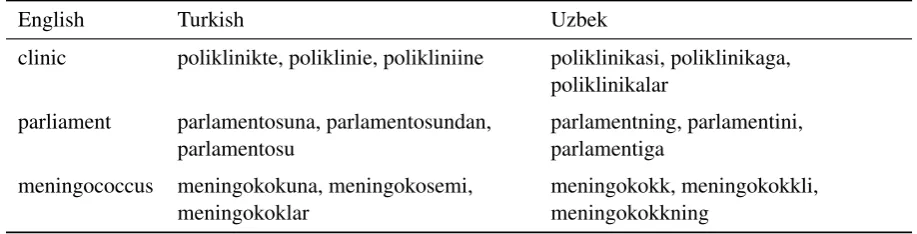
English Turkish Uzbek
clinic poliklinikte, poliklinie, polikliniine poliklinikasi, poliklinikaga, poliklinikalar
parliament parlamentosuna, parlamentosundan,
parlamentosu parlamentning, parlamentini,parlamentiga meningococcus meningokokuna, meningokosemi,
meningokoklar meningokokk, meningokokkli,meningokokkning
Table 1: Some examples of similar words in Turkish and Uzbek that share the same root.
2 Background 2.1 Attentional Model
We use the 2-layer, 512-hidden-unitglobal atten-tional model withgeneralscoring function and in-put feeding by Luong et al.(2015). For the pur-poses of this paper, the most important detail of the model is that (as in many other models) the word types of both the source and target languages are mapped to vector representations calledword embeddings, which are learned automatically with the rest of the model.
2.2 Language transfer
We follow the transfer learning approach proposed by Zoph et al. (2016). In their work, a parent model is first trained on a high-resource language pair. Then the child model’s parameter values are copied from the parent’s and are fine-tuned on its low-resource data.
The source word embeddings are copied with the rest of the model, with theith parent-language word embedding being assigned to the ith child-language word. Because the parent and child source languages have different vocabularies, this amounts to randomly assigning parent source word embeddings to child source words. In other words, even if a word exists in both the parent and child vocabularies, it’s extremely unlikely that it will be assigned the same embedding in both mod-els.
By contrast, because the target language is the same in both the parent and child models, the target word embeddings are frozen during fine-tuning.
2.3 Related languages
The experiments described below are on transla-tion from three Turkic languages to English. The Turkic language family is a group of related
lan-word-based BPE 5k BPE 60k
model toks sents toks sents toks sents
×106 ×103 ×106 ×103 ×106 ×103
Uzb par 1.5 102 2.4 92 1.9 103
Tur chd 0.9 56 1.5 50 1.2 57
Uzb par 1.5 102 2.4 90 2.0 103
Uyg chd 1.7 82 2.1 77 2.0 88
Table 2: Number of tokens and sentences in our training data.
guages with a very wide geographic distribution, from Turkey to northeastern Siberia. Turkic lan-guages are morphologically rich, and have simi-larities in phonology, morphology, and syntax. For instance, in our analysis of the training data, we find many Turkish and Uzbek words sharing the same root and meaning. Some examples are shown in Table1.
2.4 Byte Pair Encoding
BPE (Sennrich et al., 2016) is an efficient word segmentation algorithm. It initially treats the words as sequences of character tokens, then iter-atively finds and merges the most common token pair into one. The algorithm stops after a control-lable number of operations, or when no token pair appears more than once. At test time, the learned merge operations are applied to merge the charac-ter sequences in test data into larger symbols.
3 Method
that the parent and child languages have consider-able vocabulary overlap, and that when a word oc-curs in both languages, it often has a similar mean-ing in both languages. Thus, we need to process the data to make these two assumptions hold as much as possible.
3.1 Transliteration
If the parent and child language have different orthographies, it should help to map them into a common orthography. Even if the two use the same script, some transformation could be ap-plied; for example, we might change French-eur
endings to Spanish-or. Here, we take a minimal-ist approach. Turkish and Uzbek are both written using Latin script, and we did not apply any trans-formations to them. Our Uyghur data is written in Arabic script, so we transliterated it to Latin script using an off-the-shelf transliterator.1 The
translit-eration is a string homomorphism, replacing Ara-bic letters with English letters or consonant clus-ters independent of context.
3.2 Segmentation
To increase the overlap between the parent and child vocabularies, we use BPE to break words into subwords. For the BPE merge rules to not only find the common subwords between two source languages but also ensure consistency be-tween source and target segmentation among each language pair, we learn the rules from the union of source and target data of both the parent and child models. The rules are then used to segment the corpora. It is important to note that this results in a single vocabulary, used for both the source and target languages in both models.
4 Experiments
We used Turkish-, Uzbek-, and Uyghur-English parallel texts from the LORELEI program. We to-kenized all data using the Moses toolkit (Koehn et al.,2007); for Turkish-English experiments, we also truecased the data. For Uyghur-English, the word-based models were trained in the original Uyghur data written in Arabic script; for BPE-based systems, we transliterated it to Latin script as described above.
For the word-based systems, we fixed the vocabulary size and replaced out-of-vocabulary
1https://cis.temple.edu/˜anwar/code/ latin2uyghur.html
words with UNK. We tried different sizes for each language pair; however, each word-based system’s target vocabulary size is limited by that of the child, so we could only use up to 45,000 word types for Turkish-English and 20,000 for Uyghur-English.
The BPE-based systems could make use of big-ger vocabulary size thanks to the combination of both parent and child source and target vocabu-laries. We varied the number of BPE merge op-erations from 5,000 to 60,000. Instead of using a fixed vocabulary cutoff, we used the full vocabu-lary; to ensure the model still learns how to deal with unknown words, we trained on two copies of the training data: one unchanged, and one in which all rare words (whose frequency is less than 5) were replaced with UNK. Accordingly, the num-ber of epochs was halved.
Following common practice, we fixed an up-per limit on training sentence length (discarding longer sentences). Because the BPE-based sys-tems have shorter tokens and therefore longer sen-tences, we set this upper limit differently for the word-based and BPE-based systems to approxi-mately equalize the total size of the training data. This led to a limit of 50 tokens for word-based models and 60 tokens for BPE-based models. See Table2for statistics of the resulting datasets.
We trained using Adadelta (Zeiler,2012), with a minibatch size of 32 and dropout with a dropout rate of 0.2. We rescaled the gradient when its norm exceeded 5. For the Uzbek-English to Turkish-English experiment, the parent and child models were trained for 100 and 50 epochs, respectively. For the Uzbek-English to Uyghur-English experi-ment, the parent and child models were trained for 50 and 200, respectively. As mentioned above, the BPE models were trained for half as many epochs because their data is duplicated.
We used beam search for translation on the dev and test sets. Since NMT tends to favor short translations (Cho et al., 2014), we use the length normalization approach ofWu et al.(2016) which uses a different scores(e| f) instead of log-probability:
s(e| f)= loglpp((ee)| f)
lp(e)= (5(5++|1)e|)αα.
baseline transfer transfer+freeze
BLEU size BLEU size BLEU size
Tur-Eng word-basedBPE 12.4 10k8.1 30k 13.28.5∗† 30k20k 8.6—∗ 30k—
Uyg-Eng word-basedBPE 11.1 10k8.5 15k 10.615.4†‡ 15k8k 8.8—∗ 15k—
Table 3: Whereas transfer learning at word-level does not always help, our method consistently yields a significant improvement over the stronger BPE systems. Scores are case-sensitivetest BLEU. Key:
size=vocabulary size (word-based) or number of BPE operations (BPE). The symbols†and‡indicate statistically significant improvements with p < 0.05 and p < 0.01, respectively, while ∗ indicates a statistically insignificant improvement (p>0.05).
0 10 20 30 40 50
0 5 10 15 20
Tur
-Eng
BLEU
Word-based
baseline transfer transfer+freeze
0 20 40 600
5 10 15 20 BPE-based
baseline transfer
0 5 10 15 20
15 20 25 30
Vocabulary size (×1000)
Uyg-Eng
BLEU
baseline transfer transfer+freeze
0 20 40 6015
20 25 30
Number of BPE operations (×1000) baseline
transfer
task settings train dev
Tur-Eng word-based 30kBPE 20k 58.8% 25.0%3.9% 3.6%
Uyg-Eng word-based 15kBPE 8k 57.2% 48.5%0.5% 1.7%
Table 4: Amount of child’s source types that ap-pear in parent.
We stopped training when the tokenized BLEU score was maximized on the development set. We also optimized the vocabulary size and the number of BPE operations for the word-based and BPE-based systems, respectively, to maximize the tok-enized BLEU on the development set.
After translation at test time, we rejoined BPE segments, recased, and detokenized. Finally, we evaluated using case-sensitive BLEU.
As a baseline, we trained a child model us-ing BPE but without transfer (that is, with weights randomly initialized). We also compared against a word-based baseline (without transfer) and two word-based systems using transfer with-out vocabulary-sharing, corresponding with the method ofZoph et al.(2016) (§2.2): one where the target word embeddings are fine-tuned, and one where they are frozen.
5 Results and Analysis
Our results are shown in Table 3. In this low-resource setting, we find that transferring word-based models does not consistently help. On Turkish-English, both transfer methods give only a statistically insignificant improvement (p>0.05); on Uyghur-English, transfer without freezing tar-get embeddings helps somewhat, but transfer with freezing helps only insignificantly.
In both language pairs, the models that use BPE perform much better than their word-based counterparts. When we apply transfer learning to this much stronger baseline, we find that the rel-ative improvements actually increase; that is, the combined effect of BPE and transfer learning is more than additive. On Turkish-English, the im-provement is+0.8 BLEU over the BPE baseline; on Uyghur-English, a healthy+4.3 over the BPE baseline.
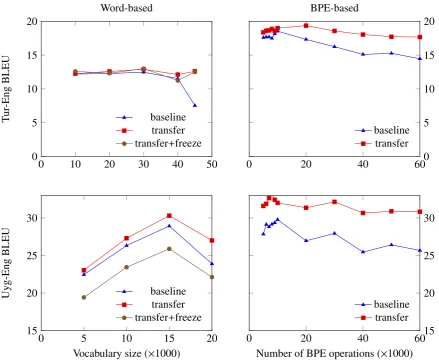
A similar pattern emerges when we examine the best BLEU scores on the development set (Fig-ure1). Whereas word-based transfer methods help
very little for Turkish-English, and help or hurt slightly for Uyghur-English, our BPE-based trans-fer approach consistently improves over both the baseline and transfer word-based models. We sur-mise that the improvement is primarily due to the vocabulary overlap created by BPE (see Table4).
6 Conclusion
In this paper, we have shown that the transfer learning method of Zoph et al.(2016), while ap-pealing, might not always work in a low-resource context. However, by combining it with BPE, we can improve NMT performance on a low-resource language pair by exploiting its lexical similarity with another related, low-resource language. Our results show consistent improvement in two Tur-kic languages. Our approach, which relies on seg-menting words into subwords, seems well suited to agglutinative languages; further investigation would be needed to confirm whether our method works on other types of languages.
7 Acknowledgements
This research was supported in part by University of Southern California subcontract 67108176 un-der DARPA contract HR0011-15-C-0115. Nguyen was supported by a fellowship from the Vietnam Education Foundation. We would like to express our great appreciation to Dr. Sharon Hu for letting us use her group’s GPU cluster (supported by NSF award 1629914), and to NVIDIA corporation for the donation of a Titan X GPU.
References
Dzmitry Bahdanau, Kyunghyun Cho, and Yoshua Ben-gio. 2015. Neural machine translation by jointly learning to align and translate. InProc. ICLR. Kyunghyun Cho, Bart van Merri¨enboer, Dzmitry
Bah-danau, and Yoshua Bengio. 2014. On the properties of neural machine translation: Encoder–decoder ap-proaches. InProc. Workshop on Syntax, Semantics and Structure in Statistical Translation.
Philipp Koehn, Hieu Hoang, Alexandra Birch, Chris Callison-Burch, Marcello Federico, Nicola Bertoldi, Brooke Cowan, Wade Shen, Christine Moran, Richard Zens, et al. 2007. Moses: Open source toolkit for statistical machine translation. InProc. ACL.
Thang Luong, Hieu Pham, and Christopher D. Man-ning. 2015. Effective approaches to attention-based neural machine translation. InProc. EMNLP. Preslav Nakov and Hwee Tou Ng. 2009. Improved
statistical machine translation for resource-poor lan-guages using related resource-rich lanlan-guages. In
Proc. EMNLP.
Rico Sennrich, Barry Haddow, and Alexandra Birch. 2016. Neural machine translation of rare words with subword units. InProc. ACL.
Ilya Sutskever, Oriol Vinyals, and Quoc V Le. 2014. Sequence to sequence learning with neural net-works. InAdvances in Neural Information Process-ing Systems 27.
Yonghui Wu, Mike Schuster, Zhifeng Chen, Quoc V Le, Mohammad Norouzi, Wolfgang Macherey, Maxim Krikun, Yuan Cao, Qin Gao, Klaus Macherey, et al. 2016. Google’s neural machine translation system: Bridging the gap between human and machine translation. arXiv:1609.08144. Matthew D. Zeiler. 2012. ADADELTA: An adaptive
learning rate method. arXiv:1212.5701v1.