905
Application Level Resource Scheduling to Improve QOS
in Cloud Computing
1
B.SivaRama Krishna, 2 Dr.T.V.Rao, 1
Research Scholar, Dept. of Computer Science and Engineering, ANU, India
2
Hod, Dept. of Computer Science and Engineering, PVPSIT, India
Abstract- Application level resource planning for conveyed distributed computing is a critical research target that caught the eye of numerous analysts in ongoing writing. Negligible resource planning disappointments, hearty errand finishing and reasonable resource utilization are the basic variables of the resource booking systems. Consequently, this original copy proposed an adaptable resource booking model for appropriated distributed computing situations that intended to accomplish the planning measurements. The proposed demonstrate called "Application Level Resource Scheduling with Optimal Schedule Interval Filling" plans the resource to individual undertaking to such an extent that the ideal usage of resource sit still time accomplished. The proposed demonstrate plays out the booking in various leveled request and they are ideal sit still resource designation, if no individual resource is found to apportion then it assigns ideal different sit out of gear resources with extensive calendar interims filling. This composition investigates (I) prerequisite of resource booking techniques, (ii) late planning models found in contemporary writing, (iii) strategies and materials utilized and approach of the proposed resource planning methodology (iv)and its favorable position over other benchmarking models. The execution investigation of the proposition done through cross approval of the measurements like load (window of errands) versus misfortune (no of assignments neglected to achieve), undertaking fruition optimality and process overhead in resource planning. The test comes about showing that the proposed display is versatile and hearty under the adjusted measurements.
Keywords: Cloud computing, distributed environment, late pruning, resource scheduling and request processing
I. INTRODUCTION
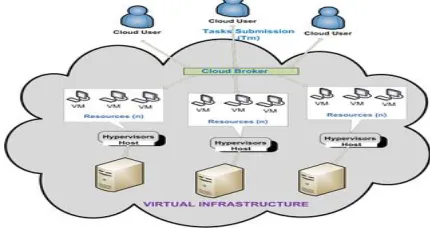
[image:1.612.340.555.445.561.2]Cloud computing is another worldview for circulated registering that conveys foundation, stage, and programming (application) as administrations. These administrations are made accessible as membership based administrations in a compensation as-you-go model to shoppers [3, 2]. Distributed computing helps client applications progressively arrangement the same number of process resources at determined areas (at present US east1a-d for Amazon1) as and whenever required. Additionally, applications can pick the capacity areas to have their information (Amazon S32) at worldwide areas. To productively and cost viably plan the assignments and information of utilizations onto these distributed computing situations, application schedulers have extraordinary strategies that fluctuate as indicated by the goal work: limit add up to execution time, limit add up to cost to execute, balance the heap on resources utilized while meeting the due date requirements of the application, thus forth.
Figure 1. Heuristic resource provisioning in cloud computing with respect to different services.
906 distributed computing [2]. The overpowered request
of distributed computing displays the need of ideal booking of the resources. This can be a huge test, since the heap of errands activated by the clients vacillates powerfully and if resource booking isn't at its ideal, at that point clients discover trouble to center around their own particular business interests [8]. The ideal resource planning observed to be the most noteworthy factor in Service Level Agreements (SLAs) executed amongst suppliers and clients in distributed computing situations [9]. From this time forward, SLA execution disappointments those frequently displayed because of inconsequential resource planning costs the income of the suppliers [10]. In fact, the cloud resource booking is a testing issue for control effective necessities in supplier's specific situation and QoS with regards to clients [11]. Critical commitments in cloud resource booking systems saw in contemporary writing [2], [3], [12]. As indicated by these commitments, the resource booking streamlining affirms to be NP-Hard [3], [4]. Subsequently the ebb and flow analysts are expecting to enhance the resource booking with the end goal that the unpredictability is direct. In this specific circumstance, this original copy proposed a novel cloud resource planning system that displaying the procedure overhead as straight.
II. REVIEW OF LITERATURE
Cloud computing is a creating business facilities show that offers to reduce or clean out the need for companies to keep up in-house high-cost components, software, and network infrastructures. It additionally reduces or even baby wipes out the high-cost of choosing specific experts to enhance these fundamentals and work the in-house IT alternatives [13]. From a generally discussed thought offering many befuddling ideas and ambiguities, Reasoning determining has quickly converted into a creating applying worldview strengthening different alternatives to be given to fascinated customers at lower expenses and higher benefits [14]. Consequently, establishing up a official significance and expression of Reasoning Computing and its requirements is a compressing need. The current NIST significance of Reasoning Computing [15] shows it as a worldview allowing customers to get to allocated configurable handling sources. The NIST significance relies upon on five essential qualities:
Customers can normally profit by the Reasoning alternatives without discussing with the professional co-ops.
Standard conferences are utilized to get to the determining sources over the system.
Reasoning alternatives take after a multi-occupant show allowing sources to be combined and allocated among customers. Computing capabilities can be instantly scaly in
or out in view of the customers' varying demands. Customers pay for used handling capabilities in light of a settlement for each usage display.
Resource allocation and arranging of sources have been an essential part that impact the efficiency of networking, similar, allocated handling and cloud computing. Many scientists have suggested various algorithms for assigning, arranging and climbing the time effectively in the cloud. These contains first come first provide, min-min max min, ant community, circular robin the boy wonder, earliest deceased line first, multiple heuristic, back monitoring, task duplication, inherited criteria, loss and gain simulated annealing, ant community , selfish etc. Various customized scheduling methods like Enhanced Genetic Algorithm, Modified ant community marketing, Prolonged Min-Min have also been suggested by scientists [6-10]. Energy-efficient (Green) source allowance guidelines and arranging methods for cloud handling are suggested. The criteria uses the forecast in making switching off/on the number of running servers/hosts in order to remove nonproductive power intake [11-12].Scheduling techniques in this cloud handling situation should fulfill the goals of customer as well as of support suppliers. Authors have resolved specific problem related to arranging of consumers’ support demands (or applications) on support instances made available by suppliers taking into account costs suffered by both customers and suppliers as the most important factor.
III. BACKGROUND WORK
907 considers the work of each source. Therefore, some
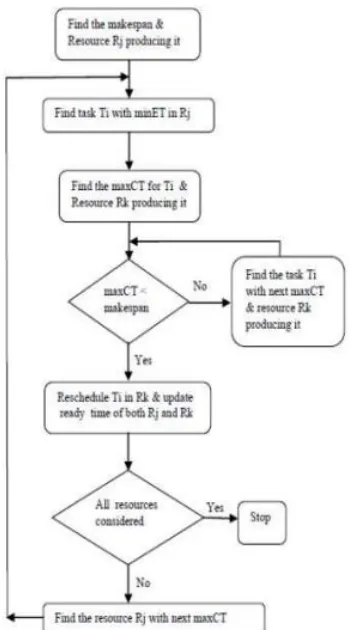
[image:3.612.103.278.145.460.2]resources maybe always get active but some nodes maybe still, as shown in figure 2.
Figure 2. Task scheduling procedure for different resources.
The suggested ILBTS will enhance the load unbalance of the Min-Min and decrease the efficiency time of each source effectively The pseudo rule of ILBTS criteria is showed in Figure 2. It begins by performing Min-Min criteria. After efficiency of the involved criteria, it selects the tiniest dimension procedure from the most large load source and determines the completion time for that procedure on all other sources. Afterwards, the minimum finalization duration of the project is in contrast to the makespan generated by the criteria. If it is less than makespan then the project is reassigned to the source that produce it, and the prepared duration of both sources are modified. The procedure repeat until no other sources can generate less completion here we are at the tiniest procedure on the large load resource than the makespan. Thus the large load sources are freed and the light load or nonproductive sources are
more used. This makes ILBTS to build a plan which improves load controlling and also cuts down on overall finalization time.
IV. METHODOLOGY IMPLEMENTATION
The Resource Scheduling with Schedule Interval Filling (RS-OSIF) is proposed in this original copy works as frontend to resource Allocation Controller. At first, the arrangements of comparative undertakings activated are pooled as a window. The calendar interim filling can be characterized as utilization of the interim time between the match of resource booked circumstances in arrangement. The booking methodology plays out the look for ideal resource for a given errands window in a progressive request. The various leveled request of the scan for ideal resource is as per the following:
A control outline separate to each activated errands window (here after alluded as window) conveys the necessities, for example, expected resource, time to connect with that resource, the span of the window, window entry time and its culmination time.
The landing time of demand window is the total estimation of time required to achieve resource allotment controller, volume of time required to process a control outline.
(
)
(
)
t i
w
t
cfw
i cfw
it
w
Aggregate value of arrival time
t
cf(
w
i)
, offrame control cf, and time of process
cf(
w
i)
andrequired time i
w
t
for different resource controllerwith threshold value
.908 arrangement of resources to meet this booking
criteria, if flopped then chooses at least one resources with maximal booking interims (sit still time between combine of calendar times in grouping) and timetable them to satisfy the prerequisites of the window to be arrived. In the event that both of these cases succeeds, at that point portions the window in to least number of windows with the end goal that resource planning prevails under determined elements. The resource portion to the objective window at planning interims, which is the third level of the proposed booking chain of importance, is investigated in following advances.
1. Schedule different resource for windows wt and
wk expected with arrived time in different
scheduling intervals s0-sn.
2. If any resource schedule fails, then select minimal set of resources which are already scheduled with different time intervals.
3. Scheduling Period start duration of all the selected compatible sources are the same and less than the arrival duration of the screen, and sum of the scheduling duration is bigger than the completion time of the duties discovered in given screen. If found pools all the chosen sources and plans to the target window.
Procedure for implementation of proposed approach for resource scheduling as follows:
Algorithm 1. Procedure for implementation of proposed approach with different steps
In order to carry out the source arranging, RS-OSIF initiates to monitor possible maximum source, if unsuccessful then attempts to section the screen in to two ms windows and performs the arranging of the sources for each partition. Here the operation of segmenting the screen is on demand; hence the segmentation procedure statements little overhead.
V. IMPLEMENTATION RESULTS
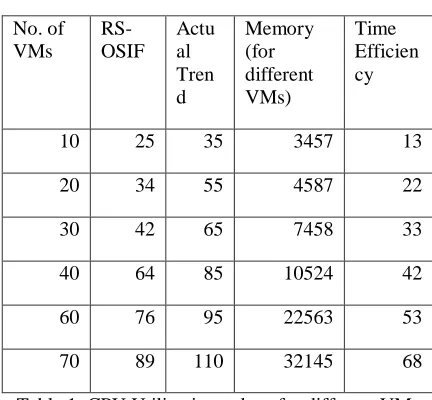
[image:4.612.324.564.311.456.2]We discuss classification accuracy with respect to different resources like CPU, Memory, Mean, Prediction Accuracy and Time analysis of proposed approach in terms of different services utilized by clients. As specified in above sections, we pre-process the data related cloud oriented resources to process different consistency client’s data. Figure 4 and table 1 shows the CPU utilization in resource provisioning in cloud with different services.
Figure 3. CPU Utilization based on different virtual services in cloud.
No. of VMs
RS-OSIF
Actu al Tren d
Memory (for different VMs)
Time Efficien cy
10 25 35 3457 13
20 34 55 4587 22
30 42 65 7458 33
40 64 85 10524 42
60 76 95 22563 53
[image:4.612.323.539.489.689.2]70 89 110 32145 68
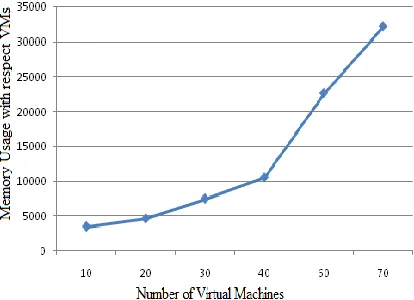
909 Memory usage for different services specified in
Figure 5, it shows different memory storage with different services based on virtual machine readings.
Figure 4. Memory reading for different virtual machine specifications.
[image:5.612.78.285.151.301.2]Execution time for different services from different virtual machines loading and running different services for different users may appear in Figure 6 with different resource utilizations.
Figure 5. Time efficiency for virtual machine utilization based on different services.
Finally, methods related to neural networks with an ideal and basic measure yield predominant forecast precision than mathematical Linear Regression presentations. To accomplish more classification accuracy in projection, the plotted graph models to be prepared with the creation information in a customary interim; along these lines have recursive data in arbiter relations. Be that as it may, construction of development procedure of neural network representations show respective time, the recurrence of the preparation ought to be resolved in light of the
fundamental asset utilization conduct of the application in outsourced cloud.
VI. CONCLUSION
This paper gives a creating way to deal with building a sensible requirements demonstrate for versatile source provisioning in the thinking encourage highly effective and realistic source management, booking and opportunity organization for amazing web based organization programs where explosiveness and responsiveness are merely crucial. All through the assessment, we have analyzed some prolonged machine learning techniques while performing source provisioning in thinking. We shown our recommended requirements systems with regards to the data-set acquired by using TPC-W, is a complete framework, which is settled for web based organization related advantages. We additionally provided assessment measurements to recognizing the truth of the recommended requirements techniques and looked at the performance of the pre-specified techniques using these measurements. The course excellence of used methods is building up and show regular adequacy of classification process i.e. Neurological Network shows and determine source use in the thinking. Further improvement of our recommended approach is to improve source provisioning with specific to improved source marketing in service utilized for cloud computing..
REFERENCES
[1] Sadeka Islam a,b,∗, Jacky Keunga,b,c, Kevin Lee a,b, Anna Liu, ―Empirical prediction models for adaptive resource provisioning in the cloud‖, Future Generation Computer Systems 28 (2012) 155–162. [2] Zhen Xiao, Senior Member, IEEE, Weijia Song, and Qi Chen, ―Dynamic Resource Allocation using Virtual Machines for Cloud Computing Environment‖, IEEE TRANSACTION ON PARALLEL AND DISTRIBUTED SYSTEMS YEAR 2013.
[3] K. Nygren, Stock prediction — a Neural Network approach, Master’s Thesis, Royal Institute of Technology, KTH, Stockholm, 2004.
[4] TPC, TPC-W Benchmark, Transaction Processing Performance Council (TPC), San Francisco, CA 94129-0920, USA, 2003.
[image:5.612.73.302.403.538.2]910 [6] A. Quiroz, H. Kim, M. Parashar, N.
Gnanasambandam, N. Sharma, Towards autonomic workload provisioning for enterprise Grids and clouds, in: Grid Computing, 2009 10th IEEE/ACM International Conference, pp. 50–57.
[7] J.a.N. Silva, L. Veiga, P. Ferreira, Heuristic for resources allocation on utility computing infrastructures, in: MGC’08 Proceedings of the 6th International Workshop on Middleware for Grid Computing, ACM, New York, NY, USA, 2008, pp. 1–6.
[8] H.C. Lim, S. Babu, J.S. Chase, S.S. Parekh, Automated control in cloud computing: challenges and opportunities, in: ACDC’09: Proceedings of the 1st Workshop on Automated Control for Datacenters and Clouds, ACM, New York, NY, USA, 2009, pp. 13–18.
[9] E. Caron, F. Desprez, A. Muresan, Forecasting for cloud computing on-demand resources based on pattern matching, Technical Report, INRIA, 2010. [10] J. Kupferman, J. Silverman, P. Jara, J. Browne, Scaling Into The Cloud.
[11] S. Arlot, A. Celisse, A survey of cross-validation procedures for model selection, Statistics Surveys 4 (2010) 40–79.
[12] B. Efron, G. Gong, A leisurely look at the bootstrap, the jackknife, and cross-validation, The American Statistician 37 (1983) 36–48.
[13] S. Theodoridis, K. Koutroumbas, Pattern Recognition, fourth edition, Academic Press, 2008. [14] S. Weisberg, Applied Linear Regression, 3rd edition, in: Wiley Series in Probability and Statistics, Wiley, 2005.