30
Lipid Extraction and Transesterification in
Microalgae for Biodiesel Production: A
Comprehensive Review
Ambreen Aslam
1, Tahira Aziz Mughal
2Environmental Science Department, Lahore College for Women University (LCWU) Lahore, Pakistan1,2
Email: [email protected], [email protected]
Abstract - Microalgae have been receiving worldwide attention as promising feedstock for production of carbon neutral biodiesel. As an alternative fuel, biodiesel is very imperative for the sustainable development of mankind. Biodiesel production process is generally carried out through upstream and downstream processing to generate cellular biomass, extracted oil and finally transesterification reaction. Transesterification reaction is facilitated with suitable catalyst either heterogeneous or homogeneous. Selection of catalyst is highly dependent on amount of free fatty acids in oil. Heterogeneous catalysts offers high sensitivity, high activity as well as higher water tolerance properties which depends on strength and amount of active basic and acidic sites. Basic and acidic catalyst can be subdivided on type of metal oxides, their derivatives and active acidic sites. This review aims to collate and present different lipid extraction process from microalgal cells, transesterification and suitability of microalgal lipid compositions for biodiesel conversion.
Index Terms - Lipid extraction; Organic solvent; Microalgae biomass; Biodiesel; FAME; In situ transesterification; Acid/base catalysts.
1. INTRODUCTION
Biofuels are renewable energy resource which recently gain so much public attention as fossil fuel alternative (Demirbas and Demirbas, 2011). Biodiesel production from microalgae lipids is feasible approach since microalgae have higher lipid accumulation more than 50% of its dry cell weight (Xiong et.al. 2008). As microalgae grown in liquid media therefore lipid extraction usually classified as dry or wet extraction depending on whether the culture broth was dried or not before extraction. Currently the extraction process is carried out after drying the wet biomass for enhancing the efficiency of lipid extraction (Wahlen et.al.
2011; Rodríguez-Meizoso et.al. 2010). However, drying process consumed 59% total energy during the biodiesel production (Yanfen
et.al. 2012). To make biodiesel production cost effective by eliminating drying process, wet extraction process should be improved by adding other operations such as ultrasonic, supercritical and microwave processes emerged as a very important issue (Xu et. al. 2011; Koberg et.al. 2011; Wahlen et.al. 2011; De Boer et.al. 2012). However, this review focuses on high yields of fatty acid methyl ester (FAME) from wet microalgae by combining the extraction and transesterification processes
into a single step named as in situ transesterification.
2. LIPID EXTRACTION
31 technology should be efficient (both in terms of
time and energy), non-reactive with the lipids, relatively cheap (both in terms of capital cost and operating cost), and safe (Kates, 1986). Since dewatering the microalgal biomass beyond a paste consistency (200g dried microalgal biomass/L culture) is energy intensive, it will be economically beneficial if the selected lipid extraction technology is effective when directly applied to wet feedstock, i.e. concentrate or disrupted concentrate with concentrations between 10 and 200g dried microalgal biomass/L culture. Removing water, beyond 10-30 wt% dry biomasses, is energy intensive. Therefore, if a lipid extraction methodology can be applied to a wet feedstock, it can save a lot of energy (Halim
et.al. 2011).
2.1. Selection of organic solvents
In addition to satisfying the previously mentioned criteria for an ideal lipid extraction technology, the selected organic solvents should preferably be volatile for low-energy distillation from the crude lipids (Kates, 1986; Medina et.al. 1998).
Chloroform/methanol (1/2 v/v) is the most frequently used organic solvent mixture for lipid extraction from any living tissue. Using this organic solvent system, residual endogenous water in the microalgal cells acts as a ternary component that enables the complete extraction of both neutral and polar lipids. It is noted that this method does not require the complete drying of microalgal biomass. Once the cell debris is removed, more chloroform and water are added to induce biphasic partitioning. The lower organic phase (chloroform with some methanol) contains most of the lipids (both neutral and polar) while the upper aqueous phase (water with some methanol) constitutes most of the non-lipids (proteins and carbohydrates) (Medina et.al.
1998).
Extraction using chloroform/methanol (1/2 v/v) is fast and quantitative. Chloroform, however, is highly toxic and its usage is undesirable. The method was originally developed by Folch et.al.
(1951) for the isolation of total lipids from brain tissues. For this reason, its efficacy in extracting lipids from microalgal biomass still needs further assessment. In a study by Lee et.al. (1998), the performance of five different organic solvent mixtures in extracting lipids from bead-beaten
Botryococcus braunii cells was compared. Chloroform/methanol obtained the highest final total lipid yield at 0.29 g/g dried microalgal
biomass. On the other hand, dichloroethane-based
organic solvent mixtures
(dichloroethane/methanol and dichloroethane/ethanol), previously recommended for lipid extraction from the green algae Cladofora, were found to have limited efficacies when applied to B. braunii (Lee et.al. 1998).
Hexane/isopropanol (3/2 v/v) mixture has been suggested as a low-toxicity substitute to chloroform/methanol system (Halim et.al. 2011). The mixture works in a similar fashion with chloroform/ methanol system. Upon biphasic separation, the upper organic phase (hexane with some isopropanol) contains most of the lipids (both neutral and polar) while the lower aqueous phase (water with some isopropanol) contains most of the non-lipids (proteins and carbohydrates). When evaluated for microalgal lipid extraction, hexane/isopropanol mixture was found to be more selective towards neutral lipids compared to chloroform/methanol system (Guckert et.al. 1988). Guckert et.al. (1988) attributed the neutral lipid selectivity of hexane/isopropanol mixture to its inability to extract the polar lipid constituents of microalgal membranes (chloroplast membranes contain glycolipids and cell membranes contain phospholipids). The hexane/isopropanol system, however, yielded a surprisingly low total lipid recovery when applied to B. braunii (Lee et.al.
1998).
The highest values of the lipid extracts i.e. those above 10% has highest efficiencies for the extraction with chloroform, ethanol, and hexane from the biomass, it may be concluded that a range of lipids varying from polar to non-polar were present in the algal biomass. It was also significant to note that acetone was the solvent with the lowest efficiency, extracting an average of 2.32% of lipids, when compared to chloroform which extracted the highest quantity of lipids, with an average value of 10.78% lipids. This also serves to confirm chloroform as the solvent of choice in reports by Bligh and Dyer and Folch and Christie, for the extraction of lipids (D’Oca
32 whereas the 1:1 chloroform:ethanol mixture
recorded the highest quantity of lipids at 11.76%. The various ratios of chloroform:hexane show extraction levels below 2% hence offering lower efficiency than the chloroform:ethanol mixtures which varied from 2.5% to approximately 12% (Ramluckan et.al. 2014).
2.2. Modifications to organic solvent extraction
A majority of the laboratory-scale organic solvent extractions reported in the literature have been performed as a batch process. Even though batch extraction is limited by lipid mass transfer equilibrium, a continuous organic solvent extraction able to overcome this limitation requires a large amount of organic solvent and becomes too expensive. Through its ingenious cycles of solvent evaporation and condensation, the Soxhlet apparatus continuously replenishes cells with fresh organic solvent (hence evading equilibrium limitation) while simultaneously minimizing solvent consumption (de Castro and Garcia-Ayuso, 1998; Wang and Weller, 2006). The apparatus has 3 compartments: a continuously heated round bottom flask to store the extracting organic solvent, the Soxhlet extractor to hold the microalgal biomass (existing as concentrate or disrupted concentrate or dried powder), and the continuously cooled condenser. Organic solvent from the heated round-bottom flask enters the condenser and is immediately channeled into the Soxhlet extractor. The organic solvent comes in contact with the microalgal biomass and performs lipid extraction. The thimble in the extractor prevents the microalgal biomass from being carried away by the organic solvent flow and, as such, serves as a filter to remove cell debris. Once the organic solvent in the extractor reaches the overflow level, a siphon unloads the organic solvent-lipids mixture from the extractor back into the round-bottom flask. The organic solvent is heated and evaporates again while the extracted crude lipids remain in the round-bottom flask. This cycle is repeated until no more crude lipids are extracted in the Soxhlet extractor. Despite its advantageous design in avoiding equilibrium limitation, the Soxhlet apparatus suffers from high energy requirement for continuous distillation (Wang and Weller, 2006).
Despite its improved total lipid recovery, Soxhlet extraction potentially suffered from lipid degradation resulting from the use of elevated
temperature throughout the process. Guckert et.al.
(1988) noted that the crude lipids recovered using a Soxhlet system contained less PUFAs than those obtained by batch extractions and ascribed this observation to potential thermal degradation due to the harshness of the Soxhlet method. A couple of modifications to organic solvent extraction have also been introduced: microwave-assisted organic solvent extraction and accelerated or subcritical organic solvent extraction. Each modification utilizes an auxiliary process that enhances the kinetics of lipid extraction by the organic solvent through speedy disruption of the cellular structures (Wang and Weller, 2006).
Microwave-assisted organic solvent extraction uses the aid of electromagnetic radiation within a specific frequency range to deliver large amount of thermal energy to the microalgal cells (Balasubramanian et.al. 2011). When the cells receive this energy, local internal superheating occurs leading to instantaneous temperature rise within the matrices and rapid pressure effects on the cell wall/membrane structure. Cell structures are immediately ruptured forcing cell constituents to spill out. This effective expulsion of cell materials facilitates a more rapid diffusion of microalgal lipids into the extracting organic solvent. Microwave-assisted heating is substantially more rapid than conventional heating as heat is delivered via radiation rather than convection and conduction. Balasubramanian et.al. (2011) examined the use of microwave-assisted hexane extraction to recover lipids from S. obliquus. Microwave-assisted hexane extractions were found to result in higher oil yields compared to conventionally water heated hexane extraction control methods at all extraction temperatures and times.
2.2.1.Bligh and Dyer's method
Lam and Lee found Bligh and Dyer method to have highest lipid extraction efficiency (Lam
et.al. 2012). The Bligh and Dyer method of lipid extraction, yields ≥95% of total lipid and further to it, this method can be used for any tissue containing water up to 80%. Therefore, for lipid extraction, the Bligh and Dyer method has been considered for both dry and wet route (Iverson
et.al. 2001).
33 homogenized to form a monophasic system and
then re-homogenized with another similar quantity of chloroform. Therefore, the overall ratio of methanol, chloroform and water should be 2:2:1.8 and that of solvent to tissue is [(3:1):1] (Iverson et.al. 2001). Considering the critical ratios, for dry route, since water content is insignificant in comparison to biomass, solvent to tissue ratio of [(3:1):1] should be considered, while for wet route because of high water content, methanol, chloroform and water ratio of 2:2:1.8 should be considered. The homogenization by centrifuge, separates the biphasis layer (lipid dissolved in chloroform and methanol dissolved in water) formed in the process. Thereafter, the lipid is separated from chloroform and methanol from water by fractional distillation (Iverson et.al. 2001).
2.2.2. Ionic Liquids
Ionic liquids (ILs) are salts that consist of relatively large asymmetric organic cations coupled with smaller inorganic or organic anions. The cations generally consist of nitrogen containing ring structure (e.g., imidazolium or pyrinidine) with a broad range of functional side groups, which decide the polarity of the ILs. The anions vary from single ions like chloride, to larger complex ions like [N(SO2CF3)2]− (Young
et.al. 2010). They are also known as green solvents and their characters like non-volatile nature and thermal stability; make them an attractive alternative to volatile organic solvents (Kim et.al. 2012).
Kim et.al. (2012) used mixture of ionic liquid [Bmim] [CF3SO3] and methanol in volume ratio of 1:1, ionic liquid [Emim] [MeSO4] and methanol in volume ratio of 1:1. Methanol was used to decrease the high viscosity of ionic liquids. The two mixtures of ionic liquids and methanol dissolved algal biomass leaving lipids insoluble. Undissolved lipids, being lighter than the ionic liquids and methanol mixture, floated during the dissolution process after which the lipid phase was separated by centrifugation. On comparison with Bligh and Dyer's extraction, it was found that [Bmim] [CF3SO3] and [Emim] [MeSO4] extracted 12.5% and 11.9% of the lipids, respectively, while only 10.6% of lipid was extracted by the Bligh and Dyer's method (Kim et.al. 2012).
The extraction efficiency of lipids is highly dependent on the anion structure of ILs. Generally, hydrophobic and water immiscible ILs
such as [Bmim][PF6] and [Bmim] [Tf2N] showed a low extraction efficiency, while hydrophilic and water miscible ILs such as [Bmim] [CF3SO3], [Bmim] [MeSO4], and [Emim] [MeSO4] showed a high extraction efficiency, with the exception of [Bmim] [Cl] and [Emim] [Ac]. These results can be partially attributed to the solubility of lipids in the ILs. Higher solubility of hydrophobic ILs for lipids can induce the partitioning of lipids to the methanol and IL mixture phase (Kim et.al. 2012).
3. OIL EXTRACTION AND BIODIESEL PRODUCTION
Harvesting is followed by oil extraction. The extracted lipid is then converted into biodiesel (Rawat et.al. 2011). Direct transesterification of dried biomass has also been reported in some microalgal and fungal species (Maceiras et.al.
2011). In this section, the technically viable conversion options for algal biomass and end-use of derived energy or energy carriers (liquid or gaseous fuels) are considered. The conversion of algal biomass-to-energy encompasses the different processes ordinarily used for terrestrial biomass and which depend, to a large extent, on the types and sources of biomass, conservation options and endues (McKendry, 2002). The conversion technologies for utilizing microalgae biomass can be separated into two basic categories of thermochemical and biochemical conversion. Factors that influence choice of conversion process include: the type and quantity of biomass feedstock; the desired form of the energy; economic consideration; project specific; and the desired end form of the product (McKendry, 2002).
4. EXTRACTION AND PURIFICATION FOR ALGAL METABOLITES
Cell disruption is often required for recovering intracellular products from microalgae. Cell walls can strongly modulate any extraction process by reducing the cell biodegradability (Sialve et.al.
2009). Most cell disruption methods applicable to microalgae have been adapted from applications on intracellular non-photosynthetic bioproducts (Middelberg, 1994). Cell disruption methods that have been used successfully (Mendes-Pinto et.al.
34 exposure to a solvent, which causes alterations to
the cell membrane to enhance the movement of globules toward the outside of the cell. Properties of the cell membrane play an important part in solvent extraction process (Hejazi & Wijffels, 2004).
5. TRANSESTERIFICATION
Transesterification is an equilibrium derived process, through which monohydric-alcohol and triglyceride ester reacts in the ratio of 1:3 to acquire an equivalent quantity of mono-alkyl esters (biodiesel) and a mole of glycerol (glycerine) as byproduct (Galadima & Muraza 2014). In this reaction, the excess supply of alcohol maintained equilibrium shift to the product and improve reaction rate (Singh & Singh, 2010). The viscosity of crude biodiesel is relatively high, thus requiring conversion of lower molecular constituents in the form of fatty acid alkyl esters. Transesterification convert triacyleglycerols/free fatty acids in raw microalgal lipid into non-toxic, renewable and biodegradable biodiesel for direct consumption (Rawat et.al. 2011). While comparing the emission of biodiesel with fossil fuel, shows clear reduction in emission through combustion engines as follows: 48% CO, 100% SO2, 67% CO2, 47% particulate matter (Lotero et.al. 2005). Hence, biodiesel leads to no sulfur, zero net CO2 and significantly reduced permanent gas emissions (Antolin et.al. 2002).
5.1. Catalyst
Catalysts that are used in the transesterification reaction are bases, acids or enzymes. Kaieda et.al.
(1999) have described the kinetics of triglyceride transesterification with methanol, i.e. methanolysis, catalyzed by Ryzopus oryzae lipase seems to be in accord with successive reaction mechanism. Transesterification through lipases at
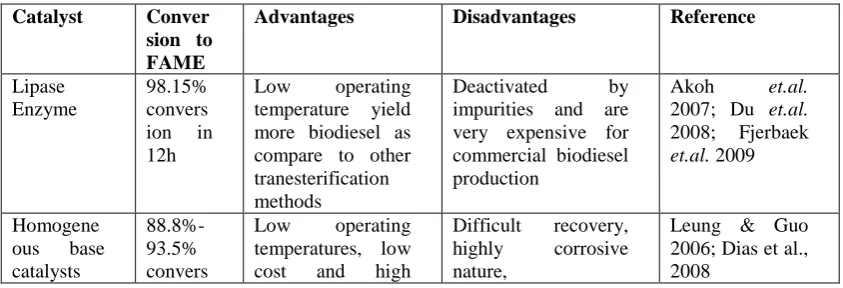
low temperatures yields more biodiesel as compare to other transesterification methods. However its amount affects the reaction rate; 75% immobilized lipase with 10% water gives a 98.15% conversion in 12h (Table 1). Unfortunately, lipases are deactivated by impurities and are very expensive for commercial biodiesel production (Fjerbaek et.al. 2009; Akoh
et.al. 2007; Du et.al. 2008). In enzyme catalyzed methanolysis free fatty acids could be easily converted to methyl esters. Free fatty acids content in the region of 20-50% is responsible for saponification during base catalyzed transesterification (Fukuda et.al. 2001).
5.1.1. Base catalysis
[image:5.595.102.524.624.768.2]Homogeneous base catalysts like sodium hydroxide, sodium methooxide or potassium hydroxide are used in the production of biodiesel primarily due to their low cost and high reaction rates. They can be used at low operating temperatures typically between 45oC and 55oC. The major drawback of these catalysts is their difficult recovery and highly corrosive nature (Leung and Guo 2006). Homogenously catalyzed processes are the conventional technologies. However, their large-scale applicability is compromised due to their characteristic challenges. Batch processes and continuous processes are used for industrial purposes with typical capacity of 7.26-7.5 Gg y1 and 8-125 Gg y1 respectively, and heterogeneous catalysis may be sustainable for the continuous processes (Table 1). Heterogeneous catalysts from renewable sources may be both environmentally and economically viable (Aransiola et.al. 2014). Teo & Idris 2014, investigated that maximum biodiesel production efficiency of 90.71% was attained at 1:12 lipid to methanol ratio during the application of simultaneous cooling and microwave heating (SCMH) under alkali transesterification as shown in Table 1.
Table 1. Transesterification through different catalysts
Catalyst Conver
sion to FAME
Advantages Disadvantages Reference
Lipase Enzyme
98.15% convers ion in 12h
Low operating temperature yield more biodiesel as compare to other tranesterification methods
Deactivated by impurities and are very expensive for commercial biodiesel production
Akoh et.al.
2007; Du et.al.
2008; Fjerbaek
et.al. 2009
Homogene ous base catalysts
88.8%-93.5% convers
Low operating temperatures, low cost and high
Difficult recovery, highly corrosive nature,
35 (NaOH,
CH3NaO, KOH)
ion in 15min at 70oC
reaction rates Saponification
Heterogene ous Base catalysts
90.71% biodies el product ion efficien cy
Production cost of these catalysts is low and they show a very high performance
Energy intensive, recovery of glycerol is difficult, the catalyst has to be removed from the product, alkaline waste water requires treatment, free fatty acid and water interfere with the reaction, and low selectivity leads to undesirable side reactions
Fukuda et al., 2001;
Noureddini et al., 2005; Maçaira et al., 2011; Aransiola
et.al. 2014; Teo & Idris 2014
Homogene ous acidic catalyst (Sulphuric, hydrochlor ic, sulfonic and phosphoric acids)
89.5%-99% convers ion efficien cy
Higher tolerance to FFA, less capital Intensive, No soap formation, Low energy requirement, preferred for low grade oil
High alcohol to oil molar ratio, longer reaction time and recycling is problematic
Canakci & Van Gerpen, 1999; Demirbas 2007; Dias et al., 2008; Sharma & Singh 2008; Liu et al., 2008; Yan et al., 2010
Heterogene ous acid catalysts (sulphated zirconia, zeolites, ion exchange resins and mixed metal oxides)
96.22% yield under optimal conditions of 60oC, a reaction time of 10 min
Less corrosive, less toxic, and generates fewer environmental problems
Higher reaction temperature, High cost, Low micro porosity, Leaching and low surface areas
Demirbas 2007; Park et al., 2008; Zhang et al., 2010; Yan et al., 2010
Heterogeneou s catalysts from natural sources (Eeggshell, limestone calcite, cuttlebone, dolomite and hydroxyap atite)
86.13%-98% conversio n
efficiency
Recyclable,
economically and environment friendly
Lengthy process of synthesis and may be complicated in some cases, requiring
great expertise
Demirbas 2007; Kotwal et al., 2009; Sharma et al., 2010;
5.1.2. Acid catalysis
Acid catalysts convert FFAs to esters or biodiesel through esterification and simultaneously transesterification at a relatively higher temperature (100oC) (Lotero et.al. 2005). Experimentally, base-catalyzed reactions are approx. 4000 times faster than acid-catalyzed reaction. The optimization of base catalyzed
36 Mixed oxides of transition elements lick Ca, Ce,
Zr, Fe and La have also been evaluated for transesterification and recoded 95% biodiesel yield. For instance, CaTiO3 produce 79% biodiesel during 10h reaction time, whereas CaZrO3 and CaCeO3 yields between 95% and 70% of biodiesel in 10 h by using oil to methanol ratio (1:6) at 60oC (Galadima & Muraza 2014). The transesterified of Nannochloropsis oculata
was done in the presence of Al2O3 and CaO catalysts at 50oC to give 97.5% oil conversion
(Umdu et.al. 2009). In another experiment, transesterification of algae carried in the presence of titania, alumina, and zirconia catalysts at 350-400oC and 2500 psi (17.23 MPa), giving 90.2% oil conversion (McNeff et.al. 2008). C. protothecoides was transesterified in the presence of 75% lipase (from Candida sp.) and methanol at 38oC, with an oil conversion of 98.15% after 12 h (Cheng et.al. 2009) shown in Table 2.
Table 2. Transition Elements as catalysts
Mix Oxides Biodiesel Yield References
CaTiO3 79% during 10h reaction time Galadima & Muraza 2014
CaZrO3 95% in 10h by using oil to methanol ratio (1:6) at 60oC
Galadima & Muraza 2014
CaCeO3 70% in 10h by using oil to methanol ratio (1:6) at 60oC
Galadima & Muraza 2014
Al2O3 and CaO
97.5% oil conversion at 50oC Umdu et.al. 2009
Titania, alumina, and zirconia
90.2% oil conversion at 350-400oC and 2500 psi (17.23 MPa)
McNeff et.al. 2008
11.2. In Situ Algal Biomass
Transesterification
In situ transesterification is an emerging technique with potential for the reduction of costs and processing units for fuel conversion process. It increases biodiesel production up to 20% when compare with conventional method (Ehimen et.al. 2010). In situ transesterification is carried out by addition of methanol/potassium hydroxide solution in dried microalgae samples and then ultrasonicating the mixture. Centrifugation method could be used to separate reacted biomass sample from cell debris, glycerin and excess of methanol. In situ transesterification have higher comparative biodiesel yield and low cost than the conventional route biodiesel production (Harrington & Arcy-Evans, 1985). This method controls process wastes and pollution (Haas et.al. 2007).
11.3. Simultaneous extraction and
transesterification of microalgal lipids
Recent studies investigating biodiesel production from microalgae have focused their efforts on the
development of an alternative downstream processing step termed simultaneous extraction and transesterification (Wahlen et.al. 2011). A wet lipid extraction procedure was developed that was capable of extracting 79% of transesterifiable lipids from wet algal biomass (84% moisture) via acid and base hydrolysis (90oC and ambient pressures) (Table 3), and 76% of those extracted lipids were isolated, and converted to FAMEs (Sathish, & Sims, 2012). The yield of FAME gained through hexane after microwave-assisted transesterification (EHMT) of lipids in wet microalgae increased 6-fold when compare FAME extracted through chloroform of dried algae in direct transesterification. FAME content attained through EHMT is 86.74% is higher when compare with chloroform-based process is 75.93% (Cheng et.al. 2014). Former studies (Wahlen et.al. 2011; Patil et.al. 2012, 2013) employing microwaves or supercritical fluids for in situ transesterification reveal a conversion yield of 84% with 50 wt. % moisture. Whereas 90.6% yield of biodiesel attained by chloroform with the microalgae containing 65 wt.% moisture which shows solvent with high polarity achieved higher conversion yield as well as have lower production cost of biodiesel from microalgae (Im
et.al. 2014).
37
Method of Transester ification
Organic Solvent
Reactio n time
% of wate r
Assisted Reactant/ Catalyst
Biodies el yield (%)
References
Direct transesterifi cation
Hexane 90oC for 30 min
84% Acid and base hydrolysi s
Methanol/ Sulfuric acid
76% Sathish & Sims, 2012
Hexane after microwave -assisted transesterifi cation (EHMT)
Hexane 90oC for 30 min
77% Microwav e
Methanol/ Sulfuric acid
86.74% Cheng et al., 2014
Simultaneo us
Hydrolysis-esterificatio n
Hexane 140oC for 6 h
80% Microwav e
Methanol/ Sulfuric acid
90% Takisawa et al.,
2013a
In situ transesterifi cation
n- Hexane
65-95oC for 30-120 min
65% Immersin g the tube in a waterbath
Methanol/ Sulfuric acid
91% Im et al., 2014
6. CONCLUSION
Microalgae have several advantage such as high growth rate, high oil content and used as potential candidate for renewable biofuel. However, extraction of lipid from algae feedstock has faced challenge while considering large scale application as well as it is also necessary to make this process cost effective. The potential storage of lipid is hindered by presence of polyunsaturated fatty acid (PUFA) and high moisture content in biomass. After lipid extraction, oil is transesterfied into FAME which is then used as biodiesel. In situ transesterification is an emerging technology for cost reduction at large scale but it still need to necessitate optimization so that biodiesel quality meet the existing global standards.
REFERENCES
[1]. Akoh, C. C.; Chang, S. W.; Lee, G. C.; Shaw, J. F. (2007): Enzymatic approach to biodiesel production. Journal of Agricultural and Food Chemistry, 55(22), pp. 8995-9005.
[2]. Amaro, H. M.; Guedes, A.; Malcata, F. X. (2011): Advances and perspectives in using microalgae to produce biodiesel. Applied Energy, 88(10), pp. 3402-3410.
[3]. Antolın, G.; Tinaut, F. V.; Briceno, Y.; Castano, V.; Perez, C.; Ramırez, A. I.
[4]. (2002): Optimisation of biodiesel production by sunflower oil
transesterification. Bioresource technology,
83(2), pp. 111-114.
[5]. Aransiola, E. F.; Ojumu, T. V.; Oyekola, O. O.; Madzimbamuto, T. F.; Ikhu-Omoregbe, D. I. O. (2014): A review of current technology for biodiesel production: State of the art. Biomass and Bioenergy, 61, pp. 276-297.
[6]. Balasubramanian, S.; Allen, J. D.; Kanitkar, A.; Boldor, D. (2011): Oil extraction from Scenedesmus obliquus using a continuous microwave system–design, optimization, and quality characterization. Bioresource Technology, 102(3), pp. 3396-3403. [7]. Canakci, M.; Van Gerpen, J. (1999):
Biodiesel production via acid catalysis. Transactions of the ASAE-American Society of Agricultural Engineers, 42(5), pp. 1203-1210.
[8]. Cheng, Y.; Zhou, W.; Gao, C.; Lan, K.; Gao, Y.; Wu, Q. (2009): Biodiesel production from Jerusalem artichoke (Helianthus Tuberosus L.) tuber by heterotrophic microalgae Chlorella protothecoides. Journal of Chemical Technology and Biotechnology, 84(5), pp. 777-781.
38 pyrenoidosa. Biomass and bioenergy, 35(4),
pp. 1533-1538.
[10].de Boer, K.; Moheimani, N. R.; Borowitzka, M. A.; Bahri, P. A. (2012): Extraction and conversion pathways for microalgae to biodiesel: a review focused on energy consumption. Journal of applied phycology, 24(6), pp. 1681-1698.
[11].De Castro, M. L.; Garcıa-Ayuso, L. E. (1998): Soxhlet extraction of solid materials: an outdated technique with a promising innovative future. Analytica chimica acta, 369(1), pp. 1-10.
[12].Demirbas, A. (2007): Importance of biodiesel as transportation fuel. Energy Policy, 35(9), pp. 4661-4670.
[13].Demirbas, A.; Demirbas, M. F. (2011): Importance of algae oil as a source of biodiesel. Energy conversion and management, 52(1), pp. 163-170.
[14].Dias, J. M.; Alvim-Ferraz, M. C.; Almeida, M. F. (2008): Comparison of the performance of different homogeneous alkali catalysts during transesterification of waste and virgin oils and evaluation of biodiesel quality. Fuel, 87(17), pp. 3572-3578.
[15].Du, W.; Li, W.; Sun, T.; Chen, X.; Liu, D. (2008): Perspectives for biotechnological production of biodiesel and impacts. Applied Microbiology and Biotechnology,
79(3), pp. 331-337.
[16].Ehimen, E. A.; Sun, Z. F.; Carrington, C. G. (2010): Variables affecting the in situ transesterification of microalgae lipids. Fuel, 89(3), pp. 677-684.
[17].Fjerbaek, L.; Christensen, K. V.; Norddahl, B. (2009): A review of the current state of biodiesel production using enzymatic transesterification. Biotechnology and Bioengineering, 102(5), pp. 1298-1315. [18].Folch, J., Ascoli, I., Lees, M.; Meath, J. A.;
LeBaron, F. N. (1951): Preparation of lipide extracts from brain tissue. Journal of Biological Chemistry, 191(2), pp. 833-841. [19].Fukuda, H.; Kondo, A.; Noda, H. (2001):
Biodiesel fuel production by transesterification of oils. Journal of bioscience and bioengineering, 92(5), pp. 405-416.
[20].Galadima, A.; Muraza, O. (2014): Biodiesel production from algae by using heterogeneous catalysts: A critical review. Energy, 78, pp. 72-83.
[21].Guckert, J. B.; Cooksey, K. E.; Jackson, L. L. (1988): Lipid sovent systems are not equivalent for analysis of lipid classes in the microeukaryotic green alga, Chlorella.
Journal of microbiological methods, 8(3), pp. 139-149.
[22].Haas, M. J.; Scott, K. M.; Foglia, T. A.; Marmer, W. N. (2007): The general applicability of in situ transesterification for the production of fatty acid esters from a variety of feedstocks. Journal of the American Oil Chemists' Society, 84(10), pp. 963-970.
[23].Halim, R.; Gladman, B.; Danquah, M. K.; Webley, P. A. (2011): Oil extraction from microalgae for biodiesel production. Bioresource technology, 102(1), pp. 178-185.
[24].Harrington, K. J.; D’Arcy-Evans, C. (1985): A comparison of conventional and in situ methods of transesterification of seed oil from a series of sunflower cultivars. Journal of the American Oil Chemists Society,
62(6), pp. 1009-1013.
[25].Hejazi, M. A.; Wijffels, R. H. (2004): Milking of microalgae. TRENDS in Biotechnology, 22(4), pp. 189-194. [26].Hossain, M. M.; de Lasa, H. I. (2008):
Chemical-looping combustion (CLC) for inherent CO2 separations—a review. Chemical Engineering Science, 63(18), pp. 4433-4451.
[27].Im, H.; Lee, H.; Park, M. S.; Yang, J. W.; Lee, J. W. (2014): Concurrent extraction and reaction for the production of biodiesel from wet microalgae. Bioresource technology, 152, pp. 534-537.
[28].Iverson, S. J.; Lang, S. L.; Cooper, M. H. (2001): Comparison of the Bligh and Dyer and Folch methods for total lipid determination in a broad range of marine tissue. Lipids, 36(11), pp. 1283-1287. [29].Kaieda, M.; Samukawa, T.; Matsumoto, T.;
Ban, K.; Kondo, A.; Shimada, Y.; ... Fukuda, H. (1999): Biodiesel fuel production from plant oil catalyzed by Rhizopus oryzae lipase in a water-containing system without an organic solvent. Journal of bioscience and bioengineering, 88(6), pp. 627-631.
[30].Kates, M. (1986): Lipid extraction procedures. Techniques of lipidology. Elsevier, Amsterdam, pp. 100-111.
[31].Kim, Y. H.; Choi, Y. K.; Park, J.; Lee, S.; Yang, Y. H.; Kim, H. J.; ... Lee, S. H. (2012): Ionic liquid-mediated extraction of lipids from algal biomass.Bioresource technology, 109, pp. 312-315.
39
ultrasound radiation. Bioresource Technology, 102(5), pp. 4265-4269.
[33].Kotwal, M. S.; Niphadkar, P. S.; Deshpande, S. S.; Bokade, V. V.; Joshi, P. N. (2009): Transesterification of sunflower oil catalyzed by flyash-based solid catalysts. Fuel, 88(9), pp.1773-1778.
[34].Lam, M. K.; Lee, K. T. (2012): Immobilization as a feasible method to simplify the separation of microalgae from water for biodiesel production. Chemical engineering journal, 191, pp. 263-268.
[35].Lee, S. J.; Yoon, B. D.; Oh, H. M. (1998): Rapid method for the determination of lipid from the green alga Botryococcus braunii. Biotechnology Techniques, 12(7), pp. 553-556.
[36].Leung, D. Y. C.; Guo, Y. (2006): Transesterification of neat and used frying oil: optimization for biodiesel production. Fuel Processing Technology, 87(10), pp. 883-890.
[37].Liu, X.; He, H.; Wang, Y.; Zhu, S.; Piao, X. (2008): Transesterification of soybean oil to biodiesel using CaO as a solid base catalyst. Fuel, 87(2), pp. 216-221.
[38].Lotero, E.; Liu, Y.; Lopez, D. E.; Suwannakarn, K.; Bruce, D. A.; Goodwin, J. G. (2005): Synthesis of biodiesel via acid catalysis. Industrial & engineering chemistry research, 44(14), pp. 5353-5363. [39].Maceiras, R.; Rodrı, M.; Cancela, A.;
Urréjola, S.; Sánchez, A. (2011): Macroalgae: Raw material for biodiesel production. Applied Energy, 88(10), pp. 3318-3323.
[40].Manirakiza, P.; Covaci, A.; Schepens, P. (2001): Comparative study on total lipid determination using Soxhlet, Roese-Gottlieb, Bligh & Dyer, and modified Bligh & Dyer extraction methods. Journal of food composition and analysis, 14(1), pp. 93-100.
[41].McKendry, P. (2002): Energy production from biomass (part 2): conversion technologies. Bioresource
technology, 83(1), pp. 47-54.
[42].McNeff, C. V.; McNeff, L. C.; Yan, B.; Nowlan, D. T.; Rasmussen, M.; Gyberg, A. E.; ... Hoye, T. R. (2008): A continuous catalytic system for biodiesel production. Applied Catalysis A: General, 343(1), pp. 39-48.
[43].Medina, A. R.; Grima, E. M.; Giménez, A. G.; González, M. I. (1998): Downstream processing of algal polyunsaturated fatty acids. Biotechnology advances, 16(3), pp. 517-580.
[44].Mendes-Pinto, M. M.; Raposo, M. F. J.; Bowen, J.; Young, A. J.; Morais, R. (2001): Evaluation of different cell disruption processes on encysted cells of Haematococcus pluvialis: effects on astaxanthin recovery and implications for bio-availability. Journal of Applied Phycology, 13(1), pp. 19-24.
[45].Middelberg APJ. (1994): The release of intracellular bioproducts. In: Subramanian G, editor. Bioseparation and bioprocessing: a handbook. Wiley; pp. 131– 64.
[46].Molina Grima, E.; Belarbi, E. H.; Acién Fernández, F. G.; Robles Medina, A.; Chisti, Y. (2003): Recovery of microalgal biomass and metabolites: process options and economics. Biotechnology advances,
20(7), pp. 491-515.
[47].Noureddini, H.; Gao, X.; Philkana, R. S. (2005): Immobilized Pseudomonas cepacia lipase for biodiesel fuel production from soybean oil. Bioresource technology, 96(7), pp. 769-777.
[48]. Park, Y. M.; Lee, D. W.; Kim, D. K.; Lee, J. S.; Lee, K. Y. (2008). The heterogeneous catalyst system for the continuous conversion of free fatty acids in used vegetable oils for the production of biodiesel. Catalysis Today, 131(1), pp. 238-243.
[49].Patil, P. D.; Gude, V. G.; Mannarswamy, A.; Cooke, P.; Nirmalakhandan, N.; Lammers, P.; Deng, S. (2012): Comparison of direct transesterification of algal biomass under supercritical methanol and microwave irradiation conditions. Fuel, 97, pp. 822-831.
[50].Patil, P. D.; Reddy, H.; Muppaneni, T.; Schaub, T.; Holguin, F. O.; Cooke, P; ... Deng, S. (2013): In situ ethyl ester production from wet algal biomass under microwave-mediated supercritical ethanol conditions. Bioresource technology, 139, pp. 308-315.
[51].Ramluckan, K.; Moodley, K. G.; Bux, F. (2014): An evaluation of the efficacy of using selected solvents for the extraction of lipids from algal biomass by the soxhlet extraction method. Fuel, 116, pp. 103-108. [52].Rawat, I.; Ranjith Kumar, R.; Mutanda, T.;
Bux, F. (2011): Dual role of microalgae: phycoremediation of domestic wastewater and biomass production for sustainable biofuels production. Applied Energy,
88(10), pp. 3411-3424.
40
characterization of bioactive compounds from Haematococcus pluvialis microalga. Journal of Pharmaceutical and Biomedical Analysis, 51(2), pp. 456-463.
[54].Sathish, A.; Sims, R. C. (2012): Biodiesel from mixed culture algae via a wet lipid extraction procedure. Bioresource technology, 118, pp. 643-647.
[55].Sharma, Y. C.; Singh, B. (2008): Development of biodiesel from karanja, a tree found in rural India. Fuel, 87(8), pp. 1740-1742.
[56].Sialve, B.; Bernet, N.; Bernard, O. (2009): Anaerobic digestion of microalgae as a necessary step to make microalgal biodiesel sustainable. Biotechnology advances, 27(4), pp. 409-416.
[57].Singh, S. P.; Singh, D. (2010): Biodiesel production through the use of different sources and characterization of oils and their esters as the substitute of diesel: a review. Renewable and Sustainable Energy Reviews, 14(1), pp. 200-216.
[58].Takisawa, K.; Kanemoto, K.; Kartikawati, M.; Kitamura, Y. (2013): Simultaneous hydrolysis-esterification of wet microalgal lipid using acid. Bioresource technology,
149, pp. 16-21.
[59].Teo, C. L.; Idris, A. (2014): Enhancing the various solvent extraction method via microwave irradiation for extraction of lipids from marine microalgae in biodiesel production. Bioresource technology, 171, pp. 477-481.
[60].Umdu, E. S.; Tuncer, M.; Seker, E. (2009): Transesterification of Nannochloropsis oculata microalga’s lipid to biodiesel on Al2O3 supported CaO and MgO catalysts. Bioresource Technology, 100(11), pp. 2828-2831.
[61].Wahlen, B. D.; Willis, R. M.; Seefeldt, L. C. (2011): Biodiesel production by simultaneous extraction and conversion of total lipids from microalgae, cyanobacteria, and wild mixed-cultures. Bioresource technology, 102(3), pp. 2724-2730.
[62].Wang, L.; Weller, C. L. (2006): Recent advances in extraction of nutraceuticals from plants. Trends in Food Science & Technology, 17(6), pp. 300-312.
[63].Xiong, W.; Li, X.; Xiang, J.; Wu, Q. (2008): High-density fermentation of microalga Chlorella protothecoides in bioreactor for microbio-diesel production. Applied Microbiology and Biotechnology,
78(1), pp. 29-36.
[64].Xu, L.; Brilman, D. W. W.; Withag, J. A.; Brem, G.; Kersten, S. (2011): Assessment of a dry and a wet route for the production of biofuels from microalgae: energy balance analysis. Bioresource technology, 102(8), pp. 5113-5122.
[65].Yan, S.; DiMaggio, C.; Mohan, S.; Kim, M.; Salley, S. O.; Ng, K. S. (2010): Advancements in heterogeneous catalysis for biodiesel synthesis. Topics in catalysis,
53(11-12), pp.721-736.
[66].Yanfen, L.; Zehao, H.; Xiaoqian, M. (2012): Energy analysis and environmental impacts of microalgal biodiesel in China. Energy Policy, 45, pp. 142-151.